RSN: Robert Reich | The Changes at CNN Look Politically Motivated. That Should Concern Us All

28 August 22
A Daily Struggle Against Fascism
Is what our work at RSN has become. It’s real, it’s pervasive and most people would rather not look at it.
This is a pretty serious battle against some pretty serious people.
We need funding in the worst way.
Marc Ash
Founder, Reader Supported News
If you would prefer to send a check:
Reader Supported News
PO Box 2043 / Citrus Heights, CA 95611
Follow us on facebook and twitter!

28 August 22
Live on the homepage now!
Reader Supported News

Brian Stelter’s very popular and commerically successful show was axed. The reason? Follow the money
Last week, CNN abruptly canceled the show and effectively fired Stelter and his staff.
Why? The show was commercially successful. Its ratings have suffered somewhat lately but it was doing better than several of CNN’s primetime shows.
It was cancelled by Chris Licht, CNN’s new chairman and CEO, who reportedly was not a fan of Stelter’s opinionated style.
But there appears to be more to it than Stelter’s style. Licht has told CNN staff they should stop referring to Donald Trump’s “big lie” because the phrase sounds like a Democratic party talking point. Licht also wants more “straight news reporting”, along with more conservative guests.
What’s motivating Licht? Follow the money.
CNN’s new corporate overseer is Warner Brothers Discovery Inc, which now owns what used to be Time Warner, including CNN. The CEO of Warner Brothers Discovery is David Zaslav.
Zaslav has been prodding Licht to reposition CNN to the center, and be a network preferred by “everybody … Republicans, Democrats”.
But CNN is never going to be the network preferred by Republicans. Fox News has that sewn up.
As Republicans move further rightward into the netherworld of authoritarianism, there’s even less possibility that CNN’s news coverage will be able to satisfy them, nor should CNN even try. If we’ve learned anything from Trump and his lapdogs at Fox News, it’s that facts, data and logic are no longer relevant to the Republican base.
Even “straight news reporting” depends on what stories are featured, which facts are highlighted and the context surrounding the news. This necessitates judgment and values.
The anti-democracy movement in America (as elsewhere) is among the biggest issues confronting us today. Is reporting on it considered “straight news” or “opinion”? Wouldn’t failing to report on it in a way that sounded alarms be a gross dereliction of duty?
Besides, how is it possible to report on Trump or Rudy Giuliani or any number of today’s Republican leaders and not speak of the big lie, or say they’ve broken norms if not laws?
So what’s motivating Zaslav? Keep following the money.
The leading shareholder in Warner Brothers Discovery is John Malone, a multibillionaire cable magnate. (Malone was a chief architect in the merger of Discovery and CNN.)
Malone describes himself as a “libertarian” although he travels in rightwing Republican circles. In 2005, he held 32% of the shares of Rupert Murdoch’s News Corporation. He is on the board of directors of the Cato Institute. In 2017, he donated $250,000 to Trump’s inauguration.
Malone has said he wants CNN to be more like Fox News because, in his view, Fox News has “actual journalism”. Malone also wants the “news” portion of CNN to be “more centrist”.
It’s unlikely that Malone instructed Zaslav to tell Licht to fire Stelter. Power isn’t exercised that directly or clumsily in large corporate media bureaucracies.
It’s more likely that Licht knew what Zaslav wanted, and Zaslav knew what Malone wanted. A source told Deadline’s Dominic Patten and Ted Johnson that even if Malone didn’t order Stelter’s ouster, “it sure represents his thinking”.
Early last spring, Stelter wrote in his newsletter that Malone’s comments about CNN “stoked fears that Discovery might stifle CNN journalists and steer away from calling out indecency and injustice”.
When you follow the money behind deeply irresponsible decisions at the power centers of America today, the road often leads to rightwing billionaires.
Last Sunday, on his last show, Stelter said:
“It’s not partisan to stand up for decency and democracy and dialogue. It’s not partisan to stand up to demagogues. It’s required. It’s patriotic. We must make sure we don’t give platforms to those who are lying to our faces.”
Precisely.
Sadly, there are still many in America – and not just billionaires like Malone – who believe that holding Trump accountable for what he has done (and continues to do) to this country is a form of partisanship, and that such partisanship has no place in so-called “balanced journalism”.
 Volunteers lift a coffin from a mass grave at a cemetery in the village of Snizhne in Donetsk in March. (photo: Alexander Ermochenko/Reuters)
Researchers at the Yale School of Public Health’s Humanitarian Research Lab said the sites were part of a “filtration system” used for processing detainees and prisoners. They reached their conclusions after examining commercial satellite imagery and open-source information. The detainees and prisoners could be forced to live outside the centers in Russian-occupied areas of Ukraine, imprisoned for long periods, deported to Russia or even killed.
The research was a collaboration between Yale and the Conflict Observatory program that the State Department set up in May to document war crimes and other atrocities committed by Russian or Russian-backed forces in the Ukraine war. The researchers released their findings through a report from Conflict Observatory.
“We again call on Russia to immediately halt its filtration operations and forced deportations and to provide outside independent observers access to identified facilities and forced deportation relocation areas within Russia-controlled areas of Ukraine and inside Russia itself,” the State Department said in a statement referring to the new findings.
The report identified four types of centers in the filtration system: registration, holding, secondary interrogation and detention.
The researchers also found evidence of disturbed earth on two recent occasions at the Volnovakha “correctional colony” near the village of Olenivka that they said was consistent with mass graves. The appearance of disturbed earth predated an explosion on July 29 at the prison compound that killed 53 Ukrainian prisoners of war.
One area of disturbed earth appeared in imagery from April 11 — “contemporaneous with an open source account of alleged gravedigging,” the report said, referring to an online account in which a former inmate discussed a cellmate working a shift digging graves. A second area of disturbed earth appeared on July 27, two days before the explosion.
A New York Times analysis from early August of images from Maxar Technologies and Planet Labs, two satellite imaging companies, concluded that some time after July 18 and before July 21, about 15 to 20 spots of notable changes to the ground appeared on the southern side of the complex. They were about 6 to 7 feet wide and 10 to 16 feet long at first, and some later appeared to have been lengthened to merge. It was unclear whether they were grave sites.
The Conflict Observatory report said the Volnovakha center was being used as a long-term detention center for civilians being kept under the auspices of “administrative detention” and for holding prisoners of war, particularly Ukrainians who surrendered after the siege of Azovstal, in the coastal city of Mariupol. “Filtration” activities appear to have begun there in late March and have continued since then.
The researchers noted that there had been reports of torture, beatings, lack of water and proper nutrition, unhygienic conditions and overcrowded cells at the compound.
The State Department said it was giving an additional $9 million to the Conflict Observatory through the European Democratic Resilience Initiative.
“This focus on accountability lays the foundation for future civil and criminal legal processes, whether in Ukraine, through international mechanisms, or in third-party countries that have established jurisdiction,” it said.
“President Putin and his government will not be able to engage in these persistent abuses with impunity,” the department added. “Accountability is imperative, and the United States and our partners will not be silent.”
In June, the U.S. National Intelligence Council released an unclassified report that said it had identified 18 possible locations in Russian-occupied eastern Ukraine and western Russia where detainees and prisoners were being held and processed.
 Donald Trump. (photo: Brittany Greeson/NYT)
A federal judge has told the Justice Department to provide her with more specific information about the classified records removed from former President Donald Trump's Florida estate
The two-page order from U.S. District Judge Aileen Cannon signals that she’s inclined to grant a request from Trump’s lawyers, who this week asked for the appointment of an independent special master to oversee the review the records taken from Mar-a-Lago and identify any that may be protected by executive privilege, and to ensure the return of any documents outside the scope of the search warrant.
The judge scheduled a Thursday hearing to discuss the matter further, suggesting the Justice Department will have a chance to raise objections to the judge's intentions. In other recent high-profile cases in which a special master has been appointed, the person has been a former judge.
Cannon also directed the Justice Department to file under seal with her more detailed descriptions of the material taken from Trump’s estate “specifying all property seized.” The former president’s lawyers have complained that investigators did not disclose enough information to them about what specific documents were removed when agents executed a search warrant on Aug. 8 to look for classified documents.
The special master appointment, if it happens, is unlikely to significantly affect the direction of the Justice Department investigation, though it’s possible an outside review of the documents could slow the probe down.
 Taiwan president Tsai Ing-wen meets a delegation led by Japanese House of Representatives member Keiji Furuya in Taipei. (photo: EyePress News/Rex/Shutterstock)
Since the US speaker’s visit, groups from the US, Japan and Lithuania have arrived in Taipei, vowing they won’t be bullied by Beijing – and more are coming
“I just landed in Taiwan to send a message to Beijing – we will not be bullied,” Blackburn tweeted.
The solo visit by Blackburn was the fourth US delegation to Taiwan since Pelosi’s landmark visit, coming a few days after Indiana governor Eric Holcomb and a cross-party Japanese delegation, and just weeks after an 11-member delegation from Lithuania.
Shortly before his arrival, Keiji Furuya, a member of Japan’s ruling Liberal Democratic party, tweeted: “China’s military provocations and other erratic behaviour pose a risk to the peace and safety of not only Taiwan, but east Asia as a whole.”
The run of foreign dignitaries visiting Taiwan has kept attention on the island in the wake of Pelosi’s trip and continued to draw vituperation from Beijing. Taiwan’s government has welcomed them all, grateful for the international support and solidarity against the Chinese government’s threats to annex it by force.
“These warm acts of kindness and firm demonstrations of support have reinforced Taiwan’s determination to defend itself,” said Taiwan’s president, Tsai Ing-wen, at a formal meeting with Blackburn on Friday.
The Pelosi visit in early August sparked a furious reaction from Beijing, which quickly announced an unprecedented run of live-fire military drills encircling Taiwan’s main island. It targeted Taiwan with missile tests, median line incursions by hundreds of warplanes and ships, disinformation and cyber attacks, and blockade-style interruptions of Taiwanese shipping ports and aerial traffic. Beijing’s moves have created a more hostile “new normal” in the strait, but they have not deterred Taiwan, or its allies.
Symbolism over substance?
On Friday Taiwan’s foreign minister, Joseph Wu, said the military exercises “will not stop Taiwan from seeking support internationally”. “What China wants to do is cut Taiwan off from international connections, so if one day it attacks Taiwan, there will be no support for Taiwan,” he said.
But with China ratcheting up aggression and shifting the goalposts on the tentative status quo in the Taiwan Strait, analysts have warned foreign allies must quickly close the gap between these symbolic acts and the substantive support needed to actually ensure Taiwan’s security.
“A lot of what’s happening is symbolic. I don’t want to suggest it’s not important – it can have substantive effect,” said Raymond Kuo, a political scientist at the Rand Corporation.
“But in terms of Taiwan’s ability to defend itself [and] diversify its economic ties away from China … those policies haven’t been put in place yet. They’re coming down the pipe which is positive, and I think China’s action has spurred on unity in Congress and support from other countries.”
China’s ministry of foreign affairs accused the foreign delegations of violating its domestic “one China” policy, and threatened undefined “resolute and forceful measures” in response. Analysts have debated whether the visits are needlessly exacerbating tensions. But they continue; parliamentarians from the UK, Germany, Denmark, Canada and Australia are reportedly planning trips to Taipei.
A phone survey taken as the drills were under way found 53.7% of Taiwanese people felt Pelosi’s visit to Taipei benefited US-Taiwan relations, Newsweek reported. More than 64% felt Taiwan couldn’t defend against a Chinese invasion without international help.
Amanda Hsiao, senior analyst with the International Crisis Group, said there would be more symbolic visits as western politicians “increasingly view a visit to Taiwan as an opportunity to signal their anti-China bona fides for domestic political reasons”.
But Kuo says the fact both sides of Congress are now largely united over Taiwan will have tangible benefit for Taiwan when it comes to passing supporting legislation.
As China’s drills drew to an end, the US announced the beginning of bilateral trade talks with Taiwan, which Washington’s assistant secretary of state for east Asia, Daniel Kritenbrink, said would provide “an opportunity to assist Taiwan in building its resilience, and ensuring … supply chains”. . Other trade deals have been signed on the sidelines of visits.
Wu said the trade talks were “exactly what Taiwan needs”. But it also needs more weapons.
Wu is adamant that Taiwan can’t expect other nations to come to its aid if it isn’t prepared to defend itself. This week the defence ministry announced a budget increase of almost 14%.
More visits are coming. This week a Canadian parliamentary “friendship group” said it was planning to visit in October, prompting renewed threats from Beijing.
Wu said Taiwan would not “bow to pressure” from China and neither should foreign visitors.
“We will not stop making friends just because of the Chinese threat to Taiwan,” he said. “There are more people than ever who want to come and show their support for Taiwan. I can tell you there will be more.”
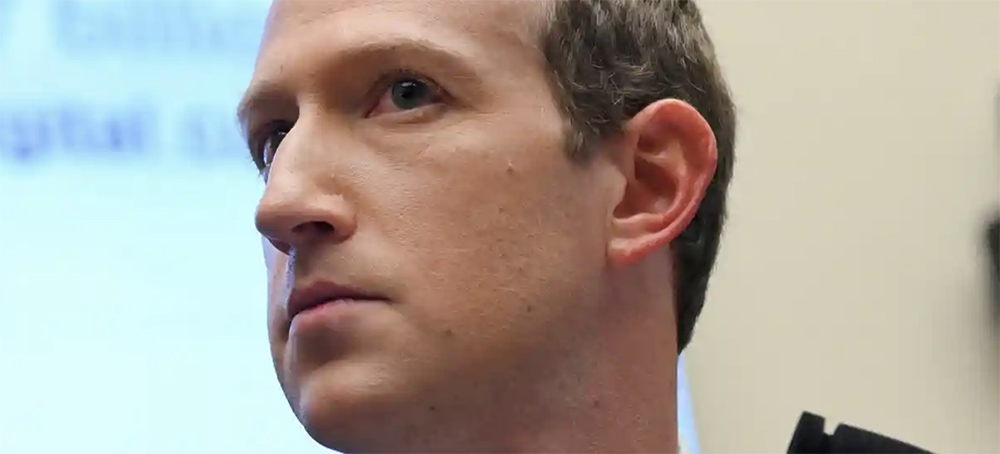 Facebook chairman and CEO Mark Zuckerberg testifies at a financial services committee hearing in Washington in 2019. (photo: Erin Scott/Reuters)
Facebook took action on the post, despite medication abortion pills being legal in Michigan.
The news shows Facebook’s, and it parent company Meta’s, continuing issues with content moderation around abortion on its platform after the Supreme Court voted to remove federal protections to abortion. In June, Motherboard reported that Facebook was removing posts from users who shared updates that say abortion pills can be mailed, and, in some cases, banning those users. Those similar sorts of content moderation issues are now expanding to established voices of authority on abortion, such as Planned Parenthood.
The post itself read “A medication abortion is a nonsurgical option for ending a pregnancy in the first trimester. Approved by the FDA for use up to roughly 10 weeks of pregnancy, these medications are highly effective with little risk of serious side effects.” The post added that Planned Parenthood of Michigan was proud to offer medication abortion to qualtifying patients, and provided a link to an article on health.com that provided more information.
The restriction meant that only people who manage Planned Parenthood of Michigan’s Facebook page, and not the wider public, could view the post, according to a screenshot tweeted Thursday by Ashlea Phenicie, who works on communications for Planned Parenthood of Michigan.
Facebook told Motherboard that the post was restricted by mistake. Facebook’s policies do allow users to discuss the affordability and accessibility of pharmaceutical drugs, Facebook added.
Along with the screenshot, Phenicie tweeted “Hey Facebook. Medication abortion is safe and legal in Michigan. You don’t need to help anti-abortion politicians restrict access any further.”
Non-profit news site The Michigan Advance first reported the removal on Monday.
Like other social media platforms, Facebook will continue to contend with how it handles not just access to information about abortions, but what data it may provide to the authorities. Earlier this month Motherboard published the search warrant affidavit in a case in which Facebook ultimately provided the chat messages of a mother and her young young daugher who conducted an apparent medication abortion at home in Nebraska. Facebook provided the data to local authorities who then charged the two with multiple felonies and misdemeanors.
After Motherboard reported on the earlier instance of Facebook removing posts from users that said abortion pills can be mailed, Andy Stone, policy communications director at Meta, tweeted that “Content that attempts to buy, sell, trade, gift, request or donate pharmaceuticals is not allowed. Content that discusses the affordability and accessibility of prescription medication is allowed. We've discovered some instances of incorrect enforcement and are correcting these.”
 Activist Adam de Monet wears an 'Abolish ICE' face mask during a 'Reunite Our Families Now' rally in Los Angeles on March 6, 2021. (photo: Frederic J. Brown/AFP)
Many incarcerated immigrants and refugees are immediately transferred to federal Immigration and Customs Enforcement (ICE) detention after release from state prisons. For criminalized immigrant survivors, this extended abuse-to-prison-to-ICE detention pipeline only prolongs the devastation of gender-based violence.
Assembly Bill 937 — the Voiding Inequality and Seeking Inclusion for Our Immigrant Neighbors (VISION) Act — ends the automatic pipelining of immigrants from prison to ICE detention, helping to break this cycle of gender-based violence and ongoing punishment.
For immigrant survivors of domestic and sexual violence, such as Gabriela Solano, Liyah Birru, Ny Nourn and Marisela Andrade, ICE transfers are particularly destructive. For example, it’s been one year since a California prison transferred Solano to ICE detention, which led to her deportation, ending her dreams of reuniting with loved ones. She was in prison because her abusive boyfriend used violence to coerce her into driving him to an area where he and others committed a car theft. Tragically, a passenger in Solano’s car instigated an altercation that ended in a person’s death. Solano was horrified, but her abuser forced her to conceal what happened. California allows courts to prosecute people like Solano for murder, even if they did not kill anyone. Solano was prosecuted and received a sentence of life without the possibility of parole, condemning her to incarceration until her death.
Solano had been incarcerated for 20 years when she was granted clemency, a rare occurrence that led to her parole. But when she was set to be released from state prison, she was immediately picked up by ICE. She spent the next agonizing months in an ICE detention center in Colorado, a third site of violence and punishment, before she was deported in June 2021.
The VISION Act will help accomplish three key goals.
First, ICE detention centers are notorious for human rights abuses, including sexual and reproductive violence. Allowing prison-to-ICE transfers makes California complicit in state-enforced pregnancy because ICE detention centers block access to abortions, including when pregnancies result from rape (a systematic form of violence that often occurs in ICE detention without recourse). Further, survivors have exposed the ICE-enforced sterilizations of people imprisoned in ICE detention. By ending the prison-to-ICE-detention pipeline, the VISION Act will help limit the numbers of people impacted by ICE detention.
Second, the VISION Act allows people who have open citizenship cases to advocate for themselves in immigration court. Even if immigrants in ICE detention make a successful claim to remain in the United States, they can remain incarcerated if ICE appeals the decision, a process that can drag on for months or even years. Ending ICE transfers allows people to return to their support networks and access any health care needed to address the traumatic impact of abuse and incarceration, which can make all the difference as they navigate an arduous legal ordeal.
Finally, the VISION Act will help curb one throughline of the intensive, ongoing punishment that disproportionately targets Black migrants, survivors of gender-based violence, and other immigrant and refugee communities that are particularly vulnerable to being targeted for criminalization.
In the interests of public safety, California must prioritize accessible care and community support rather than perpetuate violence and punishment. We must challenge institutions of punishment in our communities where lives are lost and gender violence is the norm. For these reasons, passing the VISION Act must be a priority.
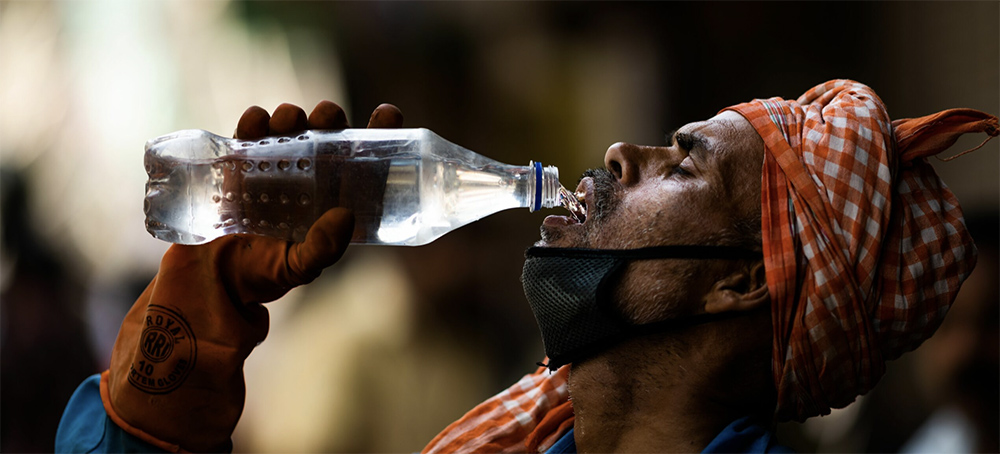 A laborer quenches his thirst with water from a bottle on a street amid rising temperatures in New Delhi on May 27, 2020. (photo: Jewel Samad/AFP/Getty Images)
Under the study’s most extreme climate and heat scenarios, as many as 90 days each year could be unsafe for people to be outside.
The study, published in the open-access journal Communications Earth & Environment, found that by 2100 there are likely to be 15 days a year in which some countries near the equator experience heat indexes exceeding 124 degrees Fahrenheit, or 51 degrees Celsius.
The heat index is derived from measurements of air temperature and relative humidity. The National Weather Service identifies a heat index above 124 degrees as a condition of “extreme danger” in which heat stroke is “highly likely” and it is unsafe for people to be outside.
Researchers from the University of Washington and Harvard University identified that extreme heat scenario as one of a range of possibilities which are contingent both on the level of global greenhouse gas emissions in the decades to come and the steps that policymakers take to mitigate them. In one of the researchers’ most extreme scenarios, as many as 90 days out of each year would be too hot for people to go outside.
Lucas Vargas Zeppetello, an atmospheric scientist at Harvard who served as the lead author of the study, said his research centered on developing statistical projections of global mean temperature change based on demographic and economic growth trends for the remainder of the 21st century. He noted that there are few examples in the historical record of locales that have exceeded a heat index at the extremely dangerous level.
“If you look 50 to 100 years into the future, there are some regions in the world where, depending on how good or bad we do curbing our CO2 emissions, that could be a regular occurrence,” Zeppetello said, referring to the extremely dangerous heat index designations.
“There’s two sides of the coin here: The good side is that we still have time to prevent the worst possible scenario and make it so that we mitigate the worst possible impacts,” Zeppetello said. “But the bad side of the coin is if we don’t do anything, the consequences—particularly for people in the global subtropics, the Indian subcontinent—are going to be fairly dramatic.”
Zeppetello and his co-researchers also found that countries in the tropics and subtropics would likely experience as many as 180 days of dangerous temperatures (a heat index above 103 degrees Fahrenheit on the National Weather Service scale) by 2050. By 2100, those regions would likely experience a heat index at that level for most of the year.
The tropical and subtropical countries experienced heat indexes at the dangerous level on about 55 days each year from 1979 to 1998,
The findings of the study build on a growing body of research that attempts to identify the potential effects of rising temperatures on future generations. Earlier this month, the First Street Foundation released a model indicating that by 2053 as much as a quarter of U.S. land area—a ribbon of states stretching from Wisconsin to Texas—would become part of an “extreme heat belt” marked by extremely dangerous heat index events.
The effects of extreme heat can take a severe toll on the human body. Researchers said that a dangerous heat index designation can lead to heat cramps, heat stroke, exhaustion, fatigue, nausea, headache, excessive muscle aches, confusion, weakness, slowed heartbeat, dizziness and fainting.
An extremely dangerous heat index includes those effects and vertigo, shortness of breath, vomiting, delirium, loss of consciousness and convulsions. If people in extremely dangerous heat index conditions go untreated, death can occur within hours.
David Battisti, an atmospheric scientist at the University of Washington who was one of Zeppetello’s co-researchers, said that while models projecting temperature change may vary in estimating such factors as how much carbon dioxide might be released into the atmosphere in the future, the pattern of warming has remained consistent.
Although researchers found that the sharpest increases in temperature would be in sub-Saharan Africa, the Amazon rainforest, northern Australia, southeast Asia and the Indian subcontinent, the effects of what researchers call “heat stress” would also increase in the United States.
In the southeastern United States, for example, locales that experienced two or three days per year of dangerous heat index levels at the end of the 20th century, might experience 20 to 30 such days by the middle of the century.
Battisti said that the high humidity levels in some parts of the country can have a dramatic effect on the heat index.
“If you live in Los Angeles or if you live in Denver, you can have these really hot days, they won’t kill you because it’s pretty dry,” Battisti said. “Whereas if you live in the southeast U.S., a day that you have even less temperature still could be more dangerous because of the humidity in the air.”
Zeppetello noted the recent record-breaking temperatures in cities in Europe and the United States and said that they may provide a glimpse of what is likely to come in the latter half of the century and beyond.
“There’s a great quote that I can’t take credit for, but there was someone in the scientific community who said, ‘Don’t think of it as the hottest year in history; think of it as the coldest year for the next hundred years,’” Zeppetello said, “And I think there’s value in that. Just seeing that we are tipping the scales pretty quickly toward really unprecedented forms of weather in the global north.”
Follow us on facebook and twitter!
PO Box 2043 / Citrus Heights, CA 95611


Comments
Post a Comment