RSN: Simon Tisdall | Putin Is Trapped and Desperate. Will His Friends in the West Rescue Him?

30 August 22
We cannot provide service to 100% of our Readership on the donations we receive from 1% of our Readers. A few of you DO help support the project. The vast majority do not. That is not fair to those who are sustaining the project, nor is it fair to the project we all want RSN to be.
We love this project and this community, but we must ask you in the strongest terms to take the funding drives more seriously.
In earnest,
Marc Ash
Founder, Reader Supported News
If you would prefer to send a check:
Reader Supported News
PO Box 2043 / Citrus Heights, CA 95611
Follow us on facebook and twitter!

30 August 22
Live on the homepage now!
Reader Supported News

Russia’s leader and his sympathisers could use old conflicts to distract attention from Ukraine and weaken European unity
Russia’s president keeps understandably schtum about his “special military operation”. But indefinite stalemate is not what he expected. He didn’t expect car bombs in Moscow and humiliating attacks on fortress Crimea, either.
Least of all did Putin anticipate 80,000 Russian soldiers dead or wounded. Dying with them is his Peter the Great pipe dream of a “greater Russia”. Extinct already is his reputation as anything other than a killer and a crook.
An endless military quagmire is not a scenario Putin can afford as slow-burn western sanctions corrode his economy and his military’s manpower and materiel are steadily depleted. So what are his options?
He could declare a specious victory, claim the Nato “threat” is neutralised and propose a settlement recognising Russia’s annexation of occupied areas. But he surely knows Kyiv will never willingly accept such terms. He could gamble on a huge battlefield escalation, for example, using Belarus to open a second front north of Kyiv – the region he failed to overrun in February. But it’s uncertain his generals have the capability or the stomach.
He certainly dare not retreat. So as pressure on him grows to produce a breakthrough, Putin may well decide his best option is to raise the cost of the war to Ukraine’s backers – and undermine Kyiv’s resistance that way.
In fact, he has already begun. It’s telling that British, French and German leaders all proclaimed long-term support for Ukraine last week. They know Putin is betting they will buckle.
The context is rising anxiety over Europe’s energy and cost of living crises, largely caused by the invasion and Kremlin cuts to gas supplies. The winter fallout from this coldest of cold wars could prove paralysing.
Yet Putin may just be getting started. He has many means by which to undermine western unity and staying power. Europe is littered with easily exploited potential flashpoints and geopolitical faultlines bequeathed from Soviet times. Likewise, Russia has surprising numbers of allies and sympathisers scattered across a politically fractured European landscape.
So will Putin’s friends in the west help rescue the beast from the east? Belarus’s Alexander Lukashenko is already in Putin’s pocket. Moscow ensured the dictator survived after his theft of the 2020 presidential election provoked nationwide protests. Lukashenko will do as he’s told.
Inside the EU, Viktor Orbán, Hungary’s prime minister, is seen as Putin’s Trojan horse. Like many on Europe’s far right, Orbán admires his intolerant nationalist ideology and shares his racist, homophobic outlook. He has repeatedly obstructed EU sanctions. Last month he cut a unilateral gas deal with the Kremlin. Orbán plainly cannot be trusted.
The collapse in June of Bulgaria’s reformist government and subsequent talk of repairing relations with Moscow fuels concern that Putin is gaining leverage to divide the EU.
Italy has plenty of Putin fans, too. Leaders of two far-right parties that are expected to join a ruling coalition after next month’s elections have enjoyed close ties with Moscow over the years. Matteo Salvini’s League formed an alliance with Putin’s United Russia in 2017. Silvio Berlusconi of Forza Italia is a personal friend. Italy’s ousted prime minister Mario Draghi took a tough line on Ukraine. That may change.
Other European far-right (and far-left) insurgent and populist parties identify to varying degrees with Putinist ideology and conservative social values. They echo his hostility to the EU. A definitive European Council on Foreign Relations study in 2016 listed Germany’s Alternative for Germany, France’s Front National (now National Rally), Austria’s Freedom party and Belgium’s Vlaams Belang as “pro-Russian”. Ukip made the cut, too.
“The parties … help legitimise the Kremlin’s policies and amplify Russian disinformation. At times they can shift Europe’s domestic debates in Russia’s favour,” the study said. In Putinworld, such channels of influence are potent weapons.
Putin can also rely on mainstream non-EU politicians such as Aleksandar Vučić, Serbia’s president, for a sympathetic hearing. Vučić has been dubbed “little Putin” by opponents. Serbia has profound historical, Slavic and religious ties to Russia, plus a shared distrust of Nato. The alliance’s 1999 bombing of Belgrade is not forgotten.
The EU and UK fear the volatile western Balkans are a critical pressure point Putin could use to stir up old conflicts and distract attention from Ukraine.
Kosovo, where ethnic Serb agitation is building again, is a case in point. Vučić last week threatened international peacekeepers with intervention. “We will save our people from persecution and pogroms if Nato doesn’t want to do it,” he said. Bosnian Serb leaders tied to Moscow also threaten new ruptures in Bosnia-Herzegovina. Bosnia has echoed Serbia’s rejection of “hysterical” western sanctions. In March, pro-Putin Bosnian Serb “Night Wolves” bikers cheered the invasion.
Partitioned Moldova and Georgia, with divided populations and Russian troops on their soil, are also potential flashpoints. Another is Kaliningrad, where Putin deployed hypersonic missiles this month to intimidate the Nato neighbours. Estonia, in particular, with its ethnic Russian minority, appears a target.
Putin’s efforts to spread fear and instability, disruption and economic pain – making countries think twice about opposing Russia – extend beyond Europe. His vetoes have left the UN security council frozen in time. Now he and China’s Xi Jinping look set to turn November’s important post-pandemic G20 summit in Bali into a crude west-versus-the-rest showdown over Ukraine. No matter that Russia’s whole argument is based on a lie.
Putin’s reckless brinkmanship at Ukraine’s occupied Zaporizhzhia nuclear power plant suggests he’ll risk almost anything to win. Quietly desperate, he grows more dangerous by the day.
 Russian soldiers. (photo: Creative Commons)
Vostok 2022 military manoeuvres will be held September 1-7 with forces from China, Syria, India, Nicaragua, and elsewhere.
The Vostok 2022 (East 2022) exercise will be held September 1-7 in various locations in Russia’s Far East and the Sea of Japan and involve more than 50,000 troops and 5,000 weapons units, including 140 aircraft and 60 warships, according to the Russian defence ministry.
It released a video of Chinese troops arriving in Russia in preparation for the massive exercise.
The drills will be conducted at seven firing ranges in far eastern Russia and will engage troops from several ex-Soviet nations, China, India, Laos, Mongolia, Nicaragua and Syria.
The ministry said units of Russian airborne troops, long-range bombers, and military cargo planes will take part in the drills along with other forces.
While first announcing the exercise last month, the Russian military emphasised it is part of planned combat training that is continuing despite Moscow’s military action in Ukraine. It has not disclosed the number of troops engaged in what the Kremlin calls the “special military operation” there.
The ministry noted as part of the manoeuvres, the Russian and Chinese navies in the Sea of Japan will “practice joint action to protect sea communications, areas of marine economic activity and support for ground troops in littoral [coastal] areas”.
“The exercise isn’t directed against any specific countries or military alliances and is purely defensive,” Russian Deputy Foreign Minister Alexander Fomin said at a meeting with foreign military attaches. He specified the naval drills would take part in the northern and central part of the Sea of Japan.
The drills reflect increasing defence ties between Moscow and Beijing, which have grown stronger since Russia sent its troops into Ukraine on February 24. China has pointedly refused to criticise Russia’s action, saying the United States is the “main instigator” of the war by supporting NATO expansion and putting sanctions on Moscow.
In return, Russia has strongly backed China amid the tensions with the US after its House Speaker Nancy Pelosi’s recent visit to Taiwan.
Speaking earlier this month, Russian President Vladimir Putin drew parallels between US support for Ukraine and Pelosi’s trip to Taiwan, saying both were part of alleged American efforts to foment global instability.
Russia and China have held a series of joint war games in recent years, including naval drills and patrols by long-range bombers over the Sea of Japan and the East China Sea. Last year, Russian troops for the first time deployed to Chinese territory for joint manoeuvres.
Putin and Chinese President Xi Jinping have developed strong personal ties to bolster a “strategic partnership” between the former communist rivals as both Moscow and Beijing face increasing tensions with the West.
Even though Moscow and Beijing in the past rejected the possibility of forging a military alliance, Putin has said such a prospect cannot be ruled out. He also noted Russia has been sharing highly sensitive military technologies with China that helped significantly bolster its defence capability.
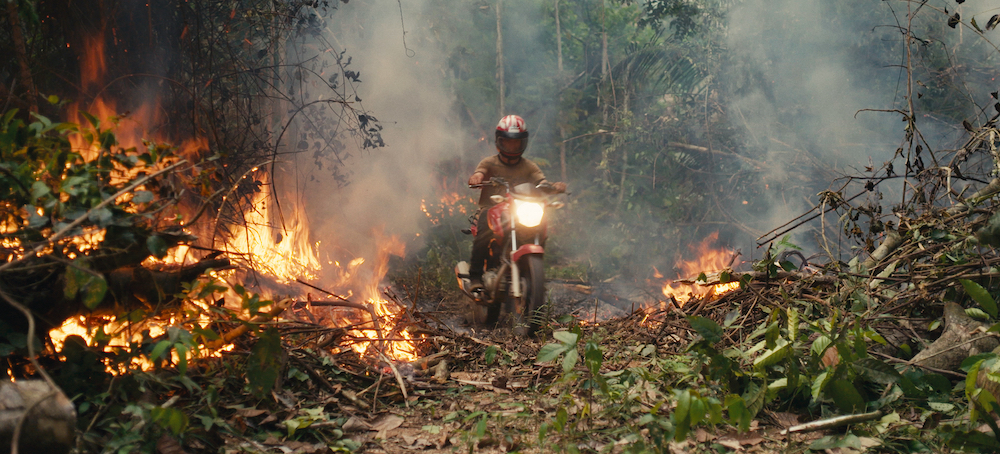 An invader rides his motorcycle through the rainforest fire blaze. (photo: Alex Pritz/Amazon Land Documentary)
In “The Territory,” documentarian Alex Pritz chronicles Indigenous Brazilians’ fight to save their home in the Amazon rainforest.
“The only thing that’s saving our planet is our rainforest,” says Bitaté, a young member of the Uru-Eu-Wau-Wau Indigenous people, in the film. “I believe the Amazon is the heart not just of Brazil, but the whole world.”
“The Territory,” which is showing in select U.S. and Canadian cities, chronicles the perilous efforts of Uru-Eu-Wau-Wau like Bitaté to defend their ancestral home as white settlers seek to illegally slash and burn the forest and turn it into pasturelands. The forest is officially protected by the Brazilian government, but Pritz shows how far-right President Jair Bolsonaro and the Brazilian state’s hostility toward Indigenous people emboldens the land thieves.
The film is very timely. Brazil is gearing up for highly polarized presidential elections in October. And, with the climate emergency exploding across the globe, environmental and Indigenous concerns remain in the spotlight, particularly following the brutal assassinations of British journalist Dom Phillips and Brazilian Indigenous expert Bruno Pereira in the Amazon in June.
Cattle ranching is the leading cause of Amazon deforestation, which has increased at a dramatic rate in recent years, much of it illegal. So much of the rainforest has already been cut down that scientists believe we are on the verge of an irreversible tipping point. The Amazon also serves as an essential carbon sink in the fight against climate change and generates the rainfall that supports almost all life on the South American continent. Ranching, as well as mining, logging, and factory farming — embraced by politicians and bankers as agents of “economic progress” — are driving us ever closer to an environmental (and socioeconomic) catastrophe.
“The Territory” was shot on the front lines of an active war zone almost 500 years after the conflict began, following the arrival of the first Europeans in search of gold. No nuclear weapons are involved, but the conflict has the potential to dramatically alter the course of life on Earth.
Pritz and his team spent three years on the southern edge of Brazil’s Amazon rainforest, beginning in 2018, just as Bolsonaro, in the name of economic development, was campaigning on promises to roll back Indigenous rights and empower miners, loggers, and ranchers. The land grabbers of the Amazon saw the opportunity.
“This is how Brazil was created,” a settler named Martins tells the camera in Uru-Eu-Wau-Wau territory, his arms speckled with wood chips from the once towering tree he had just felled.
Modern Brazil, like the rest of the Americas, was built on the genocide of Indigenous people and the forced expropriation of their lands — programs conducted by enterprising settlers, the government, and large infusions of international capital. Martins is among the poor, dispossessed, landless peasants in the film, but their like is backed and financed by powerful interests that the camera does not capture.
The colonial process has been such a successful endeavor that the Uru-Eu-Wau-Wau have been decimated — less than 200 of them remain.
“People say they’re there, but nobody’s ever seen them,” said one aspiring settler, hoping to dismiss the property claims of the Uru-Eu-Wau-Wau and other Indigenous people who live on the reserve. Cribbing from apologists for colonialism quoted in history books, Sergio, a settler leader, tells the camera, “The Uru-Eu-Wau-Wau, they don’t farm or create anything. They just live there.”
The settlers employ sometimes paradoxical rhetoric to justify their actions: patriotism, progress, fairness, the perception that the Indigenous do not make good use of their land, and even doubts that they really even exist — all infused with Christian values and heavy-handed claims to divine right.
“If there is a villain, it’s the people behind Sergio and Martins that are financing this, the people that are really benefiting from having these poor disenfranchised farmers remain with the idea that it is Indigenous people who are holding them back,” Pritz, the director, told The Intercept. “In America, same as in Brazil, it’s advantageous for the political class to keep disenfranchised people fighting amongst themselves because it keeps the heat off them.”
The Uru-Eu-Wau-Wau in the film are more direct and concise in their analysis than the settlers. “They just want money,” one unnamed elder tells a gathering of leaders. “That’s all it is.”
Hope in the face of overwhelming odds is the Uru-Eu-Wau-Wau’s strategy. Fears of the complete extermination of their people — genocide — are on the lips of multiple Uru-Eu-Wau-Wau in the film. They are angry but also cognizant that they are outgunned. Rather than use the warfare tactics of their ancestors, we accompany their surveillance teams, armed with bows and arrows, drones, cameras, and GPS trackers, to document and report invasions to authorities with the help of environmentalist allies.
This is one of the contradictions that the film reveals: The Indigenous, derided as backwards by their enemies, employ modern technology and sophisticated public relations to promote a vision for the future that is increasingly the only hope for survival. Meanwhile, the supposed agents of socioeconomic progress use antiquated ideologies and outright criminality to destroy Brazil’s most precious resource.
Indigenous groups are also testing their luck in courts. The patrols, meanwhile, take matters into their own hands and snuff out incipient invasions whenever they judge it safe enough to do so.
Invasions into Indigenous territories are up 180 percent under Bolsonaro, according to a new study by the Missionary Council for Indigenous Peoples. The land raiders’ bonanza has proved dangerous to the Indigenous and their defenders, who live under constant threat from ruthless enemies.
Phillips and Pereira, the journalist and Indigenous expert, respectively, were assassinated about 500 miles to the northwest while working with a similar surveillance project being implemented in the Javarí Valley, a sprawling Indigenous reserve on the border with Colombia and Peru. The accused murderers were illegal fishermen with alleged ties to politicians and international drug smuggling networks.
Prior to the killing, the Indigenous patrol group had repeatedly denounced the activities of this gang to authorities with documented evidence, but nothing came of it. Human rights organizations complain that the police have been hesitant to investigate who is really behind the killers.
Phillips, who was writing a book called “How to Save the Amazon,” strongly believed that most of the people committing environmental crimes on the ground are also victims of a system designed to make unsustainable development their only viable economic option. In addition to empowering Indigenous movements, he argued, any solution must include more sustainable alternatives for those working in the extractive and land-grabbing industries — the very sort of people that assassinated Phillips.
None of this is likely to happen under the current government. Recent polling suggests that leftist former President Luiz Inácio Lula da Silva continues to lead nationwide, but Bolsonaro and aligned anti-Indigenous and anti-environment politicians have the upper hand in the Amazon region in this October’s elections.
All hope is not lost, though: Eighty-one percent of Brazilians believe that protecting the Amazon should be a priority of the next president, and two-thirds nationally, and in the North specifically, believe the Bolsonaro administration is not actively combating crimes such as land grabbing, drug trafficking, and illegal logging in the region, according to another recent poll.
It seems contradictory that polls show that people in Brazil’s north both support Bolsonaro and want more done to protect the Amazon, but the responses are indicative of the complexity of the issues at hand.
The realities are that policies of death and destruction are subsidized by the government and bankrolled by faraway investors, while criminality is not held accountable. Options for Brazilians are limited.
It is easy to imagine that if alternative, sustainable economic models were incentivized, a different electoral reality would exist. “In another world,” said Pritz, “Sergio could be an advocate for agrarian reform and some of these other leftist movements.” Instead, social programs, law enforcement, and sustainable development have been whittled away and most Brazilians are feeling increasingly desperate.
“The government isn’t doing their job,” Bitaté says in “The Territory.” “That’s our reality — they’re not. And now we’re doing their work for them.” The young Uru-Eu-Wau-Wau leader spoke as he was trekking through the forest in search of invaders. The words, though, could just as easily have come from the mouth of Martins as he chainsawed the path for a new road into the reserve that he hoped will one day be built — the only path he can imagine to escaping poverty.
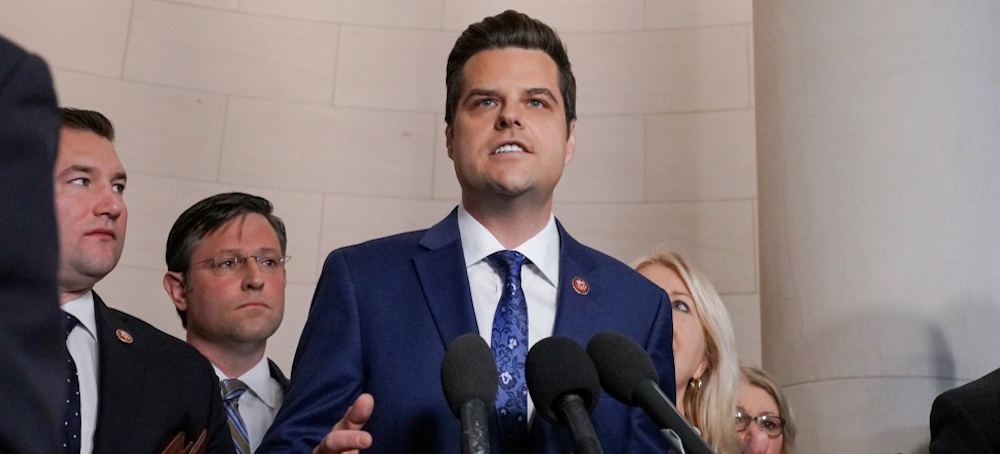 Matt Gaetz. (photo: Jemal Countess/Redux)
There is something happening with angry women voting on abortion. Male politicians don’t seem to have noticed.
It is surely the very textbook definition of “privilege” to find yourself unbothered by protests, polling numbers, and voter registration data. Justice Samuel Alito actually laughed in the face of outraged females who called out the bad history, bad economics, and bad medicine in his leaked draft opinion—their complaints were numerous and well-founded, yet he didn’t change a thing. Instead, he smugly told women that if they didn’t like the outcome in Dobbs, they could just “seek to affect the legislative process by influencing public opinion, lobbying legislators, voting, and running for office” and that “women are not without electoral or political power.” The court’s newest approval ratings suggest the same, though I don’t think Justice Alito likes that kind of political power very much at all.
Because, Happy Women’s Equality Day, women are taking him up on the offer. One analysis of the Kansas’ voter registration list showed that in the week after Dobbs, more than 70 percent of newly registered voters in that state were women. Those numbers, according to an Upshot analysis of 10 states with available voter registration data, show consistently higher registration for women after the Dobbs leak in May. As Jennifer Rubin recently noted, The Philadelphia Inquirer reported that, “62 percent of women registering since Dobbs registered as Democrats, 15 percent as Republicans and that 54 percent were younger than 25.” And a Pew Research Center poll indicates that “a majority of registered voters (56 percent) say the issue of abortion will be very important in their midterm vote, up from 43 percent in March.” Tom Bonier, CEO Of TargetSmart recently posted on Twitter: “We are seeing early signs of what could lead to a huge increase in women voting in November. …This surge is young and female.” Both Mitch McConnell and RNC Chair Ronna McDaniel are panicking about the GOP’s odds in Congress, directly connected to fundraising around abortion.
I have a lot of theories about why nobody should be surprised that women are friggin’ furious right now, which include, as Mark Joseph Stern has been arguing all summer, the increasingly horrifying tales of women, disproportionately on teenagers and victims of violence, left to suffer from sepsis, refused prescriptions and denied treatment for ectopic pregnancies, and ever more horrors. And yet, the forced birth Republicans continue to insist that none of this is happening, or that journalists and physicians are making it all up.
If you’ve ever suffered a miscarriage, sought emergency contraception, needed cancer drugs that were available to you in May and unavailable today, or lost a much-wanted pregnancy and then had to litigate the repercussions with hospital attorneys and wild-eyed state prosecutors, you are afraid and anxious right now. That is happening. There are a lot of us. And as President Biden warned this week, Democrats losing Congress will mean that abortion is in peril everywhere.
Yet the men, they just keep on talking. Some examples:
· In June Rep. Warren Davidson of Ohio told CNN’s Pamela Brown, in response to a question about his state law that contains no rape exceptions: “You don’t know you were raped for two months? … It’s hard to conceive of somebody who doesn’t know they were raped for two months.”
· In July Rep. Matt Gaetz, R-Fla., asked a gathering of like-minded misogynists “Have you watched these pro-abortion, pro-murder rallies?… The people are just disgusting. But why is it that the women with the least likelihood of getting pregnant are the ones most worried about having abortions? Nobody wants to impregnate you if you look like a thumb.”
· Last month during debate over a near-total abortion ban in West Virginia, Republican Del. Chris Pritt said on the floor of the legislature that that child support requirements bad because if a man gets a woman pregnant, he would force her to have an abortion to avoid paying child support. And abortion is bad.
· When Indiana lawmakers approved a near-total ban on abortion earlier this month, Rep. John Jacob (R) announced that he voted in support because “the body inside of the mom’s body is not her body. Let me repeat that: The body inside of the mom’s body is not her body. Not her body, not her choice.”
It actually never ends. And the harder these guys try to seem sensitive and caring, the worse it goes for them.
Case in point: Viral video last week showed South Carolina state Rep. Neal Collins (R) describing the excruciating hurdles faced by a 19-year-old thanks to anti-abortion legislation he himself had supported. But Collins, fighting back tears while telling that story, didn’t actually change his vote: He just abstained, while his colleagues advanced one of the most restrictive bans in the nation. (His statement also bizarrely focused on his own sleepless suffering rather than that of the victim). These guys sure do like to keep on talking.
I don’t understand what some of these legislators are thinking. Do they forget that women have the vote? (Happy Women’s Equality Day.) Do they think women don’t have ears? Or cannot read words? Or that women are just kidding when they take to the streets, register to vote, and flip elections?
Even the politicians who are changing their tune are doing so in a matter that is frankly confusing: Arizona Republican Senate candidate Blake Masters quietly scrubbed his website’s abortion policy restrictions this week, rewriting or erasing five of his six previous hardline positions, including earlier support for a “a federal personhood law.” He then released a gaslight-hued new ad posted to Twitter recasting his abortion views as “commonsense.” And then there are those who have simply stopped talking altogether. Pennsylvania’s Gubernatorial candidate Doug Mastriano, for example, has gone from a position in which he had championed a six-week ban, opposed exceptions for rape, incest, or the life of the mother, and favored criminal penalties for doctors and nurses who perform abortions to essentially being a mime. OK, this one I actually do get: It’s cowardice, but at least it’s strategic.
The notion that your words have no impact, change nothing, and reveal no truth has been so baked into public political life these past years that it’s no wonder a good many elected officials seem to really believe it. But it a non-trivial number of voters do listen carefully to their elected officials and candidates for high office when they speak. They do absorb the gist of the sentiments offered and the cruelty that underlies it. And they also vote. It says so much about where we are just now that this simple connection must be explained as if it were string theory.
It’s not mere coincidence that new polling shows that “threats to democracy” is suddenly ranked as the number one issue for registered voters. It rolled in at 21 percent, this week, overtaking the economy, crime, and abortion. When you are repeatedly being told by those in power that your preferences don’t matter and when those in power believe that saying the quiet parts out loud is electorally costless, they aren’t just saying that women don’t matter. They’re saying democracy doesn’t matter either. But it turns out they don’t get to decide that. You do.
 'A billionaire transferred $1.6 billion to a political group controlled by Republican operative Leonard Leo, who spearheaded the construction of a conservative supreme court supermajority to end abortion, block government regulations, stymie the fight against climate change and limit voting rights.' (photo: Carolyn Kaster/AP)
A donor secretly transferred $1.6bn to a Republican political group. Because of America’s lax laws, the donation was never disclosed in any public record or database
This anonymous donation – which flowed to a tax-exempt trust that was never disclosed in any public record or database – was probably completely legal.
Whether you support or abhor Leo’s crusade, we should be able to agree on one larger non-partisan principle: such enormous sums of money should not be able to influence elections, lawmakers, judicial nominations and public policy in secret. And we should not have to rely on a rare leak to learn basic campaign finance facts that should be freely available to anyone.
Unfortunately, thanks to our outdated laws, those facts are now hidden behind anonymity, shell companies and shadowy political groups. America is long overdue for an overhaul of its political disclosure laws – and news organizations in particular should be leading the charge for reform.
In the early 1970s, leaks and shoe-leather reporting by news organizations uncovered the Watergate scandal – the modern era’s foundational dark money exposé. That debacle birthed the original federal disclosure laws and a golden age of journalism. For a time, the new statutes allowed campaign finance reporting to become systematic, methodical and based on required disclosures, rather than sporadic, random and reliant on the goodwill of courageous whistleblowers.
A half-century later, however, the dark money practices of 50 years ago have again become normalized. In 2020 alone, more than $1bn worth of dark money flooded around weak disclosure rules and into America’s elections, financing Super Pacs, ad blitzes, mailers and door-knocking campaigns. As millions of votes were swayed, reporters and the public had no knowledge of the money sources, or what policies they were buying.
Heading into the 2022 election, the situation is getting worse. The two parties’ major Senate and House Super Pacs are all being funded by anonymous dark money groups that are not required to disclose their donors.
These problems aren’t unique to the campaign arena. Front groups are also shaping public policy, leaving reporters unable to tell voters who exactly is funding what. In the last few years, an anonymously funded group used post-election ads to successfully pressure lawmakers to water down landmark healthcare legislation designed to eliminate so-called “surprise” medical bills.
Similarly, Leo’s anonymously funded network spent tens of millions to boost the nomination campaigns of three conservative supreme court justices, after leading a campaign supporting Republicans’ refusal to hold a vote on Barack Obama’s 2016 high court nominee, Merrick Garland.
To be sure, news outlets can still cover the shrinking portion of the political finance system that still discloses some money flows to politicians, lobbyists and advocacy groups. And thankfully, there are occasionally disclosures like the Leo leak, which provide a fleeting glimpse into the real forces influencing sweeping policy decisions.
But for every sporadic leak, there are scores of secret donors systematically funneling ever more dark money into elections and legislative campaigns without ever being exposed – and they are reaping the rewards of corrupted public policy.
That’s the bad news. The good news is there is already a legislative blueprint for reform.
The Disclose Act, sponsored by the Democratic senator Sheldon Whitehouse, would force dark money groups to disclose any of their donors who give more than $10,000, require shell companies spending money on elections to disclose their owners, and mandate that election ads list their sponsors’ major contributors. These requirements would extend not only to election-related activity, but also to campaigns to influence governmental decisions – including judicial nominations.
A separate Whitehouse bill would additionally require donor disclosure from shadowy groups lobbying the supreme court through amicus briefs designed to tilt judicial rulings without letting the public know which billionaire or CEO’s thumb is on the scale. And other pending legislation would finally allow the Securities and Exchange Commission to require major corporations to more fully disclose their political spending.
Journalists should proudly advocate for laws like these, which allow us to tell the public what its government is doing. Our industry has done that before in defending open records laws, and we must do it now in advocating for new campaign finance disclosure rules.
In practice, that means reporters elevating the transparency issue and demanding answers from politicians about where they stand on disclosure laws – rather than ignoring or downplaying the rising tide of dark money now shaping every public policy in America.
It means newspaper editorial boards advocating for campaign finance reform.
It means media organizations lobbying for stronger disclosure laws at the federal, state and local levels.
It means the journalism industry participating in – and at times leading – this fight, rather than using objectivity as a cop-out.
This battle to update campaign finance disclosure laws and bring sunlight to the darkest of dark money already faces powerful opponents. In recent years, the US Chamber of Commerce and Koch Industries – which represent some of America’s biggest dark money spenders – have been lobbying against the Disclose Act, preventing it from advancing for more than a decade.
The Koch network recently convinced the supreme court’s conservative bloc to strike down a California law requiring non-profit dark money groups to at least disclose their major donors to state tax regulators, after spending to back some of those justices’ confirmations to the court.
Most recently, conservative groups and Republican state attorneys general have been trying to block a proposal to force companies to disclose greenhouse gas emissions by arguing that it is unlawful “compelled speech” – a preview of the argument they might use against new campaign finance transparency legislation.
Just as alarming, segments of the journalism industry itself have opposed transparency efforts. The National Association of Broadcasters (NAB) — which represents the major media outlets making huge profits off of dark money ads — tried to block a rule at the Federal Election Commission a decade ago to require TV and radio stations to disclose ad buys from political groups, arguing it would cost them advertising revenue.
The NAB has recently successfully opposed the Federal Communications Commission’s requirements that broadcasters disclose when foreign governments sponsor material. NAB is right now lobbying on the Disclose Act.
But this week’s revelations about history’s largest dark-money donation should be an alarm telling us that the status quo must change – and indeed it can change, even within the confines of the supreme court’s own precedents.
In the landmark Citizens United ruling that unleashed the modern era of big money politics, the majority noted that while it was unwilling to permit political spending restrictions, it still held that “government may regulate corporate political speech through disclaimer and disclosure requirements”.
Those requirements are so desperately needed now – for the free press to play its vital role, and for voters to make informed decisions when they go to the polls.
But the only chance it will happen is if news outlets and reporters get off the sidelines and enter the battle to secure what they need to do their jobs – and what we all need to preserve our democracy.
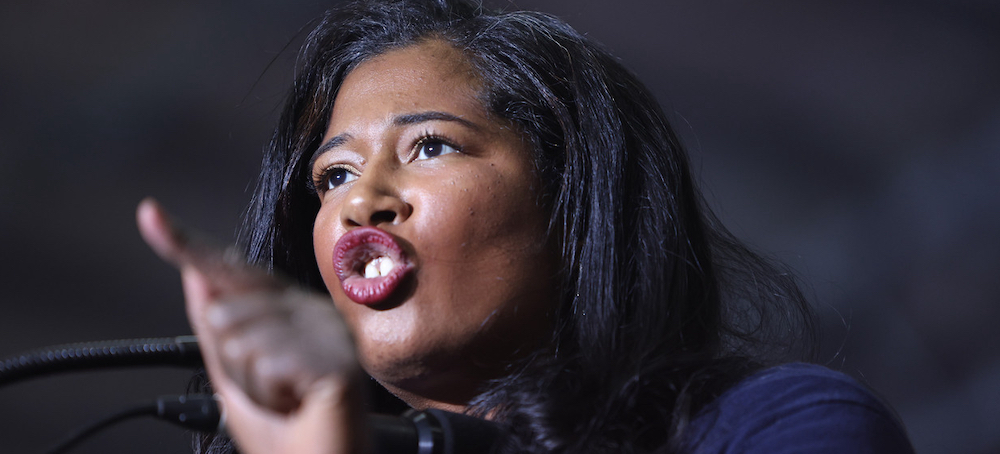 Some secretary of state nominees such as Kristina Karamo in Michigan want to roll back access to mail voting, which once enjoyed broad bipartisan support but has come under intense attack from Republicans led by former President Donald Trump. (photo: Scott Olson/Getty Images)
Trump-aligned secretary of state hopefuls are campaigning against ballot counting machines and could complicate mail voting, among other changes.
The bigger question — amid concerns about whether they would fairly administer the 2024 presidential election — is exactly what powers they would have if they win in November.
Atop the list of the most disruptive things they could do is refusing to certify accurate election results — a nearly unprecedented step that would set off litigation in state and federal court. That has already played out on a smaller scale this year, when a small county in New Mexico refused to certify election results over unfounded fears about election machines, until a state court ordered them to certify.
But secretaries of states’ roles in elections stretch far beyond approving vote tallies and certifying results. Many of the candidates want to dramatically change the rules for future elections, too.
The Donald Trump-aligned Republican nominees in a number of presidential battleground states have advocated for sweeping changes to election law, with a particular focus on targeting absentee and mail voting in their states — keying off one of Trump’s obsessions.
And even if they cannot push through major changes to state law using allies in the legislatures, they could still complicate and frustrate elections through the regulatory directives that guide the day-to-day execution of election procedures by county officials in their states.
That could include things from targeting the use of ballot tabulation machines, which have become the subject of conspiracy theories on the right, to changing forms used for voter registration or absentee ballot requests in ways that make them more difficult to use.
Election officials “are the people who protect our freedom to vote all the way through the process,” said Joanna Lydgate, the CEO of States United Action, a bipartisan group that has opposed these candidates. “But all the way through, there are opportunities for mischief, opportunities for election deniers to add barriers to the ballot box, to curtail the freedom to vote.”
Targeting mail voting
Four Republicans on the ballot in major battlegrounds this fall have banded together in what they call the America First Secretary of State Coalition: secretary of state nominees Kristina Karamo in Michigan, Mark Finchem in Arizona and Jim Marchant in Nevada, along with Pennsylvania gubernatorial nominee Doug Mastriano, who would appoint the state’s chief election official if he wins.
One common thread binding the candidates, none of whom responded to requests for comment from POLITICO about their policy platforms, is that they want to roll back access to mail voting, which once enjoyed broad bipartisan support but has come under intense attack from Republicans led by Trump. One of the stated goals of the coalition is to “eliminate mail-in ballots” while keeping “traditional absentee ballots,” presumably for people who have a specific excuse not to vote in person on Election Day.
Thirty-five states and the District of Columbia allow any voter to request a mail ballot, according to the National Conference of State Legislatures, including Arizona, Michigan and Pennsylvania. Nevada is among a handful of states where all registered, active voters are automatically mailed a ballot.
Pennsylvania passed a bipartisan law allowing no-excuse mail voting in 2019, but Republicans in the state have turned sharply against it, and Mastriano has made overturning it central to his pitch to the MAGA base in the state, introducing a proposed constitutional amendment to stop “no-excuse” mail voting.
Similarly, Marchant has vowed to fight to roll back Nevada’s switch to an predominately by-mail system, which Nevada Democrats passed last year after the state sent ballots to voters during the 2020 pandemic on an emergency measure.
“We’re going to do our best to get rid of these ridiculous universal mail-in ballots,” Marchant said on Steve Bannon’s show “War Room” on the day he won his state’s primary earlier this summer. “Same-day voting, we would like to go to that.”
Similarly, election deniers have sought to curtail or eliminate the use of ballot drop boxes, which saw widespread adoption in 2020.
Members of the coalition have also turned their attention toward vote tabulation machines, which have been central to conspiracy theories about “flipped votes” in the 2020 election.
Finchem — along with Kari Lake, the Republican gubernatorial nominee in Arizona — filed a federal lawsuit earlier this year looking to block the use of voting machines in this year’s elections. “We got to swamp the system with legitimate votes. We know they’re going to try to inject fictitious votes into the system,” Finchem said in an interview with Patriot_Mom007.
That lawsuit was dismissed on Friday.
In Nevada, Marchant has been leading a state and local push to dump ballot tabulators and count results by hand only, which election experts say would be costlier, more time-consuming and less accurate. “We all are advocating for getting rid of the electronic voting machines,” Marchant told Bannon, falsely claiming that using computers in election systems introduces a “10 percent error rate.”
But perhaps the most radical proposal from some of the candidates would be to completely scrap their states’ voter rolls, requiring people to re-register. Both Marchant and Mastriano have floated similar ideas.
“One of the things that I’m going to look at, and I don’t know if we can do this yet, but it’s something I’ll most certainly consider is wipe out the voter rolls completely and then have everybody re-register,” Marchant said on a local radio show last year, in remarks recently unearthed by the liberal watchdog Media Matters.
The power of red tape
Would-be secretaries cannot unilaterally rewrite state election law on their own, however. Many of their most drastic changes they discuss would need to pass through a state legislature and be signed by a governor.
But just by holding secretary of state offices, there are opportunities for election deniers to remake their state’s election procedures in their image, current and former election officials say. Experts in Arizona, for example, say a secretary of state could radically reshape voting there by rewriting the state’s elections manual, which dictates election procedure on things like signature matching and aspects of mail voting.
“It certainly can’t contradict statute,” said Tammy Patrick, a one-time Maricopa County, Ariz., election official who is now a senior adviser at Democracy Fund. “But it does allow for the secretary of state — with the attorney general and governor signing off on it — to make some pretty dramatic procedural requirements that could certainly bog down the system.”
Patrick said that the elections manual lays out procedures for things like how and when to process provisional ballots, how voters can fix rejected ballot signatures and more. And while changes to the manual couldn’t outright ban mail voting in the state, a secretary looking to discourage mail voting could make it far more onerous by changing application or registration forms.
“You could make it so mired in legal language and so convoluted, as many of those types of forms already are, that voters can’t navigate it,” Patrick said. Others in the state raised potential tension points — everything from the certification of election equipment to qualifying candidates for the ballot — as places where a rogue secretary could affect future elections.
Other states that give secretaries less ability to dictate procedures to counties, like Pennsylvania, have still generally seen local election officials give some degree of deference to guidance issued by statewide officers, especially in smaller jurisdictions.
Secretaries also generally have the power to represent the state’s interest in court — which would be key, because election experts said there would be a wave of litigation in an already busy area of law should election deniers try to make sweeping changes.
The Pennsylvania Department of State “does provide guidance, which is very helpful, and when counties don’t comply [with the law], it obviously has standing to go to court,” said Al Schmidt, a former Philadelphia election official who now chairs the good government group Committee of Seventy. “But the system is so decentralized. … They can try to coerce the counties, they can’t compel the counties.”
Election deniers running state offices could also look to overhaul staff in state elections departments, even in positions where staffers are civil servants with broader protections from being fired from their jobs. Experienced election officials predicted that staff would look to leave the office rather than work for someone who did not believe in free elections, in addition to staffers being pressured to leave or just moved to somewhere else in the government.
“If a secretary wanted a new [elections] director, they could figure out how to do that,” said Christopher Thomas, a fellow at the Bipartisan Policy Center who served as Michigan election director for secretaries of state of both parties. “I haven’t seen a civil service process yet that you can’t work around.”
 Chinook salmon. (photo: Steve Ringman/The Seattle Times)
The staff's recommendation, which largely echoes an earlier draft opinion, tees up a vote on the roughly $500 million project by the five-member Federal Energy Regulatory Commission later this year.
The removal of the four hydroelectric dams on the lower Klamath River — one in southern Oregon and three in California — would be the largest dam demolition project in U.S. history.
The aging dams near the Oregon-California border were built before current environmental regulations and essentially cut the 253-mile-long (407-kilometer-long) river in half for migrating salmon. Migratory salmon have been hit hard by warming waters and low river flows caused by severe drought and competition for water with agricultural interests.
The project on California’s second-largest river would be at the vanguard of a push to demolish dams in the U.S. as the structures age and become less economically viable and as concerns grow about their environmental impact, particularly on fish.
Northern California tribes have been fighting for years to remove the dams. They applauded the latest news.
“We can see the light at the end of the dam removal tunnel,” Karuk Chairman Russell ‘Buster’ Attebery said in a statement. “I am so proud of everyone in our river communities that have worked so hard for the past 20 years to realize our vision of river restoration.”
Coho salmon from the river are listed as threatened under federal and California law, and their population has fallen by anywhere from 52% to 95%. Spring chinook salmon, once the Klamath Basin’s largest run, have dwindled by 98%.
Fall chinook, the last to persist in any significant numbers, have been so meager in the past few years that the Yurok Tribe canceled fishing last year for the first time in memory. In 2017, they bought fish at a grocery store for their annual salmon festival.
In recent years, as many as 90% of juvenile salmon sampled tested positive for a disease that flourishes when river flows are low.
If the dams remained, power company PacifiCorp would likely have to spend hundreds of millions of dollars to retrofit the structures to comply with today’s environmental laws. As it is, the utility has said the electricity generated by the dams no longer makes up a significant part of its power portfolio.
The original demolition proposal foundered after regulators initially balked at allowing PacifiCorp to completely exit the project.
A historic deal reached in 2020 made Oregon and California equal partners in the demolition with a nonprofit entity called the Klamath River Renewal Corporation, which will oversee the project. That deal also added $45 million to the project’s $450 million budget after concerns that the available funds weren’t enough to cover any overruns.
Oregon, California and PacifiCorp, which operates the hydroelectric dams and is owned by billionaire Warren Buffett’s company Berkshire Hathaway, each provided one-third of the additional funds.
Some critics have said governors in Oregon and California were irresponsible to assume financial responsibility for cost overruns and object that part of the project is financed by a voter-approved California water bond.
Some local and state officials worry about flood control and residents who live around a large reservoir created by one of the dams have unsuccessfully sued to stop the project.
The dams that would be demolished are the Iron Gate, Copco 1, Copco 2 and J.C. Boyle, which is in Oregon.
Follow us on facebook and twitter!
PO Box 2043 / Citrus Heights, CA 95611


Comments
Post a Comment