RSN: Bodies in a Mass Grave in Ukraine Show Signs of Being Tortured, Investigators Say

19 September 22
Live on the homepage now!
Reader Supported News

White barricade tape weaves between the trees, as workers dressed in blue gowns and paper face masks systematically dig up each grave, one by one, pulling out body after body, examining them and then placing them gently into white body bags lined up nearby.
They're searching for cause of death for each of the estimated 400-some bodies expected to be found at this makeshift cemetery, all thought to be civilians killed during Russia's nearly six-month occupation of the city. Investigators are hoping to find and document possible evidence of war crimes, and also to be able to identify those buried here without a name.
Izium had a population of around 46,000 before Russia's large-scale invasion was launched in late February. The city was taken on March 1, and soon became Russia's hub of operations for the area. Residents had little time to flee. Thousands ended up living under occupation — which meant constant fighting, no electricity, little access to running water or other resources and cut off communication with the outside world.
Ukrainian armed forces took back the town as part of their massive counteroffensive launched last week, which Ukrainian President Volodymyr Zelensky says has now reclaimed more than 3,100 square miles of land in the country's east. Now, Ukrainian officials are looking to see if torture was also part of the hardships residents endured under Russian control.
"There's a huge amount of work for us to do," said Oleksandr Ilyenkov, Kharkiv region's chief war crimes prosecutor, standing in front of the graves. "We have found bodies with signs of torture — hands tied behind backs, ropes around necks."
NPR witnessed at least one such body, with their hands tied behind their back, after it was pulled from a grave.
Ilyenkov pointed out that the gravesite is made up of clay soil, which has preserved many of the bodies relatively well, giving him hope that evidence would also be preserved. He said that in his 10 years as a prosecutor, he'd never seen anything like this.
Just a short drive away, the city center of Izium is almost totally destroyed. Buildings torn up by bombs, windows blown out, cars flipped and burnt. Ukrainian armed forces estimate 80% of the city is ruined from the violence.
But on a recent visit, residents were out — riding bikes, walking, feeding stray cats and dogs.
Victoria Bondarenko, 58, welcomed us into her fifth-floor apartment, which had been hit several times in the shelling. A giant hole in the roof leaked water into her building almost daily, she said, and the glass on the windows had been gone for months. A pot of potatoes boiled on a gas stove in the kitchen, but she said there hadn't been electricity since March. Like other residents, she's been visiting a nearby spring for water.
Ukrainian officials have told her that they hope to have power restored soon, but to not expect the heat to be working by winter.
"I'm at my absolute breaking point," she said, starting to cry. "I don't want to live any more."
Bondarenko described being without any credible information for nearly the entire war so far, as all communications were cut. When the town was liberated, she finally had access to the news and has been catching up nonstop on the atrocities that have unfolded in places like Bucha and Mariupol.
"I've been shocked. Absolutely shocked. I don't have any other words for it," she said.
Back at the gravesite in the woods, 72-year-old Hryhory Pryhodko, stood watching the examiners do their work. He said his wife was buried at the site, after she was killed by in an aerial assault while they were out walking together. He paid the Russians a large amount of money to allow a burial team entry into the site.
Although he didn't want his wife's body to be disturbed, he said he appreciated the work that was happening, saying the unidentified needed to be put to rest.
"When you're born, you're given a name, and these people need names when they die," he said.
He wanted to make sure the world knew his wife's name: Ludmilla. He said she was the gentlest soul he'd ever met.
"If all people were like her, there would never have been a war like this," he said, gesturing at the graves. And then he walked away.
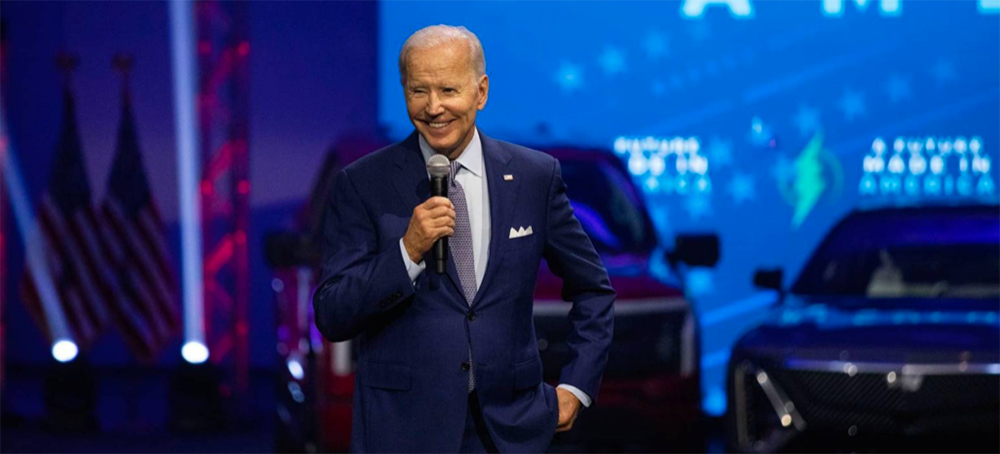 President Joe Biden speaks at the North American International Auto Show on Sept. 14, 2022 in Detroit, Michigan. (photo: Bill Pugliano/Getty Images)
The president's comments to 60 Minutes about the end of the Covid-19 pandemic reportedly came as a surprise to his own health officials
“The pandemic is over,” he told 60 Minutes from the Detroit Auto Show. “We still have a problem with Covid. We’re still doing a lot of work on it. But the pandemic is over. If you notice, no one is wearing masks. Everyone seems to be in pretty good shape. I think it’s changing, and I think this is a perfect example of it.”
The Centers for Disease Control notes that nearly 400 Americans are still dying per day from Covid-19 and that over 1,047,000 have died since the pandemic began, as of Monday.
Multiple outlets have reported that Biden’s comments blindsided administration officials and that the declaration was not part of his prepared remarks.
Biden’s interview with 60 Minutes aired Sunday night, but his comments were made while he was attending the Detroit Auto Show on Wednesday. The same day, World Health Organization Director General Tedros Ghebreyesus said the pandemic was not over.
“We are not there yet, but the end is in sight,” he said after noting that the world has never been in a better position to end the pandemic. “If we don’t take this opportunity now, we run the risk of more variants, more deaths, more disruption, and more uncertainty.”
Biden celebrated that not many people at the Detroit Auto Show wore masks but still acknowledged the toll the pandemic has exacted on the United States.
“The impact on the psyche of the American people as a consequence of the pandemic is profound,” the president said. “Think of how that has changed everything. You know, people’s attitudes about themselves, their families, about the state of the nation, about the state of their communities. And so there’s a lot of uncertainty out there, a great deal of uncertainty. And we lost a million people.”
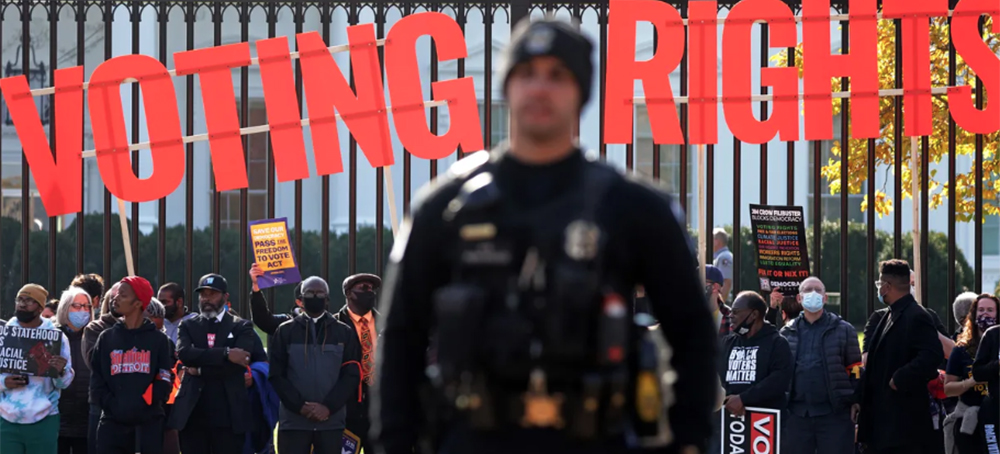 A policeman stands guard as activists take part in a voting rights protest in front of the White House on November 17, 2021. (photo: Alex Wong/Getty Images)
All those new restrictive voting laws might come to a head during the midterms.
During the first two years of the pandemic, states expanded voting options, ushering in unprecedented access to the ballot via 24-hour voting, drive-through voting, mail-in ballots, ballot drop boxes, and other measures. But following Donald Trump’s defeat in 2020, the myth of voter fraud and a stolen election quickly spread. By May of 2022, nearly 400 restrictive bills had been introduced in legislatures nationwide.
In 2021, legislators in every state except Vermont introduced at least one provision restricting voting access, according to data from the Brennan Center for Justice, which tracks the legislation. Ultimately, by May 2022, 18 states had passed a total of 34 laws restricting voting.
An analysis by the Brennan Center’s voting rights program found that race and racial resentment, not only partisanship, play a part in the proliferation of these laws: legislative districts that scored higher on markers of racial resentment were more likely to be represented by legislators who introduced the restrictions. They were also more likely to be introduced by legislators from majority-white districts in diversifying states.
I talked to Sean Morales-Doyle, the acting director of the Brennan Center’s voting rights programs, about their analysis, the connection between election subversion and voter suppression, and why there’s still hope that voting is powerful in our democracy.
Our conversation has been edited for length and clarity.
Fabiola Cineas
What are the most glaring statistics about the vote suppression bills that have been introduced or adopted in the past two years or so?
Sean Morales-Doyle
At the Brennan Center we’ve been tracking every piece of voting rights legislation introduced in every state legislature across the country for more than a decade now.
Since the beginning of 2021 and as of our last roundup of the legislation in May 2022, 18 states have passed 34 new restrictive voting laws. 2021 was so extreme. If you look at the entire decade that we have been tracking this legislation, one out of every three restrictive laws was passed during that year.
Fabiola Cineas
Are there patterns that emerge when you look at these laws together?
Sean Morales-Doyle
We’ve done a statistical analysis to figure out the patterns. We wanted to know what was predicting the introduction of this legislation. Is it just a partisan trend? Certainly, it is a partisan trend: One party by and large is responsible for distributing the legislation and the vast majority of it is introduced by Republican legislators. But we wanted to know what’s really going on here because we had a suspicion that perhaps it wasn’t that simple.
What we found is the legislators that represented the whitest districts of the most diverse states are the legislators most likely to introduce restrictive legislation. Similarly, legislators that represented districts with high levels of racial resentment were more likely to introduce the legislation. Those trends held true even after we controlled for party, even after we controlled for how competitive a district was.
Party definitely tells part of the story, but it doesn’t tell the whole story. This is also a story about race. That’s always been the case in this country, frankly. The fight over voting rights and the fight over our democracy has been a fight with race at its core. What this shows is that this continues to be the case even in this moment of hyper-partisan debate over voting rights. That story is consistent with a story of racial backlash.
Fabiola Cineas
Is there anecdotal evidence that supports these findings?
Sean Morales-Doyle
Yes. When Texas passed SB 1, it restricted all kinds of aspects of the voting system in a state that was already incredibly restrictive. And it targeted the methods that were used to expand access during the pandemic in Harris County, where Houston is. Harris County had 24-hour voting and drive-through voting available to voters at a time when people were scared to be gathered in polling places. Those are the forms of voting Texas decided to go after, in addition to many others — the forms of voting that voters in the largest, most diverse county of Texas were using.
Georgia has had an expanded mail voting system for a long time. It wasn’t until 2020 when who was voting by mail shifted dramatically and far more Black voters began voting by mail. Then in 2021, Georgia suddenly acted to put restrictions on mail voting. So that’s why the Department of Justice is suing Georgia over parts of that bill and claiming that it is intentionally racially discriminatory.
The larger statistical trend suggests that it is more than just anecdotal evidence.
I want to be clear: Our statistical analysis does not prove causation. We’re not claiming that for every single one of those bills we have proof that it was introduced for racially discriminatory reasons. But we think it’s telling that race seems to be such a good predictor of where these things are being introduced and that it is a predictor independent of, and above and beyond, party.
Fabiola Cineas
Can you say more about how these laws fit into the general racial backlash we are seeing, whether that’s the backlash against critical race theory or the backlash against “wokeness”?
Sean Morales-Doyle
Restrictive voting legislation is just one way that we’ve seen racial backlash in our politics over the last couple of years. We saw in 2020 people of color, and, in particular, Black people, demonstrating political power in ways that they hadn’t before. They had a real powerful impact on the political conversation heading into the 2020 elections. We saw high voter turnout across the board, among everybody in 2020, but we had high voter turnout among populations of color and we saw that voters of color were often a deciding factor in a number of races around the country.
In the period that followed, we see laws that are attempting to limit the conversation about race, and a trend in restricting access to the political power of people of color. Those two things are connected. They’re part of the same trend.
Fabiola Cineas
And what about the “big lie,” the false idea that the 2020 presidential election was stolen from Donald Trump?
Sean Morales-Doyle
The lie is motivating so much of this legislation and the lie itself has racial undercurrents. We have research linking the lies and conspiracy theories that were told about the 2020 election to the legislation passed in 2021.
Fabiola Cineas
So you’ve seen all these patterns in which states pass these laws — what did you learn from the primaries this year about how these vote suppression laws operate and affect voters?
Sean Morales-Doyle
In Texas in the March primary, thousands of mail-in ballots were rejected because of a restrictive provision of SB 1 that said you have to put either your driver’s license number or the last four digits of your social security number on your mail ballot application.
That provision is a great example of how these restrictive provisions function in 2022. It’s not the blunt instrument of the Jim Crow era that sort of knocks out a huge swath of the electorate. (Sadly, there’s still examples of that, too, like the pay-to-vote requirements in Florida.) But there are these more nuanced restrictions, and it’s about layering restriction on top of restriction.
Fabiola Cineas
How do these layered restrictions work to create a bigger system that limits voters?
Sean Morales-Doyle
Look at a state like Texas where there’s already extremely limited mail voting. You have to apply to vote by mail every year, and only certain people are eligible to vote by mail. They have no online voter registration, and no online mail ballot application process. They changed the law in 2021 to require you to put this ID number on your application; that ID number has to match what’s in your voter registration record.
So if you put down your driver’s license number and it turns out your voter registration record contains your social security number, your application is going to be rejected. If you put down your social security number, and it turns out your registration record has your driver’s license number, your application is going to be rejected. If you registered at a time when you didn’t have to put down either and your registration record doesn’t contain either then no matter what number you put down your application is going to be rejected.
If the county is using the old form, or if you have an old paper form because there’s no online application, and there’s not even a place to put down the number, then your application will be rejected. You have to use paper to fix the problem because there’s no online voter registration. You may not realize that until it’s late in the game.
The same law, SB 1, makes it a crime for election officials to encourage people to vote by mail. So election officials feel constrained in what they can actually affirmatively tell voters about filling out their application because they could be accused of committing a crime. So people are deprived of the information they need.
Fabiola Cineas
There’s been high voter turnout in 2022. How do you make sense of that alongside these vote restriction trends?
Sean Morales-Doyle
There’s been really high turnout in the 2022 primaries, and that’s fantastic. We celebrate that. We love to see people participating in our democracy. But it is important to keep in mind that you can’t evaluate the impact of any particular policy just by looking at the top-line turnout numbers.
Turnout relies on many factors. And there are a lot of reasons to expect high turnout for a midterm year this year. But it also doesn’t take much scratching below the surface to see that these high turnout numbers don’t tell the whole story.
We have seen for years now that the racial turnout gap in the United States is not only persistent, but it’s actually growing in many parts of the country. And it is growing in the parts of the country that used to be covered by preclearance on the Voting Rights Act of 1965. Georgia had high turnout in the primary even after this omnibus restrictive voting law was adopted, but the racial turnout gap in Georgia’s primary was larger than it’s been in a decade.
Fabiola Cineas
How do you define the racial turnout gap?
Sean Morales-Doyle
It’s the gap between the percentage of registered white voters that turn out and the percentage of registered non-white voters that turn out. The gap we looked at in Georgia was specifically white versus Black turnout. But when you look at white versus non-white turnout — including other voters of color in that comparison — in many parts of the country, the gap is even wider. It is significantly wider for Latino voters and Asian American voters a lot of times.
Fabiola Cineas
I know you said we really don’t know what we will see in the general election come November in terms of how these vote suppression bills will play out. But what will you be keeping an eye on?
Sean Morales-Doyle
I don’t think any of us knows precisely what that impact of these laws will be. But what happened during the primaries in Texas makes me very worried.
And unlike in years past, the federal courts have signaled a retreat from the protection of voting rights. That doesn’t just include big blockbuster decisions like Shelby or Brnovich, but also includes this use of what’s called the “Purcell principle” to make it very difficult to get relief in advance of an upcoming election. The Supreme Court has basically said, “We’re not going to let federal courts step in to block state voting laws, even if a federal court finds them to be unconstitutional or a violation of the Voting Rights Act, if it’s too close to an election.” And “too close to an election” is not a very precise term. We saw the Supreme Court put a stay on a ruling out of Alabama in February because it’s “too close to the election.”
Fabiola Cineas
It feels like the national conversation has shifted more toward thinking about the threat of election subversion and we are talking less about vote suppression. Is that a fair assessment? And how should we be thinking about the connection between these two threats?
Sean Morales-Doyle
Election subversion or sabotage is different than vote suppression. But they all have the same goal, which is to undermine the will of the people and to take power away from voters. They’re different sides of the same coin.
To oversimplify it, people love a conspiracy, so the idea of election sabotage and what happened on January 6 is a narrative that people can follow. But it isn’t actually a separate thing from the attempts to restrict access to voting. The same lie that was used to justify John Eastman and Donald Trump’s attempt to overturn the presidential election is the lie that is being used to justify restrictive voting legislation. It all comes from the same place and the goal is always the same. We do a disservice when we separate them out too much.
Fabiola Cineas
What kind of confidence can voters have that there is still a reason to vote in the face of all these potential roadblocks?
Sean Morales-Doyle
There are laws in place that will make it difficult and hopefully impossible for people to sabotage elections. There are laws against voter intimidation and harassment. There are laws protecting election officials from harassment and violence. There are laws that offer some protection against restrictions.
2020 should demonstrate to all of us that we have a resilient and strong democracy in this country, that in the midst of a pandemic, in the midst of unprecedented attacks on our democracy, in the midst of people attempting to overturn the will of the people following the election and storming the nation’s capital, we carried off an election that was, by the account of the federal government, the most secure we’ve ever had.
We have institutions and rules in place that prevent the worst things from coming to fruition. I know I talk a lot about the threats, and I don’t want discussion of those threats to get voters to think that they shouldn’t be participating, shouldn’t trust the system, and that we should be scared. I think we do have reason to worry, and that’s why we’re going to be as vigilant as ever to push back against all of this nonsense. But voters should still feel confident in our democracy and should still go out and vote.
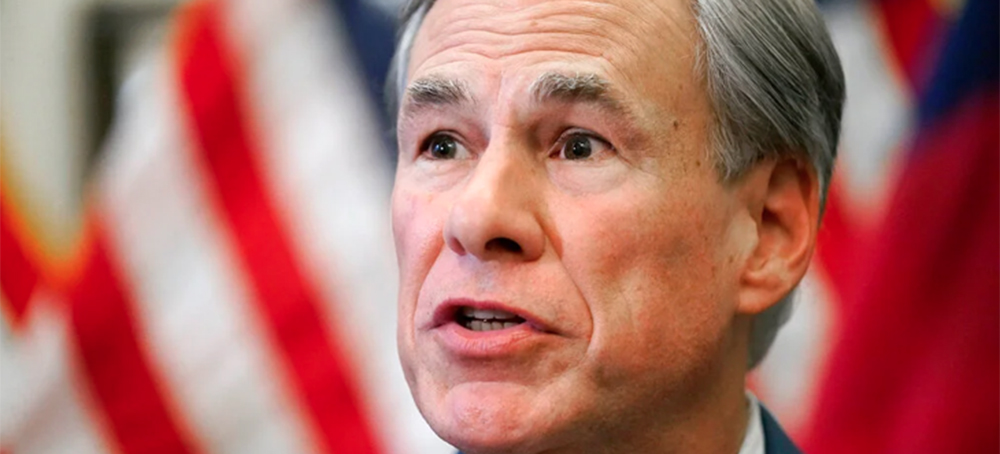 Texas Gov. Greg Abbott speaks at a news conference in Austin, Texas on June 8, 2021. (photo: Eric Gay/AP)
ALSO SEE: Attorneys for ‘Duped’ Migrants Flown to Martha’s Vineyard Call for Criminal Investigation
Texas Gov. Greg Abbott (R) and Arizona Gov. Doug Ducey (R) led the charge, sending migrants north as early as April of this year, and Florida Gov. Ron DeSantis (R) initiated his own transport of migrants this week.
Democrats are criticizing the busing as a “political stunt” by the three Republican governors, two of whom are up for reelection this year.
“There is a process in place to manage migrants at the border, and Republican governors meddling in that process and using desperate migrants as political tools is shameful and it is wrong,” a White House official said in an email to The Hill last month.
Here are the four Democrat-led cities that have so far been targeted by the Republican governors:
Washington, D.C.
Abbott first sent a bus of migrants to the nation’s capital in April and has since sent more than 8,000 migrants on over 190 buses. Ducey soon followed Abbott’s lead, sending Arizona’s first bus of migrants to D.C. in May. He has sent just over 1,800 migrants on 50 buses since the spring.
Receiving close to 10,000 migrants total, D.C. has faced the largest group of migrants. D.C. Mayor Muriel Bowser declared a public emergency earlier this month and has requested the activation of the D.C. National Guard to help the city manage the influx of migrants, an ask the Defense Department has denied.
“We know that they are targeting Washington, D.C., not because of any particular ties that the people boarding the buses have to Washington, D.C., but they want to make a point to the federal government,” Bowser said last week in a press conference.
Abbott also recently sent two buses to Vice President Harris’s Naval Observatory residence in D.C.
“VP Harris claims our border is ‘secure’ … denies the crisis. We’re sending migrants to her backyard to call on the Biden Administration to do its job … secure the border,” Abbott said on Twitter on Thursday.
New York City
Texas has sent more than 2,500 migrants to New York City on over 45 buses since Aug. 5.
New York City Mayor Eric Adams (D) hit back at Abbott over the issue, calling for Texas voters to oust the governor in this year’s midterm elections.
“I am deeply contemplating taking a busload of New Yorkers to go to Texas and do some good old-fashioned door knocking. Because for the good of America, we have to get him out of office,” Adams said last month.
Abbott is up for reelection, fighting to keep his seat in a tight race against Democratic nominee Beto O’Rourke.
Adams has followed Bowser in requesting federal assistance.
Chicago
Migrants first began arriving in Chicago on Aug. 31 and continue to arrive daily, according to Illinois Gov. J.B. Pritzker (D). Abbott has sent more than 600 migrants on over 10 buses in the weeks since.
Chicago Mayor Lori Lightfoot (D) has criticized Abbott over the move, calling him “un-American.”
“You don’t treat people with this lack of respect, lack of dignity, putting them on buses to an unknown destination with very little food, very little water,” Lightfoot said last week.
Pritzker issued an emergency disaster declaration on Wednesday and activated 75 members of the Illinois National Guard to help respond to the influx of migrants.
Martha’s Vineyard, Mass.
DeSantis on Wednesday sent two planes carrying about 50 migrants to Martha’s Vineyard, Mass., an island south of Cape Cod.
The planes reportedly arrived from Texas, though they were chartered by the Florida governor. Abbott in Texas has thanked DeSantis for “the support in responding to this national crisis,” but denied involvement in the move.
DeSantis, a rumored presidential candidate for 2024, had last year named the island, where former President Obama owns an estate, as a potential destination in his effort to transport migrants out of Florida.
He has also mentioned sending migrants to Delaware, Biden’s home state.
“All those people in D.C. and New York were beating their chests when Trump was president, saying they were so proud to be sanctuary jurisdictions, saying how bad it was to have a secure border,” DeSantis said during a news conference Thursday.
“The minute even a small fraction of what those border towns deal with every day is brought to their front door, they all of a sudden go berserk and they’re so upset that this is happening.”
DeSantis said on Friday that the Martha’s Vineyard planes were “just the beginning” of his efforts to relocate migrants.
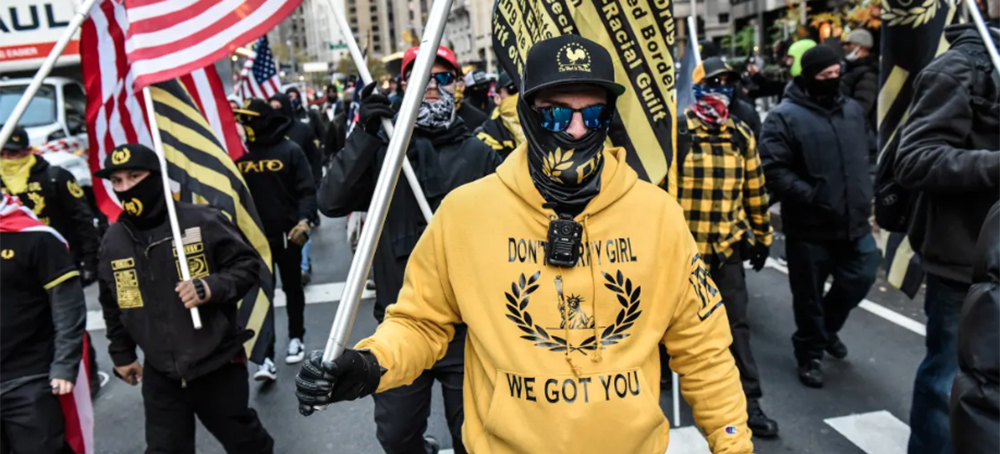 Members of the Proud Boys march in Manhattan against vaccine mandates on 20 November 2021 in New York City. (photo: Stephanie Keith/Getty Images)
Document of 23 pages shows the lengths to which the far-right group goes to prepare for potentially violent encounters and exposes the militaristic structure and language it has adopted
On the cover, two words give a clue to the notoriety of the group that produced it: “MAGA” and “WARNING”. That and the date: 5 January 2021, the day before the US Capitol attack.
What goes unsaid on the cover and is barely mentioned throughout the 23 pages is that this is the work of one of the most violent political gangs in America, the far-right street fighters told by Donald Trump to “stand back and stand by”: the Proud Boys.
The document, published by the Guardian for the first time, gives a very rare insight into the meticulous planning that goes into events staged by the far-right club.
The document was obtained from a Proud Boys member by the extremism reporter Andy Campbell as he researched his new book, We Are Proud Boys: How a Right-Wing Street Gang Ushered in a New Era of American Extremism. The book will be published on Tuesday. Campbell shared the document with the Guardian.
The Proud Boys have been designated a hate group by the Southern Poverty Law Center and are alleged to have acted as key organizers of the violent assault on the Capitol.
In the wake of January 6, which has been linked to the deaths of nine people, the New York march featured in the document was called off and the strategy so fastidiously laid out was never implemented. But the document remains sharply revealing.
It shows the lengths to which the Proud Boys go to prepare for potentially violent encounters and then to cover their tracks – something prosecutors have stressed but that has never been seen in the group’s own words. It exposes the militaristic structure and language the Proud Boys have adopted, and their aspiration to become the frontline vigilante force in a Trump-led America.
It also provides clues as to how the group continues to spread its tentacles throughout the US despite the fact that many of its top leaders, including its national chairman, Enrique Tarrio, are behind bars awaiting trial on charges of seditious conspiracy.
The purpose of the document is to provide a “strategic security plan” and call to action, summoning Proud Boys members to a pro-Trump Maga march that was scheduled for New York City on 10 January 2021. That was four days after Congress was to certify Joe Biden’s victory in the 2020 presidential election – the occasion that would be targeted by the fatal insurrection.
The author of the document is Randy Ireland, who as president of the group’s New York branch, the Hell’s Gate Bridge Chapter, is one of the most prominent Proud Boys in the US north-east. The paper was circulated through Telegram, the encrypted chat app widely used by the Proud Boys as an organizing tool, to at least nine other chapters in New York and beyond.
Campbell told the Guardian the decentralized structure of the group, into what it claims are 157 active chapters in all but three states, is one of the Proud Boys’ greatest strengths, as reflected in the autonomous nature of the New York planning.
“Chapter leaders like Randy can create their own events, run independently of each other,” Campbell said. “Enrique Tarrio and other leaders are in prison, but these guys are going to continue what they are doing.”
‘We will not disappoint’
The language in the planning paper is overtly militaristic. Ireland designates himself “General of Security Detail”, while his underlings in the chain of command are “VPs” of “Recruiting”, “Scout Security” and “Team Leads”.
The plan is for 60 or so Proud Boys at the 10 January event in Manhattan to be corralled into seven “tactical teams” of five to eight men each (they are all men, as one of the overriding values of the group is misogyny). Members are told to bring protective gear, including “knife/stab protection, helmets, gloves, boots etc” and to make use of radio channels, walkie-talkies or Telegram to communicate with each other.
They are to stick together in groups and under no circumstances allow “Normies” – ordinary Trump supporters who are not Proud Boys – or “Females” into their ranks.
“Their presence will jeopardise the health and safety of all those involved with Security, and simply cannot be allowed to happen!” Ireland writes.
Maps reproduced at the back of the document show positions “scouts” and “tactical teams” should adopt at key points along the route of the march, which was planned to start at Columbus Circle and pass Trump Tower.
“That spot is understood in a very public way to hold special meaning for us,” the paper says, referring to Trump’s home on Fifth Avenue. “WE WILL NOT DISAPPOINT!”
Campbell, who has been reporting on the Proud Boys since they started turning up at Trump rallies in early 2017, describes them as America’s most notorious political fight club. In the planning paper, he sees equal parts fantasy and danger.
“These guys see themselves as super soldiers, like some sort of military outfit,” he said. “On one level it’s funny, as nothing is in fact going to pan out the way they say it will. But on another level, it’s alarming because it shows how much thought they put into this stuff.”
In We Are Proud Boys, Campbell traces the group from its birth in 2015-16 through to its central role on January 6 when a member, Dominic Pezzola, became the first person to breach the US Capitol. At least 30 Proud Boys have been charged in relation to the insurrection, including Tarrio and four others accused of seditious conspiracy – among the most serious indictments yet handed down.
The group was invented by the British-born founder of Vice magazine, Gavin McInnes, who branded himself a “western chauvinist” and peddled in bigotry. McInnes floated the Proud Boys name on his online chatshow in May 2016, introducing them as a “gang” and inventing a uniform, a black Fred Perry polo shirt with yellow trim.
McInnes was careful to brand his creation as harmless fun, a satirical male-only patriotic drinking club that later attached itself to all things Trump. But Campbell argues that from the outset political violence was baked in.
A Proud Boy was an organizer of the 2017 Unite the Right rally in Charlottesville, Virginia, during which an anti-fascist protester was murdered. The group has held violent gatherings in Portland, Oregon. Outside a Republican event in New York in 2018, several members were arrested and charged with felonious assault.
‘Street-level violence’
Proud Boys membership is structured into four ranks, known as “degrees”, the fourth granted once you “get arrested or get in a serious violent fight for the cause”, as McInnes himself explained. In an interview with Campbell for the book, McInnes denied promoting violence and insisted the Proud Boys were never proactively aggressive, only reacting to leftwing attacks.
That official line is reiterated in the document published by the Guardian. Ireland is careful to portray the Proud Boys as a defensive group.
He writes: “If any violence does spout off, all Proud Boys are expected to respond immediately – only so far as to eliminate and end that threat to them or others. VERY IMPORTANT: Once the threat has been neutralized, WE STOP!”
But there is a glaring contradiction: Ireland presents his chapter as a non-violent organization yet it goes out seeking violence. He assigns the group, uninvited, the role of a vigilante police force.
“We are there as the first line of defense for all event attendees,” he writes, then contradicts himself by saying the only role of the Proud Boys is to play a “back-up role” to law enforcement and to “force them to do their jobs”.
That speaks volumes. It carries the implication that if the police will not assail anti-fascist protesters, Proud Boys will.
“I’ve reported at Proud Boys events where they stood back and relaxed as police lobbed teargas and other munitions into the crowd of counter-protesters,” Campbell said. “Then the Proud Boys didn’t have to do what Randy Ireland is hinting at here – step in and do the fighting themselves.”
For Campbell, the most disturbing aspect of the document is that, with its soft-lensed double-talk and contradictory meanings, it falls into arguably the main ambition of the Proud Boys: the normalization of political violence. Despite having so many leaders behind bars, the group is prospering.
As new chapters pop up, Americans are increasingly inured to the idea of heavily armed gangs in public settings. Proud Boys have posed as “security details” at anti-abortion rallies, anti-vaccination demonstrations, pro-gun protests and of course Trump rallies.
“The street-level violence the Proud Boys helped to create is now being carried out by regular people,” Campbell said. “You saw it on January 6, you see it at Planned Parenthood and LGBTQ+ events where people are harassed and attacked by everyday Americans.”
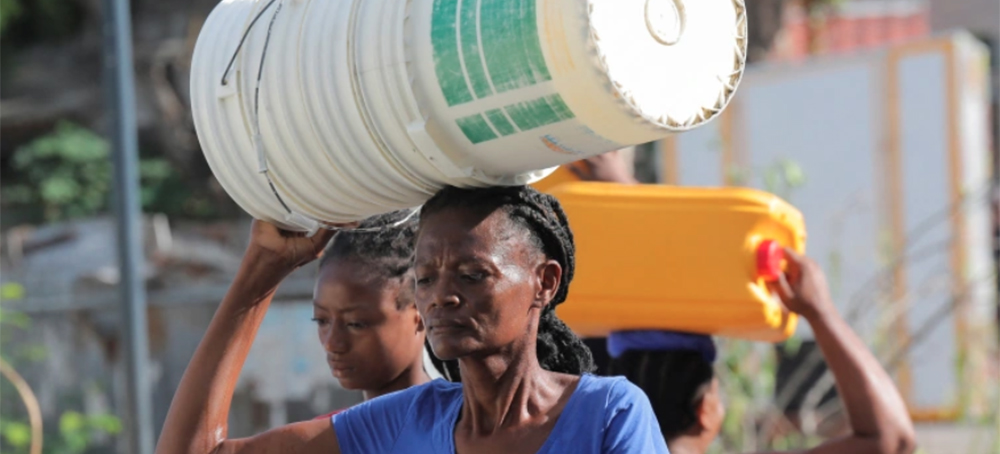 Women carry containers to be filled with water amid shortages of water, cooking gas and other items after days of protest forced them to shelter at home, in Port-au-Prince, Haiti September 17, 2022. (photo: Ralph Tedy Erol/ Reuters)
Days of protests over fuel prices and crime have slowed or halted water distribution in Haiti’s capital, Port-au-Prince.
An approaching storm was causing more worry in the Caribbean country on Saturday.
Many residents of Haiti’s capital Port-au-Prince have been forced to shelter at home this week as gunfire broke out and burning tires blocked streets during protests over fuel price hikes and crime.
The unrest slowed or halted companies that typically deliver water in the city where daily high temperatures have been hitting 34 degrees Celcius (93 Fahrenheit).
Many took advantage of an expected half-day truce on Saturday to rush to distribution centres to stockpile a few days’ supply of water and cooking gas, which has also run short in many places.
Fears about the approach of tropical storm Fiona also fueled the rush to get water.
Forecasters said the storm’s heaviest rains were more likely to hit the Dominican Republic on the east of Hispaniola island.
Jean-Denis Severe, a resident of Fort National, said many had to travel miles to fill buckets and bottles, and then carry them back home.
“I live in Fort National, since there are blockades in the country, we came here to buy water. If it was not for these places, we would die from thirst,” he said.
The country’s latest unrest came as inflation surged to its highest in a decade and gang violence has left hundreds dead and thousands displaced, with much of Haiti’s territory beyond government reach.
Richardson Adrien, a Port-au-Prince resident, told the Reuters news agency that the lack of potable water was just the latest headache. Residents in recent months have also struggled to find fuel, leaving some unable to work.
Finding clear water “is a problem. We look for it everywhere and we can’t find it. We put Clorox in the water to be able to drink it, you can’t find water,” he said.
The Haitian government did not immediately respond to a request for comment.
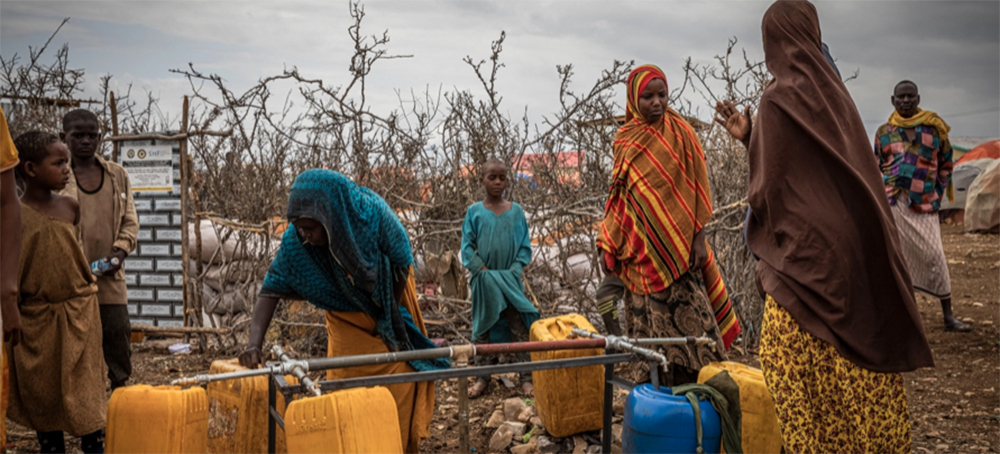 Drought in East Africa. (photo: Ed Ram/Getty Images)
Four failed rainy seasons and supply chain disruptions threaten millions with food insecurity.
Famine experts expect the situation to deteriorate through the fall and winter. A recent report from the Food Security and Nutrition Working Group of the Intergovernmental Authority on Development, a trade block representing East African countries, found that more than 25 million people across the region could be experiencing dire food insecurity by early 2023.
“The drought this year was both the most extensive on record and the most intense on record,” Chris Funk, the director of the Climate Hazards Center at the University of California, Santa Barbara, told Grist. He said a combination of climate change and La Niña weather patterns have produced five consecutive dry seasons, which has all but destroyed the domestic food supply in Somalia and its neighboring countries.
According to the latest estimates from UNICEF, more than 7 million people in Somalia alone are already experiencing severe food shortages — around half the country’s population. That includes more than 1.5 million children under the age of five. In addition, 4.5 million Somalis are currently facing severe water shortages. More than 700 children have died in malnutrition treatment centers across the country, though experts caution that the figure is likely an undercount.
“I couldn’t get out of my head the tiny mounds of ground marking children’s graves,” UNICEF official Rania Dagash told reporters after a visit to the worst-affected areas. “I’m from this region and I’ve never seen it so bad.”
Food security experts say it’s only going to get worse from here. The Famine Early Warning System, a famine tracking program funded by the U.S. Agency for International Development, projected last week that the region’s food emergency will reach the technical definition of a famine by the end of the year, which would likely mean even more widespread death and starvation “in the absence of a significant scale-up of humanitarian food assistance.” Rainfall projections for the next month show that there will be minimal precipitation in Somalia or the other worst-affected parts of the region.
Climate change has devastated Somalia’s farming sector for the past several years. A persistent drought has caused four consecutive years of missed rainy seasons, the longest dry spell in four decades; the next rainy season is expected to be just as bad. The drought has thinned out camel herds in the north part of the country, killing off a livestock animal that provides herders with meat and milk, and devastated agriculture in the south. Meanwhile, warmer temperatures have allowed locusts to spread out across the region and chew through crops; one swarm in Kenya two years ago measured 37 miles long by 20 miles wide.
Research suggests that climate change will continue to hit the Horn of Africa on multiple fronts, increasing the risk not only of prolonged drought but also of extreme heat and devastating flash floods.
“Four failed rainy seasons was already unprecedented,” said Funk. “It’s all thanks to this three-year La Niña event combined with climate change.” As climate change makes La Niña temperature events in the Pacific more intense, he added, it increases the risk of dry spring seasons around the Horn of Africa; at the same time, warmer air temperatures in the region also lead to more intense dry spells.
The war in Ukraine has further exacerbated regional food insecurity by threatening to disrupt critical grain shipments. Prior to the war, Somalia imported around 90 percent of its grain from Ukraine and Russia. Grain shipments have still been reaching Somalia, but the high prices the war has generated for staple foods have made it impossible for most households and aid groups to make necessary purchases. An ongoing civil war between the Somali government and the militant group known as al-Shabaab has also contributed to instability, displacing thousands of people from their homes and disrupting the movements of the pastoral populations in the country’s north.
The Horn of Africa experienced another drastic famine in 2011 and 2012, when two missed rainy seasons caused widespread crop failures across the southern part of the region. The Famine Early Warning System predicted that food emergency almost a year before the United Nations made an official famine declaration in Somalia, but humanitarian aid deliveries were not sufficient to prevent widespread suffering. The halting relief efforts made by rich countries were further restricted by those countries’ efforts to make sure that food supplies did not reach al-Shabaab militants.
As many as 250,000 people died across the region during the 2011-2012 famine, which lasted about 10 months. More than half of them were children.
Follow us on facebook and twitter!
PO Box 2043 / Citrus Heights, CA 95611


Comments
Post a Comment