RSN: Dahlia Lithwick and Mark Joseph Stern | The Solution to the Trump Judge Problem Nobody Wants to Talk About

07 September 22
It Looks Like We’re in For a Dogfight on Funding
We are not getting any traction on donations no matter how hard we try, it’s not a good sign for the month.
Good news, we don’t need a lot. Bad news, a lot of damage may be done raising what little we do need. There is no choice, the bills have to be paid.
With resolve.
Marc Ash
Founder, Reader Supported News
If you would prefer to send a check:
Reader Supported News
PO Box 2043 / Citrus Heights, CA 95611
Follow us on facebook and twitter!

07 September 22
Live on the homepage now!
Reader Supported News

It’s possible to agree with every one of these criticisms but still find them less than satisfying. Because at the end of the day, no matter how much withering criticism she faces, Cannon still gets to put on the black robe and run interference for her benefactor. She will still get a standing ovation at some future Federalist Society gathering. She remains in control of this case. But it’s not just Cannon: Many smart lawyers also noted that the Justice Department now faces the unenviable task of having to appeal this decision up to higher courts that are filled with Trump appointees, which takes the sting out of the opprobrium: For all we know, the Trump-stacked 11th U.S. Circuit Court of Appeals or five radical justices on the Supreme Court may also greet her outrageous decision with a standing ovation.
So the problem is not just the extreme and heinous flaws in Cannon’s ruling. It’s also the Trump-shaped world in which Cannon operates, with impunity, which we will all have to endure for the foreseeable future. It’s the brutal reality that we may face a steady stream of depraved decisions like Cannon’s for the rest of our lives—and the pain of hearing from every quarter that nothing can be done to remedy it.
We watched the same pattern play out at the end of this last Supreme Court term. One case after another blew up decades of existing precedent and tests and doctrine and replaced them with Rorschach exams that transformed contemporary Republican policies into constitutional law. Smart lawyers dutifully digested these opinions and set to work figuring out just how the EPA, or public school districts, or state legislatures that want to stop mass shootings can plausibly work around these new tests. And of course, were we living in a rational regime in which the rule of law governed, that would make perfect sense. But if the last term at the Supreme Court and indeed Cannon’s baffling new order mean anything, they signify that in this new age of legal Calvinball, one side invents new “rules” and then the other scrambles to try to play by them. For every single legal thinker who read the Mar-a-Lago order to mean, quite correctly, that ex-presidents are above the law, furrowing your brow and pointing out its grievous errors only takes you halfway there. The better question is what, if anything, do you propose to do about it? The furrowing is cathartic, but it’s also not a plan.
If there were a principle that best embodies why progressives are losing ground so quickly—even as they are correct on the facts, and the law, and the zeitgeist—it must be this tendency to just keep on lawyering the other side’s bad law in the hopes that the lawyering itself will make all the bad faith and crooked law go away. But for those who are genuinely worried that democracy will rise or fall based on whether a case lands before their judges or others, merely explaining legal flaws in pointillist detail isn’t an answer. And soberly explaining that Cannon was wrong about most stuff but correct about two things is decidedly not an answer, either. You do not, under any circumstances, have to hand it to them.
It is not a stand-alone answer to point out that Cannon was a Trump pick—a member of the extremely not-neutral Federalist Society, seated after Trump lost the election—or that the former president’s lawyers forum-shopped in order to get this case in front of her. It also doesn’t help to note that Cannon herself acknowledged the proper venue to adjudicate the executive privilege claims made in this case (which are on their face absurd) is in fact in a different court in D.C., where Cannon has no jurisdiction and where Trump did not make his case. Nor is it an answer to note that federal judges have literally no constitutional authority to stop an ongoing criminal investigation in its tracks, as Cannon purported to do, rendering her decision an imperious assault on the separation of powers. That, too, is an accurate description of the problem. Stating that, too, is not a solution.
Until and unless those of us who are shocked and horrified at lawless rulings by lawless Trump judges are prepared to propose structural solutions, the aggregated effect of criticizing their rulings won’t be to restore the rule of law or even to restore public confidence in the rule of law. The aggregated effect will be just to confirm that we will all be living under the thumb of Donald Trump’s lifetime-appointed hacks for many decades.
There are solutions out there for the problem of Trump’s runaway judges. Expanding the courts—even just the lower courts—is the most bulletproof. Congress has periodically added seats to the federal judiciary from its inception to help judges keep up with ever-ballooning caseloads. Today’s litigants (who are not named Donald Trump) often face yearslong court delays. The Judicial Conference, a nonpartisan government institution that develops administrative policies, has begged Congress to add seats to the lower courts. Some Republicans have supported the idea in recognition of the crisis facing our understaffed judiciary. Letting Joe Biden balance out far-right courts like the 11th U.S. Circuit Court of Appeals—which will weigh Cannon’s ruling if the government appeals—would go a long way to tame the jurisprudence of Trumpism. When district court judges know their radical decisions will be overturned on appeal, they may be less likely to swing for the fences in the first place.
There are other worthy ideas too. Term limits for justices and lower court judges. Limits on courts’ jurisdiction to strike down democratically enacted laws. Modest reforms that restrict the Supreme Court’s ability to suppress voting rights before an election. Let’s hear them all. (God knows Biden’s court reform commission studied them extensively, to little end.)
But the chorus from the left, the middle, and the sane right that the lawlessness is lawless only affirms that we cannot ever escape this closed loop of Trump’s judges. Being really mad but doing nothing to change things is a terrible strategy for democracy and for public confidence in the courts. It creates the illusion that if we work really hard to debunk corrupt rulings, we can force Trump judges to see the light, or feel shame, or do something different. Meanwhile, the targets of our meticulous takedowns laugh at the pains we take to prove them wrong. They. Do. Not. Care.
We get it. Lawyers are trained to lawyer. But if you are lawyering within a system you believe to be broken, or immoral, or lawless, and you aren’t standing up with meaningful fixes for that system, you are, fundamentally, acceding to that lawlessness. It is a moral victory to point out the errors, but it’s also a tacit concession that the system is, in fact, legitimate, no matter how low it may go. Every one of us is going to need to decide how long we can continue to operate that way.
There are too many things wrong with the Cannon order to litigate. And there are too many things wrong with Trump’s judicial dominion of every part of our lives— for years to come—to litigate. So maybe it’s time to stop litigating them and start fixing them.
 Nourah bint Saeed al-Qahtani. (photo: Screengrab/AlEkhbariya)
Exclusive: court document details charges against Noura al-Qahtani, who was sentenced to 45 years in prison
Noura al-Qahtani, whose case first emerged last week, is a mother of five daughters, including one with a disability, is nearly 50 years old and has health issues, according to the court records.
The document, which describes Qahtani’s conviction and sentencing by a special criminal court, was shared with the Guardian by Abdullah Alaoudh, the Gulf director at Dawn, a pro-democracy group based in Washington founded by the murdered Saudi journalist Jamal Khashoggi.
The court records reveal – for a second time in weeks – a draconian sentence against a seemingly ordinary woman who used social media to voice support for dissidents but was not personally engaged in political activity. It contradicts the public image the Saudi government and its supporters have sought to foster of women enjoying more personal freedom under the rule of the de facto Saudi leader, Mohammed bin Salman.
Last month, a Saudi appeals court sentenced Salma al-Shehab, a Leeds University PhD student and mother of two, to 34 years in prison for having a Twitter account and for following and retweeting dissidents and activists. Shehab was arrested and convicted after she had returned home to Saudi Arabia for a holiday. The sentence was widely condemned and the US state department said it had several discussions with Saudi counterparts to discuss the case.
In Qahtani’s case, the court document states that she used two anonymised Twitter accounts. One of the accounts, @Najma097, appears to have last been active on 4 July 2021 and follows 293 Twitter accounts. Some tweets appear to be critical of Prince Mohammed and support the rights of political detainees.
Qahtani was convicted of several charges, including that she sought to “besmirch” the crown prince and King Salman; that she “encouraged participation in activities that damage the security and stability of society and the state”; that she expressed “support” for the ideology of those who wish to “destabilise” the kingdom; for joining a group dedicated to these causes on Twitter and following them on YouTube. She was also convicted of “insulting” state symbols and officials, seeking the release of detainees, and obstructing the investigation into her social media use by “destroying and hiding the mobile phone use in the crime”.
She was also convicted of being in possession of a banned book, which was written by Salman Alaoudh, a well-known reformist cleric – and father of Abdullah Alaoudh of Dawn – who is himself serving a life sentence in a Saudi prison. Salman Alaoudh has been in prison since 2017 after he called for peace on Twitter following the implementation of a Saudi-led blockade on Qatar.
The book Qahtani is alleged to have possessed was not one of Alaoudh’s political books. It was described by Abdullah – who is based in the US – as a book about self improvement and fighting selfishness within one’s self.
“It is a very apolitical book,” Abdullah Alaoudh said.
The court document also references a technical analysis by state officials but it does not contain any information about how Saudi authorities identified the Twitter handle as – allegedly – being used by Qahtani.
Twitter did not immediately respond to a request for comment.
The US social media company was infiltrated by Saudi state officials in 2014 and 2015. US prosecutors have described how the infiltration by the officials, who were employed by Twitter but were secretly being paid by senior Saudi government officials, led Saudi authorities to gain access to information about anonymous dissidents who were using Twitter inside the kingdom.
The company has allowed Bader al-Asaker, a senior aide to Prince Mohammed, who was described by US prosecutors as the mastermind behind the Saudi infiltration, to maintain his verified Twitter account.
The court document states that Qahtani was first sentenced to 13 years’ imprisonment in connection with her “crimes”. The sentence was lengthened to 45 years after a prosecutor complained during her appeal that the original sentence was too lenient.
The court document shows Qahtani presented a defence in court, including that she was not a terrorist or planning a terrorist attack or part of a terrorist organisation. She also stated that she was nearly 50, had no prior record, and regretted her tweets.
The appeals court, the document shows, not only increased her sentence to 45 years, but imposed a 45-year travel ban once she emerges from prison, at about the age of 100. Her disabled daughter is 10 and suffers from a genetic disorder that causes developmental disabilities.
The Saudi embassy in Washington was not immediately available for a comment. According to the date on the court document, the new sentence was handed down on 9 August 2022.
 Brazilian authorities adopted electronic voting machines in 1996 to tackle long-standing fraud. (photo: Nelson Antoine/AP)
ALSO SEE: Lula Holds Lead as Brazil’s Election Campaign Officially Begins
Jair Bolsonaro says electronic voting machines in Brazil are prone to fraud, but there is no such proven record.
He has long insisted that the machines, used for a quarter-century, are prone to fraud, though he acknowledged last year that has not been proved.
Brazil’s top electoral authority says the system has been tested rigorously and some critics of Bolsonaro say he may be laying the groundwork for an attempt to cling to power if the vote doesn’t go his way – much like former US President Donald Trump, whom Bolsonaro has said he admires.
Here’s a look at Brazil’s electronic vote system:
Why does Brazil use an electronic system?
Brazilian authorities adopted electronic voting machines to tackle long-standing fraud. In earlier elections, ballot boxes had arrived at voting stations already stuffed with votes. Others were stolen and individual votes were routinely falsified, according to Brazil’s electoral authority.
Electronic machines were first used in 1996 and the first nationwide, electronic-only vote took place four years later. Today, results from more than 150 million eligible voters are presented mere hours after polls close. And no significant fraud has ever been detected.
How common is electronic voting elsewhere?
More than two dozen countries use some form of an electronic system for national elections, according to the International Institute for Democracy and Electoral Assistance. But 80 percent do not, and voters in most advanced democracies cast their ballots on paper.
Brazil’s system does not produce a paper record of individual votes, though Bolsonaro has advocated for that.
How is Brazil’s voting system audited?
The electoral authority says voting machines are checked for reliability before, during and after balloting. Votes recorded by each machine can be cross-checked with the overall tallies after the vote.
Election officials have acknowledged that hacking is always a risk, but say no one has ever managed to alter the machines’ source code or election results. They say risks are further minimised because the machines are not connected to the internet and information is sent only through internal systems, segments of which shut down if alterations are detected.
For this year’s elections, over a dozen institutions — including police, the military, prosecutors and universities — accepted the electoral court’s invitation to audit the machines. During a three-day hackathon in May, some 20 hired experts sought to penetrate the system. None succeeded.
When did fraud allegations begin?
In 1993, then-lawmaker Bolsonaro complained to members of the military that the paper voting system was rigged, and spoke in favour of digitalisation. Once electronic voting was implemented, however, he became one of its fiercest critics. In 2015, he proposed a constitutional amendment to introduce printed records of votes that would allow manual recounts. That passed Congress, but arguments it was too costly and could violate the right to a secret ballot led the Supreme Court to block it.
What evidence does Bolsonaro cite?
Bolsonaro won the presidency in a 2018 runoff, and later vociferously claimed fraud had denied him an outright victory in the first round.
For months, he promised proof was coming, and his administration tasked the Federal Police with scouring the prior 25 years for evidence. Finally, last year he acknowledged, “There is no way to prove the elections were or weren’t fraudulent. There are indications.” Following that admission, lawmakers rejected a new Bolsonaro-backed bill once again seeking to adopt printed records.
Still, Bolsonaro has continued to attack the machines’ reliability. In July, he called dozens of diplomats to the presidential residence to present his claims. He focused heavily on the existence of a police investigation into a 2018 incident in which a hacker broke into the electoral authority’s internal system. The authority, which asked for the police investigation, said the hacker never accessed any voting machines nor their source code and so could not alter the data or compromise results.
Allegations that the system is unreliable have spread across social media and messaging apps — often in groups backing the president. That is similar to the attacks questioning the security of voting equipment in the US since Trump lost the 2020 presidential election. Republicans in some places have sought to ditch all voting and tabulating machines in favour of paper ballots and hand-counting.
 Packaging for an electronic cigarette and menthol pods from Juul Labs is displayed on Feb. 25, 2020, in Pembroke Pines, Fla. In a deal announced Tuesday, Juul will pay nearly $440 million to settle a two-year investigation by 33 states into the marketing of its high-nicotine vaping products. (photo: Brynn Anderson/AP)
Connecticut Attorney General William Tong announced the deal Tuesday on behalf of the states plus Puerto Rico, which joined together in 2020 to probe Juul's early promotions and claims about the safety and benefits of its technology as a smoking alternative.
The settlement resolves one of the biggest legal threats facing the beleaguered company, which still faces nine separate lawsuits from other states. Additionally, Juul faces hundreds of personal suits brought on behalf of teenagers and others who say they became addicted to the company's vaping products.
The state investigation found that Juul marketed its e-cigarettes to underage teens with launch parties, product giveaways and ads and social media posts using youthful models, according to a statement.
"Through this settlement, we have secured hundreds of millions of dollars to help reduce nicotine use and forced Juul to accept a series of strict injunctive terms to end youth marketing and crack down on underage sales," Tong said in a press release.
The $438.5 million will be paid out over a period of six to 10 years. Tong said Connecticut's payment of at least $16 million will go toward vaping prevention and education efforts. Juul previously settled lawsuits in Arizona, Louisiana, North Carolina and Washington.
Juul has already halted some promotions of its products
Most of the limits imposed by Tuesday's settlement won't affect Juul's practices, which halted use of parties, giveaways and other promotions after coming under scrutiny several several years ago.
Teen use of e-cigarettes skyrocketed after Juul's launch in 2015, leading the U.S. Food and Drug Administration to declare an "epidemic" of underage vaping among teenagers. Health experts said the unprecedented increase risked hooking a generation of young people on nicotine.
But since 2019 Juul has mostly been in retreat, dropping all U.S. advertising and pulling its fruit and candy flavors from store shelves.
The biggest blow came earlier this summer when the FDA moved to ban all Juul e-cigarettes from the market. Juul challenged that ruling in court, and the FDA has since reopened its scientific review of the company's technology.
The FDA review is part of a sweeping effort by regulators to bring scrutiny to the multibillion-dollar vaping industry after years of regulatory delays. The agency has authorized a handful of e-cigarettes for adult smokers looking for a less harmful alternative.
The company has shifted its product pitches to target older smokers
While Juul's early marketing focused on young, urban consumers, the company has since shifted to pitching its product as an alternative nicotine source for older smokers.
"We remain focused on our future as we fulfill our mission to transition adult smokers away from cigarettes - the number one cause of preventable death - while combating underage use," the company said in a statement.
Juul has agreed to refrain from a host of marketing practices as part of the settlement. They include not using cartoons, paying social media influencers, depicting people under 35, advertising on billboards and public transportation and placing ads in any outlets unless 85% of their audience are adults.
The deal also includes restrictions on where Juul products may be placed in stores, age verification on all sales and limits to online and retail sales.
Juul initially sold its high-nicotine pods in flavors like mango, mint and creme. The products became a scourge in U.S. high schools, with students vaping in bathrooms and hallways between classes.
But recent federal survey data shows that teens have been shifting away from the company. Most teens now prefer disposable e-cigarettes, some of which continue to be sold in sweet, fruity flavors.
Overall, the survey showed a drop of nearly 40% in the teen vaping rate as many kids were forced to learn from home during the pandemic. Still, federal officials cautioned about interpreting the results given they were collected online for the first time, instead of in classrooms.
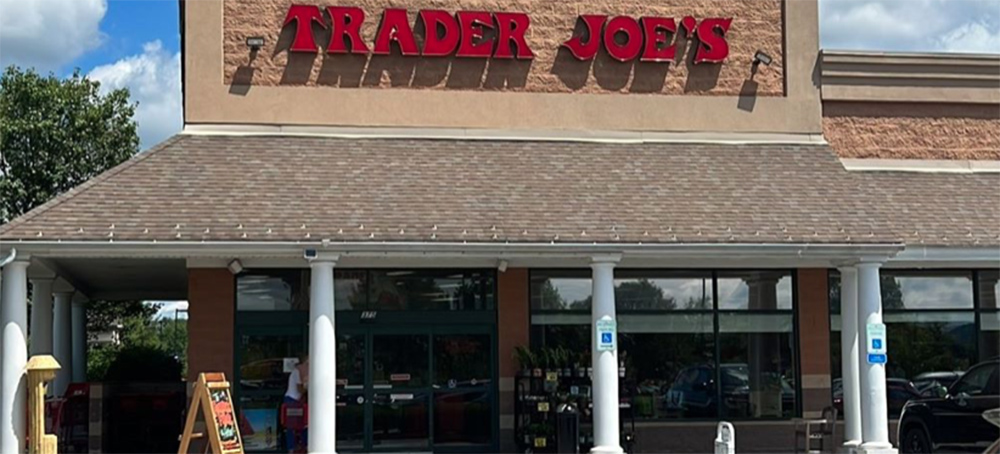 The Trader Joe’s in Hadley, Massachusetts, the first of the major grocer chain’s stores in the United States to unionize. (photo: Christian Smalls/Twitter)
Two Trader Joe’s stores have now unionized, raising the question of whether the chain could be the next Starbucks. But the company may at least be following in Starbucks’s footsteps in one way — by engaging in illegal union busting.
It seems that Trader Joe’s management is considering becoming the next Starbucks in a different sense: closing stores and harassing workers out of union drives. A store in Boulder, Colorado, had a vote lined up for this week, but workers seeking affiliation with the United Food and Commercial Workers (UFCW) Local 7 there withdrew their petition the day after filing charges against the company for coercion and intimidation.
The Trader Joe’s drives reflect an emerging theme of recent new organizing: independent versus affiliated unionism. UFCW, which represents 800,000 grocery workers, has watched as workers in its jurisdiction begin to form or join other unions.
In Portland, Oregon, workers at three stores of the regional grocery chain New Seasons have filed for election to form an independent New Seasons Labor Union; workers at a fourth store have filed to join UFCW Local 555. And in Baltimore, workers at a MOM’s Organic Market are seeking to join Teamsters Local 570.
Cutbacks in a Pandemic
Workers at the three Trader Joe’s stores to go with union campaigns organized independently of one another, but they were all reacting to corporate cuts to wages and benefits, and they all took inspiration from the Starbucks workers organizing drive.
Like many other large grocery chains, Trader Joe’s had implemented a national pay bump early in the pandemic. The $2-an-hour “thank you pay” was put into place in March 2020, and further upped to $4 an hour in February of 2021, in response to local ordinances that UFCW won to boost grocery worker pay in Seattle, Los Angeles, and other West Coast cities.
Then came the cutbacks. By May 2021, just three months after implementing the $4 raise, Trader Joe’s announced it was ending all hazard pay except where mandated by law.
“We kind of assumed that . . . they would bump it back down to $2, because that’s what the market had moved to,” said Keenan Dailey, a fourteen-year Trader Joe’s employee in Boulder. “And then they cut COVID pay entirely.” Workers who had been making around $21 an hour were down to $17, while some new hires were being brought in for $18 or more.
Next, Trader Joe’s cut retirement benefits.
“When I started, we got 15 percent put into our retirement for us,” said Maeg Yosef, an eighteen-year employee at the Hadley, Massachusetts, store, which was the first to vote to unionize:
That really made the job something people could commit to. But then last summer the language in the handbook was changed to “The company might give us a discretionary contribution,” but nothing was guaranteed at all. We got one last year but might not get one next year.
The change also set a new formula for the contributions Trader Joe’s did make, roughly halving the company’s retirement contribution for most workers and penalizing those who had taken leave, which many workers did during the pandemic for safety considerations.
Inspired by Others
Although workers in each store began their organizing separately, they were encouraged when they found out others were on the same track.
“We had been organizing seriously for three months, March, April, and most of May,” said Sarah Beth Ryther, who helped organize her store in Minneapolis,
and we were just about at the point where we were going to decide which union we wanted to go with or whether we wanted to go independent, and then Hadley announced. They were organizing in secret, so we had no idea.It looks from the outside like we were all working together at the same time, but actually we were inspired by each other.
They were also inspired by the Starbucks workers’ organizing wave. “I was like, ‘We could do that. You’re just talking to people,’” Yosef said.
At the Boulder store, “we started talking to people very casually about what was going on at Starbucks,” said Dailey:
If they seemed positive we’d say, “Do you think we should do that here?” If they were emphatic about it, we would talk about it more.When Hadley filed, we started talking about Hadley, and then talking about filing [for a union election] here.
An Appealing Strike
There was another important source of inspiration for the Boulder store. In January, just after the cuts to retirement benefits were announced at Trader Joe’s, eight thousand grocery workers at King Soopers stores across Colorado walked off the job with UFCW Local 7.
The King Soopers workers struck eighty stores for ten days. They won up to $6-an-hour raises, protected their health care and pension benefits, and won safety improvements — a major concern following a shooting that killed ten people at the grocer’s Boulder store in March 2021.
The wins — and how they were achieved — were not lost on Trader Joe’s workers in Boulder.
“We saw what they [UFCW] got for King Soopers, the way they took care of them, the way they fought for them,” said Dailey:
The workers weren’t giving up a paycheck to go on strike; they were getting paid through the strike fund. The idea of having that weapon was very appealing. If the company knows you can go on strike and keep getting paid, you have a lot more power.
The Employer Offensive
It’s too early to say whether or not the 530 Trader Joe’s stores will be organized at scale — whether independently or by the UFCW — given the company’s intense anti-union efforts out the gate.
Soon after these efforts went public, Trader Joe’s got aggressive. In New York City, the company closed its popular wine store the same week that employees there were planning to go public with their own organizing drive with the UFCW, as Dave Jamieson reported for the Huffington Post.
In Boulder, UFCW Local 7 filed charges August 23 at the National Labor Relations Board, saying the company was illegally coercing and intimidating workers. The next day, the union withdrew its petition for a union election that was set to take place August 25 and 26.
Like Starbucks, the company has also attempted to undermine the union campaign by offering improvements to wages and benefits. In July — before the votes in Hadley and Minneapolis — the company announced it was providing $10-an-hour premium pay for Sunday work, as well as increasing paid time off and raising wages for some existing employees.
Path to a Contract
It’s also an open question whether these new unions will be able to extract a first contract from Trader Joe’s.
In response to the union win in Hadley, Trader Joe’s corporate issued a statement agreeing to “immediately begin discussions with union representatives for the employees at this store to negotiate a contract.” In what may have been a dig at the UFCW, the company said it was
willing to use any current union contract for a multi-state grocery company with stores in the area, selected by the union representatives, as a template to negotiate a new structure for the employees in this store; including pay, retirement, healthcare, and working conditions such as scheduling and job flexibility.
Many UFCW stores have lower starting wages than Trader Joe’s.
In Boulder, where workers went with UFCW Local 7, the company tactic of holding up inferior union contracts has had a big impact.
But it’s a tactic workers will need to be prepared for if they try affiliating with an existing union. “With an independent union, people can put all their hopes and dreams into that, and we won’t know until we see their contract how that works out,” Dailey said. “I hope it works out exactly the way they’re hoping, but we don’t know. I think winning an election is easier independent — but winning a contract is the hard part.”
“With these giant corporations, they can afford to take losses,” says Matt Rogers, a coffee roaster at MOM’s Organic Market in Baltimore, where workers are organizing with Teamsters Local 570. “It helped to partner with an organization that has a history and has leverage and has contacts.”
“I was looking for a sense of discipline and militancy around what we were doing because I know how hairy things can get,” Rogers said, explaining the decision to organize with the Teamsters rather than going independent.
Local 570’s biggest unit consists of eight hundred Costco workers, who have a strong contract and recently authorized a strike. “I knew about UPS and also the Costco contract. That was something that we learned about and found out what they got paid and that they had a good contract.”
“The Whole Country Knows, Guys”
Despite having to pull the petition this week, Dailey says he plans to keep organizing at the Boulder store. He is in touch with other Trader Joe’s workers across the country who are quietly doing the same.
“When we first organized, it was very hush-hush,” he said:
It no longer feels scary to many people to discuss the idea of having a union. Whatever happens down the line . . . that’s part of our history now — that’s not something that can be taken away. It’s not like, “What if they find out we talked about this?” Well, they know. The whole country knows, guys.
 A Congolese policeman and a peacekeeper from the United Nations Organization Stabilization Mission in the Democratic Republic of Congo (MONUSCO) attempt to stop protesters inside the compound of a UN warehouse in Goma, DR Congo on July 25, 2022. (photo: Arlette Bashizi /Reuters)
Since July, there have been violent demonstrations against UN peacekeepers who have been accused of using deadly force in retaliation.
The incident happened on Tuesday, a police spokesperson said.
Protesters on motorbikes had gathered and blocked a MONUSCO convoy in Beni – a continuation of violent demonstrations against the mission that have killed dozens, including civilians, peacekeepers and Congolese police elsewhere in eastern DR Congo in recent months.
Thirty-six people, including four UN peacekeepers, were killed in July as hundreds of protesters vandalised and set fire to the mission’s buildings in several cities in the region.
One motorcycle taxi driver was killed when shots broke out, Beni police spokesperson Nasson Katembo said without giving further details about who was responsible for the gunfire.
MONUSCO did not immediately respond to a request for comment.
The situation was calm by mid-afternoon, a Reuters reporter said.
UN peacekeeping troops have been accused of retaliating with force during the recent protests against them in the eastern cities of Butembo and Goma, which saw hundreds of protesters throw rocks and petrol bombs and set fire to UN buildings.
The protests have been spurred by complaints that the peacekeepers have failed to protect civilians against militia violence that has raged for years. The mission has been deployed to Congo for more than two decades and costs more than $1bn per year.
In August, the DR Congo government expelled MONUSCO spokesman Mathias Gillmann, saying he had made “indelicate and inappropriate” statements that contributed to the tensions between the population and the peacekeepers.
“The Congolese government considers that the presence of this official on the national territory is not likely to promote a climate of mutual trust and calm between Congolese institutions and MONUSCO,” the statement said.
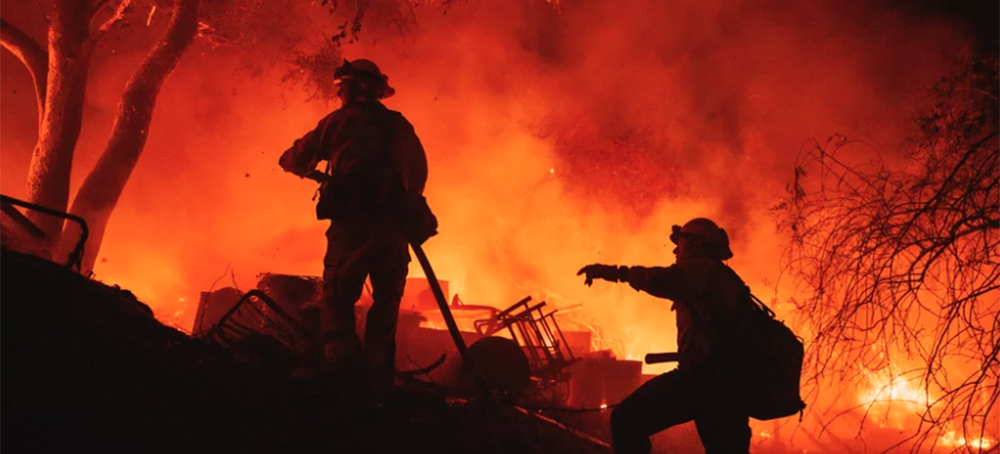 Firefighters coordinate efforts at a burning property while battling the Fairview Fire on Monday, near Hemet, Calif. (photo: Ethan Swope/AP)
As people crank up their air conditioners, the state forecasted record levels of energy use, said Elliot Mainzer, president of California Independent System Operators, which runs the state's electrical grid. The state has additional energy capacity at the moment "but blackouts, rolling, rotating outages are a possibility," Mainzer said, calling additional conservation "absolutely essential."
The CAISO site Tuesday morning showed California could fall more than 5,000 megawatts short of its power supply at peak demand, forecasted for 5:30 p.m.
The danger of wildfires was extreme as scorching heat and low humidity turned brush to tinder. Four deaths were reported over the Labor Day weekend as some 4,400 firefighters battled 14 large fires around the state, with 45 new blazes on Sunday alone, said Anale Burlew, a deputy chief with the California Department of Forestry and Fire Protection.
In Southern California, two people were killed and one injured by the Fairview Fire, which started Monday near the city of Hemet, the Riverside County Fire Department said. Roughly 50 miles southeast of Los Angeles, the fire had quickly spread to more than 2,000 acres by 11 p.m., prompting evacuations, and was only 5% contained. Multiple residential structures burned.
California's energy grid runs on a mix of mostly solar and natural gas during the day, along with some imports of power from other states. But solar power begins to fall off during the late afternoon and into the evening, which is the hottest time of day in some parts of the state. And some of the aging natural gas plants California relies on for backup power aren't as reliable in hot weather.
At CAISO's request on Monday, four temporary emergency power generators deployed by the Department of Water Resources in Roseville and Yuba City were activated for the first time since they were installed last year, providing up to 120 megawatts, enough electricity for 120,000 homes.
CAISO also has issued a Flex Alert call for voluntary conservation between 4 p.m. to 10 p.m. Tuesday, making seven alerts in as many days. Consumers were urged to keep air conditioners at 78 degrees (25.5 degrees C) or higher during the period and avoiding using major appliances such as ovens and dishwashers.
The efforts have worked to keep the lights on "but we have now entered the most intense phase of this heat wave" that could last into the week, and two to three times the level of conservation will be needed from people and businesses, Mainzer said.
CAISO also issued a Stage 2 Energy Emergency Alert from 6:30 p.m. to 8 p.m. Monday. The second of three emergency alert stages means taking emergency energy-saving measures "such as tapping backup generators, buying more power from other states and using so-called demand response programs," according to a CAISO website. Stage 3 would be rolling blackouts.
Several hundred thousand Californians lost power in rolling blackouts in August 2020 amid hot weather, but the state avoided a similar scenario last summer. Gov. Gavin Newsom signed legislation on Friday that could allow the state's last remaining nuclear plant to stay open beyond its planned 2025 closure, to ensure more power.
The National Weather Service predicted highs between 100 and 115 degrees (37.7 C and 46.1 C) across inland California, with 80s to 90s (above 26.6 C and below 37.2 C) closer to the coast. Nighttime won't bring much relief, with many places seeing lows in the 80s or even 90s (above 26.6 C and below 37.2 C).
Ironically, unsettled weather also brought the chance of thunderstorms over Southern California and into the Sierra Nevada, with a few isolated areas of rain but nothing widespread. The storms also could produce lightning, forecasters said, which can spark wildfires.
South of the Oregon state line, the Mill Fire was 55% contained Tuesday morning after killing two people, injuring others and destroying at least 88 homes and other buildings since it erupted last week, CalFire said. The bodies of the two women, 66 and 73, were found in the city of Weed on Friday, the Siskyou County Sheriff's Office announced Monday. Details weren't immediately released.
A few miles away, the Mountain Fire grew to nearly 18 square miles (29 square kilometers) square miles and only 20% contained, with winds threatening to renew its eastward spread in steep terrain, fire officials said.
Scientists say climate change has made the West warmer and drier over the last three decades and will continue to make weather more extreme and wildfires more frequent and destructive.
Follow us on facebook and twitter!
PO Box 2043 / Citrus Heights, CA 95611


Comments
Post a Comment