RSN: Dan Rather and Elliot Kirschner | A Shameful Stunt

17 September 22
Folks. We — Really — Need Some Progress on Donations
We are looking at really poor fundraising returns. Some of you are going to be offended, but we have to improve on this situation. We need you to help. The time is now to get it done.
With urgency.
Marc Ash
Founder, Reader Supported News
If you would prefer to send a check:
Reader Supported News
PO Box 2043 / Citrus Heights, CA 95611
Follow us on facebook and twitter!

17 September 22
Live on the homepage now!
Reader Supported News

It is clear that Republicans, facing tremendous blowback in the face of the Supreme Court’s abortion ruling, falling gas prices, the specter of Donald Trump, and the backlash he provokes for many voters, have settled on immigration as a motivator to turn out their base in the upcoming midterm elections.
The stunts by Republican politicians — specifically Texas Governor Greg Abbott and Florida Governor Ron DeSantis — of busing and flying migrants and asylum seekers to places like Washington, D.C. (including outside of the vice president’s residence), New York City, and now Martha’s Vineyard have all the toxic energy of a fraternity prank. This is deadly serious.
And it may be effective politically. It has been the case many times before, both in this country and abroad. History is replete with political power built on vilifying foreigners and immigration. As much as they might not like to admit it, Democrats may worry about their vulnerability on this issue, especially in close elections. Fear can be a motivator to get people to the polls.
The public rationale for what Republicans are doing can’t be only to “own the libs,” although that desire is clearly behind the glee with which the governors and their supporters justify their actions. They say they are pointing out rampant hypocrisy, that blue states should have to carry the burden of immigration. The truth is, of course, that blue states, and cities in particular, are full of immigrants, documented and undocumented. And many of these immigrants are thriving members of local communities. Furthermore, blue state tax revenue is a major source of federal government funds, which are then distributed across the nation, including to red states and in support of immigration infrastructure.
You could imagine a reason it would make sense for migrants and asylum seekers to travel from the border to other parts of the country. But a good faith effort would include planning and resources. It would include giving people full and accurate information about where they would be going and some choice in their fate. These current stunts are nothing of this sort. They are driven by cruelty and lies. They are certainly not for the benefit of the immigrant or even the immigration system. They are about scoring political points on the backs of others. Can you imagine being put on a bus or a plane with your children — or even being a child yourself — and arriving at some street corner, maybe late at night, with no idea where you were or what would come next?
Immigration is a complicated issue. It always has been. It stirs emotions deep and powerful.
The movement of people across oceans, over lines on maps, and within nations is a fraught endeavor. It is often driven by desperation, coercion, bondage, and hope. Those in transit tend to be vulnerable for exploitation.
One of the hallmarks of the human species is that we are incredibly mobile. From our origins (probably in Africa, say scientists) we spread out to almost every imaginable corner of the Earth — from the arctic tundra to equatorial rainforests, from the tops of mountains to remote islands. We invented all manner of conveyances to carry us over open seas, across continents, and even through the air. Horizons beckon us to go beyond them.
Humans, however, are also territorial. We have claimed time and time again, around the world, and throughout history, that this land is “ours.” We have divided the globe into discrete states. We have created borders, sometimes hundreds or thousands of miles long, that delineate divisions over who has the right to live on either side. Sometimes these boundaries follow geographic reasoning — rivers or mountains. Sometimes they are literally just random lines on the map.
For all this human movement, however, we are also a species with a strong sense of home. We group ourselves in regions where we share language, culture, family, and friends. Some of us may be inveterate wanderers, but many would rather stay close to where we are most familiar and comfortable.
But that changes when violence threatens us, when living conditions prove inhospitable, when our prospects for earning a livelihood and providing for our family are hopeless, when our freedoms are trampled. Then a primal survival mode kicks in. We would do anything to protect ourselves and our families. We would put our own health and security at risk in search of a better life. It was this very instinct that over the course of many centuries brought waves of immigrants to the United States.
America, it is often said, is a land of immigrants. Most of us here had ancestors who attempted a similar journey to that of those now being used as pawns in political showmanship. Back in our family tree, someone made the decision that they needed to leave somewhere else and come here. For some of us, that decision was decades or centuries in the past. For some it was recent. Many in this country now are immigrants themselves.
There are also those among us whose ancestors didn’t choose to leave. They were ripped from their homes by force — chained, beaten, and raped — and taken to a new land where they were separated from their families and forced to live in bondage. Others still are the descendants of the original inhabitants of the Americas, whose lands were taken by new immigrants. Many of these Native peoples perished from the diseases brought by white settlers. Those who didn’t were forced from their homes and pushed into far less hospitable lands.
Of course, you won’t hear any of this context from those sneering now with xenophobic fear-mongering. There is no nuance in the MAGA slogan. Heck, they want to ban the teaching of this very history in schools. The truth isn’t comfortable, and it challenges their divisive narratives.
For as long as America remains a beacon for those seeking a better life, we will have to find ways of creating a fair, equitable, safe, and humane system for immigration. What can be done? Recognize the incredible advantages immigrants have brought to this nation. Be driven by empathy. And keep our nation protected. We should not expect these balances to be easy. And that is all the more reason to debate the issue with seriousness instead of scapegoating, with a commitment to our noblest values rather than an appeal to our basest instincts.
We would do well to remember those stirring lines from the Emma Lazarus poem “The New Colossus” that adorn the Statue of Liberty in New York Harbor:
“Give me your tired, your poor,
Your huddled masses yearning to breathe free,
The wretched refuse of your teeming shore.
Send these, the homeless, tempest-tost to me,
I lift my lamp beside the golden door!”
We are talking about people here. Our fellow human beings. And there but for the grace of God go I.
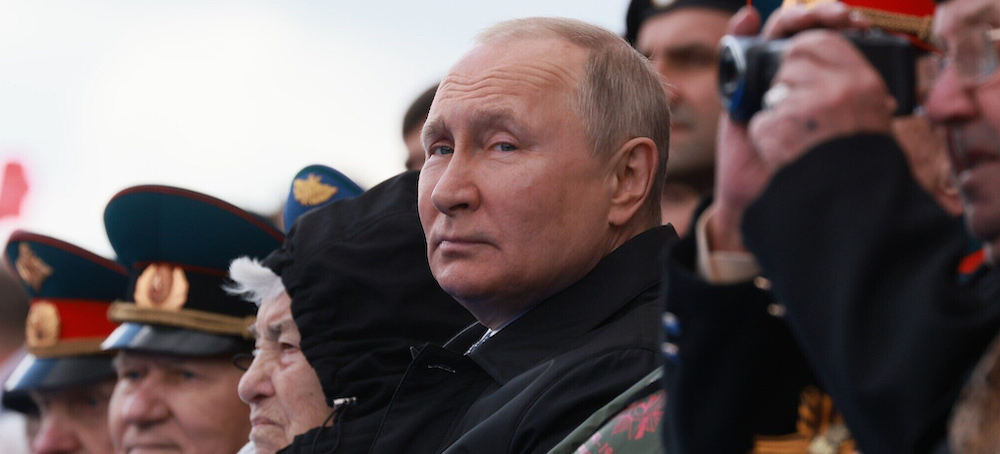 Russian president Vladimir Putin. (photo: Mikhail Metzel/Sputnik/AP)
Here’s what their responses say about the political factors weighing on Putin — and how that all might affect his response to the Ukrainian counteroffensive.
In just days, Ukrainian forces liberated more than 150,000 people and 3,100 square miles of territory in the country’s Kharkiv region from Russian occupation, according to Ukrainian government officials. Ukraine’s push forced Russian troops to quickly abandon key supply hubs and military equipment. Video circulating on social media shows some residents emerging from their homes and embracing Ukrainian soldiers. Russian forces have responded with strikes on critical infrastructure, but it’s unclear whether they will be able to regain their footing in the region.
As Washington Post Russia reporter Mary Ilyushina tells Today, Explained’s Sean Rameswaram, Ukrainian troops overcame an exhausted and disorganized Russian army with the help of Western intelligence and weapons.
While it’s too early to say whether this breakthrough represents a turning point in the war, it does appear that it’s made some of Putin’s supporters skeptical of whether his “special operation” is actually winnable. Some have advocated for a more aggressive Russian response, even pushing for general mobilization and the use of weapons bought from North Korea. As Ilyushina says, the typically “unanimous choir of pro-Kremlin and state propagandist voices” was in disarray.
Today, Explained spoke to Ilyushina to understand those different responses, what they tell us about the political factors weighing on Putin, and how that all might affect his response to the Ukrainian counteroffensive.
Sean Rameswaram
How embarrassing is all this for Vladimir Putin?
Mary Ilyushina
It is pretty embarrassing because his main brand, and the one that he’s been building for the past 20 years, is that he knows what he’s doing. He always gets the job done. In this case, we see even people who are extremely pro-Kremlin, extremely pro- this invasion, saying that they don’t like the way Russia has gone about this. We’ve heard from people like the leader of the Russian Communist Party saying that Russia is not really fighting anymore in a “special operation” and this is an actual war. And the very use of the word “war” to describe this mission has been essentially banned by Russia. People get fined or even jailed for talking about the war out in the open. They have to call it a “special military operation.” So we’ve definitely seen a lot of criticism coming from the very pro-Putin, very hawkish camp. That is a very new development that we’ll have to see whether that will push the Kremlin to change anything in the way they go about this invasion.
Sean Rameswaram
Tell me more of what we’ve been hearing in terms of criticism of this war in Russia.
Mary Ilyushina
Last weekend, just when the news broke that Russia lost a lot of this land and it retreated, the usually quite unanimous choir of pro-Kremlin and state propagandist voices was really in disarray. Some people chose to completely ignore the news because they didn’t know how to handle it. Some outlets, like the Kremlin’s official newspaper, just did not report on this at all. Some very prominent TV shows started to say that, look, Russia is not just fighting against Ukraine, it’s fighting against the entire NATO alliance. That’s why they’re having such a hard time doing that. They want Putin and the Kremlin to be even more aggressive, retaliate against Ukraine, hit civilian targets, and just do more. They believe that the way Russia is waging this war now is not enough. They want general mobilization. They want the whole country to be set on this war path and they want to go all out. So there’s a lot of really conflicting messaging going on in the camp that is usually really pro-Putin and follows the party line.
Some of the liberal and opposition forces have been also trying to seize on the moment. There’s been a pretty remarkable effort from local lawmakers to collect signatures from regional officials to call for Putin’s resignation and accuse him of treason. They are already facing administrative offenses and fines, and the police have launched an investigation. [Those opposition forces] say that their goal — which they believe they achieved — is to tell antiwar Russians who are still in the country that they’re not alone. They know that Putin is not going to read this request and say, “Look, yes, exactly. You’re right, I should stop doing this.” But they want to get the word out that there is still some resistance. And even though there are big risks in presenting this resistance in the public, they’re still willing to do that.
Sean Rameswaram
Tell me more about Vladimir Putin’s decision to not hold a draft, to not conscript more Russians into this war.
Mary Ilyushina
In terms of general mobilization, the problem with that is that it would be really unpopular because a lot of Russians are trying to tune this out. They’re trying to live their life as normal. Putting the whole country [under a draft notice] would mean not only drafting all the eligible men, it would mean resetting the whole economy and turning the whole country into this war machine that only works for the advancement of the front line. And that would have a lot of repercussions because what Putin has been promising Russians for a long time is this concept of stability. “As long as you stay out of politics, you can have your house, your job, you can, you know, live a normal life.” That’s something a lot of Russians sort of cling on to. And it would be a pretty huge political decision to change all that and take that away. So Putin has been resisting that, and instead he has been seeking really alternative and creative ways to draft people. There is the concept of shadow mobilization that’s happening in Russia.
Sean Rameswaram
What is shadow mobilization?
Mary Ilyushina
So that means there are several private military companies, basically mercenaries, that are fighting on behalf of the Russian Federation in Ukraine, but not officially with the Defense Ministry, even though it is giving them orders and placing them where they need them. They have been responsible for a lot of the very crucial gains that Russia had in this campaign. Using private military companies also gives Russia some plausible deniability because there’s conscripts fighting and they don’t have to really acknowledge them among the losses.
Another thing they have been doing is conscripting people from prisons. So there are multiple reports of these private military companies going to prisons and offering people deals if they go to the front lines. In six months, if they survive, they’ll get a pardon. And they’re specifically looking for people who have been accused of murder, of violent crimes. So that’s how they’ve avoided a draft. Whether that’s going to be enough — again, a big question.
Sean Rameswaram
Do Russians have any idea that their prisoners, murderers, and thieves are fighting this war for them in Ukraine?!
Mary Ilyushina
I think a majority does not know about this. It’s obviously not covered by the national media because it’s very controlled. There are multiple human rights organizations that are working to help these convicts, because the convicts are not given any guarantees. Mercenary service is outlawed in Russia. It’s illegal; nothing is written on paper. So their rights are also being violated by this.
But a lot of these human rights groups have been recognized as foreign agents in Russia, so they can’t operate on a wider scale and inform the general public about what’s happening effectively. And it’s really difficult to do so. So I think the majority does not know about this.
Sean Rameswaram
Do we have any idea what Putin’s plans are to regain footing in Ukraine, if any?
Mary Ilyushina
The planning is really not public in any way. We don’t even know who is the overall commander of this operation in Ukraine. We know there is the Defense Ministry, but there is somebody who’s supposed to navigate all of that on the ground and be really hands-on. Russia has not even publicly announced who that person is. So it’s all really, really secretive. We can glean things from social media, through some of the soldiers who speak out, or some of the intelligence assessments from the other side. But it’s quite difficult to analyze what Russia is going to do next.
We know that they have some reserve forces, but they’re also needed in some other directions. So we don’t know exactly if they’re going to be sent to Kharkiv to regain any footing. A lot of their battalion tactical groups have been depleted of forces throughout this campaign, and they’ve been kind of a minced salad. Russia has been throwing them together from different parts and trying to reassemble these groups. But what that means is that the chain of command is really disrupted. And it’s difficult to control all these groups because they really don’t have any combat experience together. So that makes it difficult for them to quickly respond and efficiently respond to all these targets.
Sean Rameswaram
How significant is this, all told? I mean, this conflict escalated just over six months ago. It felt like Ukraine surprised the world by making it last six months, though there have certainly been any number of low points for Ukraine throughout. But now it seems like they’ve got the upper hand?
Mary Ilyushina
All things aside, it’s obviously very important. What by now appears to be clear is the fact that Russia thought Ukraine was a really weak country that wouldn’t rally together and that the Ukrainian forces have spent the last eight years training with Western officers in vain. But the Ukrainian forces actually learned a lot and became much stronger than they were in 2014 when Russia annexed Crimea. So all these things, I think, were not taken into account, which is showing now. It’s showing.
What’s going to happen next is obviously difficult to predict, especially when we have very little information coming publicly out of Moscow. But I think we shouldn’t underestimate Moscow, either. It’s maybe too early to say that this is the end or this is the turning point. But we should also not underestimate Moscow.
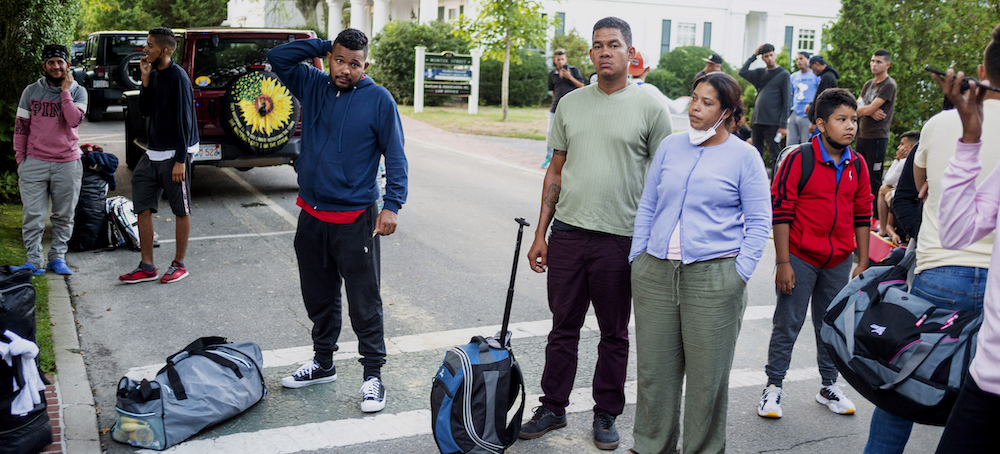 Immigrants gather with their belongings outside St. Andrews Episcopal Church, Sept. 14, 2022, in Edgartown, Massachusetts, on Martha's Vineyard. (photo: Ray Ewing/Vineyard Gazette/AP)
ALSO SEE: Migrants Sent to Martha's Vineyard
Are Being Rehoused on a Base in Cape Cod
Florida lawmakers allocated $12 million in the state budget this year to “facilitate the transport of authorized aliens from this state” — raising questions about how the governor could justify the spending. The two Ultimate Air Shuttle flights originated in San Antonio — not Florida — according to Geoffrey Freeman, director of the airport on Martha’s Vineyard.
Two state Democratic lawmakers said Friday they will ask the legislature to instruct DeSantis to “cease his inappropriate use of taxpayer money.”
“This use of state funds is not what was intended or described in law, nor was it what was discussed in debate,” legislators Evan Jenne and Fentrice Driskell said in a statement.
The Florida governor — widely considered a potential 2024 presidential contender — doubled down Friday in defending transporting the migrants to Martha’s Vineyard, saying they were all intending to go to Florida. He said state officials has “had people in Texas for months” trying to figure out how migrants are reaching his state after crossing the border and how they might intercept them and divert them. He said it is difficult to find newcomers once they leave the large groups crossing the border and switch to traveling in cars or buses.
Stopping them in Texas made that easier, he said.
“Most of them are intending to come to Florida,” said DeSantis, adding later that, “Our view is you have to deal with it at the source.”
DeSantis surprised federal and state officials on Wednesday by sending migrants who recently crossed the U.S.-Mexico border to the affluent resort island. The move is part of an ongoing campaign by DeSantis and other Republican governors in Texas and Arizona to send migrants to Democrat-heavy cities such as Washington, New York and Chicago to publicize soaring numbers of crossings this year on the southern border.
Many migrants might have ended up in these places anyway, but the unexpected arrivals are catching locals off-guard and sending them scrambling to find supplies and shelter for the newcomers. Many of the migrants are from Venezuela, a South American nation that has been engulfed in a political and economic crisis, with shortages of food, water and electricity.
Activists have also called on Biden administration officials to do more. Domingo Garcia, president of the League of United Latin American Citizens, one of the oldest Hispanic membership organizations in the country, said Friday at a news conference in Martha’s Vineyard that the governors’ flights to Democratic-majority cities and towns were a “gross abuse of power.” He called on the Justice Department to investigate the incident for possible human trafficking or civil rights violations. The Justice Department declined to comment.
Republicans defended the action, saying border cities were experiencing influxes in even greater numbers. Federal border agents have made nearly 2 million apprehensions on the southern border this fiscal year, exceeding last year’s total.
“If there is a humanitarian crisis in Martha’s Vineyard, wouldn’t it stand to reason there is a drastically more significant humanitarian crisis at the Southwest border?” the Republicans on the House Homeland Security Committee tweeted Friday.
State and local politicians in Massachusetts praised the response on Martha’s Vineyard, an offshore island accessible only by air and sea, where volunteers turned out in droves to assist the migrants when they showed up carrying maps and a few belongings. Some said they had expected to arrive in a bigger city, close to public transportation, and not a small island of 20,000 people.
The state said that “the island communities are not equipped to provide sustainable accommodation.”
On Friday morning, the migrants filed out of the church they’d been sleeping in for two nights to hugs from the local volunteers. They left with full bags and new cellphones. As they boarded the three white buses that would take them to the ferry, many cried.
Eliomar Aguero, 30, put up a peace sign, smiling and thanking the dozens of volunteers waving him on. “Thank you all,” Aguero said in Spanish.
Gov. Charlie Baker (R) said the migrants will be offered “shelter and humanitarian supports” in dormitory-style rooms at Joint Base Cape Cod in Bourne. State and local officials will also ensure migrants have food, shelter and other services. Baker said he plans to activate up to 125 members of the Massachusetts National Guard to aid in the relief effort. The move was voluntary, the state said, and migrants will decide on next steps from there.
In the past, the base has sheltered Louisiana residents who fled Hurricane Katrina and Massachusetts residents affected by covid-19.
“We are grateful to the providers, volunteers and local officials that stepped up on Martha’s Vineyard over the past few days to provide immediate services to these individuals,” Baker said.
White House press secretary Karine Jean-Pierre accused DeSantis Friday of luring asylum seekers onto planes and buses with the false promise of jobs, only to leave them “abandoned” on the roadside “with nothing but Ziploc bags of their belongings.” Officials marooned migrants in cities and towns where nobody expected them, she said. Many migrants who arrived in the vineyard this week could not easily communicate in English.
“These are the kinds of tactics we see from smugglers in places like Mexico and Guatemala. And for what, a photo op? Because these governors care about creating political theater,” she said.
She criticized Republicans for opposing legislation that would create paths to citizenship for millions of undocumented immigrants and expedite processing for asylum seekers and other legal immigrants, which Democrats and some Republicans have pushed to alleviate labor shortages in the United States. “They vote against policies to fix this broken system,” she said. “Stunts aren’t solutions here.”
But Republicans say they are finding — and financing — their own solutions under an administration whose lax policies have led to rising numbers of immigrants crossing into the United States illegally, creating a burden on taxpayers who must provide health care and schooling for children.
At a news conference Friday, DeSantis said his program was insulating Florida against the costs of absorbing new immigrants.
“The legislature gave me $12 million. We are going to spend every penny of that to make sure we are protecting the people of the state of Florida,” DeSantis said.
The Florida governor also disputed claims that migrants brought to Martha’s Vineyard were misled about where they were heading. He said they got packets that contained a map of the island and said it was “all voluntary.”
He drew a distinction between Cubans who have arrived in South Florida for decades fleeing communism and the newcomers turning up at the southern border, who he alleged were exploiting federal immigration laws by claiming asylum to gain entry into the United States, where long immigration court backlogs mean they could wait years for a decision.
DeSantis said Wednesday’s flights were only a start: “There is also going to be buses and there will likely be more flights.”
State records show the Florida Department of Transportation paid Vertol Systems Company $615,000 on Sept. 8 — about a week before the flights — as part of the “relocation program of unauthorized aliens.”
It is unclear what specifically that money was used to pay for. A person who answered the phone at the company’s headquarters hung up on a Washington Post reporter. The company did not respond to messages requesting comment on the payment.
Vertol has donated thousands of dollars to the Florida state Republican Party and politicians such as Rep. Matt Gaetz (R-Fla.), a close ally of former president Donald Trump.
“The fact that he used state dollars, as far as we know thus far to the tune of over $600,000, to charter these planes, which sounds like an outrageous sum of money, but it’s state dollars that he’s utilizing for a political stunt,” said former Florida Gov. Charlie Crist, who is challenging DeSantis in the governor’s race this year. “It just smells of high heaven.”
The Florida legislature wasn’t briefed on these plans and has not since received any information about the flights, according to a person familiar with the matter.
As politicians sparred over the legality of the Republican governors’ policies, migrants settled into the military base on Cape Cod Friday, another way station en route to a new life in America. Children kicked soccer balls and cuddled shark-shaped stuffed animals as lawyers interviewed their parents about why they fled countries such as Venezuela.
Though DeSantis described them as “illegal immigrants,” lawyers said border and immigration authorities had “paroled” the migrants into the United States — a temporary legal entry — though they cannot work legally. Many lacked government identification, some of which were seized by immigration officials, who gave them paperwork so they could travel.
“My understanding is that these individuals were in Texas pursuing legal methods of obtaining citizenship,” Driskell, who leads the house Democratic caucus, said. “So why the governor of Florida inserts himself in a federal matter, in Texas, is beyond me. And it’s certainly beyond the scope and limitations of what he’s permitted to use that money in the budget for.”
Each family’s fate will depend on their individual circumstances. Most, if not all, will face deportation hearings in immigration courts, which could take months or years. Some may ask judges to let them stay permanently, by granting them asylum, based on their fear of being persecuted in their home countries. Others may seek special protections for crime or human-trafficking victims.
Some have family and friends in the United States who can help them, others do not.
Susan Church, a Boston immigration lawyer among those aiding migrants on Friday, said migrants are free to return to Florida if they wanted to go there.
“This is just a ridiculous political ploy that puts these extremely innocent people in a terrible situation,” she said. “You can definitely see the anxiety, stress and fear on people’s faces here. They got on a plane. They ended up in a media circus.”
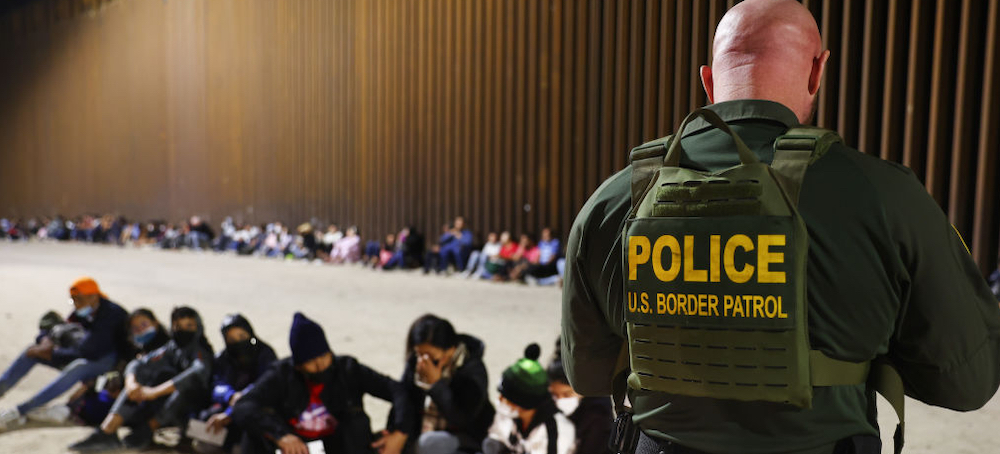 A U.S. Border Patrol agent checks the passports of immigrants after they crossed the border with Mexico on May 18, 2022, in Yuma, Arizona. (photo: Mario Tama/Getty Images)
The Border Patrol has largely avoided the scrutiny that police have come under in recent years. That should change: the Border Patrol’s powers are increasingly authoritarian, with few legal checks, and expanding throughout the United States.
Today, with more than 60,000 employees, seemingly endless jurisdiction, increasingly sophisticated use of surveillance technology, and a continued lack of oversight, the US Border Patrol has become one of the largest — and most threatening — enforcement agencies in the world.
On July 1, 2020, former acting secretary of Customs and Border Patrol Mark Morgan tweeted that the agency was working alongside local law enforcement across the nation to protect cities amid protests of George Floyd’s murder by Minneapolis police officer Derek Chauvin. “As a federal law enforcement agency, it’s our duty and responsibility to respond when our partners request support,” he asserted on Twitter.
Soon after, videos surfaced online of armed men with few official markings other than the word “POLICE” written across their clothing hauling away Black Lives Matter protesters from the streets of Portland, Oregon. As later evidence would show, these mysterious agents came from the Border Patrol. Far from the border and with authority beyond the confines of the Constitution, including the power to carry out unwarranted stops and interrogations, the Border Patrol’s presence in Portland represented a further advancement of the agency’s mission to become a national police force.
In his recent book Nobody Is Protected: How the Border Patrol Became the Most Dangerous Police Force in the United States, political geographer Reece Jones tells the story of how the US Border Patrol developed into the powerful, lawless agency it is today. While historians have previously provided excellent historiography of the Border Patrol, the narrative in Jones’s book urges an imperative question for immigrants’ rights activists and all Americans alike: For how long are we willing to allow the Border Patrol to exert and expand its extraconstitutional power?
In the following interview with Jones, he lays out the story of how a number of landmark but little-talked-about Supreme Court cases shaped the Border Patrol’s current powers, the role of race in the rise of the Border Patrol, the post–September 11 “border-industrial complex,” and why all Americans should pay attention to the dangerous possibilities of the Border Patrol’s expanding powers.
Conner Martinez
Race plays a major role in the development of the Border Patrol throughout your book. Could you explain how?
Reece Jones
The Border Patrol was established in 1924 to enforce the Immigration Act passed that year, often referred to as the National Origins Quota Act. That act was a law based on racial exclusion. The people who wrote it were drawing on eugenics and race science, and it was meant to prevent nonwhite people from entering the United States and to orient immigration toward Northern Europe. The Border Patrol was established two days after that law went into force, so the original purpose of the agency was as a racial police force whose job was to locate nonwhite people entering the country and remove them. This role has continued through the present.
In Nobody Is Protected, I talk about how some key Supreme Court cases defined the parameters of what the Border Patrol can do. In two of those cases, United States v. Brignoni-Ponce in 1975 and United States v. Martinez-Fuerte in 1976, the Supreme Court ruled that the Border Patrol can use race as one of the primary criteria to stop individuals while on patrol. So we can see that the Border Patrol was founded as a racial police force and is allowed to continue racial profiling today. This has always been a key part of its ethos.
Conner Martinez
You just mentioned two Supreme Court cases. Multiple such cases play a prominent role in your narrative of the Border Patrol’s extraconstitutional power. What are these cases, and how did they shape the Border Patrol’s authority today?
Reece Jones
One of the interesting things about the Border Patrol is that upon its establishment, it was given really expansive authority. Agents were allowed to stop people without a warrant inside the United States. Eventually in the 1940s, this power was set within a hundred miles of borders and coastlines, allowing agents to both stop and search people without a warrant in this area.
This law was not put in front of the Supreme Court until the 1970s, when finally the contradiction between the Fourth Amendment’s protections against unreasonable search and seizure were weighed against the Border Patrol’s authorization to stop and search anyone in the border zone. In the 1973 case Almeida-Sanchez v. United States, which was about whether the Border Patrol could carry out searches anywhere in the border zone, the Supreme Court came within just a few weeks of deciding that yes, it could search any vehicle, but a justice switched his vote at the last minute, and the court decided searches needed probable cause just as in the case of the police.
In 1975 and 1976, the Supreme Court had two more cases dealing with making stops in the Border Zone. Something additional to note about the Brignoni-Ponce decision in 1975 is that it established that the Border Patrol could stop virtually any vehicle if they had at least two facts justifying the making of that stop. Race was one. In the Martinez-Fuerte case in 1976, it was then established that race alone can be used at a border checkpoint to send someone to a secondary inspection.
Conner Martinez
What exactly is the border zone?
Reece Jones
The original idea of the Border Patrol was that it would only operate at the border line. But the agents started to encroach into the United States in order to make apprehensions. So, in the 1940s, Congress revised the Border Patrol’s authorization to say that it could operate at a reasonable distance from the border. However, it didn’t specify how far.
Later in 1947, the Department of Justice released a simply routine interpretation of the laws in the federal register, and without any input or public debate, they set the reasonable distance as one hundred miles from any borders and coastlines, which is an extremely vast area that includes around two-thirds of the US populations and many of the largest cities in the country. New York, Washington, Boston, Seattle, and Chicago are all within that one-hundred-mile zone. Even a number of entire states are within that zone.
And what makes the zone significant is, again, the lower standards of evidence that the Border Patrol has in terms of stopping vehicles without probable cause and without a warrant. It can even set up checkpoints on roads deep within the United States.
Conner Martinez
During the protests of the police killing of George Floyd in Portland, Oregon, a series of videos came out showing mysterious detentions of protesters by heavily armed agents with few official markings. As it turns out, these were Border Patrol agents. What was the Border Patrol doing so far from the border in Portland? And is this something we can expect more of in the future?
Reece Jones
Something I highlight specifically in my book is that the Border Patrol has all of this sophisticated military gear and almost 20,000 agents in the field, but it has relatively little work to do when it comes to immigration. This makes it available to be deployed for other purposes.
During the protests, Donald Trump’s administration decided to use a “war on terror”–era law that says that the secretary of homeland security could assign federal officers to protect federal buildings. But the regulation is actually quite broad, because it says they can do investigations on-site and off-site for any felony cognizable under the law. This allowed the agents to police social justice protests and also grab people off the street in the middle of the night in unmarked vans in things that have nothing to do with immigration work.
The major concern then is that these laws are still on the books. And the Border Patrol is eager to do this kind of work. One of the alarms I’m trying to raise in my book is that these laws need to be fixed before a future authoritarian president comes into power and uses them even more expansively.
Conner Martinez
Part of this shift in the Border Patrol’s work has been about rebranding. In the years after September 11, the war on terror led to a rebranding of the Border Patrol as an agency focused on terrorism. Has this rebranding worked, and does the Border Patrol actually prevent terrorism?
Reece Jones
The Border Patrol will often issue press releases where it says that it has arrested someone at the border who is on the terrorism watch list, but often the people it finds have nothing to do with terrorism. It also tends to release press releases when it arrests someone with the same name as someone on the terrorist watch list, even when in reality it’s not the person who is on the watch list. So the Border Patrol claims that it does make a number of terrorism-related arrests at the border, but no significant prosecutions have happened based on arrests by the Border Patrol.
What we do see in the post–September 11 era is that the Border Patrol is doing a kind of repositioning. Prior to September 11, the Border Patrol was primarily focused on immigration and drug enforcement. But after the attacks, the atmosphere of fear allowed the Border Patrol to reposition itself as primarily a front line against terrorism. This resulted in a lot of money flowing to the Border Patrol, giving it access to more agents it could hire and access to much more military gear it didn’t previously have. This also coincides with the wars in Iraq and Afghanistan and the procurement of military gear that also ends up eventually in the hands of security services within the United States.
After September 11, we can see that the agency has transformed into a much more aggressive, violent organization, even though in practice it’s interacting with the same kinds of people as before. And who is it finding at the border? It’s encountering people who are coming to the country to work and increasingly finding families who are trying to apply for asylum. So instead of trying to evade the Border Patrol, these people often turn themselves in after they cross the border.
What the United States should then be investing in is aid to people who are on the move — social workers and others who can handle asylum claims and families in need, instead of the militarized force we are currently spending on. This leaves us not equipped in any way for dealing with what is actually going on at the border.
Conner Martinez
Where is support for the militarization and growth of the Border Patrol coming from?
Reece Jones
There has become a border-industrial complex. What we saw with the military — corporations donating to members of Congress, setting up factories in congressmembers’ districts that provide jobs and foster a cycle of military spending — we’re seeing with border security. The whole security industry has become extremely lucrative for corporations.
Additionally, the border is one of the main issues for the Right. This fear of immigration is often depicted in the racialized terms of the white-supremacist “great replacement” theory. It has become a motivating force for right-wing voters, with politicians on the Right then becoming more supportive of higher spending on border security, even if the crisis at the border they’re depicting doesn’t exist.
Conner Martinez
Why do you think the Border Patrol’s activities away from the border often fly under the radar of the US public?
Reece Jones
For a long time, the Border Patrol simply wasn’t that big. With so few agents, its work within the interior of the United States wasn’t able to affect many people’s lives. But after the rapid growth in the agency, it can now operate in many of the places they didn’t in the past. So I think more people are actually running into the Border Patrol in their daily lives.
A recent report on checkpoints has shown that from 2016 to 2020, 250 million vehicles passed through an interior checkpoint. That’s 50 million a year, which is a huge number of people who are subjected to a violation of their rights to be stopped and have their vehicles briefly seized in order to ask them questions about immigration — even though they’re driving on an American road in between two American towns.
We’re seeing more people come into contact with the Border Patrol and becoming aware of it. But the question is also in many ways why I wrote this book: to raise attention to these exceptions the Border Patrol has to the Constitution and the impact the Border Patrol has on both immigrants and, increasingly, US citizens alike.
Conner Martinez
Is there any constitutional authority within the border zone?
Reece Jones
Of course, the Constitution exists within the boundaries of the United States. But what we have seen is that Congress has authorized exceptions to it and the Supreme Court has decided to defer to Congress on those exceptions, providing the Border Patrol special authority to circumvent the law and make stops without a warrant or probable cause and to stop vehicles at checkpoints and ask anyone about immigration.
These exceptions have an impact on US citizens and immigrants. They are directly related to the increases in deaths at the border, where border crossers have to go past the one-hundred-mile mark to get out of the border zone, and they result in many drug-related citations for American citizens at interior checkpoints. What they don’t serve is any deep immigration enforcement purpose.
Over 50 percent of the Border Patrol’s immigration apprehensions happen at the border. We need to reconsider this vast authority that has been given to the Border Patrol’s expansive zone at the border before the power expands even further. We’ve seen a dramatic expansion of its activities over the last fifty years, and it only makes sense to ask what it will look like in another fifty years. How far into the United States will it be operating? How will it be setting up its checkpoints? Because right now, it can do all of this in an area that includes two-thirds of the nation’s population. All of this needs to be reconsidered before it expands those powers.
 Oil pumps. (photo: History)
Fury as ‘explosive’ files reveal largest oil companies contradicted public statements and wished bedbugs upon critical activists
The communications were unveiled as part of a congressional hearing held in Washington DC, where an investigation into the role of fossil fuels in driving the climate crisis produced documents obtained from the oil giants ExxonMobil, Chevron, Shell and BP.
“First they ignore you, then they laugh at you, then they wish bedbugs on you, then you win,” said Varshini Prakash, executive director of Sunrise. The organization accused Shell of a “legacy of violence and of ignoring the wellbeing of communities across the globe”.
The revelations are part of the third hearing held by the House committee on oversight and reform on how the fossil-fuel industry sought to hamper the effort to address the climate crisis. Democrats, who lead the committee, called top executives from the oil companies to testify last year, in which they denied they had misled the public.
The new documents are “the latest evidence that oil giants keep lying about their commitments to help solve the climate crisis and should never be trusted by policymakers”, said Richard Wiles, president of the Center for Climate Integrity.
“If there is one thing consistent about the oil and gas majors’ position on climate, it’s their utter inability to tell the truth,” Wiles added.
Ro Khanna, co-chair of the committee, said the new documents are “explosive” and show a “culture of intense disrespect” to climate activists. The oil giants’ “climate pledges rely on unproven technology, accounting gimmicks and misleading language to hide the reality,” he added. “Big oil executives are laughing at the people trying to protect our planet while they knowingly work to destroy it.”
Several of the emails and memos within the released trove of documents appear to show executives, staffers and lobbyists internally contradicting public pronouncements by their companies to act on lowering planet-heating emissions.
Exxon, which recently announced profits of $17.9bn for the three months until June, more than three times what it earned in the same quarter a year ago, has publicly said it is “committed” to the Paris climate agreement to curb global heating.
However, the documents released by the Democratic-led House committee include an August 2019 memo by an executive to Darren Woods, Exxon’s chief executive, on the need to “remove reference to Paris agreement” from an announcement by an industry lobby group that Exxon is a member of.
Such a statement “could create a potential commitment to advocate on the Paris agreement goals”, the executive warned. A separate note on a 2018 Exxon presentation also admitted that biofuels derived from algae was still “decades away from the scale we need”, despite the company long promoting it as a way to lower emissions.
Shell, meanwhile, has committed to becoming a “net zero” emissions business by 2050, and yet the documents show a private 2020 communication in which employees are urged to never “imply, suggest, or leave it open for possible misinterpretation that (net zero) is a Shell goal or target”. Shell has “no immediate plans to move to a net-zero emissions portfolio” over the next 10 to 20 years, it added.
A Shell tweet posted in 2020 asking others what they could do to reduce emissions resulted in a torrent of ridicule from Twitter users. A communications executive for the company wrote privately that criticism that the tweet was “gaslighting” the public was “not totally without merit” and that the tweet was “pretty tone deaf”. He added: “We are, after all, in a tweet like this implying others need to sacrifice without focusing on ourselves.”
The UK-headquartered oil company, which in July announced a record $11.5bn quarterly profit, also poured scorn on climate activists, with a communications specialist at the company emailing in 2019 that he wished “bedbugs” upon the Sunrise Movement, a youth-led US climate group.
Previous releases of internal documents have shown that the oil industry knew of the devastating impact of climate change but chose instead to downplay and even deny these findings publicly in order to maintain their business model.
The hearings have been attacked by Republicans as a method to “wage war on America’s energy producers” and the oil companies involved have complained that the documents don’t show the full picture of their stance on the climate crisis.
Exxon supports the 2015 Paris climate deal, a spokesman said, claiming that the “selective publication of dated emails, without context, is a deliberate attempt to generate a narrative that does not reflect the commitment of ExxonMobil and its employees, to address climate change and play a leading role in the transition to a net-zero future.”
A Shell spokesman, meanwhile, said the committee chose to highlight only a small handful of the nearly half a million pages it provided to the body on its “extensive efforts” to take part in the energy transition.
“Within that pursuit are challenging internal and external discussions that signal Shell’s intent to form partnerships and share pathways we deem critical to becoming a net-zero energy business,” he said.
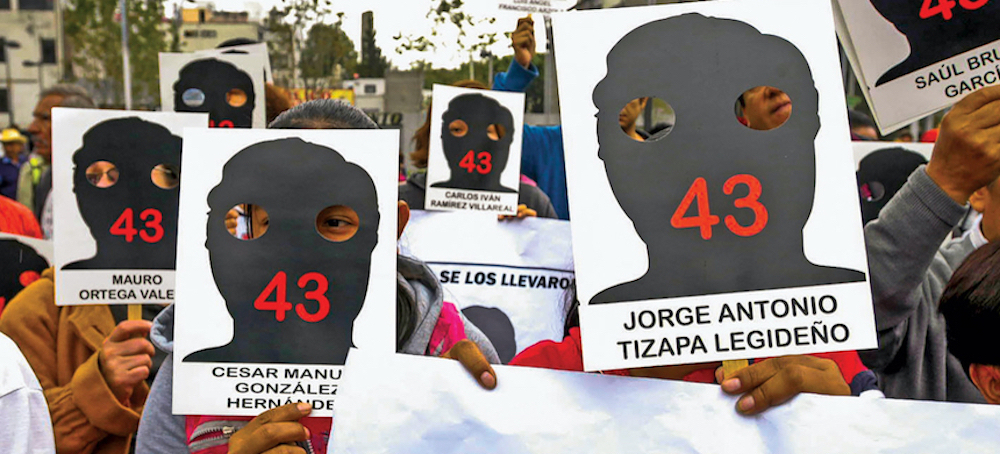 A march in Mexico City on the anniversary of the disappearance of 43 students from Ayotzinapa, Guerrero. (photo: Keith Dannemiller)
Tomás Zerón de Lucio, a key figure in the forced disappearance and subsequent government cover-up of the Ayotzinapa case, is hiding out in Tel Aviv thanks to his close ties to the Israeli cybersurveillance industry.
The commission systematically debunked what the Peña Nieto government called the “historical truth”—the story that the students were killed and incinerated by a rogue drug gang without the federal government’s knowledge or participation. Indeed, the man who coined the phrase “historical truth,” then attorney general Jesús Murillo Karam, has been imprisoned on charges of torture, forced disappearance, and obstruction of justice.
The events of last month marked a stunning turn toward justice in the case. But as the families of the disappeared have pointed out in recent days, critical questions remain.The events of last month marked a stunning turn toward justice in the case. But as the families of the disappeared have pointed out in recent days, critical questions remain. Two figures have been conspicuously exempt from the current prosecution effort—namely, Salvador Cienfuegos, then Secretary of National Defense, and ex-President Peña Nieto himself. The commission has pointed out sites in the municipalities of Atzcala, Tepecoacuilco, Tepeguaje, and Iguala that have not yet been searched. There are accused culprits who have not yet been taken into custody. The most prominent among these fugitives is Tomás Zerón de Lucio, head of the now defunct Criminal Investigative Agency (AIC) created under Peña Nieto. Though he has been wanted by Mexican prosecutors since 2016, Zerón is currently being harbored in Israel.
Tomás Zerón de Lucio and the Fabrication of the “Historical Truth”
“Zerón is a central figure in the construction of the false ‘historical truth’ version of the Ayotzinapa case—the version that federal authorities manufactured under torture and that has now been discredited,” said Stephanie Brewer, Mexico Director at the Washington Office on Latin America and a long-time observer of the Ayotzinapa case. “The importance of his return to Mexico to be held accountable, and potentially to provide useful information, shouldn’t be underestimated.”
Zerón fled the country long before the current roundup began. His legal woes began in 2016, when he was forced to resign his post as head of the AIC after international investigators from the Inter-American Commission on Human Rights accused him of evidence tampering in the Ayotzinapa case. The Interdisciplinary Group of Independent Experts (GIEI) questioned whether Zerón had, during his initial “investigation,” planted evidence at a site along the San Juan River in Guerrero with the help of torture-induced testimony from accused Guerreros Unidos boss, Agustín García Reyes, known as “El Chereje.” Reyes later said in a deposition by the Físcalia General de la República (FGR), an independent prosecutor’s office, that Zerón had brought him to the site in October 2014 to falsely state on camera that he had thrown trash bags full of the students’ burnt remains into the river, and that Zerón had threatened to throw him from the helicopter they were traveling in lest he refuse to parrot the story.
In July 2020, Secretary of Foreign Affairs Marcelo Ebrard announced that Mexico was seeking to extradite Zerón from Canada, where he was last spotted, on charges that he had overseen the torture of detainees as part of the previous administration’s cover-up. Days later, video footage was leaked to the Mexican daily Milenio showing Zerón interrogating Felipe Rodriguez Salgado, also known as “El Cepillo,” an accused Guerreros Unidos Boss. Salgado is hunched over, shirtless and hooded. In front of him stands Zerón, arms crossed, directing his testimony. “A la primera mamada te mato, güey,” Zerón tells him—roughly, “One wrong move and I’ll kill you, dumbass.”
But by the time of Ebrard’s announcement, Zerón was long gone, reportedly having escaped to Israel in September 2019. Why Israel? The answer seems to lie primarily in the deep ties between Zerón and the Israeli cyber-surveillance industry.
Mexico’s Expansion of Cybersurveillance Technology Under Peña Nieto
Mexico was one of the first clients of the Israeli technology firm NSO Group, whose proprietary Pegasus spyware has been used by authoritarian governments around the world to spy on journalists, dissidents, lawyers, and others. In its dealings with the company, Mexico reportedly selected around 700 mobile phones for Pegasus espionage—the largest number of surveillance subjects submitted by any state client of the NSO Group.
In 2016, the magazine Proceso reported on emails between the Mexican private security company Balam Seguridad Privada and the Italian cybersurveillance company Hacking Team. Their correspondence showed that in 2014, two Balam employees, Rodrigo Ruiz Treviño de Teresa and the Israel-born Asaf Israel Zanzuri, sold NSO Group’s Pegasus software to the office of the Mexican attorney general in a $32 million contract. In one email “a Balam employee indicated that the ‘key person’ in the negotiations for the sale of spying programs was Tomás Zerón de Lucio.” Another email from Hacking Team described Zerón’s hunger for the company’s Remote Control System tool, saying that he planned to use the malware to surveil prosecutors across Mexico.
In 2017, researchers from the University of Toronto’s Citizen Lab found that Pegasus had been used to target a range of groups and individuals who could potentially undermine the government’s story about the Ayotzinapa case.In 2017, researchers from the University of Toronto’s Citizen Lab found that Pegasus had been used to target a range of groups and individuals who could potentially undermine the government’s story about the Ayotzinapa case. Among the targets were attorneys representing some of the family members of the 43 disappeared students, the GIEI’s international investigators, and two of Mexico’s best-known journalists, Carlos Loret de Mola and Carmen Aristegui, who have both reported extensively on the case. Citizen Lab found that, while the GIEI was preparing its final report on Ayotzinapa, at least two attempts were made to infect a cell phone belonging to the group. The cyberattacks occurred just over a week after the GIEI held a press conference asserting that their investigation was being deliberately hampered by the Mexican government, and specifically by the NSO Group’s client, the office of the attorney general.
“The Ayotzinapa case has received high levels of national and international attention and has had a substantial political cost, so the level of espionage deployed may be higher than that seen in other cases,” Brewer said. “But it’s not the only example of the use of spyware against human rights defenders and others. Investigations into this practice have shown that Mexico stood out as a massive consumer of spyware, and there still hasn’t been full transparency and accountability for the spying that went on.”
Prospects for Extradition?
In December 2020, Proceso published a photo of a smiling Zerón allegedly taken in a Tel Aviv apartment. “A source in Israel indicated that the ex-official close to Peña Nieto was able to enter [Israel] thanks to his contacts and friendships in [the cybersurveillance] sector,” Proceso reported.
News reports in May 2022 finally confirmed this claim by pinning down Zerón’s exact location. According to an investigation by the Israeli business daily Calcalist, which was followed up by Proceso, Zerón is living in the Neve Tzedek tower in an affluent neighborhood of Tel Aviv. “For many months,” Calcalist reported, Zerón has shared an apartment with the Israeli businessman David Avital, who owns a 31 percent share in a subsidiary of Rayzone, a technology firm widely active in Mexico. According to Calcalist, Avital also owns 100 percent of the Mexican branch of a company that manufactures wiretapping tools (which are then marketed by Rayzone).
“Zerón and Avital have been acquainted with each other for a long time from Avital’s operations in Mexico,” Calcalist reported. As Proceso’s Mathieu Tourliere put it in his report, Zerón became “one of the key figures for the cybersurveillance industry during Peña Nieto’s term: he chose which systems were purchased, and from which suppliers, which allowed him to forge strategic alliances with businessmen from the sector.”
For its part, the Israeli government has so far seemed to rebuff Mexico’s efforts to extradite Zerón. The two countries have no standing extradition agreement, and The New York Times reported last year that Israel was deliberately spurning Mexico’s requests in retaliation for Mexico’s support for human rights investigations into Israel at the United Nations. “Why would we help Mexico?” said a senior Israeli official to the Times. Responding to the report, the Israeli ambassador to Mexico, Zvi Tal, told The Times of Israel that “Israel does not take political considerations into account in extradition proceedings” and said the extradition would move forward in due time.
“The extradition process is still running its course, but from a broader standpoint, it’s certainly not in the interest of any foreign country to be harboring someone in this type of situation,” Brewer said. “This is not some case of political persecution but rather charges for serious crimes and human rights violations, for which clear evidence exists to justify the extradition request.”
Legal experts and human rights advocates such as Brewer have underscored that no single arrest, no matter how high-profile, will serve as a silver bullet of justice in this case. Far more important is the question of whether new evidence and testimony, properly collected by courts of law, can contribute to transformative justice for the victims and survivors.
At this point, it is beyond question that Zerón played a key role in covering up the crimes of the Mexican state during that long night in Iguala eight years ago. According to Ebrard, a team of diplomats in Israel is trying to negotiate Zerón’s extradition, though Zerón and his attorneys in February rejected a prosecution agreement that would presumably involve sharing information about his crimes in exchange for a reduced punishment.
When it comes to Zerón, last month’s Truth Commission report is absolutely damning. What the former government called the “historical truth” was in fact a “fabrication by the federal government,” resulting from the “concerted action” of a range of state officials. Key among these, the report concluded, is Zerón, “who has reported the participation of authorities at the highest level of the federal government.” It was Zerón who “went about ordering the whole case to be cleaned of chicharrones,” referring to the burnt remains of the students.
Understanding Zerón’s actions in the aftermath of the enforced disappearance of the 43 students is key to unlocking the real truth of what happened. Extradition is the only way to force Zerón to face the charges leveled against him. Only time can tell whether Zerón will be brought to justice in Mexico, but as the legal maxim goes, justice too long delayed is justice denied.
 Climate protesters march to the White House in Washington, D.C. (photo: Kevin Dietsch/Getty Images)
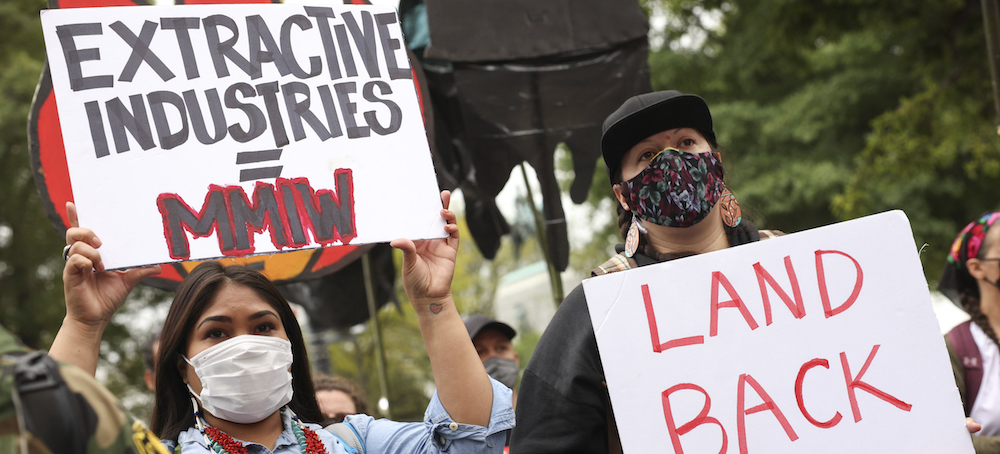
As oil companies push to criminalize dissent, they’re also making the case that climate denialism is protected speech, not fraudulent advertising.
In her Committee on Natural Resources hearing, Porter highlighted the role PR firms play in blocking climate policy. Rep. Blake Moore, R-Utah, and his selected witness, Amy Cooke, CEO of the conservative John Locke Foundation, expressed concern that preventing companies and their hired PR firms from spreading misinformation about climate change would have a chilling effect on free speech.
Meanwhile, the House Oversight Subcommittee on Civil Rights and Civil Liberties, chaired by Raskin, focused on free speech attacks against environmentalists, digging into the fossil fuel industry’s attempts to curb citizens’ speech rights via strategic litigation and laws that criminalize protest. Taken together, the two are a perfect illustration of the industry’s First Amendment strategy: expand free speech for corporations, curb it for citizens.
Raskin’s free speech hearing focused on two key tactics: the increased filing of strategic lawsuits against public participation, or SLAPPs — defamation suits aimed at penalizing citizens or citizen groups for exercising their First Amendment rights — and the proliferation of so-called critical infrastructure bills, which pile on fines and criminal sentences for those caught trespassing or vandalizing near pipelines, power plants, railroads, or other infrastructure. These anti-protest bills were a direct industry backlash to the Standing Rock protests in 2016 and 2017. Starting with a law passed in Oklahoma in 2017, they proliferated with the help of the industry group American Fuel and Petrochemical Manufacturers and the American Legislative Exchange Council, which drafts and disseminates pro-corporate model legislation for adoption by state governments. Seventeen states now have critical infrastructure laws on the books, with several more considering proposals.
“SLAPPs and anti-protest bills are really two sides of the same coin,” said Deepa Padmanabha, deputy general counsel for Greenpeace and a witness at Raskin’s hearing. “They’re tactics used by the same corporate actors to quash dissent. They’re pushing legislation to silence us, to criminalize our critiques through anti-protest bills. And they’re also filing SLAPP suits to silence dissent.”
Greenpeace has dealt with both. Greenpeace USA activists were arrested in 2019 under Texas’s felony critical infrastructure law for unfurling banners on a bridge, which temporarily blocked shipping. The goal of the action was to highlight the connection between the oil industry and climate change.
Greenpeace is engaged in active litigation in a couple of SLAPP suits too. In one, Energy Transfer, the company behind the Dakota Access Pipeline, sued the organization for its role in the Standing Rock protests. The suit was initially filed in federal court and invoked the Racketeer Influenced and Corrupt Organizations Act, or RICO, a law designed to prosecute organized crime. “Energy Transfer was alleging that our advocacy work to uplift Indigenous voices at Standing Rock constituted organized crime,” Padmanabha said.
Because RICO allows for damages to be tripled if a defendant is found guilty, Greenpeace faced a $1 billion fine. Losing that suit would have had a truly chilling effect on free speech. A federal judge threw out the case, but Energy Transfer filed again in North Dakota (minus the RICO charge), a state that doesn’t have an anti-SLAPP law on the books.
Anti-SLAPP laws allow defendants a quick way to get SLAPP suits dismissed, minimizing the time and money spent on meritless cases. Currently, 31 states and the District of Columbia have adopted anti-SLAPP statutes, which makes it fairly easy for corporate entities to go venue shopping for a court in a state without such a law. To address that gap, Raskin proposed new legislation this week to create federal anti-SLAPP protection. While some players in the fossil fuel industry may oppose Raskin’s bill, others have actually sought to avail themselves of anti-SLAPP protections. Exxon Mobil, for example, in its final attempt to thwart the fraud case against it in Massachusetts, argued that the suit was a SLAPP.
The oil company’s attorney Justin Anderson maintained that Massachusetts Attorney General Maura Healey’s fraud complaint against Exxon was not valid because the company’s public statements on climate policy should be considered political opinion (“petitioning activity,” in legal parlance), not misleading advertising — even when Exxon falsely claimed that climate change wasn’t real and overstated the company’s investments in low-carbon technology.
When one judge asked why Exxon would file an anti-SLAPP complaint rather than make a First Amendment argument in court, Anderson made clear that the point was to avoid discovery, when the corporation would be asked to hand over files and make its executives available for depositions. “The anti-SLAPP statute provides a mechanism to have a case that is brought against someone for petitioning activity dismissed at the outset before burdensome discovery is imposed on the party,” he argued.
The “petitioning activity” argument is one that the industry and its allies have trotted out repeatedly, both in court and in congressional hearings like those held this week. It’s a broad interpretation of free speech rights for corporations, the very sort of protection these same companies are opposed to extending to individuals. In his testimony before Raskin’s subcommittee, Daren Bakst, a senior research fellow on environmental policy and regulation for the Heritage Foundation, said, “The chilling effects are states bringing lawsuits against people for their speech.” It’s hard to tell because he said “people,” but he meant oil companies. Which he made clear by immediately referencing “what municipalities are doing, the government is doing against these fossil fuel companies. And I also see that Massachusetts is doing.”
This view of an oil company as a person who is being silenced for simply sharing their views on climate policy is the basic argument oil companies are making in dozens of cases across the country. These cases, brought by both municipalities and states, hinge either on fraud or nuisance claims and effectively ask that fossil fuel companies pay up for delaying action on climate, which increased both the impacts of the climate crisis and the price of adapting to a warming world. In all of them, the corporate defendants make some version of a free speech argument. They maintain that their public speech about global warming differed from their internal knowledge because their public statements were “petitioning speech,” related to their political views and desires and thus, protected. The industry has been building the foundation for such an argument for about as long as it has known about climate change — since the late 1960s.
The argument arose out of a situation not unlike the one playing out today, with war driving up prices at the pump and oil companies desperate to control public perception.
According to documents from Mobil’s corporate archive at the University of Texas at Austin, the company’s longtime PR whiz Herbert Schmertz and then-CEO, Rawleigh Warner, came up with an idea to help wrestle back control of the narrative. Using Mobil’s PR and advertising budget, they would create “idea advertising” to push the company’s take on key issues of the day and create the sense of Mobil as a citizen with a distinct personality.
They ran weekly advertorials in the New York Times as well as regular placements in a wide range of other publications, from the Los Angeles Times and the Wall Street Journal to Time and Fortune. Then Schmertz proposed TV and radio too. Why not?
In the early 1970s, Mobil took their TV and radio advertorials to all the big broadcast stations and only one, NBC, agreed to run them. CBS and ABC said they preferred to have their journalists cover energy issues. For Schmertz and Warner, it was a battle they had to win. What if the newspapers, or PBS, started to rethink playing nice with Mobil? In a media blitz, the two blasted CBS and ABC from every angle, in their NYT spot, on radio and TV programs, at events. Warner went to various business clubs to talk about the importance of protecting corporate free speech. Schmertz testified before Congress in 1978, urging First Amendment protection for Mobil’s ads and arguing that there was no difference between Mobil advertorials and New York Times editorials, because after all the Times was a business too.
Mobil helped rally support and funding for the first big Supreme Court case on the matter, First National Bank of Boston v. Bellotti, the precursor to Citizens United. The court ruled that corporations could spend whatever money they wanted to influence politics, overruling a Massachusetts statute that said otherwise. “If the restricted view of corporate speech taken by the Massachusetts court were accepted,” Justice Lewis A. Powell wrote, “government would have the power to deprive society of the views of corporations.”
“I don’t think people really appreciate how big of a deal that was in shifting the rules of speech in the public space,” environmental sociologist Robert Brulle said. “Now, suddenly, corporations could use their budgets — which are enormous, you know, much larger than individuals — to advocate their position in the public space. … It allowed for a systematic distortion of the public space that gives corporations basically a loudspeaker to amplify their voice above everybody else’s.”
The 2010 Citizens United ruling, of course, intensified that dynamic. Whereas Bellotti allowed corporations to publicly campaign for particular ballot initiatives or candidates, Citizens United allowed political speech of any sort without disclosure of who was paying, who was actually speaking. Oil companies have been working to broaden corporate free speech rights even more in recent years, as their arguments in climate litigation and before Congress show.
“They will try to defend their misinformation efforts as political speech covered by the First Amendment and not subject to false advertising laws,” said Brulle, who has co-authored briefs in some of these cases.
Robert Kerr, who’s researched Mobil’s role in the corporate free speech movement for years, said to side with the oil companies’ arguments in these cases, the Supreme Court would have to turn its back on about a century’s worth of legal precedent. “It’s really deeply established even by some of the members of the current Supreme Court that the First Amendment will never protect expression that is fraud,” he said. “The worry now is that with this court there seems to be a majority that wants to say yes to almost any question the corporate interests raise.”
It makes sense then, that the industry and its allies would be working hard to rebrand climate denialism as simply a difference of opinion, to put some distance between greenwashing and fraud, to collectively gasp about the “chilling effect” (a phrase that came up so often in minority witness testimony this week that it’s hard to believe someone somewhere wasn’t disseminating talking points) that tackling misinformation might have on free speech. The fact that those efforts are happening alongside coordinated attempts to criminalize protest is more of the same: corporations drowning out the public.
Follow us on facebook and twitter!
PO Box 2043 / Citrus Heights, CA 95611


Comments
Post a Comment