RSN: Dan Rather and Elliot Kirschner | Trump Had a Day

24 September 22
Live on the homepage now!
Reader Supported News

And it might get worse
This could be one of his worst, but there may be far worse ones coming down the line if today turns out to be a preface and not a denouement.
This morning started off bad enough.
New York Attorney General Letitia James made it known that she was going to issue a “major announcement.” And she did not disappoint. The lawsuit she filed in state court is in essence a guided missile aimed right at the heart of the Trump family business. Calling the level of fraud she uncovered “staggering,” James outlined a list of facts that could have been a plotline in The Sopranos.
And it isn't just the patriarch in her legal crosshairs. The three children who have been foisted upon the American public — Don Jr., Eric, and Ivanka — also earned starring roles in the court papers.
While this is a civil suit, that’s because James is limited from bringing criminal charges. She did refer her findings to federal prosecutors in Manhattan, but if they choose to press forward, they will likely have to get in line.
That’s because as rough as this morning’s news cycle was for Trump, more pain was in the offing.
This evening, the 11th Circuit ruled on the outrage that has been festering over the investigation into the classified documents the former president took (for still unknown reasons, at least publicly) to Mar-a-Lago.
If Trump was hoping that Trump judges at the appellate level would fall in line like Judge Cannon (the district judge who’s done legal backflips well beyond the bounds of precedent or prudence to accommodate Trump), he was sorely mistaken. Two Trump judges sided with an Obama appointee to issue a stinging rebuke of the lower court’s ruling — a ruling that most judicial experts had felt was about as serious as an episode of Laugh In.
I will leave it to legal scholars to parse the specifics of the lawsuits and rulings, but some big things are clear. One, Trump is in trouble. Big trouble. And not the kind of trouble that he can squirm his way out of by bloviating to Sean Hannity or browbeating Mitch McConnell. He’s on the defensive, and pressure is closing in from all directions.
The timing of these quickening drumbeats of scrutiny overlap with the final stretch of the midterm elections — into which Trump has vociferously inserted himself according to the only metric he knows: what benefits him. November thus is shaping up to be a referendum on Trumpism, to the dismay of many Republican officials. But those same Republicans have made a decision en masse to embrace Trump, at least publicly. From a cynical political calculus one can understand why. The Republican base is the Trump base, or maybe it’s more accurate to put that the other way around.
It is also clear that the core of this base is not enough to power Republicans to majorities in Congress. And yet, if the base stays home, Republicans also will lose.
With so much at stake, the unknowns hanging over Trump and his legal jeopardy are very consequential. How bad might this get for Trump and those who have fastened themselves to him? Will more be revealed? Will any Republicans decide that they need to separate themselves from Trump? Will that lead to disarray within the party as election day approaches? All of this is possible. But it is also possible that Trump skates by once again, at least for now. It is possible that Republicans take back Congress, and they frame their victory as a validation of Trumpism, nevermind what it means for the health and security of the country.
Right now it looks like a close election, but tides can shift, sometimes drastically. Support can crumble. What once looked like strength can be recast as weakness. Just ask one of the few people having a rougher go of it of late than Trump — Vladimir Putin.
Oh, and in other late-breaking news, the January 6th committee has come to an agreement to interview Clarence Thomas’s wife Ginni Thomas. Can’t forget about that investigation.
One imagines all is not quiet tonight in Mar-a-Lago.
Note: If you are not already a subscriber to our Steady newsletter, please consider joining us. And we always appreciate you sharing our content with others and leaving your thoughts in the comments.
 A woman gets assistance fleeing from a civilian apartment complex that was bombed in Chuhuiv, near Kharkiv, Ukraine. (photo: Alex Lourie/Redux)
Investigators visited graves and detention and torture centres, and interviewed more than 150 victims and witnesses.
A team of three independent experts visited 27 towns and settlements, as well as graves and detention and torture centres in four regions – Kyiv, Chernihiv, Kharkiv and Sumy. Their findings are based on interviews with more than 150 victims and witnesses.
“Based on the evidence gathered by the commission, it has concluded that war crimes have been committed in Ukraine,” Erik Mose, the head of the investigation team, told the UN Human Rights Council on Friday.
The categorical nature of the statement was unusual. UN investigators typically couch their findings on international crimes in conditional language, referring the final confirmation of war crimes and similar violations to courts of law.
The council was set up by the Commission of Inquiry (COI) – the highest possible level of investigation – in May to investigate crimes following Russia’s invasion of Ukraine in late February.
Speaking a day before the seven-month anniversary of the war, Mose pointed to “the Russian Federation’s use of explosive weapons with wide area effects in populated areas”, which he said was “a source of immense harm and suffering for civilians”.
Mose highlighted that a number of attacks the team had investigated “had been carried out without distinguishing between civilians and combatants”, including attacks with cluster munitions in populated areas.
The team, which plans to broaden the probe beyond the four regions, had been especially “struck by the large number of executions in the areas” that they visited, Mose said, and the frequent “visible signs of executions on bodies, such as hands tied behind backs, gunshot wounds to the head, and slit throats”.
Mose said the commission was currently investigating such deaths in 16 towns and settlements, and had received credible allegations regarding many more cases which it would seek to document.
The investigators had also received “consistent accounts of ill-treatment and torture, which were carried out during unlawful confinement”.
Some of the victims had told the investigators they were transferred to Russia and held for weeks in prisons. Others had “disappeared” following such transfers.
“Interlocutors described beatings, electric shocks, and forced nudity, as well as other types of violations in such detention facilities,” Mose said.
The commission chief said the investigators had also “processed two incidents of ill-treatment against Russian Federation soldiers by Ukrainian forces”, adding that “while few in numbers, such cases continue to be the subject of our attention”.
The team had also documented cases of sexual and gender-based violence, Mose said, in some cases establishing that Russian soldiers were the perpetrators.
“There are examples of cases where relatives were forced to witness the crimes,” he said. “In the cases we have investigated, the age of victims of sexual and gendered-based violence ranged from four to 82 years.”
The commission had documented a wide range of crimes against children, he said, including children who were “raped, tortured, and unlawfully confined”.
 Charles Koch. (photo: Patrick T. Fallon/WP/Getty Images)
Election watchdogs say Koch’s about face after pledging change following January 6 is disturbing given the threats to democracy
Koch, which is controlled by multibillionaire Charles Koch, boasts a corporate Pac that has donated $607,000 to the campaigns or leadership Pacs of 52 election deniers since January 2021, making Koch’s Pac the top corporate funder of members who opposed the election results, according to OpenSecrets, which tracks campaign spending.
In addition, the Super Pac Americans for Prosperity Action to which Koch Industries has given over $6m since January 2021, has backed some election deniers with advertising and other communications support, as well as a few candidates Donald Trump has endorsed who tried to help him overturn the 2020 election, or raised doubts about the final results.
A top official with AFP Action told Politico after the January 6 insurrection by Donald Trump supporters that it planned to “weigh heavily” future spending and back “policy makers who reject the politics of division”.
Altogether, 139 House members and eight senators voted against certifying Biden’s win in Arizona or Pennsylvania.
Election and campaign finance watchdogs say that the financial support for candidates who were election deniers by Koch’s Pac and the Super Pac AFP Action is very disturbing given the threats to democracy posed by election deniers.
“There’s a unique danger in having politicians who cast doubt on the validity of the last election results play a role in certifying the next election,” said Ian Vandewalker, a senior counsel for the Democracy program at the Brennan Center for Justice.
“Even if they don’t take any overt action to reject the will of the voters, the election denial message itself harms voter confidence in the system. Democracy requires the losing side to accept the results – without that we could see civil unrest on a much larger scale than January 6.”
Although the Koch-funded Super Pac AFP Action had suggested it would not back election deniers after 6 January, analysts aren’t shocked given Koch’s lobbying and legislative priorities, which include fighting various tax and regulatory measures related to fossil fuel issues including climate change that affect the company’s bottom line.
Koch spent $12.2m last year on lobbying – more than any other oil and gas company during 2021.
“Like other corporations pledging change following January 6, Koch Industries has returned to business as usual,” said Sheila Krumholz, who leads OpenSecrets.” Without repercussions and continued public attention, companies will go back to funding politicians who support their agenda.”
“Like many big business spenders, Koch seems more interested in their favored party controlling Congress than the characteristics of specific members,” Vandewalker added.
To be sure, the Koch Pac’s support for 52 election deniers included a number of members whose votes are often helpful to fossil fuel interests.
Senator John Kennedy of Louisiana, who is often a staunch ally of fossil fuel interests, received $20,000 from Koch’s Pac, a sum only matched by the corporate Pac of Capital One. Kennedy teamed up with other senators in January 2021 on a statement that claimed the 2020 election was “rife with allegations of fraud and irregularities that exceed any in our lifetimes”.
Senator Roger Marshall of Kansas, where Koch is headquartered, also voted against certifying Biden’s election and has received support from Koch’s Pac. Marshall is not up for re-election this year.
Separately, Americans for Prosperity Action, to which Koch has donated $6m, has spent almost $20m on ads and other communications much of which has gone to support some election deniers running for the Senate and House, plus Senate candidates who tried to help Trump reverse the 2020 election results or who have raised doubts about its outcome.
For instance, House member Ted Budd, who voted against certifying Biden’s win on 6 January, and now hopes to win a Senate seat in North Carolina, has benefited from almost $3.1m that AFP Action has spent to help him win the seat of the retiring senator Richard Burr. Budd has also told CNN that he had “constitutional concerns” about the election while acknowledging that Biden is president.
Similarly, two House members who opposed certifying Biden’s victory, Kat Cammack of Florida and Steve Chabot of Ohio, have both attracted backing from AFP Action. AFP Action has spent $369,750 to help Cammack and $287,902 to help Chabot.
Moreover, AFP Action has spent $4.9m to boost the Missouri attorney general, Eric Schmitt, who filed a lawsuit in December 2020 in tandem with the Texas attorney general to overturn the election results, and is running for an open seat.
The Wisconsin senator Ron Johnson also has benefited from $4.2m spent by AFP Action to help him in what seems to be a tight re-election race. According to revelations at a House January 6 committee hearing in June, an aide to Johnson reportedly helped promote efforts to substitute fake electors for Trump for legitimate ones that Biden won in the run up to 6 January when Congress certified the election results.
And Mehmet Oz, the GOP Senate candidate in Pennsylvania, whose campaign has been backed by over $2m of ad and other support from AFP Action, told Fox News in September that “lots more information” was needed to assess whether Trump won the 2020 election, contradicting prior Oz remarks that he would have certified Biden’s election if he was senator.
Election objectors won substantial donations from other corporate Pacs besides Koch’s. OpenSecrets reported in August that altogether members who voted against certifying Biden’s win received a whopping $22m post-January 6 from the Pacs of 700 corporations. Besides Koch’s Pac, the other top corporate Pacs were those of Home Depot and Boeing that respectively ponied up $593,000 to 44 members and $520,000 to 27 members.
Still, at least one veteran of a thinktank that Charles Koch co-founded and has helped fund says that the company’s ongoing support for election deniers is very troubling.
“When the only elected officials who will carry your political water are proto-fascists, what is one to do?” said Jerry Taylor, a former vice-president at the Cato Institute in DC where he oversaw climate and energy issues. “Charles Koch has made his choice. This self-proclaimed voice of freedom and liberty has apparently decided that advancing the public policies he desires is more important than democracy.
“His choice is not unlike the choices that most German industrialists made in the Weimar Republic.”
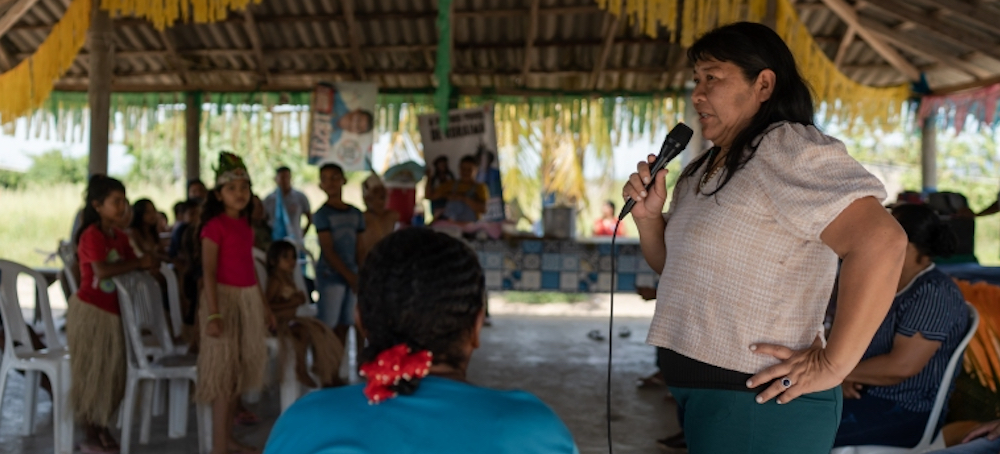 Joenia Wapichana addresses a crowd at a political campaign event. (photo: Avener Prado/Al Jazeera)
In Roraima, where two-thirds of people support the far-right president, Indigenous activists aim to halt illegal mining.
In 2018, Wapichana became the country’s first Indigenous woman elected to Congress; today, she seeks a second term for the Amazonian state of Roraima, where far-right President Jair Bolsonaro has more support than in any other state, according to recent polls.
But Wapichana says Bolsonaro has been a disaster for Indigenous communities across Brazil, as his pro-mining rhetoric fuels the growth of illegal gold mining operations on Indigenous lands.
“From the moment he opens his mouth to talk about the absurd, illegal, illicit issues that he supports, he puts the lives of the Indigenous people at risk,” she told Al Jazeera in a rare interview with foreign media.
Highlighting the importance of Indigenous political representation, she added: “Thirteen percent of Brazil is Indigenous territories, yet in Congress, they make decisions without our participation.”
Indigenous advocacy groups hail Wapichana as a trailblazer, and this year, a record number of Indigenous candidates — more than 180 — have registered to run in Brazil’s October 2 elections. Yet, with campaigns on shoestring budgets, lacking traditional political party structure and wealthy donors, many face an uphill battle.
In Roraima, nearly two-thirds of people support Bolsonaro’s re-election, while just 18 percent back national frontrunner and left-wing former President Luiz Inacio Lula da Silva, according to the latest opinion polls by Ipec.
“It’s a frontier state with a mainly conservative population that mostly shares the president’s views on family, land use and Indigenous rights,” political scientist Paulo Racoski, who teaches at the Federal Institute of Roraima, told Al Jazeera.
He highlighted several of Bolsonaro’s past claims, including that Indigenous people have too much land for their population numbers and that if he were “king” of Roraima, its economy would rival that of Japan or China on account of the state’s mineral wealth.
“Despite being mostly untrue, these are messages that resonate,” Racoski said.
Searching for El Dorado
In the 16th century, Spanish conquistadors scoured Roraima for the mythical, gold-rich kingdom of El Dorado. In the late 20th century, thousands of migrants from across Brazil, and especially the poorer northeastern region, flocked here in search of opportunities. Many ended up working as gold miners on the Yanomami Indigenous territory, which, since Bolsonaro’s election, has seen a new uptick in illegal mining and related violence.
Today, while there are no legal gold mines operating in Roraima, a seven-metre-high monument to miners outside the legislative assembly in the capital Boa Vista is emblematic of the state’s relationship with mining.
“Politically, it’s tough for a candidate to confront the interests of wildcat mining in the state,” Alisson Marugal, a federal prosecutor based in Roraima, told Al Jazeera. “It plays a large part in the economy.”
Last October, Bolsonaro visited an illegal mining site in Raposa Serra do Sol and touted a proposed bill to legalise mining and other industrial-scale activities on Indigenous lands.
“If you want to plant, you will plant,” the president, wearing an Indigenous headdress, told an assembled crowd. “If you are going to mine, you are going to mine.”
According to Roraima’s Indigenous Council, the state’s largest Indigenous rights group, more than 4,000 illegal miners have operated on the Raposa Serra do Sol reserve since Bolsonaro took office in 2019. The council has presented federal prosecutors with a report listing alleged human rights violations linked to these operations.
“The invasion of illegal miners causes environmental degradation, deforestation, pollution of rivers, streams and lakes, an increase in cattle and vehicle thefts, high rates of malaria, STDs and COVID-19 in communities,” notes the report, a copy of which was seen by Al Jazeera.
It further highlights “drug trafficking, presence of criminal gangs and firearms … increased violence in communities, death threats and persecution of leaders”.
In April, three people were shot to death in the territory, in a killing authorities alleged might have been tied to illegal mining debts.
While federal agencies run frequent enforcement operations to combat illegal mining, there has not been one in Raposa Serra do Sol for more than a year, authorities confirmed. Federal police told Al Jazeera that the last operation to combat illegal mining on the reserve took place last year, but offered no further comment.
This has led some locals to take matters into their own hands. In one recent example, a surveillance group organised by Indigenous guardians in Raposa Serra do Sol in June burned a raft used by illegal miners to extract gold on the Ireng River, near the border with Guyana.
Destroyed landscape
During Roraima’s recent rainy season, Al Jazeera joined three Indigenous guides on an expedition through flooded plains to one of several illegal mining sites at the base of a sacred local mountain known as Serra do Atola, and surveyed the area with a drone. The destruction was striking: the mining encampment opened up like a brown scar across the otherwise green landscape, with dozens of mining pits, some covered by blue tarpaulin to protect miners from the elements.
“Lots of strange people pass through here,” said one of the Indigenous guides, who asked to remain anonymous for security reasons. The guides said that because of the recent heavy rains, the number of miners was temporarily reduced, but they would flow back in again for the dry season.
Last year, the Amazon military command, federal police and environmental agencies raided the site and found 400 people, precision scales, excavation pits, gold and toxic mercury for gold processing. Months later, an Associated Press news agency investigation found the mining camp up and running again, with workers using portable generators to power jackhammers to break the rocks.
Roraima’s Indigenous Council says that businesspeople and politicians from outside the reserve have financed the mining, taking a percentage of the gold extracted, while Indigenous people have often been exploited as cheap labour.
“There is no Indigenous person here that has gotten rich from illegal mining,” Bartolomeu da Silva Tomaz, running for Roraima as Brazil’s only Indigenous Senate candidate, told Al Jazeera.
“The people who get rich from illegal mining are the businessmen … companies that sell machines, motors and equipment, the companies that sell fuel … these guys get rich,” he said.
If elected, he says he would make the removal of illegal miners from Indigenous lands a top priority — a bold position in a state whose economy is sustained in part by illegal mining, according to federal prosecutors.
Lacking a voice
Today, more than 26,000 Indigenous people from five ethnic groups live on the 17,470sq-km (6,745sq-mile) Raposa Serra do Sol territory, which borders Venezuela and Guyana. Unlike many Amazonian Indigenous lands covered in lush rainforest, Raposa Serra do Sol is mostly tropical savannah. Cattle ranching, often associated with deforestation, is also permitted in the area.
In all of Brazil, which is home to some 900,000 Indigenous people from more than 300 ethnic groups, Roraima has the largest Indigenous population, at more than 55,000. Nearly half of its territory comprises Indigenous lands, and yet, there is no Indigenous representative on its 24-seat state assembly.
“Today we have a voice in Brasilia, which is our lawmaker Joenia Wapichana,” Aldenir Wapichana, an Indigenous leader who is running to be a state legislator, told Al Jazeera. “But on a state level, we still don’t have dignified representation … It’s important to defend our rights, in health, in education.”
He praised the work of Lula da Silva, who is running again to unseat Bolsonaro and leads polls by a double-digit margin, in ensuring that Raposa Serra do Sol gained full protected status in 2005. Bolsonaro has previously said he would “undo” this demarcation, even though he does not have the power to make that change, and arm local farmers “with rifles”.
In Brazil’s 2018 elections, Normandia, Uiramuta and Pacaraima, located within the limits of Raposa Serra do Sol, voted against Bolsonaro — the only three municipalities in Roraima to do so. A rock painted with the words “Get Out Bolsonaro” sits near an entrance to Normandia.
Still, public opinion on Bolsonaro remains divided in this region.
Last year, the Society for the Defence of the United Indians of Roraima, which opposes the Indigenous Council’s leadership and advocates for mining and other activities, invited Bolsonaro to an illegal mining site in the Flexal community, where he touted the bill to legalise mining. The group’s leader, Irisnaide Silva, is also running for Congress against Joenia Wapichana.
In March, the Brazilian government awarded Silva, Bolsonaro and a group of ministers “Indigenous merit” medals, drawing scorn from Indigenous advocacy groups.
While Silva did not respond to Al Jazeera’s request for comment, she has publicly described herself as “the Indigenous woman who defends development”.
‘Environmental crisis’
In Brazil, political parties are allocated public funding based on how many seats they have in Congress. Joenia Wapichana’s Sustainability Network has only two seats in the lower house, compared with 77 for Bolsonaro’s Liberal Party.
Candidates may also receive private donations from individuals, a system that tends to favour those who represent mining or agricultural interests. In addition, candidates can use their own money to help fund their campaigns.
Joenia Wapichana, who declared 20,000 Brazilian reals ($3,900) in assets this year, is competing against Rodrigo Cataratas, a pro-mining businessperson and Liberal Party supporter of Bolsonaro who declared 33 million Brazilian reals ($6.45m) in assets, for one of eight congressional seats for Roraima. The fight promises to be a tough one, and it will not end on election day.
If re-elected with enough support in Congress, Bolsonaro could try to push through his long-planned bill to allow mining and other industrial activities on Indigenous lands. As is the case with many Indigenous territories, official requests from companies to mine in Raposa Serra do Sol, including proposals for both gold and diamond mines, have increased since Bolsonaro took office, according to data compiled by the monitoring group Amazonia Minada and seen by Al Jazeera.
Some fear that a long-planned hydroelectric dam on the Cotingo River, a project considered strategic by mining interests, could also be resurrected in the event of Bolsonaro’s victory, posing a flood risk to many communities in Raposa Serra do Sol.
“If Bolsonaro is re-elected, we will see a continuation of anti-Indigenous policies,” Antenor Vaz, a former coordinator with Brazil’s Indigenous agency Funai who now works as an independent consultant, told Al Jazeera. “Raposa Serra do Sol would face even more pressure from illegal gold miners, as well as large landowners from outside the reserve.”
Back at her campaign event, Joenia Wapichana maintains that Indigenous representation in Congress is vitally important, both for Brazil and for the planet as a whole.
“Many non-Indigenous people have the same interests as Indigenous people, such as the preservation of the environment,” she said. “The planet is going through an environmental crisis, and we know that a lot depends on the protection of Indigenous territories.”
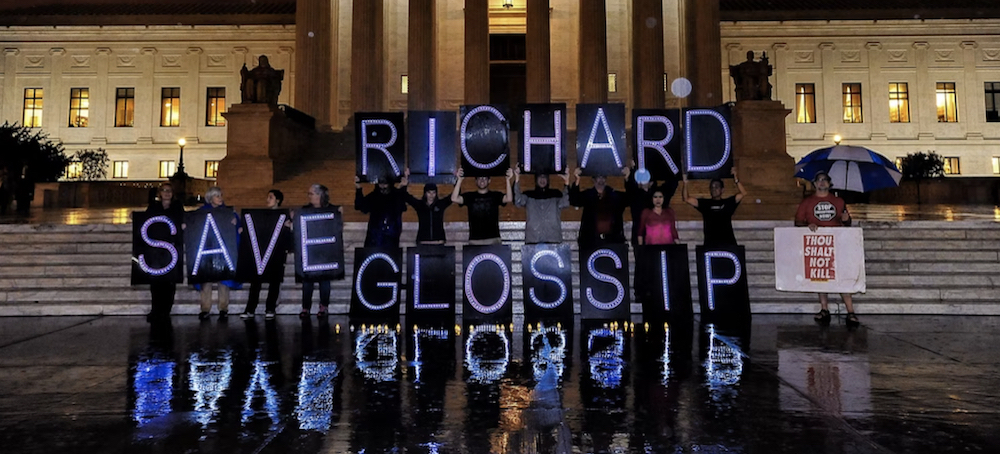 Anti-death penalty activists rally outside the U.S. Supreme Court in an attempt to prevent Oklahoma's planned execution of Richard Glossip. (photo: Larry French/Getty Images)
Richard Glossip faces a December execution date as Oklahoma lawmakers call attention to new evidence of prosecutorial misconduct in his case.
Glossip’s life had been spared by Gov. Kevin Stitt, who paused the September 22 execution date amid explosive new evidence in the case. The stay of execution followed a petition filed by Knight to the Oklahoma Court of Criminal Appeals, asking for a hearing to consider new evidence that cast further doubt on Glossip’s guilt. With a new execution date set for December 8, even more disturbing revelations had come to light: including evidence of prosecutorial misconduct so alarming that state Rep. Justin Humphrey called for an investigation into the Oklahoma County District Attorney’s Office.
“I was very reluctant, as a law enforcement officer, to look at this case,” Humphrey said at the press conference. But the investigative failures in Glossip’s case shook him to the core. Today Humphrey is convinced that not only should Glossip never have been sentenced to die, he also never should have been sent to prison. “Now I’m at the point we’re investigating the wrong people,” he said, calling the government’s conduct in Glossip’s case “extremely unethical.”
Humphrey is one of more than 60 state lawmakers who have raised alarm over Glossip’s case. The press conference came on the heels of a third report in as many months by the law firm Reed Smith LLP, which is conducting an independent investigation into the case at the lawmakers’ behest. Like the previous reports, the newest revelations expose how Oklahoma City prosecutors twice convicted Glossip despite clear indications that he was an innocent man.
Glossip was sentenced to death for the 1997 murder of Barry Van Treese at the Best Budget Inn, a rundown motel owned by Van Treese. No physical evidence connected Glossip to the crime. Instead, the case against Glossip was almost entirely based on the testimony of Justin Sneed, then 19, who admitted to bludgeoning Van Treese to death with a baseball bat inside Room 102. Sneed implicated Glossip as the mastermind behind the crime, but only after a highly coercive interrogation by Oklahoma City police detectives who repeatedly emphasized their belief that Glossip was involved.
From the beginning, Sneed offered wildly shifting accounts — starting with his confession to police and continuing through each of Glossip’s trials, where he was the star witness for the prosecution. In recent years, Sneed has continued to contradict himself, while a slew of new witnesses have come forward to say that he’d boasted about falsely implicating Glossip in order to save his own skin.
After failing to convince Stitt or the Oklahoma attorney general to investigate Glossip’s case, the Oklahoma lawmakers turned to Reed Smith in February 2022, and the firm took on the work pro bono. Thirty attorneys, three investigators, and two paralegals have reviewed over 12,000 documents and interviewed more than 36 witnesses. The firm’s first report was released in June. Since then they have released two additional reports, the most recent on September 20. In all, the reports contain bombshell revelations that paint the clearest picture to date of Glossip’s wrongful conviction.
Among the most compelling pieces of new evidence are handwritten letters from Sneed that reveal how close he came to taking back his story about Glossip. In 2003, a year before Glossip’s retrial, Sneed wrote to his public defender, asking, “Do I have the choice of re-canting my testimony at any time during my life, or anything like that.” In 2007, he sent the lawyer another letter: “There are a lot of things right now that are eating at me,” he wrote. Things he needed “to clean up.” Although he didn’t specifically mention recanting, he suggested that he’d made a “mistake.” The lawyer, Gina Walker, who has since died, discouraged him from coming forward.
The most recent report digs deeper into Sneed’s conflicting statements, his efforts to recant, and prosecutors’ efforts to keep him in line. Investigators with Reed Smith interviewed Sneed in prison three times over the last month, for a total of more than eight hours. Portions of the interviews contained in the report show that Sneed’s account remains a mess of shifting narratives — save for his parroting of the key element of the prosecution’s theory of the case: that he was an impressionable young man lured into a murder plot. “It is disconcerting that the only details he appears to state consistently are that he killed Barry Van Treese, and that Glossip is to blame for it,” the report says.
The letters from Sneed to his attorney are not the first indication that Sneed sought to take back his story. In October 2014, O’Ryan Justine Sneed — Justin Sneed’s grown daughter — sent a letter to the Oklahoma Pardon and Parole Board saying that she “strongly believe[s]” that Richard Glossip is an innocent man. “For a couple of years now, my father has been talking to me about recanting his original testimony,” she wrote. “I feel his conscious [sic] is getting to him.”
In his interviews with Reed Smith, Sneed confirmed for the first time that he had spoken to his daughter about a desire to break his plea deal and to recant. But he also insisted that by “recant,” he didn’t mean he necessarily wanted to change his story. During an interview on August 26, Sneed told Reed Smith that “it was more about silencing my testimony in the way of me not having to be there,” he said, and “taking back the plea agreement.”
In all, Sneed has spent 11 years discussing recanting “with various individuals that he trusts,” Reed Smith noted. “When these admitted statements from Sneed made to his family in 2014 are combined with the recently obtained letters written by Sneed from 2003 and 2007, all discussing ‘recanting’ or needing to ‘clean things up’ it is deeply troubling.”
Bad Faith
Perhaps one of the most stunning new revelations is that the prosecutors who retried Glossip in 2004 were aware that Sneed had considered recanting — and took extraordinary steps to keep that from happening. “In his August 25, 2022 interview, Sneed confirmed that he met with representatives of the District Attorney’s Office along with his attorney, Gina Walker, before Glossip’s retrial where his plea agreement and his not wanting to testify were discussed,” the report says.
Notes found in the prosecutors’ file document a series of meetings with Assistant District Attorney Connie Smothermon, Sneed, and Walker regarding Sneed’s reluctance to testify — information that, by law, should have been turned over to the defense. Smothermon’s trial partner Gary Ackley told Reed Smith he didn’t know anything about this, and that it was cause for concern. “Any prosecutor would be concerned about any cooperating witness in any big case regarding the uncertainty of the waffling back and forth and the disingenuous bad faith nature of such actions,” Ackley said.
Not only was this information never disclosed to the defense, Smothermon also apparently worked with Sneed’s attorney as Glossip’s second trial was underway to keep Sneed in line. In a May 2004 memo to Walker, Smothermon laid out six detailed questions for Sneed based on the testimony already delivered by other witnesses at the retrial. The apparent goal was to try to square Sneed’s testimony with what others had said: a maneuver that would violate rules designed to insulate witness testimony from being contaminated by outside information or from the testimony of another witness.
The most egregious example involves testimony from Dr. Chai Choi, the medical examiner who conducted Van Treese’s autopsy. At the retrial, Choi testified that Van Treese had puncture wounds, “a stabbing-type injury,” to his chest. Although there was a knife found at the scene, Sneed had previously said that he did not use the knife — an inconsistency that Smothermon sought to fix before Sneed took the stand.
“Our biggest problem is still the knife,” Smothermon wrote in the memo to Walker. “Justin tells the police that the knife fell out of his pocket and that he didn’t stab the victim with it.” But when Sneed took the stand at the retrial, he testified for the first time that he had in fact stabbed Van Treese. “This reversal of his statement given to police does not appear to be a coincidence,” Reed Smith wrote. “Rather, it appears to be manufactured in response to ADA [Smothermon’s] communication during trial to Sneed’s attorney explicitly about what had been testified to by other witnesses about the knife.”
Ackley told Reed Smith that the change in Sneed’s testimony was “night and day,” and that if it was prompted by Smothermon’s memo, it would be a problem.
At the press conference, Knight, Glossip’s attorney, again emphasized the need for an evidentiary hearing. “It becomes ever more apparent with each passing day that not only did the prosecution destroy evidence, they manufactured evidence. They changed people’s testimony. They broke the rules. All to try to get a conviction against Rich Glossip on a death penalty case that should never have been brought at all,” he said. “The thing that I think everybody needs to take away from this: Rich Glossip is a nobody. He’s not some powerful person. He’s just like all the rest of us. This is what the government can do when they’re allowed to run amok.”
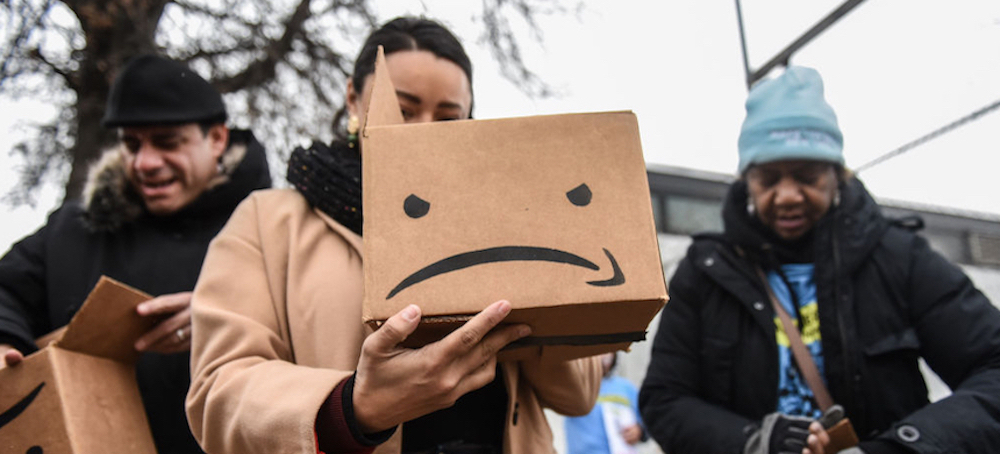 A good union can transform the workplace. (photo: Stephanie Keith/Getty Images)
Starbucks and Amazon’s current anti-union strategy is an effective one: infinite delay. Employers can’t always stop workers from winning a union election, but labor law currently allows them to buy time to kill union support.
None of this is surprising. The ALU won the election by more than five hundred votes. It is very hard to overturn a margin that big. Amazon did not expect to win, and indeed winning was not their goal. Delay was their goal, and by filing twenty-five essentially bogus allegations they bought more than five months of delay.
After the regional director issues a decision, Amazon will appeal to the board in Washington. It will most likely lose there as well. They will then appeal to a federal court of appeals. It should also lose there. But Donald Trump’s administration successfully appointed many right-wing judges who care little about the lives of working people and know even less about labor law. Nonetheless, even in the federal courts, winning is not Amazon’s goal. Once again, delay is the goal.
I worked as an NLRB attorney at the Manhattan Region in the mid-1980s. Shortly after I started, the region opened a ballot box that had been “impounded” for a few years. (Sometimes if there is a lot of litigation concerning a representation case, the region will conduct the election, seal the ballot box, and not count the ballots until the legal issues are resolved.) When the ballots were counted, the union had won. None of the workers who voted in the election were still working for the company, I was told. The union had won a pyrrhic victory as it no longer had any support.
This is not the situation with the Amazon election in Staten Island, as the ballots were counted. But Amazon’s goal is to have the same result — delay the proceedings until all the union supporters are gone. Even if the union ultimately wins, it loses.
Amazon, like other employers who can afford to buy time, want to delay the process as much as possible to convince workers that unionization is futile. With a turnover rate of 150 percent, Amazon knows that most of the workers who defied the company and voted for the union will have left the company long before the legal issues are resolved.
This is a well-worn employer playbook. While the lawyers file endless delaying motions and appeals, union-busting companies use other means to crush support for the union. They subject workers to endless captive audience meetings where they drone on about the evils of unions, they bombard them with anti-union propaganda, they fire leaders, they change work rules, they give greater benefits to non-union workers, they drag out bargaining, they covertly encourage anti-union workers to petition for another election to vote the union out. Their aim is to make unionizing so difficult that workers and their unions give up.
Over the last year, workers have been winning union elections across the country. Petitions for representation elections have increased at the NLRB by 58 percent. Along with victory at Amazon, Starbucks workers have filed petitions for union elections at hundreds of stores, winning most. These victories have inspired others. Workers at REI, Trader Joe’s, and even the Audubon Society have also organized. Industries once thought immune to union ideas such as the video game and tech industries are now organizing. In most of these campaigns, the unions have been certified.
The next step is harder. Once a union is certified, the employer allegedly has an obligation to bargain in “good faith.” That term has been stretched so thin that it’s almost meaningless. During the last many decades, employer-side lawyers successfully eroded any punch the good faith requirement once had. Skilled union-busting law firms know how to come up to the line and not cross it, making it very difficult to prove bad-faith bargaining. NLRB decisions during Republican administrations uphold atrocious employer behavior as lawful. These terrible decisions become precedent granting employers even more leeway to deny workers their rights. This process has been going on for a long time.
A union cannot be voted out for one year after being certified. Thus, during this first year, the employer’s goal is — no surprise — delay. It drags out bargaining so that an agreement cannot be reached before the end of the certification year. With little happening at the bargaining table, workers understandably become discouraged. As the one-year anniversary approaches, employers working behind the scenes begin encouraging anti-union workers to file a decertification petition seeking a second vote to oust the union.
While it takes many different forms over the course of the process, delay is an incredibly effective anti-union strategy. Unfortunately, our labor law is set up to support employers in dragging things out.
The Cablevision Story
In early 2012, workers at Cablevision in Brooklyn (now Optimum) voted overwhelmingly for a union. The mostly black workforce voted 180 to eighty-six to be represented by the Communications Workers of America (CWA).
Like many of the workers in this current wave of organizing, Cablevision workers began by organizing themselves. Inspired by a massive strike in New York and New England of telephone workers against Verizon, the Brooklyn Cablevision workers collected signatures for a representation election and came to CWA with signed cards. Several months later, after building a strong committee at the three garages in Brooklyn, the union filed for an election. Cablevision, like Amazon and other big employers, had successfully fought unionization for years; they did not expect to lose.
After the vote, Cablevision spent many millions trying to get rid of the union. Early on, its lawyers rejected bargaining dates using one lame excuse after another. They failed to provide needed information requested by the union or gave the wrong information. While refusing to bargain with CWA over money issues for the Brooklyn workers, Cablevision gave all other workers in the entire company raises averaging 14 percent. As at Amazon and Starbucks, the union filed multiple unfair labor practice charges with the NLRB.
Shortly before the first year was up, Cablevision illegally fired twenty-two workers at the same time. Those twenty-two workers were almost 10 percent of the Brooklyn workforce. To put this in perspective, if Amazon had fired the same percentage of workers at the Staten Island warehouse, they would have had to fire over five hundred workers. On the same day that Cablevision fired twenty-two workers, it gave out a memo reminding the Brooklyn workers that the one-year certification period was almost over and they should call the NLRB if they wanted to know how to decertify the union. Helpfully, it gave the phone number for the Brooklyn Region.
The Cablevision firings were illegal, but Cablevision was not concerned. Their aim was to terrify the Brooklyn workforce with the firings and goad them into voting the union out. If way down the road they had to pay backpay to the twenty-two workers, so be it — that would be considered the cost of doing business. The goal was shedding the union.
Their plan failed. The decertification petition filed by a group of anti-union workers was dismissed by the NLRB region because of the many unremedied unfair labor practices. Cablevision fired more workers. When the labor board refused to conduct another election, Cablevision conducted its own illegal election to vote the union out. Not surprisingly, the union lost Cablevision’s sham election (although not by much). Cablevision then took out full-page ads in the New York Times and the Daily News announcing their victory. The Cablevision election did not mean that the union did not represent the Brooklyn Cablevision workers — its purpose was to demoralize the workers. It also was illegal.
Eventually the Cablevision workers and CWA won. It took more than five years. During those five years, the workers and the union organized, marched, demonstrated, testified, petitioned, and held strong. Many unfair labor practice charges were filed at the region and multiple trials were held, two lasting more than twenty days each. The NLRB even considered seeking an injunction in federal court against the company. Cablevision finally put a serious offer on the table, although not 14 percent as workers at the rest of the company had gotten.
The battle went on for several more years. The workers and CWA eventually won. The timing of the victory involved the sale of the company, but more important, the workers and the union won because they never gave up.
At the time of the settlement, none of the unfair labor practice charges filed by the union against Cablevision had been resolved. The union had won at the trial level, but Cablevision appealed every decision to the board in DC and announced that it would appeal to federal court as well if it lost at the NLRB. In the face of these tactics, the victory was achieved because the workers kept fighting.
To win, workers and unions must throw everything into the fight. When the parties finally reached agreement at Brooklyn Cablevision, the document settling all the outstanding NLRB issues was more than seventy pages long.
The Right to Organize
Under our current labor laws, employers with enough resources, like Cablevision, Amazon, and Starbucks, can drag things out for a very long time, spending millions and millions of dollars to get rid of a union. One might ask: Why don’t they just spend the money on making things better for the workers at their companies? The answer is simple: they believe that in the long-term unions will cost them more.
Beyond the issue of financial cost, there is also the issue of control. Companies do not want to share control of the workplace with the people who work there. They want to be able to hire and fire as they see fit, to reorganize work without dispute, and to shut down an operation or facility without consideration of the workers they are harming. In essence, they want to squeeze as much as possible out of their workforce without organized resistance.
The fact that employers fight so hard tells you how much a union is worth. A good union can transform the workplace. Getting there today is hard. Newly organized workers need to be prepared for the long haul.
To support these newly organized workers, the labor movement must demand more resources for the NLRB now. The agency was hollowed out under the Trump administration and is in crisis. It is underfunded and underresourced. Delay is endemic, and as we have seen, delay advantages employers. Labor law in this country must be changed.
Support for unions is now 71 percent, the highest it has been in more than fifty years. Joe Biden pledged to be the most pro-union president in history. He and other Democratic politicians claiming to support labor need to do more than just mouth platitudes. For a start, they need to pass the PRO Act, which would impose meaningful penalties on outlaw employers, require real good-faith bargaining with mediation and arbitration as a backstop when such bargaining does not occur, make union organizing easier, and more.
A great deal of damage has been done to labor law over the last few decades, and there is a lot to undo. Working people have the right to organize unions, and those rights must be promoted and protected.
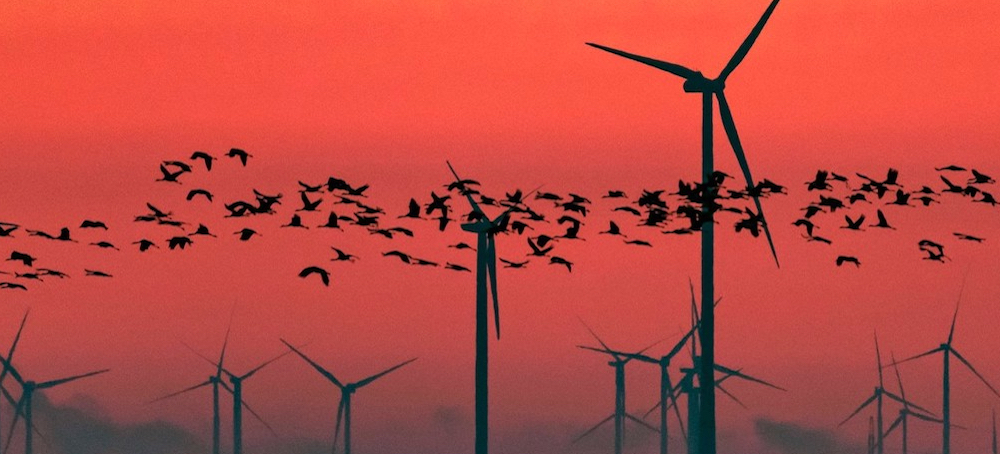 A wind farm. (photo: Jens Meyer/AP)
“No one wants a mine in their backyard.”
Over the next several decades, global demand for these “critical minerals,” a group that includes lithium, cobalt, nickel, and copper, is projected to increase by 400-600 percent driven by a surge in manufacturing of renewable technologies. For some metals like lithium and graphite, it could skyrocket by as much as 4,000 percent.
China dominates this global market, processing 50-70 percent of the world’s lithium and cobalt. But the Biden administration has taken a hard line against providing tax breaks to manufacturers who source metals from countries without free trade agreements with the U.S. That means that developers of technologies like electric vehicles and wind turbines need to find new supply streams – and fast.
But the process of extracting metal and mineral deposits from the earth, known as hardrock mining, has a reputation for contaminating local watersheds and causing irreparable environmental damage. That’s why domestic mining projects often encounter legal challenges and protests when they are initially proposed.
“It’s very hard to open up a mine in the United States. No one wants a mine in their backyard,” said Jordy Lee, a program manager at the Payne Institute for Public Policy at the Colorado School of Mines. “It’s not clear how the U.S. is supposed to mine and produce all these minerals when there’s so much pushback against the industry.”
Domestic mining is governed by a 150-year old law that critics characterize as a relic of the Wild West Era. Unlike laws regulating other extractive industries like oil and gas, the General Mining Law of 1872 doesn’t require companies to pay federal royalties on the resources they extract from public lands. A patchwork of more recent legislation regulates the environmental impacts of mining, but since it is distributed across multiple federal agencies, it can take years before a project gets approved. The Biden administration has recently passed a batch of bills to incentivize the buildout of a domestic supply chain to mine and process the minerals necessary for weaning the country off fossil fuels.
Now, Senator Joe Manchin, Democrat of West Virginia, is proposing legislation that would speed up permitting for major energy and infrastructure projects, including mining. The National Mining Association has said that the bill would help hardrock mining companies meet rising demand by providing some certainty that their projects will get greenlighted.
Environmental advocates and community groups whose land risks destruction from proposed projects see it differently. Mining activity has left deep scars across the American West, where the Environmental Protection Agency estimates that 40 percent of watersheds have been contaminated by hardrock mines. This environmental degradation has had particularly severe consequences for indigenous communities because many live close to the country’s largest deposits of nickel, lithium, cobalt, and copper.
The history of mining in the United States is inextricably linked to the history of westward expansion. The General Mining Law of 1872, inked 150 years ago by President Ulysses S. Grant, proclaimed mineral extraction to be the highest and best use of U.S. public lands, and encouraged waves of settlers to move West, displacing indigenous people from their native lands.
A century later, the Cold War spawned another mining boom, as uranium was needed for nuclear weapons. Government incentives helped develop mining from an industry of pickaxes and shovels to one that employed massive machinery to blast through mountaintops and scrape the surface of the earth. At the time, the only law governing mining was the one Grant had signed in 1872, and companies were allowed to abandon sites without cleaning up the toxic by-products they left behind. The consequences of this unregulated activity were disastrous: More than 22,000 abandoned hardrock mines around the country still pose an environmental hazard to the surrounding area.
After a national environmental movement swept through the nation in the 1960s, President Richard Nixon signed a series of laws that changed how the mining industry is regulated, including the Clean Water Act, the National Environmental Policy Act, and the Endangered Species Act. Regulations passed in the 1970s mandated that companies clean up project sites after they finished. But by the time these measures were implemented, demand for critical minerals had waned as the Cold War came to a close. When the tech boom started in the late 1990s, companies needing lithium and other metals for cell phone batteries and high-speed cables sourced them from other parts of the world. As countries like China and Chile built out their hardrock mining industries, the U.S. focused on developing other industries, like oil and gas.
“We used to be the largest lithium producer in the world and now we’re one percent of it,” said Ben Steinberg, a former Department of Energy official who represents the mining industry at the public relations firm Venn Strategies in Washington, D.C.. “So the knowledge about how mining operates, and what its value is to the country, is largely lost.” This is all the more challenging, Steinberg said, because many of the people who live near new extraction projects are against mining at the very moment when the country suddenly needs a lot more of it.
“It’s a big threat,” said Joe Kennedy, a Western Shoshone activist who spoke to Grist after a day of lobbying against the mining industry in Washington, D.C. Western Shoshone lands, which stretch across parts of Nevada, California, Idaho, and Utah, have been contaminated by uranium extraction and open pit gold mining. Today, numerous companies are looking to open new gold and lithium mines in the region. “We’re playing with fire, and we’re probably going to get burned.”
The question of how much the U.S. should develop its hardrock mining sector is hotly contested. The impact of Russia’s invasion of Ukraine on the European economy has highlighted the risk of relying too heavily on foreign nations for critical resources. Numerous environmental organizations have pointed out that the development of a circular economy in which critical minerals are recycled rather than continually extracted could decrease the country’s need for mining. The environmental watchdog Earthworks estimates that recycling has the potential to reduce demand by approximately 25 percent for lithium, 35 percent for cobalt and nickel, and 55 percent for copper by 2040. But more recycling isn’t likely to meet the demands for critical minerals anytime soon.
“This isn’t the choice of yes or no for the need for minerals that come from the ground,” said Steinberg. “This should be a conversation about how.”
Both Lee and Steinberg think it’s possible to mine for critical metals sustainably with the consent of locals, and also avoid repeating the mistakes of the twentieth century. But doing so will require Congress to pass stronger laws and standards.
That’s why the Biden administration recently convened an interagency working group on mining reform, which has been directed to come up with recommendations for creating new environmental standards and defining procedures for incorporating local recommendations.
But some people living near proposed project sites have argued that certain parts of the country are simply too culturally precious to mine. Take Chi’chil Biłdagoteel (known in English as Oak Flat), a forested region of southeast Arizona where mining giants Rio Tinto and BHP want to build a copper mine on land sacred to members of Western Apache and Yavapai tribes. The companies hope to extract the metal material by blasting through underground ore deposits, a method that could create a crater up to two miles wide and 1,000 feet deep. Tribal members and their allies have been fighting the project for nearly two years in federal court.
“There are different types of sustainable mining, and one of those is the actual process of choosing where,” said Blaine Miller-McFeeley, a senior legislative representative at Earthjustice. “That is just as important as choosing how.” He called the bill Manchin is pushing in Congress “a sellout to industry” because it would enable mining companies to force through a project without taking concerns of the community into account, undermining the administration’s purported goal of giving locals a say in the permitting process.
Kennedy said that after witnessing decades of biodiversity loss and water contamination on Western Shoshone land at the hands of mining companies, he is skeptical that domestic hardrock mining will become a truly sustainable industry.
“There would have to be a lot of built trust,” Kennedy said. “I mean, the Western Shoshone should be the ones to say yes or no to this type of project because it is Western Shoshone territory. It is Shoshone land, and that really is the bottom line.”
To Steinberg, Manchin’s bill is a “step in the right direction,” because it would streamline an outdated permitting process, but he agreed that there are certain places that should be off limits.
“We have the Grand Canyon. Probably shouldn’t mine in the Grand Canyon,” Steinberg said. “But we can’t plan millions of years of geology, and earth’s deposits are where they are, so we need a process and place for the industry and governments and the public to come together to make this vision about where to mine.”
Follow us on facebook and twitter!
PO Box 2043 / Citrus Heights, CA 95611


Comments
Post a Comment