RSN: Edward Snowden | America's Open Wound: The CIA Is Not Your Friend

21 September 22
Live on the homepage now!
Reader Supported News

“Better that right counsels be known to enemies than that the evil secrets of tyrants should be concealed from the citizens. They who can treat secretly of the affairs of a nation have it absolutely under their authority; and as they plot against the enemy in time of war, so do they against the citizens in time of peace.”– Baruch Spinoza
“What’s happening in our country,” the President said, “is not normal.”
Is he wrong to think that? The question the speech intended to raise—the one lost in the unintentionally villainous pageantry—is whether and how we are to continue as a democracy and a nation of laws. For all the Twitter arguments over Biden’s propositions, there has been little consideration of his premises.
Democracy and the rule of law have been so frequently invoked as a part of the American political brand that we simply take it for granted that we enjoy both.
Are we right to think that?
Our glittering nation of laws observes this year two birthdays: the 70th anniversary of the National Security Agency, on which my thoughts have been recorded, and the 75th anniversary of the Central Intelligence Agency.
The CIA was founded in the wake of the 1947 National Security Act. The Act foresaw no need for the Courts and Congress to oversee a simple information-aggregation facility, and therefore subordinated it exclusively to the President, through the National Security Council he controls.
Within a year, the young agency had already slipped the leash of its intended role of intelligence collection and analysis to establish a covert operations division. Within a decade, the CIA was directing the coverage of American news organizations, overthrowing democratically elected governments (at times merely to benefit a favored corporation), establishing propaganda outfits to manipulate public sentiment, launching a long-running series of mind-control experiments on unwitting human subjects (purportedly contributing to the creation of the Unabomber), and—gasp—interfering with foreign elections. From there, it was a short hop to wiretapping journalists and compiling files on Americans who opposed its wars.
In 1963, no less than former President Harry Truman confessed that the very agency he personally signed into law had transformed into something altogether different than he intended, writing:
“For some time I have been disturbed by the way CIA has been diverted from its original assignment. It has become an operational and at times a policy-making arm of the Government. This has led to trouble…”
Many today comfort themselves by imagining that the Agency has been reformed, and that such abuses are relics of the distant past, but what few reforms our democracy has won have been watered-down or compromised. The limited “Intelligence Oversight” role that was eventually conceded to Congress in order to placate the public has never been taken seriously by either the committee’s majority—which prefers cheerleading over investigating—or by the Agency itself, which continues to conceal politically-sensitive operations from the very group most likely to defend them.
"Congress should have been told," said [Senator] Dianne Feinstein. "We should have been briefed before the commencement of this kind of sensitive program. Director Panetta... was told that the vice president had ordered that the program not be briefed to Congress."
How can we judge the ultimate effectiveness of oversight and reforms? Well, the CIA plotted to assassinate my friend, American whistleblower Daniel Ellsberg, in 1972, yet nearly fifty years of “reforms” did little to inhibit them from recently sketching out another political murder targeting Julian Assange. Putting that in perspective, you probably own shoes older than the CIA’s most recent plot to murder a dissident... or rather the most recent plot that we know of.
If you believe the Assange case to be a historical anomaly, some aberration unique to Trump White House, recall that the CIA’s killings have continued in series across administrations. Obama ordered the killing of an American far from any battlefield, and killed his 16 year-old American son a few weeks later, but the man’s American daughter was still alive by the time Obama left.
Within a month of entering the White House, Trump killed her.
She was 8 years old.
It goes beyond assassinations. Within recent memory, the CIA captured Gul Rahman, who we know was not Al-Qaeda, but it seems did save the life of Afghanistan’s future (pro-US) President. Rahman was placed in what the Agency described as a “dungeon” and tortured until he died.
They stripped him naked, save a diaper he couldn’t change, in a cold so wicked that his guards, in their warm clothes, ran heaters for themselves. In absolute darkness, they bolted his hands and feet to a single point on the floor with a very short chain so that it was impossible to stand or lie down – a practice called “short shackling” – and after he died, claimed that it was for his own safety. They admit to beating him, even describing the “forceful punches.” They describe the blood that ran from his nose and mouth as he died.
Just pages later, in their formal conclusion, declare that there was no evidence of beating. There was no evidence torture. The CIA ascribes responsibility for his death to hypothermia, which they blamed on him for the crime of refusing, on his final night, a meal from the men that killed him.
In the aftermath, the Agency concealed the death of Gul Rahman from his family. To this day, they refuse to reveal what happened to his remains, denying those who survive him a burial, or even some locus of mourning.
Ten years after the torture program investigated, exposed, and ended, no one was charged for their role in these crimes. The man responsible for Rahman’s death was recommended for a $2,500 card award — for “consistently superior work”.
A different torturer was elevated to the Director’s seat.
This summer, in a speech marking the occasion of the CIA's 75th birthday, President Biden struck a quite different note than he did in Philadelphia, reciting what the CIA instructs all presidents: that the soul of the institution really lies in speaking truth to power.
“We turn to you with the big questions,” Biden said, “the hardest questions. And we count on you to give your best, unvarnished assessment of where we are. And I emphasize “‘unvarnished.’”
But this itself is a variety of varnishing — a whitewash.
For what reason do we aspire to maintain — or achieve — a nation of laws, if not to establish justice?
Let us say we have a democracy, shining and pure. The people, or in our case some subset of people, institute reasonable laws to which government and citizen alike must answer. The sense of justice that arises within such a society is not produced as a result of the mere presence of law, which can be tyrannical and capricious, or even elections, which face their own troubles, but is rather derived from the reason and fairness of the system that results.
What would happen if we were to insert into this beautiful nation of laws an extralegal entity that is not directed by the people, but a person: the President? Have we protected the nation’s security, or have we placed it at risk?
This is the unvarnished truth: the establishment of an institution charged with breaking the law within a nation of laws has mortally wounded its founding precept.
From the year it was established, Presidents and their cadres have regularly directed the CIA to go beyond the law for reasons that cannot be justified, and therefore must be concealed — classified. The primary result of the classification system is not an increase in national security, but a decrease in transparency. Without meaningful transparency, there is no accountability, and without accountability, there is no learning.
The consequences have been deadly, for both Americans and our victims. When the CIA armed the Mujaheddin to wage war on Soviet Afghanistan, we created al-Qaeda’s Osama bin Laden. Ten years later, the CIA is arming, according to then-Vice President Joe Biden, "al-Nusra, and Al-Qaeda and the extremist elements of jihadis coming from other parts of the world." After the CIA runs a disinformation operation to make life hard for the Soviet Union by fueling a little proxy war, the war rages for twenty-six years — far beyond the Union’s collapse.
Do you believe that the CIA today — a CIA free from all consequence and accountability — is uninvolved in similar activities? Can you find no presence of their fingerprints in the events of the world, as described in the headlines, that provide cause for concern? Yet it is those who question the wisdom of placing a paramilitary organization beyond the reach of our courts that are dismissed as “naive.”
For 75 years, the American people have been unable to bend the CIA to fit the law, and so the law has been bent to fit the CIA. As Biden stood on the crimson stage, at the site where the Declaration of Independence and Constitution were debated and adopted, his words rang out like the cry of a cracked-to-hell Liberty Bell: "What's happening in our country is not normal."
If only that were true.
 In this picture, Ukrainian soldiers pose outside of Izyum, Ukraine on September 17, 2022. Russian soldiers are sandwiched between Ukrainian troops and the Dnipro River, Ukrainian official Nataliya Humenyuk said Monday. (photo: Juan Barreto/AFP/Getty Images)
Russian President Vladimir Putin launched his "special military operation" on the Eastern European country on February 24, hoping he would see a fast victory. However, Ukraine responded with a stronger-than-expected defense, which has prevented Putin's troops from achieving any substantial goals in the nearly seven months of conflict.
In recent weeks, Ukraine's successes have allowed them to launch their own counteroffensives to take back formerly occupied territory in the south and eastern regions of the country. A counteroffensive near Kharkiv, Ukraine's second largest city, appeared to catch Russia by surprise, forcing them to retreat from key cities such as Izium.
A second counteroffensive in Kherson—a southern city strategically located near Crimea, the territory Russia annexed in 2014—has seen slower progress since it began in August. Russia and Ukraine continue to battle for control of the area, with British intelligence indicating Moscow is now ramping up attacks against civilian infrastructure amid losses.
However, some Russian troops have now found themselves "sandwiched" between Ukrainian forces and the Dnipro River, Nataliya Humenyuk, who serves as the head of the joint press center of Ukrainian Defense Forces of the South, said during an appearance on the Ukrainian parliament's television channel on Monday.
"The fire control that we maintain over crossings and transport arteries across the Dnipro makes them understand that they are sandwiched between the defense forces and the right bank—units that are in this part of the Kherson region," she said, according to The New Voice of Ukraine.
She added that Russian troops were offered a way out "under the auspices of international humanitarian law" or were given the chance to return to their home.
Humenyuk also said she received information that Russian troops were demoralized and that some don't see any need to stay trapped between Ukrainian troops at the Dnipro River, according to The New Voice of Ukraine.
Russian Losses Continue Amid Ukrainian Counteroffensives
Humenyuk's remarks come just one day after the British Ministry of Defence said Russia, facing mounting setbacks, has increased its targeting of civilian infrastructure including strikes against Ukraine's electricity grid "in an attempt to directly undermine the morale of the Ukrainian people and government."
The Kremlin has also continued targeting Ukrainian power plants in recent days. The Ukrainian military on Monday released video showing the exact moment when a Russian missile exploded about 900 feet from the Pivdennoukrainsk Nuclear Power Plant. The attack came amid already existing fears that Russian attacks on nuclear plants could lead to nuclear disaster in Ukraine.
Newsweek reached out to the Russian Ministry of Defense for comment.
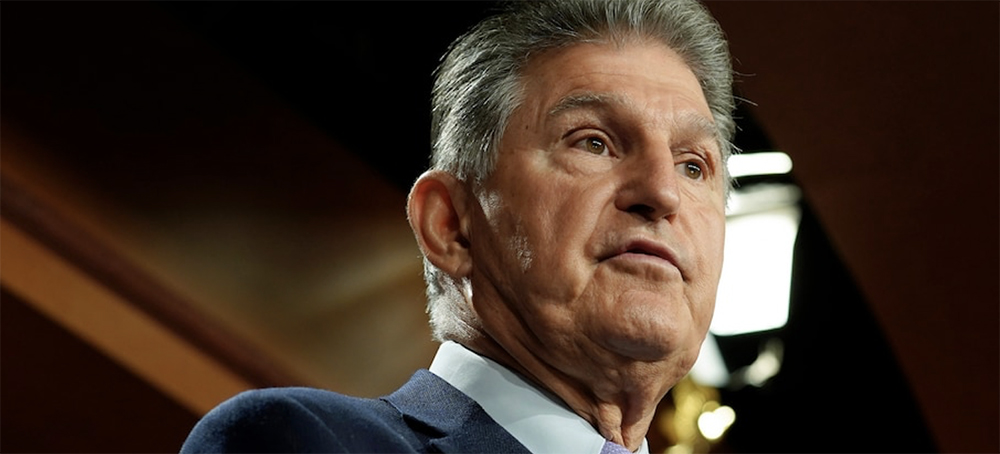 Sen. Joe Manchin III (D-W.Va.) speaks during a news conference Tuesday. (photo: Mariam Zuhaib/AP)
Manchin, a West Virginia Democrat who chairs the Senate Energy Committee, secured a commitment from President Joe Biden and Democratic leaders to include the permitting package in a stopgap government-funding bill in return for his support of a landmark law to curb climate change.
But in the weeks since Biden signed so-called Inflation Reduction Act last month, Democrats and environmental groups have lined up to oppose the permitting plan, calling it bad for the country and the climate. Climate hawks such as Vermont Sen. Bernie Sanders and Massachusetts Sen. Ed Markey, along with dozens of House members, say the permitting plan should be excluded from the must-pass spending bill.
Many Republicans agree. Wyoming Sen. John Barrasso, the top Republican on the Senate energy panel, called the permitting deal a “political payoff” to Manchin, whose vote on the climate bill was crucial to the law's passage.
Manchin's actions on the climate — including secret negotiations with Senate Majority Leader Chuck Schumer, D-N.Y. — "engendered a lot of bad blood” among Republicans, Sen. John Cornyn, R-Texas, told reporters. “There’s not a lot of sympathy on our side to provide Sen. Manchin a reward.”
At a news conference Tuesday, Manchin expressed bewilderment at such sentiment, saying he's “never seen" such an example of “revenge politics,'' with Sanders and the "extreme liberal left siding up with Republican leadership'' to oppose his plan.
"It's revenge towards one person — me,'' Manchin said.
“I'm hearing that the Republican leadership is upset,'' he added. “They're not going to give a victory to Joe Manchin. Well, Joe Manchin is not looking for a victory.''
Replying Tuesday on Twitter, Sanders was defiant.
“Defeating the Big Oil side deal is not about revenge,″ he said. “It’s about whether we will stand with 650 environmental and civil rights organizations who understand that the future of the planet is with renewable energy and energy efficiency not approving the Mountain Valley Pipeline,″ a nearly-completed natural gas pipeline from northern West Virginia to southern Virginia. Manchin’s plan would expedite the pipeline and steer legal challenges to a different federal court.
While legislative text of his permitting plan has not been made public, Manchin called the bill “a good piece of legislation that is extremely balanced” and does not “bypass any environmental review.″ Instead it would accelerate a timeframe that can take up to 10 years for a major project to win approval.
Sen. Shelley Moore Capito, R-W.Va., has released a similar plan that would speed environmental permitting, but Manchin said his plan should have broader appeal, since it would streamline environmental reviews for renewable energy projects as well as fossil fuels. Manchin's plan has support from Biden and other Democratic leaders.
But a letter signed by more than 70 House Democrats slams the proposal as a “dirty side deal being negotiated behind closed doors, outside of proper government process and the view of our families and communities who it will deeply impact.''
If passed, "this deal will only make it easier for the fossil-fuel industry to site polluting projects in our communities and perpetuate the industry’s practice of concentrating destructive pollution projects in communities of color and poor communities,'' said the letter, led by House Natural Resources Chairman Raul Grijalva of Arizona.
The fissure among Democrats could complicate the party’s efforts to keep the focus on this summer’s major legislative victories — including the climate bill and a separate law to boost the semiconductor industry and create more high-tech jobs in the United States — heading into the midterm elections to determine which party controls the House and Senate.
More immediately, the divide is testing the ability of Schumer and House Speaker Nancy Pelosi to keep enough Democrats in line to avoid a partial government shutdown at the end of the month.
Schumer has said he will attach Manchin’s proposal to the stopgap funding bill, a promise Manchin said Tuesday he expects Schumer to keep.
The permitting plan "is going to be in the" funding bill to avert a government shutdown Sept. 30, Manchin said. If opponents are willing to close down the government “because of a personal attack on me, this is what makes people sick about politics,'' he added. “It makes me sick about it.''
House Majority Leader Steny Hoyer, D-Md., did not directly answer when asked whether Manchin's permitting proposal would make it harder to pass the government funding bill, known as a continuing resolution.
"We’re going to pass the CR, and we're going to be here as long as it takes,'' Hoyer said Tuesday.
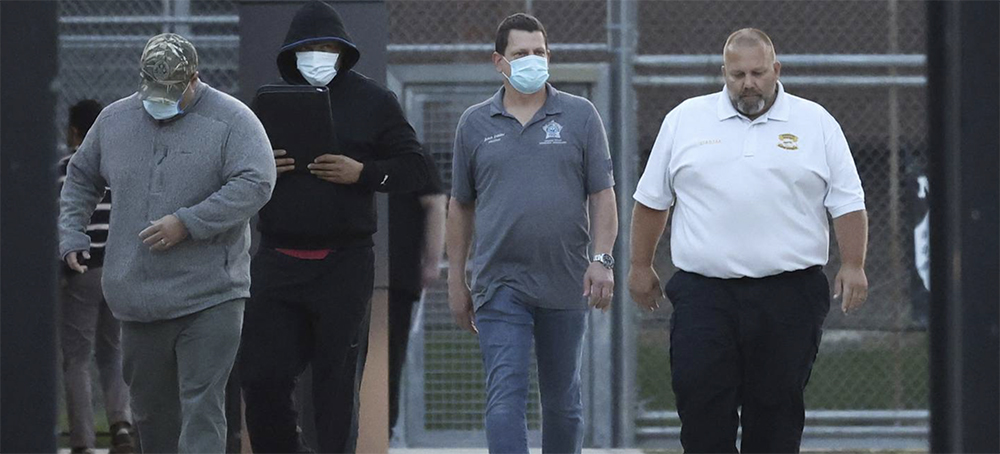 Sept. 16, 2022. The two officers were charged with felonies connected to an on-duty shooting of a man in the Pilsen neighborhood in July. (photo: John J. Kim/Chicago Tribune)
Sgt. Christopher Liakopoulos, 43, who has been with the department since 2001, and Officer Ruben Reynoso, 42, who has worked at CPD since 2003, were charged last week with aggravated battery and official misconduct after the July 22 shooting.
After the shooting, police Superintendent David Brown initially told reporters that after one officer identified himself to the group outside the closed business, one of the people in the group pulled out a handgun, sparking an exchange of gunfire.
Last Friday, Cook County State’s Attorney Kim Foxx announced the charges against the officers at a news conference, and said video of the shooting contradicted the officers’ statements of events. Cook County Associate Judge Maryam Ahmad had set $25,000 bonds for both during a hearing Friday afternoon, and they both were released the same day.
The video shows the two officers, who were heading to the Chicago Police Training Academy, happen upon a group of people standing outside a closed business just before 7 a.m. in the 1000 block of West 18th Street.
The surveillance video — which has no audio — shows the 23-year-old, who is wearing a white hoodie and holding a bottle of wine and a phone in one hand, walk toward the officers’ vehicle, waving toward them with his empty hand. Suddenly, the man falls to the ground, and then the two officers exit the vehicle and appear to fire shots toward a juvenile, who had run out of view of the video.
The 23-year-old continues to lay lie in the street as cars pass by him and one of the officers can be seen still standing in the street. The officers don’t appear to render aid as he lies on the ground for several minutes until additional officers and emergency services arrive.
COPA said in a news release that it has additional video that shows the juvenile shooting a gun toward the officers after the officers shot the 23-year-old man, but the agency is prohibited from publicly releasing video that involves juvenile subjects.
In court last Friday, Reynoso’s attorney, Brian Sexton, said, “It’s not clear who fired first” based on the surveillance video, but that it didn’t matter because the footage does show the juvenile had a gun in his hand.
The surveillance video released Tuesday, a gun does not appear to be visible in the juvenile’s hand until after the 23-year-old is lying on the ground and the juvenile is running away from the officers.
Sexton had said Reynoso was in the front passenger seat of the car when he believed “some gang members” were tagging the door of a closed business on his right side. He showed the group his badge and told them to “knock it off” when surveillance footage apparently shows the 23-year-old and the juvenile walking toward the car and the 23-year-old “make a gesture like pointing,” Sexton said.
“This all happened within 2 seconds,” Sexton said. “My client saw the juvenile gunman come up with the gun from the satchel bag and pointed toward that. He immediately withdrew his holster, and he fired one shot in the car.”
It is not clear in the surveillance video that the officers showed anyone their badges before opening fire and it also does not appear that the men were tagging a business door.
“When he had a chance to look at the video, he talked to the state’s attorney, we did a proffer, we talked to COPA, and he said, ‘Yeah, I see the video, I just don’t remember it, but I shot once when I was in,’ so this whole thing about contradicting or lying, that’s completely false,” Sexton said.
Tim Grace, attorney for Liakopoulos, adopted part of Sexton’s argument on behalf of his client and added that the defendants were “on-duty police officers who are confronted with armed assailants who points the gun at them and eventually fires at them.”
The released surveillance video does not clearly show anyone pointing a gun toward the officers at any point during the exchange. It also does not show the juvenile firing shots at the officers after the 23-year-old was shot.
Grace referenced Graham v. Connor, a U.S. Supreme Court case about seeing police officers’ actions as “objectively reasonable,” he said.
“We don’t use 20/20 hindsight,” Grace said. “We don’t second-guess. We don’t slow down videos like the Cook County state’s attorney’s office does, and that’s what the eventual trial judge will do.”
Both officers have been relieved of their police powers.
READ MORE Orange County Supervisor of Elections workers prepare mailed ballots for the high-speed tabulator in the Vote-By-Mail Ballot Counting Room, on Aug. 18, 2020. (photo: Ricardo Ramirez Buxeda/Orlando Sentinel/Tribune News Service via Getty Images)
These candidates are one election away from becoming their states’ top election officials, and they’ve all denied the legitimacy of the 2020 presidential election.
One of the most disruptive things they could do is refuse to certify free and fair election results. But secretaries of state have broad influence that stretches far beyond approving vote tallies, and many of these candidates want to dramatically change the way future elections are run in those states.
In this episode of Today, Explained — Vox’s daily news explainer podcast — host Noel King talks to Zach Montellaro, a reporter who covers democracy and state politics at Politico, to understand how much is at stake if these election-denying candidates win their tight races.
Below is an excerpt of the conversation, edited for length and clarity. There’s much more in the full podcast, so find Today, Explained wherever you get podcasts, including Apple Podcasts, Google Podcasts, Spotify, and Stitcher.
Noel King
In these upcoming midterms, 25 states are going to decide who’s in charge of state elections. You’ve been looking into candidates for these offices who deny the results of the 2020 elections — and who may win. Tell me about who you’ve been following.
Zach Montellaro
The four I’m really watching the most closely is Pennsylvania, where Doug Mastriano is a state senator running for governor, but he can appoint the secretary of state. In Nevada, Jim Marchant, a former state lawmaker; in Michigan, Kristina Karamo; and then Arizona, where state Rep. Mark Finchem is running for secretary of state. Those are the four “top of the ticket” election-deniers running for chief election official in their states.
Noel King
Tell me about each of them.
Zach Montellaro
Mark Finchem is maybe the most prominent of the four of them. He really rose to fame in the state and elsewhere shortly after the 2020 election, where he hosted allies of then-president Donald Trump — right after the election for that “hearing,” where he spread conspiracy theories about the election trying to create misinformation about the election — has basically never stopped since then.
Karamo is running in Michigan after she was a poll watcher in the 2020 election, the folks who watch the proceedings, basically. And she claimed to have seen some malfeasance there, never backed it up, kind of shot off from there. She’s the Republican Party’s nominee, and she won the nomination through a convention, not through a primary there, so she didn’t have a whole regular population voting on her to give in the nomination. She’s spread some conspiracy theories and conspiracy theories-adjacent, both with and without elections. And there she’s running against the Democratic incumbent, probably might be one of the closest states. Jocelyn Benson, there, is the Democratic secretary of state.
Jim Marchant is the self-appointed leader of all these candidates. He brought them together in a coalition called the America First Secretary of State Coalition. They can kind of swap ideas, theoretically fundraise for each other, even though none of them are really strong fundraisers. And Marchant has been trying to rally them all together and give them a common platform and give them a common ideal to run on. Ironically, out of the four of those folks that we’ve talked about, he’s the only one not endorsed by former President Donald Trump.
Noel King
These folks have all secured the Republican Party’s nomination. But can they really win a general election?
Zach Montellaro
There’s not a lot of attention on these races, so it really gives any one of them a viable opportunity to win. Of course, this year we’ve seen a lot more attention on these races, and none of these folks are good fundraisers. Money isn’t everything in politics, but it helps your campaign. But just think about the states where they’re running. Michigan, Pennsylvania, Arizona, Nevada have some of the closest elections over the last decade. That probably won’t change this year. You know, could Mark Finchem win, Kristina Karamo, and could Jim Marchant win? Absolutely. These are down-ballot races that don’t attract a lot of attention. So it gives candidates a much easier path to winning in a nomination that they wouldn’t otherwise win in a Senate race where there would be hundreds of millions of dollars potentially pouring in to kind of tip the race.
Noel King
If these “America First” coalition candidates win in November — and they did pick a nice, anodyne name for their group — what is their platform? What are they pledging to do?
Zach Montellaro
The Marchant group puts forward six broad policy ideas. One big one that they focus on is voter ID. Voter ID is something that’s not just limited to this group of election deniers. It’s popular among the American right. It’s actually popular among most Americans. Most Americans think, in poll after poll after poll, there should be some level of ID, and ID laws are very, very different across the country. They’re running to have some level of ID, likely photo ID, in their state.
Another thing they’re running on, which actually most election officials broadly think is a good idea: paper ballots. Most people vote on paper ballots, meaning that when you go fill out your ballot, you actually have the physical paper that is counted. Most states then count those ballots with the machine. [It is] much, much quicker to count an election with a ballot tabulator than doing it by hand. A lot of these candidates are saying, actually, we want to go back to hand-counting ballots. Hand-counting is likely less accurate than a ballot tabulator, which has been proven over and over and over and over again to be accurate.
Another of the biggest things is looking to eliminate or severely curtail the use of mail-in voting.
Noel King
If they win, given that they’re in swing states, the big unknown will be the 2024 election. What could they do in their jobs to upend the electoral process in the states where they’re from in 2024?
Zach Montellaro
One that gets the most attention, I actually think wrongly, is certifying elections. That final check: This person won who said “We won.” That would almost assuredly end up in state and/or federal court. But even the premise of that, saying they’re not going to sign off on a free and fair election, is in itself a challenge to the fundamental baseline of the system.
The next things they can do vary really dramatically state by state. But broadly, a lot of them can set policy. They can’t change the laws automatically, but they can make things much, much harder to happen. Think about [ballot] drop boxes, which have become a point of contention. What sort of rules could they put around drop boxes? If you submit a mail ballot in many states, there’s a process called signature matching (a process where states require voters to provide valid signatures on their absentee/mail-in ballots). How do they make it harder to have those ballots be approved?
What many of these candidates also say they want to do is totally erase the state’s current voter rolls and start fresh. And that is what I think is most concerning, at least to me. What can they do, not when everyone’s watching, you know, the day after the election, what do they do in the two years leading up to it?
Noel King
Have you talked to anyone who said if people like this win elections and start fiddling with the system, Americans’ trust in the way we vote is going to bottom out? And that could just be catastrophic.
Zach Montellaro
A lot of Americans don’t think about elections. They think about elections as a one-day event. Elections really are, you know, a full year. It does not take 48 hours to prepare for a primary. It takes a year. It does not take 72 hours to prepare for a general election. It takes that whole year running up to it.
So the challenge is how do you restore people’s trust in elections when they don’t trust them? And there’s been no really good answer to that. Some part of America, at this point, won’t be reachable by election officials, will never believe we have free elections. And they’re wrong, but they’ll never believe that they’re free elections. It’s a race for election officials of both parties to reach the rest of Americans who just don’t think about elections all that much and say, “no, look, we do have a fair system. Come in and see.” The real push, since 2016 but especially since 2020, is transparency, transparency, transparency. “Come in and see how we test the ballot machines to make sure that they are actually counting what they say they’re going to count, come in and ask questions.”
By and large, your state election official, your local county clerk, will be more than happy to answer your questions. Maybe not right at this very second because they’re super busy preparing for the general election, but election officials want you to feel good about elections. They want to answer your questions. They want you to come in and watch the testing. They want poll watchers to actually watch and see how American elections are run. So the arms race is: Can you reach enough Americans who just have a weird gut feeling about it but aren’t so ... far gone? How do you reach them this year and ahead of 2024?
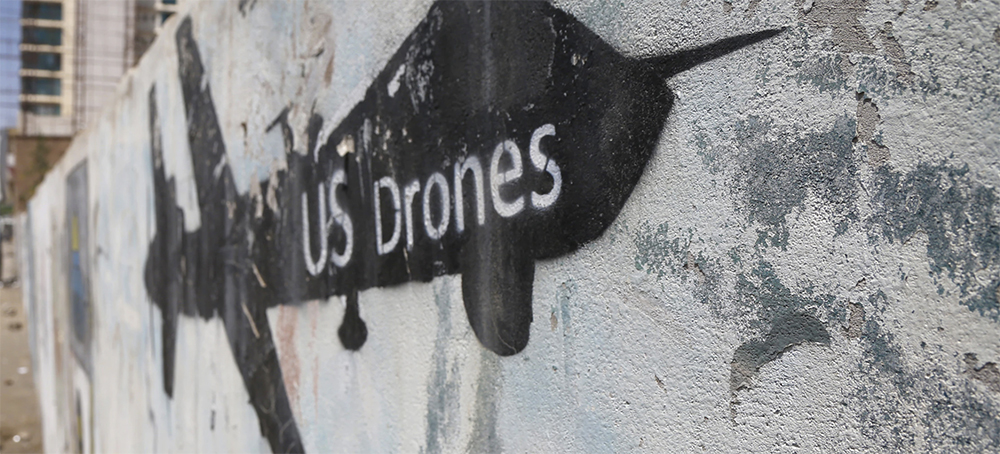 Graffiti protesting against U.S. drone strikes in Sana’a, Yemen on Sept. 19, 2018.(photo: Mohammed Hamoud/Getty Images)
Adel Al Manthari was injured in a 2018 drone strike — and now he’s releasing his medical bills. Will it finally shame the U.S. government into helping?
Al Manthari’s body was ravaged. His entire left side was burned. His right hip was fractured and his left hand sustained catastrophic injuries to its blood vessels, nerves, and tendons. Despite multiple surgeries and nine months of medical treatment after the strike, he was permanently disabled. The severe burns left his skin vulnerable to infection, and his body has regularly been covered in bed sores due to his limited mobility.
The U.S. military claimed that Adel Al Manthari and the others in the vehicle were “terrorists” from Al Qaeda in the Arabian Peninsula, but independent inquiries said otherwise. There is no evidence to suggest that the United States ever reinvestigated the strike. And every day for the past four years, Al Manthari has paid the price for America’s shoot-first-ask-no-questions-later system of remote warfare. The irreparable damage to his body left Al Manthari unable to walk or work, robbing him of dignity and causing his daughters — ages 8 and 14 at the time of the strike — to drop out of school to help care for him. The psychological impact of the strike has been profound, leaving Al Manthari traumatized and in need of treatment. And the financial impact has been ruinous.
Repeated surgeries and medical treatment plunged his family into debt and the bills have never ceased. While the U.S. has millions of dollars in funds earmarked for civilian victims of U.S. attacks, the military ignored pleas on Al Manthari’s behalf, leaving the 56-year-old to rely on a GoFundMe campaign earlier this year to save his life. But he’s back on the brink again, with more surgeries and bills, and, in an unusual move, his family agreed to share these new bills with The Intercept to provide itemized — and visceral — evidence of the financial as well as human cost of the U.S. attacking an innocent man and refusing to pay so much as a dime for his medical treatment.
Al Manthari, who is receiving treatment in Egypt, now needs six weeks of hospitalization to recover from a hip replacement ($6,266.32), a skin graft operation on his left hand and arm ($7,000.00), and at least three physical therapy sessions a week for six months ($892.95), according to Reprieve, an international human rights organization that is representing him. The total cost of these treatments is close to $23,000, which includes hospitalization and medications; fees for a surgeon, doctors, and nurses; six months of rent for an apartment in Cairo for Al Manthari and his two adult sons, who are his main caretakers now; utilities; and transport to and from physical therapy. Once again, Al Manthari’s health and well-being rests with a crowdfunding campaign.
But it doesn’t have to be this way.
“It is appalling that innocent people, civilians who have no connection to armed groups, are left to fend for themselves,” said Aisha Dennis, project manager on extrajudicial executions at Reprieve. “It is heartening that ordinary people, particularly Americans, have stepped in to support Mr. Al Manthari where their government has failed. But it is not — it must not be — their job to do this. It is the duty of the people dropping the bombs, in this case the U.S. government, to face the wreckage they are causing to families and communities and address it with humanity.”
Reparations Are Rare
Al Manthari’s case highlights the seldom seen devastation to the lives of drone strike survivors and their families, especially those who live in areas outside formal war zones such as Iraq and Afghanistan.
From Libya to Somalia, Syria to Yemen, the United States has left a trail of broken bodies and shattered families. Secret Pentagon investigations have shown that Hellfire missiles are often far more effective at killing people than the United States is at targeting the “right” ones. But every so often, an innocent person living in the backlands of an African or Middle Eastern nation survives a drone attack.
Since at least World War I, the U.S. military has been paying compensation for harm to civilians. During the Vietnam War, solatia payments, as they are called, were a means for the military to make reparations for civilian injuries or deaths without having to admit guilt. In 1968, for example, the going rate for adult lives was $33. Children merited half that.
At the beginning of the forever wars, activist Marla Ruzicka became a tireless advocate for war victims, founding the Campaign for Innocent Victims in Conflict (now the Center for Civilians in Conflict, or CIVIC) to advocate on their behalf and, with the assistance of Sen. Patrick Leahy, D-Vt., helped to secure tens of millions of dollars from the U.S. government for Afghans and Iraqis harmed by U.S. military operations.
Between 2003 and 2006, the Defense Department paid out more than $30 million in solatia and condolence payments to “Iraqi and Afghan civilians who are killed, injured, or incur property damage as a result of U.S. or coalition forces’ actions during combat,” according to the Government Accountability Office. But in more recent years, the sums paid out have plummeted. From 2015 to 2019, for example, the U.S. paid just $2 million to civilians in Afghanistan.
In 2005, after Ruzicka was killed by a suicide bomber in Iraq, a U.S. Agency for International Development program was renamed the Marla Ruzicka Iraqi War Victims Fund and began paying out tens of millions of dollars. But while the program was intended to provide assistance to Iraqis who suffered damages, injury, or death due to U.S. or coalition forces’ actions, experts say it was repurposed into a more general use fund for economic development, such as promoting local businesses and youth entrepreneurship. USAID was unable to provide statistics on just how much money was paid out under the program or what percentage went to victims of U.S. attacks. A spokesperson would only speak off the record, which The Intercept declined to do.
Payouts under various compensation, solatia, and battle damage schemes have also varied widely — from $124 to $50,000, for example — for a civilian killed in Afghanistan. Basim Razzo, who survived a 2015 airstrike in Iraq that killed his wife, daughter, and two other family members and destroyed two homes he valued at $500,000, was offered a “condolence payment” of $15,000, which an Army attorney said was the capped limit. Razzo rejected it as “an insult.” But after Italian aid worker Giovanni Lo Porto was killed by a U.S. drone strike that same year while being held hostage by Al Qaeda, the U.S. paid his family $1.3 million as a “donation in the memory” of their son.
While the United States provided compensation to significant numbers of Iraqis and Afghans affected by ground combat and, in certain cases, airstrikes in the first half of the so-called war on terror, more recent victims of drone attacks or the air war against Islamic State have rarely received reparations, experts say. Even those whose civilian casualty allegations have been deemed “credible” by the United States are seldom compensated.
Resorting to GoFundMe
Earlier this year, Adel Al Manthari’s feet and legs blackened due to restricted blood flow, and his doctor said he was at imminent risk of developing gangrene. Unable to access the required medical care in Yemen, his family needed to get him to Egypt and, as is common in the region, pay in advance for medical care. For his treatment at Cairo’s Kasr al-Aini Hospital, according to documents provided to The Intercept by Reprieve, Al Manthari paid for admission fees ($327.96); an initial surgery on his leg ulcers ($322.58), two separate bills for hospital service fees ($913.98); a biopsy ($48.39); a skin graft operation to replace burned skin, reduce swelling, and begin to restore movement to his legs ($1,129.03); a gastric sleeve surgery to facilitate his hip replacement ($2,741.94); the costs of a hospital bed, follow-up care from nurses and consultants, blood tests, X-rays, scans, and medications ($7,795.68); three weekly physical therapy sessions to prepare for his hip replacement operation ($1,075.27); a hip prosthetic ($4,838.71); a hip replacement operation ($1,612.90); and a wheelchair and folding walker ($261.10), among other expenses.
The total cost exceeded $21,000. The average per capita income in Yemen is around $2,200.
Al Manthari was in danger of losing his legs and possibly his life, both of which ended up dependent on a GoFundMe campaign that had stalled at around $8,700. Media attention, largely from The Intercept, helped spur the generosity of strangers who donated enough money for Al Manthari to pay for the surgeries he needed to keep his legs and stave off death. But that was hardly the end of the medical care that the Yemeni drone strike survivor requires. He faces a lifetime of medical bills that the U.S. government is, thus far, unwilling to pay or even acknowledge.
The exact status of Al Manthari’s plea for U.S. reparations is unclear. In 2018, CENTCOM announced that it was aware of civilian casualty reports stemming from the March 29, 2018 attack that injured him and was conducting a “credibility assessment.” Asked about the results four years later, CENTCOM spokesperson Lt. Col. Karen Roxberry told The Intercept, “We are not able to provide responses on this.” Investigations by the Associated Press and the Yemen-based group Mwatana for Human Rights both determined that the U.S. had attacked only civilians.
In March, Sens. Chris Murphy, D-Conn., and Elizabeth Warren, D-Mass., asked Defense Secretary Lloyd Austin to open a new investigation into the airstrike that disabled Al Manthari, as well as 11 other U.S. attacks in Yemen. The Pentagon did not respond to repeated requests for comment on what actions, if any, Austin has taken in response to the request. In a letter to Murphy and Warren shared with The Intercept, Colin H. Kahl, the Pentagon’s top policy official, did not even address the issue of new investigations.
“It’s really important that they look back at these cases from the last five or 10 years — especially in theaters of war, like Yemen, where they have made few acknowledgements of civilian harm,” said Joanna Naples-Mitchell, a human rights attorney and director of the nonprofit Zomia Center’s Redress Program, which assists survivors of U.S. airstrikes to submit requests for amends. “You can count on one hand the cases in which they’ve offered condolence payments in the air wars against ISIS in Iraq and Syria.”
The U.S. has conducted more than 91,000 airstrikes across seven major conflict zones and killed as many as 48,308 civilians, according to a 2021 analysis by Airwars, a U.K.-based airstrike monitoring group. But only a tiny fraction have received any type of reparations. In 2020, Congress began providing the Defense Department $3 million each year to pay for deaths, injuries, or damages resulting from U.S. or allied military actions, but in the time since, the U.S. has not announced a single ex gratia payment, leaving victims like Al Manthari to fend for themselves.
“It’s tragic and shameful that covering the costs of medical care for people bombed by the U.S. has fallen on crowdsourcing,” Naples-Mitchell said. “Payments would be a drop in the bucket for the U.S. military, but there is clearly no system to help people. It’s even unclear that allocated funding, like the USAID Marla Fund, is currently being used for that purpose.”
“Under Review”
As Al Manthari’s health deteriorated in the spring, Reprieve repeatedly reached out to the Pentagon and U.S. Central Command, sending them detailed evidence about his case while requesting assistance with a medical evacuation to Egypt and financial aid for urgent medical care. On September 14, while this story was being reported and five months after Reprieve first reached out, CENTCOM finally responded, noting that the documents were “under review” to “determine if the information changes the assessment of the strike.” Reprieve was, however, met with silence from Austin; Anna Williams, the Pentagon’s senior adviser for civilian protection; and Cara Negrette, the Defense Department’s director for international humanitarian policy.
Negrette and Williams declined to speak to The Intercept. Pentagon spokesperson Lt. Col. César Santiago asked that questions be sent in writing. Those questions, submitted on May 17, have still not been answered.
The Pentagon appears to be dodging responsibility on many fronts. On May 26, Santiago told The Intercept that Negrette and Williams personally told him that they had never received any communications from Reprieve. “But they welcome any communications from Reprieve regarding this case,” Santiago said. “You can provide my email and I will facilitate communications with Ms. Negrette.”
On June 1, Reprieve forwarded to Negrette and Williams four messages it had sent in April, including Al Manthari’s documents, and copied this reporter and Santiago. “As the matter is urgent, I look forward to your prompt confirmation of receipt and reply,” Reprieve’s June email said. This reporter followed up as well and was told in a June 6 email from Santiago, “I forwarded and provided the information to the appropriate office.” More than three months later, according to Dennis at Reprieve, the organization has yet to hear from Austin, Negrette, Williams, or Santiago.
Reprieve also reached out to Caroline Krass, the general counsel of the Department of Defense. This reporter was CC’d on the message, which Krass read, according to a return receipt, on June 1. But Krass, said Dennis, never responded to Reprieve either.
“It’s been a difficult and frustrating process. We contacted CENTCOM back on April 13, then on the first of June, the 7th of June, the 13th of July. When we finally were able to speak to someone by phone, we were told that the email was likely being blocked because it was coming from a .org.uk email address,” said Dennis. “If we, as a U.S. legal action charity, cannot get a substantive response from CENTCOM, what hope do civilians harmed by U.S. drone strikes living in Somalia, Syria, or Afghanistan have to access accountability?”
While there is a formalized mechanism to contact CENTCOM concerning civilian harm allegations and millions of dollars set aside for victims, the Pentagon lacks a formal procedure in place to file claims for compensation. “There is no officially articulated process,” said Naples-Mitchell, who is currently representing more than a dozen victims of civilian casualty incidents acknowledged by the U.S. military. “When I spoke with a CENTCOM lawyer, he was very clear that they did not want the public to have the perception that there is an official process. They also shy away from using the word ‘claims’ because, I think, they are concerned that it suggests some sort of a legal application.”
Experts are hopeful that the Pentagon’s new Civilian Harm Mitigation and Response Action Plan, or CHMR-AP — which provides a blueprint for improving how the Pentagon addresses civilian harm — will be an impetus for the Defense Department to remake its broken claims and compensation programs. But experts say the CHMR-AP is light on the question of accountability. Austin has also publicly stated that the Pentagon has no intention of reinvestigating past civilian harm incidents.
“The new DoD Action Plan includes some important steps towards remedying these policy failures, including improving investigation processes, recognizing the importance of amends to those harmed, and establishing a diverse menu of response options, from acknowledgements to condolence payments to the provision of medical care,” said Annie Shiel, senior adviser for U.S. policy and advocacy at CIVIC. “But even if implemented effectively, it’s unclear what difference those changes will make to someone like Adel Al Manthari, since the CHMR-AP doesn’t include a clear commitment to looking back at the many past cases of civilian harm that have gone under-investigated, unacknowledged, and without amends.”
Dennis also welcomes the CHMR-AP, with caveats, calling for increased congressional oversight of civilian casualty issues — precisely what a new congressional Protection of Civilians in Conflict Caucus has pledged to do — as well as workable mechanisms for reporting civilian harm; deadlines for responding to complaints; genuine investigations, including site visits and witness interviews (which are rarely conducted); details about how disciplinary measures and individual criminal liability will be handled; and protections for whistleblowers. “If we see all of this, we might begin to see some semblance of accountability,” Dennis said.
In the four years since the Al Uqla airstrike, Al Manthari has been largely immobile and easy to find. Asked if the fact that the U.S. military has taken no further action against a man previously deemed too dangerous to live was a tacit admission that Al Manthari is — as two independent investigations found — innocent of any terrorist ties, a U.S. military spokesperson demurred. “I’ll follow up with policy,” he said on June 6. “I’ll get back to you.” He never did.
Maimed by a U.S. drone strike and abandoned to the cruel fate of crowdfunding, Al Manthari is again dependent on the kindness of strangers to get him through his next round of surgeries and follow-up care. And there’s no certainty that he, or the other victims suffering in America’s far-flung war zones of the last 20-plus years, will ever see the money owed to them for their losses, injuries, pain, and suffering.
“There are likely thousands of cases like Adel Al Manthari’s — victims and survivors of devastating civilian harm, still waiting for any kind of acknowledgement or amends from the U.S. government,” said Shiel. “Far too many cases have been erroneously dismissed despite painstaking research from human rights groups and journalists. And even when the U.S. government confirms it caused civilian casualties, it has rarely made ex gratia payments or other amends. … The result is that civil society groups and journalists have had to fill this gap, from conducting rigorous investigations the government should be doing, to setting up crowdfunding campaigns to support victims. That’s just not how accountability is supposed to work.”
 A home is submerged in floodwaters caused by Hurricane Fiona in Cayey, Puerto Rico, on Sunday. (photo: Stephanie Rojas/AP)
A relatively quiet hurricane season has given way to three storms with heavy rainfall that experts say show how a warming atmosphere is already having devastating consequences.
From Hurricane Fiona barreling over Puerto Rico and the Dominican Republic to Typhoon Nanmadol pounding Japan, to the remnants of Typhoon Merbok wreaking havoc in Alaska, the past 72 hours have demonstrated the devastating effects of heavy rain and flooding.
The three weekend storms add to a trend of wetter storms in a warmer future, said Michael Wehner, a senior scientist at the Lawrence Berkeley National Laboratory.
“The worst storms will get worse,” he said.
With climate change making storms rainier and more intense, the weekend's extreme weather events offer a glimpse of what could become more common in the future, according to experts.
One of the most pronounced ways storms have been affected by climate change in recent years can be measured in rainfall increases, said Kevin Reed, an associate professor of atmospheric science at Stony Brook University in New York.
As the world's oceans heat up, they provide more energy for storms, allowing them to intensify as they form. A warmer atmosphere can also hold more moisture, Reed said.
"If you have warmer water, you'll have more evaporation, which means you have more moisture in the atmosphere, which means you can get more precipitation," he said.
Until the weekend, the Atlantic hurricane season had been unusually quiet, but Reed said mid-September is usually the peak of the season, which means other powerful storms could still be on the way.
“Hurricane Fiona is a reminder that even though it has been relatively quiet, things can change and strong storms can have a really big impact,” he added.
Scientists have estimated that for every 1 degree Celsius of temperature rise, the atmosphere can hold 7% more evaporated moisture. The planet has warmed roughly 1.1 degrees Celsius since pre-industrial times.
Hurricane Fiona, which hit Puerto Rico on Sunday and triggered an islandwide power failure, is already soaking the region with high levels of precipitation.
In an update early Monday morning, the National Hurricane Center warned of "heavy rainfall and catastrophic flooding" across much of Puerto Rico. Multiple locations on the island received more than 20 inches of rain over the past 72 hours.
A day earlier, one of the strongest storms in at least a decade hit Alaska. Remnants of Typhoon Merbok brought hurricane force winds, high seas and rain that caused widespread flooding along the coast. (Typhoons and hurricanes are both tropical cyclones but differ in their naming based on where they occur.)
And thousands of miles away, in Japan, Typhoon Nanmadol became one of the most intense storms to hit the country in years. Weather stations on the island of Kyushu recorded nearly 20 inches of rain in 24 hours on Sunday, according to weather experts at Yale Climate Connections.
More than 8 million people were asked to evacuate before the typhoon made landfall. The Japan Meteorological Agency warned Monday that heavy rains, gales, high waves and storm surges are expected to continue as the storm moves up the coast. Heavy rainfall advisories remain in effect across much of the country.
Wehner of the Lawrence Berkeley National Laboratory and Reed of Stony Brook University collaborated on a paper published in April in the journal Nature Communications that examined precipitation in the 2020 Atlantic hurricane season, which was one of the most active hurricane seasons on record. They found that climate change made the entire season wetter overall, and they measured a 10% increase in rainfall rates during the heaviest three-hour period of precipitation during storms.
"That means the storm rained 10% more because of climate change than it would have without," Reed said.
These increases in extreme precipitation can be catastrophic for the people who live in the areas hit by supercharged storms. In Puerto Rico, for instance, communities have still not fully recovered from Hurricane Maria in 2017.
"These storms are scientifically interesting for sure," Wehner said, "but the human tragedy part is far more important."
Follow us on facebook and twitter!
PO Box 2043 / Citrus Heights, CA 95611


Comments
Post a Comment