RSN: Luke Mogelson | How Trump Supporters Came to Hate the Police

11 September 22
Alms for the Information Revolution
Why is good work always badly funded. Imagine just for a moment a world where good work were adequately funded. We want a financially stable organization. We want to change the perception that to do good you have to be broke. Not so.
Reader Supported News, a great place for a few bucks.
Marc Ash
Founder, Reader Supported News
If you would prefer to send a check:
Reader Supported News
PO Box 2043 / Citrus Heights, CA 95611
Follow us on facebook and twitter!
11 September 22
Live on the homepage now!
Reader Supported News

At the Capitol riot and elsewhere, MAGA Republicans have leaped from “backing the blue” to attacking law-enforcement officials.
Given the broad support that Republicans have historically enjoyed from law enforcement, their escalating hostility toward the F.B.I. may seem paradoxical. Right-wing extremists, however, have always viewed state agents as pernicious antagonists, and so the institutionalization of that mind-set should come as no surprise as the G.O.P. embraces the ideas and attitudes of its radical flank.
In the early days of the pandemic, as Trump supporters began mobilizing against lockdowns and other public-health measures, much of their rage was directed at law enforcement. On April 30, 2020, heavily armed conservatives descended on the Michigan state capitol, in Lansing. Facing off against police outside the barred doors of the legislature, they denounced the officers as “traitors” and “filthy rats.” Some members of the mob belonged to the Michigan Liberty Militia, whose founder later told me that he had created the outfit in 2015, after “seeing what happened with the Bundys.” Cliven Bundy, an elderly rancher in Nevada, had declared war on the government when the Bureau of Land Management impounded his cattle over his refusal to pay outstanding grazing fees. After a tense standoff in which Bundy supporters surrounded law-enforcement agents and trained rifles on them from nearby hilltops, the Bureau of Land Management released the livestock and withdrew from the area.
Following the incident in Lansing, Mike Shirkey, the Republican Senate majority leader in Michigan, condemned the protesters as “a bunch of jackasses” who had used “intimidation and the threat of physical harm to stir up fear and rancor.” Shirkey seems to have quickly realized, though, that such principled nonpartisanship was no longer tenable in American politics. A couple of weeks later, at an anti-lockdown rally in Grand Rapids, I watched him publicly laud the Michigan Liberty Militia and assure its members, “We need you now more than ever.”
In the weeks that followed, resentment of law enforcement intensified sharply, with anti-lockdowners perceiving individual officers as complicit in an oppressive, tyrannical order. “They deserve to wear the Nazi emblem on their sleeves!” one retiree told me of the state police who’d served a cease-and-desist order to a barber violating the governor’s suspension of personal-care services. “People like me used to fucking back you!” a veteran shouted at police handing out citations at a gathering in Lansing. “But you are trash!”
Then, on May 25, 2020, a police officer murdered George Floyd, in Minneapolis. I left Michigan to cover the ensuing demonstrations and riots, and when I rejoined the anti-lockdowners I found that their stance toward law enforcement had undergone a dramatic reversal. That June, I attended a demonstration outside the capitol orchestrated by the Michigan Liberty Militia and a right-wing organization called the American Patriot Council. Ryan Kelley, a co-founder of the latter group, climbed the steps and pointed to several officers who were monitoring the scene. Not long ago, I had witnessed anti-lockdowners furiously berate these very same men. “We say thank you for being here,” Kelley told them now. “Thank you for standing up for our communities.”
The volte-face reflected a larger pattern of contradiction. The original Michigan Militia was created, along with a wave of other white paramilitary groups, in 1994, following the government’s botched attempt to arrest the survivalist Randy Weaver at his cabin, on Ruby Ridge, in northern Idaho. The deadly siege, less than a year later, of the Branch Davidian compound, in Waco, Texas, and the Clinton Administration’s subsequent ban on assault weapons reinforced a right-wing narrative that white Christians were under attack. After Waco, the Michigan Militia ballooned to an estimated seven thousand members. In 1995, on the second anniversary of the Waco massacre, Timothy McVeigh, a white supremacist who’d attended several Michigan Militia meetings, detonated an enormous truck bomb in Oklahoma City, killing a hundred and sixty-eight people. The leaders of the Michigan Militia decamped to Alaska, and the organization collapsed. Over the next decade and a half, right-wing militants across the U.S. remained largely dormant. Meanwhile, under President George W. Bush, the federal government enacted unprecedented infringements on personal privacy and other individual rights while the F.B.I. employed extraordinarily invasive surveillance and investigatory techniques against law-abiding citizens, largely on the basis of their religion. The reason that none of this provoked anti-government extremists was simple: the targets of the overreach were Muslims.
Similarly, after George Floyd was killed, conservatives repudiated the national uprising that demanded police reform and accountability, choosing instead to “back the blue.” As President Trump and his allies portrayed demands for racial justice as the sinister work of subversives intent on sowing chaos—much as segregationists had dismissed civil-rights activists as Communist agitators—backing the blue became analogous with opposing the left. After my stay in Michigan, I spent a month covering antifascist protests in Portland, Oregon, where demonstrations against the local police department were punctuated by clashes with Trump supporters, including members of the Proud Boys, who presented themselves as allies of law enforcement. As anti-lockdowners had shown in Michigan, however, this alliance was conditional and tended to break down whenever laws intruded on conservative priorities. Right-wingers rationalized the inconsistency by assigning the epithet “oath breaker” to any American in uniform who executed his duties in a manner they disliked.
About a month after the 2020 Presidential election, at a rally in Washington, D.C., I followed hundreds of Trump supporters as they marauded on the streets around the White House, assaulting pedestrians, vandalizing Black churches, and seeking to engage antifascists in fist fights. The Metropolitan Police, the Park Police, and the Capitol Police did their best to keep the two sides separate. Their interference enraged the Trump supporters, who called the officers “piggies,” “cunts,” and “pieces of shit.” Some of the insults were indistinguishable from those shouted by leftists in Portland.
“Fuck your paychecks!”
“Fuck the blue!”
“Vigilante justice will be king!”
“Defund the police!”
Many of these same Trump supporters returned to D.C. on January 5, 2021, and by then it was clear that law enforcement would no longer be exempt from their belligerence. Online, Proud Boys made plain that their days of backing the blue were over. “Fuck these DC Police,” one commented. “Fuck those cock suckers up. Beat them down. You dont get to return to your families.”
The next day, I followed thousands of people up the National Mall after Trump’s incendiary speech from the Ellipse. On the west side of the Capitol, two broad flights of granite steps descended from an outdoor terrace on the third floor. In anticipation of Joe Biden’s Presidential Inauguration, huge bleachers had been erected over the steps, with a ten-thousand-square-foot platform constructed between them; the bleachers had been wrapped in ripstop tarpaulin, creating a sort of monolith that functioned as a rampart. Trump supporters climbed the steps and began cutting through the fabric with knives. Officers blocked an opening at the bottom of the bleachers, but they were outnumbered and obviously intimidated as the mob pressed against them, screaming insults, pelting them with cans and bottles. Some people shoved and punched individual officers; others linked arms and rammed their backs into a row of riot shields, their eyes squeezed shut against blasts of pepper spray. A few Trump supporters used their own chemical agents against the police. The stone slabs underfoot were smeared with blood. “You’re a bunch of oath breakers!” a man making his way along the police line barked through a bullhorn. “You’re traitors to the country!”
Seconds later, the mob overwhelmed the officers and everyone flooded into the understructure of the bleachers. Toward the top, a temporary security wall contained three doors, one of which was instantly breached. Dozens of police stood behind the wall, using shields, nightsticks, and chemical munitions to prevent the mob from crossing the threshold. Other officers took up positions on the platform above us, firing a barrage of pepper balls into the horde. A few feet away, I recognized a corpulent man with a graying goatee and glasses leaning all his weight into the bodies directly beside me.
It was Jason Howland, another co-founder of the American Patriot Council. At the Lansing rally on June 18th, I’d watched Howland rail against George Floyd protesters, calling them “operatives of fear and dissent.” Now he dropped his head, planted his feet, and added his considerable mass to the others churning over the police. Balanced on a crossbeam above him was his compatriot Ryan Kelley, who, six months earlier, had thanked law enforcement for “standing up for our communities.” (Neither man could be reached for comment.) In D.C., a cell-phone video captured Kelley yelling at rioters, “This is war, baby!”
I eventually found myself in the chamber of the U.S. Senate, where Trump supporters rifled through desks, took documents, and delivered prayers and speeches from a dais that had recently been occupied by Vice-President Mike Pence. When a young Capitol Police officer with a medical mask over red facial hair entered the room, he approached a rioter who had been shot with a rubber bullet and was bleeding from his cheek. “You good, sir?” the officer asked with concern. “You need medical attention?”
“I’m good, thank you,” the rioter answered.
In the moment, I attributed the officer’s incongruously affable demeanor to the fact that he was by himself and perhaps afraid. But shortly thereafter, two more Capitol Police officers arrived. One was a sergeant with a shaved head whose uniform was half untucked and missing buttons, his necktie ripped and crooked. A man wearing a TRUMP beanie with a furry pompom approached him. “Got a little bit of a situation?” the man asked jokingly. He was holding a gold-tasselled American flag over his shoulder. Sticking out of the back pocket of his jeans were rolled-up documents that I had seen him take from a senator’s desk.
“I’ve had better days,” the sergeant said.
“You all right, man?”
“Yeah, I’m good.”
“You sure?”
The sergeant pointed at his colleague. “I feel better than he looks.”
The officer was covered with a white powdery substance, as if a sack of flour had been dumped on him. “Some dude got me with a fire extinguisher,” he said.
“I think I ate a whole container of pepper spray,” the sergeant added, with similar good cheer. It was as if they were recounting some long-ago, amusing experience that had nothing to do with the rioters in the Senate chamber.
It is tempting to understand such bizarre scenes as part of a “de-escalation” strategy. The problem with this is that there was no strategy, to de-escalate or otherwise. “We were on our own, totally on our own,” an officer later recalled. In the absence of guidance, officers had to decide for themselves how to engage with the mob. One posed for pictures with rioters inside the building. A video appears to show others allowing a restive crowd to pass through a perimeter on the east side of the grounds. A lieutenant was filmed wearing a MAGA hat and coördinating with Oath Keepers to help his beleaguered colleagues exit the building. In the footage, the crowd cheers and a woman gives the officers a hug. (Later, several members of law enforcement would be placed under investigation and reprimanded for their conduct. According to the Capitol Police, none of the inquiries found that officers had “aided the rioters before or during the attack.”)
My impression was that a simple contract—sometimes tacit, sometimes explicit—governed most interactions between Trump supporters and law enforcement on January 6th: the insurrectionists would attack only those officers who stood in their way, while bestowing the usual respect and deference on those who stood down. Still, the vicious brutality encountered by officers who fought back makes the passivity of some of their peers all the more confounding. I’d been in the Senate chamber for about twenty minutes when a large phalanx of Metropolitan Police entered. The Trump supporters were suddenly corralled, with no avenue of escape. Assuming that everyone in the chamber would be detained and that our phones would be confiscated, I withdrew my wallet and prepared to show my press card. But no arrests were made. No one was searched. Nobody questioned. The red-bearded officer approached a rioter and spoke to him privately, after which the rioter announced, “We gotta go, guys, otherwise we’re goin’ in handcuffs.” As we filed out through the main door, the sergeant with the shaved head told us, “Be safe. We appreciate you being peaceful.”
The corridor outside was also full of police. “This way,” one of them said, extending his arm in invitation. Another officer led us to a staircase. His hair was dishevelled, he looked exhausted, and he was limping. A Proud Boy wearing biker gloves and a black-and-yellow flannel kept telling him, “We support you guys, O.K.? We support you guys. We support you guys.”
“Thank you,” the battered officer replied.
I followed the Proud Boy to an emergency exit and out of the building. Police in riot gear stood beneath a portico; as I filmed them with my phone while walking backward, a female officer (who had no way of knowing that I was a member of the press) jabbed her finger in the air, pointing emphatically at something behind me. I turned to look. Had she spotted some of the purloined documents? Was she signalling a colleague?
No. There was a low step, and she was worried that I might trip.
Strategic forbearance is one thing. But can we really attribute such outright solicitude, in the midst of what one officer called a “medieval battle,” to some tactical shrewdness intended to beguile a volatile adversary? I don’t think so. I think that the complex, often contradictory actions of officers on January 6th flowed from their complex, often contradictory relationship with that adversary. The day after the attack, one member of the Capitol Police sent a private message on Facebook to an insurrectionist who had admitted on that platform that he had entered the building. Introducing himself as someone “who agrees with your political stance,” the officer advised him to delete the confession.
“Just looking out!” he explained.
More than eight thousand D.C. officers belong to the Fraternal Order of Police, which enthusiastically endorsed Trump twice. In 2019, the organization’s D.C. branch held its annual holiday party at the Trump International Hotel. (The decision was controversial and the event poorly attended.) Nor is there any reason to assume that the Capitol Police or the Metropolitan Police was immune from the insidious bigotry, or infiltration by white supremacists, that plagued other police departments. In a 2001 class-action lawsuit, more than two hundred and fifty Black officers claimed that “racial discrimination is rampant in the ranks of the U.S. Capitol Police,” and subsequent lawsuits have made similar allegations. (The Capitol Police have disputed many of the claims.) Two months after January 6th, a Jewish congressional staffer photographed a copy of “The Protocols of the Elders of Zion”—a century-old anti-Semitic text that influenced some of the very Americans who spearheaded the insurrection—on a Capitol Police officer’s desk.
Numerous law-enforcement agents and their relatives participated in the attack. Thomas Webster, a retired N.Y.P.D. officer, was filmed assaulting a member of the Metropolitan Police with a metal pipe and calling him a “fucking piece of shit.” (Webster was sentenced to ten years in prison.) A grand jury indicted Alan Hostetter, a former chief of police for La Habra, California, on multiple charges related to the siege. “People at the highest levels need to be made an example of with an execution or two or three,” Hostetter had declared, in a YouTube video. (He has pleaded not guilty.) Two officers from Virginia took selfies inside the building. One of them, Thomas Robertson, posted on social media, “The right IN ONE DAY took the f***** U.S. Capitol. Keep poking us.” (Robertson was convicted of five felonies and sentenced to more than seven years in prison.) Scott Fairlamb, the son of a New Jersey state trooper, was sentenced to three and half years after being filmed outside the Capitol punching an officer in the head. Fairlamb’s brother was a senior agent in the Secret Service who had led Michelle Obama’s security detail. A lawyer representing Fairlamb told HuffPost that his client donated to law-enforcement charities and shared “the same ideological viewpoint” as the police.
One way to think about January 6th is as the consummation, in real time, of a tumultuous shift between two distinct eras of conservatism. Before 2020, most conservatives celebrated law enforcement as the protectors of a system that was, on balance, reliably favorable to their interests. By the end of 2020, after the lockdowns and the election, many conservatives had come to see that system the same way that right-wing extremists did—as corrupt and tyrannical, perhaps even satanic. At the same time, so long as Trump was still in power and weaponizing law enforcement against leftists, neither conservatives nor the police were forced to confront what this meant for their alliance. That reckoning could no longer be avoided on January 6th, and it is understandable that people on both sides of the line persisted in respecting the terms of a compact that was now obsolete.
The platoon members who were cheered and hugged by Trump supporters seconds after being assaulted by them must have experienced the same disorientation as some victims of abusive relationships, and one wonders how many officers at the Capitol believed—or wanted to believe—that the people trying to kill them also loved them. During testimony before a Senate committee, the officer Harry Dunn described a rioter who “displayed what looked like a law-enforcement badge, and told me, ‘We’re doing this for you.’ ” As if to memorialize the dissonance, Trump, a couple of minutes after I exited the Capitol, tweeted, “Remember, WE are the Party of Law & Order.”
After leaving the Capitol, I followed several people around a corner, to the north end of the building. Incredibly, a renewed offensive was being mounted there, and some of the intruders who had just been politely escorted from the Senate chamber—including the man with the TRUMP beanie and the rolled-up documents in his back pocket—joined the attack. Using metal barricades as battering rams, the mob charged officers guarding an entrance and screamed at them, “Choose a side!” and “We stood behind you—you stand behind us!”
At some point, a gaunt and somewhat tremulous officer from the Metro Transit Police stepped forward and asked to borrow a rioter’s megaphone. “Ladies and gentlemen, can I have your attention, please?” he said. The obsequious request was met with jeers and insults. Nevertheless, the transit officer persisted: “I hear you. President Bush also said this after 9/11. ‘We hear you.’ ”
This was a remarkable reference. Three days after the attack on the World Trade Center, Bush had visited Ground Zero. Standing amid the ruins, he had borrowed a megaphone to address the firefighters, paramedics, and other rescue workers clearing debris. “I can hear you,” Bush told them. “The rest of the world hears you. And the people who knocked these buildings down will hear all of us soon.” It was an expression of solidarity with the victims of a grave injustice, and it was a vow to the bereaved that their dispossession would be avenged. We now know that Bush was also uniting the country against an imaginary enemy, honoring American patriots while invoking their injury to legitimize a bogus war. His audience had chanted, “U.S.A.”
In May, 2020, when I had arrived in Minneapolis after a nine-hour drive from Michigan, I had gone directly to the Third Precinct house—the station to which Derek Chauvin, the officer who’d killed George Floyd, belonged. When I got there, the building was on fire. As I stood in the street watching flames leap from the second-story windows, a young Black resident of the city remarked, “Hopefully, they hear us.”
During the seven months that had passed since then, I’d attended many protests for racial justice—yet the transit officer standing before the Trump supporters was the first member of law enforcement I had seen offering an assurance that he had heard anyone. Black protesters in Minneapolis had taken heed of the indiscriminate violence with which the police and military responded to their appeals (at least eighty-nine people, ranging in age from fifteen to seventy-seven, went to the hospital); they had believed President Trump when he threatened their lives (“When the looting starts, the shooting starts”); and they had reasonably surmised that demonstrating came with a risk of being killed. Conversely, on January 6th, Trump’s followers also listened to him (“We have truth and justice on our side”), took heed of the military’s absence and of law enforcement’s restraint, and reasonably surmised that they could proceed with impunity.
None of the insurrectionists I observed appeared to experience fear—certainly nothing resembling the physical terror that I had seen police and soldiers elicit during Black Lives Matter protests following George Floyd’s death. One day in Minneapolis, I was following peaceful marchers when troops in armored Humvees surrounded and brutalized them with less-lethal munitions. Some of the marchers panicked, fearing that the bullets were real. “Don’t shoot!” a young Black man pleaded, raising his arms. “Let us leave!” (Minutes later, a rubber bullet struck him squarely in the chest.) The Trump supporters who attacked the Capitol, on the other hand, assumed that there was a limit to what could be done to them, and one ingratiating law-enforcement official after another—from the transit officer to the sergeant with the shaved head—confirmed this assumption. (The sole exception was Ashli Babbitt, who was fatally shot while breaching a lobby adjacent to the House chambers, where lawmakers were fleeing. The officer who fired the round would be condemned by Trump and his supporters.)
In April, 2021, an inspector general testifying before a House committee revealed another likely reason that so many insurrectionists felt so undaunted: the Capitol Police had not availed itself of sting-ball grenades or of 40-millimetre launchers capable of shooting beanbags, sponge bullets, and other large-bore projectiles, both of which had been regularly deployed against racial-justice protesters across the country over the summer. (A sergeant’s body camera in Minneapolis recorded him telling officers, “You got to hit them with the forties.”) Such weapons “would have helped us that day to enhance our ability to protect the Capitol,” the inspector general explained. Nonetheless, an assistant deputy chief of police had forbidden their use, because of their potential to “cause life-altering injury and/or death.” While I was under the bleachers, the rounds that rained down on us, whatever calibre they were, did nothing to repel or even discourage the attackers from crossing that critical choke point. “Is that all you got?” one Trump supporter had taunted. The answer was no—but that was all they were willing to use. (The sole exception was Ashli Babbitt, who was fatally shot while breaching a lobby adjacent to the House chambers, where lawmakers were fleeing. The officer who fired the round would be condemned by Trump and his supporters.)
Even if the docility of some law-enforcement members on January 6th could be chalked up to a good-faith attempt at de-escalation, it was a profound misjudgment that only emboldened many insurrectionists. After the transit officer told the Trump supporters that he heard them, he went on to say, “We are not here to kick you out and use force. That is not why we are here.”
“We have guns, too, motherfuckers!” a man yelled over him. “With a lot bigger rounds!” Another added, “If we have to tool up, it’s gonna be over! We’re coming heavy!” I also overheard a woman talking on her phone. “We need to come back with guns,” she said. “One time with guns, and then we’ll never have to do this again.”
Less than a year later, on August 22, 2021, Proud Boys once more mobilized and battled with antifascists in Portland. Videos showed Trump supporters in body armor smashing up vehicles with baseball bats and shooting semi-automatic paintball guns on busy streets. A man shot a pistol at antifascists, two of whom drew their own sidearms and returned fire.
Two days earlier, the department had released a statement telling Proud Boys and antifascists that it would not “keep people apart” should they choose to assault one another. The hands-off policy, which effectively assured the Proud Boys that they would receive a wide berth to commit violence when they came to town, underscored how little January 6th had changed law-enforcement blindness to the threat posed by right-wing extremists. At the same time, the efforts of Trump and his allies to diminish and distort the events of January 6th have precluded any meaningful reckoning with right-wing extremism, and have all but guaranteed that it will continue to metastasize, irrespective of the specific groups, movements, and causes through which it finds expression.
On the night of January 6th, after the Capitol had been secured, Trump tweeted, “These are the things and events that happen when a sacred landslide election victory is so unceremoniously & viciously stripped away from great patriots.” The statement was not only a defense of the insurrection and a tribute to its perpetrators; it was also a threat. This is what happens; this is what *will *happen. Since then, numerous conservative politicians have more or less promised violence if Democrats continue to win office—or if Trump is held accountable for any of his alleged crimes. The Arizona state representative Wendy Rogers tweeted in July, 2021, “The election fraud will either be exposed and stopped and many people will go to jail or they will keep doing it ushering in a new era of 1776.” That October, at a conservative conference in Idaho, an audience member asked, “How many elections are they gonna steal before we kill these people?” On Twitter, a Republican lawmaker responded, “The question is fair.” Senator Lindsey Graham recently told Fox News that “there’ll be riots in the streets” if Trump is prosecuted for illegally removing classified material from the White House. Trump swiftly shared Graham’s comments on Truth Social, his social-media company.
Hoping to stave off an encroaching despair on the morning after the Capitol attack, I caught a taxi to the Lincoln Memorial. When I arrived, the monument was closed. Squad cars were pulling up. Officers expelled a braying mob.
Many of the people wore red MAGA hats and TRUMP 2020 shirts. I asked someone what had happened. It seemed that a woman had been posing for pictures with an American flag and a Gadsden flag—DON’T TREAD ON ME below a hissing snake, on a yellow field—when an officer advised her that such displays were not allowed. (She later claimed that the officer had grabbed the flags away from her.) A fracas had ensued. Now the Trump supporters converged at the bottom of the steps and began calling the officers Nazis, Marxists, and pigs. Young men in Oxford shirts waved their middle fingers. “Aren’t we the pussies?” a little bald man asked others in the crowd. “Honestly, we’re not overrunning them?”
“That’s when they just start executing people,” a petite, bespectacled woman said, glaring hatefully at the police.
It occurred to me that some of the officers impassively absorbing this abuse probably had friends in the hospital. Roughly a hundred and fifty law-enforcement agents had been wounded the previous day. Some had sustained brain injuries. According to the Capitol Police Labor Committee, one had suffered “two cracked ribs and two smashed spinal disks.” Another was stabbed with “a metal fence stake.” Now, though, it was not the police but the Trump supporters who were outraged.
The woman with the Gadsden flag was a pastor from Los Angeles. “How dare they?” she demanded. “What is wrong with this country? This is not my America. I don’t understand.”
That made two of us. I could think of only one question to ask. “Where do we go from here?”
The pastor wiped her tears. “I will tell you this,” she sobbed. “I will not turn the other cheek to what’s not right. This is not right. This is not right.”
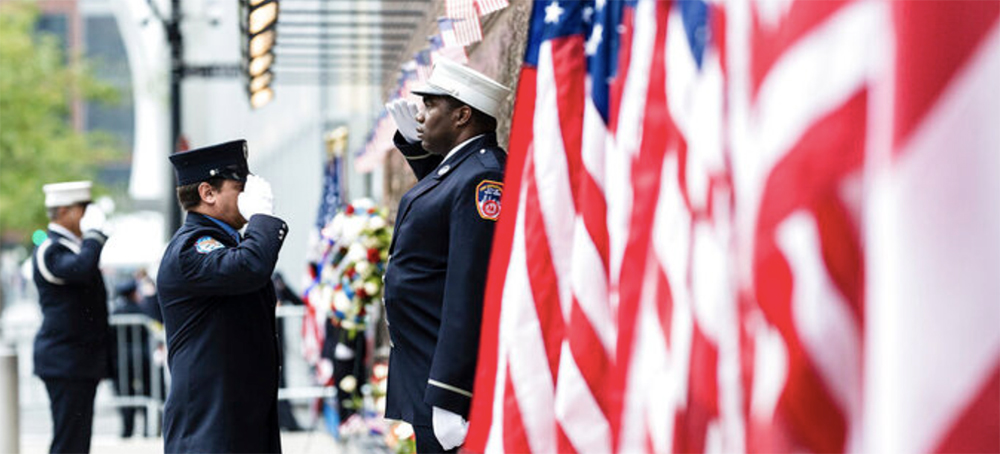 Firefighters salute each other outside the FDNY Engine 10, Ladder 10 fire station near the commemoration ceremony on the 21st anniversary of the September 11, 2001 terror attacks on Sunday, Sept. 11, 2022 in New York. (photo: Stefan Jeremiah/AP)
The loss still feels immediate to Bonita Mentis, who wore a necklace with a photo of her slain sister, Shevonne Mentis.
“It’s been 21 years, but it’s not 21 years for us. It seems like just yesterday,” she said before reading victims’ names at the World Trade Center to a crowd that included Vice President Kamala Harris and husband Doug Emhoff. Mentis’
At the Pentagon, which also was targeted on 9/11, President Joe Biden vowed that the U.S. would continue working to root out terrorist plots and called on Americans to stand up for “the very democracy that guarantees the right to freedom that those terrorists on 9/11 sought to bury in the burning fire, smoke and ash.” First lady Jill Biden spoke at the third attack site, a field near Shanksville, Pennsylvania.
On Sept. 11, 2001, conspirators from the al-Qaida Islamic terror group seized control of jets to use them as passenger-filled missiles, hitting the trade center’s twin towers and the Pentagon. The fourth plane was headed for Washington but crashed near Shanksville after crew members and passengers tried to storm the cockpit.
The attacks killed nearly 3,000 people, reconfigured national security policy and spurred a U.S. “war on terror” worldwide. Sunday’s observances came little more than a month after a U.S. drone strike killed a key al-Qaida figure who helped plot the 9/11 attacks, Ayman al-Zawahri.
Pierre Roldan, who lost his cousin Carlos Lillo, a paramedic, said “we had some form of justice” when a U.S. raid killed Osama bin Laden in 2011.
“Now that al-Zawahri is gone, at least we’re continuing to get that justice,” Roldan said.
The self-proclaimed mastermind of the attacks, Khalid Shaikh Mohammed, still awaits a long-postponed military tribunal. An attorney for one of Mohammed’s co-defendants this week confirmed ongoing negotiations toward a potential agreement to avoid a trial and impose lesser but still lengthy sentences.
The Sept. 11 attacks stirred — for a time — a sense of national pride and unity for many, while also subjecting Muslim Americans to years of suspicion and bigotry and engendering debate over the balance between safety and civil liberties. In ways both subtle and plain, the aftermath of 9/11 ripples through American politics and public life to this day.
But like some other victims’ relatives, Jay Saloman fears that Americans’ consciousness of 9/11 is receding.
“It was a terrorist attack against our country that day. And theoretically, everybody should remember it and, you know, take precautions and watch out,” said Saloman, who lost his brother, Wayne Saloman.
By tradition, no political figures speak at the ground zero ceremony. The observance centers, instead, on relatives reading aloud the names of the dead.
Like a growing number of readers, firefighter Jimmy Riches’ namesake nephew wasn’t born yet when his relative died. But the boy took the podium to honor him.
“You’re always in my heart. And I know you are watching over me,” he said.
Nikita Shah wore a T-shirt that bore the de facto epigraph of the annual commemoration — “never forget” — and the name of her father, Jayesh Shah. She was 10 when he was killed.
The family later moved to Houston but often returns to New York for the anniversary to be “around people who kind of experienced the same type of grief and the same feelings after 9/11,” said Shah.
Readers often add personal remarks that form an alloy of American sentiments about Sept. 11 — grief, anger, toughness, appreciation for first responders and the military, appeals to patriotism, hopes for peace, occasional political barbs, and a poignant accounting of the graduations, weddings, births and daily lives that victims have missed. A few readers note recent events, this year ranging from the still ongoing coronavirus pandemic to Russia’s war in Ukraine.
Some relatives also lament that a nation which came together — to some extent — after the attacks has since splintered apart. So much so that federal law enforcement and intelligence agencies, which were reshaped to focus on international terrorism after 9/11, now see the threat of domestic violent extremism as equally urgent.
“It took a tragedy to unite us. It should not take another tragedy to unite us again,” said Andrew Colabella, whose cousin, John DiGiovanni, died in the 1993 bombing World Trade Center bombing that presaged 9/11.
Beyond the attack sites, communities around the country marked the day with candlelight vigils, interfaith services and other commemorations. Some Americans joined in volunteer projects on a day that is federally recognized as both Patriot Day and a National Day of Service and Remembrance.
Others observed the anniversary with their own reflections.
More than 70 of Sekou Siby’s co-workers perished at Windows on the World, the restaurant atop the trade center’s north tower. He had the day off because another cook asked him to switch shifts.
The Ivorian immigrant wrestled with how to comprehend such horror in a country where he’d come looking for a better life. And Siby, now president of restaurant workers’ advocacy group ROC United, said ahead of the anniversary that the attacks made him wary of becoming attached to people when “you have no control over what’s going to happen to them next.”
“Every 9/11 is a reminder,” he said, “of what I lost that I can never recover.”
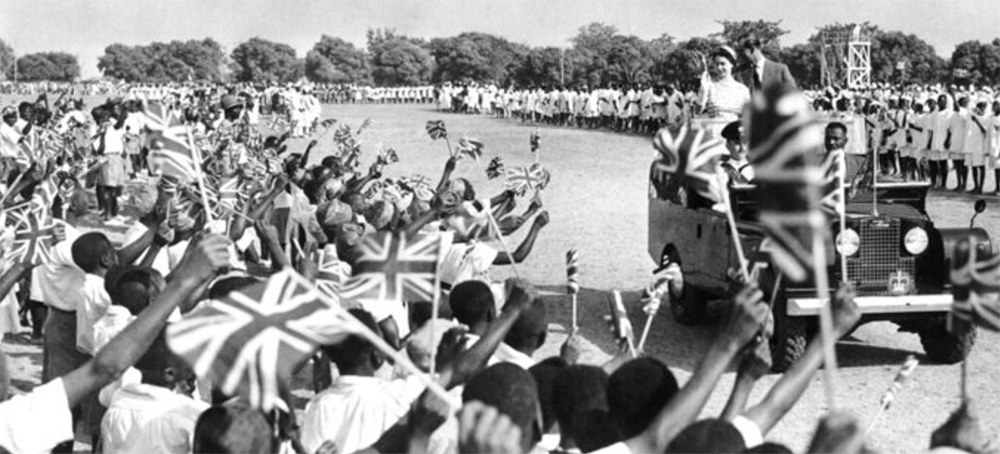 Thousands of flag-waving youngsters cheer as Queen Elizabeth II and the her husband Prince Philip, Duke of Edinburgh, ride through the Kaduna racecourse in Northern Nigeria on Feb. 2, 1956. (photo: ;AP)
Beyond official condolences praising the queen’s longevity and service, there is some bitterness about the past in Africa, Asia, the Caribbean and elsewhere. Talk has turned to the legacies of colonialism, from slavery to corporal punishment in African schools to looted artifacts held in British institutions. For many, the queen came to represent all of that during her seven decades on the throne.
In Kenya, where decades ago a young Elizabeth learned of her father’s death and her enormous new role as queen, a lawyer named Alice Mugo shared online a photograph of a fading document from 1956. It was issued four years into the queen’s reign, and well into Britain’s harsh response to the Mau Mau rebellion against colonial rule.
“Movement permit,” the document says. While over 100,000 Kenyans were rounded up in camps under grim conditions, others, like Mugo’s grandmother, were forced to request British permission to go from place to place.
“Most of our grandparents were oppressed,” Mugo tweeted in the hours after the queen’s death Thursday. “I cannot mourn.”
But Kenya's outgoing president, Uhuru Kenyatta, whose father, Jomo Kenyatta, was imprisoned during the queen's rule before becoming the country's first president in 1964, overlooked past troubles, as did other African heads of state. “The most iconic figure of the 20th and 21st centuries,” Uhuru Kenyatta called her.
Anger came from ordinary people. Some called for apologies for past abuses like slavery, others for something more tangible.
“This commonwealth of nations, that wealth belongs to England. That wealth is something never shared in,” said Bert Samuels, a member of the National Council on Reparations in Jamaica.
Elizabeth’s reign saw the hard-won independence of African countries from Ghana to Zimbabwe, along with a string of Caribbean islands and nations along the edge of the Arabian Peninsula.
Some historians see her as a monarch who helped oversee the mostly peaceful transition from empire to the Commonwealth, a voluntary association of 56 nations with historic and linguistic ties. But she was also the symbol of a nation that often rode roughshod over people it subjugated.
There were few signs of public grief or even interest in her death across the Middle East, where many still hold Britain responsible for colonial actions that drew much of the region’s borders and laid the groundwork for many of its modern conflicts. On Saturday, Gaza’s Hamas rulers called on King Charles III to “correct” British mandate decisions that they said oppressed Palestinians.
In ethnically divided Cyprus, many Greek Cypriots remembered the four-year guerrilla campaign waged in the late 1950s against colonial rule and the queen's perceived indifference over the plight of nine people whom British authorities executed by hanging.
Yiannis Spanos, president of the Association of National Organization of Cypriot Fighters, said the queen was “held by many as bearing responsibility” for the island’s tragedies.
Now, with her passing, there are new efforts to address the colonial past, or hide it.
India is renewing its efforts under Prime Minister Narendra Modi to remove colonial names and symbols. The country has long moved on, even overtaking the British economy in size.
“I do not think we have any place for kings and queens in today’s world, because we are the world’s largest democratic country,” said Dhiren Singh, a 57-year-old entrepreneur in New Delhi.
There was some sympathy for the Elizabeth and the circumstances she was born under and then thrust into.
In Kenya’s capital, Nairobi, resident Max Kahindi remembered the Mau Mau rebellion “with a lot of bitterness” and recalled how some elders were detained or killed. But he said the queen was “a very young lady” then, and he believes someone else likely was running British affairs.
“We cannot blame the queen for all the sufferings that we had at that particular time,” Kahindi said.
Timothy Kalyegira, a political analyst in Uganda, said there is a lingering “spiritual connection” in some African countries, from the colonial experience to the Commonwealth. “It is a moment of pain, a moment of nostalgia," he said.
The queen’s dignified persona and age, and the centrality of the English language in global affairs, are powerful enough to temper some criticisms, Kalyegira added: “She’s seen more as the mother of the world.”
Mixed views were also found in the Caribbean, where some countries are removing the British monarch as their head of state.
“You have contradictory consciousness,” said Maziki Thame, a senior lecturer in development studies at the University of the West Indies in Jamaica, whose prime minister announced during this year’s visit of Prince William, who is now heir to the throne, and Kate that the island intended to become fully independent.
The younger generation of royals seem to have greater sensitivity to colonialism’s implications, Thame said — during the visit, William expressed his “profound sorrow” for slavery.
Nadeen Spence, an activist, said appreciation for Elizabeth among older Jamaicans isn't surprising since she was presented by the British as “this benevolent queen who has always looked out for us,” but young people aren't awed by the royal family.
“The only thing I noted about the queen’s passing is that she died and never apologized for slavery,” Spence said. “She should’ve apologized.”
 Stephen Miller. (photo: Brandon Bell/Getty Images)
 The decommissioned electric chair in which 361 prisoners were executed between 1924 and 1964, is pictured 05 November 2007 at the Texas Prison Museum in Huntsville, Texas. (photo: Fanny Carrier/AFP/Getty Images)
Those were the conclusions of a truly unprecedented judicial “two-for.” On Wednesday, a South Carolina state judge, Jocelyn Newman, relying in large part on that state’s constitution, struck down two methods of execution at once. Unless it is reversed on appeal, her decision brings that state’s death penalty apparatus to a halt.
Judge Newman’s ruling is a welcome recognition of America’s current methods of execution mess and the folly of trying to solve it by resurrecting previously discredited ways of putting condemned inmates to death. The mess has been caused by drug shortages due to suppliers that don’t want to be involved with capital punishment, and it has led to experimentation with new drugs and drug combinations. The mess has sometimes halted lethal injection executions entirely, or more often made this already unreliable method even more error-prone. It has also led to experimentation with previously abandoned methods of execution, like the ones that were struck down in South Carolina this week.
Judge Newman’s ruling is also a clear break with a long history in which courts have, with a few notable exceptions, generally deferred to legislative decisions about execution methods.
In fact, more than a century ago, the United States Supreme Court gave its blessing to both the firing squad and the electric chair.
In 1878, the court reviewed the firing squad’s history and extensive use in military executions. It determined that, even though “[c]ruel and unusual punishments are forbidden by the Constitution”:
the punishment of shooting as a mode of executing the death penalty for the crime of murder in the first degree is not included in that category within the meaning of the Eighth Amendment.
Twelve years later, the court upheld New York’s decision to replace hanging with the electric chair, calling the latter a “humane method” even though such an electrocution had never been carried out.
In the more recent past, other courts have given the green light to hanging. Almost 30 years ago, the U.S. Court of Appeals for the 9th Circuit found that hanging, the method then used in the state of Washington, did not violate the United States constitutional prohibition of cruel and unusual punishment. The court concluded that hanging does not involve “the wanton and unnecessary infliction of pain.”
However, since the start of this century, the electric chair has not fared quite as well when it has had its day in court. Two state supreme courts, one in Georgia in 2001 and one in Nebraska seven years later, have declared it illegal in their states.
The Georgia Supreme Court, hardly a citadel of judicial liberalism and activism, called attention to what it called the “specter of excruciating pain and… certainty of cooked brains and blistered bodies” associated with electrocution. The Nebraska Supreme Court said that “electrocution has proven itself to be a dinosaur more befitting the laboratory of Baron Frankenstein than the death chamber of state prisons.”
That brings us back to South Carolina.
In 2021 South Carolina, which has been unable to get the drugs needed for its lethal injection protocol for a long time, added electrocution and the firing squad to its roster of execution methods. Other death penalty states authorize them but still use lethal injection as the default method. South Carolina now requires death inmates to choose between being shot and electrocuted as their method of execution, but is the only state to use the electric chair if the condemned inmate refuses to make a choice.
Responding to this legislative change, several death row inmates brought suit, and offered a long list of alleged violations of law. Key to their suit was their contention that “both electrocution and the firing squad are prohibited by the South Carolina constitution” and that their “right to elect their manner of execution is rendered meaningless by the lack of constitutional choices….”
Judge Newman found in their favor on all counts.
After undertaking a detailed and careful evaluation of the conflicting expert testimony about each execution method, she found both the firing squad and the electric chair to be wanting and, as applied by the South Carolina legislature, to violate the South Carolina and the U.S. constitutions.
First, the firing squad: Being put to death by a firing squad is the rarest of all the methods of execution (the others being hanging, the electric chair, the gas chamber, lethal injection) used in the United States since 1900. During that period, it has only been the method of choice in 34 executions, all but one of which were in Utah.
Judge Newman described the firing squad as a “reversion to a historic method of execution that has never before been used by our State….” She concluded that it would be “unusual” and for that reason unconstitutional.
But her indictment of the firing squad did not stop there. Someone subject to execution by firing squad, she added “will feel excruciating pain resulting from the gunshot wounds and broken bones…. The firing squad mutilates the human body.”
She likened it to “torture.” And, borrowing a phrase from the U.S. Supreme Court’s definition of what would make an execution cruel, Judge Newman said that the firing squad causes “pain beyond that necessary for the mere extinguishment of ….(life).”
The judge was also unsparing in her treatment of the electric chair. Unlike the firing squad, South Carolina has had some experience with the electric chair. Since 1976, the state has electrocuted seven people. Judge Newman found from each of these cases that “South Carolina’s electric chair causes severe damage to the inmate’s body.”
“There is evidence,” she continued, that “inmates executed by electrocution continue to move, breathe and even scream after the shock is administered…(and) would suffer the experience of being burned alive.”
Finally, noting the important role of social progress in constitutional interpretation, the judge concluded that using the electric chair is “inconsistent with both the concepts of evolving standards of decency and the dignity of man….” It is time, she said, “to retire South Carolina’s electric chair as a violation of… the South Carolina Constitution.”
Judge Newman’s unusual ruling punctures the long-held belief that this country could find a way of putting people to death that would be safe, reliable, and humane. Over the course of the last century and more, that belief has led us to try one method after another.
As each new method was rolled out, their proponents made the same claims, namely that the proposed method—whether the firing squad, the electric chair, or most recently lethal injection—would ensure that executions would neither be torturous nor be like being burned alive.
None has filled the bill or lived up to the hype.
Judge Newman’s two-for-one ruling reminds us that turning back the clock to previously discredited methods is a sign of desperation not of progress. We would do well to heed her descriptions of these brutal means of carrying out executions, and better still to realize that there is no method that can make it acceptable for the state to kill its citizens.
 Maryan Madey, who fled the drought-stricken Lower Shabelle region, holds her malnourished daughter Deka Ali, 1, at a camp for the displaced on the outskirts of Mogadishu, Somalia, on Sept. 3. (photo: Farah Abdi Warsameh/AP)
More than 7.1 million people — roughly half of Somalia’s population — are in need of food assistance. One out of every five children in the country will face deadly forms of malnutrition by October should current conditions remain. Four failed rainy seasons have plunged the region into its worst drought in more than four decades, prompting roughly a million people in Somalia to leave their homes and trudge through the arid countryside in search for food and aid. Their woes were compounded by events far from their reach, with the Russian invasion of Ukraine causing a surge in global grain, fuel and fertilizer prices that have impacted some of the world’s poorest countries.
Eyewitness accounts detail scenes of unending misery, as countless hungry children succumb to otherwise preventable diseases. “We are burying babies and watching with heartbreak as mothers cry because they don’t know what to feed their children, now dying of hunger and thirst, and drought robs families of crops and livestock, their only source of income,” Daud Jiran, Somalia country director for humanitarian organization Mercy Corps, said in an email.
For months, U.N. officials and international organizations have warned about mounting hunger in Somalia and other parts of Africa. But the declaration of famine itself is a specific and rare event usually invoked by the United Nations and national governments. A declared famine implies that the data shows more than 20 percent of households in the country have extreme food gaps, about a third of children experience acute malnutrition, and two people out of every 10,000 is dying every day from starvation, according to the Integrated Food Security Phase Classification.
Famine was last declared in Somalia in 2011 when more than a quarter million people died, half of them under the age of 5. Much has changed in the intervening years, but certain fundamental challenges remain, including the persistence of a violent Islamist insurgency by al-Shabab militants. They control a swath of the country and have made access to some areas hit by drought difficult for relief workers. Close to a million Somalis live in parts of the country dominated by al-Shabab. Experts believe the true extent of suffering in Somalia is far worse than the publicized data, with countless deaths going uncounted in rural areas.
A decade ago, critics warned that the famine declaration in Somalia came far too late, and that an earlier designation would have spurred the international community faster into action. The same may be true now.
“People are already dying,” International Rescue Committee head David Miliband said in a statement. “During the last famine in Somalia in 2011, half of all deaths occurred before famine was declared. … The international community pledged to ‘never again’ allow famine in Somalia or wait so long to act, but it is repeating the same mistake this year.”
The warning signs have been there for all to see. In April, the U.N.’s children agency said that 1.4 million kids under the age of 5 faced acute malnutrition and had already documented hundreds of deaths of children in malnutrition treatment centers. In May, at least 213,000 people in the central Bay region were deemed to be in “catastrophe,” a term for starvation. Through the rest of the summer, U.N. agencies and aid organizations raised the alarm, cataloguing widespread hunger and decrying a lack of international support.
“The crisis is worse now than any time in my lifetime working in Somalia for the last 20 years, and it is because of the compounded effect of the war in Ukraine,” said Mohamud Mohamed Hassan, Somalia country director for the charity Save the Children, to my colleague Sudarsan Raghavan in June. “Communities are at a breaking point.”
Foreign aid has been slow to come. A $1.5 billion response plan for Somalia proposed by the United Nations was only 17 percent funded in April, and just two-thirds funded by August. Compare that to the tens of billions of dollars mustered by Western powers with minimal political discussion or fuss to support Ukraine’s war effort against the Russian invasion.
Samantha Power, USAID administrator, said Tuesday that a famine can still be averted. “Today, a significant increase in humanitarian assistance can still help prevent mass starvation and deaths,” she said in a statement. “But the window to prevent this famine projection from becoming a reality is closing quickly and the next several weeks are critical.” Her agency has put into a motion a plan to feed at least 3.5 million people a month and committed at least $668 million in funding in this fiscal year alone.
Somalia sourced 90 percent of its wheat from Russia and Ukraine before the war. The first major shipment of Ukrainian grain since negotiations eased a Russian blockade reached East Africa last week. But the damage done to a region so dependent on these imports has been deep and lasting.
So, too, the toll of climate change. Ordinary Somalis — like ordinary Pakistanis who saw a third of their nation get flooded over the past week — have contributed little to the emissions that are warming the planet. But they are on the front lines of the catastrophic climatic events scientists believe will only grow more common in the years to come. In Somalia’s case, experts predict more dry spells in the near future.
“The world is witnessing how climate change, conflict, rising food costs, and the knock-on impacts of COVID-19 are collapsing food systems and leading to preventable deaths,” Jiran said in an email. “Continuing drought and starvation are the future if we do not protect the planet from a changing climate and help the communities hit first and hardest, like those in Somalia, mitigate and adapt.”
 Induction stove. (photo: Getty Images)
The secret to an induction stove is that it’s basically just a big magnet. And when a pan is sitting on the stovetop, that magnetic field creates little electric currents that swirl through the pan. This heats up the pan, but leaves everything around it cool. It also means that induction stoves can heat up food in a fraction of the time for a fraction of the energy.
But does the technology live up to its hype? Grist’s video team set out to answer two questions: How good are induction stoves for the environment? And how affordable are they for the average person?
Each day, an average home cook using a gas stove produces about 0.95 pounds of carbon dioxide. Induction stoves, on the other hand, use electricity. And to figure out the carbon emissions of using an electric induction stove, we have to look at the grid.
Right now, the United States’ electric grid is powered by a mix of renewables, nuclear, and fossil fuels like coal, natural gas, and some petroleum. When you add it all up, an average home cook would produce about 0.96 pounds of carbon dioxide every day by using an electric induction stove. That means right now, an electric induction stove and a gas stove produce about the same amount of CO2.
But those emissions could vary a lot depending on where your state or region gets its power. For example, an induction stove in renewable-heavy Vermont would be a lot cleaner than one in coal-filled West Virginia. As our grid transitions away from coal and toward renewables, induction and electric cooking is only going to get cleaner.
There are other concerns with natural gas, too. With natural gas stoves, that gas has to be piped into homes, and all of that natural gas infrastructure is notoriously leaky.
Electrifying your stove now is kind of like making a bet: You’re hoping that the grid is going to get a lot cleaner over the next few decades. And you’re also helping to move away from gas infrastructure entirely by disconnecting your home from natural gas. All this means there are climate benefits to switching to induction, but right now those benefits are fairly small.
What about the financial cost? Based on an informal survey of the Lowe’s website, it’s clear that induction stoves are generally more expensive. For example, entry-level induction stoves are priced just over $1,000. Gas stoves, on the other hand, begin at just over $400.
Experts that we spoke to said this is mostly because of the industry’s scale. Induction stoves have only been commercially available in the U.S. for a few decades. The industry is pretty new and small, and prices should come down once the technology is more popular.
The passage of the 2022 Inflation Reduction Act could speed this up. Under the act, low-income households can get an electric or electric induction stove fully reimbursed, up to $840. Middle-income households can get half the price of the stove reimbursed. Still, individual states have to set up and apply for funding, so this process will take some time.
At the moment, it costs about the same amount to run an electric stove or a gas stove. Depending on energy prices in your area in a few states, an induction stove could save you around $20 a year or cost you around $20 a year. But mostly you’re only looking at the difference of a few bucks.
Finally, if you go for an induction stove, you also might need new cookware. In order for your pots and pans to heat up, they have to contain some kind of iron compound — essentially, they have to be magnetic. So while cast iron and stainless steel pots are generally fine, aluminum or copper pots might not work as well. Basically, if a magnet sticks to the bottom of your pan, you’re in good shape.
But there’s one final comparison to make that actually seems pretty important: gas stoves are actually terrible for people’s health. When your gas stove is on, it lets off toxic chemicals like nitrogen dioxide. Outside air pollution laws require that this chemical stay below around 100 parts per billion, but inside a gas stove or oven can easily cause nitrogen dioxide levels of up to 300 parts per billion. That’s three times as high as what would be legal outside.
And even brief exposure can cause breathing problems and asthma attacks in some people. One team of researchers looked at dozens of studies on the health impacts of gas stoves. They found that a child living in a home with a gas stove was 42 percent more likely to have asthma. That’s about the same risk as living in a house with a smoker. If you do decide to keep your gas stove, it’s probably worth upgrading your ventilation system. That can be expensive, but it could be really important for your family’s health.
Emissions from cooking overall are relatively small compared to things like transportation, travel, or home heating. If you want to limit your carbon footprint, buying an induction stove is probably not the best bang for your buck. Something like getting an electric bike, an electric vehicle, or switching your home heating system over from fossil fuels to heat pumps might go a little bit further.
But if you love to cook and want to limit your future carbon emissions, then an induction stove could be a pretty good fit for you, especially if it means you can get rid of a gas line going to your house altogether.
Follow us on facebook and twitter!
PO Box 2043 / Citrus Heights, CA 95611


Comments
Post a Comment