RSN: Trump Told White House Team He Needed to Protect 'Russiagate' Documents

09 September 22
Live on the homepage now!
Reader Supported News

The former president, who left the White House with a trove of sensitive material, believes there are documents that would expose a Deep State plot against him — and told confidants he needed to protect them from the next administration
The documents related to the federal investigation into Russian election meddling and alleged collusion with Trump’s campaign. At the end of his presidency, Trump and his team pushed to declassify these so-called “Russiagate” documents, believing they would expose a “Deep State” plot against him.
According to a person with direct knowledge of the situation and another source briefed on the matter, Trump told several people working in and outside the White House that he was concerned Joe Biden’s incoming administration — or the “Deep State” — would supposedly “shred,” bury, or destroy “the evidence” that Trump was somehow wronged.
Trump’s concern about preserving the Russia-related material is newly relevant after an FBI search turned up a trove of government documents at the former president’s Mar-a-Lago residence.
Since the search, Trump has refused to say which classified government papers and top-secret documents he had at Mar-a-Lago and what was the FBI had seized. (Trump considers the documents “mine” and has directed his lawyers to make that widely-panned argument in court.) The feds have publicly released little about the search and its results. It’s unclear if any of the materials in Trump’s document trove are related to Russia or the election interference investigation. A Trump spokesperson did not respond to a request for comment.
But both Trump and his former Director of National Intelligence have hinted that Russia-related documents could be among the materials the FBI sought. “I think they thought it was something to do with the Russia, Russia, Russia hoax,” Trump said during a Sept. 1 radio interview. “They were afraid that things were in there — part of their scam material.”
Former DNI John Ratcliffe told CBS days earlier that, while he had no knowledge of what was in the records, “It wouldn’t surprise me if there were records related to [Russia] there.”
A month before the 2020 election, Ratcliffe declassified intelligence detailing how the U.S. had obtained information about “Russian intelligence analysis” on Hillary Clinton’s campaign. The intelligence community, Ratcliffe wrote, couldn’t determine whether the information contained “exaggeration of fabrication.” Both CIA director Gina Haspel and NSA chief Paul Nakasone reportedly opposed the declassification on the grounds that it could reveal how American spies had obtained the information. Indeed, a variety of other officials familiar with the internal debate felt such declassifications could out sensitive sources.
“That document was from a pretty sensitive place that you would know where it was from if you were in Russia,” one former intelligence official tells Rolling Stone about the material released by Ratcliffe. “There were enough clues in there that the Russians could’ve figured it out.”
Other intelligence officials expressed concern that Ratcliffe would reveal even more information potentially damaging to U.S. intelligence sources. “We were worried they’d try to counter the bipartisan Senate Intelligence committee endorsement of the 2017 Intelligence Community Assessment by selectively declassing intel that the House Intelligence minority had cobbled together to counter the narrative that Russia preferred Trump,” another former intelligence official says.
The 2017 assessment concluded that Russian president Vladimir Putin had meddled in the 2016 election because he wanted Trump to win — a conclusion Putin himself half admitted to during his 2018 summit with the former president in Finland. But Republicans on the House Intelligence committee, led by Devin Nunes, repeatedly disputed that conclusion, even as their Republican counterparts on the Senate Intelligence committee accepted it.
The intelligence community’s resistance to Trump’s efforts to declassify sensitive material related to Russia and the election — specifically a classified report by Nunes disputing the 2017 assessment — reportedly led Trump to consider firing CIA director Gina Haspel in November 2020 as he moved trusted allies into sensitive intelligence positions, CNN reported at the time.
Trump never fired Haspel, and the House Intelligence committee’s classified report wasn’t released publicly. But both Trump and Meadows worked up until Biden took the oath of office to declassify information they viewed as beneficial to Trump’s narrative of “Deep State” persecution.
In a memo to the acting attorney general and intelligence officials sent the day before Trump left office, he claimed the Justice Department had sent him a binder of materials on the FBI’s so-called “Crossfire Hurricane” investigation in late December 2020. The department sent Trump that information, he claimed, “so I could determine to what extent materials in the binder should be released in unclassified form.”
The materials included “transcripts of intercepts made by the FBI of Trump aides, a declassified copy of the final FISA warrant approved by an intelligence court, and the tasking orders and debriefings of the two main confidential human sources, Christopher Steele and Stefan Halper,” according to John Solomon, Trump’s representative to the National Archives.
Trump White House Chief of staff Mark Meadows later wrote in his memoir that he “personally went through every page” of the documents to make sure the declassified portions didn’t “disclose sources and methods” and described his frustration by what he considered “push back” from the Department of Justice and FBI.
Meadows and Trump worked to release the material up until “minutes before” Biden’s inauguration. Trump sent a memo on Jan. 19 accepting the FBI’s redactions and ordering declassification. Meadows sent a followup memo on Biden’s inauguration day. The material was never released publicly. But in a series of podcast interviews recorded before the FBI search, former Nunes and Trump official Kash Patel shed some light on the administration’s broader plans. He claimed Trump had asked him to help retrieve and publish so-called “Russiagate” material the White House counsel’s office had sent to the National Archives in the last days of the administration.
 The Justice Department is barred for now from using a trove of documents seized in a search of former President Donald J. Trump's Mar-a-Lago residence and club in Florida. (photo: Josh Ritchie/The New York Times)
Judge Aileen Cannon, appointed to the bench by Trump in 2020, ruled Monday that the federal investigators probing whether Trump mishandled classified documents were to stop using the seized documents in their criminal probe, pending the review of a special master.
The Justice Department also asked Cannon to partially lift her own ruling so that investigators can continue reviewing the 103 most sensitive documents seized from Mar-a-Lago that contained classified markings, including TOP SECRET, the highest classification level.
Trump and his attorneys have until Monday morning to respond to the request to resume investigating the documents.
The Justice Department's appeal will be considered by the 11th Circuit Court of Appeals.
In her 24-page ruling earlier this week, Cannon sided with Trump's legal team that the independent review was necessary and wrote that a special master would analyze "potentially privileged material subject to claims of attorney-client and/or executive privilege." The ruling did allow the Office of the Director of National Intelligence its examination of potential national security risks posed by the seized record, even when criminal investigators were barred from accessing them.
Cannon's order was largely criticized by many in the legal community, including Trump's former Attorney General William Barr.
Trump, the judge wrote, faces "unequitable potential harm by way of improper disclosure of sensitive information to the public," and a special master, Cannon reasoned, could work to mitigate that potential damage.
But in Thursday's motion, which highlighted its concerns in detail, the Justice Department argued the contrary; that halting their investigation posed grave harm to national security and the intelligence review of the records could not be effectively performed without the involvement of criminal investigators. The investigation and the public at large, prosecutors wrote, could be "irreparably injured" by the pause.
"The ongoing Intelligence Community ("IC") classification review and assessment are closely interconnected with—and cannot be readily separated from—areas of inquiry of DOJ's and the FBI's ongoing criminal investigation," the Justice Department's filing on Thursday said, adding it would be "exceedingly difficult to bifurcate the FBI personnel working on the criminal investigation from those working in conjunction with other departments or agencies in the IC."
Thursday's filing also revealed the 103 documents with classified markings were already separated from the remaining thousands of seized records and that the Intelligence Community had actually paused their analysis of the documents due to "uncertainty" caused by Cannon's Monday order.
In his lawsuit, Trump alleged the Justice Department's search warrant that prompted the Aug. 8 search was "overbroad" and that investigators took "presumptively privileged" information. Cannon's opinion earlier this week indicated she thought this claim warranted further review.
Prosecutors have staunchly opposed that characterization and implemented a filter team to do its own review of the material. And on Thursday, they argued the special master review should not apply to the records with classified markings because such documents explicitly belonged to the government and not Trump.
"There is no justification for extending the injunction and special-master review to the classified records. The classification markings establish on the face of the documents that they are government records, not Plaintiff's personal records."
Investigators are examining allegations that documents with classified markings were mishandled when they were transferred from Trump's White House to his Mar-a-Lago residence after the presidential transition in 2021. In three separate instances earlier this year that culminated in the August 8 search, the National Archives and the FBI recovered troves of documents from the Florida resort. They are also probing whether Trump or his team obstructed the investigation by not properly responding to a grand jury subpoena, which prosecutors reiterated in their motion on Thursday.
Trump's request for a special master came two weeks after the FBI took 33 items from a storage room on the property and the former president's office. More than 100 documents with classification markings were found in 13 boxes or containers, while three documents with "confidential" and "secret" classification markings were taken from desks in Trump's office at Mar-a-Lago, the Justice Department revealed in past filings.
The FBI also found 48 empty folders with "classified" banners alongside newspaper and magazine articles, books and pieces of clothing kept in boxes or containers retrieved from the storage room.
Both the classified documents and the empty folders, prosecutors wrote Thursday, pose potential risks to national security that warrant continuing the investigation.
"The FBI would be chiefly responsible for investigating what materials may have once been stored in these folders and whether they may have been lost or compromised—steps that, again, may require the use of grand jury subpoenas, search warrants, and other criminal investigative tools and could lead to evidence that would also be highly relevant to advancing the criminal investigation," they argued.
To underscore the urgency of their request, the Justice Department notably included a declaration written by Alan Kohler, the FBI's Assistant Director for the Counterintelligence Division.
"The FBI must be able to access the evidence, duplicate it, discern the appropriate [intelligence community] agency…to which it should be provided," Kohler wrote. The declaration carries a penalty of perjury.
Cannon ordered Monday that the Justice Department and Trump's legal team submit potential candidates for the role of special master by Friday.
Trump, who has denied wrongdoing, reacted on social media to the Justice Department's response, calling investigators "leakers" and praising Cannon's initial ruling, calling her "brilliant" and "courageous."
The judge noted in her ruling that the FBI's filter team found medical and tax documents in the seized records and revealed that in two instances, potentially privileged information made its way through the filter and into the hands of investigators. The Justice Department has since asked the court to unseal a report prepared by the filter team.
 Abortion rights supporters gather outside the Michigan Capitol in Lansing, Michigan, during a rally, September 7, 2022. (photo: Jeff Kowalsky/Getty)
It's up to the Michigan Board of State Canvassers Friday to decide in a final vote whether the measure should go before voters. Last week, the question was sent to the state Supreme Court after Republican canvassers argued the amendment's spacing and formatting would be confusing to voters. They deadlocked on the decision and the group behind the amendment, Reproductive Freedom for All, appealed the decision to the state's highest court.
Chief Justice Bridget Mary McCormack called the effort by board members to keep the abortion rights question off the ballot "a game of gotcha gone very bad."
"What a sad marker of the times."
Justices held that more than enough signatures were collected (about 750,000 signatures, far more than the 425,000 signatures required) and that other matters were not up to the board to decide.
"We are energized and motivated now more than ever to restore the protections that were lost under Roe," said Darci McConnell, the communication director for Reproductive Freedom for All, in a statement after the court's ruling.
"It falls to voters now to reject this mistake-ridden, extreme proposal on Election Day," said the spokesperson for MI Women and Children, Christen Pollo, in a statement. "We are confident that a majority will say No to Proposal 3."
It's been a contentious week for abortion Michigan — one of the only states in the region where abortion remains legal. Wednesday, a judge ordered to bar enforcement of a 1931 law that criminalizes the procedure.
If the amendment moves ahead, Michigan will join other states such as California and Vermont where voters will see similar state constitutional abortion rights amendments on their ballots this November.
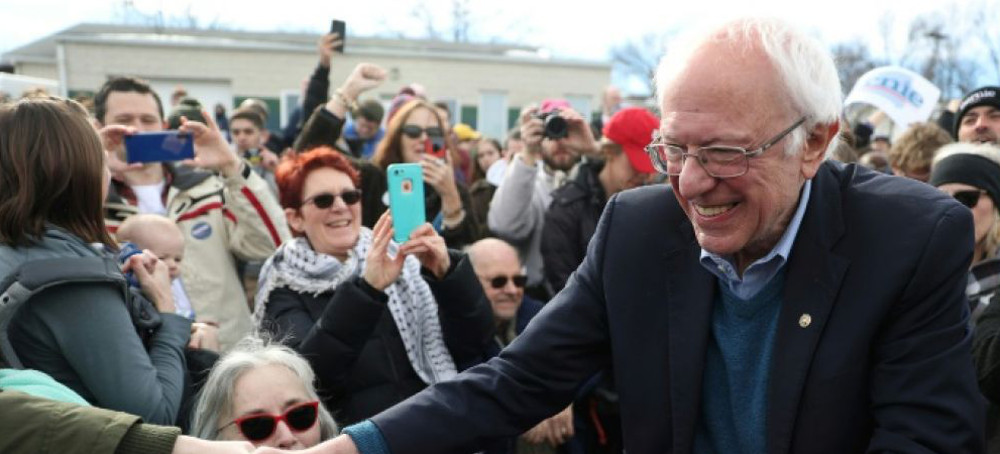 Sen. Sanders slammed an agreement Between Sen. Schumer and Sen. Manchin as 'a huge giveaway to the fossil fuel industry.' (photo: Getty)
Schumer told reporters Wednesday that he plans to attach Manchin’s permitting reform bill to the stopgap spending measure that needs to pass by Sept. 30 to prevent a government shutdown.
Sanders slammed the agreement as “a huge giveaway to the fossil fuel industry” and angrily warned that it would undermine President Biden’s pledge to reduce carbon emissions by 50 percent by the year 2030.
“I rise this morning to express by strong opposition to the so-called side deal that the fossil fuel industry is pushing to make it easier for them to pollute the environment and destroy our planet,” Sanders said.
He said the legislation crafted by Manchin would make it easier for the fossil fuel industry to receive permits and complete what he called “some of the dirtiest and most polluting oil and gas projects in America.”
He added the bill would speed the approval of a pipeline spanning from West Virginia to North Carolina that would “generate emissions equivalent to 37 coal plants or over 27 million cars each and every year.”
“Really, at a time when climate change is threatening the very existence of our planet, why would anybody be talking about substantially increasing carbon emissions and expanding fossil fuel production in the United States?” Sanders asked.
Sanders said he understood the power of oil, gas and coal companies “in our corrupt political system” but called on his colleagues to vote against the deal.
Pairing permitting reform to a continuing resolution gives it a very good chance of passing, even though opposition is building among progressive House Democrats.
Schumer said he promised to pass the bill in exchange for securing Manchin’s vote last month for the Inflation Reduction Act (IRA), which will invest more than $300 billion in programs to combat climate change and further develop domestic energy production.
“Permitting reform is part of the IRA, and we will get it done,” Schumer said.
The Democratic leader admitted last month that he was not thrilled to agree to permitting reform, but he noted that it could help the development of renewable energy projects as well as those to extract fossil fuels.
“In terms of the permitting reform, I didn’t like it but it was something that Sen. Manchin wanted,” Schumer told reporters in early August. “And in fact it has some very good things for the environment. It’s going to make permitting easier for clean energy.”
 Ukrainian soldiers on the Sloviansk front, Donetsk region, one of the areas where advances have been made. (photo: David Goldman/AP)
President announces soldiers have taken key eastern town of Balakliia, as US secretary of state visits Kyiv
Zelenskiy also released a video late on Thursday in which Ukrainian soldiers said they had taken the key eastern town of Balakliia, which has a population of 27,000 people.
Earlier, Brig Gen Oleksiy Gromov said at a briefing that Ukrainian armed forces had advanced up to 50km (31 miles) into Russian lines and that “the total amount of territory returned to Ukrainian control in the Kharkiv and Pivdennyi Buh directions stands at more than 700 sq km”.
Gromov said Ukrainian troops had advanced up to 3km on the Sloviansk front in the east and recaptured a settlement called Ozerne.
This is the first time Kyiv has disclosed details of its recent counteroffensive since last week so as not to compromise the operation.
The general singled out the role of Turkish-made Bayraktar drones. “Enemy infantry and motorised artillery units unprotected by air defence systems become easy prey for our Bayraktars, the quantity of which is always increasing, thanks to our volunteers,” he said.
A top US general, Mark Milley, described the progress of Ukraine’s counteroffensive as “steady” and “deliberate”, and pointed in particular to the impact of US-supplied high-mobility artillery rocket systems (Himars) in supporting Ukraine’s advance.
“We are seeing real and measurable gains from Ukraine in the use of these systems,” Gen Milley, the chair of the joint chiefs of staff, said in Ramstein, Germany. “For example, Ukrainians have struck over 400 targets with the Himars and they’ve had a devastating effect.
“Russian lines of communication and supply channels are severely strained. It is having a direct impact on the Russian ability to project and sustain combat power. Russian command and control in their headquarters have been disrupted and they’re having great difficulty in supplying their forces and replacing their combat losses.”
Milley and the US defence secretary, Lloyd Austin, were in Ramstein to meet their counterparts from about 50 countries to coordinate military support for Ukraine on a day when the US secretary of state, Antony Blinken, announced another $2.8bn in arms supplies, both short- and long-term, for Ukraine and neighbouring states.
A state department official, speaking on condition of anonymity, said the US package would “bolster the security of Ukraine and 18 of its neighbours, including … many of our Nato allies as well as other regional security partners”.
Blinken made the arms announcement on a surprise visit to Kyiv. His arrival, which was not publicly expected until he landed, came after Zelenskiy, reported “good news” from the war’s frontlines.
In a Wednesday evening address, Zelenskiy cited “the extremely successful hits in areas where the occupiers are concentrated”, and thanked Ukrainian artillery troops for what he said were successful strikes against Moscow’s forces in the south.
Also on Wednesday, an official representing the Russian-controlled self-proclaimed republic in Donetsk confirmed that Ukraine had launched a surprise counterattack in the north-east Kharkiv region and “encircled” Balakliia, an eastern town of 27,000 people situated between Kharkiv and Russian-occupied Izium.
Unverified footage circulating on social media showed what looked like a Ukrainian soldier posing in front of an entrance sign for Balakliia.
The US Institute for the Study of War (ISW), which follows the fighting in detail, said the Ukraine counterattack in the east drove Russian forces back to the north side of the Siverskyi Donets and Serednya Balakliika rivers and that Kyiv had retaken 400 sq km of territory in the east of the Kharkiv region.
It appeared that Ukraine forces had also recaptured Verbivka and that Russian forces may have destroyed bridges to prevent Ukrainian fighters from pursuing them, ISW said.
“Russia’s deployment of forces from Kharkiv and eastern Ukraine to Ukraine’s south is likely enabling Ukrainian counterattacks of opportunity,” it said.
The long-awaited counteroffensive came at a crucial moment in the conflict. After months in which Ukraine’s fate seemed sealed, with Moscow cornering Ukraine in the Donbas and threatening to advance towards Odesa, the reconquest of territory by the Ukrainian armed forces seems to have raised the morale of the people, who are resigned to a conflict that could last for years.
“Each success of our military in one direction or another changes the general situation along the entire frontline in favour of Ukraine,” Zelenskiy said. “The more difficult it is for the occupiers, the more losses they have, the better the positions of our defenders in Donbas will be.”
The Ukrainian counteroffensive in the east does not seem to have stopped the Russian bombing in the city of Kharkiv. On Thursday, the regional governor of Kharkiv, Oleh Synehubov, said two people were killed and five were injured in Russian shelling in the city’s industrial district.
Ukraine’s commander-in-chief of the armed forces, Gen Valeriy Zaluzhnyi, gave a detailed assessment of the war to date in rare public comments published on Wednesday and warned of the threat of Russia using nuclear weapons in Ukraine, which would create the risk of a “limited” nuclear conflict with other powers, according to an opinion piece attributed in his name in Ukraine’s state news agency Ukrinform.
Zaluzhnyi said the “direct threat” of Russia’s possible use of tactical nuclear weapons had had a major influence on the adoption of relevant decisions.
“Another factor is the direct threat of the use by Russia, under certain circumstances, of tactical nuclear weapons,” he said. “Battles on the territory of Ukraine have already demonstrated how much the Russian Federation neglects the issues of global nuclear security even in a conventional war. It is hard to imagine that even nuclear strikes will allow Russia to break Ukraine’s will to resist. But the threat that will emerge for the whole of Europe cannot be ignored.”
Heavy fighting was raging on Thursday in areas near the Russian-occupied Zaporizhzhia nuclear power station in Ukraine after Kyiv said it may have to shut down the plant to avoid disaster.
The general staff of Ukraine’s armed forces said in its daily update that some villages and communities near the plant were heavily shelled in the 24 hours to Thursday morning from “tanks, mortars, barrel and jet artillery”.
The occupation of the nuclear power plant has prompted fears of a nuclear disaster as both sides trade blame for shelling the site.
On Wednesday, the head of the IAEA, Rafael Grossi, who was in Rome for a meeting with the Italian prime minister, Mario Draghi, told La Repubblica newspaper that he was moved when he visited the plant.
When asked what he thought about Vladimir Putin and Zelenskiy, who accused him of not saying who was to blame for the strikes on the plant, Grossi replied: “Being a judge, the referee between two contenders, is not my mandate. Indeed, if it was, it would cancel my utility as guarantor of the safety of the nuclear power plant.”
 Sen. Warren plans to reintroduce a bill on Thursday that would ban anti-union 'right-to-work' laws that are now on the books in a majority of states. (photo: Gage Skidmore/Creative Commons)
Such laws forbid employers and unions from entering into agreements stipulating that every worker covered by the contract pay fees to the union. In doing so, they allow workers to opt out of paying any dues while still enjoying the benefits of a union contract and representation.
Warren and other Democrats have railed against the provisions for years, but that hasn’t stopped the laws from proliferating in Republican-led states hostile to organized labor. Twenty-seven states have now put right-to-work laws in place, with Kentucky being the most recent in 2017.
Warren said in a statement to HuffPost that Democrats were making clear they “stand in solidarity with workers everywhere.”
“Republicans and their corporate interest backers have imposed state laws with only one goal: destroy unions and discourage workers from organizing for higher wages, fair benefits, and safer working conditions,” she said.
The Massachusetts senator has rounded up 18 co-sponsors in her chamber ― all Democrats, plus the independent Sen. Bernie Sanders (Vt.) ― for what she’s calling the Nationwide Right to Unionize Act. She previously introduced similar versions of the bill in 2017 and 2020.
Rep. Brad Sherman (D-Calif.) has introduced a companion bill on the House side, where a dozen Democrats have co-sponsored it so far.
Despite Democrats currently holding threadbare majorities in the House and Senate, the odds of the legislation making it to President Joe Biden’s desk are slim to zero in the current Congress.
Even if Senate Democrats were willing to dispense with the filibuster that requires 60 votes to surmount, they could still struggle to get centrist colleagues in their caucus onboard with the plan. Two of those colleagues — Democratic Sens. Kyrsten Sinema and Mark Kelly — hail from the right-to-work state of Arizona and have a history of frustrating their party’s progressive wing.
Nonetheless, the right-to-work bill and other aggressive labor proposals like it can help unions gauge where Democrats stand on their priorities.
Unions have been fighting right-to-work measures on multiple fronts in recent years. In addition to the state laws that have been passed, the conservative majority of the Supreme Court ruled in 2018 that government workers could not be required to pay what are known as “fair share” fees to cover the cost of union representation. The decision, Janus v. AFSCME, effectively made the entire U.S. public sector right-to-work.
Missouri nearly became the latest state to implement such a law, but after the GOP-led state legislature passed one in 2017, voters promptly overturned it the following year by referendum.
Democrats have included a ban on right-to-work laws in their massive proposal to overhaul labor law known as the Protecting the Right to Organize Act. The bill would also significantly ramp up penalties against employers for illegal union-busting and make it easier for workers to secure a first collective bargaining agreement, among other significant legal changes.
Like Warren’s standalone proposal to unwind the right-to-work regime, the PRO Act faces an obstacle in the Senate filibuster. Progressives had hoped to include some measures of the PRO Act in their big party-line package that was passed in August, but none made it into the final law.
Biden, who has fashioned himself the “most pro-union president” in history, has endorsed the PRO Act as well as the repeal of right-to-work laws.
“We should change the federal law [so] that there is no right-to-work allowed anywhere in the country,” Biden told a Teamsters conference in 2020. “For real. Not a joke.”
 Researchers identified a beached whale that washed onto shore at Moon Bay, California as "Fran," a 17-year-old humpback who was well-known to local marine biologists and whale enthusiasts alike. (photo: Jodi Frediani)
Key Facts
The 49-foot-long humpback whale was spotted Sunday on a beach in Half Moon Bay, Calif., and a necropsy by the Marine Mammal Center found one of her vertebrae was fractured and her skull was dislocated, suggesting she died after being struck by a ship.
Within days, researchers identified the beached whale as “Fran,” a 17-year-old humpback who was well-known to local marine biologists and whale enthusiasts alike.
Fran was the most frequently spotted whale in California on Happywhale, a site that allows users to track the giant marine mammals, with more than 250 sightings since 2005 spanning from Monterey Bay in California (where humpback whales feed in the warm months) to the Pacific coast of Mexico (where they tend to breed).
Fran’s personality also made her something of a local celebrity in Monterey Bay, where scientists and whale watchers often spotted her dramatically breaching above the surface of the ocean or gregariously swimming up to boats, according to interviews with the San Jose Mercury News, NBC’s San Francisco affiliate and SFGATE.
For the first time, Fran brought a healthy female calf to California this season, and the mother and daughter were both spotted swimming in Monterey Bay last month, according to the Marine Mammal Center and Happywhale.
Including Fran, at least four whales in the San Francisco area have washed up on the shore this year due to ship collisions, the Marine Mammal Center says.
Key Background
Humpback whales were killed en masse during the age of whaling, when ships scoured the ocean hunting the 40-ton mammals for their oil-producing blubber. The species has recovered since then as the whaling industry declined and governments introduced conservation efforts in the 20th century, and researchers think thousands of humpbacks now feed off the coast of California and spend their winters in Mexico and Central or South America. However, the massive animals still face a handful of manmade threats, including entanglement in fishing gear and collisions with container ships and oil tankers, Karen Grimmer, a resource protection coordinator with the Monterey Bay National Marine Sanctuary, told Forbes. It’s difficult to estimate exactly how many whales are killed by boats, but Grimmer said “there is a very high risk” as mega-ships often transit through areas frequented by whales. Grimmer believes part of the solution is for ships to slow down to under 10 knots—or 11.5 miles per hour—during peak whale season. Many shipping companies have agreed to voluntarily reduce their speeds off the coast of California, particularly in designated lanes, but while Grimmer notes this system has achieved some success, she added “we would like to see them slow down throughout sanctuaries” rather than specifically in shipping lanes.
Crucial Quote
“We are very concerned about ship strikes,” Grimmer said. “Hundreds of large container ships are transiting through the [Monterey Bay] sanctuary every year.”
Surprising Fact
Humpback whales are spending more time feeding off the coast of California every year, according to Grimmer. This trend is partially due to the population’s recovery, but it’s also linked to climate change, which has extended the season and made food more available.
Follow us on facebook and twitter!
PO Box 2043 / Citrus Heights, CA 95611


Comments
Post a Comment