RSN: Bernie Sanders Leaves Door Open to 2024 White House Run

30 September 22
Live on the homepage now!
Reader Supported News

Bernie Sanders Leaves Door Open to 2024 White House Run
Julia Mueller, The Hill
Mueller writes: "Sen. Bernie Sanders on Monday said he hadn't yet decided whether he will make another bid for the White House."
READ MORE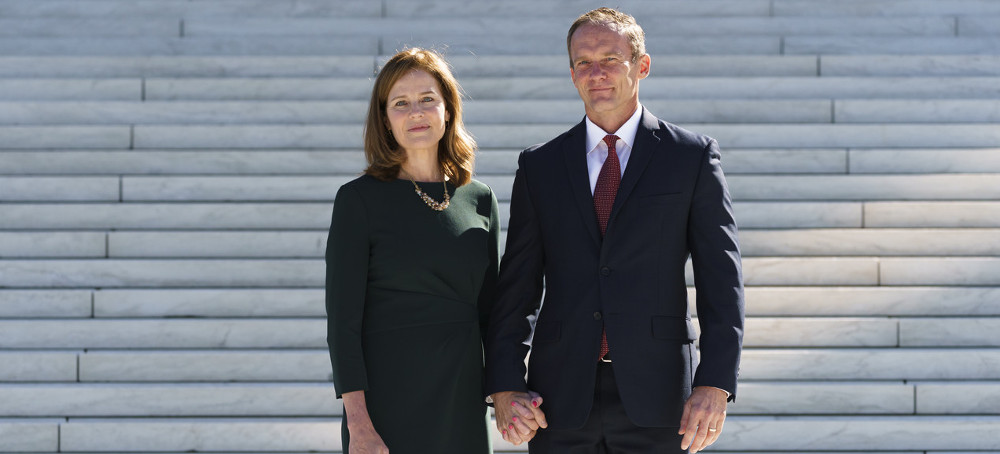 Amy Coney Barrett stands with Jesse Barrett at her investiture ceremony at the Supreme Court. (photo: J. Scott Applewhite/AP)
Ginni Thomas, Jane Roberts and Jesse Barrett’s clients remain a mystery, fanning fears of outside influences.
The head of the office, Jesse M. Barrett, is the justice’s husband, whose work is described by the firm as “white-collar criminal defense, internal investigations, and complex commercial litigation.”
SouthBank Legal — which lists fewer than 20 lawyers — has boasted clients across “virtually every industry”: automobile manufacturers, global banks, media giants, among others. They have included “over 25 Fortune 500 companies and over 15 in the Fortune 100,” according to the firm’s website.
But if anyone wants to find out whether Jesse Barrett’s clients have a direct interest in cases being decided by his wife, they’re out of luck. In the Supreme Court’s notoriously porous ethical disclosure system, Barrett not only withholds her husband’s clients, but redacted the name of SouthBank Legal itself in her most recent disclosure.
Over the past year, Virginia Thomas, known as Ginni, has gotten significant attention for operating a consulting business that reportedly includes conservative activist groups with interest in Supreme Court decisions as clients. Her husband, Justice Clarence Thomas, has chosen not to reveal any of his wife’s clients, let alone how much they contributed to the Thomas family coffers, dating back to when her consulting business was founded.
But a POLITICO investigation shows that potential conflicts involving justices’ spouses extend beyond the Thomases. Chief Justice John Roberts’ wife, Jane Roberts, has gotten far less attention. But she is a legal head-hunter at the firm Macrae which represents high-powered attorneys in their efforts to secure positions in wealthy firms, typically for a percentage of the first-year salary she secures for her clients. A single placement of a superstar lawyer can yield $500,000 or more for the firm.
Mark Jungers, a former managing partner at Major, Lindsey … Africa, the firm that employed Jane Roberts as a legal recruiter before she moved to Macrae, told POLITICO the firm hired her hoping it would benefit from her being the chief justice’s wife, in part, because “her network is his network and vice versa.”
Roberts lists his wife’s company on his ethics form, but not which lawyers and law firms hire her as a recruiter — even though her clients include firms that have done Supreme Court work, according to multiple people with knowledge of the arrangements with those firms.
The POLITICO investigation found that some spouses of other Supreme Court justices have also had careers of their own, but none currently appear to have the potential to intersect as closely with the court’s work as Barrett, Thomas and Roberts. Justices Samuel Alito and Neil Gorsuch reported no non-investment income from their spouses in 2021. Justices Sonia Sotomayor and Elena Kagan are not married. Brett Kavanaugh’s wife Ashley Estes Kavanaugh — a former George W. Bush White House aide — reported a salary from her position as town manager of Chevy Chase Village Section 5.
This week, the court is formally welcoming a new justice, Ketanji Brown Jackson. Her husband, Patrick Graves Jackson, currently serves as chief of the general surgery division at MedStar Georgetown University Hospital.
But Jackson noted in a disclosure form filed earlier this year, while serving as a lower-court judge, that she had previously left out “self-employed consulting income that my spouse periodically receives from consulting on medical malpractice cases.”
Like in the cases of Thomas, Barrett and Roberts, the names of his clients were not included in the filing.
Special interests court the justices
As an independent branch of government, the Supreme Court has long been determined to set its own path on ethics, with each justice left to make their own determination on when to recuse themselves from cases with no enforcement mechanism to hold them accountable.
Since 1979, the justices have produced annual disclosure forms that mimic those filed by their judicial underlings. The justices say the filings comply with federal ethics laws, but some sources of potential conflicts — such as expensive dining and use of vacation homes — are often kept off the lists.
But now, as the Supreme Court prepares to begin a new term after a tumultuous summer in which Roe v. Wade was upended, the longstanding gaps in its ethical disclosures are being cast in a harsher light amid revelations of outsiders using perks and money to attempt to influence the justices.
Former religious right leader Rob Schenck has said the organization he led for more than 20 years, Faith and Action, engaged in an elaborate scheme to play on the justices’ financial insecurities by recruiting wealthy couples to “wine and dine” the court’s conservative members. The couples were chosen for their support for a religious right political agenda, and coached in advance in ways to make the justices feel more secure in their support of a faith-based legal agenda.
Schenck said the overtures to some of the justices in the first two decades of this century included not only highly expensive meals and club visits but invitations for the justices to use plush vacation properties — none of which appear to have been reported on their disclosure forms, according to a POLITICO review.
The refusal to provide spousal information is also salient because justices have often noted that their salaries — $274,200 for associate justices and $286,700 for the chief in 2022 — don’t compare to those of elite attorneys who can make millions in private practice. That means that some of the justices who are married receive a disproportionate share of their family income from their spouses.
POLITICO emailed a set of questions to Jesse Barrett. He did not respond. Instead, a response to that query came from a spokesperson for the Supreme Court, who said: “Justice Barrett complies with the Ethics in Government Act in filing financial disclosure reports.”
A spokesperson for Macrae declined to comment on the firm and Jane Roberts’ behalf.
In response to broader questions about the justices’ spousal disclosures, the court spokesperson also cited the federal law governing judicial recusals and pointed to a nearly three-decade old statement in which justices with spouses or other close relatives in the legal profession rejected the notion of recusal from a case simply because such a relative works in a firm involved in the litigation.
“We do not think it would serve the public interest to go beyond the requirements of the statute, and to recuse ourselves, out of an excess of caution, whenever a relative is a partner in the firm before us or acted as a lawyer at an earlier stage,” the seven justices who adopted the policy declared. “Even one unnecessary recusal impairs the functioning of the court.”
Given the financial stakes involved — and the interests that law firms, corporations and activist groups have in influencing the outcome of court decisions — many ethical observers believe that the court is ignoring potential conflicts at its own peril.
One of the nation’s leading experts in legal ethics, New York University Law Professor Stephen Gillers, said the gaps in disclosure about the clients of justices’ spouses fuel public doubt.
“We don’t know who that is and we don’t know the amounts of money,” Gillers said. “That’s a legitimate concern.”
“Since a justice who owns 10 shares of stock in a party has to recuse even though the effect would be negligible on their finances, if that’s true, why should a justice’s spouse not have to reveal a very large payment from a client that could substantially improve a justice’s quality of life?” he asked.
Leveraging Roberts family connections
The vast majority of the attention on income among Supreme Court spouses has centered on Ginni Thomas, who founded her own consulting firm known as Liberty Consulting. Although her clients are now shielded from the her husband’s financial disclosure reports, Thomas has reportedly worked with the Center for Security Policy — a think tank accused of Islamophobia — and entities tied to conservative activist Leonard Leo. Ginni Thomas also recently reached an agreement to testify before the Jan. 6 select committee, meeting with the panel on Thursday.
Even less is known about Jane Roberts’ clients. She is a graduate of Brown University and Georgetown University Law Center, and married her husband in 1996. From 1987 until 2007, she worked at the law firm now known as Pillsbury Winthrop Shaw Pittman, where she advanced to the rank of partner.
In 2007, two years after her husband became chief justice, she joined the firm of Major, Lindsey … Africa, as a legal recruiter, and since 2019 has worked at Macrae.
Jungers said the firm’s efforts to attract the wife of the chief justice were originally kept to only a small number of the firm’s employees. There was a sense that Jane Roberts would be a big get for the firm — somebody who knows everyone in this town, with one of the most prestigious networks in Washington.
“We hoped that that’s what we were doing,” he said, also emphasizing that good recruiters have a level of skill beyond just their networks. However, he noted that she was “a good lawyer” at a “decent law firm.” Her husband was an “extraordinary lawyer at a very, very good law firm” who became the most important person in the Washington legal scene.
“We recruited her to help our firm with the recruitment of in-house lawyers,” he said. “I think some of us realized that there was a better place for her, which was to be recruiting partners for law firms because that’s both where she was, where her husband was, and then she knew lots of very important people in the legal landscape in Washington, D.C., and it was sort of a waste not to really use that.”
When Jane Roberts began her role at the firm, Jungers trained and mentored her. They started a role-playing exercise to practice phone calls with potential clients: She was the recruiter and Jungers was the potential client.
Jungers sat in Jane Roberts’ chair, and she sat in the guest chair. Behind Jane Roberts in her office, he recalled, there was a bookshelf with photographs of her and her husband with world leaders — he recalled seeing the Pope and Queen Elizabeth II among them.
Jungers said Jane Roberts soon proved to be highly effective at her job, and he noted that nearly everyone in the legal world would take her phone calls. The high-profile couple’s social scene is filled with “fairly closed circle” events of Washington, D.C., lawyers who mingle over exclusive events like wine drinking groups, book clubs or poker games, Jungers noted.
“As opposed to even some couples where he’ll have a network and she’ll have a network, it’s not really like that,” Jungers said, while also expressing his great admiration for Jane Roberts.
Jane Roberts’ clients include lawyers or law firms sometimes with active Supreme Court practices, at least some of which were more likely to work with her because of her status as the chief justice’s spouse, three people close to law firms told POLITICO.
Jane Roberts has also represented top government officials at federal agencies with direct interests in court business, said Stephen Nelson, another D.C.-area hiring consultant who said he and Roberts had referred candidates to one another in the past.
“I think because of her background in law firms, she already had a strong reputation and network, but being married to the … chief justice of the United States Supreme Court … certainly doesn’t hurt,” said Nelson.
One consultant who worked with a firm with a Supreme Court practice said that the firm explicitly decided to work with Roberts because of her marriage to the chief justice.
“It’s known that her access to people is heavily influenced by her last name,” said the consultant, who was granted anonymity under the condition that the firm for which the person consulted not be named. “It’s no secret within the industry.”
Holes in disclosures
When SouthBank Legal opened a new Washington office headed by Jesse Barrett in 2021, the firm hailed the expansion in a press release as a demonstration of the firm’s “national capabilities.”
“A physical presence in Washington helps us solidify our national service footprint,” said Jesse Barrett, managing partner of the firm’s D.C. office, in the press release. “It is an exciting step, and our clients will benefit from our expanded ability to handle matters nationwide.”
Earlier this year, Barrett acknowledged the tension between her and her husband’s work. In an interview at the Ronald Reagan Presidential Library, Fred Ryan, former POLITICO chief executive officer and current publisher of The Washington Post, questioned Barrett on the challenges of balancing the couple’s careers. Barrett maintained that they were careful to avoid conflicts but argued that society’s expectations must change.
“But you know, I think we’re living in a time when we have a lot of couples who are both, are working, and so I think that the court and, you know, society has to adjust to expect that,” Barrett said.
When asked about whether there should be court guidelines for working spouses, Barrett facetiously pushed back against the idea.
“I don’t think most of the spouses would be very happy about those guidelines,” she quipped. “Certainly when I try to give my husband guidelines about what to do and not to do in the house even that doesn’t go over very well.”
In the case of Jesse Barrett, even the name of his firm is unavailable on his wife’s most recent disclosure statement. Information about spouses’ employment is required on the forms, but justices may ask to redact it for certain reasons. Despite Barrett’s profile appearing prominently on the front of his firm’s website — and its touting of his employment in a press release — the name SouthBank Legal was redacted on Justice Barrett’s public financial disclosure filing for 2021.
The terms that would allow a justice to redact some information appear to be somewhat broad. A memo authored by a financial disclosure adviser to judges offers a rationale to request the exclusion of broad categories of information on the grounds of safety.
The concern is based on increasing threats against the judiciary, culminating in such high-profile events as the killing of a federal judge’s son in New Jersey by a man who had once appeared before her in court, and the arrest of an alleged attempted assassin outside the Washington, D.C.-area home of Justice Kavanaugh in June.
The memo — issued by the director of legal services at a firm that helps judiciary members fill out their forms — explains that judges may ask to redact their position at a homeowners’ association, travel reimbursements, a teaching arrangement or an agreement with a law firm, as it could “indicate your presence in an unsecured location” or “present a security concern.” Even a club membership or a lake cottage could require redactions for security concerns, said the memo, which POLITICO obtained from Fix the Court and independently confirmed its authenticity.
A spokesperson for the Administrative Office of the U.S. Courts declined to comment on the memo, but said only a small fraction — fewer than 4 percent — of reports filed with the office last year sought redactions.
Russell Wheeler, a visiting fellow at the left-leaning Brookings Institution, underscored the balance between privacy and regulation; however, he noted that the justices are not the average person.
“It’s a rule of reason that says judges must be willing to accept restrictions on their behavior and that the ordinary citizen would find burdensome,” he said. “I think that probably applies to justices’ spouses and families as well.”
Like the reporting policies the court observes, the requirements for justices to recuse themselves from matters are also limited. A court spokesperson, asked about Jesse Barrett’s work, pointed to the Code of Conduct for judges and a federal statute that says a judge or justice should disqualify himself when the jurist’s spouse has a financial stake in a proceeding before the court.
The spokesperson also said Barrett adopted a policy a group of justices issued in 1993 calling for recusal when a “relative’s compensation could be substantially affected by the outcome here,” including cases where a relative is a law firm partner that receives a share of its profits.
However, under the standard accepted by Barrett, a justice need not recuse if the law firm commits to permanently excluding income from Supreme Court litigation from that spouse’s partnership shares.
An email to Jane Roberts also brought a reply from a court spokesperson who said that as the chief justice’s wife developed her recruiting practice she drew guidance from a 2009 Judicial Conference ethics panel opinion that says: “As a general proposition, the fact that the spouse or the spouse’s business has a business relationship with an entity that appears in an unrelated proceeding before the judge usually does not require the judge’s recusal.”
There’s some movement on Capitol Hill to change Supreme Court ethics rules, though it has found only modest traction.
When Congress passed ethics legislation in 2012, it expanded disclosures for stock trading by members of the House and Senate, their staffs and some executive branch employees. However, judges and justices were omitted from the more timely reporting required by the STOCK Act.
It took a decade, but in April of this year Congress enacted a bill sponsored by Sen. Chris Coons (D-Del.), Sen. John Cornyn (R-Texas), Rep. Deborah Ross (D-N.C.) and Rep. Darrell Issa (R-Calif.) ending that exemption. President Joe Biden signed the bill in May and the requirement for judges and justices to report stock trades more promptly kicked in last month.
Sen. Sheldon Whitehouse (D-R.I.) has introduced the Supreme Court Ethics, Recusal, and Transparency Act, which would require the Supreme Court to, among other provisions, establish recusal requirements — including cases that involve the income of a justice’s spouse — and certain required disclosures.
In a statement to POLITICO, Whitehouse noted that disclosure requirements for the justices lag behind other senior government officials. His bill aims to address the “weak ethics and transparency rules before the court’s reputation is damaged beyond repair,” he added.
“The ethical rot at the court continues to spread, and public faith in the court erodes along with it,” Whitehouse said. “The questions about financial conflicts of interest are one area of concern among many. There’s also the flood of dark-money influence bearing down on the court, from the nameless donors behind judicial selection to the orchestrated flotillas of anonymous amici curiae lobbying the justices to the spate of partisan decisions handing wins to corporations and big donor interests.”
A call for stricter Supreme Court ethics rules
Until recently, concerns about potential conflicts of interest tended to focus on appearances alone, but recent revelations suggest that certain interest groups have actively sought to influence the justices with expensive dining and entertainment, playing on their financial insecurities.
Schenck, a minister who headed Faith and Action from 1995 to 2018, cited Thomas and Justice Samuel Alito as targets of religious right overtures, along with the late Justice Antonin Scalia. Schenck said he would recruit wealthy couples to wine and dine the justices, with a goal of tacitly urging them to be more comfortable expressing their religious beliefs.
“We would rehearse lines like, ‘We believe you are here for a time like this,’” Schenck told POLITICO, referring to the Old Testament Book of Esther in which the Hebrew woman born with the name Hadassah becomes queen of Persia and succeeds in preventing a genocide of her people.
The effort openly sought to exploit the justices’ willingness to accept free meals and entertainment from supporters — and not to report all such private hospitality on their disclosures.
Even beyond Schenck’s allegations, Scalia was a frequent beneficiary of free travel from people with interests before the Supreme Court. In 2016, he died while on an exclusive hunting trip at Cibolo Creek Ranch, where he was the guest of John Poindexter, a financial services mogul who owned a company which had a case before the Supreme Court just the previous year.
The ranch is a famed destination for celebrities and European royalty, where guests hunt birds and big game.
Scalia had made the journey to Marfa, Texas, in a private plane with C. Allen Foster, a Washington attorney whose past clients included Republican interests and the Iraq War contractor Blackwater.
Scalia’s duck-hunting trip to southern Louisiana with former Vice President Dick Cheney, at a time when the Supreme Court was considering a case involving Cheney’s energy task force, was also chronicled in the media — but did not ultimately appear on Scalia’s disclosure forms.
Scalia refused to recuse himself in the case, rallying to the defense of “social intercourse” in Washington and savaging what he termed “so-called investigative journalists.”
“While the political branches can perhaps survive the constant baseless allegations of impropriety that have become the staple of Washington reportage, this court cannot,” the late justice wrote. “The people must have confidence in the integrity of the justices, and that cannot exist in a system that assumes them to be corruptible by the slightest friendship or favor, and in an atmosphere where the press will be eager to find foot-faults.”
Efforts to pressure Supreme Court justices to adopt more stringent ethics rules have often turned on the question of whether the court, at the summit of an independent branch of government, must follow the dictates of Congress, another co-equal branch.
In 2007, following a round of public criticism about judges’ attendance at retreats hosted by nonprofit advocacy groups, the Judicial Conference created a policy requiring more prompt and detailed disclosure about such events and their sponsors. However, the justices were omitted from the rule and don’t post such disclosures even when attending or speaking at the same events.
In a 2011 report, Roberts noted that the high court has never addressed whether Congress has the power to impose financial reporting requirements on the justices. Still, he noted, the justices comply. He said the same was true of Congress’ mandate for certain recusals.
In more recent years, Roberts has expressed concerns about lapses in the federal courts’ ethics practices undermining confidence in the judiciary. In his most recent annual report on the state of the federal judicial system, he lamented the findings of a Wall Street Journal investigation that identified nearly 700 instances over the span of nine years where federal judges ruled on cases in which they or their families had some financial interest.
“Let me be crystal clear: the Judiciary takes this matter seriously,” Roberts wrote. “We are duty-bound to strive for 100 percent compliance because public trust is essential, not incidental, to our function. Individually, judges must be scrupulously attentive to both the letter and spirit of our rules, as most are. Collectively, our ethics training programs need to be more rigorous.”
Despite those concerns, the Judicial Conference has pushed in recent years for more legal authority to keep personal details about federal judges and their family members out of the public domain, citing security concerns, threats and acts of violence.
For more than two years, the judiciary has pressed Congress to grant special protections to a wide swath of information about judges and justices and their family members, including primary and vacation homes, details on their vehicles, their spouses’ employment and other affiliations. Some of the proposals drew criticism for intruding on free-speech rights protected by the First Amendment.
The federal Judicial Conference has backed pending legislation that would allow judges to force government agencies and social media sites to take down certain categories of information deemed to pose a security risk. Sen. Rand Paul (R-Ky.) has twice blocked a floor vote on the bill by insisting that federal lawmakers get the same protection.
Some courtwatchers say the disclosure and ethics policies have already done about as much as is feasible to ferret out conflicts.
“It seems like it’s impossible in the real world for there not to be some outside factors affecting the justices,” said Curt Levey of the conservative Committee for Justice. “We probably just have to live with that and trust. We’re already putting a lot of faith in the justices. There’s this semi-fiction that whatever their ideological political or other differences they put that aside. I guess we have to kind of trust them to not be influenced by who someone is working for or what cause they’re working for.”
However, with the increasing power of the court, the “American people deserve to know” the clients of Supreme Court Justice’s spouses, said Gabe Roth, executive director of Fix The Court, an advocacy group calling for stricter ethics reform for federal courts.
“To be a federal government institution that the people have trust in — ethics is a major part of it and accounting for conflicts of interest is a major part of it,” Roth said. “If the Supreme Court — the Supreme Court — can’t account for their conflicts of interest, we’re in a bad place.”
He added: “It’s important for the public to know that the justices’ spouses not only have jobs but have jobs that oftentimes directly intersect with the work of the Supreme Court, and currently there’s no real good way to delineate that …
“And it almost seems that the current system is designed in a way where it’s easy to hide those connections, and that doesn’t impart trust in the institution as a whole.”
READ MORE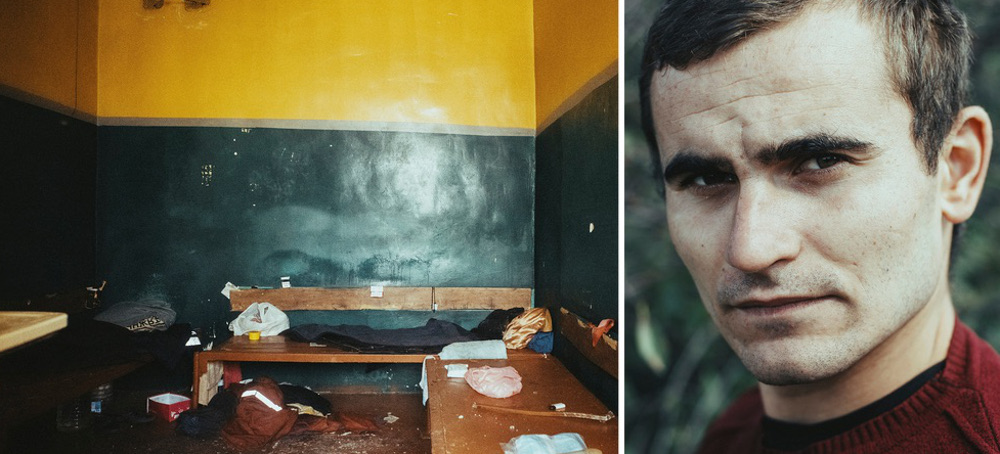 Torture victim Oleksandr Shutov and a cell at the police station in Balakliya. (photo: Maxim Dondyuk)
Russian troops occupied the town of Balakliya for six months, before Ukrainian troops regained control earlier this month. During that period, say residents and investigators, torture and imprisonment of the locals was common.
Maksym Soter, 37, was only detained briefly, but suffered through the torture of his friend Vanya, abuse so savage that he would later die.
Lidiya Shulha, 64, was arrested shortly before liberation. She was one of the few women prisoners in Balakliya.
They are three of possibly several hundred people who were thrown into prison in the town in northeastern Ukraine. And now, they are able to tell their stories.
Just a few days after Putin’s troops began their invasion of Ukraine, the war reached Balakliya, a town with a prewar population of 30,000. Russian warplanes flew sorties in the surrounding area and panic quickly spread among the residents. Many fled, while others went into hiding. Russian soldiers and their auxiliary forces from the self-proclaimed people’s republics in the Donbas moved into the town with tanks, personnel carriers and rocket launchers.
, throwing the Russians out of Balakliya and dozens of other towns and villages in the Kharkiv region. The soldiers were followed by forensics specialists, Ukrainian investigators, criminal law experts and human rights activists. They quickly began scrutinizing the period of occupation and are looking into mounting evidence of torture and war crimes.
In the town of Izyum, located 50 kilometers away, investigators have exhumed a mass grave in a forest containing the bodies of 445 civilians killed in recent months. In a trench nearby, they found the corpses of 17 Ukrainian soldiers. Some of the dead showed clear signs of torture. Several had their hands tied behind their backs, and at least one of the bodies had a rope around the neck. Investigators also say that they have found 10 torture sites in the recently recaptured towns of the region. One of them is Balakliya.
On the tenth day after the town’s liberation, a warm, summerlike day in mid-September, dozens of elderly people are standing in front of a truck on October Street, the wide, main road of Balakliya. Aid workers from Kyiv have arrived to distribute flour and water, noodles and canned vegetables along with medical supplies to those in need. The signs of recent battle are visible. Just 100 meters from the gathered crowd is a gigantic crater, likely the product of a bomb dropped from a Russian warplane as Ukrainian troops advanced into town.
Also on October Street, not far from the monument to the national poet Taras Shevchenko, stands a two-story building – a broad, nondescript structure with neon letters on the roof spelling out "BalDruk," the name of the publishing house that occupied the building before the war. Now, though, nobody is allowed to enter, and investigators are walking across the courtyard. One of them, a criminal investigator from Kharkiv, points to the entrance door and says that the "Russian fascists" had operated from here. During their occupation of the town, the occupiers installed themselves inside the building, and Ukrainian officials say that around 40 prisoners were held by the occupiers of Balakliya at all times. The Russians, the officials say, tortured many of them.
Across the street, spruce trees surround a three-story building of bright sandstone, the Balakliya police station. The Russian occupiers set up a base here too, and it was also used for torture, as both locals and investigators report. Dozens of people were apparently locked away in the cells and rooms on the ground floor and in the basement.
It could be months before investigators are able to paint a detailed picture of what took place inside the two buildings. And several factors are making their efforts more challenging: Many residents are difficult to reach, either because they have no phones or because the mobile network isn’t up and running again yet. Meanwhile, some suspected torture victims have left town while others are too traumatized to speak about what they experienced.
Oleksandr Shutov also doesn’t trust the peace that has returned to Balakliya. But despite his fears and trauma, he has decided to speak out – at the place where his suffering began.
A gaunt man with dark eyes, Shutov has a short, vertical scar running between his eyebrows, lending him a severe appearance and making him look older than his 22 years. Shutov is calm and composed as he speaks, but when he shows where the guards attached electric wires to his fingers, it becomes apparent that his hands are swollen and are shaking.
It is impossible to confirm all the details from his story. But DER SPIEGEL reporters spoke with relatives, neighbors and friends of Shutov in addition to investigators, and compared his narrative with that of other prisoners. Shutov’s description of events along with witness testimony and preliminary results from the investigation allow for a preliminary reconstruction of the atrocities that took place in Balakliya during the six months of Russian occupation.
As was the case for many Ukrainians, the war began for Shutov with shattered dreams. Just days before the invasion, he had received his trucker’s license and found a job with a dairy. His first trip was to take him to Odessa, the Black Sea port city. When the Russian army attacked the Kharkiv region with heavy artillery, bombs and rockets on Feb. 24, Oleksandr’s girlfriend Alina was among the hundreds of thousands of people who fled westward, ultimately crossing the border to safety in Poland.
He remained in Balakliya. Though he has his own home in town, he spent much of his time with his grandmother Svyeta. The occupiers set up roadblocks throughout the city, patrolled the streets and even distributed their own newspaper called Kharkov Z, a combination of the Russian name for the region and the symbol of the Russian invasion.
At the end of Gogol Street, where Oleksandr’s mother lives, the Russians set up a Grad multiple rocket launcher. They had little trust in the residents of areas under occupation and depended heavily on sympathizers and collaborators. Investigators and residents say the Russians had their eyes primarily on two groups: Ukrainian soldiers and their families, and all those that the Russians suspected of identifying targets for the Ukrainian artillery.
On August 3, Oleksandr Shutov was once again visiting his grandmother, sitting in the yard and drinking coffee. Vlad, a friend and neighbor of the same age as Shutov, climbed up onto the roof of his house to get better reception for a phone call to his wife. From there, he was able to see a truck marked with a "Z" approach the house.
Russian soldiers stormed into the yard and called for Shutov. "They knew my nickname," he says. He believes that a woman from the neighborhood had reported him to a neighborhood police officer who was working for the occupiers. The soldiers pulled a hood over his head and forced him and Vlad into the military vehicle – regular Russian soldiers, Shutov says. They drove him and his friend to the police station. "They put Vlad in the fourth cell and me in the first."
Even several days after the Russians left, the cell block is still in a shambles. Scraps of lumber, documents, empty cardboard boxes and garbage bags are strewn about on the floor and the windowsills. Broken glass crunches underfoot in the offices. In four of the cells, there are two cots each behind the green metal doors. One cell has three cots and another, especially small one, has just a single bunk. Plastic bottles and items of clothing are scattered on the floor.
This is where Shutov spent more than a month. The soldiers locked him in a dark room packed with eight people, though there were just two beds. "They would continually bring in new prisoners, even at night," says the 22-year-old. Because the prisoners were kept in different cells, he cannot say for sure how many people were locked away during his time there. Shutov says the captives kept largely silent out of fear. A prayer is scratched into the wall of one of the cells.
On the first two days he was there, he says, he was given nothing to eat. Later, they were served soup if there was anything leftover after the soldiers and guards had eaten their fill. Most of the time, they were served porridge. "You can hardly call it food," says Shutov. "There were worms and grub in the porridge."
After just a few days, he began suffering from an upset stomach, and when he had to use the bathroom, guards would pull a sack over his head and take him to a pit toilet at the end of the hall. After just 10 seconds, they would start yelling at him to hurry up.
Only rarely would the guards turn on the fans in the cell tract. "They only did so when they were in a good mood," he says. It was almost impossible for him to sleep given the lack of space. The other prisoners encouraged him to lay down beneath the bed, but it was full of insects. And then there were the screams coming from the interrogation room when the guards zapped the prisoners with electric shocks. Others were beaten. One Russian soldier from the Caucasus beat up the older prisoners, Shutov recalls. "They even cut the ear off one of the prisoners from our cell."
Some detainees, though, had it even worse. Around a month before Oleksandr Shutov was arrested, another man whose parents also live on Gogol Street was taken to the police station. His name is Maksym Soter, a short-tempered 37-year-old with nervous eyes.
"I don’t want to think about that shit," Soter says in greeting. He says he fought in the Donbas from 2016 to 2018 against the Russian and their allies from the separatist regions. Despite that history, though, the occupiers allowed Soter to go free after just three days at the police station. He still has no idea why.
His friend Vanya, though, says Soter, was tortured to death. "I didn’t see what they did to him." But he says that Vanya was in such bad shape that he had to feed him with a spoon, and that he had smelled like excrement and urine. At the insistence of the other prisoners, the Russians brought him to a hospital in the city of Kupyansk, around 80 kilometers away. One investigator confirmed to DER SPIEGEL that the case of a young man named Ivan, nickname Vanya, was being looked into. The investigator said the young man died in Kupyansk, apparently as a result of torture.
At the end of August, it was Shutov’s turn, and the guards hauled him out of the cell. At 9 a.m., according to his recollections, they took him to be interrogated. It was day 27 of his imprisonment. A soldier attached wires to his fingers and then they sent an electrical current through his body. "I trembled, everything inside of me pulled together and twisted around." The soldier asked about Shutov’s father. He had fought in the Ukrainian army, hadn’t he, the man asked? Shutov replied by saying that nobody in his family was in the army. "Bullshit," the soldier yelled as a second jammed a stun gun into his back. "I can’t remember how long the interrogation lasted," says Shutov. "I only know that I lost consciousness."
A short time later, without Shutov realizing it, an acquaintance of his was brought to the police station: Lidiya Shulha, the administrator of a village on the outskirts of Balakliya where Shutov’s parents live.
It was during the period when the Ukrainians were softening up the Russian lines in preparation for their rapid surge in the region. They were firing on Russian positions with heavy artillery and the occupiers were growing increasingly nervous. On Sept. 3, according to Shulha, a Russian major and his deputy showed up and accused the 64-year-old of having communicated the locations of Russian positions to the Ukrainian army and threatened to blow her up with a grenade. Shulha fled to a village in the surroundings, but was ultimately found and brought to the police station in Balakliya two days later.
She was locked away in a basement room with three other women. When DER SPIEGEL visited the site, a woman’s handbag was still on the floor of the room, along with mattrasses.
"I was neither interrogated nor tortured," Shulha says. "But I think the other women went through a rough time." One of them, says Shulha, was 65 years old and the other two in their mid-50s. "One woman said that we were in the hands of the FSB," the Russian secret service. "But I don’t know if that’s true."
On the very next day, Sept. 6, the prisoners began hearing nervous shouting from their guards. The occupiers were running through the hallways, yelling at each other. And then, they left. Two days later, the inmates were able to break open the cell doors with iron bars. That is when Lidiya Shulha saw her acquaintance Oleksandr Shutov.
Neither of them was aware that the Ukrainian army had just liberated the town. Videos of locals falling into the arms of soldiers were being uploaded to social media sites, and one of them is from Gogol Street in Balakliya. It shows Shutov’s grandmother Svyeta and her neighbors cheering on the Ukrainian troops.
Just as they did when retreating from the Kyiv region in spring, the Russian troops in the area of Balakliya have left behind traces of potential atrocities. According to officials, 200 investigations against the Russian occupiers have already been launched in the Kharkiv region. A publisher from Izyum also told DER SPIEGEL of being tortured with electric shocks. A young construction worker from a town near Balakliya says that he lost his father when he stumbled into a booby trap in the neighbor’s yard. Two farmers from the region north of Kharkiv accuse the occupiers of having taken family members back to Russia against their will.
Shutov’s grandmother Svyeta says that her grandson still has trouble sleeping and is anxious. Like many others in town, he is afraid that the Russian troops could return. The horror of the occupation is still present in Balakliya.
 Supporters of debt relief rally by the White House. (photo: Stefani Reynolds/Getty)
The Associated Press reported on Thursday that six Republican-led states are suing the Biden administration over the president’s plan to forgive some student-loan debt. As Republicans would have it, they’re fighting elites. “It’s patently unfair to saddle hardworking Americans with the loan debt of those who chose to go to college,” Arkansas attorney general Leslie Rutledge told the AP. The truth is more complicated. Rutledge’s lawsuit is no broadside against the wealthy but rather a direct attack on middle- and working-class households who benefit from the plan. By suing over student-debt relief, they’re waging class war, and if they win, they could keep millions shackled to debt.
Threats from the right and from the student-loan industry itself have already harmed some student borrowers. The Biden administration announced on Thursday that borrowers with privately held student loans will no longer qualify for relief, apparently fearing the measure would be struck down in court. “The federal student loans held by private entities — through a program known as the Federal Family Education Loan program — is a relatively small subset of outstanding federal student loans,” Yahoo News reported. Such loans account “for just several million of the 45 million Americans who owe federal student loans,” but this still means that many people are now stranded without relief. This outcome may be tolerable to student-loan servicers, to the right, and perhaps even to the Biden administration, which hopes to protect its forgiveness plan against further damage. For these borrowers, however, the news is a personal catastrophe that, when repeated millions of times, amounts to a tragedy.
The nation’s student-debt crisis is real, and it should not exist. We got here through a series of lamentable policy decisions that made a college education more available to the masses while fattening the burgeoning student-loan industry. Student-loan debt, in other words, is not a condition imposed upon the wealthy, who can afford to pay for college outright. By definition, student-loan debt penalizes the comparatively disadvantaged for trying to get ahead. Black and Latino borrowers stood to benefit heavily from the Biden administration’s plan as originally outlined: In August, ABC News reported that Black women alone hold two-thirds of the nation’s astonishing $2 trillion collective student-debt burden, and about half of Latino borrowers would have their debt completely canceled.
There were limitations to the Biden administration’s forgiveness scheme even before the White House scaled it back. If you believe, as I do, that student-loan debt is the by-product of a broken and immoral system, then the Biden plan was merely a step on the way to true justice. It fell far short of plans proposed by others, including Senators Bernie Sanders and Elizabeth Warren, and as such, it did not fully recognize the scale of the harm done to student borrowers. However, it was something, and in a nation where meritocracy is dust and legend, that is an improvement on the status quo. Getting ahead wouldn’t become easy, at least not overnight, but millions would no longer suffer for trying. That Republicans could not tolerate this is not a surprising outcome. The GOP is the party of hierarchy, which makes it the party of the status quo; student-loan forgiveness in any form threatens the order they seek to protect. The goal of class war is to keep one tier down while another stands on its back. The gentility of the GOP’s chosen method — the courts and not the streets, at least for now — disguises the brutality of its vision.
The Biden administration could stand for an alternative: equality. Yet the president is already sacrificing his superior vision to fear. Student borrowers deserve better from the government that indebted them. The stakes are nothing short of freedom.
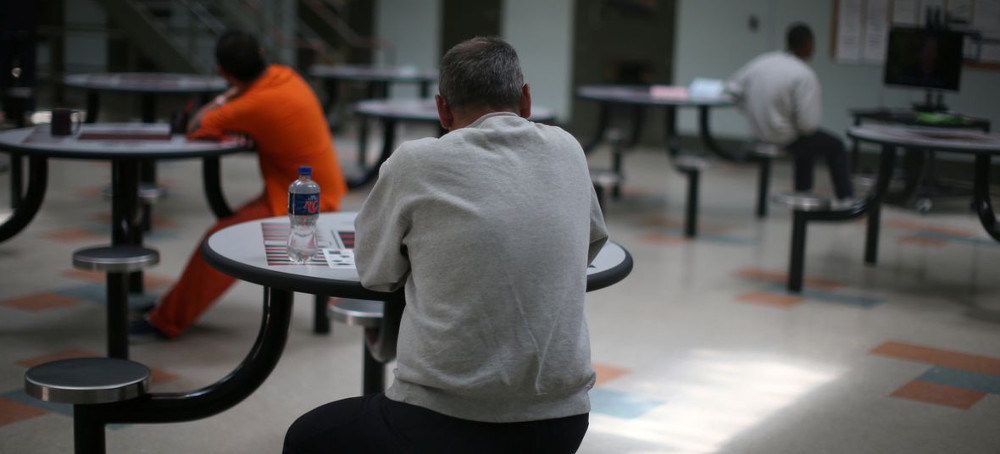 A communal area is seen at the Adelanto immigration detention center, which is run by the Geo Group Inc (GEO.N), in Adelanto, California, U.S., April 13, 2017. (photo: Lucy Nicholson/Reuters)
The San Francisco-based 9th U.S. Circuit Court of Appeals said California's 2019 ban gave the state too much control over how the federal government handles immigrant detainees.
A federal judge in San Diego had upheld the state law in 2020, ruling that California could prohibit private detention centers because federal law does not explicitly allow for them.
The 9th Circuit, in an 8-3 decision, said the government has come to rely almost exclusively on detention centers operated by GEO Group and other companies. California, the largest U.S. state, does not have the authority to interfere with the federal government's operations, the court said.
About 80% of immigrants awaiting deportation hearings are held in private facilities, according to the American Civil Liberties Union and other advocacy groups. Most are operated by GEO Group and rival CoreCivic Inc (CXW.N), but dozens are owned by smaller companies.
GEO Group and the U.S. Department of Justice did not immediately respond to requests for comment.
The California Attorney General's office in a statement said it was disappointed with the ruling. The state could ask the U.S. Supreme Court to take up the case.
The ban "was enacted to protect the health and welfare of Californians and recognized the federal government's own documented concerns with for-profit, private prisons and detention facilities," the AG's office said.
Immigrant advocates have said private facilities often are overcrowded and understaffed, subjecting detainees to inhumane conditions.
While campaigning for the 2020 election, Biden said he wanted to end the use of private detention centers to house immigrants. But Biden did not mention the detention of immigrants in a 2021 executive order limiting the federal government's reliance on private criminal prisons, which drew criticism from advocacy groups.
California's law prohibits the operation of any private detention facilities in the state, including prisons, but the lawsuits only challenged the ban on immigrant detention centers.
The dissenting 9th Circuit judges on Monday said the law should be upheld because it applies to private companies such as GEO Group and only indirectly regulates the federal government.
 This Dec. 11, 2016 photo shows the Virunga National Park, taken from the rim of the crater of the Nyiragongo volcano and looking over the crater of another extinct volcano, in North Kivu Province, in Congo. (photo: Juergen Baetz/AP)
The auctioning of oil and gas blocks in Congo has stirred resistance and concern among local Indigenous communities worried about damage to their homes and large swaths of forest, according to a report released Thursday by several environmental groups.
In late July, the Congolese government put 30 oil and gas blocks in the country up for auction with 13 blocks crisscrossing through protected areas and national parks, causing uproar among environmentalists. The Congo Basin forest absorbs an extraordinary 1.5 billion tons of carbon dioxide — about 4% of global emissions — some of which would be released into the atmosphere if the areas are cleared for oil and gas drilling.
The report comes just days before Congo’s government is set to co-host with Egypt a meeting on climate change in the capital Kinshasa. That’s ahead of the United Nations’ climate summit in November in Egypt.
But concerns about the blocks extend well beyond the increase of greenhouse gas emissions, the report said.
Recent hostile relations between Congo and its neighbors, especially Rwanda, could escalate, as 18 of the proposed oil blocks are in borderlands shared by Congo, Rwanda and four other nations, it warned.
“Small communities of Indigenous peoples will inevitably be impacted,” added Tal Harris, a spokesperson for Greenpeace, which was part of the report. Harris said the Twa and Mbuti people would be especially at risk of waterborne diseases and pollution if the forests are transformed for drilling.
Many members of affected Indigenous groups in the area are strongly opposed to the oil and gas block auctions, the report said.
“What do the people stand to benefit from these 30 oil and gas concessions?” asked Simon Counsell, a spokesperson for Indigenous rights charity Survival International.
Counsell pointed to a new Congolese law passed a month before the oil and gas blocks auction which called for the rights of its Indigenous population, including the right to consultation, to be considered.
The Congolese government said the oil and gas block auctioning process “is in line” with development plans and government programs in the country.
“The auctioning process intends to scrupulously respect all Congolese laws and regulations, and adhere to the most rigorous international standards,” said Tosi Mpanu-Mpanu, senior climate negotiator for Congo and former chair of the Least Developed Countries group at U.N. climate negotiations.
The government also pledged that drilling will be conducted using methods that minimize environmental impacts.
The Congo Basin is known for massive reserves of cobalt, lithium and other minerals that, among other uses, are essential for renewable energy technologies such as batteries needed for solar panels. The country is the world’s largest cobalt producer. Congo’s government has previously defended the auctions by stressing the need to diversify the country’s cobalt-reliant economy.
Despite its wealth of minerals and biodiversity, Congo is one of the world’s poorest nations and part of a negotiating bloc of states at the United Nations that are the most vulnerable to the effects of climate change. Millions of people across Africa, particularly those in densely populated informal settlements outside of major cities, are vulnerable to weather extremes, such as drought, heat waves and flooding, according to the U.N.’s weather agency.

Follow us on facebook and twitter!
PO Box 2043 / Citrus Heights, CA 95611


Comments
Post a Comment