RSN: Dan Rather | The Eye of the Storm

01 October 22
Live on the homepage now!
Reader Supported News

The full scale of the damage will take a long time to assess. There are the immediate wounds of a natural disaster — the loss of life, the destroyed property, the emotional trauma of prolonged power and infrastructure outages.
Hardship, however, will ripple outward over time, like concentric waves from a stone thrown into a placid pond. Except there is nothing placid about the world Hurricane Ian has struck.
Natural disasters have always been part of the human experience on a sometimes inhospitable planet. Human ingenuity and science have created tools for us to mitigate harm. We can predict storms through satellite imagery and evacuate before they strike. We can construct buildings to be more resilient to winds, or earthquakes, for that matter.
But humans have also helped increase the danger these natural disasters pose. Scientists tell us the data are clear — human actions have induced a climate crisis that makes weather events like storms, droughts, and fires more frequent and more severe. In addition, disasters like these exacerbate our societal weakness. The poor, the marginalized, and the elderly tend to suffer disproportionately.
Just as the wake of a mass shooting IS the right time to talk about our national gun problems, the wake of a natural disaster IS the right time to talk about our climate crisis and our social divisions. Sadly, Hurricane Ian is not an isolated event. It is a harbinger of a more chaotic future, and we would be wise to learn from its lessons.
Our planet is different from what it once was, and that truth should be factored into how we answer an urgent question: How do we rebuild, and where?
This storm also highlights another reality. Either we build strength and resilience by looking out for one another, or we worsen our weaknesses by fomenting our divisions. Last night I tweeted the message below, and the response has been overwhelming. I think that’s because deep down, “most Americans know it.”
Right now, most of us can provide little immediate help to those in the path of the storm other than to say, we see you and hear you. We will be there for you. And when we make that pledge, we should not forget those in Puerto Rico, Alaska, and other areas recently enduring natural disasters.
There are too many problems this country must face, and there are too many problems this world must face, for us to have the performative poppycock we have seen from so many of our supposed “leaders.” It’s easy to strut upon a stage of divisiveness when it is others in need. When the tables turn, you must hope they treat you with the grace and empathy you lacked in responding to their pain.
We are one planet and one species. We either learn how to live in harmony with each other and our natural world, or we inflame a culture of division. The first path is one of sharing our burdens and our risk. The second path increases the odds that we will be the ones one day staring down the eye of the storm.
It is unlikely that this storm will cause those stoking our destructive politics to rethink their approach. But maybe it will help the rest of us refocus on what kind of country and what kind of global citizens we aspire to be.
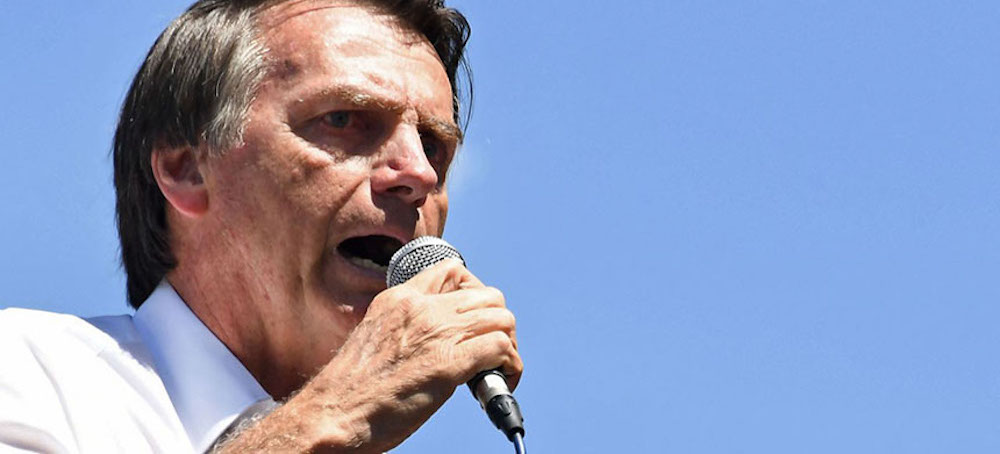 Jair Bolsonaro. (photo: Evaristo Sa/Getty Images)
Brazil’s far-right President Jair Bolsonaro faces former President Luiz Inácio Lula da Silva in Sunday’s presidential election. Lula is a former union leader who held office from 2003 through 2010. He’s running on a leftist platform to uplift Brazil’s poor, preserve the Amazon rainforest and protect Brazil’s Indigenous communities, and is supported by a broad, grassroots alliance, explains Brazilian human rights advocate Maria Luísa Mendonça. Polls show Lula has a strong lead over Bolsonaro, but it is unclear if he will win the majority of the vote needed to avoid a runoff. This comes as Bolsonaro and his party appear to be attempting to prepare to stage a coup if he loses the election, says reporter Michael Fox, former editor of NACLA and host of the new podcast “Brazil on Fire.” Despite fear over a coup, Fox says people in Brazil “are really hopeful that they’re going to see change on Sunday.”
Lula is a former union leader who served a president of Brazil from 2003 to 2010. During that time, he helped lift tens of millions of Brazilians out of poverty. He’s been running on a platform to reduce inequality, preserve the Amazon rainforest and protect Brazil’s Indigenous communities.
In 2018, he was jailed on trumped-up charges, paving the way for the election of Jair Bolsonaro, a retired military officer who’s often praised Brazil’s former military dictatorship. There is widespread fear in Brazil that Bolsonaro could attempt to stage a coup if he loses the election. Earlier in the campaign, Bolsonaro said, quote, “Only God will remove me [from power]. … The army is on our side. It’s an army that doesn’t accept corruption, doesn’t accept fraud,” he said.
During Thursday night’s debate, Luiz Inácio Lula da Silva criticized Bolsonaro’s efforts to keep secret many of his government’s actions, including his handling of the COVID pandemic.
LUIZ INÁCIO LULA DA SILVA: [translated] I’m going to do something for you. I’m going to make a decree to end your 100-year secrecy, to know why you want to hide so much for 100 years. I’m going to do it. I’m going to make a decree and sign it, to know what this man wants to hide for 100 years. And I’m going to stop here, because I want others to participate in the debate. President, when you show up here, please lie less.
AMY GOODMAN: During Thursday’s debate, Bolsonaro, the Brazilian president, accused Lula, the former president, of lying.
PRESIDENT JAIR BOLSONARO: [translated] The ex-convict says that I decreed the secrecy of my family. Which decree? Give me the decree’s number. He says I delayed the purchase of vaccines. No country in the world bought a vaccine in 2020. Stop lying. When you talk about hunger, I gave 600 reaies in aid to Brazil. You gave little to the poorest. You used the poorest as a way to win votes.
AMY GOODMAN: To talk more about Sunday’s vote in Brazil, we’re joined by two guests. Michael Fox is a freelance journalist based in Brazil, former editor of NACLA and host of the new podcast Brazil on Fire. He’s joining us from São Paulo, Brazil. Here in New York, Maria Luísa Mendonça is the director of the Network for Social Justice and Human Rights in Brazil and a visiting scholar at City University of New York Graduate Center.
We welcome you both to Democracy Now! Maria Luísa Mendonça, let’s begin with you. Talk about what’s at stake in Sunday’s election.
MARIA LUÍSA MENDONÇA: [inaudible] Bolsonaro of having a far-right government that —
AMY GOODMAN: Maria Luísa, if you could begin again? I didn’t catch the beginning of what you said.
MARIA LUÍSA MENDONÇA: Yes. Thank you. Yeah, this is a very important election in Brazil, because after four years of having a far-right government represented by Bolsonaro, voters in Brazil are about to send a strong message and say that we don’t want a far-right government. And I think it’s important also for people to understand that Bolsonaro only won elections four years ago because Lula was in jail and based on false charges. There was no evidence against him, but he was put in jail anyway so he couldn’t run four years ago. And before that, there was a parliamentary coup in 2016 against President Dilma Rousseff. So, that was the context that created the possibility for Bolsonaro to get elected. And now, you know, there is a broad alliance in society to support the candidacy of Lula. So, you know, there is a lot of activism. Many artists are involved with the campaign. And so, Lula was able to build a broad alliance for this election.
AMY GOODMAN: And, Michael Fox, what about the threats of Bolsonaro, similar to Trump, not to accept the results of Sunday’s election? Talk about the polls, what they’re showing right now. It’s not just between the two of them, of course, and there’s like, what, more than — there’s close to a dozen candidates. But one of them has to hit 50% for it to be an outright victory.
MICHAEL FOX: That’s right. So, what we have right now is Lula is roughly 14 to 17 points ahead of Bolsonaro. He’s hovering around 50% of the valid votes, according to the latest polls. So, even though all those other candidates, they have less than 10% — they’re minor candidates. Ciro Gomes would be the one who has the most; it’s around 6 or 7%. So, the big question: Is Lula going to hit that 50% mark? Is he going to be able to win it in the first round? And that is the thing that everyone’s asking themselves.
Now, like you said, the potential for Bolsonaro to come out and say that, “No, I don’t respect these results,” that is absolutely — and most people think that he’s going to follow down Trump’s path, he’s going to do that. He’s been setting the scene for that for the last year and a half. And, in fact, what we saw just two days ago, his party, the Liberal Party, came out and released a document saying that they had audited the electoral, the voting system, and saying that there was the potential for grave fraud. Of course, the electoral court responded almost immediately, putting this in an inside the fake news investigation, calling it absurd. And, in fact, they have now requested from the Liberal Party: Who paid the invoice? Who actually bankrolled this document? Because they think what is happening here is trying to set the scene for, then, Bolsonaro to come out later on and say, “Oh, well, see, I told you it was fraud.” That’s what we’re already seeing. So, this is kind of the general playbook that we’re already expecting. Everybody in Brazil is pretty much expecting this.
The reality behind it is the fact that most of Brazilian society, just they are not on board with the potential for a coup. They don’t want that. Three-quarters of Brazilians said in a recent poll that they want democracy and they’d like to stick with this. And I think that, well, we’re crossing our fingers and hoping that’s what happens.
AMY GOODMAN: Maria Luísa, we’re talking about the, what, sixth- or seventh-largest population in the world, Brazil. This election is extremely significant. Talk about what Lula represents.
MARIA LUÍSA MENDONÇA: Yes. Lula is a very popular figure in Brazil, because when he was president, there was a, you know, real change in the lives of people. I think for the first time in Brazilian history, there was a great deal of investment in education, in healthcare, in job creation. So, there was also a lot of support for culture, for the arts. So, I think people saw, in very concrete terms, what — you know, the results of his government. Also, one of the main programs in his administration was the zero hunger program. And now, you know, in a few years of Bolsonaro, Brazil again is in the so-called hunger map, so there was a huge increase in hunger and poverty in the country.
So, also President Dilma, who was also with the Workers’ Party, after Lula, was a very popular president in her first term, before the orchestration of a parliamentary coup. So, the only way the right-wing parties can take power is by, you know, orchestrating those kinds of coups. So, that’s why there is a real fear right now.
But I think at the same time Brazilians — the majority of Brazilians understand that their lives were much better before, and they want those kinds of changes and investments in education, healthcare, culture and the arts.
AMY GOODMAN: Let’s go to Brazil’s presidential candidate Luiz Inácio Lula da Silva speaking Monday to his supporters.
LUIZ INÁCIO LULA DA SILVA: [translated] Never before in the history of this country have so many parties, popular movements, unions, trade unions, associations of classes, workers and entrepreneurs, liberal professionals, artists, intellectuals, athletes, people of different colors and religions, sexual orientations and political preferences come together in the first round of an election to say, “Enough with so much hatred, so much destruction, so many lies, suffering and so many deaths.” We are going right now, on the 2nd of October, to rebuild the country.
AMY GOODMAN: So, Michael Fox, if you can take off from what Lula is saying? And also talk about the Brazilian rainforest. Talk about the Amazon, the protection of the Amazon, and what has happened to it under Bolsonaro.
MICHAEL FOX: Well, absolutely. The organizing in support of Lula has been extremely important and unprecedented. In fact, many different social movements even joined forces to create what they’re calling these popular committees, these grassroots committees, in neighborhoods around the country. And it kind of takes off the work that was happening under the pandemic to try and respond to the rising hunger, where people were organizing and bringing food and working in solidarity. Well, they’ve now built these grassroots committees, somewhere between 5,000 and 7,000 around the country, to organize for Lula and then to continue organizing regardless of what happens. So, it is an extremely important election. Everyone sees it as that.
And I just want to say for a second that it’s not just on the presidential election, but also on like the very local level. You have different social movements, Indigenous peoples, women, Black movements who have an unprecedented number of new candidates that they’re putting out there. So that is really important on the local legislative level.
Now, the Amazon, it has been devastated under Bolsonaro. I think just one thing to point out, if you remember back in 2019, when we had all the huge fires that were going around, people were protesting around the world. Well, the fires this last year were even worse. They’ve been worse consecutively each year. And deforestation in the Amazon is the worst we’ve seen in a decade. And this is because Bolsonaro came in with a promise to push development in the Amazon. He gutted agencies, state agencies, the environment agency, the Indigenous agencies, that in the past had defended Indigenous territories and defended the environment. And he came in, gutted all this.
And his own violent rhetoric of trying to open up the Amazon for development really let loose landowners and miners and loggers and narcotraffickers, and said, “You have carte blanche to do whatever you need to do in the Amazon.” And that’s what they’ve done. The invasions of Indigenous territories spiked 150% just in the first three months of Bolsonaro’s government. And under COVID, basically what happens is they pulled the rug out. Everybody backed off, because everything was isolating. And that’s — the illegal forces really took advantage of that to really move into the territories. Violence spiked. And this is the destruction that’s happening in the Amazon right now.
Now, it’s really important to understand that if you look back just 20 years ago, when Lula came into power, deforestation in the Amazon was even worse than it is today. And within a couple of years, with the help of Marina Silva, his environment minister, he went in, and they were able to enact a series of new measures, policies that cut Amazon deforestation in half within two years. So, there is obviously hope that if Lula is able to win, if he’s able to come back into office, you know, he might be able to reimplement some of these things to push back on the devastation that’s happened in the Amazon up ’til now.
AMY GOODMAN: In August, Jair Bolsonaro formally launched his reelection campaign with an attack on Lula. This is what he said.
PRESIDENT JAIR BOLSONARO: [translated] Our country does not want to take steps back. We don’t want gender ideology in schools. Our country does not want to legalize drugs. Our country respects life from its conception. Our country does not want to become an ally to communism in other countries; a country that wants a president who defends private property, a country that increasingly preaches its people the freedom to raise their children. We are going to talk politics today, so tomorrow no one will prohibit us from believing in God.
AMY GOODMAN: Maria Luísa Mendonça, touch on these themes. Talk about what he’s getting at.
MARIA LUÍSA MENDONÇA: Yes. Bolsonaro is part of this global far-right movement, and also he has a lot of support from the evangelical church in Brazil. And he dismantled several policies and institutions that protected women’s rights, that fought against racism in Brazil, and, you know, the arts, the culture. He dismantled the Ministry of Culture and the human rights institutions in Brazil. And he promotes this violent rhetoric. And I think this is another reason why in Brazil what we see, for example, is that he tries to spread fear, fake news and hate.
And what we see is also a broad coalition. In addition to the grassroots movements, the social movements that Michael was talking about, there is also a broad coalition of artists, of musicians. Very well-known artists in Brazil are speaking out and are campaigning for Lula. So, there is a broad coalition.
And so, this is a key moment for Brazil. And we also need international solidarity. For example, in relation to the destruction of the Amazon, we need to look at the role of foreign corporations that benefit from that. And we are not talking about development. We are talking about destruction, destruction of the land, destruction of Brazil’s natural resources. And there are mining companies, agribusiness corporations, financial corporations in the U.S. that benefit from that destruction. So, I think it’s very important for us to build international solidarity, because we will need that, moving forward.
AMY GOODMAN: On Wednesday, the U.S. Senate passed to resolution calling on Brazil to ensure the election is conducted in a, quote, “free, fair, credible, transparent and peaceful manner.” Senator Bernie Sanders sponsored the resolution.
SEN. BERNIE SANDERS: It is imperative that the U.S. Senate make it clear, through this resolution, that we support democracy in Brazil. It would be unacceptable for the United States to recognize a government that came to power undemocratically, and it would send a horrific message to the entire world if we did that. It is important for the people of Brazil to know we are on their side, on the side of democracy.
AMY GOODMAN: Michael Fox in São Paulo, your final comments, leading into Sunday’s election in Brazil?
MICHAEL FOX: I just want to say that that resolution from the Senate was so important. I mean, if you look back, in 1964, the coup that happened here in Brazil, the military coup, that was greenlighted by the United States. So, to get a really strong, profound statement from the U.S. Senate, that means a lot. It means a lot to the military here. It means a lot to the business sector. It means a lot in Brazil. And I just say that, look, the mood on the ground is one of a lot of excitement. It’s one of tension. And people are really hopeful that they’re going to see change on Sunday.
AMY GOODMAN: Michael Fox, journalist in São Paulo, Brazil, we want to thank you for being with us. And, Maria Luísa Mendonça, Network for Social Justice and Human Rights in Brazil, thank you so much for being with us, from the CUNY Grad School here in New York City.
Next up, as a cinema dedicated to documentary film opens in New York City at the DCTV firehouse, its lobby will be dedicated tonight to the documentary filmmaker Brent Renaud, killed in March covering the war in Ukraine. We’ll speak to Jon Alpert and Brent’s brother Craig, as well as the filmmaker Reid Davenport, whose new film about how he sees the world as a person with a disability opens at the Firehouse today. It’s called I Didn’t See You There. Stay with us.
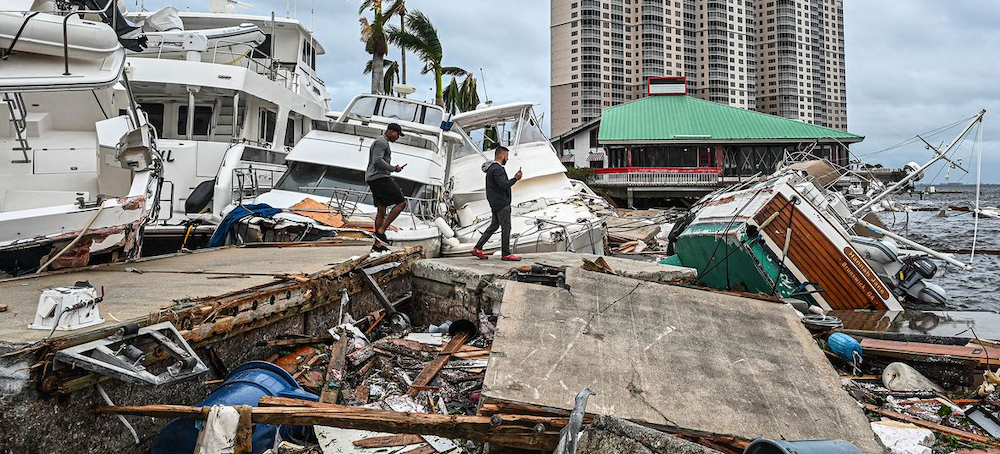 Residents inspect damage to a marina in the aftermath of Hurricane Ian in Fort Myers, Florida, Sept. 29. (photo: Giorgio Viera/AFP/Getty Images)
Ian is one of the five worst hurricanes in America’s recorded history. That’s not a fluke – it’s a tragic taste of things to come
Ian made landfall as one of the five most powerful hurricanes in recorded history to strike the US, and with its 150 mile per hour winds at landfall, it tied with 2004’s Hurricane Charley as the strongest to ever hit the west coast of Florida. In isolation, that might seem like something we could dismiss as an anomaly or fluke. But it’s not – it’s part of a larger pattern of stronger hurricanes, typhoons and superstorms that have emerged as the oceans continue to set record levels of warmth.
Many of the storms of the past five years – Harvey, Maria, Florence, Michael, Ida and Ian - aren’t natural disasters so much as human-made disasters, whose amplified ferocity is fueled by the continued burning of fossil fuels and the increase in heat-trapping carbon pollution, a planet-warming “greenhouse gas”.
This Atlantic hurricane season, although it started out slow, has heated up, thanks to unusually warm ocean waters. Fiona hit Puerto Rico as a powerful category 4 storm, and hundreds of thousands of people there are still without power. The storm barreled on into the open Atlantic, eventually making landfall in the maritime provinces to become Canada’s strongest ever storm. Then came Ian, which feasted on a deep layer of very warm water in the Gulf of Mexico.
Human-caused warming is not just heating the surface of the oceans; the warmth is diffusing down into the depths of the ocean, leading to year after year of record ocean heat content. That means that storms are less likely to churn up colder waters from below, inhibiting one of the natural mechanisms that dampen strengthening. It also leads to the sort of rapid intensification we increasingly see with these storms, where they balloon into major hurricanes in a matter of hours.
Too often we still hear, even from government scientists, the old saw that we cannot link individual hurricanes to climate change. There was a time when climate scientists believed that to be true. But they don’t any more. We have developed powerful tools to attribute the degree to which global warming affects extreme events. One study found, for example, that the devastating flooding from Hurricane Florence as it made landfall in North Carolina four years ago was as much as 50% greater and 80km (50 miles) larger due to the warmer ocean.
We can also draw upon basic physics, as we explained in Scientific American in 2017. Warmer oceans mean more fuel to strengthen hurricanes, with an average increase in wind speeds of major hurricanes of about 18mph for each 1C (1.8F) of ocean surface warming, a roughly 13% increase. Since the power of the storm increases roughly the wind speed not only squared but raised to the third power, that amounts to a roughly 44% increase in the destructive potential of these storms.
There is also evidence that human-caused warming is increasing the size of these storms. All else being equal, larger storms pile up greater amounts of water, leading to larger storm surges like the 12 to 18 feet estimated for Ian in some locations. Add sea level rise, and that’s the better part of foot of additional coastal flooding baked into every single storm surge. If humanity continues to warm the planet, and destabilize the Greenland and west Antarctic ice sheets, we could see yards, not feet, of eventual sea-level rise. Think of that as a perpetual coastal flooding event.
Then there is the flooding rainfall, like the 20 inches (50cm) of it we’re seeing across a large swath of Florida with Ian. Simple physics tells us that the amount of moisture that evaporates off the ocean into the atmosphere increases about 7% for each 1C of ocean surface warming. That means 7% more moisture to turn into flooding rains. But that’s not the whole story. Stronger storms can entrain more moisture into them – a double whammy that produced the record flooding we saw in Philadelphia a year ago with Hurricane Ida, and the flooding we saw with Harvey in Texas in 2017 and Florence in the Carolinas in 2018, the two worst flooding events on record in the US.
Tampa’s wide shallow coastal shelf, low topography combined with rising sea levels and vulnerable infrastructure make it particularly vulnerable to a landfalling major hurricane. Tampa Bay has dodged multiple bullets in recent years in the form of major hurricanes that ultimately weakened or swerved away from the city. Ian is the latest example, as it passed to the east rather than to the west of Tampa Bay, sparing the sprawling urban population a devastating storm surge that would have flooded the homes of millions.
Unfortunately, Tampa’s luck will eventually run out. We must prepare for the inevitable calamity that will occur when the city is at the receiving end of a losing roll of the weather dice.
It is important to take steps to increase resilience and adapt to the changes that are inevitable, taking all of the precautions we can to spare our coasts from the devastating consequences of sea-level rise combined with stronger, more damaging hurricanes. But no amount of adaptation can shield Florida, or anywhere else, from the devastating consequences of the continued warming of our planet.
Only mitigation – the dramatic reduction of heat-trapping pollution – can prevent things from getting worse. We’ve seen some progress on that front recently, both in the US and globally. The climate provisions of the recently passed Inflation Reduction Act are a great start, but they’re not adequate on their own for the US to meet its obligations to cut carbon emissions in half by 2030.
We need more aggressive climate action to pass Congress. And that means we need politicians who are willing to support that action, rather than act as apologists for powerful fossil fuel interests. That’s something for all Americans to think about as they go to the voting booths in a matter of weeks.
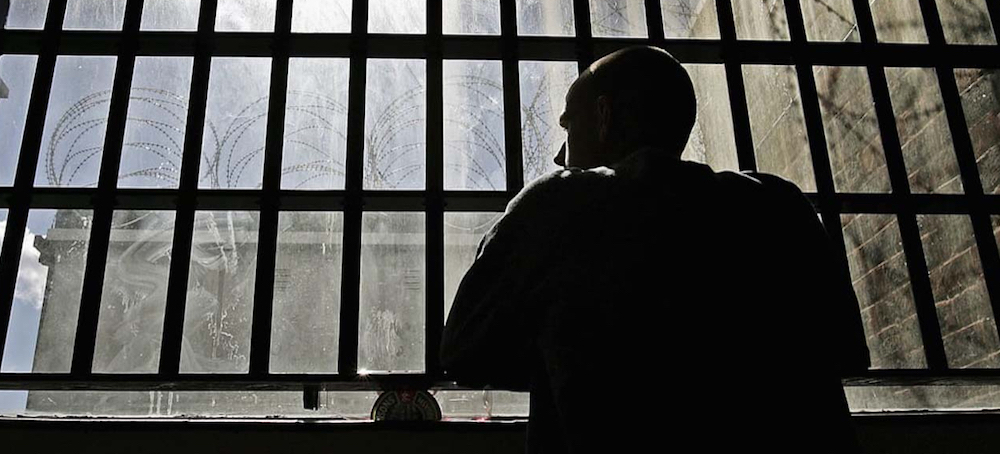 A prisoner. (photo: Peter Macdiarmid/Getty Images)
To protect those most vulnerable to covid-19 during the pandemic, the Cares Act allowed the Justice Department to order the release of people in federal prisons and place them on home confinement. More than 11,000 people were eventually released. Of those, the Bureau of Prisons (BOP) reported that only 17 of them committed new crimes.
That’s not a typo. Seventeen. That’s a 0.15 percent recidivism rate in a country where it’s normal for 30 to 65 percent of people coming home from prison to reoffend within three years of release.
Of those 17 people, most new offenses were for possessing or selling drugs or other minor offenses. Of the 17 new crimes, only one was violent (an aggravated assault), and none were sex offenses.
This extremely low recidivism rate shows there are many, many people in prison we can safely release to the community. These 11,000 releases were not random. People in low- and minimum-security prisons or at high risk of complications from covid were prioritized for consideration for release.
Except for people convicted of some offenses, such as sex offenses, no one was automatically barred from consideration because of their crime, sentence length or time served. The BOP instead assessed each eligible person individually, looking at their prison disciplinary record, any violent or gang-related conduct and their risk to the public.
The agency allowed a person’s release if they had a home to go to and would be able to weather all the burdens of home confinement. Home confinement requires people to wear an ankle monitor with GPS tracking, stay home except when given permission to leave for things such as work or doctor’s appointments and remain drug- and crime-free. No one was simply released onto the street without support or supervision.
The Cares Act policy teaches us that many of our prison sentences are unnecessarily lengthy. People who commit crimes should be held accountable, and that might include serious time in prison. Many of the people released to home confinement had years or even decades left to serve on their sentences. But they changed in prison and are no longer a danger to others, as the new data confirms.
Releases to home confinement were also focused on two groups of people who pose little to no risk to public safety: the elderly and the ill (i.e., those most likely to face serious covid complications). Study after study confirms that people become less likely to reoffend as they get older. America’s elderly prison population is growing rapidly, because of our use of lengthy prison terms.
People with serious chronic illnesses or physical disabilities are another group who can be safely released from long sentences. They are not dangerous, but their increased medical needs make them exponentially more expensive to incarcerate. Taxpayers aren’t getting much public safety bang for their buck when we incarcerate bedridden people.
The federal Cares Act home confinement program should inspire similar programs across the country. Virtually all states have programs available to release elderly or very sick people from prison, but they are hardly used and should be expanded. States should also give people serving the longest sentences a chance to go back to court after 10 or 15 years and prove that they have changed and can be safely released.
The data is in. It shows that we can thoughtfully release low-risk people from prison with supervision and not cause a new crime wave. At a time when crime is going up in so many cities and towns, we cannot afford to waste money or resources keeping those who no longer need to be in prison locked up.
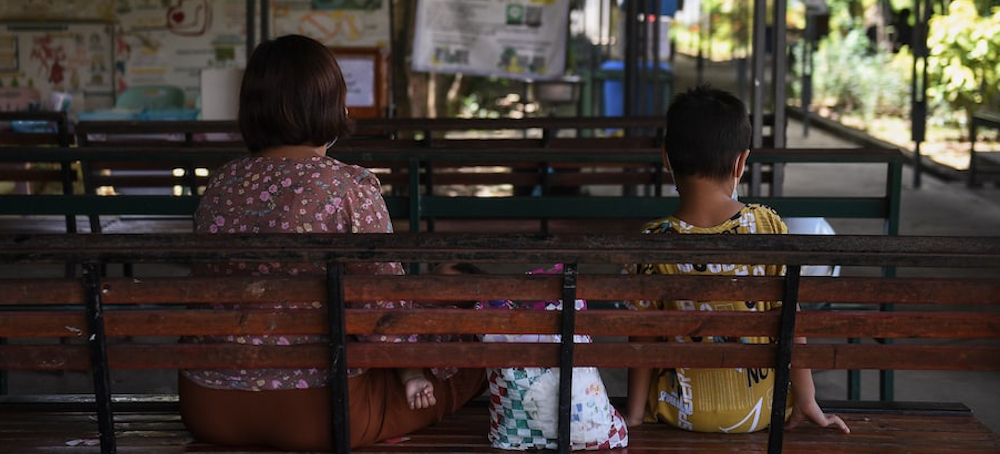 Myanmar migrant workers wait in August at the Mae Tao clinic in Thailand, just across the border from their home country. (photo: Chalinee Thirasupa/WP)
Thousands have been injured or killed since the military takeover, but the human costs go well beyond that
One recent afternoon, in an empty house along Thailand’s western border where he’s been sheltering, Kyaw Shwe retrieved the coffee packets. He wanted to explain that his 18-year-old son had given him the coffee and the cigar the day before he disappeared. He wanted to say his name, Bhone Wai Yan Kyaw, and talk about what soldiers did to him when they found him in a safe house with other student activists.
Kyaw Shwe lifted the coffee in his hands but couldn’t bring himself to speak. His shoulders sagged. He let out a wail.
As fighting rages on in Myanmar, its citizens are faltering under the losses they’ve incurred in a year and a half of violent conflict. Entire villages have been razed; loved ones have been executed in secret; and 1.1 million jobs have evaporated from the economy. International attention has waned, drawn away by crises such as the war in Ukraine. But the costs of the military’s takeover — and the ongoing desperate push to resist it — have continued to mount.
Cynthia Maung runs a community clinic on the Thai-Myanmar border and has seen, over the past year, a trickle of war casualties become a flood. The military has killed more than 2,000 civilians, including some in apparent war atrocities, according to the U.N. special rapporteur on Myanmar. Nearly a million people, a quarter of them children, have been displaced, forced to live in temporary shelters where malaria, dengue and dysentery are rife.
At some point, humanitarian groups may be able to tally the number of people lost to violence, famine or disease during this period, Maung said. But every day, she also sees signs of an invisible toll that will be impossible to calculate. Grief and despair are everywhere.
“We cannot even begin to understand,” Maung said, “how huge it’ll be.”
Not far from where Kyaw Shwe is sheltering, a young engineer who joined a rebel army is learning how to walk after his right leg was shattered by a land mine. A single mother begs for news back home of her 14-year-old son, who hasn’t spoken to her since the military put out a notice for her arrest, while a pair of newlyweds search for work after the garment factory they relied on in Yangon shut down. An esteemed professor who once held court in one of Myanmar’s best universities paces around an old, barren terrace house, terrified to slide open the gate because his family of six, including his two children, crossed into Thailand without documentation.
In nondescript buildings along the border, there are tens of thousands more like them. They traveled through jungles and combat zones to make it here. For many, it’s the first place they were able to pause — and take stock.
“I still don’t know how to believe it,” said Zin Moe, Kyaw Shwe’s wife. She held the T-shirt her son wore the last time he visited, unwashed after six months because she hoped it would keep his smell.
“We’ve lost everything.”
The steepest costs
Myanmar’s young people, who grew up during the country’s brief window of democracy, have led the resistance against the military junta, also known as the Tatmadaw. As the conflict drags on, many are paying the steepest costs while contending with a loss of faith in their future — and a sense of being abandoned by the world.
Violence has escalated in Myanmar’s northwest, particularly in the Sagaing and Magway regions, which are almost entirely isolated from international assistance. Experts warn that tensions are also on the verge of exploding in places like Rakhine state, site of the military’s systematic persecution of the Rohingya Muslim minority — now considered by the United States to be genocide. The United Nations said it needs $826 million to address basic humanitarian needs in Myanmar for 2022. As of July, the world body had raised $106 million — 13 percent of that goal.
Powerful countries have done little to stem this downward spiral, resistance leaders say.
Japan, Australia and Singapore, all of which moved swiftly to punish Russia after its invasion of Ukraine, have made no move to do the same with the Tatmadaw. The United States adopted some sanctions but has stopped short of fulfilling key requests from activists, such as penalizing the Myanmar Oil and Gas Enterprise, a state-owned energy company that serves as a lifeline for the junta. The European Union imposed sanctions on the firm in February.
“There are villages in Magway and Sagaing literally on fire,” said a 31-year-old rebel who asked to be identified only by his battlefield name, Comrade Kite. “And who is helping us?”
Like many who have joined Myanmar’s rebellion, Comrade Kite was not a fighter — he had never even held a gun — until the coup in early 2021. A computer network engineer, he enlisted with a rebel army after watching the junta’s soldiers open fire at peaceful protesters.
In April, he was on a reconnaissance mission in the southern jungles when he heard a high-pitched whistle. There was a buzzing in his ears, he recalled, before he fell to the ground. When he woke up in a hospital on the Thai side of the border, the bottom of his right leg was gone.
Land mines have long been a weapon of the Tatmadaw, and since the coup, soldiers have been laying mines in conflict zones at a “massive scale,” possibly constituting war crimes, rights advocates say.
In the Thai hospital, Comrade Kite was surrounded by young men just like him, he said. Some had lost limbs; others were blinded or left paralyzed. In the daytime, he kept himself distracted with his laptop, watching YouTube tutorials and Marvel movies. But at night, no matter how he tried, he couldn’t block out the sound of crying.
“It’s not easy for us, mentally,” he said. “We’re young. Most of us aren’t married; we don’t even have girlfriends.”
“We worry about how we’re going to fit back into society. We worry about whether we’ll ever be able to be happy.”
The narrowing of hope
It’s hard to know how many Myanmar families have been separated since the coup. In addition to people who have been killed, thousands are in prison and even more in hiding. Under pressure from the military, some families have started cutting ties with relatives associated with the resistance, posting public notices disowning sons, daughters and siblings.
Ma Cho, 48, lived with her teenage son in the southeastern state of Karen before the coup. They were close, she said, and ate nearly every meal together until soldiers came looking for her a year and a half ago.
Ma Cho was a volunteer for a women’s committee within the National League for Democracy, the political party led by Nobel Peace laureate Aung San Suu Kyi. After the coup, Ma Cho said, she found her face broadcast on state-run TV stations — a single mother and motorcycle saleswoman transformed into a “political criminal” wanted by the junta. She’s tried contacting her son numerous times after fleeing Karen, she said, but he’s been too afraid to respond.
“This, really, is a very painful feeling for me,” Ma Cho said, choking back tears. “I think I’ll meet him only after the revolution.”
Many others along the border sustain themselves on similar hopes — at least, for as long as they’re able.
Bhone Wai Yan Kyaw, the oldest of Kyaw Shwe’s three children, had been an ordinary teenager before the military takeover. He was interested in soccer, poetry and music, and hated bullies. He had just started learning how to play the guitar, and on Instagram, he posted covers of folk songs that he and Kyaw Shwe recorded together. It made his father happier than he ever knew.
After the coup, Kyaw Shwe, a Yangon taxi driver, took Bhone Wai Yan Kyaw to his first demonstration and saw him blossom. The teen was thoughtful and charismatic, and when he rose to speak at the back of pickup trucks, people stopped to listen.
On Feb. 25, Kyaw Shwe said, Bhone Wai Yan Kyaw disappeared. Kyaw Shwe and Zin Moe went to the safe house in Yangon he’d been sharing with other student activists, and neighbors told them that a convoy of five military trucks had come by. Bhone Wai Yan Kyaw was in the house with two others and was helping one of them, a 15-year-old girl, escape over a wall when soldiers shot him twice. Once in the chest and once, after he had fallen onto the ground, in the head. Soldiers dragged his body onto the street, neighbors said, then loaded him onto a truck and drove off.
Kyaw Shwe showed a photo he had taken of a dirt-streaked wall with a hole where sunlight was streaming through. It had been left by one of the bullets that killed his son.
“Merciless,” he said.
Kyaw Shwe spoke slowly, leaning against his knee as he sat on the floor. It was painful to talk about his son, but his death was the reason Kyaw Shwe had made his family leave Myanmar. It wasn’t possible to mourn publicly in the country anymore. And he had wanted Bhone Wai Yan Kyaw’s life to amount to more than that bullet hole.
“I will let myself be hurt,” Kyaw Shwe said, “because the world needs to know.”
Early this year, he recalled, on one of the few quiet weekends the family had together, Bhone Wai Yan Kyaw announced that he planned to have a birthday party when he turned 19 on Sept. 6.
Zin Moe told him that he was already an adult and that adults didn’t need birthday parties. But he shook his head.
“No,” he said, smiling at his parents. “I’m not an adult.”
“I’m still just a kid.”
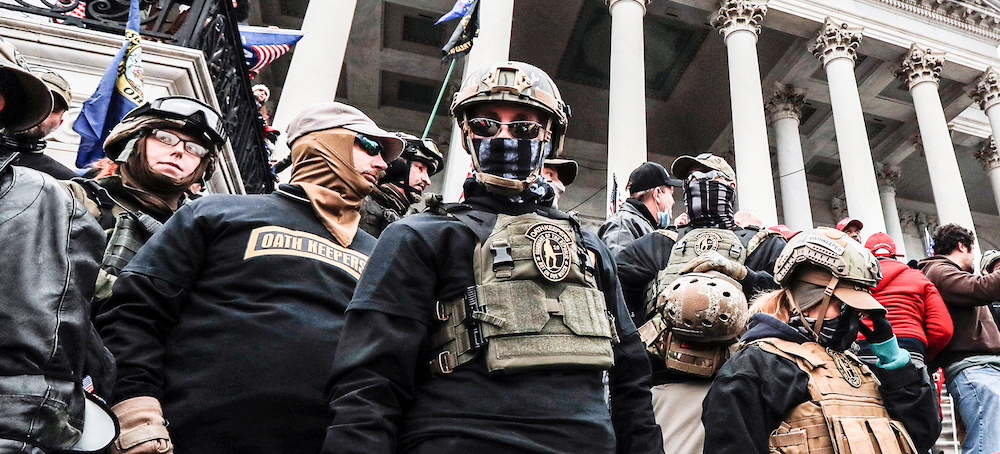 Members of the Oath Keepers militia group stand among supporters of Donald Trump occupying the east front steps of the U.S. Capitol, January 6, 2021. (photo: Jim Bourg/Reuters)
We talked with author Andy Campbell about Roger Stone, right-wing goons, and what messages they’re getting from Donald Trump.
Opening statements in the seditious conspiracy trial of Oath Keepers founder Stewart Rhodes and four other co-conspirators from the group are due to start Monday morning. The group is accused of amassing weapons and planning to storm the Capitol on Jan. 6. Oath Keepers were also seen guarding Stone in Washington on Jan. 5 and 6.
More than anyone, Stone is at a nexus between Trump, the Oath Keepers, and the Proud Boys. Members of that group, including longtime leader Enrique Tarrio, are set to have their own sedition trial in November.
I called up Andy Campbell, a senior editor at HuffPost and author of the new book “We Are Proud Boys: How a Right-Wing Street Gang Ushered in a New Era of American Extremism.” We talked about the trials, the group’s plans, and what messages they’re getting from Donald Trump.
Our conversation has been edited for length.
The Oath Keepers’ sedition trial is starting this week. What do people need to know about the Oath Keepers, Proud Boys, and similar groups?
The DOJ believes that not only did these two groups have a role in the execution of the insurrection but that they may have had a hand in plotting it. Hopefully these sedition trials bring clarity to what the planned plot was, and also illuminate the relationships between these guys and Trump’s inner circle. Roger Stone, Trump’s old confidant, had both Stewart Rhodes and Enrique Tarrio in a group text called “Friends of Stone,” and apparently was in contact with Tarrio by phone before and after the insurrection. Stone also told me in an interview last year that he’d been advising the Proud Boys for years on their political ambitions. And so I’m hoping that these sedition trials illuminate that relationship. I think we might learn some bombshells about their connection to Trump’s inner circle. And the fact that several top-level Proud Boys have already agreed to testify against their own means we may learn a lot.
How connected are Proud Boys to Donald Trump’s inner circle, even if Roger Stone is the buffer?
Stone has been the Proud Boys’ through-line to the GOP since 2017. He was the reason why they were able to so quickly position themselves as Trump soldiers and the reason why the GOP has been unable to rebuff or refute these extremist groups. And so I think all of Trump’s dealings with Enrique Tarrio are just going to be evidence against him; I really think that in the end, Trump’s going to have a hard time putting distance between himself and these trials.
Where do the Proud Boys fit into the Trump movement? How important are they to actualizing his threats of violence and his authoritarian movement overall?
Founder Gavin McInnes built the Proud Boys to do the things that the crusty old Republicans wouldn’t do. To go out into the streets and fight the GOP’s grievances. Tarrio used his relationships in Florida with Stone and others to try and make the organization more of a political monster. But their end goal was still political violence in the name of Trump. The playbook that the Proud Boys created for the extremist movement is to show how you can legitimize yourself and sanitize yourself through the right relationships. If the Proud Boys dissolve tomorrow, nothing changes. We have so much overlap now between all of the extremist groups: QAnon, all types of militias. The normalization that they’ve helped create means that this machine is going to keep on running with or without them.
Kyle Young, a Jan. 6 rioter, was sentenced this week to more than seven years. Trump several times has called for people like this to be pardoned. What do the Proud Boys hear when they hear Trump say that?
It’s just like when Trump told them to “stand back and stand by” in September of 2020. They truly believe that Trump is behind them all the way, and that the things that he says are marching orders. They also believe that for Fox News. So I think they have real hope that they can find some pardons. Certainly they’re excited about Trump saying he’s going to pardon January 6 people because they believe that they have Trump’s ear.
But none of these people are loyal. So I can’t imagine Trump going out of his way to help them get out of jail. I don’t see how that really helps him. The majority of the Proud Boys are still out there doing their thing in the name of Fox News and Trump. Just this last weekend, you have something like four drag queen story hours shut down because Proud Boys across the country were showing up and intimidating and harassing them, after weeks of Fox News whining about drag queens and trans issues. So the machine with or without Tarrio is working as planned. So I don’t see Trump going out of his way for him and the others charged with sedition.
How do you interpret Trump’s warnings that bad things will happen if he’s indicted?
Is it a direct communication?
Totally. In 2017 the Proud Boys were a lead group responding to the rhetoric. But now the political violence is so normalized that everybody’s involved, including everyday Americans. So I think Trump knows that everybody is going to react violently to this. The pipeline between the rhetoric and the violence in the street is so short now. How many hours was it between the time he was complaining about the FBI going through Mar-a-Lago and somebody showing up with a gun to an FBI field office? He knows he has people waiting to mobilize.
Do you see Proud Boys as a direct threat? What role are they planning on playing in 2024 around the election?
There will absolutely be Proud Boys violence in 2024 and I think in the 2022 election, too.
Arizona Republicans are calling for vigilante justice around ballot boxes. So you’re going to see the people out there. Tarrio told the Proud Boys following January 6, “We’re going to lay low, we want less violence and more political events because we’re in trouble now.” But the guys who joined the organization to fight still want to fight. Yes, I think they are absolutely going to show up in force for Trump’s election regardless of what happens.
I think we have to realize that the violence has trickled out to everyday Americans. It’s not just extremist groups anymore. Trump pointing to the back and calling the press the enemy, Trump glorifying Jan. 6 rioters,... that has come full circle. I think the spirit of January 6 is still here. All of the groups involved are still here, and everyday Americans have joined them. A swath of people believe that Jan. 6 defendants are wrongly accused. It’s going to be scary.
Note: Gavin McInnes was a co-founder of VICE. He left the company in 2008 and has had no involvement since then. He later founded the Proud Boys in 2016.
That’s a Bolduc Statement
Trump-endorsed New Hampshire Senate candidate Don Bolduc, during his GOP primary in August: “I signed a letter with 120 other generals and admirals saying Trump won the election, and dammit I stand by my word.”
Don Bolduc, when attacked in the general by Dem incumbent Sen. Maggie Hassan for servicing Trump’s lies: “So… you know … we, uhh … we, uhh … you know, live and learn, right?...Umm, I’ve done a lot of research on this, and I’ve spent the past couple of weeks talking to Granite Staters all over the state, from, you know, every party, and I’ve come to the conclusion—and I want to be definitive of this—the election was not stolen.”
T.W.I.S.™ Notes
Now that we’re fully ensconced in DOJ’s pre-election 60-day “no overt investigative moves” window, it’s OK to let your guard down for warrants and searches of possibly criminal coup plotters, would-be election stealers, and classified document takers. But This Week in Subpoenas is still here with the latest from the Trump Comic Universe!
- Cannon fodder
Donald Trump is free to keep lying about the feds planting evidence in his Mar-a-Lago property. That’s one bottom line of Judge Aileen Cannon’s ruling yesterday, saving Trump from the special master she appointed at his request.
Retired judge Raymond Dearie had given Trump’s lawyers until today to detail what parts of DOJ’s inventory of seized documents aren’t accurate. But Cannon stepped in at the eleventh hour to back Trump up, and said he didn’t have to comply. A lot of these developments are incremental, but it’s pretty disturbing how Cannon appears to be pulling for Trump as he seeks to delay DOJ at every turn of its document review.
Dearie appeared to be trying to make Trump’s lawyers back up their client’s (almost certainly bullshit) claims that DOJ was inventing evidence. Of course if Trump’s lawyers make false statements in court, they do it under oath. But Cannon saved Trump from that self-brined pickle.
None of this affects DOJ’s criminal investigation involving about 100 classified documents, however. A federal appeals court already stayed Cannon when she said DOJ couldn’t keep using them in its probe.
- Askin’ Robin
It’s now clear the January 6 committee’s investigation is reaching beyond the riot, insurrection, and associated post-election coup attempt. That’s mostly because nearly two years later, Trump is still trying to get his loss overturned. Normal politics! The panel this week subpoenaed Wisconsin GOP Assembly Speaker Robin Vos, inquiring about a July phone call when Trump asked him (not for the first time) to rescind the results of the 2020 election. Vos is suing to try to get out of testifying.
Vos tried for well over a year to placate Trump’s demands for stolen-election froth in Wisconsin, mostly by giving retired judge Michael Gableman well over $1 million in taxpayer money to investigate 2020. Now Vos and Gableman hate each other, and Trump hates Vos. Midwestern nice!
- Slow Gin
It’s taken a while, but Ginni Thomas finally came in for a chat with the January 6 committee on Thursday. Once seated, she promptly disavowed cockamamie conspiracy theories and apologized for spreading them. Just fooling! In fact, Thomas, who actively lobbied White House chief of staff Mark Meadows to overturn the election, corresponded with one of the key legal architects of the coup plot, and is also the spouse of the only Supreme Court Justice to vote for letting Trump hide documents from the committee, told the panel that she still thinks the election was stolen.
Thomas reportedly also told the committee that she and her husband never discuss pending SCOTUS cases and never discussed her “post-election activities.”
- But His Emails
DOJ asked a court to make Trump adviser and TV beggar Peter Navarro turn over government emails he sent and received on a private account. Yes, yes, I know.
If the “lock him up” jokes just wrote themselves in your head, recall that Navarro is due to face a criminal trial next month on a separate matter: refusing to comply with January 6 committee subpoenas. It’s the same thing Steve Bannon was convicted for in July. He awaits sentencing.
“If core First Amendment rights have a core, such a debate is certainly at the core of core First Amendment rights.” — a court filing from Arizona GOP Chair Kelli Ward, trying to quash a January 6 committee subpoena of her phone records.
The study of agent texts - The U.S. Secret Service confiscated the phones of two dozen agents and handed them over to investigators looking at the agency’s role in Jan. 6. The phones went to the Department of Homeland Security’s inspector general, who himself seemed… suss… to Jan. 6 investigators, when they found out agents’ messages from Jan. 5 and 6 had been deleted. Turns out Joseph Cuffari knew about it for months and said nothing.
So they DO have a point — QAnon sub-subcultures are all over the place, each with its own unique take on reality. Now that Trump is single-handedly keeping QAnon alive, let’s all agree that everyone saw, with their own eyes, that creepy one-finger salute that’s been cropping up at Trump rallies. But WHERE did it come from?
Legit political discourse — Surprise! One of Herschel Walker’s Georgia GOP Senate campaign “captains” is a Jan. 6 defendant!
Election crimes chief dies — The man Florida Gov. Ron DeSantis appointed to head up his new Election Crimes and Security Office died suddenly this week. Pete Antonacci was the first director of the DeSantis creation, which as its first act announced the arrest of 20 convicted felons for alleged illegal voting.
READ MORE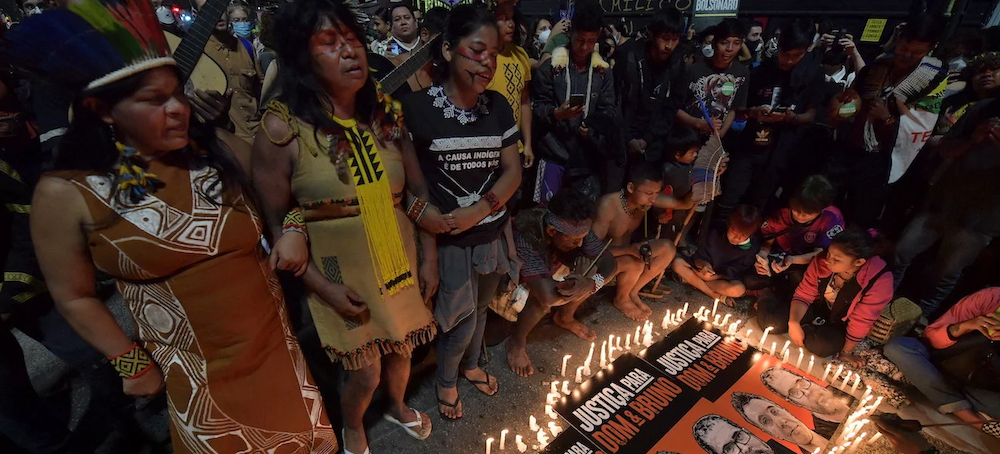 A vigil for murdered land defenders in Brazil. (photo: Nelson Almeida/AFP/Getty Images)
That’s one sobering statistic from the latest Global Witness report “Decade of Defiance: Ten Years of Reporting Land and Environmental Activism Worldwide.” For every year since 2012, the environmental and human rights organization has published a record of every death of a land or environmental defender it could verify. Now, in 2022, the organization is taking a moment to reflect on the 1,733 lives lost in what amounts to a war for the future of life on Earth.
“We are not just in a climate emergency,” Dr. Vandana Shiva wrote in the report’s foreword. “We are in the foothills of the sixth mass extinction, and these defenders are some of the few people standing in the way. They don’t just deserve protection for basic moral reasons. The future of our species, and our planet, depends on it.”
A Decade of Defiance
Over 10 years of completing their reports, Global Witness has noticed some patterns. Thirty-nine percent of the defenders killed have been Indigenous and 68 percent of the killings have taken place in Latin America. Almost all of them have occurred in the Global South.
The deadliest countries for defenders for the past decade have been Brazil, with 342 killings; Colombia, with 322; and the Philippines, with 270. In Brazil, more than 85 percent of the killings have taken place in the Amazon rainforest, which is a constant battleground between extractive industries looking to exploit the territory and Indigenous peoples defending their homes and way of life. Around a third of those killed in Brazil were either Indigenous or Afro-Brazilian. In the Philippines, violence has also been linked to extractive industries, in this case mining followed by agribusiness. More than 40 percent of the victims have also been Indigenous.
There are also certain things the most violent countries for defenders have in common. These include highly unequal land ownership, a history of violent conflict — as in Colombia, government corruption, a shrinking civil society and no accountability for large corporations.
“We’ve seen clear trends and patterns when it comes to threats and attacks against defenders over the last ten years: across the Global South violence occurs where there is a lack of civic protections for activism and where the priority is placed on resource extraction,” a Global Witness spokesperson told EcoWatch in an email. “Communities, many of them Indigenous, who have protected their land for generations, are left in the firing line of unaccountable companies, state security forces and contract killers. Impunity is rife, with credible investigations into killings rare, and even fewer prosecutions.”
One trend that’s harder to see is whether the situation is getting better or worse for defenders overall. That’s because Global Witness has gotten better at collecting data over the years, but is also aware it is likely underestimating the number of deaths, since many are never reported and the organization strives for a high standard of accuracy.
“Whilst the figures for individual countries may vary from year to year, overall figures remain horribly high and urgent action is needed from governments to protect defenders,” the spokesperson said.
2021’s Report: Dismissing the ‘Zone of Silence’
The new report also gathers figures from 2021. Last year, a total of 200 land and environmental defenders were killed, or about four people for every week. In keeping with decadal patterns, more than 40 percent of the murdered defenders were Indigenous. More than three quarters of the attacks were in Latin America and more than a quarter had known connections to extractive activities like mining, logging, agribusiness and hydroelectric dams.
On a country-by-country basis, Mexico saw the most killings, followed by Colombia and Brazil. In Mexico, killings increased for a third year in a row. A total of 54 people lost their lives in the country in 2021, nearly half of them Indigenous. Two-thirds of the deaths were connected to land conflicts or the mining industry.
One of these was the death of José Santos Isaac Chávez, an Indigenous lawyer who dared to run for office in his community of Ayotitlán while vocally opposing the operations of the Peña Colorada iron ore mine. Owned by the Luxembourg-based ArcelorMittal and Ternium steel corporations, the mine has operated since the 1970s in the area around the Sierra de Manatlán UNESCO Biosphere Reserve.
“The mine has destroyed the Cerro de Los Juanes mountain, turning the surrounding area into a wasteland,” the report states. “Mining operations have driven deforestation, loss of wildlife, climatic changes and toxic contamination.”
Activists and journalists have maintained that people who opposed the mine in the past have disappeared or been murdered, and Chávez was only the most recent. In April of last year, his body was found in the wreck of his car at the bottom of a cliff. There was evidence he had been tortured.
Adriana Sugey Cadenas Salmerón, a lawyer who coordinates the human-rights and environmental organization Tskini, said that violence was indeed increasing in Mexico. While there are several hypotheses as to why, Indigenous communities like one in Ayotitlán that Tskini is defending have lived for centuries in areas rich in natural resources that large companies now want to exploit.
“We are going against their interests, which are the interests of millionaires,” she told EcoWatch.
Salmerón saw hope in the immediate publication of the Global Witness report because it would bring attention to the struggles of the Ayotitlán community, which has been stuck in what she called a “zone of silence.” The report noted that the mining company does not allow outside researchers to enter the mine to assess conditions.
“This report will help a great deal to dismiss this zone of silence,” she said.
The Next Decade?
While stories like Chávez’s are tragic, there are signs of hope that a global movement is coalescing around defending land defenders.
“Where we are seeing change is in the opportunities to tackle violence against defenders. Businesses are now more aware of the threats that defenders face with a number establishing specific policies on human rights defenders; and some governments, predominantly in Europe, either have or are in the process of introducing mandatory human rights and environmental due diligence for companies,” a Global Witness spokesperson said.
Further, on April, 22, 2021, the first-ever legal agreement applying to environmental defenders entered into force. This is the Regional Agreement on Access to Information, Public Participation and Justice in Environmental Matters in Latin America and the Caribbean, or the Escazú Agreement, and signatories must both investigate and take steps to combat violence against defenders. So far, it has been ratified but yet not carried out in Mexico. Salmerón said there were many positives to the accord, but the government in Mexico moves slowly. In Colombia and Brazil, it has not yet been ratified.
There is some hope the situation might improve in Colombia following the June election of the country’s first left-wing President Gustavo Petro and its first Black Vice President Francia Marquez, a Goldman Environmental Prize winner. However, a Global Witness spokesperson said it was too soon to assess any impact the new government might have. In Brazil, there is also a chance for change if right-wing President Jair Bolsonaro, whose anti-Indigenous rhetoric has emboldened the violence of extractive industries against land defenders in the Amazon, is defeated in October’s election.
Moving into the next decade, Global Witness wants to see governments step up to defend their own citizens by overturning any legislation that criminalizes defenders and respecting the rights of Indigenous communities to free, prior, and informed consent; maintaining their lifestyles; enjoying a healthy environment; life; freedom; and free speech.
“Ultimately, we’d like to see governments reporting, investigating, and providing remedy for the killings of defenders themselves,” a Global Witness spokesperson said.
They also emphasized the role of governments in the Global North, who need to ensure companies based in their countries are held accountable for the violence in their supply chains.
Defenders and the Climate Crisis
As in last year’s report, Global Witness emphasized the link between the violence of the climate crisis and the violence against environmental defenders.
“Defenders are not only on the frontline protecting their land and resources — and ultimately our earth — from climate-destructive industries such as logging and mining, but they are also the ones most [affected] by extreme weather events caused by the climate crisis, from the wildfires in the Amazon to floods in the Philippines,” a Global Vision spokesperson said.
Yet the report also offers a warning of what might happen to these same defenders if wealthy companies in the Global North attempt to mitigate the climate crisis using the same exploitative logic that birthed it. An emerging displacer of Indigenous communities is the voluntary carbon market, in which wealthy companies offset their emissions by funding forestry or renewable energy projects in the Global South. While this might sound positive, it can be harmful in practice. Thousands of people in Uganda were forced from their traditional homes to make way for a Green Resources tree plantation, and three Indigenous defenders were killed in Honduras in 2015 for resisting a dam on their land that had been funded as a carbon offset.
Salmerón also said the demand for minerals for clean energy projects and electric vehicles was fueling the mining industry in Mexico, and, therefore, violence against people who did not want their ancestral lands exploited for the profits of others.
“While the capitalist system exists, violence will keep increasing in our country and around the world,” she said.
Follow us on facebook and twitter!
PO Box 2043 / Citrus Heights, CA 95611


Comments
Post a Comment