RSN: Juan Cole | As Saudis Stab Biden in the Back With OPEC+ Oil Cut, Only Electric Vehicles Can Make US Independent

07 October 22
Live on the homepage now!
Reader Supported News

Saudi Arabia has ambitious plans to transition to a post-oil economy over the next two decades, and so wants to get as much for its petroleum as it can, while it is still worth something. Russia is facing further European boycotts and sanctions that will kick in at the end of the year, and so needs to make up with a high price what it will lose in volume if it is to remain capable of funding the Russian state and the expensive war on Ukraine.
In July, President Biden was convinced by his national security team and perhaps his Democratic Party pollsters to make a trip to Saudi Arabia, where he met with Crown Prince Mohammed Bin Salman, helping rehabilitate the disgraced royal whom the CIA had fingered in the murder of Washington Post columnist Jamal Khashoggi in the Saudi consulate in Istanbul four years ago. Biden had pledged to make Saudi Arabia a pariah over that and other issues, but was forced to eat crow when Russia invaded Ukraine last February. Russia is a major petroleum producer, and the sanctions Biden and his European allies placed on Russian oil drove down its production. The loss of some Russian production caused a spike in gasoline prices, which hurt Biden among US consumers. The subsequent fall of gasoline prices for the past several months has been good news for Democrats. Biden was asking Saudi Arabia to increase production, which would hurt Russia’s war effort and help the Democrats in the midterms.
Bin Salman pocketed the fist bump of recognition by Biden, but now has stabbed Joe in the back by pushing for a significant cut in production, which will drive prices up again. This helps Russia and hurts the Democrats. Maya Angelou said that when people show you who they are, you should believe them the first time. Bin Salman has done a lot of showing — launching the ruinous Yemen War, kidnapping the prime minister of Lebanon, shaking down his cousins among the princes with house arrest in the Ritz Carlton, and allegedly ordering the murder of Khashoggi. Because the Saudi hit team (which was from Bin Salman’s own security detail) brought along a medical examiner to cut Khashoggi’s body up into pieces that could be smuggled in garbage bags out of the consulate and secretly buried around Istanbul, and because the ME used a bone saw, Bin Salman is jokingly called Abu Minshar, Mr. Bonesaw, on the Arab street.
It was pretty predictable that Mr. Bonesaw would take Joe Biden for a ride. And he has.
This year the US is producing 11.8 million barrels a day of petroleum. Based on this summer’s numbers, the US is using 20.8 million barrels a day. There is a shortfall of several million barrels a day, which is met by imports– mainly from Canada and Mexico but also we import 500,000 or so barrels a day of petroleum from Saudi Arabia.
Not only that, but our European allies depend on Russian and Gulf petroleum, though the EU is trying to cut Russia off by the end of this year. Europe is not energy-independent, which has sometimes made its member states reluctant to sign on to US policy. That most European countries have yielded to President Biden’s entreaties and supported Ukraine against Russia has opened the bloc to Russian blackmail over petroleum and fossil gas supplies, and to Russian schemes to get Europe to pay for the war on Ukraine through those energy imports.
Both the United States and the European Union need a Declaration of Independence from Oil.
Biden knows very well the proper response to the OPEC cartel’s monopoly pricing of petroleum, and its collusion with Moscow in raising prices, which is to turbocharge the adoption by Americans of electric cars. The Inflation Reduction Act has generous subsidies for EVs assembled in the US. The bipartisan Infrastructure Investment and Jobs Act has billions to help states build a network of electric chargers for cars so that people are not afraid of running out of juice. I drive an EV. It doesn’t happen. So the anxiety is misplaced, but sure, it is great to have lots of fast charging options.
There is lots of good news on the EV front in America. In the second quarter of this year, EVs doubled to nearly 6% of new car sales nationally year on year.
Despite a decline in purchases of internal combustion engine (ICE) vehicles, Ford tripled its sales of electric vehicles year over year in September, with the Mustang Mach-E continuing to rise in popularity. I’ve test-driven one. It is a very nice electric SUV.
The Chevy Bolt saw sales rise by 23.9% in the US in the third quarter. The Bolt is maybe the best value in EVs at the moment, with a basic starting price of only $26,000. As of January 1, you can also get a $7500 federal tax rebate on a Bolt, as well as on a Tesla. Demand for the Bolt is so strong that Chevy plans to increase production from 44,000 in 2022 to more than 70,000 next year.
We are on the ground floor of what Arezou Rezvani at NPR recognizes as a huge transformation, down to the kind of automobile engineers universities need to train.
One good thing about the OPEC+ production cut and consequent likely rise in gasoline prices? It will help even more consumers see the beauty of having an electric car. We just plug ours in at home. During the day (I don’t work 9-5), it is taking in electricity generated by our solar panels, which is free. The idea of running my car on clean, free sunlight is a trip. I look forward to the time, which is rapidly nearing, when everyone can afford to do the same, and can in fact save loads of money in doing so, not to mention saving the earth from a baleful climate emergency.
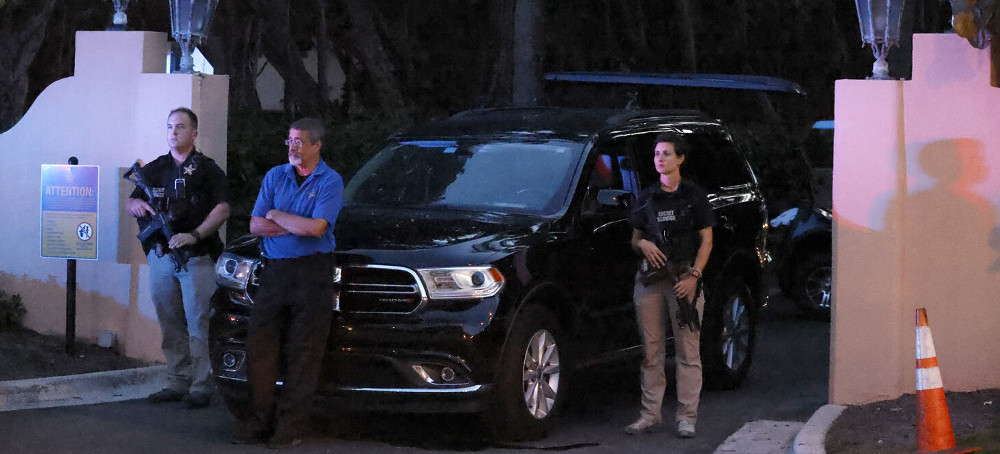 The Justice Department said Tuesday that classified documents were 'likely concealed and removed' from former President Donald Trump's Mar-a-Lago estate as part of an effort to obstruct the federal investigation into the discovery of the government records. (photo: Terry Renna/AP)
The DOJ’s head of counterintelligence matters, Jay Bratt, recently told Trump’s attorneys that the department believed he had not turned over all the government documents he took when he left office, classified or not, NBC reported.
The news, first reported by The New York Times and The Wall Street Journal, comes two months after FBI agents empowered by a search warrant raided Trump’s residence in Florida and seized thousands of government documents. More than 100 of the records were marked classified.
It also comes days after acting Archivist of the United States Debra Steidel Wall, in a letter to the House Oversight and Reform Committee, said that the National Archives and Records Administration still has not recovered Trump White House staff records that are contained on nonofficial electronic accounts they used during his presidency.
NARA found more than 150 documents marked classified in boxes of records that Trump turned over to the agency from Mar-a-Lago in January.
The DOJ declined to comment.
Trump’s spokesman, Taylor Budowich, in a statement to NBC News, said, “The weaponized Department of Justice and the politicized FBI are spending millions and millions of American tax [dollars] to perpetuate witch hunt after witch hunt.”
Budowich said that “all recent Presidents moved millions of pages of documents,” and argued that “President Trump is being unjustly, illegally, and unconstitutionally targeted because he won’t stop fighting to restore power back to the people.”
The Aug. 8 raid at the Mar-a-Lago Club in Palm Beach was part of an ongoing criminal investigation of Trump for the removal of government records when he left office, and potential obstruction of justice in not returning those documents as federal authorities sought their return.
By law, such records are the property of the U.S. government.
The DOJ has said that the raid found empty file folders that were marked classified. Officials also have complained that a judge’s ruling temporarily barring the DOJ from examining the seized classified documents “appears to bar the FBI and DOJ” from a review that could identify other records that are “still missing.”
Although the FBI searched Mar-a-Lago, where Trump resides in nonsummer months, agents did not search either his residence at his golf club in Bedminster, New Jersey, or his apartment at Trump Tower in New York City.
The Daily Mail last month published a video taken of Trump in May 2021 boarding a jet from near Mar-a-Lago as file boxes were being loaded on the plane. Trump was traveling to Bedminster at the time.
Trump’s lawyers are divided over how to respond to the DOJ’s suspicion that the former president still has classified material, the Times report noted. One group of attorneys, headed by Chris Kise, had suggested that Trump retain a forensic accounting firm to search for the suspected records. But other attorneys dissuaded Trump from that route, according to the report.
The latest reports on the potentially still-missing classified documents complicate an already tangled legal situation.
Judges in four federal courts, including the Supreme Court, are dealing with disputes between Trump’s lawyers and the DOJ over the parameters and timing of the use of the records in the criminal probe.
READ MORE Jackson Women's Health Organization, shown above on June 21. It closed in early July after being at the center of the case that overturned Roe v. Wade. (photo: Rogelio V. Solis/AP)
As of Wednesday, abortions are almost entirely unavailable in 14 states and significantly limited in a 15th, according to a new report from the Guttmacher Institute.
Of those 66 clinics, 40 still offer non-abortion services while 26 have shut their doors, the analysis found. Among them is Jackson Women’s Health Organization in Mississippi — the abortion clinic at the center of the Supreme Court case decided in June that dismantled Roe — which closed in early July with plans to move to New Mexico.
As of Wednesday, abortions are almost entirely unavailable in 14 states — Alabama, Arizona, Arkansas, Idaho, Kentucky, Louisiana, Mississippi, Missouri, Oklahoma, South Dakota, Tennessee, Texas, West Virginia and Wisconsin. And access is significantly limited in a 15th state, Georgia, where the procedure is allowed until the detection of fetal cardiac activity, which usually happens around six weeks of pregnancy.
The 14 states were responsible for 125,780 abortions in 2020, according to Guttmacher’s analysis. And 41,620 abortions were performed in Georgia the same year.
“Even before Roe was overturned, getting an abortion was difficult or outright impossible for many people, especially those who were already facing steep barriers to accessing health care, including people with low incomes, Black and Brown people, immigrants, young people, those with disabilities and rural populations,” said Rachel Jones, principal research scientist at the Guttmacher Institute, in a statement. “These inequities are likely to worsen as clinic-based abortion care disappears in many states, many of them clustered in regions like the South.”
The Biden administration — as part of its efforts to mitigate the impact of the Supreme Court’s decision — announced on Tuesday it is giving clinics that provide free and subsidized family planning services an additional $6 million. Providers in Florida, Maryland, Michigan, New Jersey, New York, North Carolina and Wisconsin will receive the funds.
Since Roe was overturned in June, the Biden administration has used a federal law governing emergency medical care to challenge Idaho’s near-total abortion ban; warned pharmacists not to withhold prescription medications just because they can also be used to induce an abortion; and requested that mobile phone providers share information about their data retention and data privacy policies, among other efforts.
While anti-abortion groups this week celebrated the new abortion restrictions, they also slammed the Biden administration’s attempts to ameliorate the impact of the state-level abortion restrictions.
“While two dozen states are poised to protect the unborn and their mothers, saving as many as 200,000 lives a year thanks to the historic Dobbs victory, radical Democrats led by the Biden-Harris administration are determined to use the full weight of the federal government to impose abortion on demand until birth with no limits, paid for by taxpayers, nationwide,” said SBA Pro-Life America President Marjorie Dannenfelser. “Their agenda is wildly out of step with America.”
Abortion access remains in limbo in seven other states, including Indiana, South Carolina and Ohio, where laws restricting access to the procedure have been put on hold in court.
READ MORE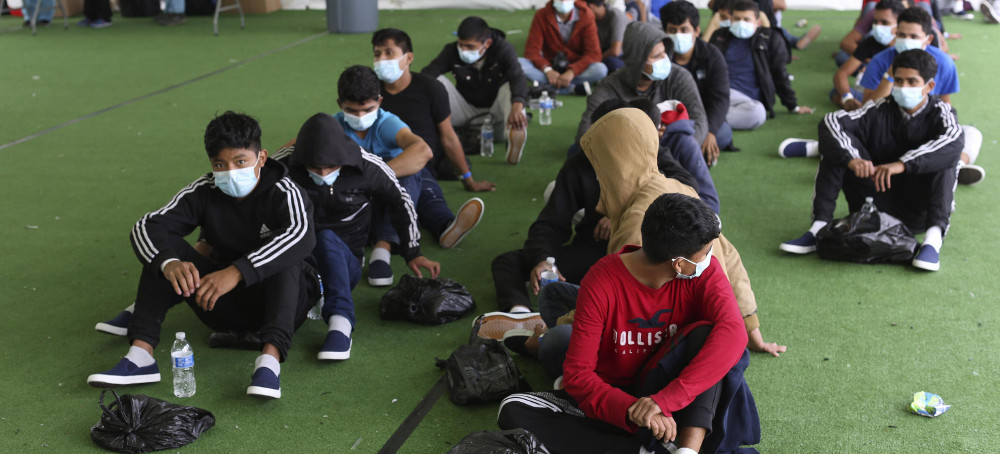 In this March 30, 2021 file photo, young migrants wait to be tested for COVID-19 at the Donna Department of Homeland Security holding facility, the main detention center for unaccompanied children in the Rio Grande Valley, in Donna, Texas. (photo: Dario Lopez-Mills/AP)
A system intended to protect young immigrants while they wait for new homes has instead been overused, experts say, leading to prolonged stays in federal custody.
But the shelter system remains in place under President Joe Biden. The numbers can fluctuate but, as of earlier this week, more than 9,000 unaccompanied immigrant children were in custody, according to data from the federal Office of Refugee Resettlement, which oversees the privately run shelters.
The vast majority are children and teens from Central America who entered the country through the U.S.-Mexico border without a parent or legal guardian. The shelter system is designed to house these children temporarily — the average length of stay is about a month — until they can be placed with a relative or family friend or, in some cases, in foster care.
Last fall, ProPublica reported on one Chicago shelter’s failure to meet the language and mental health needs of dozens of traumatized Afghan children and teens who’d been brought to the country without family by the U.S. during its widely criticized military pullout from Afghanistan. Many of them had no one who could take them in; some tried to kill themselves, harmed others or ran away.
Months later, we saw those problems repeat themselves as the youths were transferred to other facilities. Office of Refugee Resettlement officials have said they’re doing their best to support the Afghan children by providing interpreters, mental health services and additional staffing. As of this week, some 84 unaccompanied Afghan minors remain in ORR custody, federal officials said. Some have been in custody for a year.
Another issue we’ve come across in our reporting is ORR’s system of “significant incident reports.” Shelter staff are required to report to ORR any “significant incidents” that affect children’s health, well-being or safety.
The system is intended to elevate serious concerns and protect children, but over the years, dozens of shelter staffers, advocates and children have told ProPublica that it has been overused and negatively affects children. For example, Afghan youth have expressed “extreme distress around how SIRs will be used against them,” said Neha Desai, senior director of immigration for the National Center for Youth Law, which is authorized to interview children in U.S. immigration custody.
“They’ve asked whether these reports will impact if or when their parents are evacuated” from Afghanistan, Desai said in an email. Some children “have been told by staff that SIRs will delay their release from custody.”
Last month, two prominent immigrant rights organizations that work with children in ORR custody issued a report calling for an overhaul of the incident reporting system. The report, “Punishing trauma: Incident Reporting and Immigrant Children in Government Custody,” is based on surveys last year of staff at ORR facilities and of attorneys and social workers who work with unaccompanied children.
An ORR official did not respond to the report’s specific findings. But, in a statement, the official said significant incident reports are primarily meant as internal records to document and communicate incidents for the agency’s awareness and follow-up. Last year, ORR revised its policies to limit the sharing and misuse of confidential and mental health information contained in SIRs. (For example, U.S. Immigration and Customs Enforcement was previously using notes taken during therapy sessions inside shelters against children in immigation court, The Washington Post reported.)
“ORR continues to clarify through technical assistance to care providers and ongoing policy development that SIRs should never be used by care provider staff as a form of discipline or punishment of the child,” the ORR official said.
I spoke with the primary authors of the report that calls for the overhaul of the incident reporting system. Jane Liu is senior litigation attorney for the Young Center for Immigrant Children’s Rights, and Azadeh Erfani is a senior policy analyst at the National Immigrant Justice Center. We discussed how significant incident reports are used inside shelters and the authors’ ideas for reform.
This is a condensed, edited version of that conversation.
What would you say are the biggest challenges that kids face when they’re inside ORR facilities?
Jane Liu: Children do best in a family-based setting, but the large majority of the children in government custody are in large congregate care settings, where they often face a lot of restrictions on their movement, monitoring and supervision. They’ve also likely just navigated a very difficult migration journey that may have included exposure to violence and traumatic experiences. They may have suffered traumatic experiences in their home country. They may have been separated from their families at the border. Then they go into custody and they’re navigating this completely unfamiliar environment in a large-scale setting where they often aren’t receiving the individualized care that they need. They may also be facing language barriers. And so it’s extremely stressful for them and disorienting.
What prompted you to look into significant incident reports, or SIRs?
Azadeh Erfani: They have been on both of our radars for some time now. They are a really central facet for children’s legal cases. A child’s placement level — where they end up within the security hierarchy of ORR — is greatly impacted by the number and the type of SIRs that they have.
On a personal level, I’ve represented kids with dozens of SIRs. I’ve seen up close how they really have widespread impact for kids who end up being branded as “problem children” and basically are stuck in the system with very little recourse.
What kinds of behavior can lead to a child accumulating these reports?
Erfani: It could be sharing food. It could be getting up and going to the bathroom at the wrong time. It can also be a child acting out, testing boundaries. It could be a child simply disclosing something about their past. If they disclose that they’ve survived trafficking, abuse or neglect, or have been preyed upon by gangs in their home country, those kinds of things can trigger an SIR. So the scope is really broad, which really leads to overreporting.
What are the consequences for children who accumulate SIRs?
Erfani: ICE has the authority to review every single child’s case when they are about to turn 18. They make a decision to either take them into adult custody or release them on their own recognizance. At that juncture, SIRs play a pivotal role.
We’ve also seen SIRs getting used in immigration court or in asylum interviews to basically put the child on the spot to defend something that was written up about them that they may not even have known was written up.
I’ve heard over and over from people who work in the system that the accumulation of SIRs makes it harder for kids to leave shelters, even if there is an available sponsor. Can you talk about how that happens?
Liu: It can create all sorts of barriers to release. It can lead to children getting “stepped up” [to more secure, restrictive facilities] and then it’s harder to step back down. Often a long-term foster care provider won’t accept a child unless they’ve had a period without behavioral SIRs. But even if a child has a potential sponsor, we’ve seen it lead to requirements for home studies where ORR will say that “These SIRs indicate that the child may have a need, and we need to investigate whether the sponsor can fill that need.” Ultimately, what that means is that it delays the release of the child to a family member.
In our reporting on unaccompanied Afghan kids in ORR custody, I was surprised to see how often shelter staff called police to deal with behavioral issues. How common is police intervention at shelters?
Liu: It’s a much bigger problem than the public may be aware of. Often those children are not getting the services that they need, such as mental health support. And by that I mean holistic services tailored to the unique experiences of each child. They’re also usually facing prolonged periods of custody, so they’re also experiencing detention fatigue. And it’s not surprising that they can act out and that there can be these sorts of behavioral challenges. But what is extremely troubling is that when these behaviors are documented in SIRs, they can sometimes prompt ORR facilities to report the incident to police, leading to unnecessary interactions for children with law enforcement and even arrests.
What should shelters be doing?
Erfani: One of our recommendations to ORR is to actually train staff in crisis prevention. For the most part, there’s a very passive approach to incidents. There’s not a lot of scrutiny with respect to how to prevent these crises from erupting in the first place.
SIRs very much lack the context of the child. Being in a congregate setting indefinitely can be incredibly, incredibly aggravating. And of course, they are bringing tons of trauma because of their backgrounds. So oftentimes these triggers, this background, if they receive bad news from the home country, those kinds of things are absent from the SIR and make it look like this child is incredibly erratic. That’s also really alarming from a trauma-informed perspective.
This makes me think about the dozens of Afghan children who remain in federal custody. Can you talk about what role SIRs have played in these kids’ experiences inside the shelters?
Erfani: The Afghan kids walked into a really terribly broken system right after escaping a war zone. The fact that they may not have had a sponsor lined up meant that they had to spend more time in custody. And every day they kept seeing kids leaving while they had to stay. That’s heartbreaking. Then you pile on the language barriers, the cultural competency barriers. A lot of their behavior is a manifestation of trauma that staff isn’t equipped to understand. And it was much easier to write up reports, or call law enforcement, than it was to try to put the system on trial itself, to see what’s really missing within the facility and address those needs on a systemic level.
Inadequate staffing and turnover at shelters seems to be a chronic problem. How do you see that playing into the SIRs?
Erfani: I think it’s really hard on staff. The SIR system is incredibly time-consuming. They have to dedicate tons and tons of resources into it. The rules are really intricate. When there’s turnover, for the new staff a compliance mindset can settle in, where it becomes less about that child’s needs, less about these child welfare principles, and instead about, “Well, I should probably be writing this report.”
Liu: It’s really critical that the government provides more support for facility staff, whether it be ongoing training or more funding for more staff with expertise in child welfare, mental health and the needs of immigrant children. I think it’s really up to the government to understand that children’s time in custody can be very difficult for them and figure out ways to prevent situations from escalating and being extremely harmful for children.
Have you shared your concerns or this report with ORR, and if so have you gotten any response yet?
Liu: We have shared the report with the government. It is not a new revelation to ORR that this is something of huge concern for those of us who advocate for children. We have been raising concerns about SIRs in particular with greater frequency in the last couple of years.
Erfani: We strongly believe that nothing short of a complete transformation of incident reporting is going to meet their duty to these children.
It really feels like issues affecting immigrant kids in ORR custody have just fallen off the radar since Trump left office. How do you get people to pay attention?
Erfani: That’s a tough one. We’re just trying to really put this problem on the map and then try to address it. And it’s not a Republican problem. It’s not a Democrat problem. It’s really something that’s in the system.
Liu: We know incident reporting is not a sexy topic. It’s not something flashy. It doesn’t involve Gov. Greg Abbott or Gov. Ron DeSantis. And so it’s hard to get people to see the urgency. But I think it sort of goes to the whole family separation thing. When that occurred, I think people could understand the humanity involved. That children are not being treated as children, and children are being traumatized by government actions.
I think a lot of people think of their own children. How would they want their own children to be treated? If your child was acting out or talking back to you, would you want a report written up and for that report to be used against your child for all sorts of purposes? The reality is that immigrant kids, particularly those in custody, are not treated like other kids. And that should be a concern to all of us. That’s a failure on all our parts.
READ MORE A woman says she was on her way to pick up groceries with two of her children when officers surrounded her car, hit the vehicle and detained her. (photo: NBC4 Washington)
Jamee Kimble, who was out getting groceries, had given birth just six days earlier.
“They had me hold both of my hands out the car window while they pointed a gun at me screaming that I could become a threat if I moved,” Jamee Kimble, who is Black, said in an Instagram caption alongside a video she filmed in the aftermath of the Oct. 1 incident. “In front of my kids!”
The vehicle Kimble was driving had been flagged in the database of the National Crime Information Center, according to a statement by the department, and police say they’d been warned that the occupants could be armed and dangerous.
Now, Kimble says she wants the Fairfax County Police Department to issue a formal apology for the terrifying ordeal.
“It was just so shocking and mind-wrecking,” the mother of three told NBC4 Washington. “I still am very angry and, more than anything, hurt, because I teach my children that the police are supposed to protect us, and that if they need anything, they can call them for help.”
Kimble says the officers, with guns pointed at her and her friend, claimed her vehicle had been involved in a high-speed chase days earlier. In the video Kimble posted to Instagram, she explains that there was no way she could have been involved in that alleged crime. She also says that police conducted their stop without warning, without using sirens or police lights.
“He hits me from the front and claims that I was in a high-speed chase,” she says. “I was in the hospital. Having my baby. My baby is six days old.”
Kimble says that she delivered her baby via cesarean section and was still recovering from surgery at the time of the encounter. When police removed Kimble and her friend from the car and handcuffed them, her other two kids, ages 5 and 1, were placed in the back of a police car as officers investigated further.
In a statement released the following day, police explained their side of events, saying they conducted a felony stop and detained the occupants of the car. They also say that a cruiser did strike “the front bumper of the wanted vehicle while traveling at an estimated speed under 10 mph,” adding that there was little damage to Kimble’s vehicle.
“ Further information confirmed the stopped vehicle was the wanted vehicle involved in an incident in Arlington County and they requested the car be stopped so the occupants could be identified,” the statement said. “Officers identified the occupants, determined they were not owners of the vehicle, were not involved in the incident in Arlington County, and were released.”
When reached for comment, the Fairfax County Police Department did not clarify what crime the car was allegedly involved in or why police sirens were allegedly not used during the stop. However, Kimble told NBC4 Washington that a police department representative was expected to reach out to her on Wednesday.
Routine traffic stops by police can be deadly, particularly for non-white Americans. The Guardian reported that from January 2017 through April 2022, officers killed 589 people during traffic stops. At least 28 percent of those killed were Black.
READ MORE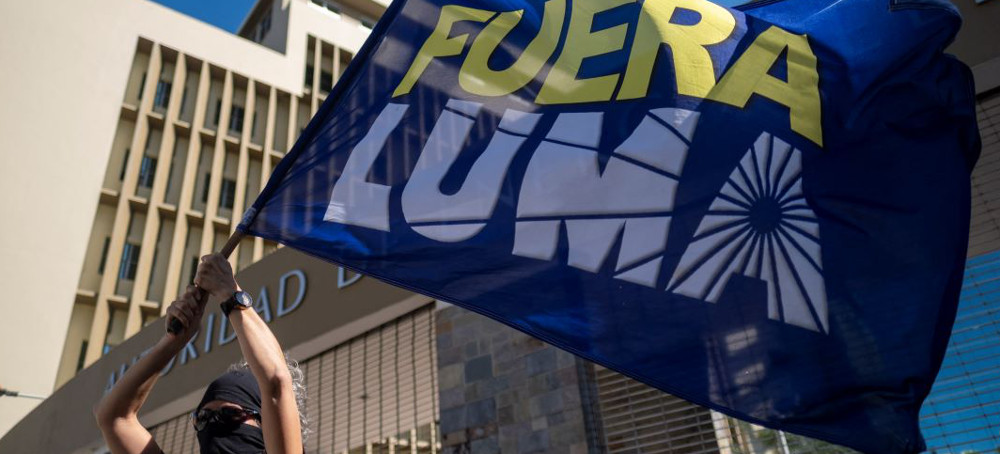 A woman waves a flag that reads in Spanish'LUMA Out' during a protest in front of the headquarters of LUMA Energy after a blackout hit the island two days earlier, in San Juan, Puerto Rico, April 8, 2022. (photo: Ricardo Aduengo/AFP)
For years, Puerto Rico has endured a ruthless campaign of austerity and privatization, including a corporate takeover of its once-public power grid. The result: nearly a quarter-million people have been without power for over two weeks since Hurricane Fiona.
Puerto Rico’s energy sector hasn’t been overseen by a government department since 2014. The energy industry is now controlled by the independent Puerto Rico Energy Bureau (PREB), which oversaw the privatization of the formerly publicly owned power grid, approving a fifteen-year contract for LUMA.
The bureau has a directive to carry out the Puerto Rico Energy Public Policy Act, a mandate which requires 40 percent of all energy to be renewable by 2024, among other environmental goals. The Public Policy Act is an important step toward the modernization of the grid, with some experts identifying centralized fossil fuel plants and their resultant miles-long cable network as the root cause of distribution problems. The prudent thing to do, Tom Sanzillo of the Institute for Energy Economics and Financial Analysis argues, would be to expand the grid’s solar capacity through a decentralized user-operator network.
The Puerto Rican grid is already home to one of the largest renewable peaker plants in the world — a web of individually owned solar panels some 55,000 units strong. The Federal Emergency Management Agency (FEMA) allocated almost $10 billion to redo the grid under Donald Trump in 2020, money that could have subsidized per-house panels and batteries to expand the network’s capacity to the entire island. Unfortunately for the Puerto Rican public, LUMA wasn’t interested in prudent solutions. It was interested in profit.
LUMA Rising
The commonwealth lost its ability to meaningfully influence structural decisions with a 2016 Barack Obama–era law called the Puerto Rico Oversight, Management, and Economic Stability Act, known as PROMESA or La Junta. This act allowed the US Congress to infringe on the island’s pecuniary autonomy through the appointment of a Financial Oversight and Management Board (FOMB). Since its formation, the FOMB has enacted severe austerity measures on public services in order to help Puerto Rico “achieve fiscal responsibility and ultimately reestablish access to credit markets,” according to the text of the legislation. La Junta also gives the FOMB authority to deny unionized utility workers their right to strike.
The FOMB’s independence from Puerto Rican lawmakers meant that it could clear the way for Puerto Rico’s public electrical company, the Puerto Rico Electric Power Authority (PREPA), to sell commonwealth assets and outsource services related to the generation and transfer of electricity. In 2018, legislation was passed to enable the placement of Puerto Rico’s energy grid under private management. That 2018 act revealed La Junta’s true purpose: raising the bridge to make way for muck-dredging capitalists who have long lusted after utility contracts in the Global South. From then on it was inevitable that PREPA would seek a public-private partnership in order to improve the public grid. That’s where LUMA came in.
LUMA Energy took charge of the commonwealth’s electrical distribution in June of 2021, after its public predecessor racked up almost $9 million USD in debt. The two now work in a public-private partnership, where PREPA handles energy generation and LUMA handles distribution. LUMA was incorporated specifically for the private management of Puerto Rico’s grid and was granted a fifteen-year contract worth $1.5 billion. In response to the deal, lineworkers with the Union of Workers of the Electrical Industry and Irrigation (UTIER) declared a twenty-four-hour strike.
According to PREB chair Edison Avilés-Deliz, the goal in outsourcing transmission and distribution to LUMA was to “transform the [grid] into a modern, sustainable, reliable, efficient, cost-effective, and resilient electric system consistent with prudent utility practices to increase electric service quality.” That was in October of 2021. Since then, LUMA has received a $71.4 million cash injection from FEMA with more than $12 billion on the way — funds that LUMA has failed to parlay into service even equal to that of its poorly managed predecessor.
Under LUMA’s watch, Puerto Rico has seen an increased number of massive blackouts, including one in April of 2022 that left the entire island without power. In exchange for continued blackouts and poor service, customers are hit with constant price hikes — Puerto Ricans on average now spend 8 percent of their income on electricity. This is a symptom of the grid’s reliance on fossil fuels, which made up 97 percent of energy generated in 2020–21, and LUMA’s resistance to weaning itself from the centralized grid. With little resistance from PREB, the all-important Public Policy Act has seen next to no environmental progress since LUMA took charge.
Worker Mistrust Breeds Corporate Chaos
LUMA’s failure to improve its own fossil fuel–based grid, let alone act on Puerto Rico’s renewable energy mandates, can be partially traced to the bottleneck resulting from labor issues following its takeover.
A report by Ricardo Cortes Chico for El Nuevo Día in May of 2021 found that LUMA, poised to take over in a matter of weeks, had only secured 250 lineworker contracts out of 800 qualified lineworkers with UTIER. UTIER’s previous contract with PREPA was a point of contention for a young LUMA, which forced PREPA workers to reapply for their jobs. This forced reapplication came as LUMA recognized the Insular Union of Industrial and Electrical Construction Workers (UITICE) as the bargaining representative for lineworkers. UITICE offered more concessions and a corporate-friendly attitude at the bargaining table.
This is not how it’s supposed to happen. In a multiunion workforce, the majority-representative union is selected to represent workers in collective bargaining — the important factor here being worker autonomy. Instead LUMA chose for them, stealing their right to determine representation along with myriad hard-won benefits and wage agreements.
This undemocratic move was the first nail in the corporate coffin. It ended up alienating over three thousand PREPA workers who declined to resign for LUMA. It also confirmed workers’ fears that no government bureau would step in to help.
LUMA’s takeover was the subject of its own House subcommittee hearing in October of 2021, with a heavy emphasis on staffing issues. In an interview, LUMA CEO Wayne Stensby stumbled over the question of “how many” blackouts Puerto Rico has experienced under his company’s leadership, admitting simply that “outages happen daily.”
LUMA’s solution to the growing staffing problem was to outsource labor, both to independent contractors on the island and to employees from LUMA’s parent companies: the American Quanta Services and Canadian ATCO Group. This move came with its own set of labor debates, with independent contractors rejecting the International Brotherhood of Electrical Workers (IBEW) labor agreement they would need to sign in order to work with LUMA.
Despite assurances, outsourcing has not improved the situation facing LUMA on the ground. It has only compounded preexisting problems, resulting in the continuing lack of service after Fiona. Municipalities are being forced to step in to fill the gaps, with the mayor of Bayamón planning to engage emergency lineworkers to rebuild poles LUMA hasn’t touched, and the mayor of Auguadilla hiring lineworkers from PREPA. According to Mayor Julio Roldán Concepción, Auguadilla went days without assistance from LUMA after Fiona made landfall.
Private utility management has been imposed by legislators who are prioritizing their commitment to fiscal conservatism over the common good. In the meantime, Puerto Ricans experience regular disruptions to education, food service, transportation, health care, and clean water. Privatization was sold as a solution to Puerto Rico’s energy problems. Instead, it’s been its own kind of disaster.
READ MORE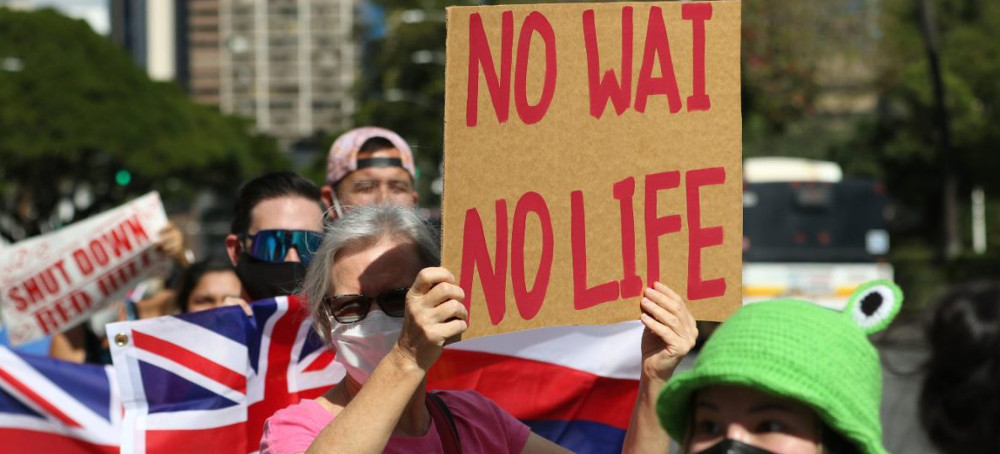 A $9 million fine and a sewage leak into Pearl Harbor are just the latest in a series of water crises. (photo: Caleb Jones/AP)
A $9 million fine and a sewage leak into Pearl Harbor are just the latest in a series of water crises.
At issue are not only the underground aquifers that supply drinking water for much of the island of Oahu, but also answerability by the military that has long had a contentious presence in Hawaii.
“I think it’s incredibly important that there is accountability and that accountability begins with the Navy assuming responsibility for the actions and the situations they’ve created,” said Trisha Kehaulani Watson, the vice president of ‘Āina Momona, a Hawaiian social and environmental justice organization.
The wastewater leak and the fine are just the latest in a series of water crises on Oahu that have been attributed to the U.S. military presence in Hawaii.
Last November, hundreds of members of the military and their families living on a joint operations base near Honolulu were sickened after a Navy-run underground fuel storage facility leaked petroleum into the source of their drinking water. After the incident was made public, Hawaii’s health department issued an emergency order requiring the Navy to immediately stop its operations at Red Hill Bulk Fuel Storage, the fuel storage facility. On November 28, the Navy shut down the well at Red Hill that provided base members with water.
On Oahu, aquifers are often in such close proximity to military installations that any contamination from a leak poses a public health risk to hundreds of thousands of residents. In a January hearing into the Red Hill incident, Hawaii’s Board of Water Supply found that the Navy’s fuel storage facility posed “an imminent peril to human health and the environment, that it places Oahu’s sole-source aquifer at significant risk of further contamination, and that immediate action is necessary to protect our critical drinking water resources.”
In February, residents of Kailua Bay, north of Honolulu, were advised to avoid the namesake waters after a leak from a US Marine Corps wastewater treatment facility released water contaminated with unsafe levels of fecal bacteria into the bay. In March, the Defense Department announced that it would permanently close and defuel the Red Hill facility.
During a visit to Hawaii last weekend, Lloyd Austin, the US Secretary of Defense, toured the Red Hill facility and reiterated in a tweet that its permanent closure was “the right thing to do.” But Austin’s visit was criticized by some local military families as well as representatives from O‘ahu Water Protectors, a local environmental justice organization, who argued that they have not been included in a federal task force on the safe defueling of the Red Hill facility.
The Red Hill incident galvanized a broader cross-section of Hawaiians who in the past had not always seen eye-to-eye on environmental issues, according to activists. “I think the fact that you now have an alliance between local people and environmentalists and native Hawaiians and military families, that’s been a monumental shift,” said Kehaulani Watson of ‘Āina Momona.
“Red Hill immediately connected people to the issue in a way through our shared sense of vulnerability,” said Kyle Kajihiro, a lecturer and Native Hawaiian rights activist at the University of Hawaiʻi at Mānoa. Kajihiro believes that the level of attention by locals towards the recent wastewater leaks into Pearl Harbor, itself a source of strong emotional ties, was strengthened by the impact of Red Hill. “I think it helped to wake up a latent understanding of the military’s environmental and social impacts that often get pushed to the back because people have other things on their mind,” he said.
Follow us on facebook and twitter!
PO Box 2043 / Citrus Heights, CA 95611


Comments
Post a Comment