RSN: Masha Gessen | Putin's Draft Order Has Inspired a Russian Exodus

06 October 22
Live on the homepage now!
Reader Supported News

'I Refuse to Comply,' Says Russian Journalist, Days After Escaping House Arrest
Jennifer Hassan and Robyn Dixon, The Washington Post
Excerpt: "In her first remarks since fleeing pretrial house arrest earlier this week, Russian journalist Marina Ovsyannikova said she considers herself 'completely innocent' and issued a call for Russian President Vladimir Putin to be isolated from society and put on trial."
READ MORE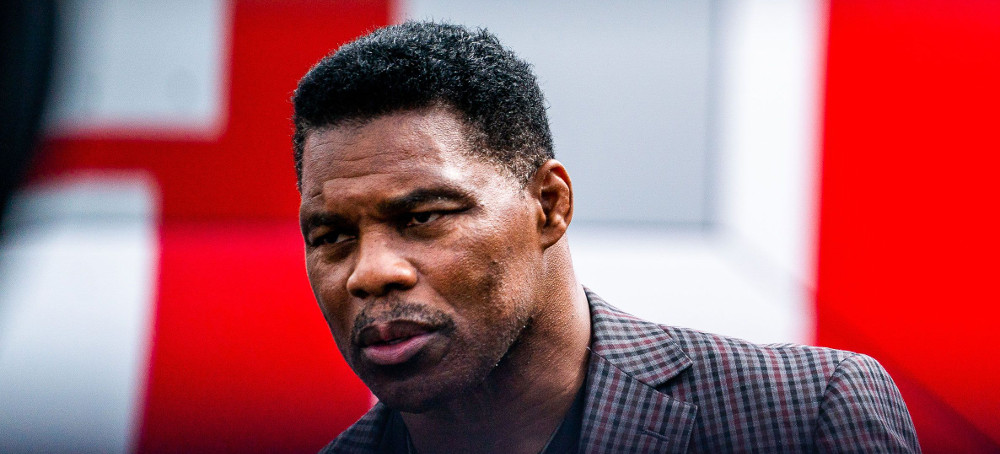 A woman who had an abortion with Herschel Walker had a child with him too. (photo: Demetrius Freeman/The Washington Post)
Herschel Walker has claimed he has no idea who this woman could be. Here’s why that’s surprising.
But there’s a good reason the woman finds that defense highly doubtful: She’s the mother of one of his children.
When the woman first told The Daily Beast her story, we agreed not to reveal certain details about her identity over her concerns for safety and privacy. But then Walker categorically denied the story and said he didn’t know who was making this allegation.
On Wednesday morning, Fox News host Brian Kilmeade asked Walker whether he had figured out the woman’s identity, based on details in the original report.
“Not at all,” Walker replied. “And that’s what I hope everyone can see. It’s sort of like everyone is anonymous, or everyone is leaking, and they want you to confess to something you have no clue about.”
Walker then spun the report as an attack from “desperate” Democrats eager to maintain control of the pivotal Senate seat. Instead of being deterred by his now-public hypocrisy, he said he now feels “energized.”
“They see me as a big threat, and I know that and I knew it when I got into this race. But they don’t realize that I think they came for the wrong one. They energized me,” Walker said. “They energized me, because I know how they really want to try to keep this seat.”
The anonymous woman said that defense sounded ridiculous.
“Sure, I was stunned, but I guess it also doesn’t shock me, that maybe there are just so many of us that he truly doesn’t remember,” she said. “But then again, if he really forgot about it, that says something, too.”
The woman, a registered Democrat whose years-long relationship with Walker continued after the abortion, told The Daily Beast that her chief concern with revealing her name was because she is the mother of one of Walker’s own children and she wanted to protect her family’s privacy as best she could while also coming forward with the truth. (Walker has publicly acknowledged the child as his own, and the woman proved she is the child’s mother and provided credible evidence of a long-term relationship with Walker.)
The Walker campaign declined to comment for this story.
But even with the woman remaining anonymous, the story has still rocked Walker’s family in other ways.
After Walker denied the report, one of his three sons, conservative social media influencer Christian Walker, released a series of angry statements and videos condemning his dad as a liar, and alleging that the University of Georgia football hero had threatened to murder him and his mother—Walker’s ex-wife.
“I know my mom and I would really appreciate if my father Herschel Walker stopped lying and making a mockery of us,” Christian Walker tweeted after the abortion story broke Monday night. “You’re not a ‘family man’ when you left us to bang a bunch of women, threatened to kill us, and had us move over 6 times in 6 months running from your violence.”
The anonymous woman said that while she’s been a “good sport” about the campaign, after Walker’s denial, she could no longer keep this information from the public.
“I’ve been very civil thus far. I keep my mouth shut. I don’t cause any trouble. I stay in the background. But I’m also not gonna get run over time and time again,” she said. “That’s crazy.”
Walker and his campaign have put out seemingly conflicting messages to battle the story, denying it on one hand as a “lie” while also appealing to themes of religious redemption and forgiveness on the other. On Wednesday, Walker put out a new ad where he discusses overcoming his struggles with mental health “by the grace of God.”
But if Walker is seeking redemption for the abortion, that would be a recent shift. He lied about his role in abortions just this year—once in a June interview with The Daily Beast, and later to a Democratic activist posing as a Walker supporter, who caught his denials on video.
Asked about the role faith played in Walker’s life, the anonymous woman, who identifies as a Christian herself, said even though Walker often talked about Christianity, he uses it “when it works for him.”
She said Walker frequently talked about being a Christian, but never once expressed any misgivings about abortion generally—or any regret about the one that they had. When she got pregnant again years later, the woman says she made a different choice, even though Walker said it still wasn’t “a convenient time” for him.
“He didn’t express any regret. He said, ‘relax and recover,’” the woman recalled, alluding to the message on the “get well” card Walker sent her along with the abortion payment.
“He seemed pretty pro-choice to me. He was pro-choice, obviously,” she said.
“I don’t think there’s anywhere in the Bible where it says ‘Have four kids with four different women while you’re with another woman.’ Or where it praises not being a present parent. Or that an abortion is an OK thing to do when it’s not the right time for you, but a terrible thing for anyone else to do when you are running for Senate. He picks and chooses where it’s convenient for him to use that religious crutch,” she said.
The campaign has used the woman’s desire to remain anonymous to raise money, saying in its first fundraising email after the news broke that “Now, they’re using an anonymous source to further slander me.”
Asked how she felt about the campaign’s boast that Walker saw record-setting contributions in the hours after he called her a liar, the woman said she hoped they would give the money away.
“It would be really nice if when he loses they would turn that money over to someone who needs it,” she said. “Maybe to a mental health organization. It would be really nice of them, instead of taking that and putting it in some other politician’s pockets, they used it to help someone else.”
Walker finds his campaign in crisis as election day is a month away. The outcome of the race could tip the balance of the Senate, and polls are tight. Recent surveys taken before the abortion news broke show Walker narrowly trailing his Democratic opponent, Sen. Raphael Warnock.
But the woman’s allegation has reframed the race and sent Republicans scrambling.
According to The Daily Beast’s reporting, after Walker and the woman first conceived a child in 2009, he urged her to have an abortion and then reimbursed her for it. The woman provided a receipt from the clinic showing the date of the procedure, along with a signed personal check Walker had mailed her inside a “get well” card five days later.
But many Republican backers and media personalities—including Walker himself—have seized on the woman’s anonymity to dismiss the report. On Tuesday, former National Rifle Association spokesperson Dana Loesch called her “one broad” and a “skank.”
On the whole, however, the story has clearly had traction.
“It’s good to see my story has been so well received,” the woman said, “because I’m telling the truth. I’m not trying to glorify abortion—that’s a very personal choice that everyone has to make for themselves—but I have no shame in it. It is what it is. It’s part of my story, and what makes me who I am today.”
The woman continued that she hopes her story makes other people feel less alone, “to maybe find comfort and a sense of dignity.”
“You’re not a monster, not a murderer,” she continued. “These are real life decisions that can completely change your life. Making it so black-and-white makes it easy for these old men to say it’s wrong or it’s right, but they’ve never been put in a position where it’s done to their body.”
She said it was wrong, however, for Walker to use abortion when it suited him personally and try to deny others the procedure when it suits him politically.
“He didn’t accept responsibility for the kid we did have together, and now he isn’t accepting responsibility for the one that we didn’t have. That says so much about how he views the role of women in childbirth, versus his own. And now he wants to take that choice away from other women and couples entirely,” she said.
“This was a decision I had to make—twice—about my future and a potential child’s future, and I was able to make it, both times. And Herschel was also able to have a say. The fact he now thinks it’s OK to just take that away,” she said, “I just can’t understand.”
READ MORE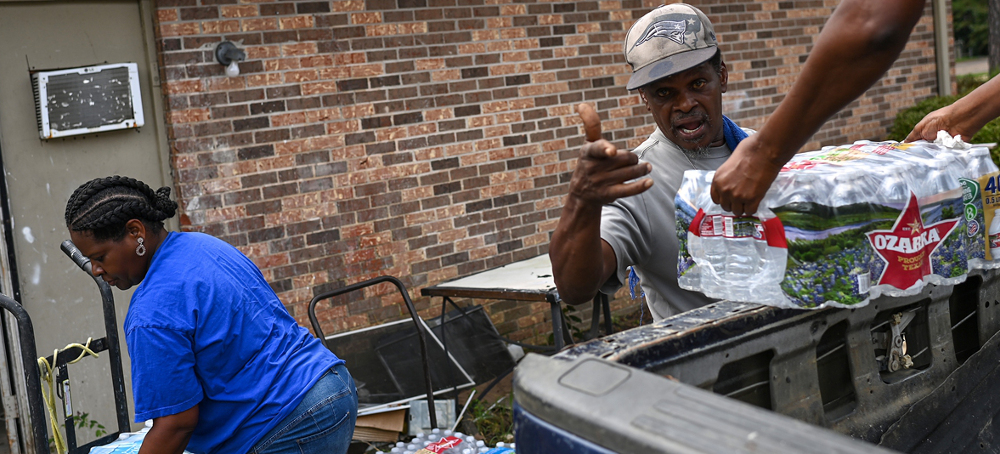 Rodney Moore, maintenance supervisor at Addison Place apartments, receives cases of bottled water from City of Jackson workers for elderly and disabled residents on September 3, 2022, in Jackson, Mississippi. (photo: Joshua Lott/Getty)
The water crisis in Jackson, Mississippi, wasn’t the product of government mismanagement. It was the result of Wall Street jacking up the city’s interest rates, which left residents with decaying infrastructure that couldn’t even deliver clean water.
In 2018, ratings analysts at Moody’s Investors Service — a credit rating agency with a legacy of misconduct — downgraded Jackson’s bond rating to a junk status, citing in part the “low wealth and income indicators of residents.” The decision happened even though Jackson has never defaulted on its debt.
Moody’s move jacked up the price of borrowing for Jackson, costing the cash-strapped city between $2 and 4 million per year in additional debt service costs — a massive financial roadblock to officials’ plans to fix the municipality’s aging water system. And since the state of Mississippi and the federal government refused to use their powers to address the city’s infrastructure problems, that meant Jackson was essentially powerless to stop the impending catastrophe.
The situation underscores how Wall Street works to prevent governments from fixing their public works, contributing to an infrastructure crisis nationwide. Such actions by ratings agencies are particularly harmful in majority black and brown areas like Jackson, which have tight budgets and often receive minimal federal support.
All major — and most minor — cities, states, school, and utility districts take on debt to pay for infrastructure improvements. That debt is issued as bonds, which are agreements to pay back loans at a set interest rate. Bondholders are typically wealthy residents of the state where the bonds were issued who are seeking to accrue tax advantages; banks; insurance companies; and mutual funds.
To determine creditworthiness for this debt, bond rating agencies give state and municipal governments a credit rating, based on factors like the community’s existing debt load and its current pension obligations. When the rating is lower, the debt is considered higher risk, and the interest rate to pay back the loans increases substantially.
Historically, the lowest possible bond ratings have been reserved for Jackson, Puerto Rico, American Samoa, Detroit, and other places long plagued by systemic disinvestment — meaning that it becomes almost impossible for these communities to finance their way out of their infrastructure crises.
“The practices of the ratings agencies are often extremely racist,” Brittany Alston, research director at the Action Center on Race and the Economy (ACRE), told us. “We did an analysis that showed that all the cities at the bottom of the ratings scale have been majority-minority. As I’ve been monitoring the reporting, I’ve noted how the local government is characterized, and I’ve heard the term ‘mismanagement’ multiple times.”
Alston continued: “I think that term has been used to really vilify local governments who are working with what they have and are struggling because they’re stuck in a system that has denied them federal support for decades.” The federal government’s share of contributions to water infrastructure fell from 31 percent in 1977 to just 4 percent in 2017.
Jackson’s Water Crisis Has Deep Roots
Some of Jackson’s water infrastructure dates to 1914. The city has a longtime problem with industrial concerns dumping their waste into the city’s water system, in part driven by Environmental Protection Agency underfunding and weak environmental regulations in Mississippi.
Nationally, federal government support for water infrastructure has dwindled. And at the state level, Mississippi has seemed more interested in diverting $8 million of state funding to enrich former NFL player Brett Favre than investing in Jackson’s infrastructure, despite frequent water system failures in the past.
In 2010, the transnational engineering firm Siemens made an offer to automate Jackson’s water billing system, assuring the city that the energy savings it could create would more than pay for the contract. In the largest contract in Jackson’s history, the city agreed to pay $90 million based on Siemens’ promise to create $120 million in “guaranteed savings,” according to a lawsuit the city later filed against the company for what appeared to be a fraudulent and defective system.
The Siemens performance contract put Jackson on the hook to Wall Street bondholders for over $200 million, with more than 55 percent of that total collected as interest on the $91 million principal loan amount.
Money that could have gone to new water infrastructure, in other words, instead went to Siemens, as well as the banks and investors who owned Jackson’s water sewer debt.
Progressive Jackson mayor Chokwe Antar Lumumba pledged during his 2017 mayoral campaign to use the city’s bonding authority to fix the water and sewer lines. But the following year, Moody’s downgraded Jackson’s debt to junk status.
The drop in credit rating severely limited the city’s ability to refinance the 2013 water bond it issued for the Siemens project. If Jackson had been given the highest possible bond rating — AAA — it would have been able to score a 3.55 percent interest rate on the twenty-year bond. Instead, it was forced to pay interest rates as high as 6.75 percent.
That move stopped Jackson from being able to get decent borrowing terms for any new infrastructure investment, which is likely why the bond Lumumba campaigned on was never issued.
One other major ratings agency, S…P Global Ratings, also rates Jackson’s municipal debt. While S…P has been less critical of Jackson’s general obligation debt, which was issued to fund day-to-day operations of the city, it has rated the city’s water and sewer debt harshly.
Meanwhile, Jackson has faced significant challenges. A freeze in November 2021 that caused the city to lose potable water was the canary in the coal mine, said Catherine Robinson, a community organizer based in Jackson.
“For me, when the Jackson water crisis first hit in November 2021, my mom had just had a stroke,” Robinson told us. “I had to go outside of Jackson to take showers and to cook. It was a winter storm — we really couldn’t travel like that because the roads were so icy.”
There is an entrenched racial component to this state of affairs. Mississippi’s leadership — every statewide official, the speaker of the house and the president pro tempore of the state senate, and both US senators — have been white since the Reconstruction era ended 140 years ago, despite the state being 37 percent black.
In an analysis of five million bonds issued to cities in the municipal bond market between 1970 and 2014, economic historian C. S. Ponder at Florida State University found that majority-black cities are categorically charged higher interest rates to build basic infrastructure for water systems and sewage.
The same applies to Moody’s. The firm is very disconnected from life on the ground in Jackson. Moody’s CEO, Rob Fauber, earned $9.7 million in 2021. The firm spent $6.5 billion on stock buybacks over the past decade, using the capital of the company to drive up the stock.
Two of the largest municipal bankruptcies in US history have been filed by majority-black urban areas — Detroit, Michigan, and Jefferson County (Birmingham), Alabama — whose water systems were made targets of financial extraction. In both places, the federal government mandated upgrades to their water and sewage systems without providing funding to do so, creating roughly $5.7 billion in debt for Detroit and $3.3 billion for Jefferson County on the municipal bond market.
For its part, the Federal Reserve has the authority to purchase municipal bonds directly to support the finances of communities like Jackson, as it has done with bonds for major corporations, such as when the Fed made a multitrillion-dollar intervention in the early stages of the COVID-19 pandemic.
However, a Fed facility set up to support municipalities during the pandemic only purchased $16 billion worth of municipal debt, as opposed to the $42 billion thrown at the corporate market.
Flooding Cities With Toxic Debt
While state and federal government action, or lack thereof, has factored into the shoddy infrastructure of several American cities, Moody’s also bears significant responsibility for the current state of affairs.
The bonds ratings agency made incredibly consequential decisions in the lead-up to the 2008 financial crisis, which caused 7.8 million foreclosures and nearly nine million job losses. Often deemed the most consequential factor contributing to the crisis was Moody’s decision to rate large tranches of controversial collateralized debt obligations (CDOs) and mortgage-backed securities (MBSs), financial products composed of low-quality mortgages, at the safest possible rating of AAA.
The firm did so because of a perverse incentive model whereby Moody’s and other ratings agencies would inflate ratings to generate additional fees from Wall Street firms. Holders of many of those assets, however, were nearly wiped out in the 2008 financial crisis when the housing market collapsed.
The other two major ratings agencies, S…P and Fitch Ratings, also engaged in the ratings inflation of risky Wall Street financial products leading up to the 2008 financial crisis.
At the same time, Moody’s and other agencies often rated many states and municipalities with far lower ratings — even though they had much lower probability of default, due to the unlimited taxing power of states and municipalities, as well as harsh consequences for politicians that allow defaults.
Lehman Brothers, the Wall Street firm at the epicenter of the 2008 financial crisis, was rated at A1 — seven notches above Jackson’s water and sewer current debt — in July 2008, just two months before the firm collapsed and Lehman’s bondholders received twenty-five cents on the dollar.
When government defaults do occur, as happened in Detroit in 2013 and Puerto Rico in 2016, Wall Street is almost always the culprit. Wall Street firms loaded up these communities with toxic debt that required huge debt service payments, precipitating their bankruptcies.
Moody’s largest shareholder is America’s fifth-richest person, Warren Buffett, who has also waged an aggressive campaign to keep rail workers from having paid sick days. In 2021, a European regulator fined Moody’s $4 million for inflating the credit ratings of other Buffett-owned companies.
Moody’s has in the past justified the yawning discrepancies between its corporate and financial ratings and its municipal ratings by saying that it had different standards for each class of debt. Those claims were not taken seriously when Congress wrote and passed the Dodd-Frank Wall Street Reform and Consumer Protection Act in 2010 to address the misconduct leading up to the 2008 financial crisis. The law mandated that Moody’s and the other ratings agencies use “consistent application of rating symbols and definitions,” and that the Securities and Exchange Commission (SEC) initiate rulemaking to that effect.
However, under President Barack Obama, the SEC failed to mandate that the ratings agencies actually use consistent ratings symbols and definitions across the board, allowing the agencies to continue to rate municipal debt more harshly than other forms of debt, despite its far lower likelihood of default.
The massive discrepancies have continued to today. In November 2018, Moody’s rated Pacific Gas … Electric’s (PG…E) debt at Baa3 — two notches above Jackson’s current water debt rating — just two months before the long-troubled utility company suffered one of the largest bankruptcies in history.
Jackson, meanwhile, has never defaulted on its debt. And unlike PG…E executives, who collected millions of dollars in raises in the aftermath of the company’s bankruptcy, a default by Jackson would likely prove to be a major blow to Lumumba and his expected campaign for a third term in 2025.
Congressional Democrats are now proposing $200 million in aid to Jackson, which is a fraction of the $1 billion that experts say is needed to meet the scale of the crisis. If Republicans gain control of either chamber of Congress in November, it is likely that any additional aid to the city will be cut off.
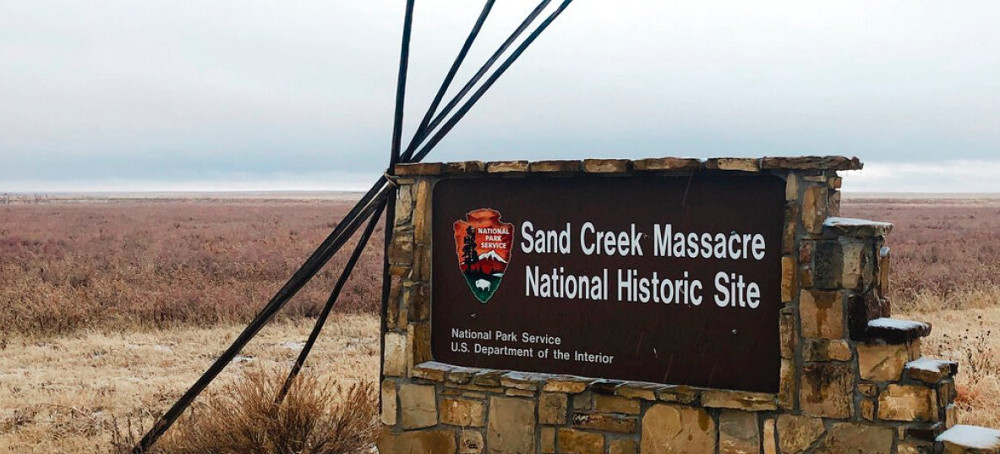 A sign marks the entrance to the Sand Creek Massacre National Historic Site in Eads, Colorado. (photo: Russell Contreras/AP)
Site in Sand Creek, Colorado memorialises the massacre of more than 230 Native Americans by US soldiers in 1864.
In a ceremony on Wednesday, US Secretary of the Interior Deb Haaland announced that the Sand Creek Massacre National Historic Site would acquire nearly 1,400 hectares (3,500 acres) of additional land.
“We will never forget the hundreds of lives that were brutally taken here – men, women and children murdered in an unprovoked attack,” said Haaland, the first Native American to lead a US cabinet agency.
“Stories like the Sand Creek Massacre are not easy to tell but it is my duty – our duty – to ensure that they are told. This story is part of America’s story.”
The announcement comes amid continuing discussions of the legacy of racism, violence, and historical memory in the US, as well as a push by Haaland to take action on issues of importance to Native Americans.
The massacre took place in November 1864, when US soldiers attacked an encampment of about 750 Native Americans in what is today southeast Colorado.
More than half of the more than 230 Native Americans killed in the attack were women and children, and some US soldiers reportedly took the body parts of victims as trophies.
The location of the massacre was established as a historical site in 2007, and the land is considered sacred by Northern and Southern Cheyenne and Arapaho Tribes.
In the solemn event held to announce the expansion, Haaland was joined by representatives from the Northern Arapaho Tribe, the Northern Cheyenne Tribe, the Cheyenne and Arapaho Tribes, as well as Colorado Senators John Hickenlooper and Michael Bennett.
The Department of the Interior has said that the expansion would “increase public opportunities to experience and interpret the site’s stories and history”. Janet Frederick, the site’s superintendent, also noted that the area has “significant archaeological remains” related to the massacre.
The expansion is the most recent attempt to reckon with the legacy of the attack. Senator Hickenlooper, previously Colorado’s governor, issued an apology on behalf of the state in 2014 on the 150-year anniversary of the killings.
Max Bear, a tribal historic preservation officer for the Cheyenne and Arapaho Tribes of Oklahoma, welcomed efforts to preserve the history and provide an honest accounting of the violence and dispossession the US enacted on Native Americans.
“We don’t want our children and grandchildren to fight an uphill battle to know what happened to our folks,” The Associated Press quoted Bear as saying. “In this time of book banning, I think it’s more important than ever that our history be told correctly.”
Haaland’s ascension to the head of the Department was hailed as a historic first, and during her tenure, the agency released a report documenting the history of Native American boarding schools that the US used to erase Native American identity and culture. The US announced in May that at least 53 burial sites had been found at boarding schools.
Similar tragedies took place in Canada, which has also taken steps to address its history of violence against Indigenous people, although advocates maintain that much work remains.
Visiting Canada in July, Pope Francis apologised for the “evil” of Canada’s Catholic residential schools, where Indigenous people were forcibly assimilated in what the pope described as a “genocide” of native culture.
READ MORE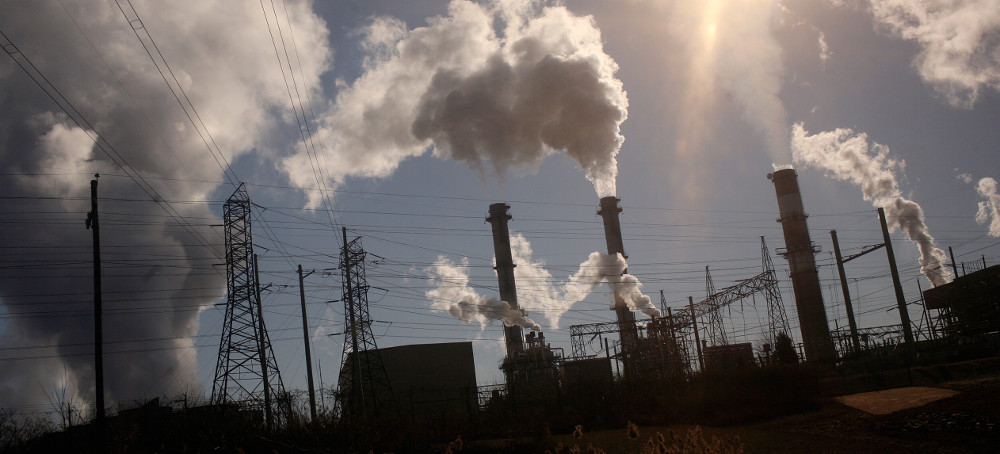 Smoke billows up from power plants alongside the tracks in Northern Virginia. (photo: Andrew Lichtenstein/Getty)
Researchers have discovered how tiny particles from fossil fuel emissions exploit a gene mutation to promote the growth of cancer.
For weeks, Molly Campbell had an intermittent dry, hacking cough that she could not shake. After a pair of doctor visits, she was prescribed steroids and an inhaler. Nothing worked. Then, about three months in, she started coughing up blood.
Campbell was given a CT scan. The result? Two large masses and hundreds of small nodules in both lungs.
“They said it’s not likely it’s cancer,” recalled Campbell, who is 29 and lives in rural Virginia. “They’re like, it’s basically no way because you’re so young and you don’t smoke and all this other stuff.”
The diagnosis left Campbell numb: adenocarcinoma. Stage 4 lung cancer.
Experts say that 10 to 20 percent of lung cancer patients in the United States are so-called “never smokers” like Campbell, and they have struggled to understand how otherwise healthy people can suddenly find themselves diagnosed with the most severe forms of the disease.
A new study, however, suggests a culprit: the polluted air that healthy people breathe.
A British research team says it has identified a mechanism in which airborne particulate matter may trigger some forms of lung cancer in otherwise healthy people who have never smoked.
The team’s findings, which scholars are currently reviewing for publication, suggest that airborne pollutants commonly found in vehicle exhaust and in the smoke given off by fossil fuels can promote cancers in patients who have a mutated form of a gene known as epidermal growth factor receptor, or EGFR. Mutations to the EGFR gene were found in about half of the patients with lung cancer who have never smoked.
“The same particles in the air that derive from the combustion of fossil fuels, exacerbating climate change, are directly impacting human health via an important and previously overlooked cancer-causing mechanism in lung cells,” said Charles Swanton, the lead researcher, in a news release. “The risk of lung cancer from air pollution is lower than from smoking, but we have no control over what we all breathe.”
Swanton presented the results this month at a symposium of the European Society for Medical Oncology in Paris.
A clinician scientist at the Francis Crick Institute and University College London, Swanton said his team had wondered whether air pollution could promote the growth of tissue that has mutations and causes lung cancer. The cancer mutations are found in normal tissue, he notes—appearing in about one in two biopsies—and they increase as a result of aging.
Then there is the air pollution factor. As part of the study, Swanton and his team tried to figure out whether PM2.5, tiny particles that are about 3 percent of the width of a human hair, could cause inflammation in the lungs and lead to cancer, according to the Francis Crick Institute.
Researchers examined data from 400,000 people in South Korea, Taiwan and the United Kingdom, comparing the levels of PM2.5 pollution and the rates of EGFR mutant lung cancer. They found higher rates of EGFR lung cancer as well as other types of cancer in people living where there were higher levels of pollution, the institute said in a statement.
Then the team turned to mice. In lab experiments, researchers found that when mice carrying cells with the EGFR mutation were exposed to air pollution, cancers were more likely to start from those cells, Swanton said.
Swanton said that when pollution enters into a person’s airway, cells in the lung release a type of protein known as interleukin-1β in an inflammatory response. Blocking the release of this protein prevents cancer from forming, the study showed.
The team hopes its study will prove useful in treating early-stage cancers in which environmental triggers awaken cells carrying cancer-causing mutations in different parts of the body, the Francis Crick Institute said.
Swanton describes PM2.5 as a “silent killer.”
“PM2.5 contributes to 8 million deaths a year, which is as many as tobacco,” he said in an interview. “So it is a big problem.”
It “took a while to put the pieces of the puzzle together,” Swanton added, but after 10 years of research, a picture started taking shape over the last six months. “It’s honestly been like a eureka period,” he said. “It’s like ‘wow.’ The implications are massive, I think, for how cancer is formed.’’
In his understanding of how cancer is formed, Swanton said he was influenced by the work of Allan Balmain, a professor of cancer genetics at the University of California, San Francisco, who began studying mutations, cancer and environmental carcinogens in the 1980s. Balmain said he believes that Swanton’s work will increase awareness of the importance of carcinogenesis, or how normal cells become cancer cells.
“The whole field of cancer genetics has been focused on the mutation,” Balmain said. “What we know is that the mutations are there in our normal cells. All of us have hundreds or thousands of mutations. Sometimes you can have thousands of mutations in a single cell. And these mutated cells are sitting there like a time bomb waiting to go off. And it’s only when you get exposed to the promoters,” like fine particulates, “that these initiated cells, these mutated cells, start to grow.”
What Swanton has demonstrated, he said, is that those cells are already in the lungs, and that when people breathe in air pollution, the fine particles stick to the lungs and cause tissue damage. The tissue tries to repair that damage and eventually succeeds. But if that damage occurred in a cell that already has a mutation, “then this really leads to the development of the disease, the very first signs of a tumor beginning to grow,” he said.
For Molly Campbell, who is undergoing chemotherapy treatment every three weeks, it was a thoracic surgeon who finally confirmed that she had lung cancer, in March. He has 30 years of experience, and before her biopsy he had told her that “if you held a gun to my head and said, ‘What is this?,’ the last thing I would say is cancer.”
But after two biopsies, it was what she feared the most. And she wonders how she got lung cancer: Could air pollution, which not only causes climate change but is aggravated by it, be to blame?
“I 100 percent believe that it has a lot to do with our health, whether it be cancer or any kind of illness,” she said of climate change. “But there’s so many environmental pollutants out there these days that probably aren’t even regulated.”
Campbell is now preparing her 8-year-old son for her death. When she talks to him, she asks him to remember the family vacations and the times they played together. He asks her if, when she goes to heaven, can she come down and see him?
She also wonders about the broader future. Will climate change ever be effectively addressed by policymakers? “I think it’s going to be several generations,” Campbell said.
Like so many other scientists and health advocates, Swanton believes it is urgent that PM2.5 levels around the world be lowered. He noted that 99 percent of the world’s population lives in areas where levels exceed what is deemed safe by the World Health Organization.
“Five times more people are exposed to pollution than tobacco, so it becomes more of an issue,” Swanton said. “And PM2.5 is causing diseases other than cancer,” he noted, from dementia to cardiovascular disease.
“Climate and human health are intimately linked. And this is just one out of over 100 other environmental carcinogens that may not cause DNA mutations,” said Swanton, adding that he found no evidence of a carcinogenic signature in DNA from lung cancers in nonsmokers. “So what are the other 99 doing? We need to know.”
Follow us on facebook and twitter!
PO Box 2043 / Citrus Heights, CA 95611


Comments
Post a Comment