“The Trump-Abbott maps are clearly illegal, and I’m glad these judges have blocked them,” said Rep. Greg Casar.
By Stephen Prager
In a direct rebuke to President Donald Trump’s hopes that mid-decade redistricting in key states could help Republicans retain control of Congress in next year’s midterm elections, a federal court Tuesday ordered Texas to halt the use of its new congressional maps, redrawn earlier this year as part of a GOP effort to maximize its advantage in the Lone Star State.
The unprecedented mid-decade power grab was expected to net Republicans an extra five seats in the House, which, in tandem with other redistricting efforts in Missouri and North Carolina, may have proven critical in their efforts to blunt a blue wave by Democrats in next year’s midterms.
But those efforts ran into an unexpected obstacle when Tuesday’s 2-1 ruling by a panel of three federal judges in Texas determined the maps were “racially gerrymandered,” disempowering nonwhite voters in violation of the Voting Rights Act (VRA). With a preliminary injunction, the court ordered the state to instead rely on the boundaries it drew in 2021.
In the majority opinion, District Judge Jeffrey V. Brown, a Trump appointee, wrote that while “politics played a role” in Trump’s request for Texas to redraw its maps, the White House explicitly “reframed its request as a demand to redistrict congressional seats based on their racial makeup.”
Specifically, Brown’s decision cited a claim made in a letter to Texas officials from Harmeet Dhillon, the head of the Justice Department’s Civil Rights Division, that the existence of four “coalition districts,” where no racial group had a 50% majority, in the 2021 map, was “unconstitutional.” The DOJ threatened legal action against Texas if it did not immediately move to redraw these districts, which it promptly did at the direction of Republican Gov. Greg Abbott.
This is despite the fact that, as Brown points out, “attorneys employed by the Texas Attorney General—who professes to be a political ally of the Trump Administration—describe the DOJ letter as ‘legally unsound,’ ‘baseless,’ ‘erroneous,’ ‘ham-fisted,’ and ‘a mess.'”
“The governor explicitly directed the legislature to draw a new US House map to resolve DOJ’s concerns,” Brown wrote. “In other words, the governor explicitly directed the legislature to redistrict based on race. In press appearances, the governor plainly and expressly disavowed any partisan objective and instead repeatedly stated that his goal was to eliminate coalition districts and create new majority-Hispanic districts.”
“The legislature adopted those racial objectives,” he continued. “The redistricting bill’s sponsors made numerous statements suggesting that they had intentionally manipulated the districts’ lines to create more majority-Hispanic and majority-Black districts. The bill’s sponsors’ statements suggest they adopted those changes because such a map would be an easier sell than a purely partisan one.”
Republicans will almost certainly appeal the ruling to the US Supreme Court. But as the Texas Tribune points out, “time is short,” as “candidates only have until December 8 to file for the upcoming election,” which means that the district lines must be determined before then.
Chad Dunn, a lawyer for the plaintiffs, said: “It seems they’d have a limited chance of success at the Supreme Court because the evidence is so overwhelming. Everyone involved said they were drawing the lines on the basis of race. I don’t see how the Supreme Court sets that aside.”
The Supreme Court’s 6-3 conservative majority has signaled that it intends to strike down Section 2 of the VRA entirely. But that case is currently scheduled for early next year and could not be brought onto the shadow docket in time to override the ruling blocking the Texas map for 2026.
While it could have major implications for future elections, likely allowing the GOP to net over a dozen additional seats, in the near term, Trump’s gambit for aggressive racial gerrymandering may blow up in his and his party’s face---at least temporarily.
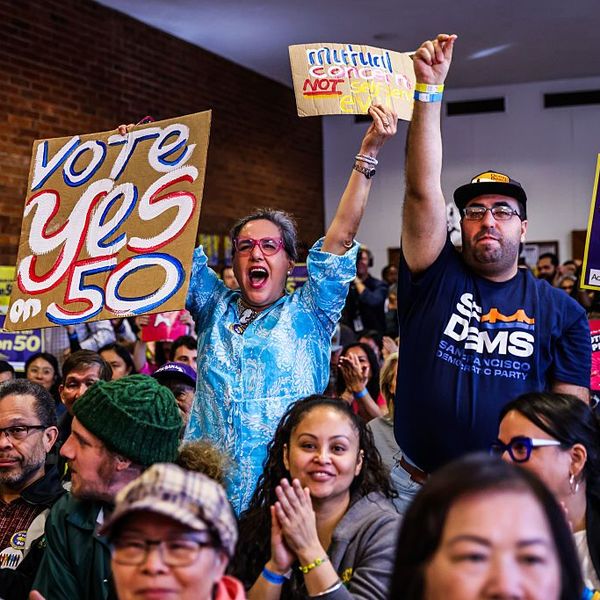
Texas’ maps kicked off a retaliatory gerrymandering push by Democrats to redraw maps to their advantage in blue states. That effort culminated in California voters’ overwhelming passage earlier this month of Proposition 50, which overrode the state’s independent redistricting commission and allowed the state legislature to draw maps that handed Democrats an additional five seats. Similar efforts may soon be underway in New York and Virginia.
With the cushion provided by Texas suddenly yanked away, Democrats now appear to be the clear winners of the gerrymandering war if things stand as they are. Instead of gaining the GOP five extra seats, Trump’s gambit could end up costing it five.
“Today’s ruling is a rebuke of Texas Republicans who caved to Donald Trump and trampled the voting rights of their constituents,” said Adrian Shelley, the Texas director of Public Citizen. “Gov. Abbott and his allies in the Legislature have forgotten their independent streak as Texans. Perhaps they can find the courage that Republicans in a few other states have to tell the president no.”
Meanwhile, Texas Democrats previously at risk of being gerrymandered out of their seats, rejoiced in the wake of Tuesday’s ruling.
This includes Austin Reps. Greg Casar and Lloyd Doggett, who, in anticipation of seeing their districts smushed into one, have spent the past several months engaged in a sort of shadow primary, which resulted in Doggett saying he’d retire if the maps were upheld. If Tuesday’s ruling holds, both of their districts would remain intact.
“The Trump Abbott maps are clearly illegal, and I’m glad these judges have blocked them,” Casar said after Tuesday’s ruling. “If this decision stands, I look forward to running for reelection in my current district.”
While he celebrated the ruling, he said, “no matter what, we must fight to pass a federal ban on gerrymandering once and for all.”
Trump also contradicted a US intelligence assessment that Saudi Crown Prince Mohammed bin Salman had ordered the murder of journalist Jamal Khashoggi.
By Brad Reed
President Donald Trump angrily snapped at ABC News reporter Mary Bruce while taking questions alongside Saudi Crown Prince Mohammed bin Salman in the White House on Tuesday.
The testy exchange began when Bruce tried to ask the crown prince about a US intelligence assessment concluding that he was responsible for the murder of journalist Jamal Khashoggi.
“Who are you with?” Trump demanded to know as Bruce attempted to ask her questions.
“I’m with ABC News, sir,” she replied.
“Fake news,” Trump said. “ABC, fake news, one of the worst in the business.”
Shortly after this, Trump described the slain Khashoggi as “somebody that was extremely controversial.”
“A lot of people didn’t like that gentleman that you’re talking about,” Trump said, referring to Khashoggi. “Whether you like him or didn’t like him, things happen. But [the crown prince] knew nothing about it. You don’t have to embarrass our guest.”
In fact, a US intelligence report that was declassified in 2021 concluded that the crown prince personally approved of a plan carried out by Saudi forces to murder Khashoggi after he entered a Saudi consulate in Istanbul, Turkey in 2018.
Shortly after this, Bruce tried to ask the president a question about FBI files related to the late sex offender and longtime Trump friend Jeffrey Epstein, and he again hit her with personal insults.
“It’s not the question I mind, it’s your attitude,” he said. “You’re a terrible person and a terrible reporter.”
He then threatened to take ABC News completely off the air.
“I think the [broadcast] license should be taken away from ABC because your news is so fake, and it’s so wrong,” he said. “And we have a great commissioner... who should look at that.”
Trump’s mention of the “commissioner” was presumably a reference to Federal Communications Commission Chairman Brendan Carr, who earlier this year threatened to pull ABC‘s broadcast license unless it fired late-night host Jimmy Kimmel, a frequent critic of the president.
Kimmel’s show was suspended shortly after Carr made this statement, although he was reinstated days later amid public outcry about government censorship.
Researchers found that informing people of the benefits of taxpayer-funded goods and services significantly boosted public opinion of larger government, spending, and taxation.
By Jake Johnson
A new study challenges the common assumption that Americans are preternaturally averse to higher taxation, showing that public attitudes become more favorable once people are made aware of the “universal benefits of public goods” funded by their tax dollars.
The study, conducted by Japanese researchers and published last month in the Japanese Economic Review, separated the US-based participants into a treatment group and a control group.
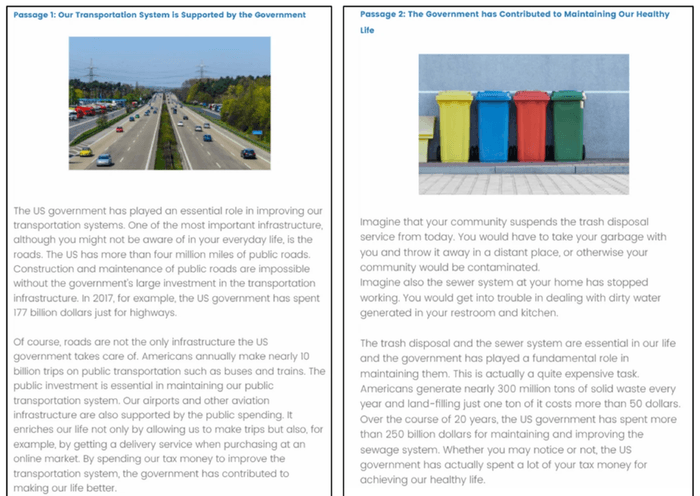
People in both groups were asked questions about their views on government size, spending, and taxation, but those in the treatment group were provided passages explaining the universal benefits of tax-funded transportation systems, public roads, trash disposal, and sewage infrastructure.
Researchers intentionally crafted the passages to highlight the benefits of universal goods, not means-tested programs targeted at low-income Americans.
Before and after reading the above passages, participants in the treatment group were asked: “How much of your taxes do you think are used for public goods and services that benefit all of you?”
They were also asked whether they agree with the following statement: “Regardless of income, everyone in the US more or less benefits from public spending.”
The researchers found that the treatment passages substantially increased support for public spending, larger government, and higher taxes among study participants.
After consuming the provided information on the benefits of public goods, nearly 64% of those in the treatment group said they would support an across-the-board tax increase of 1%. In the control group, support was significantly lower at 52.5%.
“If people become aware that more public goods are provided than they previously thought, the government might politically achieve more redistribution through expanding its size without reducing policy progressivity,” the study authors wrote. “Although we focused on transportation and trash disposal systems, governments provide other public goods. Exploring how our results may or may not generalize to other public goods would be interesting.”
The study was published amid a growing national debate over the for-profit US healthcare system, with Democrats pushing for an extension of tax credits that help millions of Americans afford private insurance plans while Republicans float vague and unworkable alternatives.
Opponents of Medicare for All—which would eliminate premiums, copays, and deductibles—have balked at the taxes Americans would have to pay to fund comprehensive health coverage for everyone in the United States.
But the Japanese Economic Review study suggests that US public opinion on taxes is malleable, particularly when people are informed of the benefits of universal programs.
"Congress and regulators must finally step in and crack down on anticompetitive behavior, opening markets, requiring interoperability, and ensuring smaller tech firms can compete," said one advocate.
“This outage is another brutal reminder that the internet is far too dependent on a tiny handful of tech giants,” said Public Citizen’s Big Tech accountability advocate, J.B. Branch, in a statement. “For years, industry lobbyists have insisted that deregulation would spark innovation from smaller companies. Instead, we got the opposite: mass consolidation of data, compute, and infrastructure into the hands of a few dominant firms whose failures now cascade across the globe.”
“Governments and companies continuing to contract with the same handful of companies are increasing the fragility of both the internet and entire economies,” Branch continued. “Congress and regulators must finally step in and crack down on anticompetitive behavior, opening markets, requiring interoperability, and ensuring smaller tech firms can compete so the entire digital economy isn’t held hostage by the failures of a few dominant companies.”
After Amazon’s outage last month, Public Citizen and other groups—including the American Economic Liberties Project, Demand Progress Education Fund, and Tech Oversight Project—called onFederal Trade Commission Chair Andrew Ferguson “to swiftly conduct a market structure review of leading cloud services providers, including but not limited to Amazon, to assess how their market dominance and use of monopoly power to stifle competition is creating systemic fragility across industries.”
“Big Tech is clearly creating systemic dangers that warrant proactive oversight and aggressive intervention by the FTC, on behalf of the American people and as soon as possible.”
“This probe should also examine dependencies of key sectors (such as financial services, telecommunications, and government services) on any single cloud provider and the extent to which those dependencies pose systemic risks to data security and privacy and consumer protection, as well as to our open markets and the resilience of our national and global infrastructure systems,” the coalition argued. “We urge you to then take robust agency action to counter these systemic dangers, particularly to bring diversification to the cloud industry.”
“Given the enormous stakes, the FTC should not defer action until the next crisis—the FTC has the mandate, the requisite knowledge, and the legal authorities to tackle this challenge now,” the coalition concluded. “Big Tech is clearly creating systemic dangers that warrant proactive oversight and aggressive intervention by the FTC, on behalf of the American people and as soon as possible.”
Just a few weeks later, the Cloudflare outage on Tuesday impacted websites including ChatGPT, Coinbase, Dropbox, X, Shopify, Spotify, Zoom, the Moody credit ratings service, and many more. According to Cloudflare, the San Francisco-based company offers over 60 cloud services globally, and it protects “20% of all websites.”
In a statement to Forbes, a company spokesperson said that “the root cause of the outage was a configuration file that is automatically generated to manage threat traffic. The file grew beyond an expected size of entries and triggered a crash in the software system that handles traffic for a number of Cloudflare’s services.”
Stressing that there is “no evidence that this was the result of an attack or caused by malicious activity,” the spokesperson added that “we expect that some Cloudflare services will be briefly degraded as traffic naturally spikes post incident but we expect all services to return to normal in the next few hours.”
Cloudflare also said on X—which is now working again—that “we always strive to be as transparent as possible in these types of situations, and we will be publishing an in-depth blog shortly.”
Meanwhile, Demand Progress Education Fund highlighted the coalition’s recent letter to the FTC, and Emily Peterson-Cassin, the group’s policy director, said that “yet again, a failure at one company disrupted the lives of people all around the globe.”
“Big Tech’s relentless drive to become the only fish in the pond and centralize the internet in their hands threatens our economy and our national security,” she added. “The FTC has the knowledge and the power to help prevent this from happening again. For all our sakes, the agency must take action immediately.”
"I’m very nervous about the size of these investments in these data centers," one tech CEO said.
By Brad Reed
Tech industry insiders are growing more wary of a financial bubble in the artificial intelligence industry that many analysts have been warning could tip the global economy into a severe recession.
Sundar Pichai, CEO of Google parent company Alphabet, said in an interview with BBC published Tuesday that he believes the speculation currently pumping up investment in AI is akin to the kind of speculation that occurred in the late 1990s ahead of the dot-com stock crash.
“We can look back at the internet right now,” he told BBC. “There was clearly a lot of excess investment, but none of us would question whether the internet was profound. I expect AI to be the same. So I think it’s both rational and there are elements of irrationality through a moment like this.”
PIchai said that he believed his firm would be well positioned to weather the bursting of an AI bubble, although he also cautioned that “I think no company is going to be immune, including us,” were such a scenario to occur.
Sebastian Siemiatkowski, CEO of global payments network Klarna, told the Financial Times on Monday that while he still believed in the potential of AI, he also thought many of the biggest players in tech were vastly overspending to build out infrastructure that would not be needed to power the technology.
Siemiatkowski pointed to advances made this year by Chinese AI firm DeepSeek in vastly reducing the power needed to run AI as evidence that the energy-devouring data centers being constructed across the US would be a massive overbuild.
“I think OpenAI can be very successful as a company but at the same time I’m very nervous about the size of these investments in these data centers,” he said. “That’s the particular thing that I am concerned about.”
Some major investors are also signaling that the boom may be over for AI.
MarketWatch reported on Monday that Palantir chairman Peter Thiel’s hedge fund, Thiel Macro LLC, dropped all its shares in Nvidia, the US-based semiconductor giant that manufactures most of the chips used to power AI. The move by Thiel was revealed just one week after Japanese investment holding company SoftBank disclosed that it had divested its entire $5.8 billion stake in Nvidia.
Nvidia has also become a target for investor Michael Burry, who famously made a fortune by short-selling the US housing market ahead of the 2008 financial crisis, and who recently revealed that his firm was making bets against Nvidia and Palantir.
Concerns about a potential AI bubble have roiled global markets this week, and all major US stock indexes once again traded lower on Tuesday, marking the fourth consecutive losing session.
According to the Wall Street Journal, the current selloff is being driven by investors spooked about “lofty valuations and a pile-up of debt to build data centers,” and the paper pointed to a new survey showing that “45% of fund managers see an AI bubble as the top ‘tail risk’ for markets” right now.
"There are a number of much-needed reforms to the healthcare system that we could offer now that would substantially improve the lives of the American people and are also incredibly popular."
By Jessica Corbett
As Americans face soaring health insurance premiums and a vote to extend expiring Affordable Care Act subsidies looms, Sen. Bernie Sanders argued in a Tuesday letter to Democratic lawmakers that “it is imperative that we all support that legislation, but we must do much more.
Congressional Democrats’ fight for ACA subsidies led to the longest government shutdown in US history—which ended last week, after eight members of the Senate Democratic Caucus caved without securing any guarantees. Instead, as Sanders (I-Vt.) noted, Majority Leader John Thune (R-SD) agreed to hold a vote on extending the tax credits no later than the second week of December.
“At a time when the Republicans have been forced to finally talk about the healthcare crisis facing our country, it is essential that the Democratic Caucus unify behind a set of commonsense policies that will make healthcare more affordable and accessible,” Sanders wrote. “The American people are paying attention. Now is the time to act.”
Sanders, who caucuses with Democrats, is the ranking member of the Senate Committee on Health, Education, Labor, and Pensions. The panel’s chair, Sen. Bill Cassidy (R-La.), is now pushing President Donald Trump’s proposal to encourage Americans to shift to high-deductible plans and have the government put money directly into their health savings accounts.
“What Republicans are proposing is a bad deal for hardworking Americans, but a good deal for the wealthy,” Jessica Schubel, who was a healthcare adviser to former President Joe Biden, explained Tuesday in a Fox News op-ed. “This new proposal could push millions into buying high-cost plans that make you pay thousands of dollars before they start paying for your care. Healthcare costs could skyrocket while undermining the entire Obamacare system—putting care at risk for millions of Americans.”
Sanders’ letter similarly warns that “while President Trump and some other Republicans in Congress are rightfully going after what they call ‘the money sucking, BIG, BAD Insurance Companies,’ the policies they have been discussing would make a bad situation even worse” by leading to “more medical bankruptcies, more unaffordable care, and more Americans going without the healthcare they desperately need.”
The country’s current debate over ACA subsidies has sparked fresh calls for a shift to government-funded universal healthcare, for which Sanders has long led the fight in Congress. He acknowledged that “while I believe that the long-term solution to the healthcare crisis is Medicare for All, and I appreciate the 16 cosponsors we have on that legislation in the Senate, and the more than 100 cosponsors we have in the House, this bill does not yet have majority support in the Democratic Caucus.”
“The good news, however, is that there are a number of much-needed reforms to the healthcare system that we could offer now that would substantially improve the lives of the American people and are also incredibly popular,” he continued.
Specifically, Sanders called for:
Extending the ACA tax credits;
Repealing Trump and congressional Republicans’ $1 trillion in cuts to the ACA and Medicaid;
Expanding Medicare to cover dental, vision, and hearing;
Cutting the cost of prescription drugs by at least 50% with legislation requiring pharmaceutical companies to charge no more for medications in the United States than they do in Europe or Canada;
Expanding primary healthcare with investments in the National Health Service Corps as well as community and teaching health centers; and
Banning stock buybacks and dividends, and restricting CEO compensation.
“At a time when the vast majority of Americans understand that our current healthcare system is broken, dysfunctional, and cruel, we must offer serious proposals which begin to address the systemic deficiencies within American healthcare,” he stressed. “We should not be defending a system which is not only, by far, the most expensive in the world, but one which numerous international studies describe as one of the worst.”
For example, last year the US-based Commonwealth Fund examined 10 peer countries—Australia, Canada, France, Germany, the Netherlands, New Zealand, Sweden, Switzerland, the United Kingdom, and the United States—and found that “the US continues to be in a class by itself in the underperformance of its healthcare sector.”
Without federal intervention, conditions in the US sector are on track to get worse. Thanks to expiring subsidies, soaring premiums, and Trump and GOP lawmakers’ recent cuts in their so-called One Big Beautiful Bill Act, an estimated 15 million Americans could lose health insurance altogether over the next decade.
JOIN THE MOVEMENT
As a people-powered nonprofit news outlet, we cover the issues the corporate media never will.
Your contribution supports this bold media model—free, independent, and dedicated to reporting the facts every day. Stand with us in the fight for economic equality, social justice, human rights, and a more sustainable future.
US President Donald Trump speaks holding a photos of his White House ballroom, in the Oval Office in Washington, DC on October 22, 2025.
(Photo by Salwan Georges/The Washington Post via Getty Images)
Amid concerns over President Donald Trump’s White House ballroom, a pair of Democratic US lawmakers on Tuesday introduced legislation “to root out apparent bribery and corruption” involving the $300 million project.
Sen. Elizabeth Warren (D-Mass.) and Rep. Robert Garcia (D-Calif.) introduced the Stop Ballroom Bribery Act, described by Warren’s office as “the first piece of legislation addressing the ballroom that would impose donation restrictions.”
“Billionaires and giant corporations with business in front of this administration are lining up to dump millions into Trump’s new ballroom—and Trump is showing them where to sign on the dotted line,” Warren said in a statement. “Americans shouldn’t have to wonder whether President Trump is building a ballroom to facilitate a pay-to-play scheme for political favors. My new bill will put an end to what looks like bribery in plain sight.”
Garcia said: “Donald Trump is raising hundreds of millions of dollars to build himself a White House ballroom at a time when millions of American families can barely make ends meet. It’s outrageous that the White House won’t reveal who’s bankrolling Trump’s pet project, and that the people’s house could be funded by shady figures, corrupt money, and bad actors.”
“This bill will ban contributions from anyone with a conflict of interest, prevent bribery, and ensure we can hold any administration accountable for blatant corruption,” he added.
Noting that many of the “wealthy individuals, corporations, and organizations” funding the ballroom “need something from the Trump administration,” Warren’s office flagged “serious concerns of quid-pro-quo arrangements and possible bribery.”
“Ethics experts have argued that the apparent pay-to-play relationship between Trump and business leaders oversteps the norms of presidential behavior and could erode Americans’ trust in government,” the senator’s office added.
As Warren’s office noted:
Key ballroom donors currently have business interests in front of the Trump administration. For example, Google, which recently donated $22 million to settle President Trump’s censorship lawsuit against YouTube, will benefit if Trump’s [Department of Justice] decides not to appeal a recent judicial ruling in a relevant antitrust case. Meanwhile, Union Pacific Railroad is seeking federal approval of a lucrative merger and Palantir is working to get more federal contracts.
The White House has refused to be fully transparent, publishing only a noncomprehensive donor list missing multiple key donors and offering donors anonymity. Donations for projects like the ballroom are often channeled through the National Park Service and philanthropic partners; nonprofits with formal ties to property used by the president and [Vice President JD Vance] raise unique conflict-of-interest risks when fundraising from individuals and corporations with interests in front of the federal government.
The Stop Ballroom Bribery Act would:
Impose pre-donation restrictions, including banning contributions from entities and individuals that present a conflict of interest, make it clear that donations cannot be conditioned on receipt of benefits from the federal government, require congressional approval for foreign donations, and proscribe the president and other senior officials and their families from taking donations;
Impose post-donation restrictions, including banning the display of donors’ names and logos, enact a two-year cooling-off period before a donor to a covered project can lobby the federal government, and prohibit conversion of leftover donated funds to anyone’s personal use or to benefit the president and other senior officials and their families;
Require transparency, including the disclosure of any meetings with senior federal officials or their relatives within a year of the donation, and mandate National Park Service publication of all donations to covered projects and ban anonymous donations; and
Enable enforcement, judicial review, and the pursuit of civil and criminal penalties for violators.
"President Trump's decision to unilaterally destroy the East Wing of the White House to build a ballroom financed by wealthy individuals and corporations not only ignores our country's laws but raises serious ethical concerns—namely, whether individuals and corporations funded this project in the hopes of buying access and influence," said Debra Perlin, vice president for policy at Citizens for Responsibility and Ethics in Washington (CREW), which supports the legislation.
Virginia Canter, chief counsel and director for ethics and anticorruption at Democracy Defenders Action—another backer of the bill—said that “over the past year, President Trump has raised millions of dollars for vanity projects at the White House—like paving over the Rose Garden and demolishing the beloved East Wing.”
“These funds have come from private donors without meaningful transparency or accountability,” Canter added. “The highest office in the land should never be for sale, nor should it ever appear to be.”
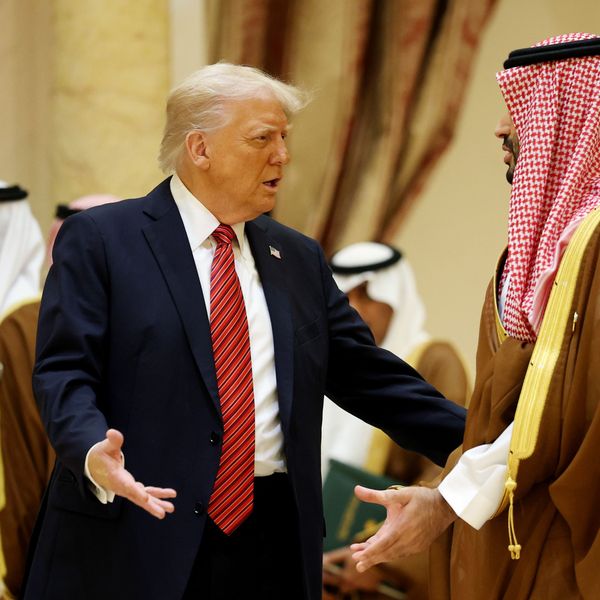
US President Donald Trump (R) takes the hand of Crown Prince and Prime Minister Mohammed bin Salman of Saudi Arabia at the White House on November 18, 2025 in Washington, DC.
(Photo by Win McNamee/Getty Images)
A US-based journalist and human rights defender was dismissed as someone “a lot of people didn’t like,” and the Saudi crown prince who US intelligence experts found had likely ordered the writer’s killing was applauded as “one of the most respected people in the world.”
That was President Donald Trump’s assessment of Washington Post columnist and Saudi dissident Jamal Khashoggi, who was assassinated in 2018, and Saudi Crown Prince Mohammed bin Salman on Tuesday at a meeting in the Oval Office of the White House.
Bin Salman also told the president he would increase Saudi investment in the US from $600 billion to $1 trillion.
The BBCreported that Trump “bask[ed]” in the $1 trillion pledge, telling the prince it was an “honor” to be his friend and saying the US “very much appreciate[s]” the investment.
“We’re doing numbers no one has ever done,” Trump said.
ABC News reporter Mary Bruce asked Trump about his family’s business interests in Saudi Arabia and questioned whether the bilateral deals presented a conflict of interest, before pointedly asking bin Salman about the Central Intelligence Agency’s finding in 2021 that the prince had likely personally ordered the killing of Khashoggi.
“Your royal highness, the US intelligence concluded that you ordered the brutal murder of a journalist,” said Bruce. “Why should Americans trust you?”
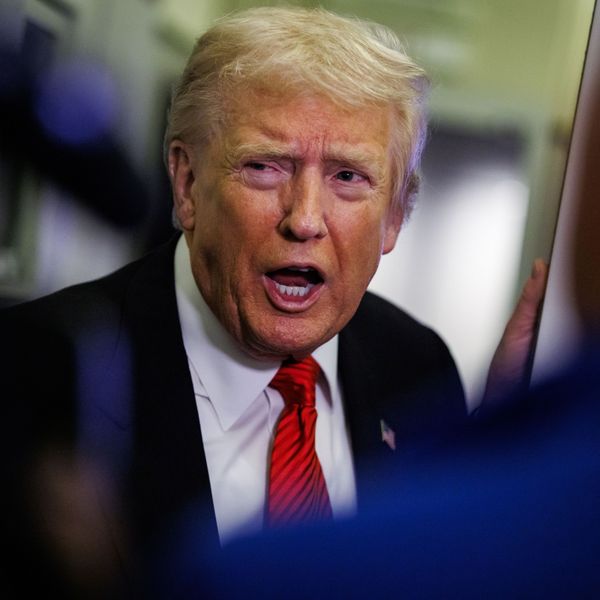
Trump was visibly angered by the question and demanded to know what outlet Bruce was with before telling her ABC was “fake news” and calling her comment “horrible, insubordinate, and just a terrible question.”
“He knew nothing about it,” said the president, contradicting the government’s findings.
Khashoggi responded to Bruce, saying, “It’s really painful to hear anyone losing his life for no real purpose or not in a legal way.”
Trump, said former Labor Secretary Robert Reich, will “overlook the murder of Jamal Khashoggi to pad his pockets and boost the bottom line of the military industrial complex.”
Following Trump’s comments, Democrats on the US House Intelligence Committee posted a link to the federal report that detailed bin Salman’s involvement in the killing of Khashoggi.
US Rep. Jim McGovern (D-Mass.) called Trump’s warm welcome to bin Salman “outrageous and disgusting.”
“Tyrants around the world are celebrating,” said McGovern. “After all, why would they hesitate to kill dissidents outside of their borders if the Saudis are allowed to get away with it?”
US President Donald Trump holds up an economic data chart in the Oval Office of the White House on August 7, 2025.
(Photo by Demetrius Freeman/The Washington Post via Getty Images)
Amid President Donald Trump’s efforts to conceal the harmful consequences of his economic policies by hiding key data and replacing economists who tell harsh truths with partisan yes-people, a leading US think tank on Monday announced a new digital dashboard “to provide an accountability check” against attempts to manipulate and mislead the public.
The Economic Policy Institute (EPI) says its new data accountability dashboard “serves as a one-stop shop” for economic data as federal statistic agencies (FSAs), once the “gold standard” for information, “face historically unprecedented threats from the Trump administration to their capacity and even their independence.”
“This raises the specter of a future where FSA data cannot be relied upon to honestly report whether the US economy is experiencing dysfunction,” EPI said.
In a bid to circumvent this, the EPI dashboard “displays a range of data not collected or disseminated by FSAs to shed some light on the economy during the pause in government data collection during the shutdown and—even more importantly—to provide an accountability check against efforts to manipulate FSA data in the future.”
As EPI senior economist Elise Gould explained in a statement: “The data collected by the federal statistical agencies are an incredibly valuable public good. While there would never be a good time to squander it, the absolute worst time to degrade data quality is when the economy is facing policy shocks that threaten to cause either a recession or an uptick of inflation.”
“Given this urgency, we’re collecting all data we can to assess the economy’s health in this time when the gold standard data are under attack,” she added.
Trump’s attempts to hide unfavorable economic data date back to his first administration, when he blocked or delayed economic analyses on the projected impacts of his tariffs. For example, half a dozen economists at the US Department of Agriculture (USDA) quit en masse in April 2019, claiming they suffered retaliation for publishing reports that shed negative light on the president’s trade and taxation policies.
In a related move that year, the USDA abruptly relocated its Economic Research Service main office from Washington, DC to Kansas City, Missouri, prompting another wave of resignations. ERS publications—including reports on farm income, rural economies, and trade impacts—dropped sharply, with key analyses delayed or blocked. Critics, including former agency officials, argued that the move to Kansas City was intended to conceal negative impacts of Trump’s trade policies from the public.
During Trump’s second administration, Commerce Secretary Howard Lutnickdisbanded the Federal Economic Statistics Advisory Committee (FESAC), a key body that worked under the Commerce Department’s Bureau of Economic Analysis to ensure that the federal government produces accurate data on economic indicators.
Trump also gutted the Bureau of Labor Statistics’ Technical Advisory Committee, which had advised the Department of Labor about how economic changes can impact data collection. In August, Trump fired BLS Commissioner Erika McEntarfer, baselessly accusing her of manipulating economic data to harm him politically by publishing a jobs report showing weak employment growth.
Two weeks later, the president nominated EJ Antoni, a senior economist at the Heritage Foundationdescribed as a “partisan bomb thrower” who helped write Project 2025, a blueprint for a far-right overhaul of the federal government, to replace McEntarfer. Antoni stunned critics with suggestions including eliminating federal monthly jobs reports, and with his overall lack of data management experience. His nomination was later withdrawn amid mounting controversy.
Additionally, the Trump administration has summarily fired dozens of independent agency leaders, required every federal agency to have a White House liaison, and required ostensibly independent agencies to submit draft regulations to theOffice of Management and Budget—headed by Project 2025 architect Russell Vought—for review before publication.
As Common Dreamsreported, an analysis published in September by the Center on Budget and Policy Priorities detailed how the Trump administration’s politicization of data, combined with funding cuts, is making it more difficult for experts to determine how the president’s policies are impacting US households.
From ending tracking of the impacts of climate-driven extreme weather, to removing a study from the Department of Justice website that showed violent attacks by far-right extremists outpaced those committed by the left, to removing questions about gender identity from key crime surveys, the Trump administration’s attacks on information transcend economic data.
“The assault on data, research, and facts is fundamental to Trump and his authoritarian regime,” Liza Featherstone, a contributing editor at The New Republic, recently wrote. “He seems to understand that data provides the basis for arguments, and he does not want any arguments. He also understands that facts and knowledge can only be nourished and sustained by institutions and experts, so he is destroying those institutions and pink-slipping those experts.”
“We must appreciate their importance and their stakes as well as he does, and remain as committed to the institutions, the data, the facts, and the experts as Trump is to their eradication,” Featherstone added. “He has brought sincere zeal to their destruction, and we must bring an even greater passion to their restoration and renaissance. We will need it, as ours is the harder job.”
An Indigenous woman holds a sign reading, “The future belongs to the people” during the “Indigenous People Global March” at the United Nations Climate Change Conference in Belém, Brazil, on November 17, 2025.
(Photo by Pablo Poriuncula/AFP via Getty Images)
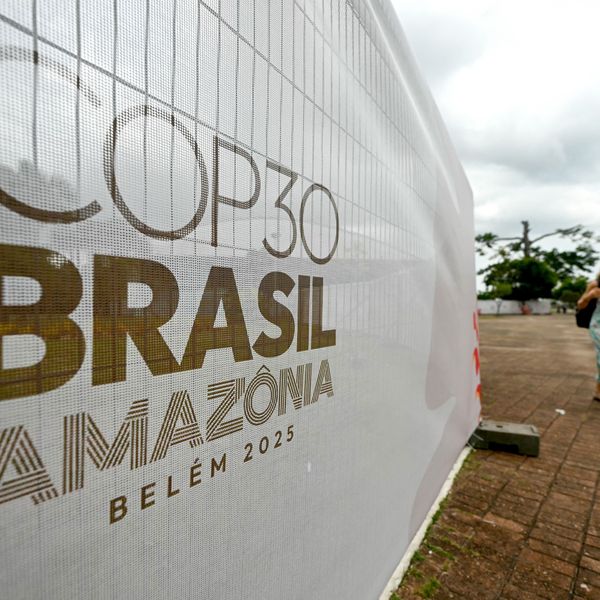
Climate justice organizers on Tuesday expressed some cautious optimism that a draft text out of the United NationsClimate Change Conference in Belém, Brazil contained “building blocks” of a climate justice package that is needed to draw down planet-heating fossil fuel emissions and help the poorest and least-polluting countries confront the climate emergency—but advocates said that with just three days to go until the summit is over, the document still falls far short of delivering solutions.
The draft text, released by COP30 President André Corrêa do Lago, includes references to a “transition away from fossil fuels,” and calls for annual reviews of countries’ Nationally Determined Contributions (NDCs), the efforts they pledge to make to reduce their emissions.
But a day after campaigners expressed optimism about 62 countries and country groups endorsing Brazilian President Luiz Inácio Lula da Silva’s call for a Transition Away From Fossil Fuels (TAFF) Roadmap, 350.org condemned the draft text for mentioning the roadmap only in paragraph 44—and excluding a fossil fuel phaseout from that section of the proposal.
The TAFF Roadmap, according to the draft, would recognize that “finance, capacity-building, and technology transfer are critical enablers of climate action.”
The text also calls for “a high-level ministerial roundtable” where countries would discuss national circumstances, pathways to limiting planetary heating to 1.5°C over preindustrial temperatures, and approaches to supporting government in developing just transition roadmaps, “including to progressively overcome their dependency on fossil fuels and towards halting and reversing deforestation.”
But 350.org condemned that call as an “exceptionally weak,” sole reference to a fossil fuel transition, warning that “a mandated ministerial and a report... offer symbolism, not action.”
“For the decision to carry credibility, the presidency must embed a fossil fuel transition roadmap directly into the 1.5°C response, not relegate it to the margins,” said the group in its analysis of the document. “The roadmap must be placed in the section addressing the 1.5°C ambition gap, where it is currently absent.”
Andreas Sieber, associate director of policy and campaigns for 350.org, said that “the draft text may contain the right ingredients, but it’s been assembled in a way that leaves a bitter aftertaste.”
“For the decision to carry credibility, the presidency must embed a fossil fuel transition roadmap directly into the 1.5°C response, not relegate it to the margins. The roadmap must be placed in the section addressing the 1.5°C ambition gap, where it is currently absent.”
“A roadmap for delivering on 1.5°C without a credible fossil fuel phaseout at its core is hollow. The COP30 presidency must heed the many parties, including President Lula, calling for a clear transition pathway and put it where it belongs: at the center of the 1.5°C response, balanced with adequate finance,” said Sieber. “Without this, the overall effort will fall short.”
The group emphasized that a credible COP30 final text will include “a balanced package that delivers climate finance, strengthened adaptation measures, and a clear road map for phasing out fossil fuels.”
“Without all three pillars in place, a durable and effective agreement will not be possible,” said 350.org
The text mentions climate finance 26 times, the Guardian reported, and urges wealthy countries to clearly lay out their plans to provide financial assistance to the Global South—at a ministerial roundtable in one option included in the document, or through a “Belém Global De-Risking and Project Preparation and Development Facility,” which would “catalyze climate finance and implementation in developing country parties by translating Nationally Determined Contributions and national adaptation plans into project pipelines.”
But 350.org noted that pledges made to a global adaptation fund on Monday “once again fell short with only $133 million secured out of the $300 million target.”
Fanny Petitbon, France team lead for 350.org, warned that “adaptation has long been forgotten in climate finance,” and called on the presidency to ensure it has a central role in the final text.
“Crucially, the call to triple adaptation finance must stay,” said Petitbon. “There is no credible ambition without supporting communities already facing the devastating impacts of the climate emergency. The presidency has begun to respond to strong demands for developed countries to pay their climate debt, which is key for rebuilding trust in all negotiating rooms.”
“But the text still lacks a plan to fully deliver on the collective climate finance goal agreed upon in Baku [at COP29]—ignoring innovative sources of finance like taxing major polluters and the superrich,” Petitibon added, “and fails to guarantee direct access for the most vulnerable, including Indigenous peoples.”
At Oil Change International, global policy leader Romain Ioualalen said the options related to fossil fuels presented in the draft were “wildly unacceptable and a blatant dereliction of duty while the world burns.”
“We don’t need a COP decision to convene a workshop or ministerial roundtable on fossil fuels. What we need is a clear collective direction of travel on how countries intend to phase out fossil fuels based on equity, and how rich Global North countries will provide finance and support to the countries that need it,” said Ioualalen.
“Ministers must fix this mess,” he added, “and deliver the progress that we need to make the fair and funded transition away from fossil fuels they promised in Dubai [at COP28] a reality.”
The president of the United States is deeply involved in dealing with the two ways we human beings have figured out how to destroy ourselves (and potentially so much else on this planet): nuclear war and climate change.
As city leaders from across the US gather this week to discuss our collective priorities, let’s reaffirm our commitment to protect access to the courts for all our communities.
LAST 2 WEEKS IN REVIEW I’m your Representative in Congress and I write to keep you informed. The chaos and costs of Trump’s tariff strategy A junior varsity national security team No one is above the law, or below it Big ideas to govern better Hitting back on behalf of scientists Meeting with constituents in the MA-04 The chaos and costs of Trump’s tariff strategy WSJ’s “dumbest trade war in history”: The president announced sweeping tariffs this week, which amount to a $500+ billion tax hike on everyday Americans. The tariffs were calculated nonsensically and communicated incoherently. There is robust debate between policymakers and economists about how tariffs might help America, but every serious participant in that debate recognizes that the chaos of this tariff roll-out will cause pain for businesses, families, and allies alike. I have often joined the tariff debate, generally arguing for free trade with the exception of Chin...
Ramble On: Waiting for the Barbarians (video) Morning thoughts on exfiltrations, the gutting of the FDA, tomorrow's protests, and how to quiet the brain by visiting Alexandria Greg Olear Apr 4 Good morning! Here is today’s ramble: And here is the transcript, edited for clarity: Good morning. It is Friday, April 4th, 6:17 a.m. We’ve made it. Those of us who have made it have made it through another batshit crazy week, courtesy of Trump and Musk and Vance and this entire cockamamie administration. There’s so many things to discuss. The Five 8 is gonna be lit tonight. I encourage you to watch that if you’re around, at 8 p.m. Eastern, on our YouTube channel, The Five 8 . This morning, I don’t know, I want to talk about a couple of things and my own emotional state this week, because I think that might be helpful. Two stories that really stuck out for me. One of them I wrote about on Monday, or Tuesday rather, in the April Fool’s piece , which is that the ICE Ge...
17 September 22 Stand Up For Reader Supported News Come on folks don’t just sit there and let RSN struggle financially. What we need to function is a drop in the bucket. When you get involved, when you take an ownership stake good things happen. Help RSN! Marc Ash Founder, Reader Supported News Sure, I'll make a donation! If you would prefer to send a check: Reader Supported News PO Box 2043 / Citrus Heights, CA 95611 Follow us on facebook and twitter ! Update My Monthly Donation 17 September 22 Live on the homepage now! Reader Supported News ONE THING MISSING THIS MONTH, LARGER DONATIONS — Each month we manage to get one or two or three thousand dollar donations. So far this month we do not have any. Obviously that kind of donation is a huge boost and goes a long way to match our smaller donors. Who can? Marc Ash • Founder, Reader Supported News Sure, I'll make a donation! 'Hat in Hand': Putin Meets Xi at Summit in Samarkand Al...





















Comments
Post a Comment