Tuesday, November 11, 2025
■ Today's Top News
Despite outcry from progressives, no Democrats in the Senate have yet expressed support for replacing Schumer as leader.
By Brad Reed
With many Democratic base voters up in arms over Senate Democrats caving on the federal government shutdown fight, there have been calls for Senate Minority Leader Chuck Schumer to step down from his leadership role.
None of those calls, however, have come from senators currently serving in the Democratic Caucus, including progressive stalwarts such as Sens. Bernie Sanders (I-Vt.) and Elizabeth Warren (D-Mass.).
As reported by The American Prospect on Tuesday, no Democrats in the Senate have yet expressed support for replacing Schumer (D-NY) as leader, despite the fact that “every single one of them has the power to force a vote on Schumer’s continued control of the caucus” if they chose to do so.
According to the Prospect, any senator in the Democratic Caucus “could bring forward a motion to amend the Democratic Caucus Rules to say that he should lose his leadership position if a set number of members disapprove of him.” What’s more, the Prospect explained, “the motion would be ‘self-executing,’ resulting in Schumer’s removal at the same time that it’s approved.”
As noted in a Politico report, Senate Democrats who were opposed to the shutdown cave did not directly criticize Schumer for his handling of the issue, and some, like Warren, tried to direct voters’ anger toward Republicans.
“I want Republicans to actually grow a backbone and say, regardless of what [President] Donald Trump says, we’re actually going to restore these cuts on healthcare,” she said on Sunday. “But it looks like I’ve lost that fight, so I don’t want to post more pain on people who are hungry and on people who haven’t been paid.”
Sen. Chris Murphy (D-Conn.) was more directly critical of the deal that Democrats cut on reopening the government, but he nonetheless stopped short of calling for Schumer’s removal.
“This bill doesn’t do anything to arrest the healthcare catastrophe, nor does it constrain in any meaningful way President Trump’s illegality,” he said. “I think the voters were pretty clear on Tuesday night what they wanted Congress to do, and more specifically, what they wanted Democrats to do, and I am really saddened that we didn’t listen to them.”
The appetite for ditching Schumer appears much stronger among Democrats serving in the US House of Representatives, however.
Axios on Monday reported that House Democrats’ anger at their Senate counterparts erupted during a private phone call among members, as Rep. Melanie Stansbury (D-NM) told her colleagues that “people are fucking pissed” at seeing Democrats once again cave in a fight with Trump.
One anonymous Democrat also told Axios that almost “everyone [was] strongly against” the deal Senate Democrats cut to reopen the government without an agreement to extend enhanced tax credits for Americans who buy their health insurance through Affordable Care Act (ACA) exchanges.
Rep. Seth Moulton (D-Mass.), who is running a primary challenge against Sen. Ed Markey (D-Mass.), called on Schumer to step down as minority leader, and challenged his opponent to do the same.
“If Chuck Schumer were an effective leader, he would have united his caucus to vote ‘No’ tonight and hold the line on healthcare,” Moulton wrote in a social media post earlier this week. “Maybe now Ed Markey will finally join me in pledging not to vote for Schumer?”
Progressive advocacy organization Indivisible on Monday started ramping up pressure on Democrats to push for Schumer to step down as minority leader, and the group explicitly said that it would “not back any Senate primary candidate unless they call for Schumer to step down as Minority Leader.”
The assumption of US backing allowed the Saudis to wage a brutal war in Yemen that cost close to 400,000 lives without fear of consequences. "Now imagine if Saudi Arabia had an ironclad US security guarantee," wrote one scholar.
By Stephen Prager
As Saudi Crown Prince Mohammed bin Salman prepares to meet with US President Donald Trump next week, experts are warning that it could cause even greater instability in the Middle East if the president agrees to the Gulf regime’s requests for a defense pact.
On November 18, the crown prince, commonly known as MBS, will be welcomed in Washington for the first time since 2018. That meeting with Trump came just months before the prince signed off on the infamous murder of the Washington Post journalist Jamal Khashoggi as part of a brutal crackdown on dissenters in the country.
Trump defended MBS from international outrage and isolation at the time and has continued to sing his praises since returning to office. In May, after inking a record $142 billion weapons sale to the Saudis during a tour of the Middle East, Trump gave a speech, practically salivating over the crown prince.
“We have great partners in the world, but we have none stronger, and nobody like the gentleman that’s right before me, he’s your greatest representative, your greatest representative,” Trump said. “And if I didn’t like him, I would get out of here so fast. You know that, don’t you? He knows me well.”
“I do, I like him a lot. I like him too much, that’s why we give so much, you know?” the president continued. “Too much. I like you too much!”
“Oh, what I do for the crown prince,” he added.
Now, according to a report Tuesday from the Financial Times, the Saudis are coming to Washington seeking a similar security guarantee to the one Trump recently granted Qatar, which one State Department diplomat referred to as “on par with the mutual defense commitments the United States provides its closest allies.”
Trump signed an executive order stating that the US would respond to any attack on Qatar by taking all “lawful and appropriate measures—including diplomatic, economic, and, if necessary, military.”
That agreement came weeks after Israel launched an unprecedented assault on Hamas leadership as they met for negotiations in Qatar’s capital city of Doha to end the two-year genocide in Gaza. Without the security agreement, the Qataris had threatened to walk away from their role in mediating the talks that ultimately led to October’s “ceasefire” agreement.
The deal expected to be reached between Trump and the Saudis has been described as “Qatar-plus,” not just pledging defense of the state were it to come under attack, but regarding it as a threat to American “peace and security.”
Such an agreement was already underway during the tenure of former President Joe Biden, following the normalization of relations with Israel, but was upended by Hamas’s October 7 attacks and two years of indiscriminate slaughter Israel launched in response, which bin Salman referred to as a “genocide.”
While MBS has publicly stated that he would not agree to continue normalization with Israel without a Palestinian state, he has not shied away from a separate security deal with the US, which reportedly includes “enhanced military and intelligence cooperation.”
According to Christopher Preble and Will Smith, a pair of foreign policy researchers at the Stimson Center’s Reimagining US Grand Strategy program, the Trump team hopes that by pursuing a heightened security and financial relationship with the Saudis, they can coax them back towards detente with Israel and bring them back into the US orbit in response to what Trump views as an overly flirtatious posture toward China.
“These developments suggest a troubling belief that handing out security guarantees is a quick, cost-free way to reassure anxious partners and ensure their alignment with US priorities. That belief is mistaken,” the researchers wrote in Responsible Statecraft Tuesday. “A US-Saudi defense pact would be unnecessary, risky, and unlikely to achieve its unclear aims. Rather than revive the misguided Biden administration initiative, the Trump administration should shelve the idea once and for all.”
They said there are few upsides to the normalization between Saudi Arabia and Israel, and that if it were to occur, it would be little more than a formal recognition of the cooperation between the two nations that already exists in combating Iran’s influence.
While a deal would lead to few benefits, they argued it would “come with significant downsides,” potentially forcing the US to ride along with “reckless driving” by the Saudis, especially with its neighbors in Yemen.
“Extensive US support emboldened Saudi Arabia to wage a disastrous, failed intervention there that dragged on for seven years, fueling a war that claimed close to 400,000 lives, including nearly 20,000 civilians killed by airstrikes,” the researchers said.
International relations scholar Adam Gallagher pointed out that the Saudis did all of this merely “because of what it assumed would be continual US backing.”
“Now imagine if Saudi Arabia had an ironclad US security guarantee,” he said.
The result, he warned, would be something akin to Israel’s sense of total impunity to wage destruction in Gaza.
“When a great power provides a security pledge to a less powerful ally, the weaker state is more willing to take on risk, and the patron often ends up paying the price,” he wrote. “There is simply no strategic reason for the United States to imperil its interests or incur costs if Saudi Arabia engaged in renewed adventurism.”
Human rights groups have noted that a deal also has massive implications for the Saudi regime’s actions at home, where its leaders have faced little accountability for their repression of dissent.
“Saudi Arabia’s crown prince is trying to rebrand himself as a global statesman, but the reality at home is mass repression, record numbers of executions, and zero tolerance for dissent,” said Sarah Yager, the Washington director at Human Rights Watch. “US officials should be pressing for change, not posing for photos.”
Matt Wells, the deputy director of Reprieve US, emphasized that outside pressure on the regime has mattered in the past: “In the fallout from Jamal Khashoggi’s assassination, Mohammed bin Salman’s regime felt international pressure to improve its human rights record, and that pressure made a difference. Some child defendants on death row were resentenced and released, and from July 2021 to July 2025, there were no executions for childhood crimes.”
“Beneath Saudi Arabia’s glittering facade, the repression of Saudi citizens and residents continues unabated,” said Abdullah Aljuraywi, monitoring and campaigns officer at ALQST for Human Rights. “To avoid emboldening this, the US should use its leverage to secure concrete commitments, including the release of detained activists, lifting of arbitrary travel bans, and an end to politically motivated executions.”
Along with "vindictively" harming the defendants, the group leader said, Lindsey Halligan "is singlehandedly undermining—maybe irrevocably—the public's confidence in the impartiality of the Department of Justice."
By Jessica Corbett
As former Federal Bureau of Investigation Director James Comey and New York Attorney General Letitia James work to have the criminal charges against them dismissed, a watchdog group on Tuesday filed a bar complaint against Lindsey Halligan, who is spearheading the cases as interim US attorney for the Eastern District of Virginia.
The Campaign for Accountability (CfA) sent the complaint to the Florida Bar and the Virginia Bar, which both have jurisdiction because Halligan is a Florida-licensed lawyer practicing in Virginia. She previously served as a defense attorney for President Donald Trump, and before her current job, she had no prosecutorial experience.
In September, shortly after Halligan took over for Erik Siebert, who declined to bring charges against Comey or James, the ex-FBI director was charged with lying to Congress—and Trump vowed that “there’ll be others.” In early October, James—who successfully prosecuted Trump for financial crimes before his second term—was indicted for mortgage fraud. Critics argue both cases are part of the administration’s broader effort to punish the president’s “enemies.”
The CfA complaint outlines how Halligan may have violated Virginia’s rules for attorneys that require candor to the court and competence, and prohibit extrajudicial statements, the prosecution of a charge the prosecutor knows is not supported by probable cause, and conduct involving dishonesty, deceit, misrepresentation, or conduct prejudicial to the administration of justice.
“We are asking the Virginia and Florida bars to investigate, making clear that a government appointment is not a hall pass for unethical behavior.”
In addition to violating the Virginia and Florida rules for lawyers, Halligan may have violated her oath to “support the Constitution of the United States” and to “faithfully discharge the duties of the office of attorney and counselor at law,” the document explains. “More generally, Ms. Halligan’s actions appear to constitute an abuse of power and serve to undermine the integrity of the Department of Justice (DOJ) and erode public confidence in the legal profession and the fair administration of justice.”
Along with laying out Halligan’s actions in the Comey and James cases, the complaint notes her related correspondence on the messaging application Signal with Lawfare‘s Anna Bower, which the journalist reported on in detail.
“Ms. Halligan’s actions with respect to the prosecution of Mr. Comey and Ms. James, and her Signal exchange with Ms. Bower, appear to represent a serious breach of her ethical obligations,” the complaint says. “Her conduct undermines the integrity of the DOJ, appears to have violated multiple provisions of the Virginia and Florida rules of professional conduct, and undoubtedly will erode public trust in the legal system if permitted without consequence.”
“The committee has a responsibility to stop Ms. Halligan from abusing her position and her Florida bar license for improper purposes,” the document stresses. “Failing to discipline Ms. Halligan under these egregious circumstances will embolden others who would use our system of justice for their own political ends.”
“Campaign for Accountability respectfully requests that the Committees in both states conduct a thorough investigation into these allegations, determine if any violation occurred and, if so, impose appropriate disciplinary measures,” the complaint concludes.
The group’s executive director, Michelle Kuppersmith, said in a statement that “it is difficult to overstate the damage wrought by Ms. Halligan’s actions. In addition to unjustly and vindictively inflicting direct personal harm on Mr. Comey and Ms. James, she is singlehandedly undermining—maybe irrevocably—the public’s confidence in the impartiality of the Department of Justice.”
“Ms. Halligan appears to have violated numerous rules of professional conduct for lawyers,” she added. “We are asking the Virginia and Florida bars to investigate, making clear that a government appointment is not a hall pass for unethical behavior.”
CBS News noted that while Halligan and the DOJ did not respond to requests for comment on the complaint, Attorney General Pam Bondi publicly praised her the week that Comey was indicted, writing on social media: “This was a big week at the Department of Justice. Our EDVA US Attorney Lindsey Halligan did an outstanding job. We will continue to fight for accountability, fairness, and the rule of law because the American people deserve nothing less.”
Bondi, also of Florida, has faced her own bar complaint—filed in June by Democracy Defenders Fund, Lawyers Defending American Democracy, Lawyers for the Rule of Law, and dozens of individual attorneys, law professors, and former judges, who collectively accused her of engaging in “serious professional misconduct that threatens the rule of law and the administration of justice.”
In the wake of another prosecutor charging Trump’s ex-adviser John Bolton, Reuters/Ipsos polling published late last month showed that a majority of American adults think the Republican president is using US law enforcement “to go after his enemies.”
A report by Euro-Med Human Rights Monitor detailed "a clear policy by the Israeli political and military leadership to use the ceasefire as a cover to continue genocide against Gaza’s residents."
By Julia Conley
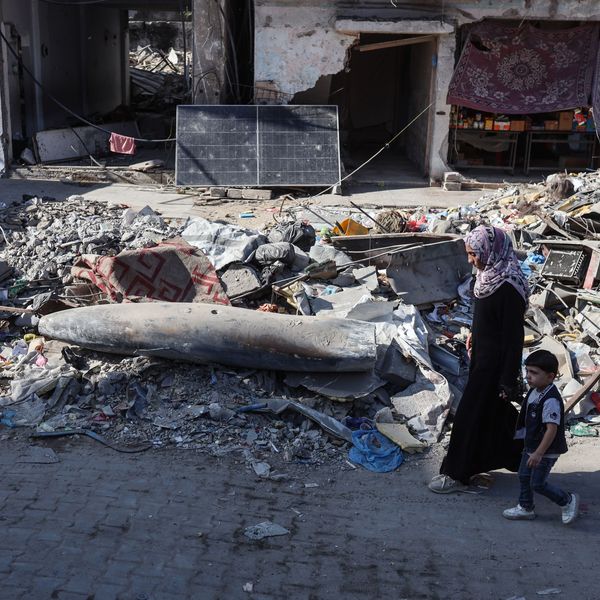
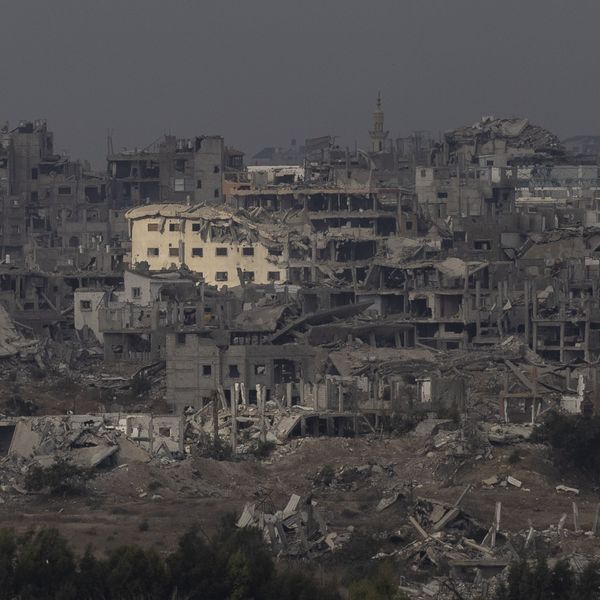
A month after Hamas and Israeli officials signed off on a ceasefire deal, a leading human rights group warned that Israel is maintaining conditions in Gaza that “prevent any recovery from over 25 months of humanitarian catastrophe,” while the international community is largely silent about the continued killing and destruction in the exclave.
Despite the ceasefire deal that was brokered by the Trump administration, an average of eight Palestinians are still being killed per day as the Israel Defense Forces (IDF) continue to wage “aerial and artillery bombardment, gunfire, and the ongoing destruction of homes and buildings, particularly in the eastern areas of Khan Younis and Gaza City,” according to the Euro-Mediterranean Human Rights Monitor.
The Government Media Office in Gaza reported Tuesday that Israel has violated the ceasefire agreement at least 282 times, as it’s claimed that Hamas has done the same by killing Israeli soldiers and failing to return the body of one of the captives who was kidnapped by Hamas on October 7, 2023.
President Donald Trump has defended the IDF’s attacks in some cases, saying an attack on October 29 that killed 109 Palestinian people, including 52 children, was “retribution” for the killing of an Israeli soldier.
With the president’s tacit approval of attacks that it considers “retribution” and his insistence that the ceasefire holds, Israel has killed 242 Palestinians since the ceasefire began on October 10, including 85 children. About 619 people have been injured.
Despite the first phase of the 20-point peace plan put forward by Trump stipulating an end to all hostilities by Hamas and Israel, said the Euro-Med Monitor, “Israel continues to commit genocide against Palestinian civilians through various means.”
In addition to continuing its military bombardment, Israel has not obeyed another requirement of the first phase of the deal: lifting the blockade that began in October 2023 and that has killed nearly 500 Palestinians so far.
“Israel continues to administer a deliberate policy of starvation in the Gaza Strip, having blocked the entry of approximately 70% of the aid required under the agreement,” said Euro-Med Monitor. “It also controls the type of goods allowed in, systematically restricting essential food items such as meat and dairy products while flooding the markets with calorie-dense but nutrient-poor products.”
Gaza’s population of about 2 million people remains “in a state of controlled, chronic hunger,” said the group. Child malnutrition rates remain 20% from last year despite the ceasefire.
The group released an infographic on Tuesday, detailing the devastation that continues in Gaza as Israel persists in committing a “silent genocide”—now without the sustained pressure of the international community for the attacks to stop.
The graphic notes that since Israel began its attacks:
- Nine out of every 10 Palestinians who have been killed in Gaza were civilians;
- 100% of hospitals have been damaged or destroyed;
- 45,600 children have been orphaned;
- 12% of all Palestinians in Gaza have been killed, injured, detained, or are missing.
- 40,000 people now have permanent or long-term disabilities, including 21,000 children;
- 100% of the population faces acute food insecurity; and
- 100% of the population has suffered psychological trauma.
The Euro-Med Monitor also warned that Israel is continuing to block movement in both directions at the Rafah crossing, restricting civilians who are sick or wounded from getting medical care.
“These actions are not isolated incidents but part of a systematic pattern indicating a clear policy by the Israeli political and military leadership to use the ceasefire as a cover to continue genocide against Gaza’s residents,” said the group. “By maintaining a disguised military assault and perpetuating killing, starvation, and systematic destruction, Israel exploits the absence of international will to protect civilians and hold perpetrators accountable.”
A “grave development” included in Euro-Med Monitor’s report is “the dismantling of the Gaza Strip’s geographical unity, turning it into an isolated and uninhabitable area.”
Ramy Abdul, chairman of the organization, posted a video on social media of an Israeli soldier “proudly documenting” his army unit’s use of excavators, “flattening what’s left of northern Gaza” behind the “yellow line” to which Israeli troops were required to withdraw under the ceasefire deal.
“The continued silence of the international community and the failure to activate accountability mechanisms provide Israel with practical cover to continue committing genocide, albeit at a slower pace, as part of a consistent policy aimed at eliminating the Palestinian presence in the Gaza Strip,” said Euro-Med Monitor.
The group’s analysis came as Politico reported that Trump administration officials have begun privately expressing concerns that the peace deal could break down due to an inability to implement core provisions, such as deploying an “International Stabilization Force” that would officially be tasked with peacekeeping in Gaza.
“The administration took its victory lap after the initial ceasefire and hostage release, but all the hard work, the real hard work, remains,” David Schenker, former assistant secretary of state for the Middle East, told Politico.
Countries including the United Arab Emirates, Turkey, Jordan, and Azerbaijan have said they will not commit to contributing forces, with the latter declining to attend a recent planning meeting and saying it would not participate until a full ceasefire is in place.
The GOP "should evaluate whether Trump’s push to ignite a redistricting arms race may have made it easier for a blue wave to wipe out more Republicans than if they had left their maps alone," wrote one analyst.
By Brad Reed
President Donald Trump’s push for mid-decade redistricting to prevent Republicans from losing control of the US House of Representatives appears to be on the verge of backfiring.
The latest blow to Trump’s nationwide redistricting efforts came in Utah, where District Court Judge Dianna Gibson shot down a proposed map drawn by Utah Republicans because it failed to abide by a 2018 ballot measure that restricted partisan gerrymandering in the state.
As reported by NBC News, Gibson instead approved a map that created “a solidly Democratic seat ahead of next year’s midterm elections,” thus giving Democrats a likely net gain of one seat in the US House.
Democratic National Committee Chairman Ken Martin hailed Gibson’s ruling and vowed that Democrats weren’t finished fighting Trump’s efforts to rig next year’s elections in his favor.
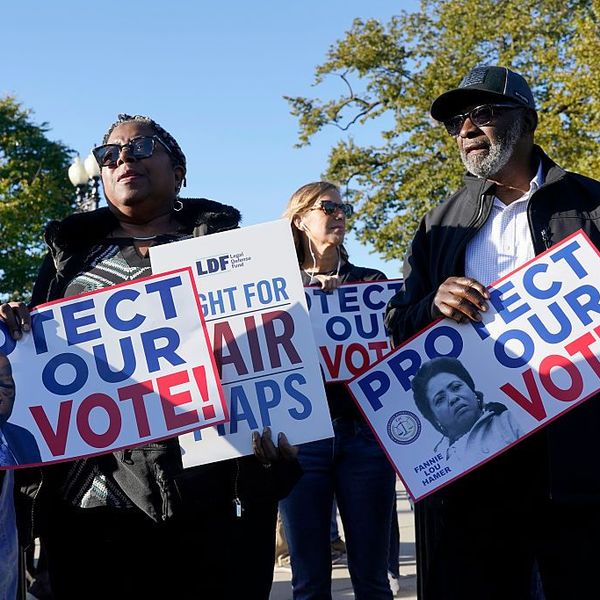
“Utah Republicans gerrymandered the maps because they knew they were losing power in the state,” he said. “Republicans doubled down when they chose to submit another gerrymandered map, but today, they were once again thwarted by impartial Courts. Democrats will continue to fight for fair maps in Utah, regardless of what Donald Trump and Utah Republicans try next. Every seat counts, and Democrats everywhere are fired up and ready to take back the House in the midterms in 2026.”
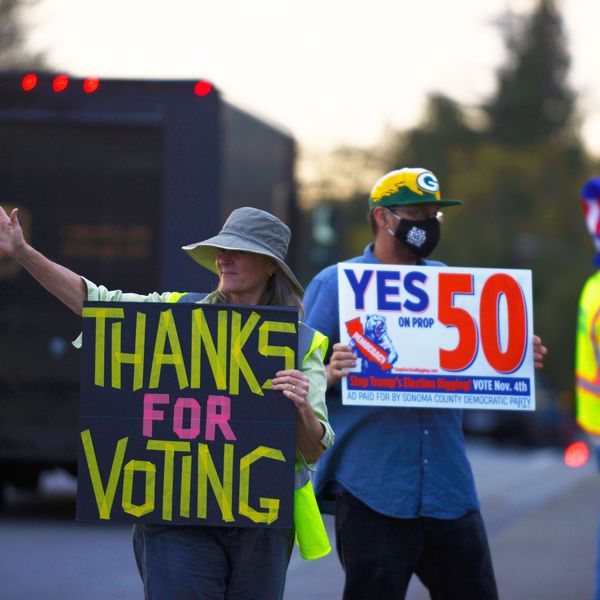
Dave Wasserman, a senior elections analyst at Cook Political Report, wrote in a post on X that the Democrats’ Utah victory, along with California voters’ approval of newly gerrymandered maps and reported plans to redraw maps in Virginia, have “pushed the mid-decade redistricting war closer to a draw.”
In a lengthy analysis published in Bloomberg on Tuesday, columnist Mary Ellen Klas argued that Republicans should take a deep breath before going all-in on Trump’s unprecedented mid-decade redistricting crusade, which began in Texas and subsequently spread to Missouri and North Carolina.
The issue, Klas explained, is that Republicans in those states have carved out more GOP-friendly districts based on assumptions that Republican gains among Latino voters and young men would hold in 2026. As last week’s sweeping Democratic victories showed, however, the GOP now appears to be hemorrhaging support among these two demographics.
“In New Jersey, 68% of Latino voters broke for Democrat Mikie Sherrill,” wrote Klas. “So did 56% of men under the age of 30. In Virginia, 67% of Latino voters went for Democrat Abigail Spanberger. So did 57% of men under 30. Many of these voters had voted for Trump last year. The exit polls show that both Sherrill and Spanberger won 7% of Trump’s 2024 voters, with Sherrill getting a whopping 18% of Trump’s Hispanic support in the state.”
If those trends hold over the next year, it could wipe out advantages the GOP had hoped to gain with its Texas gerrymander, which assumed that Latino voters who swung to Trump in the state would remain loyal partisan soldiers.
“Republicans are hardly going to admit it, but they should evaluate whether Trump’s push to ignite a redistricting arms race may have made it easier for a blue wave to wipe out more Republicans than if they had left their maps alone,” argued Klass.
In fact, some Republican strategists are already fretting about Trump’s gerrymandering plan, as one anonymous GOP insider told NBC News that if the endgame of the plan was “to net one seat across the country, then it will not have been worth it.”
A second anonymous GOP insider told NBC that there was “some concern” about whether Texas Republicans may have made themselves more vulnerable to a blue wave next year.
“In Texas, I do think there is some sense those seats will be ours, but nothing is guaranteed, so some concern there,” they said.
"Tragically, eight Democrats caved," said Sen. Bernie Sanders. "But the struggle continues. Short term, we must not allow health care premiums to double for more than 20 million Americans."
By Jake Johnson
Millions of Americans hoping for legislative action to prevent their health insurance premiums from skyrocketing will find no reprieve in the all-but-finalized deal to end the federal government shutdown.
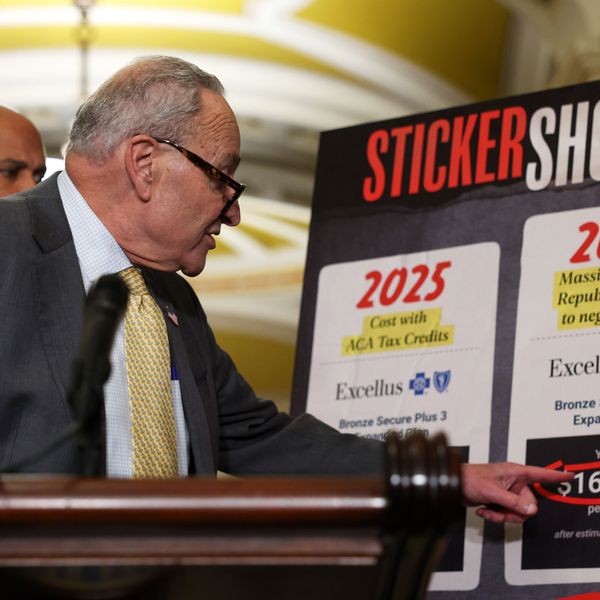
The agreement, supported by eight Democratic senators with the tacit approval of Senate Minority Leader Chuck Schumer (D-NY), includes nothing concrete regarding the enhanced Affordable Care Act tax credits that help more than 20 million Americans afford health insurance.
Rather, Democrats secured a pledge from the Senate Republican leadership to hold a vote on the tax credits next month—a vote that’s almost certain to fail amid GOP opposition. Even if a tax credit extension passed the Senate, House Speaker Mike Johnson (R-La.) has refused to commit to a vote.
That leaves millions of people across the United States facing massive premium increases; in some congressional districts, monthly costs could surge more than 600%.
“The fact is that if Republicans and the president refuse to extend the premium tax credit enhancements, millions of people will face astronomical premium increases, including small business owners, young adults, and workers without affordable employer coverage,” said Sharon Parrott, president of the Center on Budget and Policy Priorities (CBPP).
“Many will decide that they can’t afford to sign up for coverage at all; that’s why the Congressional Budget Office projects that nearly 4 million people will become uninsured,” Parrott added.
In an analysis released last week, CBPP emphasized that “people with lower incomes will tend to face the largest percentage increases in premium costs” if the ACA tax credits are allowed to lapse at the end of the year.
A family of four with an annual income of $66,000, according to CBPP, will see monthly insurance premiums rise from $121 to $373 in 2026. That amounts to $3,204 extra for next year—a price many will be unable to afford.
“I have to face the reality that I am probably going to become a late-stage cancer patient who’s uninsured,” Sunni Montgomery, a 63-year-old battling lung cancer, told CNN, noting her premium is set to rise to $1,758 per month.
“I have fought this so hard,” Montgomery added. “I want to live.”
Politico reported Tuesday “fractured conversations among Republicans are promising to bog down negotiations” on the ACA subsidies “as Obamacare beneficiaries begin to lock in their rates for the year ahead.”
“Lawmakers on both sides of the aisle are starting to privately admit it’s likely too late to avert a major premium hike for millions of Americans in 2026,” the outlet added.
Sen. Bernie Sanders (I-Vt.), the most prominent proponent of Medicare for All in Congress, said Monday that while eight Democrats “tragically” caved to Republicans, “the struggle continues.”
“Short term, we must not allow health care premiums to double for more than 20 million Americans,” said Sanders. “Long term, we must provide health care to all as a human right.”


















Comments
Post a Comment