"None of this would have been possible without everyday New Yorkers willing to spare $5, $10, or $20 to help build a government that will deliver for working people," said the mayor-elect.
By Jon Queally
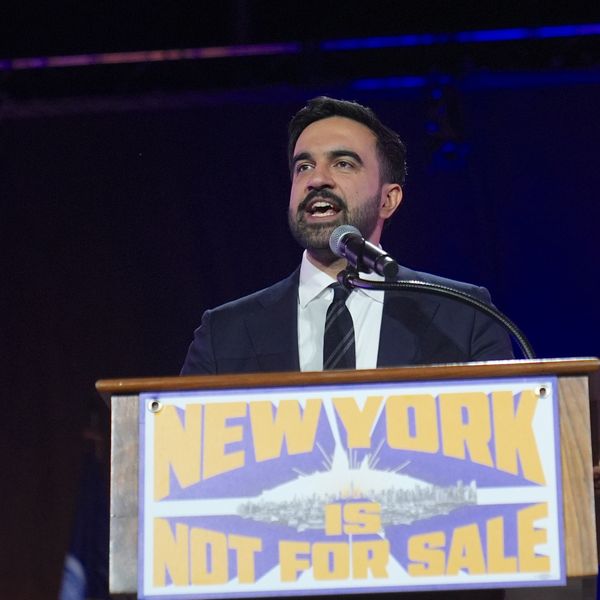
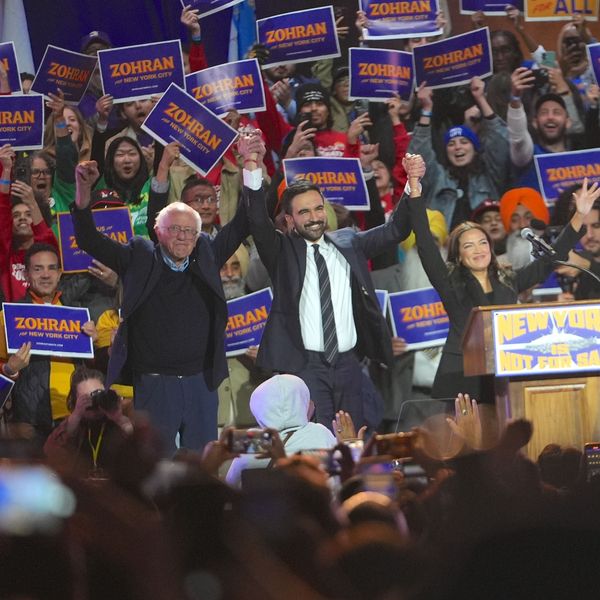
Hundreds of people in New York City gathered on Sunday in Union Square with calls to “Tax the Rich” as they showed their support for the progressive agenda of mayor-elect Zohran Mamdani, the democratic socialist elected earlier this month who will take the helm of the nation’s largest city on January 1.
The “Tax the Rich — Seize Our Future” event was co-sponsored by the New York City chapter of the Democratic Socialist of America, Housing Justice For All and NYS Tenant Bloc, Jewish Voice for Peace NYC, UAW Region 9A, the Invest in Our New Coalition, and others.
The groups are backing Mamdani’s call for universal childcare, free public busses, a rent freeze, and city-operated grocery stores in the city, all which will be made more possible with revenue raised by increased taxes on the city’s wealthiest individuals and for-profit companies.
“Zohran Mamdani’s cost-of-living agenda has the support of masses of working class New Yorkers—but winning an ambitious affordability agenda cannot be won with one mayor alone,” said the NYC-DSA in a post about the “Tax the Rich” event on their website. “To build the universal public goods we deserve, we need to ensure the wealthiest individuals and corporations in our state are paying their fair share in taxes.”
“It will take a movement to push Albany to put working New Yorkers before billionaire donors and tax the rich,” said Danny Zaldes, a DSA member and organizer as he called on others to join the effort.
“As we know, power concedes nothing without a demand,” declared Democratic state Sen. Jabari Brisport (D-25) during his speech at the rally, “and today we demand to tax the rich!”
The rally served as the launch of a new campaign by coalition members behind the event, one aimed at making sure that Mamdani maintains grassroots support even as he takes charge of the city’s municipal government in the New Year.
In order to fund his transition and maintain that popular support, Mamdani has asked supporters and donors to crowdfund for the transition and has created a nonprofit entity to mobilize on behalf of his progressive vision for the city going forward.
On Sunday, Mamdani’s office said it has raised approximately $1 million in just 10 days, coming from over 12,00 individuals with an average gift of $77.
Contrasting the money raised with that of previous administrations, a statement from Mamdani’s office said that “during Mayor Eric Adams’ transition, he had just 884 individual donors, with an average donation of more than $1,000, and former Mayor Bill de Blasio had 820 individual donors, with an average donation of $2,392.”
As it readies to take on the most powerful interests in the city as well as some of the wealthiest people on the planet who call New York City home, Mamdani said in a statement that the support of working people will be crucial to his administration’s success.
“None of this would have been possible without everyday New Yorkers willing to spare $5, $10, or $20 to help build a government that will deliver for working people,” said the mayor-elect. “I’m grateful for every dollar New Yorkers have contributed to make this vision of an affordable, more livable city a reality.”
The campaign said the money will be used primarily for recruiting and retaining during the transition period as the administration takes shape.
“More than 12,000 New Yorkers are contributing to this transition to turn the page on the politics of the past and build a new era for New York City,” said Elana Leopold, executive director of Mamdani’s transition, in a statement. “Thanks to New Yorkers’ supporter, we will be ready on day one with top talent in place and ready to deliver.”
"Healthcare is becoming unsustainable under Trump," says one progressive politician running for US Senate. "Medicare for All would fix it."
By Jon Queally
The Trump administration came under fire on Sunday after sending Dr. Mehmet Oz, the Administrator of the Centers for Medicare and Medicaid Services, onto CNN‘s weekend news show to try to explain the Republican Party’s elusive “solution” to the nation’s healthcare crisis, a topic of much interest in recent weeks amid the longest government shutdown in the nation’s history and growing fears over massive premium increases or loss of coverage for tens millions of Americans.
Asked during his appearance to explain what Republicans are considering to address the surging cost of healthcare, Oz talked about direct cash payments—something Trump himself has floated in recent weeks—as well as the idea of health saving accounts (or HSAs) which allow for personalized accounts set up to help pay for out-of-pocket medical needs, though not premium payments.
“If you had a check in the mail, you could buy the insurance you thought was best for you,” Oz stated without explaining in what way that is different from people who received tax credits to purchase plans on the insurance exchanges established by the Affordable Care Act signed into law by former President Barack Obama.
Pushing such empty ideas while claiming them as viable solutions to soaring costs is partly what led critics like Sen. Patty Murray (D-Wash.) this week to issue a public service announcement which stated flatly: “There is no Republican health care plan”—despite repeated claims to the contrary by GOP lawmakers, including Speaker of the House Mike Johnson (R-La.).
“Dr. Oz a few years ago was pitching Medicare Advantage for All—a scheme to put every person on the corporate health insurance plans he used to sell,” said Andrew Perez, a politics editor for Zeteo, in response to the interview. “Now, he’s saying let’s take away insurance from millions and give them a few bucks for their health care instead. Insane.”
In a blog post published last week, Nicole Rapfogel, a senior policy analyst with the Center on Budget and Policy Priorities (CBPP), a nonpartisan policy think tank, explained why expanded HSAs, backed by the government or otherwise, would do little to nothing to improve access or lower costs for healthcare.
“Expanding HSAs has been a consistent theme, including in the House-passed version of the Republican megabill, though those provisions didn’t pass the Senate,” explained Rapfogel. “But these policies are misguided and would do little to preserve access to affordable, comprehensive coverage.”
She further explains that HSAs generally are better for wealthier people who have spare income to direct into such accounts, but of little use to poorer Americans who are already struggling to make ends meet each month. According to Rapfogel:
Most people do not have spare cash to set aside in HSAs; an estimated 4 in 10 people are in debt due to medical and dental bills.
People in lower tax brackets also benefit less from HSA tax savings. For example, a married couple making $800,000 saves 37 cents for each dollar contributed to an HSA, more than three times the 12 cents per dollar a married couple making $30,000 would save.
Further, HSAs do not promote efficient use of health care services. Research has shown that HSAs do not reduce health care spending, but rather shield more of that spending from taxes.
Given that understanding of the well-known limitations of HSAs or other avenues of government backstopping of private insurance, the level of bullshitting or straight up ignorance by Oz on Sunday morning, for many, was hard to take.
It’s “pretty amazing,” said economist Dean Baker on Sunday, “that Dr. Oz doesn’t know that people choose their insurance under Obamacare, but no one ever said Dr. Oz knew anything about healthcare.”
In an interview with Newsmax earlier this month, Johnson—who has argued that the GOP has reams of policy proposals on the topic—accused Democrats of having no reform solutions to the nation’s healthcare crisis other than permanently fighting to save the status quo, including the “subsidizing the insurance companies” which is at the heart of the Affordable Care Act.
Taxpayer subsidies for private insurance giants “is not the solution,” Johnson admitted at the time, though his party has refused to offer anything resembling a departure from the for-profit model which experts have demonstrated is the central flaw in the US healthcare system, one that spends more money per capita than any other developed nation but with the worst outcomes.
Meanwhile, as Republicans show in word and deed that they have nothing to offer people concerned about healthcare premiums in the nation’s for-profit system, only a relative handful of Democratic Party members have matched renewed focus on the nation’s long-simmering healthcare crisis with the popular solution that experts and economists have long favored: a single-payer system now commonly known as Medicare for All.
Sen. Bernie Sanders, the Independent from Vermont who caucuses with the Senate Democrats, made the demand for Medicare for All a cornerpost of his two presidential campaigns, first in 2016 and then again in 2020. On the heals of those campaigns, which put the demand for a universal healthcare system before voters in a serious way for the first time in several generations, a growing number of lawmakers in Congress embraced the idea even as the party’s establishment leadership treated the idea as toxic.
While a 2018 study by the Political Economy Research Institute (PERI) at the University of Massachusetts at Amherst detailed why it is “easy to pay for something that costs less,” people in the United States exposed to the arguments of Medicare for All over the last decade a majority have shown their desire for such a system in poll after poll after poll.
A single-payer system like Medicare for All would nullify the need for private, for-profit insurance plans and the billions of dollars in spending they waste each year in the form of profits, outrageous pay packages for executives, marketing budgets, and administrative inefficiences.
Despite its popularity and the opportunity it presents to show the working class that the Democratic Party is willing to turn its back on corporate interests by putting the healthcare needs of individuals and families first, the party leadership continues to hold back its support.
Lawmakers like Rep. Ro Khanna (D-Calif.), who served as national co-chair to Sanders’ second presidential run, has been arguing in recent weeks, amid the government shutdown fight, that Democrats should be “screaming” their support for universal healthcare “from the rooftops” in order to seize on a moment in which voters from across the political spectrum are more atuned than usual to the pervasive and fundamental failures of the for-profit system.
Rep. Pramila Jayapal (D-Wash.), lead sponsor of the Medicare for All Act in the US House, on Thursday reiterated her support for universal coverage by saying, “Instead of raising premiums for millions, how about we just get rid of them? Medicare for All!!”
As former Ohio state senator and progressive organizerNina Turner said on Saturday, “This is a moment to mobilize for Medicare for All.”
Dr. Abdul El-Sayed, another former Sanders surrogate now running for the Democratic nomination in Michigan’s US Senaterace, has been another outspoken champion of Medicare for All in recent weeks.
“While MAGA slowly suffocates our healthcare system, we’re watching corporate health insurance choose profits—and corporate Democrats capitulating,” El-Sayed said last week, expressing frustration over how the shutdown fight came to end. “Who suffers? The rest of us. It’s time for a healthcare system that doesn’t leave our insurance in the hands of big corporations—but guarantees health insurance for all of us.”
Following Dr. Oz’s remarks on Sunday, El-Sayed rebuked the top cabinet official as emblematic of the entire healthcare charade being perpetrated by the Republican Party under President Donald Trump.
“They think we’re dumb,”saidEl-Sayed of Oz’s convoluted explanation of direct payments. “They know that no check they send will cover even a month of the healthcare Trump bump we can’t afford—but they think we’re not smart enough to know the difference. Healthcare is becoming unsustainable under Trump. Medicare for All would fix it.”
InMaine on Sunday, another Democratic candidate running for the US Senate, Graham Platner, also championed the solution of Medicare for All.
After watching Oz’s peformance on CNN, Tyler Evans, creative director who works for Rep. Alexandria Ocasio-Cortez(D-N.Y.) declared in a social media post: “If we had Medicare for All, you could simply go to the doctor.”
"It is time to put these old fuels where they belong—in the ground of history.”
By Jon Queally
An estimated 50,000 people took to the streets of Belém do Pará, Brazil, on Saturday to demonstrate outside the halls of the United Nations annual climate summit, holding a “Great People’s March” and makeshift “Funeral for Fossil Fuels” as they demanded a just transition toward a more renewable energy system and egalitarian economy.
Organized by civil society organizations and Indigenous Peoples groups from Brazil and beyond, the tens of thousands who marched outside the thirtieth Conference of the Parties (COP30) summit called for an end to the rapacious greed of the oil, gas, and coal companies as they advocated for big polluters to pay for the large-scale damage their businesses have caused worldwide over the last century.
“We are tens of thousands here today, on the streets of Belém, to show negotiators at COP30 that this is what people power looks like,” said Carolina Pasquali, executive director of Greenpeace Brazil, said as the march took hold. “Yesterday we found out that one in every 25 COP30 participants is a fossil fuel lobbyist, proportionally a 12% increase from last year’s COP. How can the climate crisis be solved while those creating it are influencing the talks and delaying decisions? The people are getting fed up–enough talking, we need action and we need it now.”
The report by the Kick Big Polluters Out coalition last week showed that at least 1,600 lobbyists from the fossil fuel industry are present at the conference, making it the second-largest delegation overall, second only to Brazil’s, the host nation.
“It’s common sense that you cannot solve a problem by giving power to those who caused it,” said Jax Bongon from the Philippines-based IBON International, a member of the coalition, in a Friday statement. “Yet three decades and 30 COPs later, more than 1,500 fossil fuel lobbyists are roaming the climate talks as if they belong here. It is infuriating to watch their influence deepen year after year, making a mockery of the process and of the communities suffering its consequences.”
While the overwhelming presence of fossil fuel lobbyists has once again diminished hopes that anything worthwhile will emerge from the conference, the tens of thousands in the streets on Saturday represented the ongoing determination of the global climate movement.
João Talocchi, co-founder of Alianza Potência Energética Latin America, one of the key groups behind the “Funeral for Fossil Fuels” portion of the day’s action—which included mock caskets for the oil, gas, and coal companies alongside parades of jungle animals, wind turbines, and solar panels representing what’s at stake and the better path forward—noted the key leadership of Indigenous groups from across the Global South.
“From the Global South to the world, we are showing what a fair and courageous energy transition must look like,” said Talochhi.
Ilan Zugman, director of 350.org in Latin America and the Caribbean, noted the significance of the demonstration, including the symbolism of the funeral procession.
“We march symbolically burying fossil fuels because they are the root of the crisis threatening our lives,” explained Zugman. “Humanity already knows the way forward: clean energy, climate justice, and respect for the peoples who protect life. What is missing is political courage to break once and for all with oil, gas, and coal. It is time to put these old fuels where they belong—in the ground of history.”
With the COP30 at its midway point, climate activists warn that not nearly enough progress is being made, with the outsized influence of the fossil fuel industry one of the key reasons that governments, year after year and decade after decade, continue to drag their feet when it comes to taking the kind of aggressive actions to stem the climate crisis that scientists and experts say is necessary.
“We are taking to the streets because, while governments are not acting fast enough to make polluters pay for their climate damages at COP30, extreme weather events continue to wreak havoc across the globe,” said Abdoulaye Diallo, co-head of Greenpeace International’s “Make Polluters Pay” campaign. “That is why we are here, carrying the climate polluters bill, showing the projected economic damages of more than $5 trillion from the emissions of just five oil and gas companies over the last decade.”
“Fossil fuel companies are destroying our planet, and people are paying the price,” said Diallo. “Negotiators must wake up to the growing public and political pressure to make polluters pay, and agree to new polluter taxes in the final COP30 outcome.”
"Clearly, the international repression of the Palestinian cause knows no bounds."
By Jon Queally
Ninety-five-year-old Richard Falk—world renowned scholar of international law and former UN special rapporteur focused on Palestinian rights—was detained and interrogated for several hours along with his wife, legal scholar Hilal Elver, as the pair entered Canada for a conference focused on that nation’s complicity with Israel’s genocide in Gaza.
“A security person came and said, ‘We’ve detained you both because we’re concerned that you pose a national security threat to Canada,'” Falk explained to Al-Jazeera in a Saturday interview from Ottawa in the wake of the incident that happened at the international airport in Toronto ahead of the scheduled event.
“It was my first experience of this sort–ever–in my life,” said Falk, professor emeritus of international law at Princeton University, author or editor of more than 20 books, and formerly the UN special rapporteur on the situation of human rights in the Palestinian territories.
Falk, who is American, has been an outspoken critic of the foreign policy of Canada, the United States, and other Western nations on the subject of Israel-Palestine as well as other issues. He told media outlets that he and his wife, also an American, were held for over four hours after their arrival in Toronto. They were in the country to speak and participate at the Palestine Tribunal on Canadian Responsibility, an event scheduled for Friday and Saturday in Ottawa, the nation’s capital.
The event, according to the program notes on the website, was designed to “document the multiple ways that Canadian entities – including government bodies, corporations, universities, charities, media, and other cultural institutions–have enabled and continue to enable the settler colonization and genocide of Palestinians, and to articulate what justice and reparations would require.”
In his comments to Al-Jazeera, Falk said he believes the interrogation by the Canadian authorities—which he described as “nothing particularly aggressive” but “random” and “disorganized” in its execution—is part of a global effort by powerful nations complicit with human rights abuses and violations of international law to “punish those who endeavour to tell the truth about what is happening” in the world, including in Gaza.
Martin Shaw, a British sociologist and author of The New Age of Genocide, said the treatment of Falk and Elver should be seen as an “extraordinary development” for Canada, and not in a good way. For a nation that likes to think of itself as a “supporter of international justice,” said Shaw, “to arrest the veteran scholar and former UN rapporteur Richard Falk while he is attending a Gaza tribunal. Clearly, the international repression of the Palestinian cause knows no bounds.”
Canadian Senator Yuen Pau Woo, a supporter of the Palestine Tribunal, told Al-Jazeera he was “appalled” by the interrogation.
“We know they were here to attend the Palestine Tribunal. We know they have been outspoken in documenting and publicizing the horrors inflicted on Gaza by Israel, and advocating for justice,” Woo said. “If those are the factums for their detention, then it suggests that the Canadian government considers these acts of seeking justice for Palestine to be national security threats–and I’d like to know why.”
"I refuse to believe that in a state like Maine where people work as hard as we do here, that it is merely hard work that gets you that kind of success. We all know it isn't. We all know it's the structures. It's the tax code."
By Jon Queally
Echoing recent viral comments by music superstar Billie Eilish, Maine Democratic candidate for US Senate Graham Planter is also arguing that the existence of billionaires cannot be justified in a world where working-class people with multiple jobs still cannot afford the basic necessities of life.
In video clip posted Friday of a campaign event in the northern town of Caribou from last month, Platner rails against the “structures” of an economy in which billionaires with vast personal fortunes use their wealth to bend government—including the tax code—to conform to their interests while working people are left increasingly locked out of controlling their own destinies, both materially and politically.
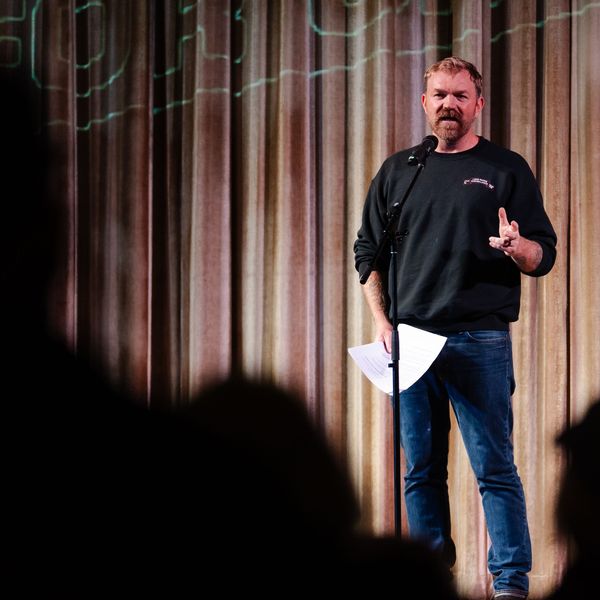
“Nobody works hard enough to justify $1 billion,” the military veteran and oyster farmer told potential voters at the event. “Not in a world where I know people that have three jobs and can’t even afford their rent.”
With audience members nodding their heads in agreement, Platner continued by saying, “I refuse to believe that in a state like Maine, where people work as hard as we do here, that it is merely hard work that gets you that kind of success. We all know it isn’t. We all know it’s the structures. It’s the tax code. That is what allows that money to get accrued.”
The systemic reasons that create vast inequality, Platner continued, are also why he believes that the process of the super wealthy becoming richer and richer at the expense of working people can be reversed.
“The world that we live in today,” he explained, “is not organic. It is not natural. The political and economic world we have did not happen because it had to. It happened because politicians in Washington and the billionaires who write the policies that they pushed made this happen. They changed the laws, and they made it legal to accrue as much wealth and power as they have now.”
The solution? “We need to make it illegal again to do that,” says Platner.
The comments questioning the justification for billionaires to even exist by Platner—though made in early October—echo more recent comments that went viral when spoken by Billie Eilish, a popular musician, who told a roomful of Wall Street movers and shakers in early November that they should do a better job reflecting on their outrageous wealth.
“Love you all, but there’s a few people in here that have a lot more money than me,” Eilish said during an award event in New York City. “If you’re a billionaire, why are you a billionaire? No hate, but yeah, give your money away, shorties.”
While those remarks took a long spin around the internet, Eilish on Friday doubled down on uncharitable billionaires by colorfully callingElon Musk, who could end up being the world’s first trillionaire, a “fucking pathetic pussy bitch coward” for not donating more of his vast fortune, among the largest in the world, to humanitarian relief efforts.
This week, as Common Dreamsreported, a coalition of economists and policy experts called for the creation of a new international body to address the global crisis of inequality.
Like Platner, the group behind the call—including economists like Joseph Stiglitz, Thomas Piketty, Ha-Joon Chang, and Jayati Ghosh—emphasized the inequality-as-a-policy-choice framework. Piketty, who has called for the mass taxation of dynastic wealth as a key part of the solution to runaway inequality, said “we are at a dangerous moment in human history” with “the very essence of democracy” under threat if something is not done.
On the campaign trail in Maine, Platner has repeatedly suggested that only organized people can defeat the power of the oligarchs, which he has named as the chief enemy of working people in his state and beyond. The working class, he said at a separate rally, “have an immense amount of power, but we only have it if we’re organized.”
“No one from above is coming to save us,” Platner said. “It’s up to us to organize, use our immense power as the working class, and win the world we deserve.”
Of 614 people on list who may have been unlawfully arrested and detained by federal officials, only 16 had a criminal record of any kind.
By Jon Queally
President Donald Trump and his administration have claimed repeatedly that the immigration raids that have terrorized communities nationwide this year are focused on getting the “worst of the worst” off the streets and out of the country, but new detention data filed by the Department of Justice on Friday shows that only a tiny fraction of the more than 600 people who remain in detention in the Chicago area from raids over recent months have any criminal record, bolstering anecdotal evidence that many of those targeted for by ICE and federal border agents are hard-working, law-abiding members of society.
The Trump administration on Friday released the names of 614 people whose Chicago-area immigration arrests may have violated a 2022 consent decree, and only 16 of them have criminal histories that present a “high public safety risk.”
The list was produced as part of an ongoing lawsuit alleging immigration agents have repeatedly violated the terms of the in-court settlement, mostly during “Operation Midway Blitz,” that puts a high bar on making so-called warrantless arrests without a prior warrant or probable cause.
The newspaper reports that of the 16 people arrested with criminal histories—representing just 2.6% of the total listed in the filing— “five involved domestic battery, two were related to drunken driving, and one allegedly had an unidentified criminal history in another country.” None had criminal backgrounds that included worst-of-the-worst offenses like rape or murder.
Earlier this week, U.S. District Judge Jeffrey Cummings ordered the government to provide more information about the more than 600 people being held in detention and suggested he would order their release if compelling public-safety reasons were not presented. While ordering the immediate release of 13 people he deemed were arrested unlawfully, Cummings gave the government until Friday to release the additional information on those being held.
The Chicago Sun-Timesreports that the list of 614 detainees comes from a longer list of roughly 1,800 individuals arrested by U.S. Immigration and Customs Enforcement in the Chicago area between June 11 and October 7, of which “only about 750 of them remain in the country.” Most of the others were deported, and their criminal histories were not presented in Friday’s disclosure.
The consent decree at issue, known as the Castañon-Nava settlement agreement, restricts the ability of ICE agents or others working with them to make warrantless arrests in Illinois.
“Communities throughout the Chicago area have been traumatized by ICE and other federal agents’ chaotic and violent actions in our neighborhoods in recent months, and potentially hundreds of families already have been permanently separated as a result of unlawful arrests and rapid deportations without due process,” said Mark Fleming, associate director of litigation for the National Immigration Justice Center (NIJC), who is backing the legal case against the unlawful arrests and detentions in Chicago, after the order issued by Cummings on Wednesday.
“NIJC and our partners will continue to demand justice for our communities and accountability for the lawless administration we all are facing.”
During Wednesday’s hearing, the judge suggested many of those who remain in detention likely have no history of criminal conduct and were targeted by federal agents simply for fitting a specific profile. As the Sun-Times reports:
Cummings said that 54 of those people were arrested at work, including 20 landscapers and four ride-share or taxi drivers. Twenty were arrested commuting to or from work, he added, and nine were arrested at a Home Depot or Menards, “presumably either seeking work or to pick up supplies.”
Seven were also arrested at an “immigration-related hearing,” Cummings said, while 11 were arrested in public places like a park, gas station or even a Dunkin’ Donuts drive-thru.
“It seems highly likely to me that at least some of those individuals are among the 615 detainees who are not subject to mandatory detention,” Cummings said. He also found them unlikely to be members of gangs, “assorted other ne’er-do-wells” or the “worst of the worst.”
Community members living in Chicago and its outlying suburbs, including Broadview, have expressed anger at Trump’s ICE operations in the region, which have seen school teachers, childcare providers, day laborers, and other neighbors targeted and arrested.
On Friday, 21 people were arrested outside the immigration detention center in Broadview following a morning demonstration outside the facility.
JOIN THE MOVEMENT
As a people-powered nonprofit news outlet, we cover the issues the corporate media never will.
Your contribution supports this bold media model—free, independent, and dedicated to reporting the facts every day. Stand with us in the fight for economic equality, social justice, human rights, and a more sustainable future.
Shoppers browse produce at Sabor Tropical Supermarket in Miami Beach, Florida on July 23, 2022.
Photo by: Jeffrey Greenberg/Universal Images Group via Getty Images
Although President Donald Trump didn’t actually confess that his global trade war is driving up the cost of groceries for Americans, he did finally drop his dubiously named “reciprocal” tariffs on key imports on Friday.
According to a White Housefact sheet, Trump’s new executive order ends his tariffs on beef; cocoa and spices; coffee and tea; bananas, oranges, and tomatoes; other tropical fruits and fruit juices; and fertilizers.
The New York Times had reported Thursday that “the Trump administration is preparing broad exemptions to certain tariffs in an effort to ease elevated food prices that have provoked anxiety for American consumers.”
The reporting drew critiques of the administration’s economic policies, including from members of Congress such as Senate Finance Committee Ranking Member Ron Wyden (D-Ore.), who said that “Trump just admitted it: Americans are footing the bill for his disastrous tariffs.”
“While this move may alleviate some of the cost increases Trump caused, it will not stop the larger problems of rising inflation, business uncertainty, and economic damage done by Trump’s crazy tariff scheme.”
Also responding to the Times reporting, Sen. Elizabeth Warren (D-Mass.) wrote on social media Friday: “After months of increasing grocery prices, Donald Trump is finally admitting he was wrong. Americans are literally paying the price for Trump’s mistakes.”
More lawmakers and other critics piled on after Trump issued the order. CNN‘s Jim Sciutto said: “Trump administration now acknowledging what economists and business leaders have told us from the beginning: that tariffs are driving up prices.”
MeidasTouch and its editor in chief, Ron Filipkowski, also called out the president on social media, with the outlet sarcastically noting, “But Trump said his tariffs don’t raise prices.”
Congressman Don Beyer (D-Va), who serves on the House Ways and Means Subcommittee on Trade, said in a Friday statement that “President Trump is finally admitting what we always knew: His tariffs are raising prices for the American people.”
“After getting drubbed in recent elections because of voters’ fury that Trump has broken his promises to fix inflation, the White House is trying to cast this tariff retreat as a ‘pivot to affordability,'” Beyer said, referencing Democrats who won key races last week, from more moderate Mikie Sherrill and Abigail Spanberger, the incoming governors of New Jersey and Virginia, to democratic socialist Mayors-elect Zohran Mamdani of New York City and Katie Wilson of Seattle.
In addition to those electoral victories for Democrats, last week featured a debate over Trump’s trade war at the US Supreme Court. According to Beyer: “The simple truth is that Republicans want credit for something they think the Supreme Court will force them to do anyway, after oral arguments before the court on Trump’s illegal abuses of trade authorities went badly for the administration. Trump is still keeping the vast majority of his tariffs in place, and his administration is also planning new tariffs in anticipation of a Supreme Court loss.”
“The same logic—that Trump’s tariffs are driving up prices on coffee, fruit, and other comestibles—is equally true for the thousands of other goods on which his tariffs remain,” he continued. “While this move may alleviate some of the cost increases Trump caused, it will not stop the larger problems of rising inflation, business uncertainty, and economic damage done by Trump’s crazy tariff scheme.”
“Only Congress can do that, by reclaiming its legal responsibility under the Constitution to regulate trade, and permanently ending Trump’s trade war chaos,” he stressed. “All but a handful of Republicans in Congress are still refusing to stand up to Trump, stop his tariffs, and lower costs for the American people, and unless they find a backbone, our economy will continue to suffer.”
As the Associated Pressnoted Friday, “The president signed the executive order after announcing that the U.S. had reached framework agreements with Ecuador, Guatemala, El Salvador, and Argentina designed to ease import levies on agricultural products produced in those countries.”
Trump’s order also came just a day after Democrats on the congressional Joint Economic Committee released a report showing that US families are paying roughly $700 more each month for basic items since Trump returned to office in January—with households in some states, such as Alaska and California, facing an average of over $1,000 monthly.
The president has floated sending Americans a $2,000 check, purportedly funded by revenue collected from his tariffs, but as Common Dreamsreported Wednesday, economist Dean Baker of the Center for Economic and Policy Research crunched the numbers and found that the proposed “dividend” doesn’t add up.
Congresswoman Rashida Tlaib (D-Mich.) speaks about ending the Gaza genocide as medical professionals and activists look on, at the House Triangle on Capitol Hill on July 24, 2025.
(Photo by Yasin Ozturk/Anadolu via Getty Images)
Congresswoman Rashida Tlaib and 20 Democratic colleagues on Friday introduced legislation that would officially recognize Israel’s 25-month war on Gaza as a genocide, a move that came as Israeli forces continued killing Palestinians in the coastal strip and violating a tenuous ceasefire with Hamas.
Tlaib (D-Mich.)—the only Palestinian American in Congress—introduced H.Res. 876, which, if passed, would “officially recognize that the state of Israel has committed the crime of genocide against the Palestinian people in Gaza” and affirm that it is official US policy to “prevent and punish the crime of genocide, wherever it occurs.”
“The Israeli government’s genocide in Gaza has not ended, and it will not end until we act,” Tlaib said in a statement Friday. “Since the so-called ‘ceasefire’ was announced, Israeli forces haven’t stopped killing Palestinians.”
According to Gaza’s Government Media Office (GMO), Israel has violated the ceasefire agreement 282 times as of November 10, 2025—exactly one month after the US-brokered truce took effect. Alleged violations include airstrikes resulting in massacres, shootings of civilians, property demolitions, and raids beyond the ceasefire’s “yellow line” buffer zones.
GMO says Israeli forces have killed least 242 Palestinians and injured more than 620 others during the truce.
This, in addition to the at least 249,000 Palestinians who have been killed or wounded by Israeli forces since October 2023, including upward of 10,000 people who are missing and presumed dead and buried beneath the ruins of Gaza, which could take decades to clear. Around 2 million Palestinians have been starved, sickened, and forcibly displaced. Many others have been arbitrarily imprisoned, tortured, and allegedly subjected to rape and other sexual abuse.
“After over two years of slaughter, forced starvation, and mass atrocities in Gaza, the global consensus is clear: The Israeli government has committed genocide against the Palestinian people in Gaza,” Tlaib noted.
The resolution calls for the United States to “respect its obligations under the Genocide Convention by employing all means reasonably available to it to prevent and punish the crime of genocide.”
These include:
cessation of relevant arms and equipment transfers;
investigation and prosecution of individuals and corporations in the United States implicated in the crime of genocide;
targeted, lawful sanctions with respect to the state of Israel and individuals or corporations involved in or facilitating the commission of genocide.
“Impunity only enables more atrocity,” Tlaib warned. “As our government continues to send a blank check for war crimes and ethnic cleansing, Palestinian children’s smiles are extinguished by bombs and bullets that say made in the USA.”
“To end this horror, we must reject genocide denial and follow our binding legal obligations under the Genocide Convention to take immediate action to pursue justice and accountability to prevent and punish the crime of genocide,” she added. “We must hold individual perpetrators and complicit corporations to account. We must stop sending weapons to a genocidal military. We must follow international law and use all means available to us, including sanctions, to bring this genocide to an end.”
Despite existing laws prohibiting US assistance to foreign security forces that commit gross human rights violations, the United States—which grew into a world power in part via genocide of Indigenous Americans—has provided arms and diplomatic cover to the perpetrators of genocides in Paraguay, Guatemala, Bangladesh, East Timor, Kurdistan, and Gaza over the past half-century, while turning a blind eye to other genocides.
Under the Biden and Trump administrations, the US has provided Israel with more than $20 billion in armed aid while thwarting efforts to end the genocide by vetoing numerous United Nations Security Council ceasefire resolutions.
Trump has also targeted individuals and nations who seek justice for Palestinians, acknowledge the Gaza genocide, or recognize Palestinian statehood.
Tlaib’s resolution is co-sponsored by Democratic Reps. Becca Balint (Vt.), André Carson (Ind.), Greg Casar (Texas), Maxine Dexter (Ore.), Maxwell Alejandro Frost (Fla.), Jesús “Chuy” García (Ill.), Al Green (Texas), Pramila Jayapal (Wash.), “Hank” Johnson Jr. (Ga.), Ro Khanna (Calif.), Summer Lee (Pa.), Jim McGovern (Mass.), Alexandria Ocasio-Cortez (NY), Ilhan Omar (Minn.), Mark Pocan (Wis.), Ayanna Pressley (Mass.), Delia Ramirez (Ill.), Lateefah Simon (Calif.), Nydia Velázquez (NY), and Bonnie Watson Coleman (NJ).
The resolution—which is unlikely to get through the Republican-controlled Congress—is also endorsed by more than 100 organizations.
“This resolution is an important step towards recognizing Israel’s actions against Palestinians in the occupied Gaza Strip for what they are—genocide,” Amnesty International Middle East and North Africa advocacy director Elizabeth Rghebi said in support of the measure.
“The US ratified the Genocide Convention which imposes a duty on states to prevent and punish the crime,” Rghebi added. “Amnesty International calls on all members of Congress to urgently support this resolution and ensure the US begins taking the actions necessary to prevent and punish Israel’s genocide in Gaza.”
Beth Miller, political director at Jewish Voice for Peace Action, said that “for over two years, the US has been a full partner in the Israeli government’s genocide against Palestinians. Presidents and members of Congress have denied and erased Israel’s ongoing atrocities in Gaza, shielded Israel from accountability in the international arena, and attempted to dehumanize Palestinians.”
“Congresswoman Tlaib and the original co-sponsors joining her on this historic resolution are making clear that this complicity must come to an end,” Miller added. “These representatives are heeding the call of the overwhelming majority of Americans who want to see an end to his genocide and a halt to US support for war crimes.”
Food insecurity has long been a feature of Republican politics, not a bug.
By Andrew Fisher
A volunteer prepares food packages for the needy at a food distribution event sponsored by the Second Harvest Food Bank of Central Florida and volunteers at the Apostolic Church of Jesus on October 31, 2025 in Altamonte Springs, Florida.
(Photo by Paul Hennessy/Anadolu via Getty Images)
Once upon a time, in what increasingly feels like the fairy tale world of the 1970s, Democrats and Republicans agreed that hunger was immoral. This consensus was embodied by the collaboration to champion the Food Stamp Program between Senate Agriculture Committee leaders and political icons, namely Republican Robert Dole and Democrat George McGovern. They had essentially revived a farm support program launched under FDR during the Great Depression, turning it into a cornerstone of the anti-hunger struggle and eventually an entitlement program, in which anyone who qualified for benefits could receive them regardless of Congressional appropriations.
While America never evolved into a welfare state like many of our European allies, through food stamps and other nutrition programs, we were able to hold the line on the lowest common political denominator: that in the midst of abundance no one should starve. As the poor balanced precariously on the knife edge of poverty, the food stamp program helped to prevent people from falling into the abyss of unfettered capitalism. And it did so not by giving the poor cash to spend as they chose but through vouchers redeemable for food at grocery stores. In the process, the food stamp program also created a powerful ally in the food industry, for which these benefits came to comprise a significant portion of their sales. This partnership became a double-edged sword, protecting the program during times of crisis, while strengthening an industry heavily reliant on worker and environmental exploitation.
By the 1980s, much of the progress made in previous decades was under challenge. Ronald Reagan threw one million people off the food stamp program rolls, reviving the Calvinist trope that the poor were lazy, scamming, and otherwise undeserving of public aid. Globalization led to stagnating wages, faltering labor unions, and disappearing manufacturing jobs. In response, the anti-hunger sector — comprising advocacy organizations, churches, food banks, and other community-based groups — responded predictably to meet the food need through expanding food charity exponentially. In subsequent decades, as the Clinton Administration’s welfare reform legislation arguably further drove the expansion of the charitable sector, the anti-hunger sector also sought to increase benefits and remove barriers to participation in the food stamp program.
However, what the anti-hunger community largely failed to do was to develop an analysis of the underlying causes of the crisis and the long-term alliances to build power. In other words, anti-hunger groups could have mobilized their community to increase wages, facilitate unionizing, or regulations that would limit businesses’ ability to offshore jobs. Instead, they focused on food provisioning and bolstering nutrition assistance programs. And they partnered with corporate America, which donated food and money, served on their boards of directors, and lobbied together. In essence, the anti-hunger community had triangulated, positioning itself as neither on the right nor the left but as a morally-centered and centrist sector.
As a result of their efforts — which were compounded by the desperation of the Great Recession and the Covid-19 crisis — the food stamp program (now known as SNAP or Supplemental Nutrition Assistance program) participation swelled to some 42 million persons. SNAP evolved into a work support program, subsidizing low-wage employment, with over three-quarters of SNAP households having at least one employed adult.
Fast forward to November 2025, when the administration had been fighting tooth and nail not to fund SNAP during the government shutdown. But the conventional wisdom among the media explaining this resistance has been incomplete.
First, the press highlighted the cruel and callous nature of the administration, given that the immorality of hunger amidst abundance no longer motivates policy. The media pointed out MAGA’s belief in a dog-eat-dog world, bifurcated into winners and losers. These beliefs are the “roid rage” version of the Reagan-era meme of the Cadillac-driving welfare queen.
Second, the media called out the administration for using the poor as pawns in the political battle over the government shutdown. They interpreted the administration’s actions to be of a more tactical nature — that is, as leverage to defeat the Democratic Party in the shutdown battle (which was arguably successful).
While both of these observations hold much water, they are missing additional context. Consider the following:
Trump’s “One Big Beautiful Bill” threatens the integrity of the SNAP program, forcing states to shoulder more of the costs, reducing future potential benefit increases, and tightening exemptions for work restrictions. According to the Food Research and Action Center, these changes will “increase hunger, push more families into deep poverty, and shift costs onto already strained state budgets.”
The Administration ended $1 billion of food donations to schools and food banks through the termination of the Local Food Purchasing Act.
USDA cancelled the purchase of $500 million of surplus foods, known as bonus commodities, for food banks. For decades, these commodities had been purchased to stabilize farming sectors and distributed to charitable organizations.
In the international realm, the elimination of USAID and $128 million of food aid annually will “threaten decades of progress in reversing malnutrition.”
Last month, the USDA announced it would no longer issue its annual report on the state of food insecurity, despite having done so since 1995. This report has been widely touted by academics as the gold standard in measuring hunger, and has been deployed by numerous other countries.
When viewed together, these actions certainly highlight an administration and political movement devoid of a moral compass on the matter of food insecurity. Yet, if we consider these shifts in conjunction with their other policies — such as ending collective bargaining for federal employee unions, restricting minimum wage in federal contracts and for certain workers, and virtually dismantling the National Labor Relations Board — it becomes evident that Trump’s pro-hunger policies are part and parcel of a decades-long shift in the balance of power to from labor to capital, harking back to at least the 1980s. Profoundly, Trump’s policies reflect a desire to reverse the social gains of the progressive and civil rights movements of the 20th Century.
In economic terms, anti-hunger programs such as SNAP, school meals, or food banking (which only provides one-ninth of the food of the SNAP program) have a complex relationship to wages. When benefits are tied to work requirements, these programs, along with Medicaid, enable businesses to avoid paying fair wages and provide health insurance, bolstering corporate profits. On the other hand, robust social assistance can drive up pressure to increase the minimum wage, as stronger safety nets theoretically keep more people, such as single mothers, out of the labor force (hence the One Big Beautiful Bill’s tightening of work requirements).
So, what’s Trump’s endgame for nutrition programs? He appears to be at odds with much of the American public, which does not buy into the cruelty of driving more people to desperation. Certainly, hunger has become a political football, highlighting his transactional nature. He appears to hold the erroneous but commonly held belief that the recipients of nutrition assistance are people of color, and if they’re not going to vote for him, then why should he help them?
Yet, to understand the deeper threat to this country, we also need to see the patterns behind his polices for what they are: an assault on progressive policies that reduce inequality, all as a means of shifting the balance of power even further towards plutocracy. Trump’s policies are not new; they follow the same neoliberal logic of the past 45 years, which has led to the rise of food banks. What is new is the brazen disregard for the poor, the callousness, and the disregard for the immorality of hunger. The veneer of care has been stripped off, the soft power of food aid trashed in favor of naked political gain.
This pro-hunger, pro-suffering movement will only be defeated when we build a mass movement — one that empowers the anti-hunger community to mobilize its tens of millions of donors and recipients, not to retreat into Bush’s “kinder gentler nation,” but to demand a new America defined by an equitable distribution of wealth.
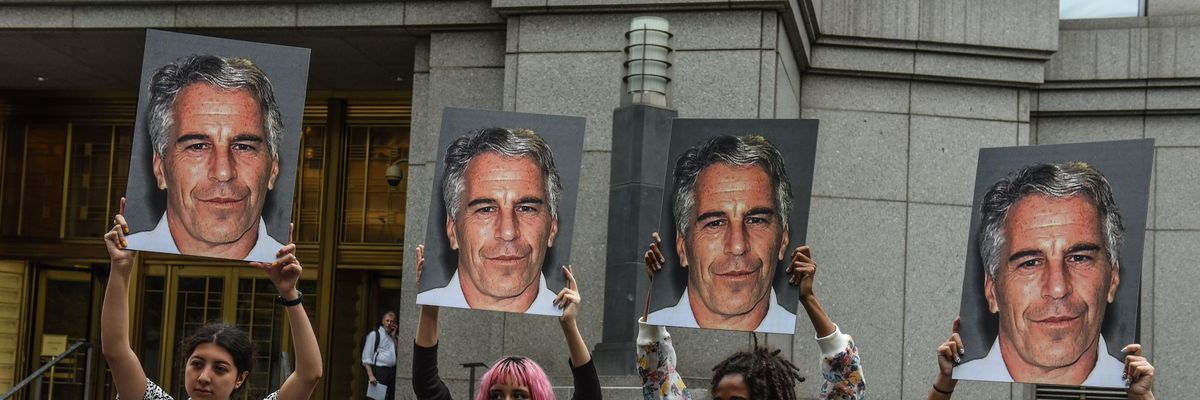
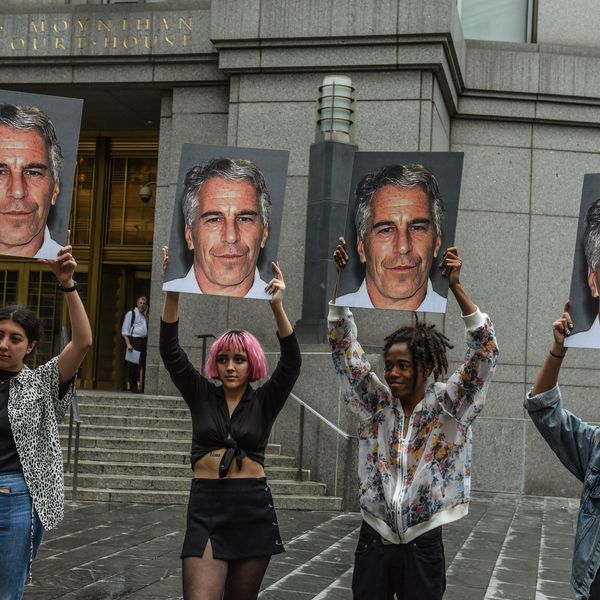
A protest group called “Hot Mess” hold up signs of Jeffrey Epstein in front of the Federal courthouse on July 8, 2019 in New York City. According to reports, Epstein will be charged with one count of sex trafficking of minors and one count of conspiracy to engage in sex trafficking of minors.
(Photo by Stephanie Keith/Getty Images)
There has been wall-to-wall US corporate media coverage of the Department of Justice’s Epstein files and the battle over its release. So why has new reporting about hacked materials largely been ignored by US corporate media?
However, the Epstein/Mossad ties were often labeled by US corporate media as “unfounded” (New York Times, 8/24/25), dismissed as a “conspiracy theory” (New York Times, 7/16/25), or said to have been “largely manufactured by paranoiacs and attention seekers and credulous believers” (New York Times, 9/9/25). Former Israeli Prime Minister Naftali Bennett has claimed that “Epstein’s conduct, both the criminal and the merely despicable, had nothing whatsoever to do with the Mossad or the State of Israel.”
It’s true that far-right antisemites like Candace Owens and Tucker Carlson have promoted a conspiratorial version of the Epstein/Israel connection as part of their bigoted, attention-seeking narratives. But recent investigations by Drop Site News—the nonprofit investigative outlet founded in July 2024—into a major hack targeting Israel revealed that Epstein did play a significant role in brokering multiple deals for Israeli intelligence. Despite the hack’s significant revelations, US corporate media coverage remains scant.
‘Knack for steering the superpowers’
Since 2024, a hacking group called “Handala” with reported ties to the Iranian government (Committee to Protect Journalists, 7/9/25) has carried out a series of cyberattacks targeting Israeli government officials and facilities (Press TV, 12/1/24; CyberDaily, 6/16/25).Aspects of the Handala hack were published on the website of nonprofit whistleblower Distributed Denial of Secrets (DDoS), including hundreds of thousands of emails from former Israeli Prime Minister Ehud Barak, one of Epstein’s closest connections.
Since the hacked information was released, numerous independent media outlets—including Reason (8/27/25), All-Source Intelligence (9/17/25, 9/29/25, 10/13/25), Grayzone (10/6/25, 10/9/25, 10/13/25), the (b)(7)(D) (10/16/25, 10/21/25) and DeClassified UK (9/1/25, 11/3/25)—have published investigations on its contents. Among the independent media outlets, Drop Site‘s coverage stands out for its in-depth research and broad scope.
Drop Site‘s investigations into the Handala hack have included six major stories since late September, four of which have centered around “Epstein’s work on behalf of Israeli military interests, particularly as it relates to his role in the development of Israel’s cyber warfare industry.”
Drop Site reporters Murtaza Hussain and Ryan Grim (9/28/25) detailed how Epstein wielded his influence to expand Israel’s cyber warfare industry into Mongolia. Drop Site wrote:
Jeffrey Epstein…exploited his network of political and financial elites to help Barak, and ultimately the Israeli government itself, to increase the penetration of Israel’s spy-tech firms into foreign countries.
In their next piece, Drop Site revealed (10/30/25) that Epstein created an Israel/Russia backchannel to attempt to oust Syrian President Bashar al-Assad. Hussain and Grim reported that Epstein also worked with Barak and Russian elites to pressure the Obama administration into approving strikes on Iran, demonstrating his “knack for steering the superpowers toward Israel’s interests by leveraging a social network that intersected the Israeli, American and Russian intelligence communities.”
In the same piece, Hussain and Grim quoted Epstein asking Barak to “wait until they could speak privately before Barak notified intelligence leaders of a deal” with Russian-Israeli oligarch Viktor Vekselberg, and to “not go to number 1 too quickly.” Number 1 has long been a nickname for the head of the Mossad, DropSite noted.
Another article (11/7/25) recounted that Epstein sold surveillance technology to Côte d’Ivoire: “Epstein helped Barak deliver a proposal for mass surveillance of Ivorian phone and internet communications, crafted by former Israeli intelligence officials.”
Most recently, Grim and Hussain (11/11/25) reported that an Israeli spy regularly stayed at Epstein’s Manhattan apartment. The spy, Yoni Koren, “made his intelligence career working in covert operations alongside the Mossad.”
Failing to cover the Handala hack
Hacked information must be handled ethically by journalists—including by verifying the files, considering public interest, concealing identities when necessary, and noting its origins. This is what Drop Site has done. And its reporting has significant public interest, revealing the ways in which Epstein served Israel’s interests.
Yet in a search of ProQuest’s US Newsstream collection for “Handala,” as well as a supplementary Google search, the only US corporate media outlet found to have covered the Handala hack is the New York Post (8/31/25). Its single 700-word story, drawing from Reason (8/27/25) and the Times of London (8/30/25), focused on how Prince Andrew stayed in contact with Epstein for five years longer than previously stated—sidestepping the revelations from Drop Site about Epstein’s ties to Mossad.
Hussain, who had not seen the New York Post story, said US corporate media is “deliberately ignoring” the story:
It’s such a goldmine of stories. They’re not going through it, they don’t want to talk about it. I think it’s very difficult for them to conceive what these emails refer to because they’ve spent so much time talking about it as a conspiracy theory. And now contravening evidence is emerging, or well-substantiated evidence, showing that it’s really not a conspiracy theory.
Indeed, recent mentions of Epstein’s ties to Israeli government officials have continued to dismiss them as conspiracy theories, ignoring the hack and Drop Site‘s work. For instance, an LA Times op-ed (10/10/25) on antisemitism in the GOP listed Tucker Carlson’s suggestion that “Epstein was a Mossad agent” (and accusing Israel of “genocide” in Gaza) as evidence of “appalling behavior,” alongside things like “entertaining Hitler/Nazi apologia” and suggesting that “Jews had something to do with [Charlie] Kirk’s death.”
The New Yorker‘s Jay Caspian Kang (10/10/25) asserted in his weekly column:
On Planet Epstein, everything that happens—the assassination of Charlie Kirk, the war in Gaza, the suppression of speech by the Trump Administration—proves the country is run by blackmail, pedophilia and fealty to Israel.
While it is of course absurd to blame “everything” on Epstein or Israel—and right-wing conspiracy theories that incorporate antisemitism are very real and dangerous—is it really unreasonable to blame “the war in Gaza” on too much “fealty to Israel”? After all, from October 7, 2023 to September 2025, the US sent $21.7 billion in military aid to Israel, according to Brown University’s Costs of War project—more than a quarter of Israel’s total post–October 7 military expenditures. Epstein’s evident connections to Mossad do raise the question of whether there is more to that “fealty” than the $100 million the pro-Israel lobbying group AIPAC spent on both parties during the 2024 election cycle (Common Dreams, 8/28/24).
By using the “conspiracy theory” frame, Kang not only overlooked the recently revealed files from Drop Site, but also failed to convey the full scope of Epstein’s influence, leaving the actions of associates and key government officials unscrutinized.
Other Handala revelations
Other aspects of the Handala hack have also been well-covered by independent media, including reports of billionaires funding an Israeli cyber campaign against anti-apartheid activists (All-Source Intelligence, 9/17/25). Other stories describe Iran striking a secret Israeli military site near a Tel Aviv tower (All-Source Intelligence, 10/13/25; Grayzone, 10/13/25), and Larry Ellison’s son, David Ellison, meeting with a top Israeli general to plan spying on Americans (Grayzone,10/6/25). The Grayzone (10/9/25) also reported that a former US ambassador secretly worked with a top Israeli diplomat to help Israel access several prestigious UN committees.
In Israeli media, Haaretz (3/9/25) reported that thousands of Israeli gun owners were exposed in an Iranian hack-and-leak operation. The paper (7/9/25) also revealed the leak of a database containing thousands of résumés belonging to Israelis who served in classified and sensitive positions within the Israel Defense Forces and other military and security agencies.
These details, like those about Epstein, have also been met with silence in US corporate media.
There has been wall-to-wall US corporate media coverage of the Department of Justice’s Epstein files and the battle over its release. So why has the hack largely been ignored by US corporate media? One possible reason is the hack’s likely origin. It has been reportedly attributed to Banished Kitten, a cyber unit within Iran’s Ministry of Intelligence (Committee to Protect Journalists, 7/9/25). Hacks purportedly emanating from Iran are rarely covered in US corporate media—and when they are, the origin of the hack, not its content, becomes the focus.
Look no further than media coverage of the 271-page official dossier of then–Republican vice presidential candidate JD Vance, which revealed that the Trump campaign believed Vance “embraced noninterventionism,” among other purported vulnerabilities (Ken Klippenstein, 9/26/24). The US government alleged the Vance dossier was leaked through Iranian hacking (FAIR.org, 9/30/24). While the New York Times,Washington Post and Politico possessed the Vance dossier for weeks, they declined to publish it (Popular Information, 9/9/24).
The contents of the Vance dossier were eventually revealed by independent reporter Ken Klippenstein, as well-documented by FAIR contributor Ari Paul (9/30/24). Paul noted that while Klippenstein’s reporting pushed the story into the legacy media, “most of the reporting about this dossier has been on the intrigue revolving around Iranian hacking rather than the content itself” (Daily Beast, 8/10/24; Politico, 8/10/24; Forbes, 8/11/24).
Today, despite Drop Site‘s thorough and revealing reporting, the Handala hack has been almost completely ignored by US corporate media. Said Drop Site‘s Hussain:
A lot of these [media] organizations, it’s kind of not a secret, they have sympathies or ties to Israel, so it’s not a story which is appealing to them, it’s not politically convenient for these organizations, for the most part. I think when something’s in the public interest, you report on it, and you’re transparent about where it came from. But in this case, [US corporate] media chose not to.
LAST 2 WEEKS IN REVIEW I’m your Representative in Congress and I write to keep you informed. The chaos and costs of Trump’s tariff strategy A junior varsity national security team No one is above the law, or below it Big ideas to govern better Hitting back on behalf of scientists Meeting with constituents in the MA-04 The chaos and costs of Trump’s tariff strategy WSJ’s “dumbest trade war in history”: The president announced sweeping tariffs this week, which amount to a $500+ billion tax hike on everyday Americans. The tariffs were calculated nonsensically and communicated incoherently. There is robust debate between policymakers and economists about how tariffs might help America, but every serious participant in that debate recognizes that the chaos of this tariff roll-out will cause pain for businesses, families, and allies alike. I have often joined the tariff debate, generally arguing for free trade with the exception of Chin...
17 September 22 Stand Up For Reader Supported News Come on folks don’t just sit there and let RSN struggle financially. What we need to function is a drop in the bucket. When you get involved, when you take an ownership stake good things happen. Help RSN! Marc Ash Founder, Reader Supported News Sure, I'll make a donation! If you would prefer to send a check: Reader Supported News PO Box 2043 / Citrus Heights, CA 95611 Follow us on facebook and twitter ! Update My Monthly Donation 17 September 22 Live on the homepage now! Reader Supported News ONE THING MISSING THIS MONTH, LARGER DONATIONS — Each month we manage to get one or two or three thousand dollar donations. So far this month we do not have any. Obviously that kind of donation is a huge boost and goes a long way to match our smaller donors. Who can? Marc Ash • Founder, Reader Supported News Sure, I'll make a donation! 'Hat in Hand': Putin Meets Xi at Summit in Samarkand Al...
Ramble On: Waiting for the Barbarians (video) Morning thoughts on exfiltrations, the gutting of the FDA, tomorrow's protests, and how to quiet the brain by visiting Alexandria Greg Olear Apr 4 Good morning! Here is today’s ramble: And here is the transcript, edited for clarity: Good morning. It is Friday, April 4th, 6:17 a.m. We’ve made it. Those of us who have made it have made it through another batshit crazy week, courtesy of Trump and Musk and Vance and this entire cockamamie administration. There’s so many things to discuss. The Five 8 is gonna be lit tonight. I encourage you to watch that if you’re around, at 8 p.m. Eastern, on our YouTube channel, The Five 8 . This morning, I don’t know, I want to talk about a couple of things and my own emotional state this week, because I think that might be helpful. Two stories that really stuck out for me. One of them I wrote about on Monday, or Tuesday rather, in the April Fool’s piece , which is that the ICE Ge...


















Comments
Post a Comment