RSN: Adam Harris | Biden's Cancellation of Billions in Debt Won't Solve the Larger Problem

28 August 22
A Daily Struggle Against Fascism
Is what our work at RSN has become. It’s real, it’s pervasive and most people would rather not look at it.
This is a pretty serious battle against some pretty serious people.
We need funding in the worst way.
Marc Ash
Founder, Reader Supported News
If you would prefer to send a check:
Reader Supported News
PO Box 2043 / Citrus Heights, CA 95611
Follow us on facebook and twitter!
27 August 22
Live on the homepage now!
Reader Supported News

Belatedly canceling some debt is what a country does when it refuses to support students up front.
Today, calls for relief were answered when President Joe Biden announced that his administration would be canceling up to $10,000 in student loans for those with federal debt, and up to $20,000 for Pell Grant recipients. As long as a borrower makes less than $125,000 a year, or makes less than $250,000 alongside a spouse, they would be eligible for cancellation. The president will also extend the current loan-repayment pause—originally enacted by then-President Donald Trump in March 2020 as a pandemic-relief measure—until December 31.
The debt relief—which by one estimate could cost a total of $300 billion—is a massive benefit for Americans who have struggled to repay loans they accrued attending college, whether they completed a degree or not. But equally as important as addressing the damage that student loans have caused is ensuring that Americans aren’t saddled with overwhelming debt again. And the underlying issue of college affordability can be addressed only if America once again views higher education as a public good. Belatedly canceling some student debt is what a country does when it refuses to support students up front.
According to a White House fact sheet, 90 percent of Biden’s debt relief will go to those who earn less than $75,000 a year—and the administration estimates that 20 million people will have their debt completely canceled. “An entire generation is now saddled with unsustainable debt in exchange for an attempt, at least, for a college degree,” Biden said at a White House event. “The burden is so heavy that even if you graduate, you may not have access to the middle-class life that the college degree once provided.” That Democrats arrived at this point at all, though, is a testament to how grim the student-loan crisis has become. A decade and a half ago, Democrats were advocating for small increases in the federal grant program to help low-income students afford college. Over successive presidential campaigns, Democratic hopefuls, including Senator Bernie Sanders of Vermont and Senator Elizabeth Warren of Massachusetts, have called for canceling most, or all, student debt issued by the government—effectively hitting reset on a broken system. And now the party is announcing one of the largest federal investments in higher education in recent memory.
When he was running for president in 2007, Biden advocated for a tax credit for college students and a marginal increase in the size of individual Pell Grant awards—tinkering around the edges of solving a brewing mess as America lurched toward a deep recession. From 2006 to 2011, college enrollment grew by 3 million, according to the U.S. Census Bureau; at the same time, states began to cut back on their higher-education spending. On average, by 2018, states were spending 13 percent less per student than they were in 2008.
Historically, when states look to cut their budgets, higher education is one of the first sectors to feel the blade. Polling shows that the majority of Americans agree that a college degree pays off. But college, unlike K–12 schooling, is not universal, and a majority of Republicans believe that investment in higher education benefits graduates more than anyone else. So lawmakers have been willing to make students shoulder a greater share of the burden. But this shift leaves those with the fewest resources to pay for college—and those whose families earn a little too much to qualify for Pell Grants—taking on significant debt.
The shift flies in the face of the Framers’ view of higher education, though. “There is nothing which can better deserve your patronage than the promotion of science and literature,” George Washington, an early proponent of the idea of a national university, said in his first address before Congress, in 1790. “Knowledge is in every country the surest basis of public happiness.” Washington, James Madison, Benjamin Rush, and others believed that colleges might be a place where Americans could build a national identity—a place where they could, for lack of better words, become good citizens.
In that spirit, the federal government provided massive investments in the nation’s colleges, albeit inequitably—through the Morrill Act, which formed the backbone of state higher-education systems as we know them; the GI Bill; and the Pell Grant program—which directly subsidize students’ expenses. But in the past half century, radical investments in higher-education access have dried up. Now a political divide has opened up: Conservative lawmakers—whose voters are more likely not to have attended college—have grown not only suspicious of but in some cases openly hostile toward the enterprise.
Meanwhile, 77 percent of Democrats believe that the government should subsidize college education. “We want our young people to realize that they can have a good future,” Senator Chuck Schumer said in April. “One of the best, very best, top-of-the-list ways to do it is by canceling student debt.” He wanted the president to be ambitious and called for giving borrowers $50,000 in relief—“even going higher after that.” A month into his administration, though, Biden shot down the idea of $50,000, to the chagrin of relief advocates. “Canceling just $10,000 of debt is like pouring a bucket of ice water on a forest fire,” the NAACP’s Derrick Johnson and Wisdom Cole argued today. “It hardly achieves anything—only making a mere dent in the problem.”
The administration is coupling its announcement with a redesign of payment plans that allows borrowers to cap their monthly loan payments at 5 percent of their discretionary income. But the basic problem remains: Young Americans of modest means can no longer afford to attend their state university by getting a part-time job and taking out a small loan. For millions of students, borrowing thousands of dollars has become the key to paying for an undergraduate degree. Biden’s plan will give graduates—and those who have taken out loans but not finished school—some relief, but the need to overhaul a system reliant on debt remains as urgent as ever.
 A missile at a demonstration show in Russia. (photo: Getty Images)
Much of the concern centers on the cooling systems for the plant's nuclear reactors. The systems require power to run, and the plant was temporarily knocked offline Thursday because of what officials said was fire damage to a transmission line. A cooling system failure could cause a nuclear meltdown.
Russian forces occupied the nuclear plant complex early in the 6-month-old war in Ukraine, and Ukrainian workers have kept it running. The Ukrainian and Russian governments have repeatedly accused the other of shelling the complex and nearby areas, raising fears of a possible catastrophe.
Periodic shelling has damaged the power station's infrastructure, Ukraine's nuclear power operator, Energoatom, said Saturday. "There are risks of hydrogen leakage and sputtering of radioactive substances, and the fire hazard is high," it said.
The plant sits on the southeast bank of the Dnipro River, right on the edge of Russian-occupied territory in southeast Ukraine, putting the sprawling complex squarely on the front line of some of the most intense battles raging between Ukrainian and Russian forces.
In the latest conflicting attack reports, the governor of Ukraine's Dnipropetrovsk region, Valentyn Reznichenko, said Saturday that Grad missiles and artillery shells hit the cities of Nikopol and Marhanets, each located about 6 miles and across the river from the plant.
But Russian Defense Ministry spokesman Igor Konashenkov said Ukrainian forces had fired on the plant from Marhanets. Over the past day, 17 Ukrainian shells hit the plant, with four striking the roof of a building that stores nuclear fuel, he said.
It was not immediately possible to verify either account given restrictions on journalists' movements and the ongoing fighting.
The U.N.'s atomic energy agency has tried to work out an agreement to send a team in to inspect and help secure the plant. Officials said preparations for the visit were underway, but it remained unclear when it might take place.
Ukrainian President Volodymyr Zelenskyy said it was essential for International Atomic Energy Agency representatives to get to the plant as soon as possible and to help keep it "under permanent Ukrainian control."
"The situation remains precarious and dangerous," Zelenskyy said in latest nightly address. "Any repetition of (Thursday's) events, i.e., any disconnection of the station from the grid or any actions by Russia that could trigger the shutdown of the reactors, will once again put the station one step away from disaster."
Ukraine has claimed Russia is using the power plant as a shield by storing weapons there and launching attacks from around it. Moscow, for its part, accuses Ukraine of recklessly firing on the nuclear complex.
The dispute over the plant led Russia late Friday to block agreement on the final document of the four-week-long review of the U.N. treaty that is considered the cornerstone of nuclear disarmament. The draft document of the Nuclear Nonproliferation Treaty review conference criticized Russia's takeover of the Zaporizhzhia plant.
The deputy head of Russia's delegation said the conference became "a political hostage" to countries that were trying "to settle scores with Russia by raising issues that are not directly related to the treaty."
Elsewhere in Ukraine, one person was killed and another wounded in Russian firing in the Mykolaiv region, local government officials said. Mykolaiv city is an important Black Sea port and shipbuilding center.
The governor of the eastern Donetsk region, Pavlo Kyrylenko, said Saturday that two people were killed in Russian firing on the city of Bakhmut, a significant target for Russian and separatist forces seeking to take control of the parts of the region they do not already hold.
The British government said Saturday that it was giving Ukraine underwater drones and training sailors to use them to clear mines from the ravaged country's coastline. Mines laid in the Black Sea during the war have hampered seaborne exports of Ukrainian grain to world markets, although an agreement reached in July has allowed shipments to resume along a single corridor.
More than 1 million metric tons of Ukrainian foodstuffs have been shipped since the start of August under the Black Sea grain deal, the United Nations said Saturday.
 Senator Joe Manchin of West Virginia. (photo: Kevin Dietsch/Getty Images)
In exchange for his support of the Inflation Reduction Act, Joe Manchin demanded major giveaways to the oil industry. He got them, making his big donors in fossil fuel companies quite happy.
Critics say the provision — tax credits for unproven carbon capture technologies — is a handout to the oil and gas industry that could end up prolonging fossil fuel use instead of accelerating a transition to renewable energy. In addition, Manchin has reportedly negotiated a side deal for separate legislation that could also enrich that same fossil fuel industry donor.
The situation illustrates the continued power of fossil fuel industry lobbyists to shape legislation, even in an era when scientists say that industry’s products are destroying the livable ecosystem.
It also sheds light on a contradiction at the heart of Democrats’ Inflation Reduction Act (IRA): a bill sold to the public as a climate solution includes significant resources for the oil and gas industry fueling the climate crisis.
“A Game Changer”
Many business interests have worked to build relationships with Manchin in recent years as he has become a key figure in deciding what Congress can and cannot pass. But none have done so more than the Houston-based oil and gas pipeline company Enterprise Products Partners.
Since the beginning of this Congress, Enterprise Products’ executives, employees, and political action committee (PAC) have donated at least $159,000 to Manchin’s campaign and leadership PAC, making the company the senator’s top donor entity this election cycle, according to OpenSecrets.
The company also now employs Manchin’s son-in-law. Marshall Roberts, who is married to Manchin’s daughter Brooke, has worked for Enterprise Products since June 2020, most recently as a senior manager for commercial refined products, according to his LinkedIn page.
Now, thanks to language in the reconciliation bill that Manchin negotiated with Senate majority leader Chuck Schumer (D-NY), Enterprise Products’ investment in the senator might soon pay off.
The IRA, signed last week, expands and extends a tax credit known as 45Q for companies that use technologies to capture carbon oxide that they would normally release into the atmosphere. More than five hundred environmental organizations signed a letter warning that the unproven technology “delays the needed transition away from fossil fuels and other combustible energy sources, and poses significant new environmental, health, and safety risks.”
But Manchin claimed credit for the subsidies in a letter to the Virginia Coal Association, and they were included in the bill — just as his donor, Enterprise Products, is positioned to profit off them.
In April, Enterprise Products signed a letter of intent with Oxy Low Carbon Ventures, a subsidiary of oil giant Occidental Petroleum, to develop and commercialize a joint carbon capture and storage (CCS) service that they plan to sell to power plants and refineries, initially focusing on those in the industrial corridor spanning from Houston to Beaumont and Port Arthur, Texas.
Enterprise Products is most excited about a line in the bill that increases the credit for carbon oxide that is captured and stored underground from its current rate of $50 per metric ton to $85 per metric ton. According to Enterprise Products CEO Randy Fowler, such changes could be “a game changer” for their joint project with Oxy.
“In our efforts to commercialize a carbon sequestration system with Oxy, we believe the proposed changes to the 45Q credits could be a game changer for postcombustion emitting customers,” Fowler said on August 3 during the company’s quarterly earnings call:
It was harder to come in or more of a challenge to come in and commercialize the carbon sequestration projects and attract these customers when the existing 45Q program was only paying $50 per metric ton and had no direct pay options.
The IRA also allows companies like Enterprise Products to claim 45Q credits as direct pay, meaning they can treat the credits like overpayments on their taxes and claim cash payments from the government annually. And the bill opens up the credits to smaller power plants, and extends the date to qualify for the credits by seven years.
The Congressional Budget Office estimates the IRA’s changes to the 45Q tax credit will cost the government $3.2 billion over the next ten years.
Although many environmental groups oppose government investments in carbon capture projects, the United Nations Intergovernmental Panel on Climate Change, which reviews climate science literature, wrote in its April report on climate mitigation that carbon capture technologies would likely be needed to avoid the most dire consequences of global warming. As the MIT Technology Review noted, “The UN report suggests that it’s now nearly impossible to prevent 1.5 degree Celsius of global warming without substantial efforts to remove carbon — and very, very difficult to steer clear of 2 degrees Celsius without it as well.”
Enterprise Products is just one of many oil and gas companies that stand to benefit from the IRA’s provisions on carbon capture technologies and other matters. The new law also mandates new oil and gas leasing in the Gulf of Mexico and offshore of Alaska and stipulates that any federal lands and offshore areas used for renewable energy development must also be available for fossil fuel projects.
The oil and gas industry has been one of Manchin’s top donor industries throughout his congressional career, giving him nearly $1.2 million, according to OpenSecrets. So far this election cycle, Manchin is the top congressional recipient of oil and gas industry money, with at least $694,000 in donations from PACs and employees in the industry.
A Side Deal Could Be Another Gift
In exchange for his vote for the IRA, Manchin convinced Schumer and House Speaker Nancy Pelosi (D-CA) to agree to hold votes on a separate bill that would accelerate the permitting process for energy projects — including potentially for a proposed Enterprise oil terminal that has long been delayed.
Since January 2019, the federal government has been sitting on an application from Enterprise to build a massive facility off the coast of Texas that would be the first US terminal capable of accommodating the world’s largest supertankers — known as very large crude containers, or VLCCs — that can hold up to two million barrels of oil and are too large to enter shallow waters.
The project, known as the Sea Port Oil Terminal (SPOT), is strongly opposed by environmentalists who have filed thousands of comments with the US Maritime Administration, the agency overseeing the application. Critics of the terminal warn that the project could cause oil spills and exacerbate the climate crisis by accelerating oil extraction.
Enterprise Products has had to repeatedly extend its timeline for the project due to government inaction, most recently blowing past the “mid-2022” estimate it gave shareholders in its annual report for last year. The text of Manchin’s bill has not yet been released, but according to the Washington Post, it would set a two-year time limit for the government to review applications for “major” energy projects, and it would make it harder for the government to deny projects because of environmental impacts that are not directly caused by the project itself.
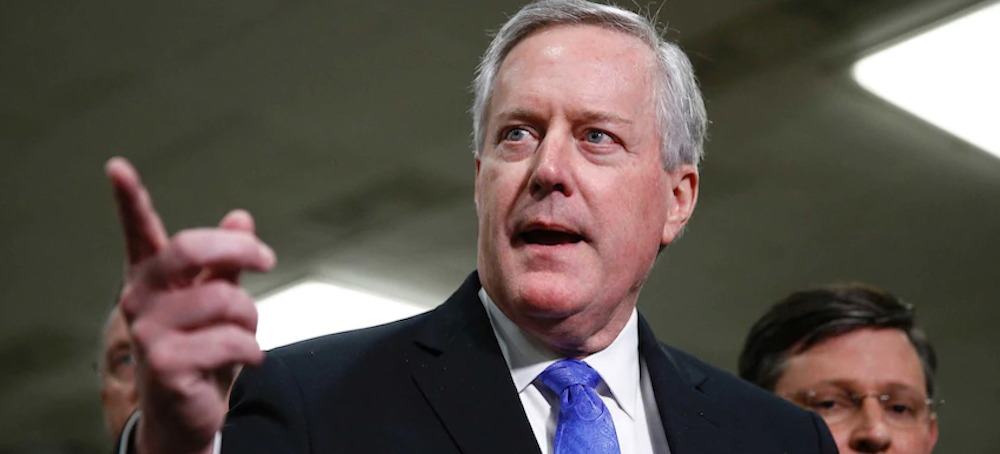 Mark Meadows. (photo: Patrick Semansky/AP)
Hint: It’s Mark Meadows.
Meadows, Trump’s final White House chief of staff, is being summoned to testify next month in Fulton County District Attorney Fani Willis’ criminal investigation into Trump allies’ attempts to flip the 2020 election.
Willis also wants to hear from pro-Trump “Kraken” lawyer Sidney Powell, Meadows contact Army Col. James “Phil” Waldron, and former Trump campaign adviser Boris Epshteyn, according to court filings released Thursday afternoon.
The attempt to compel testimony from some of Trump’s closest advisers is further evidence that Willis’ probe is looking in every corner of Trumpworld in a strikingly thorough investigation, legal experts said. Willis’ filing describes Meadows as a “material witness” to her investigation.
“The subpoena [for Meadows] tells us that the DA may be closing in on Trump and other big fish in this scandal,” Carl Tobias, a law professor at the University of Richmond School of Law, told VICE News.
Meadows participated in the infamous phone call that Trump held with Georgia Secretary of State Brad Raffensperger in January 2021 in which Trump told Raffensperger he wanted to “find” enough votes to allow him to carry Georgia. President Joe Biden won Georgia by a wafer-thin margin of 11,779 votes.
“All I want to do is this,” Trump told Raffensperger. “I just want to find 11,780 votes, which is one more than we have, because we won the state.”
Willis wrote in a court filing that her investigation uncovered that Meadows played a role in setting up the call. Willis said she wants to ask him about the planning and logistics of the call and other events from that period, including what she called a “surprise visit” Meadows took to a facility in Marietta, Georgia, where state officials were conducting ballot signature matches.
Meadows also took part in a White House meeting after the November election with members of Congress to discuss allegations of voter fraud in Georgia and elsewhere, Willis wrote, citing one of Meadows’ own tweets.
On Dec. 21, 2020, Meadows tweeted: “Several members of Congress just finished a meeting in the Oval Office with President @realDonaldTrump, preparing to fight back against mounting evidence of voter fraud. Stay tuned.”
“The witness possesses unique knowledge concerning relevant communications between the witness, former President Donald Trump, the Trump Campaign and other known and unknown individuals in the multi-state coordinated efforts to influence the results of the November 2020 election in Georgia and elsewhere,” Willis’ team wrote in court documents.
Willis has formally informed longtime Trump lawyer Rudy Giuliani and more than a dozen local Georgia political figures that they are targets of the probe, meaning they are likely to be charged with crimes. She’s also seeking to compel testimony from pro-Trump GOP Sen.Lindsey Graham of South Carolina.
Independent legal experts have told VICE News that Willis may be attempting to put together a sweeping racketeering case under a statute known as Georgia RICO, or the Georgia Racketeer Influenced and Corrupt Organizations Act. That move has the potential to wrap Trump together with his allies into a single grand case, if Willis can prove they used an organization, such as the Trump Campaign, to commit a series of crimes.
Georgia RICO is the junior cousin of the federal RICO statute, which was originally devised to bring down organized crime, and happens to be Willis’ signature move. She’s used Georgia RICO multiple times, including against the rapper Young Thug and teachers in Atlanta accused of cheating.
Meadows may seek to avoid testifying by invoking executive privilege, the legal principle that some White House conversations can be held private, as Trump allies have done repeatedly in other legal proceedings and investigations.
But using executive privilege to get out of this one is no guarantee for Meadows, said Jens David Ohlin, dean of Cornell Law School.
“Some of these meetings included members of Congress, which will complicate, or even eliminate, any possibility of claiming executive privilege,” Ohlin told VICE News. “Since members of another branch of government were present, it would be hard to claim that this was a confidential Executive Branch deliberation.”
The petitions filed by Willis for testimony are precursors to subpoenas, and must be confirmed by judges outside the state because the subjects don’t live in Georgia, according to the AP.
Willis’ public campaign to compel testimony from so many in Trump’s circle, including those close to Trump himself, may be a tactic to help induce witnesses to reveal what they know, said Harry Sandick, a former prosecutor for the Southern District of New York.
“This says that the DA’s office is conducting a full, public investigation,” Sandick said. “They are seeking information from everyone, and making public filings, so witnesses will know whether other people are going on. The idea is that someone may wonder, ‘Hey, is this other witness going to tell the whole story?’ and so it might incentivize people to come clean.”
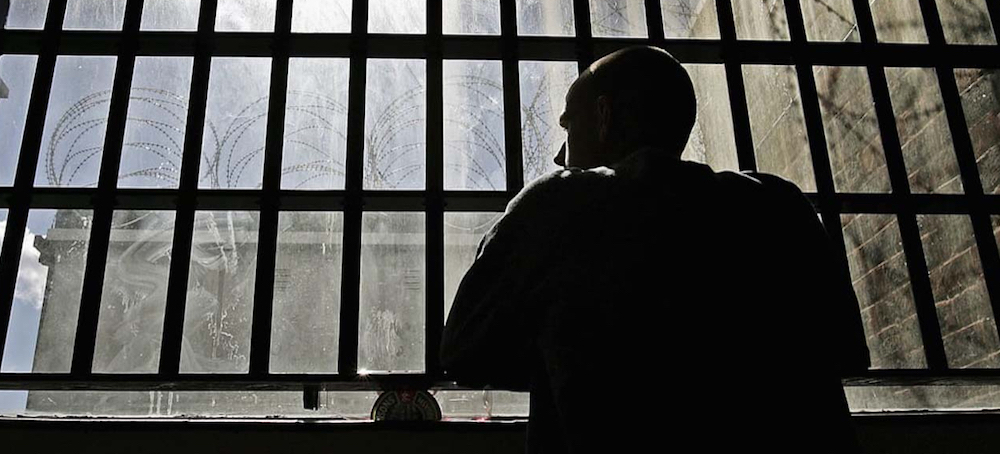 A prisoner. (photo: Peter Macdiarmid/Getty Images)
ALSO SEE: Prison-to-Detention Pipeline for Migrants Must End
When her mother died two years ago, the state of Connecticut put a lien on the Stamford home she and her siblings inherited. It said she owed $83,762 to cover the cost of her 2 1/2 year imprisonment for drug crimes.
Now, she’s afraid she’ll have to sell her home of 51 years, where she lives with two adult children, a grandchild and her disabled brother.
“I’m about to be homeless,” said Beatty, 58, who in March became the lead plaintiff in a lawsuit challenging the state law that charges prisoners $249 a day for the cost of their incarceration. “I just don’t think it’s right, because I feel I already paid my debt to society. I just don’t think it’s fair for me to be paying twice.”
All but two states have so-called “pay-to-stay” laws that make prisoners pay for their time behind bars, though not every state actually pursues people for the money. Supporters say the collections are a legitimate way for states to recoup millions of taxpayer dollars spent on prisons and jails.
Critics say it’s an unfair second penalty that hinders rehabilitation by putting former inmates in debt for life. Efforts have been underway in some places to scale back or eliminate such policies.
Two states — Illinois and New Hampshire — have repealed their laws since 2019.
Connecticut also overhauled its statute this year, keeping it in place only for the most serious crimes, such as murder, and exempting prisoners from having to pay the first $50,000 of their incarceration costs.
Under the revised law, about 98% of Connecticut inmates no longer have to pay any of the costs of their incarceration after they get out, said state Rep. Steve Stafstrom, a Bridgeport Democrat and a sponsor of the repeal legislation.
The state retained its ability, though, to collect some prison debts already on the books before the law changed. It’s unclear whether the change in the law, made after Beatty sued, will be enough to keep her in her home. That will be decided in court.
Her lawyers have asked a federal judge to block the state from enforcing the law against anyone, saying it remains unfair even after the amendments.
Beatty acknowledges she was guilty of selling and possessing drugs, but said nobody told her when she went to jail that every day behind bars would cost her more than a night at a fine hotel.
“It just drags you back to despair,” said Beatty, who has had other brushes with the law over drug possession since her release from jail, but has also become a certified nursing assistant. “That’s where I feel like I’m at. I feel like no hope. Where do I go? All of this work and it feels like I’ve done it in vain.”
Pay-to-stay laws were put into place in many areas during the tough-on-crime era of the 1980s and ’90s, said Brittany Friedman, an assistant professor of sociology at University of Southern California who is leading a study of the practice.
As prison populations ballooned, Friedman said, policymakers questioned how to pay for incarceration costs. “So, instead of raising taxes, the solution was to shift the cost burden from the state and the taxpayers onto the incarcerated.”
Laws vary from state to state. Many, like Connecticut, only go after inmates for the cost of incarceration if they come into money after leaving prison. A few, such as North Carolina, have laws on the books but almost never use them, Friedman said.
Connecticut’s partial repeal went into effect July 1. The state is projected to collect about $5.5 million less per year from ex-prisoners because of the change.
State Sen. John Kissel, the top Republican on the legislature’s Judiciary Committee, said he opposed the repeal passed by the Democratic majority, but might support reforms like allowing inmates to pay off debt in installments.
Kissel said that while Beatty’s situation tugs at one’s heartstrings, “Everybody has issues.”
“The policy is to make one appreciate that your incarceration costs money,” he said. “The taxpayers footed the bill. They didn’t do anything wrong. And knowing that one has to pay the state back a reasonable sum on a regular basis is not a bad policy.”
Connecticut used to collect prison debt by attaching an automatic lien to every inmate, claiming half of any financial windfall they might receive for up to 20 years after they are released from prison, said Dan Barrett, legal director for the American Civil Liberties Union of Connecticut. That included things like insurance settlements, inheritances and lottery winnings.
The state even collected money awarded to inmates in lawsuits over alleged abuse by prison guards.
Former Connecticut inmate Fred Hodges, who served more than 17 years in prison for killing a man while trying to retrieve his son’s stolen bicycle, came into $21,000 after his car was totaled in a 2009 traffic accident. The state claimed half of that, he said. After paying his lawyer, he was left with about $3,000.
“I have seven grandchildren and the money could have helped them. It could have helped me,” said Hodges, who works for a nonprofit that helps other inmates reenter society. “You’d be surprised at the effect it can have on you psychologically when they tell you you owe them $249 a day. I was locked up for 17 1/2 years. At $249 a day, how are you going to come up out of that?”
Beatty’s lawsuit, which is seeking class-action status, argues that the pay-to-stay seizures violate the excessive fines clause of the Constitution.
Da’ee McKnight, who works with Hodges as a coordinator for an organization called Family ReEntry, said the state took an insurance settlement from him, even though he served most of his sentence before the law was on the books.
“Here, I’m being penalized for something that I was not even made aware of at the time I was sentenced, because it did not even exist,” he said.
 A.U.C. paramilitary soldiers in Colombia. (photo: AP)
For decades, oil-rich Arauca has been the site of intense conflict involving illegal armed groups, the Colombian military, and multinational corporations.
In 2020, President Trump sent 50 U.S. special forces personnel to train and advise Colombian forces in strategic regions, including the department of Arauca. The following year, the United States provided Colombia with five UH-1 Bell Huey helicopters and 20 M1117 armored security vehicles in an effort to increase military capabilities. In December, Colombia’s Defense Minister, Diego Molano announced that the new fleet of military vehicles would be deployed to the country’s north-eastern department of Arauca near the border with Venezuela, along with two new military bases.
Why has Arauca been singled out for this “enhanced” security policy? One answer is oil.
War in Colombia’s Oil Frontier
Oil was first discovered in Colombia in 1866 near the port city of Barranquilla. Ten years later, more was found around the Gulf of Urabá, near the Panamanian border, but serious exploitation did not take place until 1922, after the ratification of the Urrutia-Thomson Treaty between Colombia and the United States. This agreement brought to a close the diplomatic imbroglio caused by U.S. support for the Panamanian separatists who revolted against Colombia in 1903 and paved the way for massive U.S. investment in Colombian banana plantations and oil fields. Soon Tropical Oil, a subsidiary of Standard Oil, began production in the central Magdalena Valley and built a refinery complex in the city of Barrancabermeja.
In 1983, tests on wells dug by Ecopetrol and Occidental Petroleum, known as OXY, at Caño Limón in Cravo Norte, Arauca, indicated that oil reserves in that location amounted to 500 million barrels. By 1994, the flow was more than a million barrels a day, and the boom in Colombia’s oil frontier was underway.
Sustained guerrilla warfare in Arauca dates back to the beginning of La Violencia, when Liberal rebels, incensed by the 1948 assassination of populist leader Jorge Eliécer Gaitán, began a virtually unwinnable struggle against the Conservatives who had long held power. On June 13, 1953, army commander Lt. General Gustavo Rojas Pinilla seized power and immediately called for an end of civil strife. He offered amnesty to nearly all the guerrillas but banned the Communist party. Many were left dissatisfied by the reparations offered and their inability to participate politically. In the late 1950 the FARC (Revolutionary Armed Forces of Colombia) and the ELN (National Liberation Army) reorganized their operations. Soon they came to dominate much of the border region where the central government had never established a strong presence.
The exploitation of petroleum in Arauca beginning in the late 1980s exacerbated the armed conflict. Both leftist guerrilla and rightwing paramilitary groups fortified themselves economically and militarily. The FARC and ELN were quick to capitalize on the opportunities to open a new front in their war against the central government and extract economic resources offered by the presence of multinational corporations (MNCs) exploring for oil. In Arauca, oil pumped through the Caño Limón-Coveñas pipeline became a major target for both guerrilla forces. According to a top OXY executive, rebels blew up the pipeline 460 times between 1985 and 1997.
However, it is not only the illegal armed actors that are responsible for the bloodshed in Arauca. The Colombian Armed Forces and, indirectly, U.S. aid and OXY have worsened the suffering for innocent Colombians. In 1998, the Colombian Armed Forces, supported by U.S. antidrug aid and a private U.S. surveillance company with logistical support and equipment from Occidental, used U.S. cluster munition to bomb the small village of Santo Domingo, killing 18 innocent civilians, including 7 children and wounding more than 25 others.
On August 20, 2004, Isabel Hilton, a reporter for The Guardian newspaper, observed that “a complex mosaic of armed groups—rightwing paramilitaries and the army, often working closely together, and leftwing guerrillas—were struggling for control of the lucrative pipeline and cocaine routes.” In response, President Álvaro Uribe declared a special security zone around the three northern municipalities of the department where the oil pipeline is located, and OXY and the U.S. government began funding the Colombian army’s 18th Brigade, the main government force in the zone. Despite this effort, security in the region did not increase, and civilians who assumed any position of leadership, such as school teachers, health workers, and union activists, were being killed in “appalling numbers.”
Blood and Oil: U.S. Counterinsurgency Policy in Arauca
The United States began funding and training the Colombian military in the late 1950s and early 1960s. U.S. military officials instructed the Colombian armed forces to target armed and unarmed actors suspected of harboring communist sympathies or “subversive thoughts.”
Alongside these threats to U.S. political influence in Colombia were specific economic interests. In 1959 for example, Colombia was one of the largest markets in South America for U.S. direct foreign investment.
Under the Clinton administration, the United States began sending billions of dollars in military aid to Colombia. As part of this multi-year counter-narcotics package called Plan Colombia, the United States sent $98 million to train approximately 4,000 Colombian military personnel to protect the OXY-owned Caño Limón pipeline, despite the military’s well-documented ties to right-wing paramilitary death squads. According to a report by Human Rights Watch these paramilitary groups were ”...fully integrated into the army's battle strategy, coordinated with its soldiers in the field, and linked to government units via intelligence, supplies, radios, weapons, cash, and common purpose that they effectively constitute a sixth division of the army.”
In 2020, the Carlyle Group, one of the most important investment groups in the world with over $221 billion in assets, purchased all of OXY's onshore continental assets for $825 million dollars. Despite OXY’s claims of environmental sustainability and social responsibility, the communities in Arauca are soundly opposed to their extractivist activities that threaten to destroy the local ecosystem and engulf the region in an armed struggle over control of the region’s vast oil reserves.
Corporate Plunder and Popular Resistance
The Colombian government has issued sweeping oil concessions in the department of Arauca, some estimate as much as 80 percent of Arauca’s territory. By taking advantage of institutional weakness and bribing local officials, transnational corporations like OXY have been able to ignore environmental regulations, dumping tens of thousands of barrels of contaminated water into the flood zones of Caño Limón and the Arauca River, destroying the vegetation and biological resources in the headwaters of the Cinaruco and Capanaparo rivers.
“[OXY] has a whole history of serious impacts on the lives of the Colombian people, and especially the people of Arauca” said Jose Vicente Murrillo, a national spokesperson for the Cumbre Agraria, Campesina, Étnica y Popular (Agrarian, Peasant, Ethnic and Popular Summit), and a member of Congreso de los Pueblos (Peoples Congress), one of the groups targeted by the car-bomb attack on January 19. He called OXY’s exploration and exploitation of the Caño Limón oil field in Laguna de Lipa an “ecocide,” adding, ”By drying up the lagoon and dispossesing Indigenous communities from their spiritual territory, they were eliminated spiritually [...] thats why we consider that there was a genocide on top of the ecocide of the species of flora and fauna that were there.”
A U.S.-backed policy of militarization is clearly underway in Arauca. In October 2021, the U.S. Southern Command donated 20 M1117 armored security vehicles in a handover ceremony at the Buenavista Military Fort. The 20 M1117 ASVs showcased during the ceremony are part of the first of 145 vehicles scheduled to be delivered to Colombia, nearly doubling Colombia’s current fleet of armored vehicles. A month later, on January 3, Colombian President Ivan Duque sent over 680 troops to the department of Arauca, joining the nearly 7,000 already deployed to the border region. On March 10, President Joe Biden designated Colombia as a major non-NATO ally, paving the way for even greater military cooperation.
Multinational corporations like OXY have even financed special investigation units within the Attorney General’s office to investigate acts of sabotage against the pipeline, however, these special units have later been weaponized to criminalize and stigmatize civil society organizations opposed to their interests.
“If you look at all the investigations that these special units have carried out, they are cases that have been fabricated, orchestrated, and framed [...] that in 99 percent of cases are proven to be false by federal courts,” said Murillo, “this means [OXY] is involved in the armed conflict, but also involved in the social and political conflict because they are injecting resources for structures that are dedicated to the stigmatization, persecution, and criminalization of social movements in Arauca.”
Despite decades of U.S.-funded counterinsurgency warfare and criminalization, popular movements in Arauca remain some of the strongest in the country. In order to protect their territory and confront large oil interests, more than 80 local grassroots organizations led an International Humanitarian Caravan to Arauca. The “Caravan for Life in Arauca,” which took place in March 2022, sought to raise awareness and stand in solidarity with the people of Arauca as they denounced the ongoing humanitarian crisis happening in the region.
“It’s incredible how state policies reflect its incapacity to guarantee comprehensive rights to the Araucanos,” said Lidia Afanador, one of the Caravan’s members. “This caravan comes to accompany, to listen, and to support the organizations that live and are present in the department of Arauca.”
On August 7, Colombia’s new leftist government, led by Gustavo Petro, took power. During the campaign, Petro vowed to end Colombia’s historic dependence on fossil fuel extraction and move towards a green economy. He also centered the need to negotiate a peaceful end to the armed conflict with groups like the ELN and strive towards building “total peace” in the country. This would have enormous impacts across Colombia, especially oil-rich regions like Arauca. However, Petro and his government face stiff opposition from multinationals and the United States, whose geopolitical interests have fueled conflict in Arauca for decades.
Despite President Joe Biden's campaign rhetoric about environmental sustainability, his administration has doubled down on interventionist policies set in motion by the Clinton administration in the early 2000s, opening up conflict-ridden regions in Colombia to foreign multinationals. The Biden administration has asked Colombia to increase oil exports to the United States by 40,000 barrels per day. The move comes as part of a U.S. diplomatic push to secure global oil supplies and keep a lid on global energy prices after Russia's invasion of Ukraine. These policies benefit corporations seeking profits at the expense of the environment and the lives of people already struggling to build peace after decades of civil war. Far from being a solution to Colombia’s armed conflict, further militarizing the region could prove to be the catalyst for a new wave of violence in Colombia.
 Drought, heat waves, wildfires, and storms fueled by climate change also endanger our native trees. (photo: Stephen Lam/SF Chronicle)
The United States recognizes eight trees as endangered or threatened. New research suggests that number should be over 100.
Trees are essential to human health and survival. Their shade cools us down on hot days, they clean the air and trap water in the soil, they provide food and shelter to countless other species, and they suck planet-warming carbon out of the atmosphere. But the world’s forests are increasingly threatened by habitat loss, climate change, pests, and pathogens. The Morton Arboretum project was part of an initiative called the Global Tree Assessment, which aims to catalog conservation assessments of all of the world’s tree species — some 60,000 total.
Many U.S. tree species had never been assessed for extinction risk, and many of the assessments that had been conducted were outdated. “Understanding the current state of trees within the U.S. is imperative to protecting those species, their habitats and the countless communities they support,” said Murphy Westwood, the vice president of science and conservation at the Morton Arboretum, in a press release.
After five years, the team has some answers. In a study that was published in the journal Plants, People, Planet on Monday, the researchers report that out of the 881 distinct species identified, between 11 and 16 percent are at risk of extinction. The most common threats to trees they found were pests and disease.
For example, the emerald ash borer, an invasive insect native to Asia that’s been eating through ash trees throughout the Northeast since the 1990s, could wipe out half of all native ash species. The study also describes a more recent threat, a fungal pathogen called laurel wilt that is transmitted by an invasive beetle and has infected laurel trees in the Southeastern U.S.
Drought, heat waves, wildfires, and storms fueled by climate change also endanger our native trees. Extreme weather can kill trees directly or make them more vulnerable to attacks from pests and pathogens. On Monday, Oregon-based forest ecologist Evan Frost, who was not involved with the tree assessment, posted photos on Twitter of his recent observations of mass die-offs of pinyon pine in the southern Sierra Nevada mountains after years of dry conditions. “Although this species is extremely drought resistant,” he wrote, “even they have limits to what is survivable. Both older & young trees have succumbed.”
Surprisingly, there is no scientific definition distinguishing trees from other shrubby plants. “There are many plant species that hover at the edge of ‘treeness,’ either in height, habit, or woodiness,” the study says. For the purposes of this study, the team went with the Global Tree Assessment’s parameters, which say that a tree is a woody plant with a single stem that grows to at least six and a half feet tall, or if it has many stems, at least one of them is vertical and about 2 inches thick “at breast height.”
Using this definition, the researchers found that only eight tree species are currently recognized by the federal government as endangered or threatened. “It is clear that the number of tree species that merit federal protections far exceeds the number currently receiving them,” the study says.
In an interview with the Washington Post, Westwood stressed that “we have a narrow and rapidly closing window” to save threatened tree species. Their survival depends on how quickly we cut carbon emissions, as well as greater forest protection and reforestation projects that produce more resilient forests.
“Our hope is that this study will inform and amplify the scope of tree conservation efforts across the country,” Westwood said in the press release.
Follow us on facebook and twitter!
PO Box 2043 / Citrus Heights, CA 95611


Comments
Post a Comment