"It's time we have a politics that puts them at the heart of what it is that we're pursuing and not as part of the appendix." |
|
As he has done numerous times before, New York City Mayor Zohran Mamdani on Thursday rejected the notion that democratic socialism has limited appeal outside of progressive urban centers by asserting that his worker-centered policies are aimed at uplifting the nation’s biggest demographic cohort—working people and their families.
Mamdani appeared on “CBS Mornings” and was asked what grade he’d give himself after 100 days leading the world’s most important city.
“You know, I’ll always leave it to New Yorkers to give me the grade but I will say that I’m proud of what the team has accomplished over the 100 days,” Mamdani told “CBS Mornings” hosts Gayle King and Vladimir Duthiers. “I mean, we saw $1.2 billion secured in a partnership with Gov. [Kathy] Hochul to deliver universal childcare in our city.”
“We held bad landlords accountable for $32 millon, fixed 6,070 apartments,” he added. “We filled 102,000 potholes and we did all of this while also returning $9.3 million back to workers and small businesses that have been ripped off by megacorporations.”
Duthiers asked whether “a democratic socialist platform can translate into something that’s electorally viable in a statewide election or a national election given that, according to Gallup, many older and rural voters still have issues with the term, with the label, socialist.”
Mamdani replied: “You know, what I find is that New Yorkers ask me less about how I describe my politics and more about whether my politics includes them, and I think what we can see is that a democratic socialist politics is one that should be judged on its delivery, like any ideology. And what we’re showing in this city is we can we can pursue the big things like universal childcare and do the pothole politics at the same time.”
“I think that this is a politics that can flourish anywhere,” he added, “because frankly there is only one majority in this country that’s the working class and it’s time we have a politics that puts them at the heart of what it is that we’re pursuing and not as part of the appendix.”
Turning to the illegal US-Israeli war of choice against Iran, Mamdani lamented that “we’re talking about spending close to $30 billion to kill thousands of people an ocean away while we’re told that we don’t have even an ounce of that money to help working-class Americans across this country.”
According to a Marist poll published earlier this month, 48% of New Yorkers approved of Mamdani’s overall performance, while 30% disapproved and 23% are unsure. A majority of respondents—55%—“have either a very favorable or somewhat favorable view of the mayor, and 33% have either a somewhat unfavorable or very unfavorable opinion.”
A majority of respondents also said the city is heading in the right direction under Mamdani, while nearly three-quarters believe the mayor is “working hard,” and 58% “have a great deal or a good amount of trust in Mayor Mamdani to make decisions that are in the best interest of New York City.”
Previous polling has also shown that Mamdani’s economic policies are popular across the country.
Responding to Mamdani’s “CBS Mornings” appearance, the Center for Economic and Policy Research (CEPR) shared its newly published “Majority Agenda,” a “roadmap” to passing policies that most Americans see as major priorities to improve their lives.
“The Majority Agenda is a collection of policy briefs on important issues where Americans generally have broad agreement across the political landscape,” CEPR explained. “The project organizes these reports into three main areas: good jobs, strong infrastructure, and fair play.”
“We’re not as divided as some media and politicians want us to believe,” CEPR contended.
"We must avoid this collapse at all costs," said a leading current researcher, who warned that "the stability of the entire planet" is at stake. |
|
The global climate crisis is causing a critical Atlantic Ocean current system to weaken much sooner than previously predicted, according to a study published on Thursday. If it stops, scientists say it could pose catastrophic consequences for Europe, Africa, and the Americas.
The Atlantic Meridional Overturning Circulation (AMOC) is one of the most important current systems in the world for maintaining the delicate balance of the global climate. It helps to keep colder regions like Europe and the Arctic mild by moving warm water northward and pushes large amounts of carbon deep into the ocean, keeping it out of the atmosphere.
Scientists have feared AMOC’s decline for some time. Previous studies have shown it to be at its weakest point in 1,600 years. But research published this month suggests that a collapse may come much sooner than anticipated.
One study, published Thursday in the journal Science Advances, used climate models and current data to predict the decline in the coming decades.
Researchers found that the system is on course to slow by more than 50% by the end of the century and could pass a significant tipping point by mid-century, at which point its decline would become irreversible.
“We found that the AMOC is declining faster than predicted by the average of all climate models,” said lead researcher Valentin Portmann, of the Inria Research Center of Bordeaux South-West. “This means we are closer to a tipping point than previously thought.”
A major driver of its slowdown has been the rapid melting of Greenland’s freshwater ice sheet into the Atlantic, which has diluted denser saltwater, making it harder to transfer northward.
He explained: “The more rapidly Greenland melts, the more freshwater floods the North Atlantic. This disrupts the sinking process, effectively applying the brakes to the entire system.”
This research followed another study published last week by scientists at the University of Miami, which found that AMOC has been weakening at four latitudes in the Atlantic.
Professor Stefan Rahmstorf, a leading AMOC researcher at the Potsdam Institute for Climate Impact Research, who was not involved in either study, called it “an important and deeply concerning result” that “confirms that the ‘pessimistic’ climate models—those projecting a severe weakening of the AMOC by 2100—are the most accurate.”
“The most dramatic and drastic climate changes we see in the last 100,000 years of Earth history have been when the AMOC switched to a different state,” Rahmstorf explained.
A shutdown of the current system poses what Canadian climate activist and marine conservationist Paul Watson described as a “domino effect of climatic upheavals.”
Scientists have projected that temperatures in northern Europe could plummet dramatically, with winters in London sometimes reaching below -20°C (-4°F) and those in Norway reaching -48°C (-54°F). It also threatens to dramatically shorten growing seasons, putting food security in peril for hundreds of millions of people.
Tropical storms in the North Atlantic would also become more severe. As the current slows, sea levels are expected to rise, and the greater temperature difference between cooling Europe and the warming tropics can fuel more intense hurricanes and increase the risk of flooding in major coastal cities.
“We must avoid this collapse at all costs,” Rahmstorf said. “The stakes are too high; this isn’t just about Europe’s climate, but the stability of the entire planet.”
Such a dramatic change in the flow of global heat could scramble temperature and rainfall patterns worldwide, putting some areas at greater risk of drought and disrupting the monsoon season that fuels agriculture in many regions.
It also risks becoming self-perpetuating, as the large amounts of carbon released from the ocean could further accelerate AMOC’s collapse. Research published last week found that carbon emissions from the Southern Ocean alone could increase global temperature by about 0.2°C.
“The science is clear: The AMOC is teetering on the edge of collapse, and the window to act is closing,” Watson said. “Yet global leaders remain paralyzed by short-term politics and denial.”
The conclusion of the most recent United Nations climate summit, COP30, has been described as woefully insufficient to address the mounting climate emergency. The roadmap for action released by the host nation, Brazil, excluded any mention of the phrase “fossil fuels” after the conference was overrun by industry lobbyists.
“The time for half-measures is over,” Watson said. “The choices we make in the next decade will determine whether future generations inherit a manageable climate or a world plunged into chaos.”
After brushing off Americans' concerns about high gas prices, the president posted a message on social media discussing the latest plans for his luxury ballroom. |
|
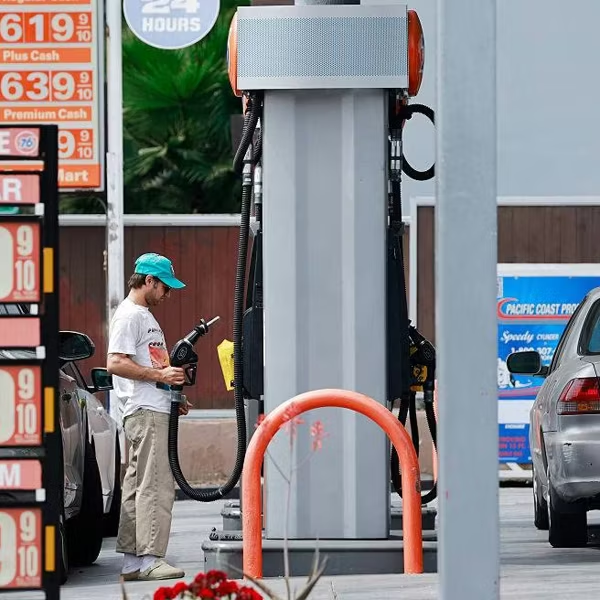
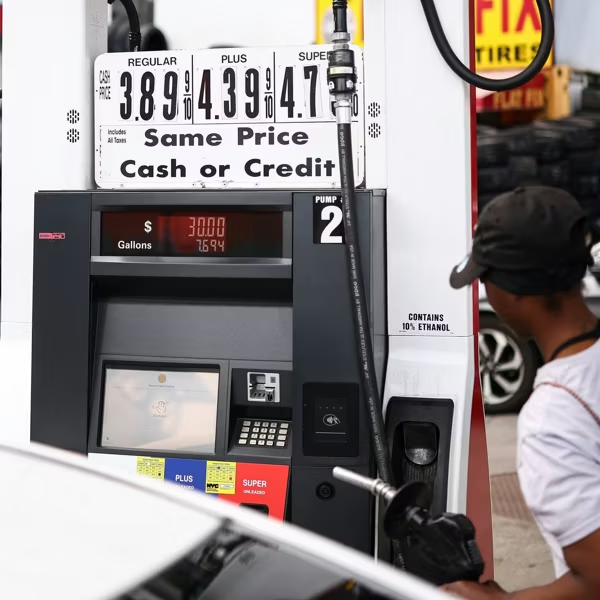
President Donald Trump on Thursday brushed off Americans’ concerns about paying $4 per gallon of gas, telling a group of reporters that this price is “not very high.”
While speaking with journalists on the White House lawn, Trump was asked by a reported from ABC News how long Americans should expect to be dealing with high gas prices, which have soared since the president launched an unconstitutional war of choice with Iran more than six weeks ago.
“They’re not very high,” Trump said. “If you look at what they were supposed to be to get rid of a nuclear weapon, with the danger that entails, so the gas prices have come down very much over the last three or four days.”
In fact, Trump-appointed Director of National Intelligence Tulsi Gabbard said under oath during congressional testimony that Iran’s uranium enrichment program was “obliterated” by US airstrikes last year, and that there had been no effort by the Iranians no effort to rebuild their enrichment capability since.
Additionally, gas prices have not come down “very much” over the last four days. According to AAA, gas prices in the US currently average $4.09 per gallon, a slight decrease from the $4.16 they averaged the week prior.
After the reporter informed Trump that gas was still over $4 a gallon, he replied, “Well, that’s what ABC says, but the fact is, if you look at the stock market, it’s up. Everything’s doing really well.”
Shortly after Trump shrugged off concerns about high gas prices, he posted a message on Truth Social discussing the security features he wants to see in the luxury ballroom he’s been planning to build on White House grounds.
Among other things, Trump said he wanted the ballroom to have “Bomb Shelters, a State of the Art Hospital and Medical Facilities, Protective Partitioning, Top Secret Military Installations, Structures, and Equipment, Protective Missile Resistant Steel, Columns, Roofs, and Beams, Drone Proof Ceilings and Roofs, Military Grade Venting, and Bullet, Ballistic, and Blast Proof Glass.”
"We don’t allow mining in Yellowstone, Yosemite, Zion, Acadia, Glacier, or any of our nation’s revered national parks—and we shouldn’t allow it in the watershed of the Boundary Waters, either," said one congresswoman. |
|
Democratic lawmakers and environmental protection groups condemned Senate Republicans on Thursday for their “heartbreaking” passage of a House resolution to overturn a 20-year moratorium on mining in the watershed of Minnesota’s Boundary Waters Canoe Area Wilderness, the nation’s most visited wilderness area—a vote that critics said was the result of years of lobbying by a foreign-owned mining firm.
House Joint Resolution 140 now heads to President Donald Trump’s desk, nearly a decade after Chilean conglomerate Antofagasta, the owner of Twin Metals Minnesota, began discussing with Trump’s first administration its desire to build a copper mine over the pristine area.
“Because of this extremely short-sighted vote, our nation’s most-visited wilderness area faces the threat of permanent toxic pollution,” said Rep. Betty McCollum (D-Minn.). “Why? So Antofagasta, a Chilean corporation that owns Twin Metals, can mine American copper and ship it to China to be smelted and sold on the global market. Twin Metals has been lobbying President Trump and Republicans in Congress for over ten years to remove the protections from this watershed and renew their mine plans to extract American minerals at the expense of freshwater for future generations.”
The 50-49 vote in the Senate, said Environment America, puts the 1.1 million-acre wilderness area for heavy metals leaching into the soil and water through acid mine drainage.
Toxic runoff from copper mining, said the group, “ultimately poisons the land and water surrounding a mine, making the ecosystem unlivable for wildlife.”
Leda Huta, vice president of government relations for American Rivers, called the vote “a betrayal of the public trust.”
“We share in the deep disappointment of millions of Americans who expect our elected leaders to protect our clean water, our abundant wildlife, and access for all to unmatched outdoor recreation spaces,” said Huta. “This is a heartbreaking moment.”
Amanda Hefner, manager of Save the Boundary Waters Action Fund, wrote in a column in Minnesota Reformer last October that “in a water-rich environment like the Boundary Waters, with its low buffering capacity, pollution would spread quickly through interconnected lakes and streams.” She also wrote that it was “reckless” to risk the preserve’s 17,000 jobs and over $1 billion in annual revenue “for a foreign-owned mine that would pollute and leave toxic waste for generations.”
According to Jacobin, Antofagasta spent $200,000 on lobbying in the final quarter of 2024 and $230,000 in the first quarter of 2025 “on issues including federal leases for Twin Metals.” The Chilean company is owned by billionaire Andrónico Luksic, who rented out his $5.5 million mansion in Washington, DC to Trump’s daughter Ivanka and her husband, then-White House adviser Jared Kushner, from 2017-21.
The Sierra Club noted that to pass the mining ban reversal, Senate Republicans “utilized a baseless interpretation of the Congressional Review Act (CRA).”
“The CRA only allows Congress to disapprove of administrative rules,” said the group. “No previous administration has considered mineral withdrawals to be ‘rules’ that are subject to the CRA.”
Athan Manuel, director of the Sierra Club’s Lands Protection Program, said that “allowing a foreign company to open a toxic mine on its doorstep puts a fragile ecosystem at risk and shows the Trump Administration will always act to benefit corporations over the American people.”
“The Boundary Waters is one of the country’s most iconic wilderness areas, visited by thousands every year. It should be a place for recreation and conservation, not for pollution and exploitation,” said Manuel.
Despite Trump’s refrain, “America First,” Rep. Ilhan Omar (D-Minn.) said the vote made clear that “for the GOP, it’s foreign billionaires first, America last.”
McCollum warned that the mining moratorium was “the only way to protect this wilderness, which is home to some of the cleanest water in the entire world.
“We don’t allow mining in Yellowstone, Yosemite, Zion, Acadia, Glacier, or any of our nation’s revered national parks—and we shouldn’t allow it in the watershed of the Boundary Waters, either,” said the congresswoman. “One hundred percent of copper mines have failed, leading to polluted waters. This case will be no different.”
Customs and Border Protection data offers little evidence that the killing of at least 177 people in recent months has stopped drugs from reaching the US. |
|
As Republicans and several Democrats in the US Senate gave the go-ahead for the US to send more bombs and military equipment to Israel for its attacks on Gaza and Lebanon on Wednesday, the Trump administration was continuing what it claims is an effort to rid Latin American countries of drug traffickers—killing three people aboard a vessel in the eastern Pacific Ocean in the US military’s third boat bombing in three days.
The US Southern Command posted a video on social media of the bombing, which it said targeted a boat that was “transiting along known narco-trafficking routes in the Eastern Pacific and was engaged in narco-trafficking operations.”
As with the 50 previous attacks on boats in the Pacific and the Caribbean Sea, the military did not publicize any evidence that the boat was carrying drugs or that its passengers were “narco-terrorists.”
A small number of the at least 177 victims of the Trump administration’s boat bombings have been identified. The Associated Press reported in November that Robert Sánchez, who was killed in the Caribbean, was a 42-year-old fisherman who made $100 per month and had started helping cocaine traffickers navigate the sea due to economic pressures. Juan Carlos Fuentes was an out-of-work bus driver who also worked as a “drug runner” to make ends meet.
The families of at least two victims have filed legal complaints over the killings of their family members, saying they were fishermen.
Adam Isacson of the Washington Office on Latin America has compared the boat bombings, assuming they have targeted people involved in the drug trade at all, to “straight-up massacring 16-year-old drug dealers on US street corners.”
On Wednesday, Isacson noted that while Trump, Defense Secretary Pete Hegseth, and Secretary of State Marco Rubio have defended the boat bombings as attacks that will protect Americans from the flow of drugs like cocaine and fentanyl into the US—with the president informing Congress that the White House views the country as being in an “armed conflict” with drug cartels—data from US Customs and Border Protection (CBP) shows little evidence that the strikes are stopping drugs from reaching the US.
“CBP’s seizures of fentanyl at the US-Mexico border had been declining, often sharply, since mid-2023. But since early 2025, the declines stopped,” said Isacson. “Halfway into fiscal 2026, seizures are almost exactly half of 2025’s full-year total: a flat trendline.”
Following Wednesday’s bombing, at least 14 people have been killed in boat strikes in five days.
Brian Finucane of the International Crisis Group emphasized Wednesday night that “despite the administration’s rhetoric and bogus legal theories, the supposed armed conflict with ‘narco-terrorists’ appears to be entirely make-believe.”
Under international law, drug trafficking is treated as a crime, with US law enforcement agencies in the past intercepting boats suspected of smuggling drugs and arresting those on board. A coalition of rights organizations sued the Trump administration in December, demanding documentation of the White House’s legal justification for the boat bombings and arguing that for any organization to be considered part of “armed conflict” with the US, it must be an “organized armed group” that is engaged in “protracted armed violence” with the country.
“Murder,” said Finucane, “is the general term for premeditated killing outside of armed conflict.”


















Comments
Post a Comment