"I feel very confident that he can do a very good job," Trump said of Mamdani after their White House meeting. "I think he is going to surprise some conservative people, actually.”
By Brett Wilkins
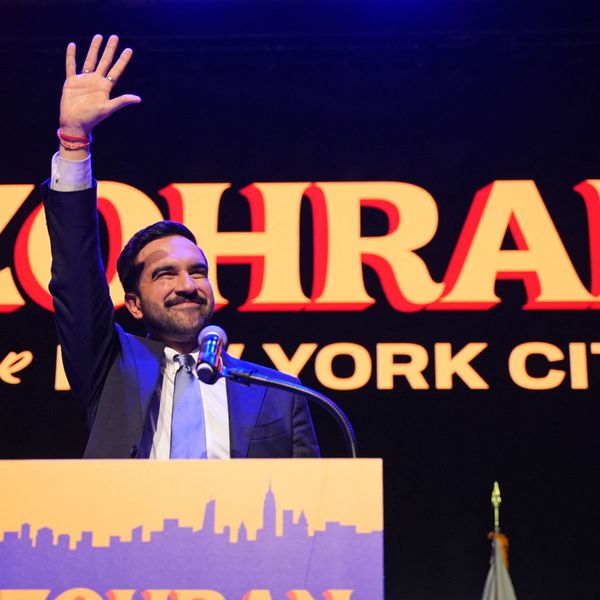
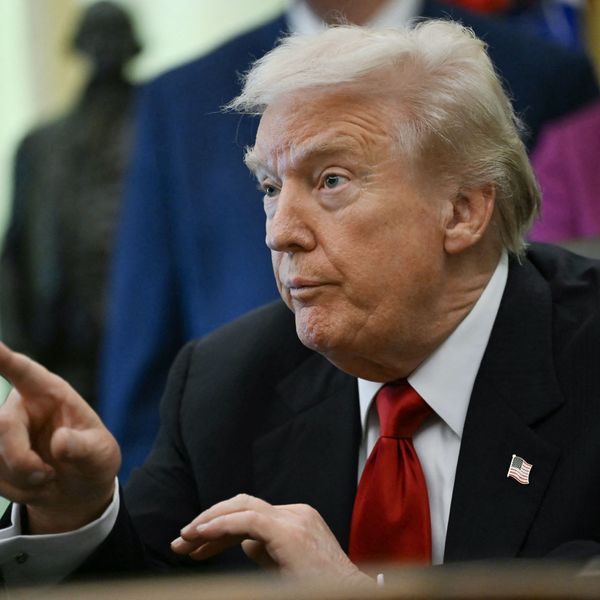
While Gothamist‘s characterization of Friday’s White House meeting between President Donald Trump and New York City Mayor-elect Zohran Mamdani as “a surprising bromance” was likely an overstretch, the far-right US leader did offer copious praise for the democratic socialist during their amiable encounter.
Asked by a reporter if he would feel comfortable living in New York City under Mamdani, Trump—with Mamdani standing beside him in the Oval Office—replied: “Yeah, I would. I really would. Especially after the meeting.”
“We agree on a lot more than I thought,” the president continued. “I want him to do a great job, and we’ll help him do a great job.”
Asked by another reporter if he was standing next to a “jihadist”—as Rep. Elise Stefanik (R-NY) called Mamdani over his support for Palestinian liberation and opposition to Israel’s genocide in Gaza—Trump said, “No... I met with a man who is a very rational person.”
“I met with a man who really wants to see New York be great again,” the president added. “I think you’re going to have, hopefully, a really great mayor. The better he does, the happier I am. And we’re going to be helping him to make everybody’s dream come true. Having a strong and very safe New York.”
Comparing Mamdani to another prominent democratic socialist, who represents Vermont in the US Senate, Trump added that “Bernie Sanders and I agreed on much more than people thought.”
The pair reportedly discussed contentious issues including Trump’s anti-immigrant crackdown and federal invasion of several US cities including Los Angeles; Washington, DC; Portland, Maine; Chicago; and Memphis.
However, they also discussed common-ground issues including the affordability crisis, which has hit New Yorkers particularly hard.
“It was a productive meeting focused on a place of shared admiration and love, which is New York City and the need to deliver affordability to New Yorkers,” Mamdani told reporters.
Friday’s friendly meeting was a stark departure from previous acrimonious exchanges between Trump and Mamdani. The president has called Mamdani a “communist lunatic” and a “total nut job,” and repeatedly threatened to cut off federal funding to the nation’s largest city if the leftist was elected. Trump also threatened to arrest Mamdani after the then-mayoral candidate said he would refuse to cooperate with his administration’s mass deportation campaign.
Asked Friday about calling Mamdani a communist, Trump said: “He’s got views that are a little out there, but who knows. I mean, we’re going to see what works. He’s going to change, also. I changed a lot.”
“I feel very confident that he can do a very good job,” the president added. “I think he is going to surprise some conservative people, actually.”
For his part, Mamdani has called Trump a “despot” and the embodiment of New York City’s problems, decried his “authoritarian” administration, and called himself the president’s “worst nightmare.” He also called Trump a “fascist” on numerous occasions.
“I’ve been called much worse than a despot,” Trump quipped Friday.
After their meeting, a reporter asked Mamdani if he still thought Trump is a fascist. The president interrupted as Mamdani began to respond, patting him on the arm and saying, “That’s OK, you can just say yes.”
Mamdani did not compliment Trump nearly as much as the president lavished praise upon him. He did say that their meeting was “cordial and productive,” and that he anticipated partnering with Trump to “improve life in New York,” highlighting their agreement on issues like housing affordability, food and energy costs, and reducing the cost of living—issues which he said motivated voters to support both men.
Observers expressed surprise over the affable meeting, with Rep. Rashida Tlaib (D-Mich.)—one of Trump’s staunchest congressional critics—asking on social media, “What the heck just happened?”
Some social media users noted that Trump offered Mamdani a more ringing endorsement than even some prominent Democrats, with one Bluesky account posting, “Donald Trump endorsed Zohran Mamdani before Chuck Schumer,” a reference to the Senate majority leader—who never endorsed his party’s nominee to lead the city they both call home.
"We stand with Rep. Deluzio and every patriot holding the line," said one veteran group. "We reject violence. We reject intimidation. And we will never apologize for defending the oath."
By Jessica Corbett
Just a day after President Donald Trumpsuggested that six congressional Democrats should be hanged for reminding members of the US military and intelligence community of their duty not to obey illegal orders, one of those lawmakers was the target of multiple bomb threats.
A spokesperson for US Rep. Chris Deluzio (D-Pa.)said Friday afternoon that his “district offices in Carnegie and Beaver County were both the targets of bomb threats this afternoon. The congressman and congressional staff are safe, and thank law enforcement for swiftly responding. Political violence and threats like this are unacceptable.”
On Tuesday, the former US Navy officer had joined Democratic Reps. Jason Crow (Colo.), Maggie Goodlander (NH), and Chrissy Houlahan (Pa.), along with Sens. Mark Kelly (Ariz.) and Elissa Slotkin (Mich.), for the 90-second video.
Trump—who notably incited the deadly January 6, 2021 attack on the US Capitol while trying to overturn his loss in the 2020 presidential contest—lashed out at the six veterans of the military and intelligence agencies on his Truth Social platform Thursday, accusing them of “SEDITIOUS BEHAVIOR, punishable by DEATH!” and reposting a call to “HANG THEM.”
Deluzio and the others have doubled down on their message that, as he says in the video, “you must refuse illegal orders.”
In a joint statement responding to Trump’s remarks, the six Democrats reiterated their commitment to upholding the oaths they took “to protect and defend the Constitution of the United States,” urged every American to “unite and condemn the president’s calls for our murder and political violence,” and stressed that “we will continue to lead and will not be intimidated.”
Deluzio also addressed Trump’s comments on CNN, denouncing his “outrageous call for political violence.”
Other lawmakers, veterans, and political observers have also condemned Trump’s comments—and the grassroots vet group Common Defense pointed to them on social media Friday, after Deluzio’s staff confirmed the bomb threats.
“First: Common Defense unequivocally condemns political violence in all shapes, forms, and from any party. Violence has no place in our democracy. We believe in the rule of law. But we cannot ignore the cause and effect here,” the organization said.
“The response to quoting the Constitution was a call for execution,” the group continued. “Now, Rep. Deluzio, an Iraq War veteran, is facing actual bomb threats. When leaders normalize violence against political opponents, this or worse is the inevitable result.”
“We stand with Rep. Deluzio and every patriot holding the line,” Common Defense added. “We reject violence. We reject intimidation. And we will never apologize for defending the oath.”
“This is during an agreed ceasefire," a UNICEF spokesperson said. "The pattern is staggering."
By Stephen Prager
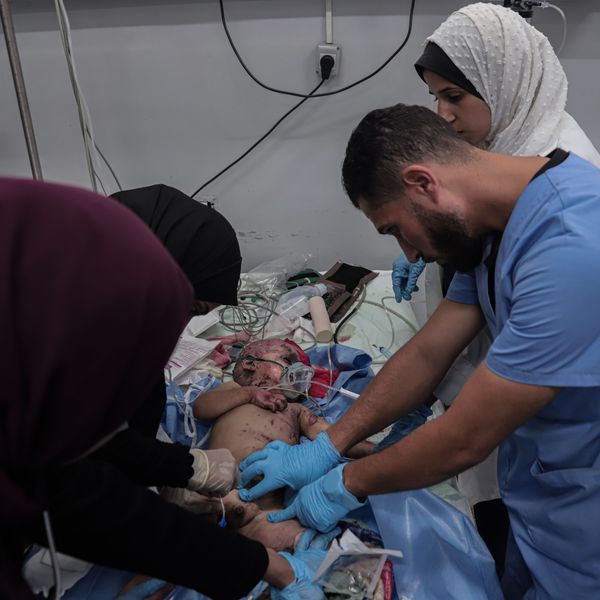
Eight children have been killed by Israeli attacks in Gaza over the past two days. They are among 67 children who have been killed since last month’s agreement for a “ceasefire” in Gaza was signed, according to a new report from the United Nations Children’s Fund.
“Yesterday morning, a baby girl was reportedly killed in Khan Younis by an airstrike, while the day before, seven children were killed in Gaza City and the south,” said UNICEF spokesperson Ricardo Pires on Friday.
The seven children were among dozens of Palestinians who were killed or injured by an Israeli quadcopter attack in Gaza City on Wednesday, according to Doctors Without Borders, also known as Médecins Sans Frontières (MSF).
“At around 11:00 am, we heard gunfire from quadcopters,” said Zaher, an MSF nurse working at a mobile clinic in Gaza City. “Shortly after, we received two casualties. The first was a woman with a leg injury. A little later, a 9-year-old girl arrived with an injury on her face caused by gunfire from the quadcopters.”
Last month, Israel signed an agreement with Hamas that required both parties to cease hostilities with one another. But since the deal went into effect on October 11, Israel has carried out attacks in Gaza on 35 of the last 42 days.
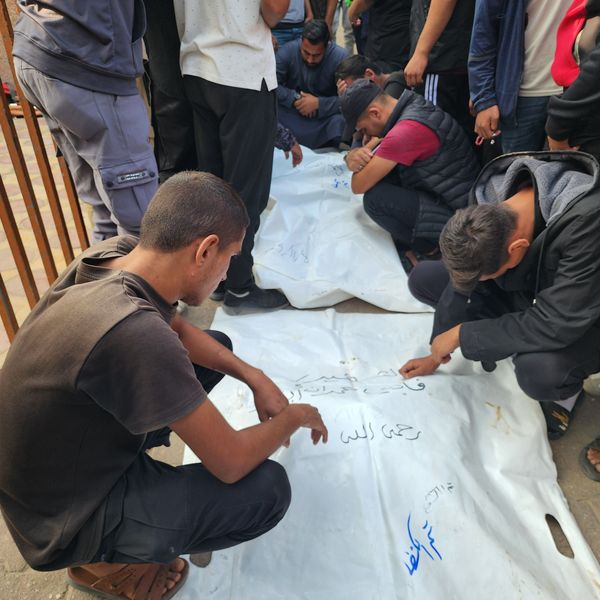
The Gaza Media Office alleges that Israel has committed nearly 400 ceasefire violations in just over a month—which have included airstrikes, shellings, and direct shootings of civilians, as well as frequent incursions by Israel past the agreed-upon yellow withdrawal lines. At least 312 Palestinians have been killed and 760 injured.
“This is during an agreed ceasefire,” Pires emphasized to reporters. “The pattern is staggering,”
Shortly after Pires’ announcement, Israel launched a new ground invasion across the yellow line on Friday afternoon, which has reportedly left another displaced person dead near Khan Younis and thousands more people in North Gaza neighborhoods fleeing for their lives.
After two years of genocidal warfare, over 20,000 Palestinian children are confirmed to have been killed, while another 3,000 to 4,000 have lost either one or both of their limbs.
“As we have repeated many times, these are not statistics: Each was a child with a family, a dream, a life–suddenly cut short by continued violence,” Pires said.
Gaza’s health infrastructure lies in disrepair following two years of relentless bombing, which left nearly all of its hospitals and clinics either partially or fully destroyed.
As another stipulation of the ceasefire deal, Israel was required to lift its blockade on humanitarian aid entering the strip, which had left the people of Gaza on the brink of starvation and unable to perform basic medical care.
But in retaliation for what Israel alleged was a failure by Hamas to return the remains of some hostages abducted by Hamas militants on October 7, 2023, Israel cut off the largest port of entry for humanitarian aid, the Rafah Crossing, which remains closed.
After several weeks in which aid was nearly all choked off, the number of trucks entering the strip has increased in recent days. But according to the World Food Program (WFP), hundreds of thousands of people still remain in dire need of food assistance, and the amount currently entering the strip is far too little.
Only about 30% of WFP’s target food parcels have been allowed to be distributed, though it says that it has been able to move that number upward more quickly in recent days.
Abeer Etefa, a spokesperson for the WFP, said that while this is “a step in the right direction... a lot of these food supplies stay in border crossing points for long days and therefore you know the possibility of them going bad is high.”
Pires said that as winter approaches, hundreds of thousands of children are “sleeping in the open” and “trembling in fear while living in flooded, makeshift shelters.”
“For hundreds of thousands of children living in tents over the rubble of their former homes, the new [winter] season is a threat multiplier,” he said. “Children are shivering through the night with no heating, no insulation, and too few blankets.”
As Gaza’s medical system lies in ruin, UNICEF says over 4,000 children urgently need to be evacuated from the strip. But even after the ceasefire deal, Palestinian journalist Eman Abu Zayed reports in Truthoutthatsecuring medical referrals from the Israeli government and traveling for treatment outside the strip is a “near-impossible task.”
“Gaza’s doctors tell us of children they know how to save but cannot,” said Pires. He said they were children “with severe burns, shrapnel wounds, spinal injuries, traumatic brain injuries, and children with cancer who have lost months of treatment. Premature babies who need intensive care. Children who need surgeries that simply cannot be done inside Gaza today.”
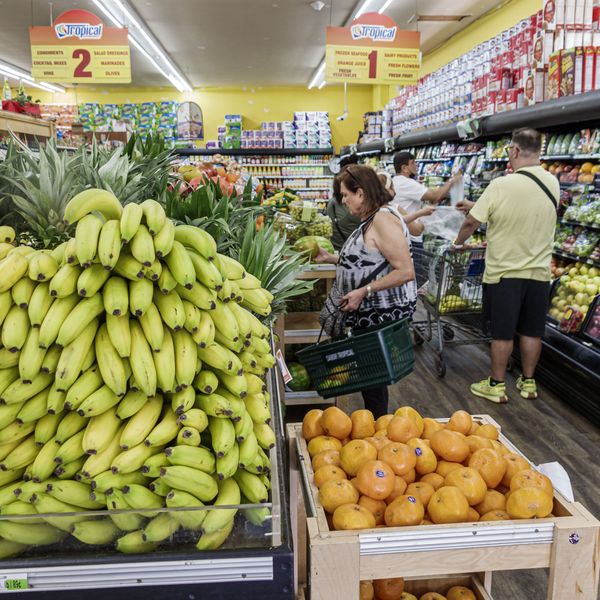
Prices for staples like turkey, cranberry sauce, and mac and cheese have gone through the roof as Trump's tariffs contribute to a spike in grocery prices.
By Stephen Prager
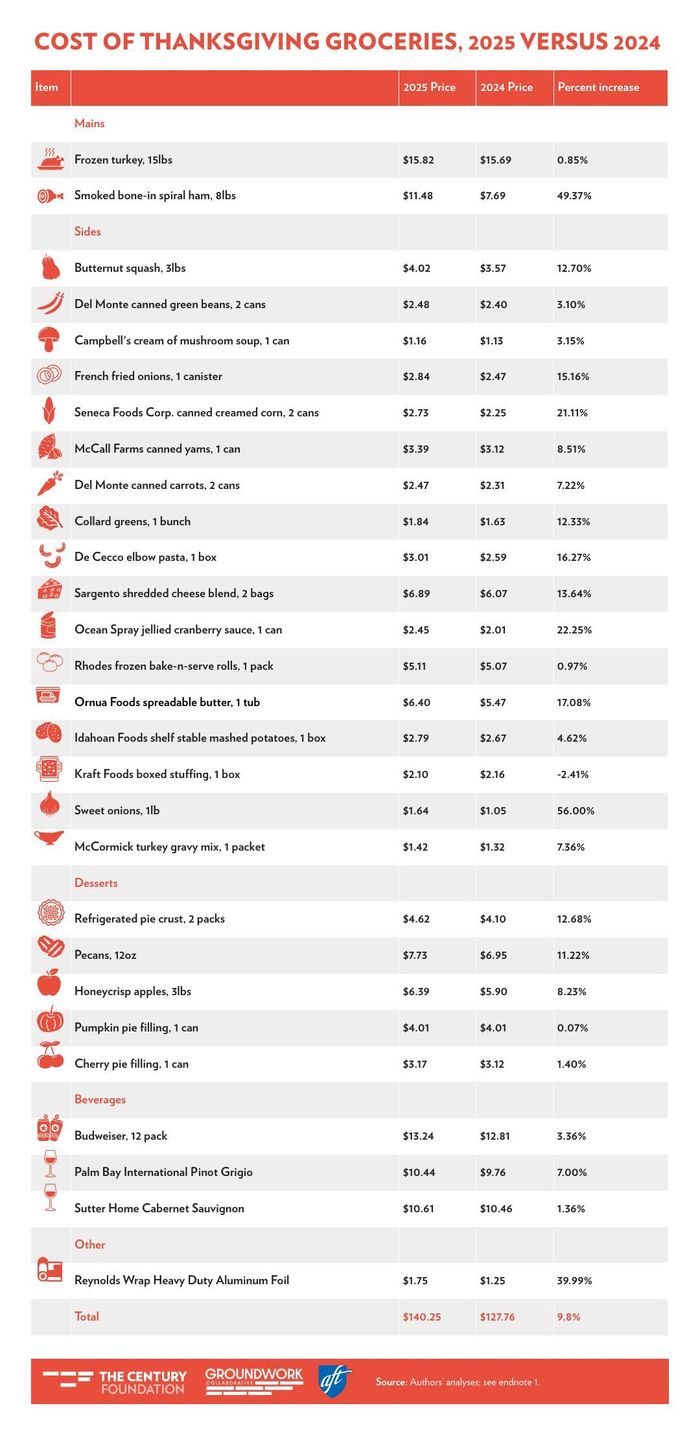
As President Donald Trumpattempts to claim the mantle of “affordability” and boasts that grocery prices are “way down,” a new report tracking the price of several Thanksgiving staples showed they have increased by 10% over the last year, more than three times the rate of inflation.
On social media, the president recently trumpeted that “2025 Thanksgiving dinner under Trump is 25% lower than 2024 Thanksgiving dinner under [President Joe] Biden, according to Walmart.” Claiming that grocery prices are down this year, he added: “AFFORDABILITY is a Republican Stronghold. Hopefully, Republicans will use this irrefutable fact!”
Trump was technically correct that Walmart had reduced the cost of its Thanksgiving dinner by about 25%. What he neglected to mention, however, was that it had also considerably reduced the meal’s size, down from 29 individual items to 22.
The most recent Consumer Price Index (CPI) data published in September by the Bureau of Labor Statistics, meanwhile, shows that at-home grocery prices have actually risen by 2.7%. That, not the spin coming from the White House, is what voters appear to be absorbing as Thanksgiving approaches.
In a poll conducted last week by Data for Progress, 53% said they felt it would be harder to afford a typical Thanksgiving meal than last year, while just 13% said it would be easier. Meanwhile, over a third said they were compensating for rising costs by buying fewer items.
That survey was done in collaboration with the Groundwork Collaborative, the Century Foundation, and the American Federation of Teachers (AFT), which published a report on Friday showing the skyrocketing cost of several holiday staples over the past year, in large part due to Trump’s aggressive tariff regime.
Graphic by the Century Foundation, Groundwork Collaborative, and American Federation of Teachers
While the cost of a 15-lb. frozen turkey has remained roughly steady, the report notes that this is a bit of a mirage.
“Typically, retailers use frozen turkeys as a loss leader, discounting them to get customers in the door to purchase the rest of their Thanksgiving meal, so it’s no surprise that frozen turkey prices are steady,” it explains. “However, wholesale prices for frozen turkeys have soared 75% over the past year, according to research from Purdue University, and fresh turkey prices are up 36% and likely to continue rising.”
The report attributes these sharp increases to a perfect storm of Trump policies. Tariffs have driven up the cost of feed and avian flu,“ which has worsened as a result of mass firings at the US Department of Agriculture, ”has further thinned an already shrinking flock, now at its lowest level in four decades, squeezing American farmers and consumers alike.“
Those who prefer pork or beef to turkey will not be so lucky: The price of an 8-lb. smoked bone-in spiral ham has jumped from $7.69 last year up to $11.48, a nearly 50% increase, while beef roasts are up 20%.
But many agree that the sides are what truly make a Thanksgiving meal great, and that’s where Americans’ pocketbooks will take the most significant hits.
The cost of sweet onions, an essential ingredient in stuffing, has spiked by 56% since last year. Ocean Spray jellied cranberry sauce and Seneca Foods’ creamed corn have each jumped by over 20%. And elbow macaroni from De Cecco and the Sargento cheese to put on top have each increased by double digits.
Pie fillings like pecans, apples, and the refrigerated crusts they’re served in have also all lept several times the rate of inflation. And even storing leftovers will be more costly, with heavy-duty aluminum foil from Reynolds up 40%.
The report chalks this up to Trump’s 50% tariffs on imported steel, which affect around 4 in 5 canned goods. Canned fruits and vegetables have increased by 5% over the past year, faster than the overall rate of inflation. These price hikes, meanwhile, have given companies cover to raise the prices of goods made with domestic steel, too.
Making Thanksgiving dinner with fresh fruit and vegetables may skirt some of the hikes, but tariffs on fertilizer and herbicides have also driven prices up by about 2.5%.
Tariffs on aluminum, meanwhile, have caused Reynolds’ CEO to increase the prices not just of foil, but also of other products to help absorb the cost.
The report by Groundwork, the Century Foundation, and AFT is not the only one to examine the cost of Thanksgiving foods, which are often used as a shorthand for the state of inflation.
While estimates vary based on methodology—for instance, the American Farm Bureau notes that the loss leader pricing of turkey is enough to reduce the price of a Thanksgiving meal on the whole from last year—reportsacross the board have found that the prices for most Thanksgiving staples are rising in tandem with food prices more broadly.
“This Thanksgiving, the main course is inflation as Trump’s policies force families to carve up their shrinking budgets,” said Lindsay Owens, Groundwork’s executive director.
Rising food prices are just the tip of the iceberg for a mounting affordability crisis: Data shows similar hikes to housing and energy costs. Meanwhile, the cost of health insurance premiums is expected to more than double next year for over 20 million Americans and increase across the board after Republicans voted not to renew a tax credit for the Affordable Care Act.
“This administration’s policies made the cost of living higher than the year before,” said AFT president Randi Weingarten. “We must do everything we can to make it easier, not harder, for working Americans to afford groceries, housing, and healthcare.”
"We condemn in the strongest terms the military escalation against Venezuela," said progressive leaders from countries including the United Kingdom, Spain, and Greece.
By Julia Conley
With thousands of US troops patrolling the Caribbean, at least eight warships deployed in the region, and the BBCreporting that it tracked four US military planes that flew near Venezuela Thursday night, lawmakers and other leaders from across Europe on Friday issued a unified demand for the Trump administration to deescalate the tensions it has ratcheted up in recent weeks.
The administration’s “show of force has already proved lethal,” said the leaders, with more than 80 people—including fishermen and an out-of-work bus driver—having been killed in the US military’s strikes on more than 20 boats, which the administration has insisted were trafficking drugs to the US. The White House has publicized no evidence of the claims.
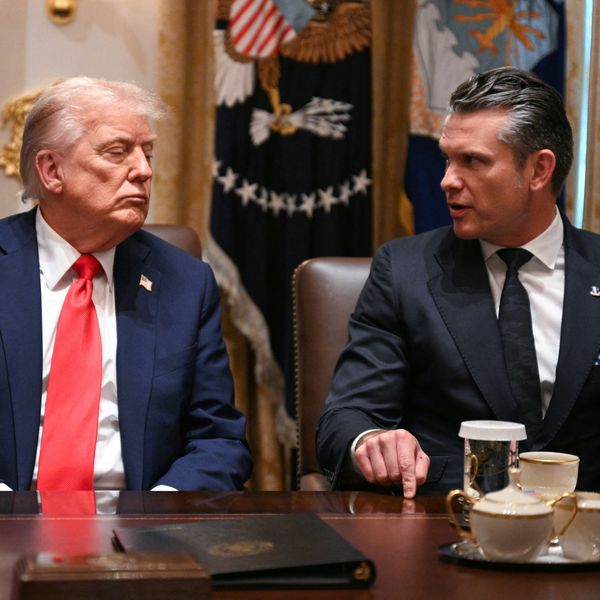
President Donald Trump has not taken further military action against Venezuela since he was presented with “options” for potential strikes last week by officials including Defense Secretary Pete Hegseth, nor has he followed through with threats he’s made against Mexico and Colombia.
But the European leaders—including British Members of Parliament Zarah Sultana and Jeremy Corbyn, former Greek Finance Minister Yanis Varoufakis, and Spanish Member of European Parliament Irene Montero Gil—noted that Trump “severed diplomatic channels with Caracas and approved covert [Central Intelligence Agency] operations in Venezuela” as the military buildup continues in the region.
The Trump administration has insisted it is engaged in a legal “armed conflict” with drug cartels in Venezuela, which it has accused of trafficking fentanyl to the US—though experts say drug boats originating in Venezuela are “are mainly moving cocaine from South America to Europe,” and analysis by both the United Nations and US intelligence agencies have shown the South American country plays virtually no role in the production or transit of fentanyl.
The US Congress has not authorized any military action against drug cartels or Venezuela’s government, and lawmakers from both sides of the aisle have attempted to pass war powers resolutions blocking the US from striking more boats or targets on land in Venezuela, only to have the resolutions voted down.
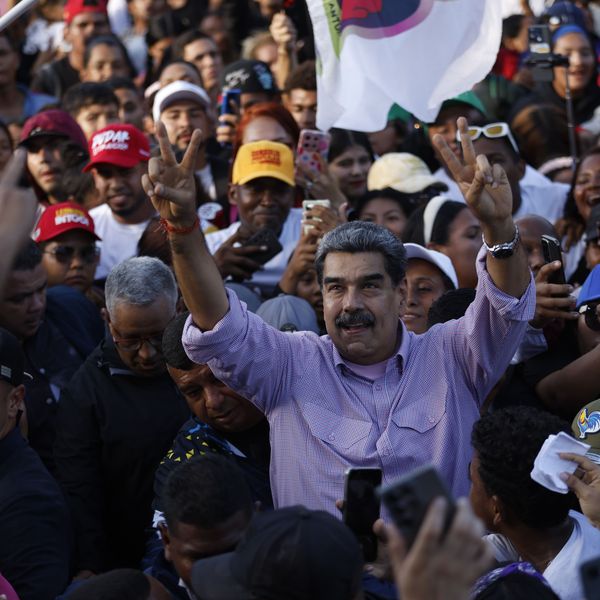
In his second term, Trump has sought to tie Venezuelan President Nicolás Maduro to drug cartels—despite a declassified US intelligence memo showing officials rejected the claim—and designated Cartel de los Soles a foreign terrorist organization last week, giving the White House what Hegseth called “new options” to go after the group.
But the escalation that Trump claims is the latest battle in the “War on Drugs” comes two years after he explicitly announced his desire to take control of Venezuela’s oil, and following years of condemnation of Maduro’s socialist government from Secretary of State Marco Rubio.
The European leaders said the administration’s narrative about the threat Venezuela poses to the US and the escalation is simply the “latest attempt to threaten and undermine the sovereignty of Latin America and the Caribbean nations.”
“Declassified documents have confirmed the CIA’s hand in overthrowing democratically elected governments in Latin America, such as Salvador Allende’s Chile in 1973, João Goulart’s Brazil in 1964, and Jacobo Árbenz’s Guatemala in 1954. The human cost of these regime change operations was catastrophic, and their political legacy endures,” reads the letter, which was organized by Progressive International.
A military intervention by the US in Venezuela “would mark the first interstate war by the United States in South America,” the leaders said, yet “the pretext for intervention is as tired as it is familiar.”
“Under the banner of combating the ‘narco-terrorists,’ Trump celebrates lethal strikes against peaceful fishermen arbitrarily labeled as carrying drugs,” the leaders said.
As in the past, they added, moving the War on Drugs to Venezuela would deliver “not security but a torrent of bloodshed, dispossession, and destabilization.”
“Therefore, we condemn in the strongest terms the military escalation against Venezuela,” they said. “Our demand is clear and our resolve is firm: No war on Venezuela.”
As Peoples Dispatchreported Thursday, many European leaders have “subordinated” themselves to Trump and have avoided speaking out against the US escalation with Venezuela, but left-wing political parties have led the way in denouncing the US deployment of soldiers and warships to the region.
The Workers’ Party of Belgium said recently that the world is “witnessing an unprecedented military escalation in 20 years, a multifaceted aggression that threatens not only Venezuela, but any project of sovereignty and social justice in Latin America.”
"We can’t have a deal that fails to deliver what science and the law require on finance, fossil fuels, or forests and call that progress."
By Jake Johnson
Climate advocates voiced alarm and outrage Friday after every mention of fossil fuels was dropped from the latest draft text to emerge from the COP30 summit, high-stakes talks that have been swarmed by a record number of oil and gas lobbyists seeking to derail any progress toward a clean energy transition.
Dozens of nations—including Spain, Vanuatu, the Marshall Islands, Chile, and Germany—are demanding that any final agreement include “a roadmap for implementing a just, orderly, and equitable transition away from fossil fuels” to fulfill world leaders’ previous commitment at COP28.
But a draft document released by COP30 host Brazil on Friday, formally the last day of talks, omits any such roadmap and does not even contain the term “fossil fuels.”
Monique Barbut, France’s environment minister, said Friday that “at this point, even if we don’t have the roadmap, but at least a mention of the fossil fuels, I think we would accept it.”
“But as it stands now, we have nothing left,” Barbut added.
While draft texts are not necessarily a definitive measure of the state of negotiations, the omission was seen as further evidence that United Nations climate talks have been captured by petrostates such as Saudi Arabia and fossil fuel industry influence-peddlers. At COP30, fossil fuel lobbyists outnumber the delegations of every country except Brazil.
The Donald Trump-led United States, the world’s largest oil producer, did not send an official delegation to the summit.
“This is outrageous,” Bronwen Tucker, public finance lead at Oil Change International, said in response to the new draft text. “The presidency has presented a shamefully weak text that fails to mention fossil fuels, fails to deliver accountability towards rich countries’ finance obligations, and only makes vague promises on adaptation.”
“A large group of countries have been vocal in their support for a roadmap to transition away from fossil fuels, but rich parties are still refusing to deliver the debt-free public finance on fair terms that is key to make it happen,” Tucker added. “Until they stop blocking efforts to address the systemic barriers developing countries face to phasing out fossil fuels, any roadmap will be a dead-end.”
“We’re walking a fine line here between survival and climate catastrophe.”
The updated text was released as negotiators raced to strike a consensus deal in the final hours of the summit, which appears likely to head into overtime. Talks were delayed for hours on Thursday after a fire broke out at the summit, an incident that activists viewed as a “potent metaphor” for world leaders’ failure to combat the climate crisis as it wreaks havoc across the globe.
“We’re walking a fine line here between survival and climate catastrophe, and in these final hours I am hoping we can take something back to our communities that indicates that the world considers our homes worth fighting for,” said Fenton Lutunatabua, Pacific team lead at the climate group 350.
Nikki Reisch, director of the Climate and Energy Program at the Center for International Environmental Law, said Friday that the toothless draft text lays bare the need to overhaul the COP process and mitigate the influence of the fossil fuel industry—the primary driver of the climate emergency.
“The world is being sold a bill of lies here at this ‘COP of truth,’” said Reisch. “We can’t have a deal that fails to deliver what science and the law require on finance, fossil fuels, or forests and call that progress. The weakness of the text underscores why the climate talks are sorely in need of reform to allow a majority vote when a handful of countries block consensus.”
JOIN THE MOVEMENT
As a people-powered nonprofit news outlet, we cover the issues the corporate media never will.
Your contribution supports this bold media model—free, independent, and dedicated to reporting the facts every day. Stand with us in the fight for economic equality, social justice, human rights, and a more sustainable future.
A tractor equipped with a sprayer applies a pre-plant herbicide to a field before planting a corn crop in Mississippi on
July 7, 2023.
(Photo by Debra Ferguson/Design Pics Editorial/Universal Images Group via Getty Images)
Just a month after the Trump administrationdoubled down on the alleged safety of atrazine, a United Nations agency said on Friday that the pesticide—which is banned by dozens of countries but commonly used on corn, sugarcane, and sorghum in the United States—probably causes cancer.
“It is outrageously irresponsible that we still allow use of this dangerous poison in the United States,” said Nathan Donley, the Center for Biological Diversity’s environmental health science director, in a Friday statement. “This finding is just the latest indictment of the industry-controlled US pesticide oversight process that is failing to protect people and wildlife from chemicals linked to numerous health harms.”
Research into and alarm over atrazine have mounted since the World Health Organization’s International Agency for Research on Cancer initially concluded in 1999 that it was not classifiable as carcinogenic to humans. IACR has now announced new findings for atrazine and alachlor, another herbicide widely used on crops, as well as the agricultural fungicide vinclozolin.
Of the three, only atrazine was previously examined by IARC. From October 28 to November 4, a working group of 22 international experts from a dozen countries met in France to evaluate the carcinogenicity of pesticides. They classified vinclozolin as “possibly carcinogenic to humans, and both alachlor and atrazine as ”probably carcinogenic to humans.“
The latter two decisions were based on a combination of limited evidence for cancer in humans, sufficient evidence for cancer in animals, and strong mechanistic evidence in experimental systems. IARC said that “for atrazine, positive associations have been observed for non-Hodgkin lymphoma that is positive for the chromosomal translocation t(14;18).”
A couple of weeks before that IARC meeting, the Trump administration sparked outrage with a US Fish and Wildlife Service (USFWS) draft opinion claiming that atrazine does not pose an extinction risk to a single protected animal or plant.
That draft opinion came as President Donald Trump and Health and Human Services Secretary Robert F. Kennedy Jr. were already under fire for the second Make America Healthy Again report. After the first MAHA publication noted concerns regarding pesticides, even naming atrazine, agribusiness lobbyists confronted the administration, and the following document ultimately featured pesticide industry talking points.
The second report’s “only mention of pesticides is an Orwellian promise to ensure ‘confidence in EPA’s robust pesticide review procedures’—procedures courts have repeatedly found unlawful and that frontline communities know cannot be trusted,” the Center for Food Safety said after its September release. “Instead, it says that it will speed up pesticide approval and it will ‘partner’ with the pesticide industry to ‘educate’ the public about the ‘robust review’ of EPA’s regulation of pesticides to provide the public with ‘confidence.’”
Then came the USFWS draft, which Center for Food Safety senior attorney Sylvia Wu said “makes clear that despite the rhetoric of MAHA, there will be no robust review of the dangers of pesticides by the Trump administration... Instead, a toxic poison like atrazine will continue to contaminate our lands and waters, making our children sick for decades to come.”
Wu’s group has long been critical of atrazine. During the first Trump administration, it was part of a coalition that sued over the Environmental Protection Agency’s (EPA) 2020 reapproval of the herbicide. So was the Center for Biological Diversity—which was also angered by the USFWS document, with Donley calling it “an absolute joke.”
Donley took aim at the Trump administration again on Friday, after IACR announced its new classification for atrazine.
“Despite its rhetoric to the contrary, there is no better friend of atrazine than the Trump administration,” he said. “Hiding behind the rhetoric of MAHA, EPA reapproval of a poison that’s likely to keep Americans sick for generations is moving ahead full steam.”
Can the coalition supporting a fossil fuel phaseout successfully put their road map back into the text, or will petrostrates like Saudi Arabia, backed up by the Trump administration, kill the deal?
Trump’s urge to suppress free speech may be about Israel today, but count on one thing: It will be about something else tomorrow.
By Mattea Kramer
Signage and flowers are placed on a tree next to where ICE agents apprehended Tuft University graduate student Rumeysa Ozturk on March 27, 2025 in Somerville, Massachusetts.
(Photo by Scott Eisen/Getty Images)
Rooting out terrorism and antisemitism was the supposed reason that plainclothes Immigration and Customs Enforcement agents arrested doctoral student Rümeysa Öztürk on a street in Somerville, Massachusetts, after she coauthored an op-ed calling on Tufts University to divest from companies with ties to Israel due to the killing and starvation of Palestinian civilians. There is an internationalmovement to boycott, sanction, and divest from Israel, but in the United States, President Donald Trump is imperiling the freedom even to publicly discuss such ideas, which should, in effect, be considered a test case for his larger attack on free speech. So far, the test is going well for Trump.
In what seems a long time ago, in 2024, the Heritage Foundation, a right-wingthink tank, released a blueprint for what it called “a national strategy to combat antisemitism” by addressing what it described as “America’s virulently anti-Israel, anti-Zionist, and anti-American ‘pro-Palestinian movement.’” In essence, and in what’s amounted to an extraordinarily effective work of political theater that has been sold to my own state, Massachusetts, among other places, that foundation dubbed its political opponents “supporters of terrorism.” It also labeled organizations working in opposition to its agenda a “terrorist support network,” and claimed for itself the noble mantle of “combating antisemitism”—even as it deftly redefined antisemitism from hatred of Jewish people to criticism of the US-Israel alliance. President Trump has put the Heritage Foundation strategy into action and gone even further.
It may be his most original idea. As political scientist Barnett Rubin put it in September, “President Trump always says he’s very creative and accomplishes things no one has ever done before. And now he is building a fascist regime which is legitimized by the fight against antisemitism. Nobody ever thought of doing that before.”
How the Defense Department (Oops, Sorry, the War Department) Promotes World Peace
I attended Hebrew school as a child, and today, when I try to recall what I learned there about Israel and Palestine, I find in my memory an image of a desert, replete with flowers, and the pleasant recollection that the State of Israel was founded in that empty landscape. In 1998, I visited Israel with my family. My brother had his bar mitzvah at the mountaintop fortress of Masada overlooking the Dead Sea. Though I enjoyed an enviable private school education, I didn’t hear the word Nakba until adulthood. That Arabic word for catastrophe refers to the displacement of 700,000 Palestinian people for Israel’s founding in 1948. A majority of the population of the modern-day Gaza Strip descended from refugees of the Nakba.
According to Amnesty International and the Israeli human rights organization B’Tselem, Israel has imposed a system of oppression on Palestinians across Israel and in the Occupied Palestinian Territories through an enforced system of segregation that constitutes apartheid. For decades, Israel has controlled who could enter or exit the Gaza Strip and, from 2007 on, that 25-mile strip of land functioned as what Human Rights Watch called an “open-air prison.” As of 2022, the unemployment rate in Gaza had hit 45%, and 65% of the people there were living in poverty. On October 7 of the following year, an armed group broke out of Gaza and waged attacks on Israel that killed 1,195 people, 815 of whom were civilians.
The real question is whether Americans will accept his violations of the First Amendment or fight to protect free speech even when they dislike things other people have to say.
In the two years since then, Israel has responded by killing more than 67,000 Palestinians in Gaza in a military campaign of such horror that, as the head of Doctors Without Borders reported to the United Nations Security Council, children as young as five said that they preferred to die rather than continue living in fear while witnessing the slaughter of their family members. A girl named Sham was born in Gaza in November 2023 and survived smoke poisoning as an infant. As a toddler, she was diagnosed with acute malnutrition, before being killed on May 6 of this year when Israel dropped explosives on the shelter where she was living with her family. The United Nations and prominent experts, including Israeli-American professor of Holocaust and genocide studies Omer Bartov, have concluded that Israel’s war on Gaza is a genocide. The current ceasefire has slowed, not stopped, the death toll.
By 2024, the International Court of Justice, the world’s highest court, had ruled that Israel’s occupation of Gaza, the West Bank, and East Jerusalem was illegal; that Israel needed to halt all settlement construction, evacuate its settlers, pay restitution to Palestinians, and allow them the right of return. It also indicated that all states and international organizations have a legal obligation not to assist Israel’s further occupation of the area.
However, since October 2023, according to the Israeli Defense Ministry and the Council on Foreign Relations, using 800 transport planes and 140 ships, my own country has delivered 90,000 tons of arms and equipment to Israel, including tanks, artillery shells, bombs, and rockets. The US government gives Israel billions of dollars annually in military aid, which that country spends mostly on purchases made through the US “Foreign Military Sales” program. According to a Defense Department website, that program sells “articles and services [that] will strengthen the security of the United States and promote world peace.”
Despite how, as Israeli historian Lee Mordechai described it, Israel has limited the flow of information out of Gaza and campaigned to discredit critical voices, a July Gallup poll found that 60% of Americans disapprove of Israel’s military actions there. Even more strikingly, a September Washington Post poll found that nearly half (48%) of Jewish Americans disapprove (and only 46% approve).
But according to recommendations issued by the Massachusetts Special Commission on Combating Antisemitism, a group created by state law in 2024, a teacher discussing such polling in a classroom could precipitate an anonymous complaint filed with the state police on the grounds that the educator has rendered the learning environment in my state hostile to Jewish students.
School Teachers Are the Problem!
Last February, Special Commission cochair and State Rep. Simon Cataldo (D-14) conducted an inquisition—yes, an inquisition—into the president of the Massachusetts Teachers Association (who is himself Jewish), including presenting a series of materials on Israel-Palestine that Cataldo had obtained from a database of educator resources. He displayed a graphic called “Born Unequal Abroad,” which lists the different rights afforded to an American Jewish child and the child of Palestinian refugees in Lebanon. The former can visit Israel and even become an Israeli citizen at any time, while the latter is barred from visiting and has no pathway to citizenship (even through marriage). Cataldo seemed to regard that graphic (and others like it) as self-evidently antisemitic and displayed it as a smoking gun that revealed the supposed antisemitism festering within the Massachusetts Teachers Association.
In other words, in my home state today, “combating antisemitism” means a governor- and legislature-appointed commission conducting an inquisition of a (Jewish) union leader for the offense of failing to suppress critical discussion of a foreign nation that the world’s leading human rights organizations have found to be upholding a system of apartheid and committing genocide. At the same time, actual antisemitism—that is, the hatred of Jewish people by xenophobic nationalists—has gone largely unexamined by the commission in the midst of its campaign to shut down criticism of Israel. (I imagine President Trump and the Heritage Foundation applauding in the background.)
Indeed, over the course of a year of hearings, the Special Commission has perhaps irreparably merged the concept of antisemitism with criticism of Israel, which seems to have been the point. State Sen. and Commission Cochair John Velis (D-2) actually uses the terms “anti-Israel” and “antisemitic” interchangeably, though they do have different meanings and anyone charged with the responsibility of leading a state panel on antisemitism should know that. Velis, who is not Jewish, has taken multiple trips to Israel paid for by the Israeli government as well as a charity affiliated with the American Israel Public Affairs Committee, the lobby group known as AIPAC.
The Special Commission has unveiled recommendations for Massachusetts schools that include utilizing a definition of antisemitism that, according to the American Civil Liberties Union, will have the effect of chilling free speech. It has also recommended launching a statewide reporting system in which anonymous allegations of antisemitism in schools would be collected by the state police.
Following the initial release of those recommendations, Gov. Maura Healey issued a statement applauding the commission’s work. Organizations like the Jewish Community Relations Council of Greater Boston have also sent out emails to their membership commending the commission.
Perhaps in response to the hours of dissenting public testimony that (mostly Jewish) people as well as scholars and education experts have offered, the commissioners wrote in their most recent report, “We should listen to and respect people who say that they have been harmed by antisemitism; we should not gaslight them or tell them that their experience is invalid.”
Who could argue?
A Federal Judge Weighs In
After Tufts University student Rümeysa Öztürk was abducted from the street by ICE agents for the offense of cowriting an op-ed in the school paper asking the school to divest from companies with ties to Israel, a federal judge found that Secretary of State Marco Rubio and Secretary of Homeland Security Kristi Noem had violated the First Amendment through a policy of targeting for deportation noncitizens who criticized Israel or voiced support for Palestinians. The judge also found that executive orders issued by President Trump had relied on a definition of antisemitism that encompassed First Amendment-protected speech (the same definition recommended by the Massachusetts Commission!).
But will that federal court ruling even matter? According to the same judge, “The effect of these targeted deportation proceedings continues unconstitutionally to chill freedom of speech to this day.”
Pulitzer Prize-winning author Benjamin Moser has noted that, after October 7, some American Jewish institutions not only supported Israel’s reign of terror over Palestinian civilians but also applauded the clampdown on free speech in order to sustain the killing. “The younger generations, people who have seen with their own eyes the crimes of the so-called Jewish state, and who feel the sacrilege, the impious desecration, of the values they thought were Jewish,” he wrote, “will never return to these institutions.”
But will it matter? Surely, it won’t stop Donald Trump from using his version of Jewish identity as a moral shield for his attack on free speech.
In Massachusetts, a coalition of organizations has publicly opposed the Special Commission’s recommendations and, in the western part of the state where I live, a group of residents has resorted to putting out yard signs with QR codes on them to call attention to this travesty. I’m part of that effort, but does it matter?
In California, a new law, ostensibly intended to protect Jewish students from discrimination, goes into effect on January 1. It has, however, put educators on alert that they may be accused of antisemitism if they share information deemed critical of Israel.
Meanwhile, the leaders of civil society organizations appear ill-suited to resist such suppression of free speech and, in some cases, seem to embrace it. In January, members of the American Historical Association voted 428 to 88 in favor of declaring their opposition to “scholasticide” (the deliberate destruction of an education system) in Gaza. But the association’s leadership council vetoed that vote. A similar episode occurred at the Modern Language Association.
Amy Hagopian, a professor emeritus of global health at the University of Washington, who for years taught a class on war and health, recently wrote about how she was expelled from the American Public Health Association after publicly protesting a decision by its executive board to halt consideration of a resolution on Palestinian health justice. (An anonymous complaint had alleged that the protest was antisemitic.)
An Alternative Could Look Like This
The usual line-toeing of politicians in both major parties has involved reciting statements of support for Israel, whatever it does. By contrast, Zohran Mamdani was clear during his victorious campaign to become mayor of New York City that he supports an end to apartheid for Palestinians and opposes the crimes against humanity committed by Israel. In American politics, that represented a fresh playbook. He focused successfully on his city’s absurdly high cost of living and did so as part of a coalition that included people of the Jewish faith and other faiths, even as powerful moneyed interests lined up against him. And he won.
Keep in mind that a clear majority of Americans do indeed disapprove of Israel’s actions in Gaza, so it makes sense that there was an electorate for a candidate who would tell the truth about the oppression of Palestinians, while rejecting claims that it’s antisemitic to do so. Mamdani won a third of voters who specified Judaism as their religion (just as he won a third of Catholics). He also overwhelmingly won among those with no religious affiliation (a quarter of the electorate) and those whose religious affiliation was described as “Other,” which is where exit pollsters put people who are Muslim.
Trump’s urge to suppress free speech may be about Israel today, but count on one thing: It will be about something else tomorrow. The real question is whether Americans will accept his violations of the First Amendment or fight to protect free speech even when they dislike things other people have to say.
There are those who believe that Mamdani’s victory cannot be replicated outside New York City. But given that free speech itself may hang in the balance, it’s at least worth a try.
We shall see in the coming days whether the corrupt governments that hope to profit from the genocide in Gaza will send their own troops to fight the Palestinian Resistance and perpetuate the Israeli occupation.
People who gain a significant amount of power over others lose the ability to empathize with people in general, isolating the powerful into their own stereotypes and egotistical certainties, which lessens their ability to make good, or even rational, decisions.
LAST 2 WEEKS IN REVIEW I’m your Representative in Congress and I write to keep you informed. The chaos and costs of Trump’s tariff strategy A junior varsity national security team No one is above the law, or below it Big ideas to govern better Hitting back on behalf of scientists Meeting with constituents in the MA-04 The chaos and costs of Trump’s tariff strategy WSJ’s “dumbest trade war in history”: The president announced sweeping tariffs this week, which amount to a $500+ billion tax hike on everyday Americans. The tariffs were calculated nonsensically and communicated incoherently. There is robust debate between policymakers and economists about how tariffs might help America, but every serious participant in that debate recognizes that the chaos of this tariff roll-out will cause pain for businesses, families, and allies alike. I have often joined the tariff debate, generally arguing for free trade with the exception of Chin...
17 September 22 Stand Up For Reader Supported News Come on folks don’t just sit there and let RSN struggle financially. What we need to function is a drop in the bucket. When you get involved, when you take an ownership stake good things happen. Help RSN! Marc Ash Founder, Reader Supported News Sure, I'll make a donation! If you would prefer to send a check: Reader Supported News PO Box 2043 / Citrus Heights, CA 95611 Follow us on facebook and twitter ! Update My Monthly Donation 17 September 22 Live on the homepage now! Reader Supported News ONE THING MISSING THIS MONTH, LARGER DONATIONS — Each month we manage to get one or two or three thousand dollar donations. So far this month we do not have any. Obviously that kind of donation is a huge boost and goes a long way to match our smaller donors. Who can? Marc Ash • Founder, Reader Supported News Sure, I'll make a donation! 'Hat in Hand': Putin Meets Xi at Summit in Samarkand Al...
By Charlie Mahtesian and Calder McHugh Presented by Elon Musk speaks during a cabinet meeting at the White House today. | Al Drago/Bloomberg BEAR MARKET — You wouldn’t know it from the frenetic, high profile he currently cuts in Washington, but tech mogul Elon Musk has lost more than $100 billion in net worth since mid-December. In the aftermath of Donald Trump’s election, the share price of the high-flying electric car company he leads, Tesla, climbed to a high of roughly $480 per share. But it has since cratered to under $300. Shares dropped another 4 percent today, to close at $290.80 per share. For Musk, the world’s richest man and Tesla’s largest shareholder, those are just paper losses. He owns and runs several other companies — among them SpaceX, Twitter, and artificial intelligence startup xAI — so Tesla’s recent decline is just a flesh wound. But the largely parallel timeline between Tesla’s nosedive and Musk’s rise as something ...















Comments
Post a Comment