RSN: Andy Borowitz | Republicans Worry That Midterm Voters Might Believe Women Deserve Rights

28 August 22
Live on the homepage now!
Reader Supported News

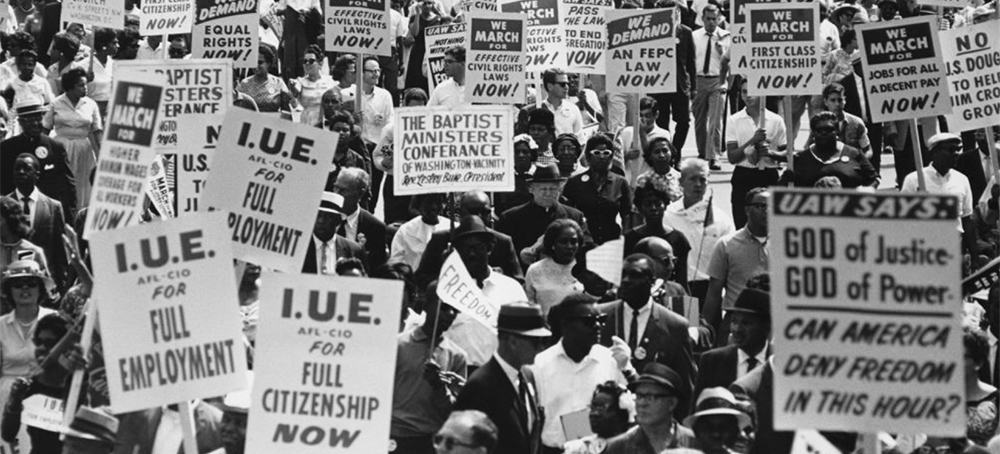 Demonstrators holding placards at the March on Washington for Jobs and Freedom, Washington DC, August 28, 1963. (photo: FPG/Archive Photos/Getty Images)
The March on Washington was 59 years ago today. It’s popularly remembered as a moderate demonstration where MLK “had a dream” — but in fact, it was the decades-long culmination of a mass, working-class movement against racial and economic injustice.
Randolph’s life alone rebuts the whitewashed versions of the Civil Rights Movement and the 1963 march. Here was a man who saw the struggle against racial oppression and economic exploitation as intimately linked; who located the locus of change in the organized masses rather than the upper crust; who regarded unions as a grand instrument to bludgeon racial injustice.
As historian William P. Jones lays out in the following interview, it was fitting that Randolph headed the August 28, 1963, March on Washington for Jobs and Freedom. For that march was a union march, a mass working-class march, a march that sought not only to end Jim Crow tyranny and racial segregation but to win a massive federal jobs program, well-funded education and housing, and a living wage for all workers.
Randolph had plenty of pro-labor company at the march: Cleveland Robinson, a key organizer, was head of the New York City local of the Retail, Wholesale, and Department Store Union. Addie Wyatt, a leader of the Packinghouse Workers union in Chicago, organized a large group to come to the march. The Garment and Auto Workers unions footed the bill for the event’s $20,000 sound system. Martin Luther King even originally tried out his “I Have a Dream” rhetoric at a 1961 AFL-CIO convention.
For years leading up to the March on Washington, black labor leaders and rank-and-file workers had used their unions, as Jones puts it, “both as vehicles of economic empowerment of black people and as tools for fighting racism.” When they gathered on that late August day, it was likely the largest-ever march of US union members up to that point. The following spring, with civil rights legislation languishing in Congress, Randolph pulled out another classic labor trick: he threatened to call a general strike. The Civil Rights Act passed that summer.
Jones tells this story to great effect in his 2013 book The March on Washington: Jobs, Freedom, and the Forgotten History of Civil Rights. He spoke with Jacobin‘s Shawn Gude about the first March on Washington, the central role that black trade unionists played in the Civil Rights Movement, and the unfulfilled promise of the 1963 March on Washington’s radical, mass working-class vision.
Shawn Gude
What was A. Philip Randolph trying to accomplish with the first March on Washington?
William P. Jones
There were two main demands. One was the integration of the armed forces, and the other was a prohibition on employment discrimination, both for federal contractors and the military.
When they initiate the march, the US is not yet in the war. Franklin D. Roosevelt is saying that we have to be the “arsenal of democracy,” and there’s a huge flood of federal money into contractors. The auto companies are retooling to make weapons and airplanes, the shipbuilding industry is gearing up, etc. But black people are being shut out of these jobs.
A student activist movement gears up in protest against the draft: people are saying, I’m not going to sign up and get drafted into a Jim Crow army. And that gives Randolph the sense that there could be this mass mobilization along the lines of the anti-colonial movement in India. He’s saying, We can bring a hundred thousand people to Washington in the midst of the preparation for the war, and that will force the hand of the government.
Shawn Gude
It’s really striking, looking back, how threatening that was perceived. Thousands of people demonstrating in Washington is kind of old hat at this point, but it certainly was not back then.
William P. Jones
It was a big deal. In ’63, it was seen as a real threat, but especially in ’41, people freaked out. The NAACP’s Roy Wilkins was like, No way, we can’t do that — it’s going to backfire, it’s going to create rioting.
There had been rioting during the war. There was a streetcar protest in Washington, DC, where Southern elected officials had encouraged soldiers to beat up protestors. There was the memory of the Bonus March, which ended in troops being called out and beating everybody up and burning down the Bonus Army village. People pointed to the fascist March on Rome.
So there was a combination of paranoia and hyperbole, and then a real threat of violence.
FDR tried ignoring the movement — he said, If I meet with you, it would show that this mob politics works. He sent Eleanor Roosevelt and New York City mayor Fiorello La Guardia to try to talk people out of the march. Then he finally caved and met half their demand: he prohibited employment discrimination by contractors and created the Fair Employment Practices Committee.
This definitely raised Randolph’s stature and gave him something to point to and say, Look, this works. We didn’t even have to march and we got this, so it’s effective.
A lot of people involved in the march were actually pissed that he called it off, because they were ready to go. But it’s not clear how many people would’ve showed up, so I think that was part of his calculation. He recognized that if they showed up with like fifty thousand people, it would still be a lot, but it would be only half of what they had said.
Shawn Gude
By this point, there’s an ascendant strain of black politics — exemplified by Randolph — that sees the black working class as the primary driver of change. That’s a real shift from earlier, more elite-driven brands of black politics — Booker T. Washington–style conservatism being the most famous, but even W. E. B. Du Bois’s idea of the “Talented Tenth.” Could you talk about the mass, working-class, black politics embodied by Randolph’s 1941 March on Washington? And how did the March on Washington Movement’s relative success affect people’s sense of mass politics as a possible strategy going forward?
William P. Jones
As I said, a lot of people in the leadership of the NAACP and the Urban League remained very committed to the idea that the way to fight for racial equality was through a kind of respectability politics —demonstrating that black people could be just as educated and behave like white people supposedly did.
The NAACP was committed to working through the courts and through access to elected officials, and Roy Wilkins was very suspicious of the idea that you could win anything through demonstrations and the like. Disruptive mass movements, the idea that working people were going to be at the forefront of change — he saw that as naive.
So it’s important to recognize that what Randolph was saying was still controversial. He was a radical. Randolph’s position was that mass politics is the way the vast majority of black people can get involved in the movement. He saw it as a way of building a biracial working-class movement.
The real thrust of this new mass politics was coming from two sources. One was young, college-educated, black radicals, mostly women: Ella Baker, Pauli Murray, Dorothy Height, Bayard Rustin. They’re pointing to the anti-colonial movement in India as a model.
And people are like, Well, India is still a colony and the movement there is getting beat up. It is a majority movement that’s trying to get rid of this tiny British minority — it doesn’t apply to the United States. If you do it here, it is going to get people killed. And that’s what happened: when Bayard Rustin started these bus rides [the original Freedom Rides of the 1940s], he got beat to hell and thrown in jail.
So this mass approach is very controversial. The NAACP and the Urban League are really hesitant to get involved in the March on Washington ’41. They do it at the last minute, only when it’s clear that it’s going to bring a significant group of people to the Capitol.
The other force that’s really important is the black working class — people who are involved in the labor movement during the Second World War, mostly in the CIO. It’s people in the autoworkers’ union, in the needle trades’ unions, in the warehouse and packinghouse workers’ unions. They take leadership in the movement, and they become the base of the NAACP, sort of in spite of the NAACP’s leadership.
Shawn Gude
Your book provides a wonderful account of labor’s foundational role in the Civil Rights Movement in these years. I was wondering if you could talk about that rich labor ecosystem — unions like the Brotherhood of Sleeping Car Porters and figures like Cleveland Robinson and Addie Wyatt — which we don’t hear about anymore, but was responsible for pushing a black working-class politics.
William P. Jones
These are people who came of age in the late ’30s, early ’40s, mostly in CIO unions, and they’re exposed to a wing of the union movement that’s deeply committed to interracial cooperation and anti-racism. They’re not naive about it — they’re often fighting within their unions against white leaders resistant to challenging racism. But they see a strong possibility for using unions both as vehicles of economic empowerment of black people and as tools for fighting racism.
That idea was hard to have faith in before the CIO. But they came up with that [“civil rights unionism“] being a real possibility, and they ran with it. In places like Detroit and Chicago and New York, black people could rise into significant positions of power within the union movement, and that made a huge difference.
They’re also deeply connected to the NAACP — as I said before, in some ways they take over the NAACP. That creates the basis of a mass movement that facilitates the ’41 March, and really, in the ’50s and ’60s, becomes a significant driving force of the Civil Rights Movement.
They’re raising funds in all the big Northern cities and sending them down to Montgomery and New Orleans and Birmingham and other places where local movements are developing. Those movements wouldn’t have taken off without that kind of support.
Shawn Gude
Can you talk more about the Sleeping Car Porters? I guess this is becoming a major theme of our conversation, but it’s sort of amazing how forgotten they are given the central role they played in the movement.
William P. Jones
Sleeping car porters were based in cities all over the country and were connected because of their work on the trains. They became these sort of communication networks, circulating information along the rails and building community bases of support. Women’s clubs were an important part of this movement — the Sleeping Car Porters had a women’s auxiliary that allied with the National Council of Negro Women and the YWCA.
So there are these community-based organizations that are able to mobilize, and you see that in every single place where there’s an upturn in civil rights mobilization in the ’50s. It’s based in these networks that had been built up since the 1920s.
What’s funny about the sleeping car porters is that, by the ’50s, it’s sort of a dying industry. The auto industry is taking off, and you have the airline industry too. But the union has the funds and, importantly, this national network that is able to mobilize and keep going. In a lot of ways, the growing industrial unions became more important to the movement, but the Sleeping Car Porters created a model that a lot of activists in those industrial unions followed. And it becomes this sort of glue, and even as it’s running into hard times, it’s created this leadership cadre — people like Randolph, like E. D. Nixon, who led the movement in Montgomery.
In almost all of the big cities, there are people who come out of the Sleeping Car Porters that are important civil rights leaders.
Shawn Gude
You mentioned the important role that women played in the Sleeping Car Porters, but often women were sort of pushed to the side in the movement, including being excluded from the leadership of the 1963 March on Washington. Can you talk about some of that exclusion?
William P. Jones
It’s complex. After the ’41 march was called off, the fight for fair employment did focus a lot on women’s jobs, largely because the civil rights organizations walked away from it, and the ones that kept going were the National Council of Negro Women and the YWCA. They explicitly shift and say, Women are getting jobs during the war. We need to have a campaign to fight to keep those jobs.
So there are a lot of cases in which women are in leadership, it’s just that the top leadership isn’t recognizing them, and often explicitly trying to push them out. The male leadership of the Brotherhood of Sleeping Car Porters is really explicit in saying that there are too many women involved.
But in spite of that, women are often pushing the movement in directions that it wouldn’t have gone. It’s women — Pauli Murray probably being the most important — who bring the idea of Gandhian nonviolence into practice.
Or look at someone like Ella Baker, who consciously avoided the spotlight and was like, I don’t want to be a leader, I want people to help people lead themselves. That’s actually extremely effective leadership, but it’s one that does not get recognized. So I think that combination of working in the trenches, doing the hard work, and then the blatant sexism, meant that they often didn’t get recognized for the leadership they were doing.
Shawn Gude
Let’s talk about the ’63 March on Washington. Obviously, the most remembered part is Martin Luther King’s “I Have a Dream” speech. But that omits a lot about the event. I was wondering if you could talk about the march, which explicitly paired the fight against Jim Crow with the fight for economic justice.
William P. Jones
There are a couple things I would emphasize. One is the painstaking attention to the message — how it was articulated and how it would be projected. Bayard Rustin insisted they get this $20,000 sound system because he said that if people in the back can’t hear, they’re not going to be engaged. They had this whole security system within the march to try to dissuade people from getting into arguments and fights — the Nazi Party was there, taunting people, trying to cause trouble. So there was this very meticulous attention to getting the message out and preserving the image of the march.
Just getting people there was a tremendous endeavor. It was a weekday, so people had to take off work. Most people came from big Northern cities, and the unions often would hire trains. For most people, they were on the train or the bus overnight.
King’s speech came at the end of this really long day. He was purposely trying to get people’s spirits up, trying to rally people before the end. What’s tragic about the way we remember the march — because they went to such extents to make sure everybody knew what the march was about — is that King’s was the least specific speech about the goals of the march.
Flyers were printed up with instructions on attending the march, then, really boldly, the demands of the march. Then they read out the demands at the beginning and at the end, and the speeches were really specific about the connection between economic justice and racial equality.
There was a lot of grumbling after the March that the media didn’t pay attention to the economic demands, but at the moment, it was pretty unavoidable. The full thing was broadcast on radio and on television. Newspapers were there. It’s only over time that the image of the march was narrowed down, and that colorblindness was seen as the main goal of the march, which it was not at all.
Shawn Gude
I was kind of astounded to learn in your book that in the spring of 1964, several months after the march, and with the civil rights bill still stuck in Congress, Randolph called for what was effectively a general strike. Could you talk about the aftermath of the march, and how the Civil Rights Act of 1964 was finally passed?
William P. Jones
A couple things about the Civil Rights Act are important to remember. John F. Kennedy introduced that bill in the summer of 1963, and he was adamant that it should not have the fair employment provision. He thought that would alienate Northern Republicans who might otherwise support a bill focused on voting rights, integration of schools, etc. An important part of the march was that they wanted to add an Fair Employment Practices Committee provision to the bill. And that’s what the march did.
There’s this idea that the march sort of convinced white people that they had been too hard on black people and, you know, that black people were okay. That’s obviously wrong. But it did convince people like George Meany and Hubert Humphrey — liberals within this coalition — that they had to support this kind of thing, and that they could actually get these fair employment provisions. So the fact that after the march, this coalition came together to pass the bill and keep those provisions in is really important — many people would see what’s now Title VII of the Civil Rights Act as the core of the law, but that was not at all Kennedy’s intention.
In terms of the effects of the march and the next few months, it’s important to remember there was a lot of frustration. It wasn’t clear the law was going to pass. It was being filibustered. And that’s the remarkable moment at which Randolph was like, we need to up the ante. Let’s call for a general strike. And they probably could’ve pulled it off.
The Negro American Labor Council [the organization Randolph founded in 1960] had people in positions of power in all the major industrial unions in all the major cities and in the public-sector unions as well. They could have shut down a few big cities.
The filibuster ended pretty quickly after he called that. I don’t know if that was people recognizing it was a realistic threat or other things, but it certainly showed both the importance of the employment provisions and the power that organized black workers had within the movement.
Shawn Gude
What is the March on Washington’s legacy, and what does it tell us about current fights against economic exploitation and racial injustice?
William P. Jones
If I would point to one thing, it’s the idea that racial equality is impossible without economic justice. That motivated Randolph for his entire career, and it was the central message of the march: desegregation. Equal treatment based upon race is important, is fundamental, but it’s not going to be substantive without guaranteed access to decent jobs and union protections. These things are integral to the fight for racial equality.
The thing I find particularly frustrating about the memory of the march is that it is seen as this moderate, watered-down, defanged movement — when I think it’s actually the moment at which that political message was delivered most effectively by working people. Philip Foner pointed out that it was probably the biggest march of union members in American history up to that point.
It was a union march. And it was a march of working people demanding economic justice and saying that it is integral to the struggle for racial equality.
Shawn Gude
You have a great part in the epilogue where you write, “Ironically, frustration with the failure to realize the more radical goals of the March on Washington led some to suggest that its agenda had never been so ambitious.”
William P. Jones
Yeah, there’s an incredible position that emerges, I think, in the ’80s and ’90s that the march was successful because it was moderate. That’s just insane. There’s absolutely no truth to that. It’s actually the reverse. It was successful because it was expansive in its demands, and because it was radical and militant. That’s a really important lesson that often gets overlooked or lost.
I also think we should make clear the present connection between the struggle for racial equality and for economic justice — between the sort of new union movement and the Black Lives Matter movement. It’s important to see them as intimately aligned, and that’s an important legacy of the march.
We’ve seen this during the pandemic and the racial inequalities in the workforce. The people who were most likely to be seen as essential workers are underpaid, disempowered, and tend to be people of color. Race and class are deeply intertwined.
And we saw this union movement emerge from frontline workers at places like Amazon who were deeply affected and who were largely people of color. I think people should be conscious of the fact that that’s a constant in American history, and that it has deeply shaped the union movement and the Left.
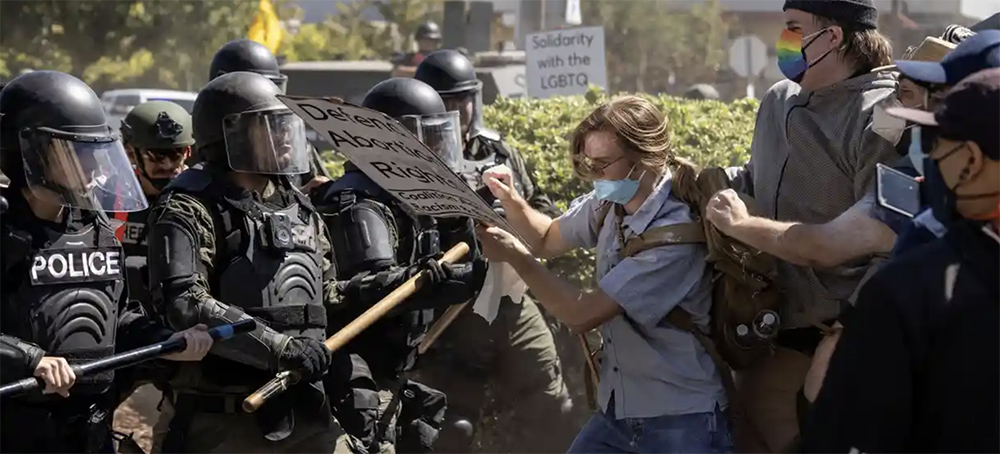 Counter-protesters clash with police during a rally of right wing group Straight Pride outside a Planned Parenthood office in Modesto, California. (photo: Carlos Barría/Reuters)
Fights broke out after counter-protesters confronted an annual rally by Straight Pride, a group with links to the alt-right
The encounter, which resulted in multiple arrests, was confirmed by the Modesto police department. Video of the clash was posted on Twitter.
“We got shit going down at the opposition to the Straight Pride rally in Modesto, CA. Cops have just declared an unlawful assembly aftee (sic) the fash (fascists) showed up,” said Daryle Lamont Jenkins, director of One People’s Project, alongside the post.
A spokesperson for the department said that clashes came during an annual protest by Straight Pride, an anti-abortion group with links to the alt-right, after they were confronted by pro-choice counter-protesters.
Four people were detained – three were arrested for failure to disperse, and one was released, police said.
Police said they didn’t immediately have the names or affiliations of those who were arrested, though they noted that the counter-protest group showed to the demonstration in larger numbers.
The clashes between rival groups came soon after the scheduled 11am start of the rally. About 11.20am, Modesto police declared an unlawful assembly and directed demonstrators to disperse.
Besides a shrub being lit on fire, “there was some fighting … so we declared it unlawful assembly, moved everybody out of the area, blocked streets and made several arrests”, the department spokesperson explained.
Straight Pride is among several fringe groups that are active against reproductive rights, which suffered a substantial blow when the US supreme court decided to overturn the landmark 1973 Roe v Wade decision that granted nationwide abortion rights.
Members of the group were reportedly among the Donald Trump supporters who attacked the Capitol on 6 January 2021 in a desperate but unsuccessful attempt to block the congressional certification of the former president’s electoral defeat to Joe Biden.
SP is often grouped with Super Happy Fun America, which bills itself as a civil rights organization that opposes gender diversity and stands in opposition to what it calls “cultural Marxism”.
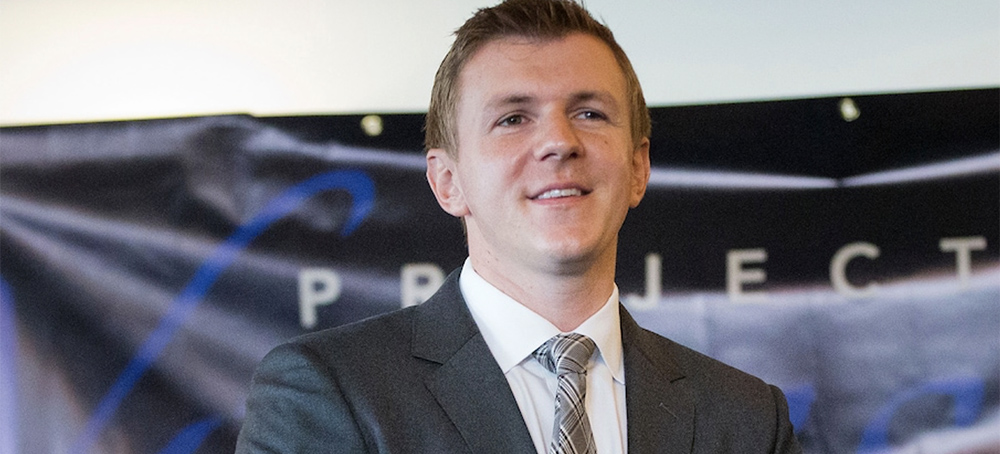 James O'Keefe, president of Project Veritas Action, at the National Press Club in Washington in 2015. (photo: Pablo Martinez Monsivais/AP)
The Justice Department on Thursday delivered a response of sorts, and the particulars don’t look favorable to Project Veritas, a group popular among conservatives for its undercover “sting” videos seeking to expose liberal bias in the media, government and tech worlds.
The upshot: If the government’s version of events is true — its claims have not been tested in court — Project Veritas appears to have a shaky case that all of its activities in the diary saga are protected by the First Amendment.
According to Thursday’s announcement, two Florida residents — Aimee Harris and Robert Kurlander -- pleaded guilty to a conspiracy to transport stolen property, which included a diary purportedly kept by Ashley Biden. “Harris and Kurlander stole personal property from an immediate family member of a candidate for national political office,” said U.S. Attorney Damian Williams. According to a court document filed by prosecutors in connection with the plea, Harris and Kurlander engaged in extensive discussions with an “organization” — known to be Project Veritas — to sell the material.
Herewith a quick summary, based on the document: In June 2020, Harris moved into a Florida house where Ashley Biden previously resided and where she’d left several items, including the diary, for safekeeping. After discovering the items, Harris enlisted Kurlander to sell them. An attempt to peddle them to the Trump campaign failed, so they turned to Project Veritas, which, according to the government, paid for the pair to travel to New York. At a Manhattan hotel, Harris and Kurlander “provided” the items, which included the diary, a digital camera and a drive containing Biden family photos. Harris explained how she’d obtained the materials and noted that there were additional items belonging to Ashley Biden at the Florida residence.
The next part is critical: An employee of Project Veritas, according to the government’s filing, then “asked” Harris and Kurlander to return to the residence “so that they could obtain and provide” more of Ashley Biden’s belongings — a step that the government says Project Veritas took in part to authenticate the diary. Harris and Kurlander complied with this alleged request, and Project Veritas paid them a total of $40,000.
In a November 2021 filing regarding the FBI search, Project Veritas provided its own account, insisting it “had no involvement with how those two individuals acquired the diary.” Instead, it said, “All of Project Veritas’s knowledge about how R.K and A.H. came to possess the diary came from R.K. and A.H. themselves.” Furthermore, the document asserts, the duo indicated that the material was “abandoned” at the house and that both of them had “reaffirmed that they had come to possess the diary lawfully.” After failing to authenticate the diary “to the degree they required to satisfy their journalistic ethics,” Project Veritas’s lawyers wrote, Project Veritas declined to publish it, but attempted to return it to Ashley Biden, and ultimately handed it over to local law enforcement in Florida.
There is little detail in that filing about the specifics of group’s communications with Harris and Kurlander, and no suggestion that they directed the pair to gather additional items from Ashley Biden.
The disclosures in Thursday’s plea documents bear on the legal arguments that Project Veritas asserted at the time of the O’Keefe raid. Back then, lawyers for the organization maintained that O’Keefe & Co. were practicing journalism — and the feds were overreaching. “What the DOJ has done in this case … they have blown federal law, they’ve blown the Constitution, they’ve blown due process and civil rights. … So this is a scandal of epic proportions,” attorney Harmeet Dhillon told host Tucker Carlson at the time. “Every journalist who isn’t worried and concerned about this should hang up their journalism card — ditto all First Amendment lawyers as well.”
As it turns out, no — this was not a scandal of epic proportions.
As for the group’s claim that the First Amendment shields its activities, that’s a complicated question. As this blog has noted before, the Supreme Court has extended First Amendment protections to the publication of information that had been obtained illegally — provided that the news outlet didn’t participate in those illegal activities. That jurisprudence stems from Bartnicki v. Vopper, in which Pennsylvania radio host Frederick Vopper received a newsworthy recording that related to an union controversy. The recording itself was illegal, but Vopper played no part in its creation. It just landed in his lap.
Project Veritas, however, may not have Vopperian clean hands in this case. The organization’s claim that it had “no involvement” in how the Florida duo acquired the diary does appear to find corroboration in the Justice Department documents. Its alleged request for a second tranche of items, however, is another matter.
According to the Justice Department document, Harris’s explanations in the New York meeting “confirmed” for Kurlander that she had stolen the items in question. Did Project Veritas reach that same conclusion? In its own filing, Project Veritas said that its sources had characterized the items as “abandoned.” From the standpoint of common sense: When two random people seek payment for items as personal as a diary and family photos involving famous people, you’d have to be pretty naive not to suspect it was stolen.
Project Veritas’s alleged push for more items appears to place its conduct in the same ballpark as a Texas radio station reporter who in the mid-1990s received illegally intercepted recordings of cordless phone conversations for use in an investigative story. The reporter gave his source tips on how to ensure the recordings’ authenticity.
Those actions, a federal appeals court ruled in Peavy v. WFAA TV Inc., were enough to expose the radio station to potential civil liability, the First Amendment notwithstanding.
No charges have been filed against Project Veritas, though law enforcement officials said that Kurlander would cooperate with their investigation, according to the New York Times. Lee Levine, a retired media defense attorney who represented the media defendant in Bartnicki before the Supreme Court, says the authorities “can feel pretty good about their chances that the First Amendment will not be an impediment to prosecution. … The combination of saying, ‘I want more stuff and, by the way, I’ll pay you for it’ — that’s a pretty powerful combination from prosecutorial standpoint.”
Paul Calli, an attorney representing Project Veritas in the case, emailed this statement to the Erik Wemple Blog:
Project Veritas and its journalists never participated in or directed any crime. A journalist must be able to engage in ethical, careful corroboration of source material prior to publication. Accepting corroborative material already in possession of the source, is not a crime. The law says as much and the PV journalists adhered to the law. The fact that sources may elect to plead guilty to a crime changes nothing as to journalists.
In an earlier statement, Calli said that a “journalist’s lawful receipt of material later alleged to be stolen is routine, commonplace, and protected by the First Amendment.”
That’s a fine statement, but let’s be clear: There’s nothing journalistically routine or commonplace about this entire affair.
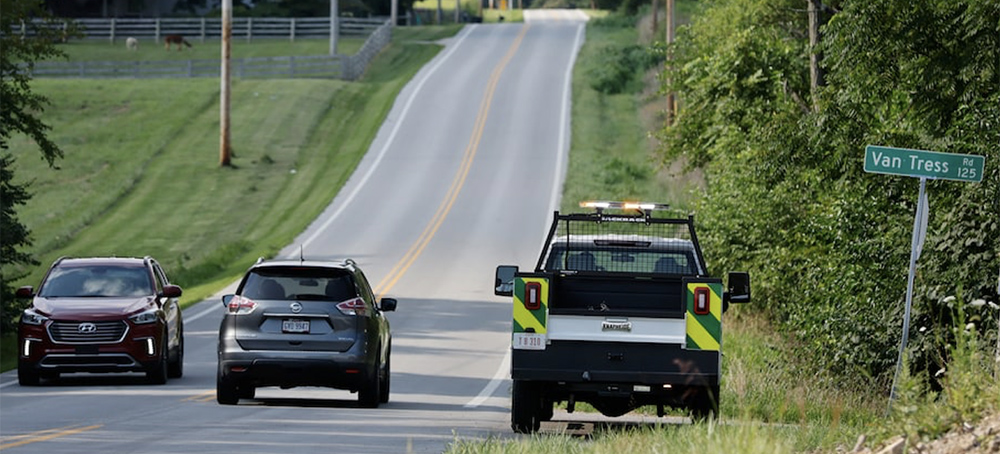 Clinton County employees sit in their vehicles blocking the road that leads to the scene where an armed man was shot and killed by police after trying to breach the FBI's Cincinnati field office on Aug. 11 in Wilmington, Ohio. (photo: Jay Laprete/AP)
Threats against the FBI and other agencies shouldn’t be a surprise—there are far-right rogues in their own houses.
Ever since the search and seizure of highly classified documents at Mar-a-Lago, the right-wing ecosystem has continued to amplify former President Donald Trump’s conspiratorial lies about the so-called “deep state.” As a result, there’s a giant target on law enforcement agencies.
On Aug. 15, the FBI and Department of Homeland Security (DHS) warned about a surge in threats against law enforcement, specifically identifying “multiple articulated threats and calls for the targeted killing of judicial, law enforcement, and government officials associated with the Palm Beach search, including the federal judge who approved the Palm Beach search warrant.”
As we saw on Jan. 6, some MAGA supporters take Trump and other right-wing ideologues literally and seriously.
Recently, a Pennsylvania man, Adam Bies, was charged with posting multiple threats against the FBI on social media. Another Trump supporter, Ricky Shiffer, was shot and killed after attempting to breach the FBI’s Cincinnati field office with an AR-15 and a nail gun. Shiffer, a Navy veteran, was known by the FBI to have associated with far-right extremist groups. He was also present at the Jan. 6 Capitol assault along with thousands of other Trump supporters, including Thomas Webster, a former NYPD officer, who was convicted of assaulting a fellow cop at the Capitol. For his crimes, the DOJ just announced it is seeking the longest sentence yet for a Jan. 6 defendant: 17.5 years.
This is an auspicious sign that the DOJ won’t show leniency to insurrectionists because they wear a badge. After all, Webster wasn’t the only police officer sacking the U.S. Capitol. There were at least 39 police officers from 17 states who took part in a failed coup attempt against our democracy, orchestrated in part by far-right militant groups like the Proud Boys and Oath Keepers, whose leaders have been indicted on charges of seditious conspiracy and other offenses related to the U.S. Capitol breach.
These violent groups have a membership that includes a disturbingly large number of law enforcement officials, veterans, and ex-military—and they even have ties with numerous Republican elected officials.
For example, GOP Rep. Mark Finchem of Arizona is an active member of the Oath Keepers and was present at the Jan. 6 rally. Pennsylvania’s Republican gubernatorial candidate, Doug Mastriano, is a Christian nationalist whose security team consists of at least one person with direct ties to the militia group. In January 2021, 12 U.S. Army National Guard members were pulled from Biden’s inauguration security team for having ties to right-wing militia groups or posting extremist views. Dan Bongino, an influential right-wing personality who peddles the big lie, was once a Secret Service member. Trump’s Secret Service team allegedly knew in advance about threats against House Speaker Nancy Pelosi, then-Vice President Mike Pence, and then-President elect Joe Biden on Jan. 6, but failed to report them. Oh, and they also mysteriously deleted their Jan. 6 text messages.
Something is rotten in the state of Denmark, and within our law enforcement agencies.
Dr. Heidi Beirich, a co-founder of the Global Project Against Hate and Extremism, believes America failed to appreciate the extent of law enforcement’s involvement in these groups until the Oath Keepers’ membership revealed the names of so many active duty and retired law enforcement personnel. Beirich teaches a course at the University of Southern California (USC) on extremism in law enforcement, and explained to me why law enforcement is such a fertile recruitment ground for hate groups and militias.
“Cops provide them legitimacy,” Dr. Beirich said. “Cops are seen as community leaders. They are also seen as more conservative than the average person. They’re someone who can bring in more recruitment. They’re kind of like veterans in that they carry the same imprimatur.”
Sadly, it shouldn’t have taken a failed coup attempt to force the FBI and DOJ to acknowledge this dangerous and growing threat within law enforcement considering they’ve known about it for more than 15 years.
In a 2006 internal bulletin, the FBI warned about white nationalists infiltrating the police to recruit members and disrupt ongoing investigations. In 2015, the FBI’s Counterterrorism policy guide warned that the white supremacists and far-right militant groups “often have identified active links to law enforcement officers.” In a leaked FBI intelligence assessment from 2021, the FBI’s division in San Antonino concluded that white supremacists and right-wing extremists would “very likely seek affiliation with military and law enforcement in furtherance of their ideologies.”
Unfortunately, the FBI has not been forthcoming about the rot in its house. In the aftermath of Jan. 6, and last year’s leaked report, Democratic Rep. Jamie Raskin blasted the agency for initially claiming there was no evidence of racist infiltration in law enforcement. In a statement, Raskin wrote, “the FBI's failure to level with the American people about organized racist infiltration of law enforcement is having dangerous and deadly consequences."
Those dangerous and deadly consequences are now arriving at their doorstep—literally.
Former FBI special agent Michael German, now a fellow with the Brennan Center for Justice, told me the FBI knew of this problem back in the 1990s when he was an undercover agent infiltrating white supremacist groups. He said the problem is so significant that FBI agents are warned to alter their counterterrorism techniques when investigating white supremacist and militia groups out of concern that their allies in law enforcement will tip them off. In 2020, German wrote a report, Hidden in Plain Sight: Racism, White Supremacy, and Far-Right Militancy in Law Enforcement, in which he concludes that the government’s response to this growing threat has been insufficient despite the numerous warning signs and intelligence produced by FBI analysts and agents.
I asked German why the DOJ and FBI have often turned a blind eye to this threat while aggressively investigating and prosecuting the War on Terror, which turned fellow Americans into suspects simply for being Muslim. “The FBI remains a predominantly white male organization—that isn’t by accident,” German replied. “The structural and explicit bias both exist within a system that predominantly protects white people and white institutions while looking at non-white people as institutions as subversive.” He said this in part explains why FBI managers prefer targeting other groups, namely Muslims, protest groups led by people of color, and anti-racist and anti-fascist groups, even though white supremacist terrorism is now the number one terror threat in America.
However, FBI Director Christopher Wray told lawmakers last year that the bureau has been sounding the alarm about this domestic terror threat for “a number of years now.” Frank Figliuzi, a retired FBI assistant director, echoes that sentiment and told me the FBI has emerged as an enemy of MAGA precisely because the agency is investigating the Oath Keepers, violent militia groups, and their “king”—Donald Trump.
“The FBI represents a giant speed bump to what they want to establish, which is an authoritarian, white nationalist society, which is anti-democratic, and has a very powerful president,” Figliuzi said. “And they don’t want brown people, and they want to stop any kind of immigration. The FBI stands in the way. They tolerate the local sheriff because they vote for him, but they don't want federal agencies breathing down their neck.”
White power movements and anti-government extremists, such as the sovereign citizens movement, have a long history of targeting federal law enforcement. For example, Timothy McVeigh’s white supremacist beliefs inspired an intense hatred of the federal government which resulted in his 1995 terror attack on Oklahoma City’s Alfred P. Murrah federal building that killed 168 people.
However, after the Jan. 6 attack and the latest threats against the FBI, there are no more excuses to ignore the domestic terror that hides behind the shield.
Dr. Beirich would like to see a “top-down policy” that finally confronts this threat. With over 18,000 law enforcement agencies in the U.S., each with different policies, she believes federal enforcement and oversight will be extremely difficult. For her, initiatives at the state level provide more hope. But even there, roadblocks remain. A recent attempt to ban cops from being in hate groups failed because there was a lack of agreement on the definition of hate groups. Still, Dr. Beirich believes rooting out extremist cops “should be a top priority” because they are threatening the very same communities they are supposed to protect and serve, and currently “we have no system to deal with it.”
Professor Joseph Darda, author of the essay “The Whiteness of Blue Lives: Race in American Policing” in the essay collection A Field Guide to White Supremacy, told me that since so many of these law enforcement institutions and agencies are run at the state and local level, federal intervention would not only be difficult but could also inspire blowback. “The second you try to issue federal level reform, there will be a fervor and, if anything, deepen the kind of support for police that we already see on the right,” he cautioned.
Figluizi would like to see a more centralized vetting process for police officer candidates, including assessing and training state and local officers to keep the bad actors from even getting their foot in the door. “Right now, it’s garbage in, garbage out, and we get what we pay for,” he said. “The departments that do it best are often from the affluent communities because they are funded correctly. We need serious tests, interviews, and specialized polygraphs to vet out and identify those who have racist and hate-based tendencies.”
German believes the solution really isn’t that complicated. “It’s not rocket science,” he told me. “Focus on the actual misconduct taking place. The actions are the problem, the ideas are not the problem.” German says the DOJ already has plenty of authority to go after civil rights violations by law enforcement officials. They could utilize the tools at their disposal, but the problem is they choose not to. He said you don’t have to search social media to uncover racist behavior on the job, you simply have to go down to the squad room and ask, “who are the racist agents?” and you’ll get the names. You can ask the community, “who is doing the most harm?” and they’ll tell you. You can look at the civil complaints and internal complaints and find out the bad actors. “Turning a blind eye,” he believes, “is an institutional choice.”
Communities of color have always been the victims of hate crimes and violence done by white supremacists, militias, and MAGA extremists who believe we’re trying to “replace” them. We’ve also historically been marginalized, targeted, and oppressed by the very saw law enforcement agencies whose duty is to protect and serve our communities. Our warnings and requests for reform are often ignored, ridiculed, or mischaracterized as irrational hatred of the police.
Now that the DOJ and FBI have become the targets of this hateful movement, perhaps law enforcement agencies will open their eyes, identify the extremists that have contaminated this country and its institutions, and aggressively clean their own house.
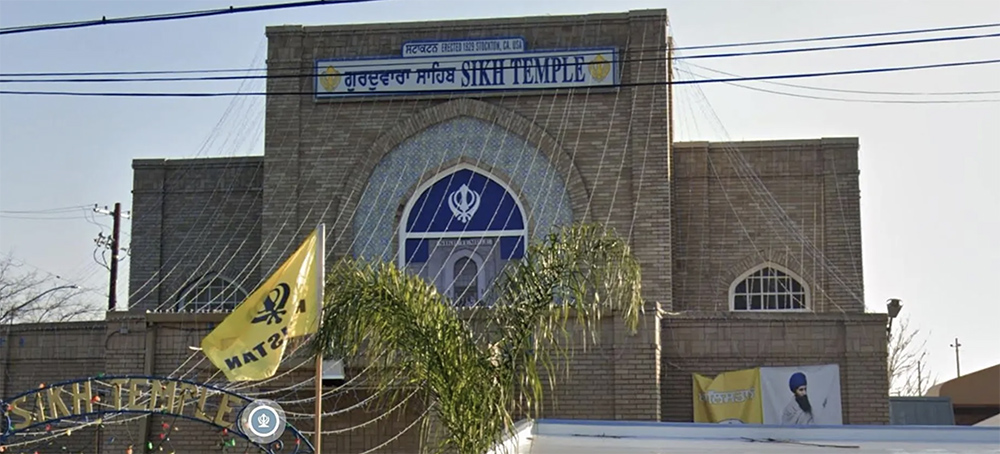 Sikh Temple. (photo: Google Maps)
Authorities were alerted about the incident at 6:42 p.m. and found three people with injuries upon arriving near Gurdwara Sahib Sikh Temple. The individuals were hospitalized with what police called "non-life-threatening injuries."
The victims and suspects are Sikh, according to SPD.
The temple said in a press release that the shooting is not believed to be connected to the place of worship. It added that it did not take place on the property of the Sikh Temple nor was it related to a weightlifting event that was held at the time.
Police said the investigation is ongoing and did not release additional information about the incident.
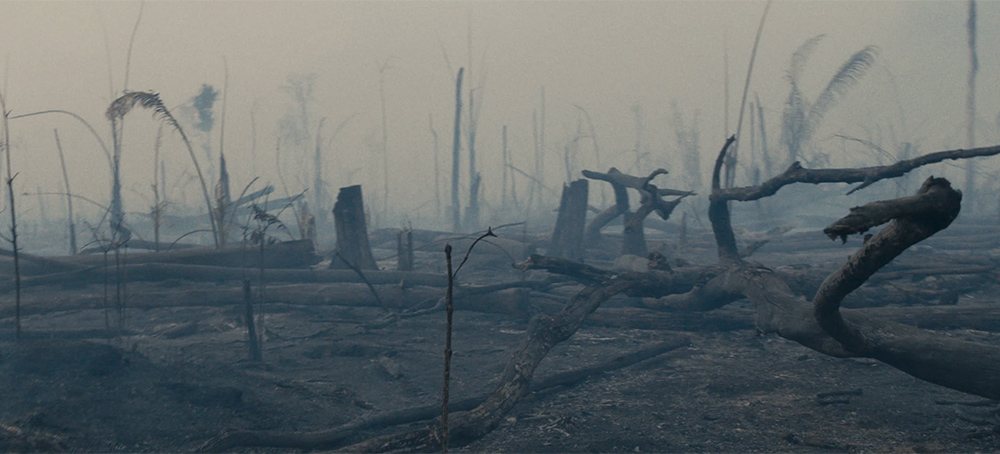 The scorched remnants of the Amazon rainforest after a blaze set by farmers tore through the land. photo: Alex Pritz/Amazon Land Documentary)
In “The Territory,” documentarian Alex Pritz chronicles Indigenous Brazilians’ fight to save their home in the Amazon rainforest.
“The only thing that’s saving our planet is our rainforest,” says Bitaté, a young member of the Uru-Eu-Wau-Wau Indigenous people, in the film. “I believe the Amazon is the heart not just of Brazil, but the whole world.”
“The Territory,” which is showing in select U.S. and Canadian cities, chronicles the perilous efforts of Uru-Eu-Wau-Wau like Bitaté to defend their ancestral home as white settlers seek to illegally slash and burn the forest and turn it into pasturelands. The forest is officially protected by the Brazilian government, but Pritz shows how far-right President Jair Bolsonaro and the Brazilian state’s hostility toward Indigenous people emboldens the land thieves.
The film is very timely. Brazil is gearing up for highly polarized presidential elections in October. And, with the climate emergency exploding across the globe, environmental and Indigenous concerns remain in the spotlight, particularly following the brutal assassinations of British journalist Dom Phillips and Brazilian Indigenous expert Bruno Pereira in the Amazon in June.
Cattle ranching is the leading cause of Amazon deforestation, which has increased at a dramatic rate in recent years, much of it illegal. So much of the rainforest has already been cut down that scientists believe we are on the verge of an irreversible tipping point. The Amazon also serves as an essential carbon sink in the fight against climate change and generates the rainfall that supports almost all life on the South American continent. Ranching, as well as mining, logging, and factory farming — embraced by politicians and bankers as agents of “economic progress” — are driving us ever closer to an environmental (and socioeconomic) catastrophe.
“The Territory” was shot on the front lines of an active war zone almost 500 years after the conflict began, following the arrival of the first Europeans in search of gold. No nuclear weapons are involved, but the conflict has the potential to dramatically alter the course of life on Earth.
Pritz and his team spent three years on the southern edge of Brazil’s Amazon rainforest, beginning in 2018, just as Bolsonaro, in the name of economic development, was campaigning on promises to roll back Indigenous rights and empower miners, loggers, and ranchers. The land grabbers of the Amazon saw the opportunity.
“This is how Brazil was created,” a settler named Martins tells the camera in Uru-Eu-Wau-Wau territory, his arms speckled with wood chips from the once towering tree he had just felled.
Modern Brazil, like the rest of the Americas, was built on the genocide of Indigenous people and the forced expropriation of their lands — programs conducted by enterprising settlers, the government, and large infusions of international capital. Martins is among the poor, dispossessed, landless peasants in the film, but their like is backed and financed by powerful interests that the camera does not capture.
The colonial process has been such a successful endeavor that the Uru-Eu-Wau-Wau have been decimated — less than 200 of them remain.
“People say they’re there, but nobody’s ever seen them,” said one aspiring settler, hoping to dismiss the property claims of the Uru-Eu-Wau-Wau and other Indigenous people who live on the reserve. Cribbing from apologists for colonialism quoted in history books, Sergio, a settler leader, tells the camera, “The Uru-Eu-Wau-Wau, they don’t farm or create anything. They just live there.”
The settlers employ sometimes paradoxical rhetoric to justify their actions: patriotism, progress, fairness, the perception that the Indigenous do not make good use of their land, and even doubts that they really even exist — all infused with Christian values and heavy-handed claims to divine right.
“If there is a villain, it’s the people behind Sergio and Martins that are financing this, the people that are really benefiting from having these poor disenfranchised farmers remain with the idea that it is Indigenous people who are holding them back,” Pritz, the director, told The Intercept. “In America, same as in Brazil, it’s advantageous for the political class to keep disenfranchised people fighting amongst themselves because it keeps the heat off them.”
The Uru-Eu-Wau-Wau in the film are more direct and concise in their analysis than the settlers. “They just want money,” one unnamed elder tells a gathering of leaders. “That’s all it is.”
Hope in the face of overwhelming odds is the Uru-Eu-Wau-Wau’s strategy. Fears of the complete extermination of their people — genocide — are on the lips of multiple Uru-Eu-Wau-Wau in the film. They are angry but also cognizant that they are outgunned. Rather than use the warfare tactics of their ancestors, we accompany their surveillance teams, armed with bows and arrows, drones, cameras, and GPS trackers, to document and report invasions to authorities with the help of environmentalist allies.
This is one of the contradictions that the film reveals: The Indigenous, derided as backwards by their enemies, employ modern technology and sophisticated public relations to promote a vision for the future that is increasingly the only hope for survival. Meanwhile, the supposed agents of socioeconomic progress use antiquated ideologies and outright criminality to destroy Brazil’s most precious resource.
Indigenous groups are also testing their luck in courts. The patrols, meanwhile, take matters into their own hands and snuff out incipient invasions whenever they judge it safe enough to do so.
Invasions into Indigenous territories are up 180 percent under Bolsonaro, according to a new study by the Missionary Council for Indigenous Peoples. The land raiders’ bonanza has proved dangerous to the Indigenous and their defenders, who live under constant threat from ruthless enemies.
Phillips and Pereira, the journalist and Indigenous expert, respectively, were assassinated about 500 miles to the northwest while working with a similar surveillance project being implemented in the Javarí Valley, a sprawling Indigenous reserve on the border with Colombia and Peru. The accused murderers were illegal fishermen with alleged ties to politicians and international drug smuggling networks.
Prior to the killing, the Indigenous patrol group had repeatedly denounced the activities of this gang to authorities with documented evidence, but nothing came of it. Human rights organizations complain that the police have been hesitant to investigate who is really behind the killers.
Phillips, who was writing a book called “How to Save the Amazon,” strongly believed that most of the people committing environmental crimes on the ground are also victims of a system designed to make unsustainable development their only viable economic option. In addition to empowering Indigenous movements, he argued, any solution must include more sustainable alternatives for those working in the extractive and land-grabbing industries — the very sort of people that assassinated Phillips.
None of this is likely to happen under the current government. Recent polling suggests that leftist former President Luiz Inácio Lula da Silva continues to lead nationwide, but Bolsonaro and aligned anti-Indigenous and anti-environment politicians have the upper hand in the Amazon region in this October’s elections.
All hope is not lost, though: Eighty-one percent of Brazilians believe that protecting the Amazon should be a priority of the next president, and two-thirds nationally, and in the North specifically, believe the Bolsonaro administration is not actively combating crimes such as land grabbing, drug trafficking, and illegal logging in the region, according to another recent poll.
It seems contradictory that polls show that people in Brazil’s north both support Bolsonaro and want more done to protect the Amazon, but the responses are indicative of the complexity of the issues at hand.
The realities are that policies of death and destruction are subsidized by the government and bankrolled by faraway investors, while criminality is not held accountable. Options for Brazilians are limited.
It is easy to imagine that if alternative, sustainable economic models were incentivized, a different electoral reality would exist. “In another world,” said Pritz, “Sergio could be an advocate for agrarian reform and some of these other leftist movements.” Instead, social programs, law enforcement, and sustainable development have been whittled away and most Brazilians are feeling increasingly desperate.
“The government isn’t doing their job,” Bitaté says in “The Territory.” “That’s our reality — they’re not. And now we’re doing their work for them.” The young Uru-Eu-Wau-Wau leader spoke as he was trekking through the forest in search of invaders. The words, though, could just as easily have come from the mouth of Martins as he chainsawed the path for a new road into the reserve that he hoped will one day be built — the only path he can imagine to escaping poverty.
Follow us on facebook and twitter!
PO Box 2043 / Citrus Heights, CA 95611


Comments
Post a Comment