RSN: Andy Borowitz | Melania Wishes She Could Get Divorced Just by Thinking About It

25 September 22
Live on the homepage now!
Reader Supported News

 A Russian law enforcement officer detains a person during a rally. (photo: Reuters)
Rights groups say more than 730 people were detained at anti-war protests across the country.
Police detained nearly 750 people, including more than 370 in the capital Moscow and some 150 in St Petersburg, according to OVD-Info, an independent website that monitors political arrests in Russia. Some of the arrested individuals were minors, OVD-Info said on Saturday.
Protests erupted within hours on Wednesday after Putin announced a call-up of 300,000 army reservists in a move to beef up his forces fighting in Ukraine after the Russian military suffered battlefield setbacks. A Russian general who handled supplies at the Ukraine front lines was replaced on Saturday.
Police deployed in cities where protests were scheduled by opposition group Vesna and supporters of jailed opposition leader Alexey Navalny, quickly arresting demonstrators before they could hold protests.
The Ukrainian president, in his late-night address, called on Moscow’s forces to surrender, saying they would “be treated in a civilised manner… no one will know the circumstances of your surrender”.
The comments came just hours after Russia passed a law making voluntary surrender and desertion a crime punishable by 10 years of imprisonment.
A separate law, also signed on Saturday, facilitated Russian citizenship for foreigners who enlist in the Russian army for at least a year, bypassing the normal requirement for five years of residency in the country.
Russia officially counts millions of former conscripts as reservists – most of the male population of fighting age – and the “partial mobilisation” gave no criteria for who would be called up.
Reports have surfaced of men with no military experience or who are past draft age receiving call-up papers, adding to the outrage that has revived anti-war demonstrations.
Criticism appeared to be spreading
Criticism also appeared to be spreading among Putin’s supporters. The head of the Russian president’s human rights commission, Valery Fadeyev, called on defence minister Sergei Shoigu to put a halt to the brutal manner with which many draft boards were proceeding.
The editor-in-chief of pro-Kremlin Russian television RT also expressed anger at the new recruitments. “They’re infuriating people, as if on purpose, as if out of spite. As if they’d been sent by Kyiv,” she said.
In another rare sign of turmoil, the defence ministry said the deputy minister in charge of logistics, four-star General Dmitry Bulgakov, had been replaced “for transfer to another role”, giving no additional details.
As long queues of men trying to leave the country formed at Russia’s borders, Russian foreign minister Sergey Lavrov delivered a fiery speech at the UN General Assembly accusing Western nations of seeking to “destroy” the nation.
“The official Russophobia in the West is unprecedented, now the scope is grotesque,” Lavrov said.
“They are not shying away from declaring the intent to inflict not only military defeat on our country but also to destroy and fracture Russia.”.
Meanwhile, Russia staged its second day of the so-called referendums in four occupied regions of Ukraine and appears set to formally annex a swath of the territory next week.
Kyiv and the West have denounced the votes as a sham and said outcomes in favour of annexation are pre-determined.
Putin this week warned that Moscow would use “all means” to protect its territory, which former Russian leader Dmitry Medvedev said on social media could include the use of “strategic nuclear weapons”.
The annexation raises concerns that Russia could then view any military move on the occupied regions as an attack on its own territory.
 GOP dumpster. (photo: Erin O'Flynn/The Daily Beast/Getty Images)
Republicans are going to lose a bunch of winnable seats in Congress because they picked the craziest MAGA candidate.
Thanks to a crop of Trumpy primary winners, Republicans are effectively conceding seats that could be winnable with better candidates.
Let’s start in Michigan, where news broke this week that Trump-endorsed House candidate John Gibbs argued against women’s suffrage while in college. But other than that, he’s… still weird.
Gibbs’ other “greatest hits” include calling Democrats the party of “gender-bending,” defending an antisemitic Twitter feed, and advancing the theory that Hillary Clinton’s campaign chairman John Podesta participated in a satanic ritual (no wonder Democrats boosted his candidacy).
Gibbs won the nomination by defeating first-term incumbent Republican Rep. Peter Meijer, whose unpardonable sins were voting for Trump’s second impeachment and accepting the results of the 2020 election. Before that, Republican Rep. Justin Amash (whose unpardonable sin was voting for Trump’s first impeachment) held that seat from 2011-2021. Aside from Amash switching to the Libertarian Party in his final year in office, a Republican has occupied Michigan’s 3rd Congressional district since 1993.
This raises the question of whether even Gibbs could blow this race if he tried. According to the Cook Political Report, the answer is YES. They rank the district as Democratic-leaning. (Gibbs’ craziness aside, the district was recently redrawn to include more Democratic voters. So at the very moment when Republicans needed a congressional candidate with broad support, they nominated Mr. MAGA.)
But Gibbs is no anomaly. Next door in Ohio, Republicans have a similar problem with GOP House candidate J.R. Majewski.
If you’re unfamiliar, Majewski is the man in this “Let’s Go Brandon” rap video. He got Trump’s attention by carving the name “TRUMP” into his farmland. And to top it off, Majewski was at the Capitol on Jan. 6.
So how did he win the GOP nomination? During an Ohio rally in April, Trump gave Majewski a shout-out. “He’s a great guy,” Trump said. “I love him.” A little over a week later, Majewski won the Republican primary.
But, for Republicans, it wasn’t much of a victory. This week, on the heels of an Associated Press report alleging that Majewski misrepresented his military service (Majewski denied this, claiming his deployments are “classified”), it was reported that the National Republican Congressional Committee (NRCC) had withdrawn about $1 million worth of ads for the candidate.
(At this point, I should disclose that my wife was a fundraising consultant for one of the Republican candidates that Majewski defeated in the primary, state Sen. Theresa Gavarone—a conservative with an impressive list of endorsements, including the Ohio Right to Life and the Susan B. Anthony Foundation. In an alternate universe, she would be poised for victory in November.)
With a better candidate, this House seat could have been a GOP pickup. Ohio’s 9th Congressional District has been held by Democratic Rep. Marcy Kaptur since 1982, but redistricting has made it more Republican (Trump won the district by three points in 2020.)
Now, you might be thinking, “There are 435 House races every year. What difference does this one make?”
Well, the seat is important enough that House Minority Leader Kevin McCarthy traveled to Ohio last month to campaign for Majewski.
Of course, Republicans are still expected to win the House of Representatives, but a narrow majority will cause headaches for McCarthy (possibly even costing him the speakership).
Trump’s support elevated unelectable candidates like Majewski, and Kevin McCarthy did nothing to prevent this or to elevate more electable candidates. Now, he’s reaping what he sowed.
A similar story is taking place in the upper chamber, where candidate quality is more likely to cost Republicans the majority. This week, it was announced that a Mitch McConnell-affiliated super PAC had pulled out of Trump-endorsed Blake Masters’ race for the U.S. Senate in Arizona.
Give these establishment Republicans credit for husbanding their resources, cutting their losses, and spending their dollars where they think they have a chance to win. But they would have more chess pieces to play with had they gotten in the game sooner—and helped more electable candidates compete with Trump’s hand-picked minions.
Even if they take the majority, Republicans are taking points off the board. In a business that is a game of inches, and in a year when the margins are looking tight, Republicans are poised to leave congressional seats on the table. The only question is: How many?
The bad news for normal Republicans who want to use this as a teachable moment is that missed opportunities don’t sting so much as long as you still come out on top. Republicans always win just enough to avoid hitting rock bottom and moving on from Trump.
READ MORE Kimberly Teehee, right, and Cherokee Nation principal chief Chuck Hoskin Jr. speak to the media in 2019 after Hoskin nominated Teehee to be the Cherokee Nation's first delegate to Congress. (photo: Sue Ogrocki/AP)
A lesser-known provision of the same treaty also granted the Cherokee Nation a delegate in the House of Representatives "whenever Congress shall make provision for the same."
Now, the tribal government is calling on congressional leadership to finally make good on the pledge of its predecessors.
"The Treaty of New Echota has no expiration date," Cherokee Nation principal chief Chuck Hoskin Jr. said in a recent video message.
"The obligation to seat a Cherokee Nation delegate is as binding today as it was in 1835," he added.
The Cherokee Nation is renewing its push to get Congress to meet its obligation three years after the nation nominated its first delegate, Cherokee Nation citizen Kim Teehee.
A former White House senior adviser, Teehee said in 2019 that it was especially important for the Cherokee Nation to have a delegate in Congress because the treaty that specified it also led to the Trail of Tears, in which some 4,000 Cherokees died.
"We can't ignore that history and what it meant for us to have a provision like that put in place given the devastation that occurred and the deaths that occurred," Teehee said at the time.
According to the tribal government, the House of Representatives has to take action to officially seat the delegate.
The Cherokee Nation's delegate would not be able to cast votes on the House floor or preside over floor sessions, but would be able to make speeches and vote in committee.
There are currently six nonvoting members of Congress, representing the District of Columbia, Puerto Rico, American Samoa, Guam, the U.S. Virgin Islands and the Northern Mariana Islands.
The Cherokee Nation describes itself as the largest tribal government in the U.S. with more than 430,000 citizens.
READ MORE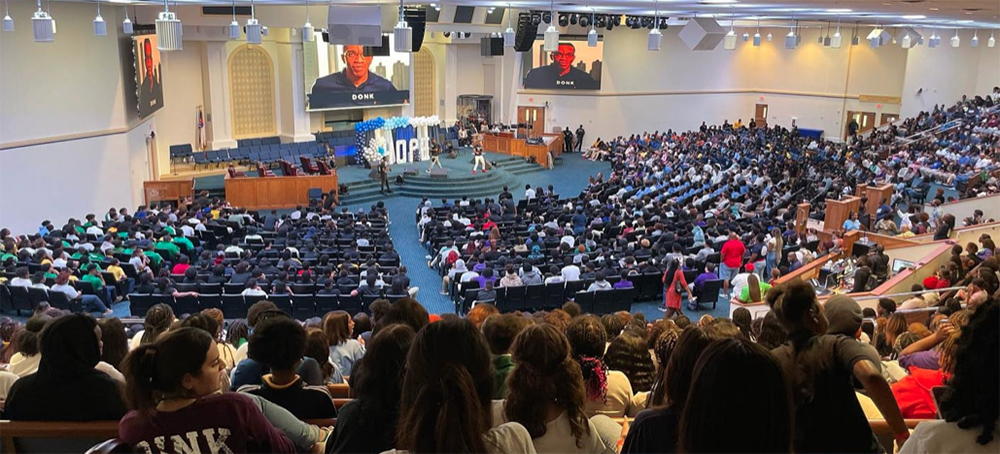 East Baton Rouge assembly. (photo: acebook/EBR Schools)
They thought they were attending a college fair. Then things took a dark turn as girls were allegedly separated and “advised to forgive men who rape and assault them.”
After students arrived at the venue—a church called the Living Faith Christian Center—they say they found something much different than a career fair called the “Day of Hope.” While several colleges did have a presence at the event, students said the emphasis appeared to be on something else entirely.
The pupils were reportedly separated into two groups by gender, forced to register to vote in order to obtain the promoted free food, and listen to speakers share disturbing stories of rape, suicide, and abstinence. One teacher claimed in a Facebook post that some transgender students were bullied by their peers at the event.
Now, a group called “Day of Nope” is seeking to file a lawsuit over the episode and asking attendees to share their experiences via a new website. “This was supposed to be a college fair, but the girls were talked to about abstinence, bullying, and death. And the guys played games,” one student told ABC affiliate WBRZ, which reported on the latest backlash to the event.
“Boys were encouraged to perform macho acts while girls were advised to forgive men who rape and assault them,” says a GoFundMe for this litigation effort, which had raised $75 as of Saturday. “Speakers subjected students to graphic tales and reenactment of suicide, which left some students with past loss due to suicide disturbed and upset with no emotional support to help them. Students were found in the bathroom weeping.”
“In violation of federal law, lunch was conditioned on completing voter registration forms and other election related materials were distributed to students,” adds the fundraising page, titled “Fight Back Against ‘Day of Hope’ Trauma.”
Brittney Bryant, a biology teacher who complained about the event on Facebook, fumed that “boys were instructed to go outside while the girls were left in the church for ‘girl talk.’ My transgender child was discriminated against for walking out.”
“I stayed and listened to the discussion,” Bryant added. “They talked about rape, forgiving the offender in life, suicide, prayer leadership, and many more dark controversial topics. We had females in the bathrooms crying due to the topics of discussion.”
Meanwhile, Bryant claims, the boys’ discussion was called “real talk” and included “male chauvinistic competition for monetary reward,” including doing pushups. “They were hyped up and egged on,” she wrote in her social media post.
A student named Alexis Budyach also took to Facebook to detail what she called “a horrible experience” that started with “rap battles and singing competitions, harmless fun.”
Her mother, Bonnie Kersch, told The Advocate that they had no idea the “college fair” would be held in a church. “She felt she was duped into thinking that she was going for a college and career fair,” Kersh told the Baton Rouge newspaper, “that she was proselytized over and prayed over.”
After the ice-breaker, male students were asked to leave the room, Budyach said in her post. “As a genderfluid person, I don’t identify as either a boy or a girl, so this was a troubling situation for me,” Budyach wrote. “However, due to the nature of this program being in a church, I immediately assumed that I would be discriminated against if I went with the boys, so I stayed sitting down and kept my mouth shut. Then, as the girls were all alone, the host introduced three women meant to ‘guide us on our journey in being young queens.’”
Budyach said the first speaker was a female pastor, who lectured about staying true to oneself and not trying to fit in with the crowd. “One of the examples she used for this was how she had kept her virginity through high school and college,” Budyach wrote. “After she announced this proudly, she expected an applause. She mentioned how everyone knew her as ‘the good Christian girl’ and that she was proud of it.”
The second speaker, Budyach added, “was involved in the education sector in some way” and talked about “how a guy she met on a dating app ended up attempting to kill her by strangling her.” The woman allegedly told the students that she kept their romance secret, so no one would know if he did murder her. “She used this to ultimately make the argument that if something needs to be kept secret, then it shouldn’t be happening at all,” Budyach wrote.
After this warning about domestic violence, Budyach says, the woman also “emphasized that if she had waited for the man god meant for her, then it wouldn’t had happened. She uses this to essentially shame the concept of ‘dating around’ and took a soulmate-esque approach on the situation.”
“In addition,” Budyach wrote, “she explained that she had forgiven her ex boyfriend for his attempted murder, even if he wasn’t sorry. Again, there could possibly be a valuable message, however it’s lost in the traumatic storytelling and religious imagery.”
The third speaker was a nurse with a PhD, Budyach continued, and “gave an extremely detailed description of the morning that she had found her son’s body after he had hung himself.”
“She explained that this happened because her son was bullied,” Budyach claimed. “She used this story to say that people these days are too mean to each other and we need to stick together. For the third time, a possibly useful message hidden behind an extremely traumatizing account of a day that we had no warning or idea that we were going to learn about.”
When both student groups were called into the venue, a speaker named Donk “gave the most fantastical story one could imagine,” Budyach said.
“He started by saying at the age of 9 he was shot in the stomach and saw his intestines fall into his hands. Then, he was paralyzed and in a wheelchair from the ages of 11-13 (not sure what happened from 9-11). One day, according to him, he was with his grandma who was snoring very loudly and he started to wiggle his toes and wasn’t paralyzed anymore. Then, he started ‘messing with the wrong crowd’ and ended up in prison with a life sentence + 90 years on two counts of armed robbery and a murder. He said how he was sad in jail and tried to kill himself with a bedsheet (which he demonstrated with a prop sheet he had on stage), but somehow he changed his mindset and got out of jail,” Budyach wrote.
“At the end of everything, the host made the audience make a choice. He said, ‘If you want to eat, pizza is right outside those doors for you. If you choose change, if you want to get better, come towards the stage towards me.’ At this point we had not eaten and frankly, I was done being traumatized, so I left the building.”
In a statement, the school district appeared to defend the field trip, which was conducted in partnership with 29:11 Mentoring Families, a religious nonprofit for at-risk youth. (The group’s website says, “We believe by being Inspirational, Intentional and Intimate we’re able to redirect our students to Jesus Christ who defines their future and to change the world.”)
“The East Baton Rouge Parish School System has partnered with to provide additional support services for students in our district,” the school system said. “One of these initiatives is the ‘Day of Hope’ event. The event was structured to assist students with exploring what options are available after high school, along with allowing students to participate in breakout sessions and student-initiated activities and projects. By providing entertaining activities with an educational focus, this event was an elevation of a traditional college and career fair.
“Students were provided with lunch and a rare opportunity to mingle with their peers from other high schools in one setting. We look forward to seeing what our over 2,100 student participants will continue to achieve with the resources and knowledge gained from this event.”
One Facebook video from Aug. 31 promotes the event with 29:11’s founder Tremaine Sterling, who stands beside the school system’s superintendent Dr. Sito Narcisse. “I’m so excited about this partnership,” Narcisse says in the video. “We have great things coming between EBR and 29:11 Academy. It’s gonna be where all the seniors in all the high schools are going to participating. Just one of many partnerships that we have coming.”
“So save the date,” Sterling adds, “It’s going to be amazing. Thousands coming under one roof, to grow, to get better.”
Trey Holiday, a student who attended the event, told The Advocate that the college portion of the event included outdoor tents for only a few schools and programs.
“It kind of felt more like a spiritual event than a career and college fair,” he said.
READ MORE Abortion rights protesters demonstrate in Los Angeles, California, on June 27, 2022. (photo: Lucy Nicholson/Reuters)
There may be little distinction between the two, but lawmakers won’t listen and doctors are wary – and women pay the price
Champion, who was sitting her high school exams in France at the time, had developed a pregnancy outside the uterus, threatening to rupture her fallopian tubes – a condition medically known as an ectopic pregnancy. The doctors intervened immediately, ending the pregnancy and saving her life.
But similarly to cookbook author and model Chrissy Teigen, who this week spoke out about miscategorizing her own abortion as a miscarriage, Champion didn’t realize she’d had an abortion until long after.
“It wasn’t an abortion for me [at the time]. I think because my health was at stake, there was no decision to be made,” says Champion, now 31 and living in New York.
Teigen told an audience at a social impact summit that she was pregnant with her third child with her husband, the singer John Legend, when she learned her pregnancy would not be viable – and that she would not survive without medical intervention.
“[It was] an abortion to save my life for a baby that had absolutely no chance. And to be honest, I never, ever put that together until, actually, a few months ago,” Teigen said.
She had very publicly discussed her pregnancy loss as a miscarriage at the time. It was only after the right to an abortion, long established by the supreme court in Roe v Wade, was overturned this summer that she realized she’d had the procedure: when she told Legend that she empathized with people who have an abortion, he pointed out she was one.
Although it is common for many people to think of miscarriage and abortion as entirely separate matters, doctors say that medically the distinction isn’t so clear. Many doctors consider an abortion as any termination of pregnancy, whether through spontaneous miscarriage or a voluntary action like taking pills to induce one. The line between voluntary and involuntary also shifts and blurs: a patient might start spontaneously bleeding during a wanted pregnancy, then require an intervention; a different patient might want to end their pregnancy only to be told to wait because early signs suggest it will be unsuccessful anyway (around a quarter of pregnancies end spontaneously).
The gray area between miscarriage and abortion is newly worrying now that more than a dozen states criminalize abortion. Patients could find themselves facing legal repercussions or traveling hundreds of miles to seek miscarriage care, for fear of it being mislabeled as an abortion. Dr Joan Fleischman, a New York-based doctor, sees a lot of overlap between abortion and miscarriage – in both cases “it’s not the right time” for a pregnancy to continue, be it for chromosomal or environmental reasons. She recently performed an abortion for a patient carrying triplets. The pregnancies, each implanted through in vitro fertilization, had stopped developing at different stages: one at six weeks, one at seven and one at eight.
“None of them were going to be successful, so I removed that tissue for her,” she says.
During in vitro fertilization, Fleischman notes, people commonly fertilize more eggs than needed, to increase the chances of a successful pregnancy. Those excess eggs are commonly frozen, disposed of or donated for scientific research (which means destroying them), but none of that is thought of as abortion. What’s more, Fleischman’s patient wanted her pregnancy to be successful – she had invested tens of thousands of dollars in it – but still, the pregnancy ended in someone making a decision that the cells had to be removed: an abortion.
Calling something a miscarriage rather than an abortion can be helpful for patients who want to avoid stigma, Fleischman says. “Often, they don’t want their doctor to know, they don’t want their husband to know,” she says.
“If somebody wants their privacy, [the term] ‘miscarriage’ offers a way to talk about a loss. You know, without dealing with the stigma that people just dish on you, no matter who you are, no matter what your situation,” she says.
The danger is not just stigma: after people who miscarry, they often need an abortion procedure to protect their health, and many people miscarry after admitting a pregnancy was unwanted, leaving them open to skepticism – and possible investigation.
In some states, like Texas, abortion-inducing pills have been forbidden, although the same pills are commonly prescribed for miscarriage.
One of Fleischman’s patients traveled from Florida to New York for miscarriage care because of Florida’s 15-week abortion ban. Although the state law makes an exception in some cases “to remove a dead fetus”, some providers are wary of providing care that might be interpreted as violating the ban – and some patients feel uncomfortable about the scrutiny they endure regarding their pregnancy.
Following Teigen’s comments, many anti-abortion advocates argued that abortion and miscarriage cannot be equated. The anti-abortion media platform LifeNews tweeted: “There is a distinct difference between losing a child to ectopic pregnancy or miscarriage and brutality and intentionally ending a life through abortion.”
“In a miscarriage a mother who wants a child loses it through medical complications outside her control. In an abortion a mother willfully enlists an abortionist to scald, dismember and kill her unborn child. See the difference?” the right-wing commentator Dinesh D’Souza said.
These sentiments reflect the changing language around abortion, says Dr Leah Torres, an obstetrician-gynecologist in Alabama. Reproductive healthcare has been subject to public redefinition for centuries, she notes, pointing to laws used to criminalize birth control in the 19th century or, more recently, to posit the existence of ‘fetal heartbeats’ or redefine ‘personhood’.
“When someone calls me and says ‘I’m aborting,’ the image I have is of someone voluntarily inducing their own abortion,” says Torres. “But it’s perfectly scientific to say they started aborting in the bathroom, right? Meaning their pregnancy was unsuccessful and it was ending – exiting their body.”
Torres, whose license was temporarily suspended after she went to Alabama to practice following that state’s abortion ban (her license has since been restored, though she remains $115,000 in debt due to the case), argues these terms matter.
“In the desire to politicize pregnancy termination, [anti-abortion advocates] have removed abortion from being a healthcare issue. They have used the word ‘abortion’ to mean one thing: you got pregnant, now you want to kill your baby. So there’s no room for the actual medical nuance,” she says.
Fleischman says so many of her patients are shocked when they see the mucus-like tissue that is extracted during early pregnancy in an abortion, because it doesn’t look like the images they’ve seen of little fetuses curled up and forming a head, eyes and an abdomen – images commonly and incorrectly used to convey what pregnancy looks like prior to nine weeks.
“It’s just like this huge ‘aha!’ moment for women, like, ‘Oh my God, I’ve been duped. I’ve been on this emotional, judgmental, roller coaster, like this is murder, and this thing just looks like mucus?’” she says.
“This is a very intentional,” says Torres. “Because it’s essentially about taking abortion out of [the] healthcare bracket, and viewing it as an issue of intention, an issue of morality, not an issue of healthcare.”
People would find it ridiculous to say that Chrissy Teigen murdered her child, Torres notes, after a pregnancy she would have continued had it not become life-threatening. But Torres says that this differentiation – between the type of abortion Teigen had, or someone has after spontaneously bleeding on their bathroom floor, and an abortion someone has after walking into a clinic – is essential for anti-abortion activists to justify their rhetoric.
“The right needs to see what happened to her to seem different, because the right has equated abortion with murder,” she says.
Champion, who had her abortion at 19, wants that distinction to be done away with, and not just for herself.
“I want to contribute to depoliticizing this word ‘abortion’. To give it more meaning, so people see it as healthcare access,” she says. “The sooner we can all talk about it as healthcare, the better.”
 Wind power is better for tax payers. (photo: Thomas Jackson/Getty Images)
A new report finds per-acre revenue from offshore wind blows oil and gas out of the water
“Americans are getting significantly more return on investment from offshore wind energy lease sales than they are from oil and gas lease sales” per acre, said Michael Freeman, a conservation policy analyst for the Center and author of the report.
Offshore leases are essentially patches of publicly-owned waters rented out by the Bureau of Ocean Energy Management for energy production — a process governed by the National Environmental Policy Act, or NEPA. The money made from these leases goes to the U.S. Treasury Department, and, through public program funding, back into the pockets of taxpayers.
From 2019 to 2021, the average winning bid from offshore oil and gas lease sales was $47 per acre. By contrast, the average winning bid for a wind lease sale was 125 times higher — just over $5,900 per acre. And that number is likely to get even higher given the American wind industry is still in its relative infancy, said Jenny Rowland-Shea, the Director of Public Lands for the Center for American Progress.
With such a high return on investment, the new analysis suggests offshore wind leases could be a promising source of public revenue in comparison to oil and gas leases, while also reducing energy and fuel costs. Freeman said this money could be redistributed to taxpayers in the form of funding federal agencies or paying for health and education programs: “Expanding offshore wind energy is good for [taxpayers’] driving, for their wallet, for the air that they breathe.”
And of course, there are environmental benefits too. Energy produced by offshore wind does not result in the same climate consequences as offshore oil and gas energy production, which releases up to 87 metric tons of carbon dioxide per active acre in the Gulf of Mexico. That’s roughly the equivalent carbon pollution of 19 cars driven for one year. And according to the report, the social cost of carbon emissions per acre for oil leases is over $16,000 and roughly $2,800 for natural gas leases. Meanwhile, the social cost of carbon emissions from offshore wind power is “essentially nil” per acre, Freeman said. “Clean energy really is clean.”
Offshore wind power has a long way to go before it can come close to the scale of its oil and gas equivalent, but the U.S. has announced big plans for the industry. Early in 2021, the Biden administration set the goal of producing 30 gigawatts of offshore wind power by 2030, or enough to power 10 million homes. This August, Biden signed the Inflation Reduction Act into law, which tied the Bureau of Ocean Energy Management’s ability to issue offshore wind leases to oil and gas leasing, effectively connecting the expansion of offshore wind to expansion of offshore oil and gas energy production.
Prior to the Inflation Reduction Act, the Bureau of Ocean Energy Management had only sold two offshore wind leases to U.S. operators, which contribute less than 1 percent of the energy required to reach the 30-gigawatt goal.
While energy analysts say offshore wind lease sales create greater return on investment for the government and produce more energy per acre compared to offshore oil and gas, the latter is, at least for the present time, more cost effective. That’s because of the high start-up costs associated with the relatively new offshore wind industry. Nevertheless, Freedman said he expects offshore leases to shift away from oil and gas in the future.
The report shows that offshore wind leasing is a valid way to harness ocean energy resources, Rowland-Shea said, and at a crucial time. “What’s at stake is acting on the climate emergency and our transition to a clean energy economy.”
Follow us on facebook and twitter!
PO Box 2043 / Citrus Heights, CA 95611


Comments
Post a Comment