RSN: Dan Rather and Elliot Kirschner | Six Weeks Away: The Midterms Approach

28 September 22
Live on the homepage now!
Reader Supported News

The Midterms Approach
What will happen? The spectrum of possibilities is wide and potent. Will Congress shift, by how much, and in which direction? What will happen at the state and local levels?
We have learned that simple majorities in Congress have their limits, especially in an age of stark partisan divides. Democrats in the Senate don’t wish just to hold onto their 50 seats — they hope to expand. The addition of two more Democratic senators (to offset the problematic Joe Manchin and Kyrsten Sinema) could be enough to eliminate the filibuster, thus changing the way the Senate works (or doesn’t).
But even if that outcome were achieved (and it is certainly not assured or even likely), for Democrats to pass their agenda, they would also have to hold onto the House. Election analysts say the prospects there are dimmer, due in part to Republican gerrymandering.
Six weeks out, the polls suggest a lot of close races that could go either way. After being burned by polling in recent cycles, we should take those prognostications with a healthy dose of skepticism. Are they once again exaggerating Democratic support? Or did they over-correct in Republicans' favor?
A key driver of midterm election results is who turns out. Trying to predict that is one of the factors that makes polling midterms more difficult than general elections, where turnout is more robust and consistent. Typically the party out of power — in this case, the Republican Party — has the enthusiasm edge. This is one reason the party that controls the White House usually loses in midterms, and sometimes dramatically.
But this time around, there are many questions about whether that assumption is accurate. Will Trump voters who surged in 2016 and 2020 still come out when he's not on the ballot? On the other hand, Trump has inserted himself into the midterms. Will that help Republicans as his supporters get energized? Or will it hurt them if the majority of Americans, who disapprove of the former president, decide they can’t afford to sit this election out? Then there is the Dobbs effect: Will the Supreme Court’s overruling of Roe lead to a surge of Democratic voters? Recent special elections suggest it might.
To us, the idea that this election is essentially a jump ball feels about right. Who comes down with the ball, however, could be the difference between a healthy, functioning democracy, and something else — and, to put it bluntly, dangerous.
Consider the landscape.
If Republicans take only the House, we can expect endless hearings on probably specious pretenses. We can expect the impeachment of President Biden for who knows what, but they’ll come up with something. We can also anticipate chaos, as the likely new speaker of the House, Kevin McCarthy, tries to herd a caucus of representatives who, like Marjorie Taylor Greene, are fueled by conspiracy theories and divisive political trolling. Under this scenario, Democrats in the Senate would probably focus on confirming judges and spend the rest of the time setting the stage for 2024.
If Republicans win both houses of Congress, everything stated above for the House still applies. The Senate likely passes all sorts of performative nonsense as well, as they appease a base beholden to Trump and Trumpism. Meanwhile Biden’s veto pen is busier than a hummingbird.
But what if Democrats somehow hold onto the House and gain enough votes to abolish the filibuster in the Senate? It’s not a probable outcome based on present odds, but it is possible. Such a result could launch one of the most consequential and prolific legislative sessions in recent times (or before many Americans alive today were even born). All the bills stymied by the filibuster — on abortion, voting rights, economic policy — could end up becoming law. We might see some type of court reform. The governance of the United States could, probably would, change in historic proportions along progressive lines.
If the Republicans have a huge win, reactionary, authoritarian forces will be empowered to continue their hard-right shift at the state and national levels. If this election turns out to be a kind of split decision, little would figure to get done legislatively for another two years.
What happens in 2022 also lays the groundwork for what will happen in 2024. Which party is in a stronger position in Congress will help determine which party is better prepared for the political climate ahead. And it’s not just Congress. As we’ve noted in Steady before, the races for governors, secretaries of state, and other offices — where many Republican candidates support the “big lie” and don’t accept the reality of President Biden’s victory — are especially consequential.
The range of outcomes is so broad that we are in essence talking about two very different Americas. Despite how many pundits wish to cover these elections, it should not be considered a “horse race” when one of the horses (the one with an “R” on its back) is hellbent on trampling American institutions and laws — the vitals of democracy — on its way to the finish line. If you need proof of this, you can just ask Liz Cheney. She remains a solid conservative when it comes to policy, but she is decrying a Republican Party beholden to Trump, animated by conspiracy theories, and in many cases actively undermining our democracy. Cheney just announced she will campaign for Democrats in Pennsylvania, Arizona, and perhaps elsewhere. Let that sink in.
This election, like all elections, will ultimately be decided by who shows up to vote. There are six weeks left. It’s not far off, but a lot can still happen. The election cycle is now in its decisive phase. Two very different futures await. Which one will America choose?
 A service member of the self-proclaimed Donetsk People's Republic passes a banner at a polling station ahead of the planned referendum on September 22. (photo: Alexander Ermochenko/Reuters)
ALSO SEE: EU Plans Russia Trade Sanctions Over 'Sham' Ukraine Votes
The vote was widely condemned by Ukraine and its Western partners as a violation of international law — with ballots cast at gunpoint.
In Donetsk, the pro-Russian separatist leader Denis Pushilin praised a "colossal result" that purportedly saw 99.23% of votes in the self-proclaimed Donetsk People's Republic back an initiative to join Russia.
"To say we didn't expect such a result simply wouldn't be true," said Pushilin in a press conference in which he shrugged off Western criticism. "We've made history," he added.
Pro-Russian officials in the occupied territories of Luhansk, Kherson, and Zaporizhzhia announced similar returns — claiming between 87% to 98% of residents had voted in favor of joining Russia.
The Kremlin now seems all but guaranteed to attempt a repeat of its annexation of the Crimean Peninsula from Ukraine following a similar referendum in 2014. The move was never internationally recognized and triggered Western sanctions.
"Welcome home to Russia!" proclaimed former Russian President Dmitry Medvedev, now a member of Russia's Security Council, in a post on social media.
Yet the exact Russian timetable for absorbing the new regions remained unclear.
There were reports Wednesday that separatist leaders were en route to Moscow for consultations.
President Vladimir Putin is expected to address the Federal Council — Russia's upper house of parliament — in a speech Friday.
Meanwhile, several senior Russian lawmakers insisted that formal legislative sessions to take up annexation could wait until next week — which could suggest that Moscow might be eager to shore up its military defenses in Ukraine first.
The vote unfolded as Russia moved to mobilize an additional 300,000 troops to stem a Ukrainian counteroffensive that has seized back vast swaths of territory in the country's east.
Western officials have pointed to that timing as evidence of Kremlin desperation to solidify Russian gains before they evaporated completely.
Meanwhile, Russian officials have insisted the newly incorporated lands would be entitled to full protection under Russian military doctrine — even threatening the use of Russia's nuclear arsenal in an effort to force Kyiv and the West to accept the new boundaries.
 Secret Service agents at a Trump rally in North Carolina in November 2020. The Secret Service did not immediately comment on the report. (photo: Brendan Smialowski/AFP)
Phones reportedly confiscated amid criminal investigation about missing text messages from January 5 and 6
Citing “two sources with knowledge of the action”, NBC News said the phones were handed to Joseph Cuffari, the Department of Homeland Security inspector general, in late July or early August, shortly after Cuffari launched an investigation requested by the National Archives.
“One source familiar with the Secret Service decision to comply with Cuffari’s request said some agents were upset their leaders were quick to confiscate the phones without their input,” NBC reported. “But given that the phones belong to the agency … the agents had little say in the matter.”
The Secret Service did not immediately comment. Cuffari’s office said it would not confirm or comment on the investigation.
In July, Cuffari told Congress Secret Service text messages from 5 January 2021, the day before Trump supporters attacked the Capitol, and 6 January had been erased despite an oversight request.
The resulting tussle between the Trump-appointed official and the House January 6 committee and made dramatic headlines.
Investigators have since secured access to chats and emails between agents on security details for Donald Trump and Mike Pence.
The committee is seeking to establish how the Secret Service moved Trump and his vice-president – and why – as the Capitol attack unfolded.
Testimony has described how Trump struggled with one member of his security detail, as he was moved to the White House instead of going to the Capitol with his supporters.
The committee has also been told how Pence’s detail moved him through the Capitol as rioters broke in with some chanting “Hang Mike Pence” as a gallows was erected outside.
An unnamed security official said: “The members of the VP detail were starting to fear for their own lives. There was a lot of yelling. There were a lot of very personal calls over the radio … there were calls to say goodbye to family members … for whatever reason it was on the ground, the VP detail thought this was about to get very ugly.
“… It sounds like we came very close to either Service having to use lethal options or worse.”
In July, referring to controversy over the missing texts and friction between the House committee and Secret Service officials, the presidential historian Michael Beschloss tweeted: “For all of those … agents who seem to love and venerate Trump, look at how he did nothing to defend Mike Pence’s agents on January 6 as they called their frightened families to say goodbye forever.”
The rioters were attempting to stop certification of Joe Biden’s election victory, a process overseen by the vice-president. Pence reportedly resisted Secret Service attempts to remove him from the Capitol.
In their book I Alone Can Fix It: Donald J Trump’s Catastrophic Final Year, Carol Leonnig and Philip Rucker of the Washington Post said Pence refused to get into a car.
A Pence aide, Keith Kellogg, reportedly told Tony Ornato, the head of Trump’s detail who became deputy White House chief of staff, Pence had “a job to do” and was going to stay at the Capitol “if he has to wait there all night”.
Pence ultimately presided over the certification in the small hours of 7 January.
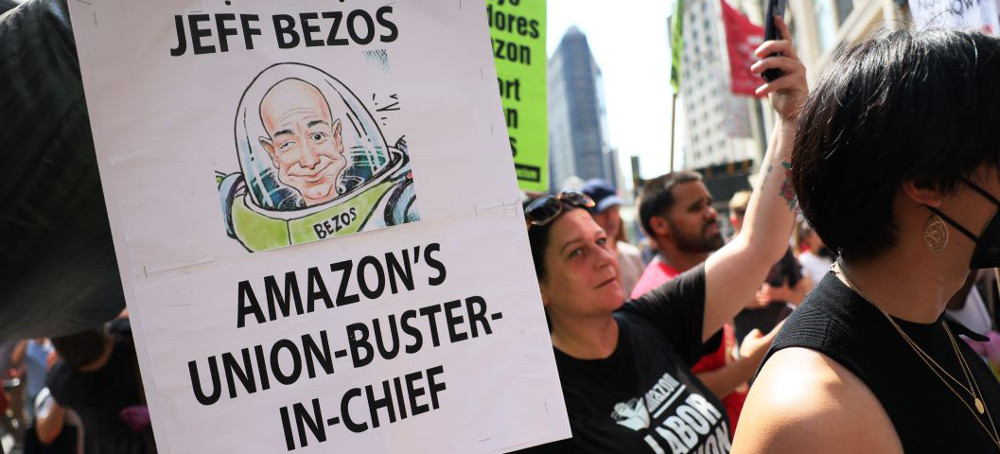 Pro-union protesters gather for a rally near the home of Amazon CEO Jeff Bezos on Fifth Avenue on September 5, 2022, in New York City. (photo: Michael M. Santiago/Getty)
The National Labor Relations Board has repeatedly ruled that Starbucks and Amazon’s union busting is against the law. Yet both companies seem intent on continuing to flagrantly break labor law in the hopes of breaking their fledgling unions.
Recent weeks have seen important victories by unions organizing at Amazon and Starbucks. First, the National Labor Relations Board (NLRB) ruled that Starbucks’s decision to exclude workers involved in union organizing from wage and benefit increases was unlawful. Howard Schultz had first threatened to withhold the increases from pro-union workers in early May; this threat, repeated endlessly by store managers and district managers throughout the country, has seriously interfered with the nationwide organizing campaign at the chain.
Over the past several months, the number of new Starbucks stores petitioning for union elections has declined dramatically because of this illegal threat, along with Starbucks’s multiple other unlawful actions. Undeterred by the board’s decision that it had broken the law, Starbucks announced another round of improvements, again only for nonunion stores, in September.
Second, an NLRB hearing officer recommended last week that the regional director dismiss, in their entirety, Amazon’s objections to the Amazon Labor Union’s (ALU) historic election win at the JFK8 warehouse in Staten Island on April 1. Amazon workers who braved the wrath of the company’s anti-union campaign have had to wait half a year, and their election result is still not official. Both decisions are major victories for the workers involved in these union campaigns.
So, great news for the workers engaged in David vs. Goliath fights against lawbreaking multibillion-dollar corporations? Not entirely.
Both campaigns have shown how vulnerable labor law enforcement is to abuse by anti-union corporations with deep pockets. These companies do not fear the board. If one were designing a process that enabled wealthy corporations to undermine this law, this would be it.
Starbucks and Amazon have exploited the quasi-judicial proceedings of the board, effectively putting them on a schedule inconsistent with protecting pro-union workers organizing at hundreds of units, in which “momentum” is a key factor. For example, Starbucks disrupted the Starbucks Workers United (SBWU) campaign by announcing in May that it would deny wage and benefit increases to workers in stores with union activity. The NLRB regional director in Seattle ruled in August this tactic was unlawfully designed to dissuade workers from supporting unionization. Starbucks stated it would contest the decision before an administrative law judge (ALJ) and in September announced another round of benefit improvements, again only for stores without union activity.
Of course, Starbucks’s newfound generosity would not have happened without the SBWU campaign. But this tactic has drastically reduced the number of new stores petitioning for NLRB elections to a trickle. Pro-union workers needed fast action, but the case will take months, if not years, to go through the ALJ, the full NLRB, and then to the federal courts.
Starbucks has also accused NLRB personnel of corruption and bias in Kansas and elsewhere and called for a halt in elections, thus challenging the legitimacy of the process itself. The NLRB currently has well over three hundred open unfair labor practice (ULP) charges against Starbucks, a staggeringly high number. And the company is engaging the board in a bizarre “whack-a-mole” process: it knows that the NLRB is woefully underfunded and understaffed, so the more ULPs it commits around the country, the less capable is the board to hold it accountable for any of its misdeeds.
Amazon is also fighting to the death. After the NLRB hearing officer recommended in August the dismissal of the company’s frivolous objections to the ALU’s election victory (Amazon had objected to the conduct of both the ALU and the NLRB regional director), Amazon shows no signs of respecting workers’ choice. If the hearing officer’s recommendation is accepted by the Phoenix regional director, which is likely, Amazon can then appeal the case to the full board. Assuming it loses there, it cannot appeal election objections to the federal courts, but it can refuse to bargain on the grounds it believes the election was tainted. The NLRB would then need to go to the federal courts to seek enforcement of a bargaining order, so it simply would take longer to end up at the same place.
Amazon CEO Andy Jassy has vowed a long fight, including an appeal to federal courts, because the board will not “rule against itself.” He believes that the company’s fight to overturn the ALU victory “will take a long time to play out.” Starbucks’s Schultz, in a New York Times interview, says he will never engage with the union because it would “lessen” the customer’s experience. Both believe the decision on unionization should be their choice, not that of their employees, and are banking on the final word of anti-union judges. Unfortunately for them, the question is not whether a “third party” might be bad for the customer experience, but whether, under the law, collective bargaining is what their employees want.
Starbucks’s and Amazon’s brazen disregard for the law and disdain for the NLRB should cause us to reassess our notions of fairness in union representation. Starbucks and Amazon are not on the ballot when workers vote; they are voting between union representation and no union. So why should the board treat them as equal partners and thus make it so easy for them to gum up the process? If they are prepared to repeatedly flaunt the law, challenge the legitimacy of the board in the election and ULP processes, and exploit every other opportunity to “throw sand in the gears,” Starbucks and Amazon can effectively “win by losing” before the NLRB.
Starbucks and Amazon behave as if the law does not apply to them. They have contempt for the board’s attempt to enforce the law. They have openly challenged the legitimacy of the NLRB’s elections, even when the country is facing a profound crisis of democracy. The workers’ clear choice in support of unionization is totally meaningless for these companies.
How did the US workplace become such a dismal and lawless dictatorship?
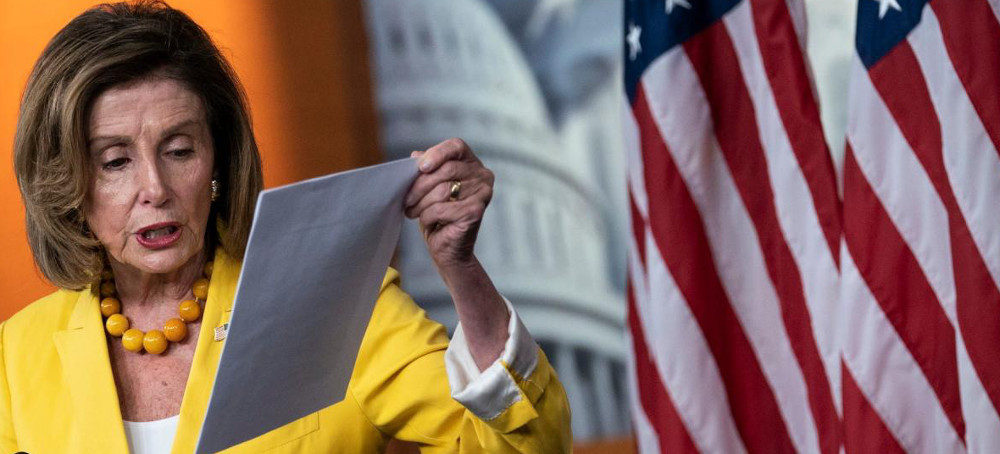 House Speaker Nancy Pelosi at a press conference on Capitol Hill, August 12, 2022. (photo: Sarah Silbiger/The Washington Post)
The bill, titled the “Combatting Financial Conflicts of Interest in Government Act,” could be introduced on Wednesday, when the House is in session. But when, or if, the bill will head to the floor for a vote was unclear, as potential action this week become muddled earlier on Tuesday amid ongoing differences within the Democratic ranks.
A spokesperson for Majority Leader Steny Hoyer said late Tuesday that more details would be released as they become available.
The bill would also apply to the spouses and dependent children of the listed officials, as indicated last week to lawmakers in an outline by House Administration Chair Zoe Lofgren, a California Democrat.
The bill’s trade and ownership restrictions cover commodities, futures, cryptocurrency or other digital assets. Also covered are interests acquired through derivatives, including options.
The legislation would require public officials to divest current holdings or put them in a blind trust. It would also tighten disclosure requirements and increase penalties for violations.
The “supervising ethics office” for each government branch would be called on to issue regulations implementing the the bill’s provisions within 180 days of the bill’s enactment.
Earlier: Bill to Ban Lawmaker Stock Trades Readied for Release in House
A group of senators is working on their own version of the legislation. Even if the House does act on its bill, there’s little chance of Congress taking any final action before the midterm elections.
But differences have emerged within the House Democratic leadership over the measures, including over the size of fines and or other penalties for violations of any new laws. Whether those disagreements have been ironed out in this text was unclear late Tuesday night.
Congressional leaders have faced intensifying calls in the past year to adopt new rules governing lawmakers’ financial activities. A New York Times analysis of disclosure forms published earlier this month found that from 2019 to 2021, almost 100 senators or representatives reported that they or an immediate family member traded a stock or other financial asset that had some overlap with issues before congressional committees on which they served.
A key point of debate has been whether to include family members in any ban on trading, with some attention falling on House Speaker Nancy Pelosi’s husband, Paul Pelosi. Some of his recent transactions, while legal, helped to draw renewed attention to the current law governing lawmakers’ trades that critics say should be changed. A Pelosi spokesperson didn’t immediately respond to requests for comment on the bill.
 Saudi Crown Prince Mohammed bin Salman has been appointed prime minister by royal decree. (photo: Getty)
MBS is already de facto ruler of the kingdom, but the appointment formalises his role as head of government.
Prince Mohammed is already de facto ruler of the world’s largest oil exporter, and the appointment formalises his role as leader of the kingdom’s government.
The crown prince, known by his initials MBS, previously served as deputy prime minister as well as defence minister. He is being replaced as defence minister by his younger brother, Khalid bin Salman, who was deputy defence minister.
The royal decree reaffirmed all the other senior ministers in their posts, including Foreign Minister Prince Faisal bin Farhan Al Saud, Finance Minister Mohammed al-Jadaan and Investment Minister Khalid al-Falih.
By appointing MBS as prime minister, a role previously – and typically – held by the king, the 86-year-old monarch continues a slow but steady transfer of power in the kingdom.
The royal decree on Tuesday did not state the reasons behind the appointment, but the state-run news agency SPA said that the king – who remains head of state – will continue to chair cabinet meetings he attends.
In May, the king was hospitalised for medical examinations and treatments, SPA reported at the time.
The 37-year-old crown prince was already in charge of many of the kingdom’s major portfolios, including the economy, defence, oil, and internal security.
Vision 2030
In April 2016, Prince Mohammed introduced Vision 2030, Saudi Arabia’s vision of the future, which is aimed at making the kingdom the heart of the Arab and Islamic world, an investment powerhouse, and a hub that connects three continents.
The initiative seeks to diversify and privatise the economy, and to make it less reliant on oil. By 2030, the initiative also aims to establish an e-government system.
MBS became heir to the throne in 2017, after he previously held the position of defence minister.
His most notable move as defence minister was leading Operation Decisive Storm, a Saudi-led coalition in Yemen against the Houthi rebels, which was launched in March 2015.
The crown prince has also been driving a more aggressive foreign policy to counter the influence of regional rival Iran.
Prince Mohammed has changed Saudi Arabia radically since he rose to power, leading efforts to diversify the economy from dependence on oil, allowing women to drive and curbing the clerics’ power over society.
His reforms, however, have come with a massive crackdown on dissent, with activists, royals, women’s rights activists and businessmen jailed.
In November 2017, four ministers, 11 princes and several high-profile entrepreneurs were detained on orders of MBS in what was presented as an anti-corruption purge. However, the measures targeted many of his direct rivals, thus consolidating the prince’s power over the kingdom.
Earlier this year, he hosted United States President Joe Biden in the kingdom, in an attempt to rebuild bilateral tumultuous relations with Washington over the killing of Saudi columnist Jamal Khashoggi in Istanbul in 2018 by Saudi agents.
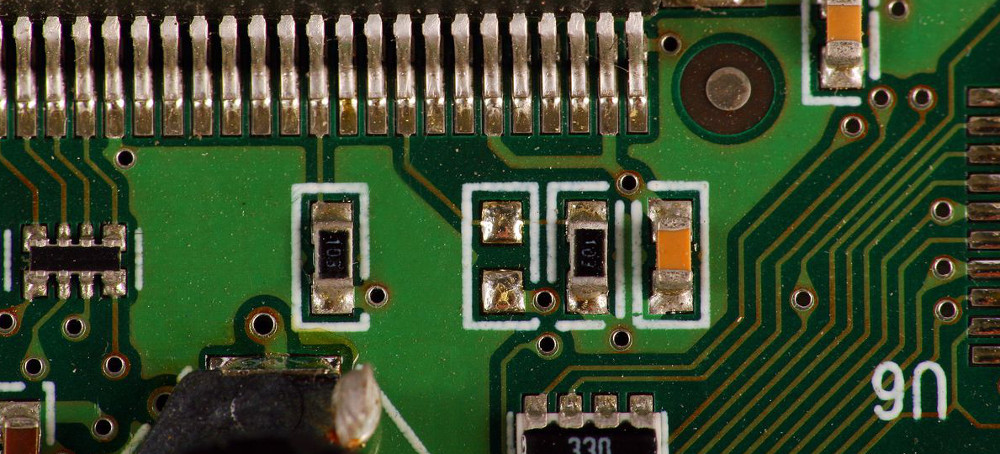 Computer chips are ubiquitous, but they're only made in a few places. (photo: Getty)
Computer chips are ubiquitous, but they’re only made in a few places.
Taiwan is located just 100 miles from China’s eastern coast, and it produces the vast majority of the advanced chips used in today’s electronics. The island is a democracy with its own government, and is home to more than 20 million people. Officials in Beijing, however, claim Taiwan as part of China and have repeatedly threatened to invade and “reunify” the island with the mainland. The US does not officially recognize Taiwan’s independence, though President Joe Biden has suggested that he would send American troops to defend the island against an invasion. As a result, there’s fear that a blockade around Taiwan could create a humanitarian and trade crisis, ultimately cutting off the world’s access to tons of critical technology.
“If Taiwan chipmaking were to be knocked offline, there wouldn’t be enough capacity anywhere else in the world to make up for the loss,” explains Chris Miller, an international history professor at Tufts and the author of Chip War. “Even simple chips will become difficult to access, just because our demand outstrips supply.”
The world is so reliant on chips produced by Taiwan that they’ve become the new oil, according to Miller. Recent military exercises along the Taiwan Strait, the critical waterway that separates Taiwan and mainland China, have raised the possibility that China might eventually block exports out of the island, which would disrupt all sorts of technology production, though some experts say there are plenty of reasons to think that a war won’t actually happen. The chair of Taiwan Semiconductor Manufacturing Company, which makes nearly all of the world’s most advanced chips, has already warned that a war would leave its factories “not operable.”
The US is trying to get a few steps ahead of this scenario. Earlier this summer, Biden signed the CHIPS and Science Act, a massive package that invests tens of billions of dollars to build new semiconductor factories across the US. Other countries with a history of chip manufacturing, including South Korea, Japan, and some European Union member states, have started scaling up their production capacity, too. An Apple supplier even said in February that it would start using semiconductors made in India, which is also developing its own chip industry. Still, Miller argues that these efforts won’t be enough to dull the impact of a war — a war the US and Taiwan aren’t guaranteed to win.
As the past few years have painfully demonstrated, depending on a single region for critical supplies can backfire. Amid the war in Ukraine, Russia has cut off much of Europe’s access to gas, creating an energy crisis that has forced countries to restart coal plants and abandon their renewable energy goals. In the early weeks of the Covid-19 pandemic, China — which was home to half of the world’s mask manufacturing capacity — limited exports of medical equipment. And when the vaccine was first rolled out, the US and other rich nations prioritized inoculating their own citizens before sending supplies to other countries.
As Russia’s war in Ukraine continues, the world is slowly transitioning away from oil. But the same isn’t true for chips, which will only become more critical as new technologies become more popular and require even more computing power. Electric vehicles, for example, require twice the number of chips used by traditional internal combustion vehicles, and the rise of 5G — the technology that could make remote surgeries and self-driving cars a reality — will create a surge in demand for semiconductors, too. That means the stakes are only getting higher.
Recode spoke with Miller recently about the growing importance of chips in global politics. This conversation has been edited for clarity and length.
Rebecca Heilweil
You argue that chips are the new oil. How ubiquitous are chips today, and to what extent do we depend on them in our daily lives?
Chris Miller
Almost anything with an on-off switch today has a chip inside. That’s true not only for things like smartphones or computers, but also for dishwashers and microwaves and cars. As we put more computing power in all sorts of devices, that requires more chips to convert signals from the real world into digits that can be processed and remembered.
The typical person in the US will end up touching several hundred chips a day. The typical person hardly ever sees a chip in their entire life unless they take apart a computer, but the reality is we touch them and rely on them more than ever before.
Rebecca Heilweil
The computer chip was invented in the US. Taiwan now manufactures much of the world’s semiconductors and almost all of the advanced chips that governments are most interested in. How did that happen?
Chris Miller
Over the course of the past 50 years, but especially over the past couple of decades, the semiconductor supply chain has gotten much more specialized. So when the first chips were made by Texas Instruments, for example, or Fairchild Semiconductor in Silicon Valley, these companies did almost everything in-house. They designed chips. They produced them. They produced the machines that were needed to design chips.
As chips have gotten more complex — and as the engineering needed to produce ever more semiconductors has become more specialized — you had firms emerge that focus on a specific part of the production process. Japanese firms, for example, play a major role in chemicals. US firms are particularly influential in the design of chips, as well as the production of machine tools that produce chips.
Taiwan has specialized in the manufacturing of chips themselves. Companies will take a design and send it to a Taiwanese firm for production. Contract manufacturing is not unique to chips, but several decades ago, the biggest Taiwanese chipmaker, TSMC, realized that there was a potentially huge market for contract and manufacturing services. It began investing very, very heavily in trying to attract customers from Silicon Valley and offered to produce chips for them. That combination of scale investment in R&D has proven just impossible to compete with.
Rebecca Heilweil
So how does that play into the risks regarding China and the world’s supply of chips?
Chris Miller
Today, Taiwan produces, depending on how you calculate, 90 percent of processor chips. In aggregate, Taiwan is one of the biggest producers of chips in the world, so companies like Apple, for example, rely fundamentally on TSMC to produce the chips that power iPhones, iPads, or PCs because no one else can produce the chips that they need. It’s not as though they have second sources in most cases. It’s TSMC or else, which means that they’re highly reliant on peace in the Taiwan Strait.
Over the past couple of years, as the military balance has shifted really dramatically in China’s direction, I think the assumption of peace going forward is being tested. The entire world economy would be dramatically hit if China were to attack Taiwan for a whole number of reasons, chips being just one of them. It’s easy to look at the biggest customers of TSMC and say the companies are most exposed — and maybe that’s true. But whether it’s autos or aviation or even chips in a dishwasher or microwave, many of these are also produced in Taiwan.
Rebecca Heilweil
The recent CHIPS and Science package allocates tens of billions of dollars to produce more chips in the US partly because of the risks you’re talking about with China. Will that be enough for an American chip comeback?
Chris Miller
It’s certainly going to have an impact in terms of getting more leading-edge production of the most advanced processor memory chips in the US. But it’s not nearly enough to dramatically reduce our reliance on Taiwan.
Part of the reason why there’s more concern today — justifiably — is that unlike in prior decades, it’s now much less clear who would win a war on the Taiwan Strait. Therefore, we’re now much less certain than we were in the past that China wouldn’t attack because it’d be too costly for China to do so. Now, that’s an open question.
Rebecca Heilweil
Is this risk set to get worse because of the rise of 5G and electric vehicles and other emerging technology? The world is going to need more chips in the coming years and decades.
Chris Miller
Our reliance on Taiwan is not going to decrease. It will be a little bit less than it otherwise would have been thanks to the CHIPS Act, but the reality is we’re going to be dependent on Taiwan.
The Chinese government is pouring many tens of billions of dollars — far more than CHIPS Act funding — into its own chip industry. Although the Chinese remain far behind the leading edge in terms of the technological level of chips they can produce, they’re going to vastly increase the capacity in producing what’s called lagging-edge chips: the types of chips you might find in a car or a consumer device. We’re going to continue to be reliant on chips from Taiwan, but also there’s a risk that we might rely more on chips from China in the future, too.
Rebecca Heilweil
Chipmaking isn’t exactly the most environmentally friendly production process. How should we be thinking about the environmental impacts of chip manufacturing, especially as companies try to scale up?
Chris Miller
One of the factors that led to the shifting of chipmaking offshore of the US was actually that the US imposed stricter environmental rules over time. There are a lot of really toxic chemicals that you use in chipmaking, and mitigating that is expensive. The bigger challenge is electricity and water consumption, because chipmaking requires a ton of both. On top of that, the more chips you have, the more devices you have that require electricity as well.
Rebecca Heilweil
For decades, we’ve seen chips getting more advanced. Is Moore’s Law — loosely, the idea that transistors’ chips will keep getting smaller and smaller, which allows chips to become more and more powerful over time — coming to an end? And what would that mean for the future of tech?
Chris Miller
What we can say is that Moore’s Law faces cost pressures that it hasn’t faced in a long time. It’s got at least a half-decade, probably a decade, to run in terms of further transistors shrinkage before we hit real, potential physical limits as to how small transistors can get. But then in terms of how much computing power you can get out of the individual piece of silicon, there are things you can do besides shrinking transistors to get more computing.
There are all sorts of innovations in how you package chips together that will make them faster and more energy intensive, without necessarily relying solely on transistor shrinkage. Right now, there are so many people who have built up their careers and expertise around how to make silicon chips work really, really well.
There are a couple of places where you could say there’s change happening. The big cloud computing firms like Microsoft, Amazon, and Google are all designing their own chips now, which they hadn’t previously done. Because so much of computing today is hosted on Amazon’s or Google’s cloud, the reality is that now everyone is becoming a user in some way of Amazon chips or Google chips.
The second shift that’s underway is electric vehicles. If you look at a Tesla, for example, they’ve got a lot of chips in the car and a lot of complicated, cutting-edge chips. We’re gonna see more and more cars with more and more cutting-edge chips, doing more and more things in the future.
Rebecca Heilweil
We keep hearing about semiconductors and technology in the news. What should people understand about this industry?
Chris Miller
Making chips is an extraordinary manufacturing process that requires lots and lots of really complicated machine tools to actually move atoms around in a way that lays out a billion or ten billion transistors on a chip. Most of us don’t think enough about the materiality of the manufacturing behind the digital world.
Some of the tooling here is really, really extraordinary and doesn’t fit into our mental model of how the digital world works. But in fact, the digital world works only because we’ve got this extraordinary control over the material world, at least as it relates to silica.
Follow us on facebook and twitter!
PO Box 2043 / Citrus Heights, CA 95611


Comments
Post a Comment