RSN: Dan Rather and Elliot Kirschner | The Nobility of Labor

05 September 22
What’s the Cost of a Corporate Information Monopoly?
Everything? In effect yes. What's the cost of RSN? If it offsets Corporate Information Monopoly then it undermines the monopoly and it no longer costs, it benefits.
RSN the benefits are huge.
Marc Ash
Founder, Reader Supported News
If you would prefer to send a check:
Reader Supported News
PO Box 2043 / Citrus Heights, CA 95611
Follow us on facebook and twitter!

05 September 22
Live on the homepage now!
Reader Supported News

We should not let the holiday pass without honoring the reason for its existence.
Labor is defined as “work, especially hard, physical work.” It is an inextricable part of human existence. In societies with divisions of wealth and privilege, there are often chasms between who toils and who benefits from that toil.
That has been a tragic truth of much of the American story. In its most violent and grotesque form, there was slavery and the subjugation and extermination of Native peoples. Even those who have been paid for their work have often suffered greatly at the hands of those who own and control the means of production, distribution, and profit.
We talk about stakeholders, but who is a greater stakeholder in a business’s success than those actually performing the work?
In recent years, there has been a sort of rejuvenation of the labor movement, and labor unions in particular, after decades of decline. This decline took place not because labor unions had failed, but rather because they had succeeded to help make America a prosperous and more equitable nation. In a new world, and a new economy, labor unions, like all of us, have to adapt. And there are encouraging signs that they are doing so.
There is so much to say about what labor is, what it does, and its importance to our country. It is central to what keeps us steady. All jobs bring honor and nobility, even work that is socially discounted or demeaned.
Take the job of cleaning spittoons. Granted, it’s not widespread these days, but there was a time when it was (spittoons were still in fairly general use, especially in courthouses and other public buildings, when I was breaking in as a reporter in the early 1950s). It’s difficult to imagine a task lower on the social order. It is not surprising that it was often the purview of Black men who faced heavy discrimination and limited job prospects even decades after the official end of slavery.
Labor in America can never be extricated from the story of racism and bigotry.
And yet, work is work. It is a source of needed funds for the rest of life and can also be a source of pride.
With this in mind, I can think of few more beautiful and nuanced tributes to the complexity of labor than the great American poet Langston Hughes’ poem “Brass Spittoons.”
I share it today for our communal reflection.
Happy Labor Day.
Brass Spittoons
By Langston Hughes
Clean the spittoons, boy.
Detroit,
Chicago,
Atlantic City,
Palm Beach.
Clean the spittoons.
The steam in hotel kitchens,
And the smoke in hotel lobbies,
And the slime in hotel spittoons:
Part of my life.
Hey, boy!
A nickel,
A dime,
A dollar,
Two dollars a day.
Hey, boy!
A nickel,
A dime,
A dollar,
Two dollars
Buy shoes for the baby.
House rent to pay.
Gin on Saturday,
Church on Sunday.
My God!
Babies and gin and church
And women and Sunday
All mixed with dimes and
Dollars and clean spittoons
And house rent to pay.
Hey, boy!
A bright bowl of brass is beautiful to the Lord.
Bright polished brass like the cymbals
Of King David’s dancers,
Like the wine cups of Solomon.
Hey, boy!
A clean spittoon on the altar of the Lord.
A clean bright spittoon all newly polished—
At least I can offer that.
Com’mere, boy!
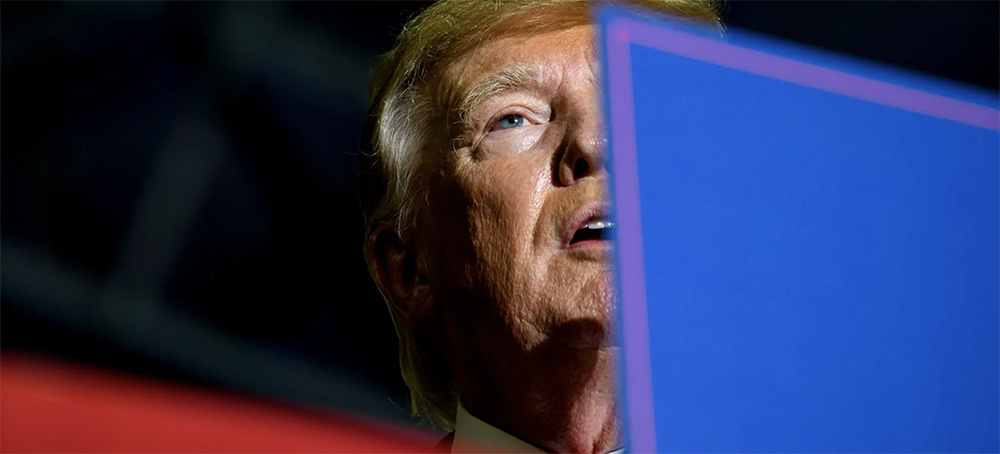 Donald Trump. (photo: Brittany Greeson/NYT)
Federal court at least partially accepts the ex-president’s bid for official to set aside materials potentially subject to privilege protections
The request was granted on Monday morning, a court filing showed. The court temporarily instructed the government not to review or use seized materials for investigative purposes, pending completion of such a special master’s review or a further court order, according to the filing.
The order on Monday from Judge Aileen Cannon, a Trump appointee, also temporarily barred the US Department of Justice (DoJ) from reviewing the documents for its criminal inquiry until the special master completes its work, in a decision that marked a procedural victory for the former president.
Cannon said in her 24-page ruling, however, that the Office of the Director of National Intelligence (ODNI) could continue to review the seized materials for its separate inquiry into whether Trump’s retention of documents with classified markings at Mar-a-Lago risked national security.
Cannon gave Trump’s legal team and the DoJ until Friday to file a proposed list of special master candidates.
The DoJ is likely to appeal the decision to the US court of appeals for the 11th circuit, officials said, though in the meantime it will delay the investigation into potential violations of the Espionage Act and potential obstruction of justice.
Trump has accused the DoJ of launching a partisan witch-hunt against him, and his lawyers argued that the appointment of an independent third party to review the materials would be an important check on the government.
Trump is under investigation for removing government records, some of which were marked as highly classified, from the White House after he departed office in January 2021, and storing them at his home in Palm Beach, Florida.
The estate includes a private club and resort as well as the former president’s private residence, and it has long been a hub of comings and goings by members as well as world leaders when Trump was in office. It also has a history of occasionally being breached by imposters.
The DoJ has also said it is investigating possible obstruction, after the FBI uncovered evidence that Trump’s team may have deliberately concealed classified documents when agents tried to recover them in June.
At a meeting on 3 June, Trump’s representatives falsely certified they had conducted a diligent search and returned all classified materials to the government – a claim that was later disproved after the FBI recovered about 33 boxes containing more than 11,000 government records and photos and more than 100 records marked as classified.
Trump’s legal team waited until two weeks after the FBI’s 8 August search before asking the court to appoint a special master – an independent third party who is sometimes assigned in sensitive cases to review materials that could be covered by attorney-client privilege.
A special master was used, for instance, to review materials seized in the searches of the homes and offices of two of Trump’s former attorneys – Rudy Giuliani and Michael Cohen.
But Trump’s request was unique. Not only did his team want the special master to review traditional attorney-client privileged material, but they also told Cannon the special master was appropriate because some of the records could be subject to executive privilege – a legal doctrine that shields some White House communications.
Neal Katyal, former US acting solicitor general, wrote that the appointment of a special master wouldn’t derail the federal investigation but that this decision “sets a terrible precedent”.
“Even though this judge’s order appointing a special master won’t stop the very serious Trump stolen docs investigation, having been the decider of whether DOJ should appeal various cases in the past, I think DoJ has to appeal here,” Katyal said on Twitter, adding: “That’s what I’d do.”
The DoJ has staunchly resisted Trump’s request, saying he cannot claim executive privilege because the records do not belong to him; they belong to the government.
“He is no longer the president,” Jay Bratt, the department’s top counter-intelligence lawyer, told Cannon at a 1 September hearing.
“And because he is no longer president, he did not have a right to take those documents.”
The DoJ also said it made no sense to appoint a special master because its filter team – a group of agents who are not part of the investigation – had completed its work.
The agents located and set aside a limited number of records that could be subject to attorney-client privilege.
The rest of the records have already been reviewed by the investigative team for the criminal investigation.
At the same time, the ODNI is conducting a parallel review as part of a national security damage assessment.
Many former DoJ attorneys, Democrats and Republicans, have criticized Trump’s call for a special master.
The former US attorney general Bill Barr, whom Trump appointed, called a special master “a waste of time” in an interview on Fox News.
A group of former federal prosecutors who served in Republican administrations also filed an amicus brief in the case, saying Trump’s request was “unprecedented”, filed in a court with no jurisdiction, and “manifestly frivolous”.
However, at the 1 September hearing Cannon, signaled a willingness to grant his request.
“Ultimately, what is the harm of appointing a special master?” she asked.
However, the issue and timing are highly sensitive, just two months before the midterm elections in November and amid fevered speculation about whether Trump will announce that he is running for the Republican nomination in 2024.
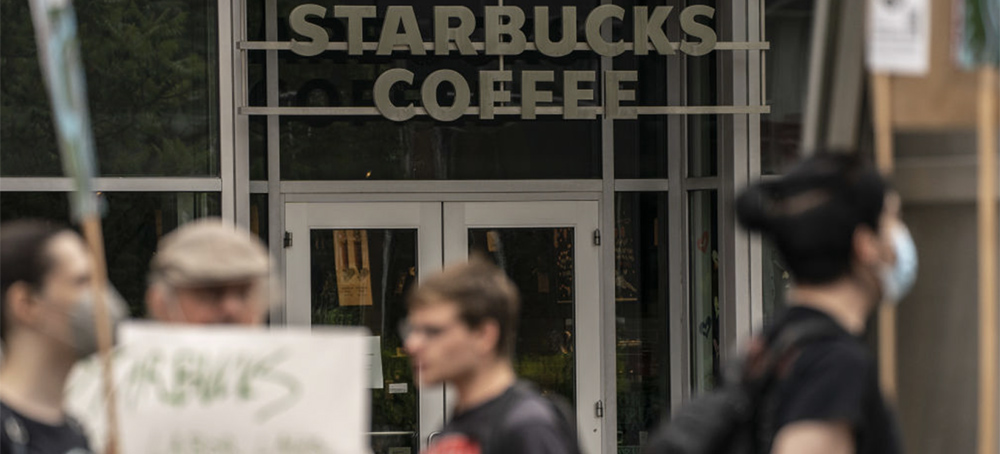 Starbucks workers and supporters demonstrate outside a Seattle Starbucks store that was closed after employees decided to unionize, July 16, 2022. (photo: David Ryder/Bloomberg/Getty Images)
This Labor Day, the overall situation for US labor remains bleak. Yet the Starbucks union campaign has spread across hundreds of stores, offering a model for other unions. In tough times, Starbucks workers are giving hope to the labor movement.
This is even more remarkable given the labor movement’s organizational weakness: unions represent just 10.3 percent of the workforce, and only 6.1 percent of the private-sector workforce. When unions last enjoyed over 70 percent public approval ratings, national union density was more than double what it is today. But considering what it would take to rebuild that level of union density, the situation seems almost hopeless.
There’s a growing disconnect between the energy and enthusiasm, especially among young workers, generated by the inspiring campaigns at Starbucks and Amazon and the long-term trends of declining union membership. Moreover, at the national level, the labor establishment appears (with a few notable exceptions) increasingly out of touch with, and irrelevant to, the unconventional organizing campaigns at places like Starbucks, Amazon, and Trader Joe’s. And while dynamism in the labor movement has rarely come from the national leadership of the AFL-CIO, and is unlikely to do so anytime soon, there’s a much broader problem of timidity and lethargy in established unions throughout the country right now.
How can the labor movement harness the dynamism of this wave of organizing and use it to rebuild union strength over the long term? Starbucks Workers United offers the most promising model for several reasons. Here are five of them:
1
The American public has a very direct relationship with Starbucks and Amazon — much more, say, than the public ever had with GM and Ford in the 1930s and 1940, the last period of significant union expansion. What that means is that union organizing at these companies generates fantastic traditional and social media coverage.
These campaigns have contributed to the resurgence of the “union beat” at major newspapers. We now have outstanding labor journalists at the biggest mainstream media outlets: Lauren Gurley at the Washington Post, Noam Scheiber at the New York Times, Josh Eidelson at Bloomberg, Steven Greenhouse contributing regularly at the Guardian, and others. The entire union movement stands to benefit from their coverage of union organizing campaigns — if only its leadership can figure out how to best make use of it.
2
Traditional and social media coverage is key to young workers hearing about these campaigns and being inspired by them. For example, several videos on TikTok — a platform mostly used by the Zoomer demographic leading the current organizing wave — that document management’s brutal anti-unionism at Starbucks have attracted millions of views. One showing workers walking out in solidarity after a union leader is fired in Buffalo, New York, has attracted over 27 million views; another showing workers reading a list of demands to a store manager in Anderson, South Carolina, where the workers had voted unanimously to unionize, has over 12 million views. Starbucks had absurdly accused those workers of kidnapping their store manager.
“”
“”
3
Campaigns such as Starbucks Workers United are critical to getting stronger labor rights. Unions have always tried to win labor law reform by forcing it through the Senate while no one is looking, so to speak. But they’ll never win it that way because the corporate lobby will always be strong enough to block it. The Obama-era Employee Free Choice Act didn’t stand a chance because it was a quiescent period for labor (no Starbucks Workers United or Amazon Labor Union back in 2009–10), which is why Obama didn’t lift a finger to push its passage.
The union establishment has given up on explaining to Americans why stronger protection for the right to unionize is important — they’ve never had the language or the imagination to do it. But media coverage of the Starbucks and Amazon campaigns has injected a vividness and concreteness into the fight over union representation and has put the issue of union busting on the front pages of the New York Times and Washington Post as well as given the public an education on how our labor laws don’t work.
The labor movement now has a language to explain the issues to the public and make a case for why they have a huge stake in the outcome of this fight. The question is whether labor is capable of taking advantage of that opening.
4
Starbucks Workers United has developed a replicable model — based on the dynamism of scores of self-assured worker organizers around the country, Zoom training and mentorship of store-level and regional activists, and the imaginative use of social media — that has enabled the campaign to spread from coast to coast and win unions at over 235 stores.
In the modern era, no other US union has ever been able to achieve this kind of organizing success at a multibillion-dollar corporation that is determined to do whatever it takes‚ including committing hundreds of labor law violations, to crush a union drive.
5
Starbucks Workers United offers the best model for how the established labor movement can interact with this new insurgent organizing wave among young workers. It shows that parts of the labor movement are organizationally flexible and capable of adapting to the needs of a particular group of workers.
Most national unions appear incapable of running an organizing campaign of this character. In the past few months, other unions have tried and failed to win elections at Starbucks. But Starbucks Workers United provides a model for how they could provide resources and encouragement while still giving the young organizers the elbow room they need to maintain their dynamism.
We don’t know what the legacy of this organizing moment will be. It might all go up in a puff of smoke. Or come next Labor Day, we might have many more campaigns inspired by Starbucks Workers United’s hundreds of victories throughout the country.
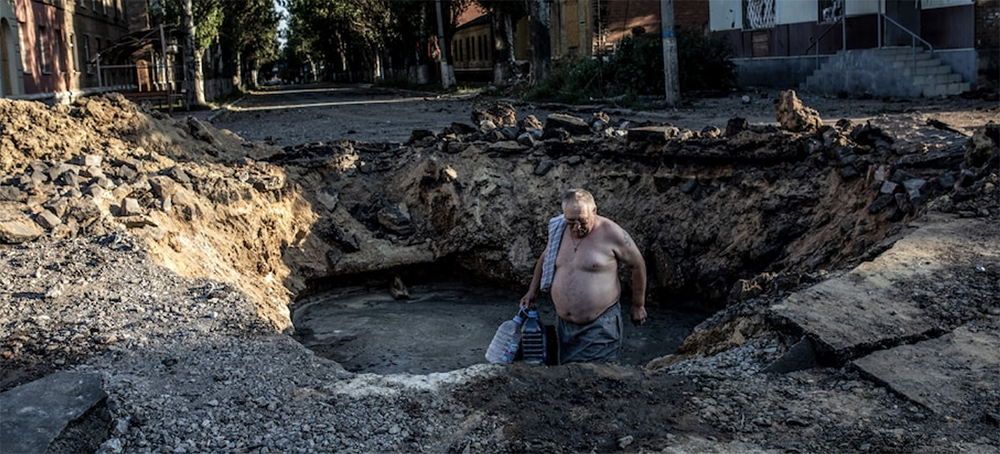 After a Russian strike left a crater in Bakhmut, residents climbed in to get water from a shattered main. (photo: Heidi Levine/WP)
“This one doesn’t have a handle,” said one muddy man, handing a bottle up to a friend. “Put it in a bag to carry.”
In what could be its final weeks of freedom before it is engulfed by Moscow’s slowly advancing tide of occupation — Russian units are less than four miles from the city’s central plaza — Bakhmut is clinging to the last shreds of bearable life.
Living in deserted apartment buildings without water or reliable power, those who remain scrape what normality they can from donated food, two partially functioning food shops, and the wood and water they can gather in what was a bustling city just six months ago.
Mostly, they do without.
“I tried to buy eggs, but with no electricity, they had no eggs,” said Nadezda Andreevna, after she had joined the line outside the Simya grocery store.
Taking Bakhmut would put Russian troops a big step closer to the major regional hub of Kramatorsk, where the frequency of incoming artillery fire has also increased in recent weeks. Taking any of the cities would be a boost to Russia’s grinding goal of controlling the huge industrial swath of eastern Ukraine known as Donbas, where Russian President Vladimir Putin formally recognized two self-declared breakaway republics that the Kremlin has backed since 2014.
More than 80 percent of Bakhmut’s population of 71,000 has fled since the invasion, according to city officials. Those left waiting in this summer warscape of blooming roses and shattered buildings say they have no choice. Many of them are elderly and say they have no family elsewhere in Ukraine and no money to leave.
The morning after a rocket blew the glass from her living room window and pocked the front of her Soviet-era apartment house with shrapnel, Maria Tiutiunnykova’s response was not to pack her bags, but to clean the sidewalk. The 81-year-old, whose daughter was killed in the fighting with Russian-backed separatists in the region several years ago, said her pension is too small and her skills too meager to make it anywhere else.
“No one wants us,” she said, sweeping shards into neat piles on the cracked pavement.
At least some stay in this region of historically divided loyalties because they don’t regret the enemy’s slow approach.
“They won’t say it to us, but there are people who will cheer the Russians,” said one Ukrainian soldier who has been stationed in the area since July.
Many of those still here are in denial of the conventional military wisdom: that the slow but inexorable crawl of Russian forces across the Donetsk region that overwhelmed the nearby cities of Severodonetsk and Lysychansk is likely to consume Bakhmut next.
“Our soldiers will protect us” is a refrain repeated by those who have watched Ukraine’s army, beyond all expectations, push the Russian invaders back from Kyiv and this week mount an offensive to take back the southern city of Kherson.
Bakhmut has been scarred by war for eight years, ever since Russian-backed separatists began a push to conquer the Donetsk region.
In 2016, as part of a wave of anti-Communist, anti-Russian sentiment, residents ditched the Soviet-era name of their city, Artemivsk, which had been adopted in 1924, and restored the historical name of Bakhmut, which dates to 1571 when it was a Cossack settlement.
Now, the city’s last remaining inhabitants are fatalistic about the future. “We will decide whether to leave when the Russians come,” said Andreevna, the shopper, as she carried her two loaves of bread and two liters of water back to her apartment. “If they come.”
As that front line inches nearer to Bakhmut, jobs and commerce have evaporated in an area of coal and salt mines that was one of Europe’s biggest salt producers. Some farmers sell flowers and grapes in the central plaza, but other retail is largely limited to a few tobacco kiosks and this darkened grocery.
Customers are not allowed in among the gloomy, empty aisles of the store, which recently had its rear windows blown out by a mortar round. Instead, they hand their lists to a clerk at the front door.
Humanitarian aid — water, rice, canned goods — still makes it into the city, carried in several times a week by volunteers. What residents come to buy here are the more-specialized goods that enliven the Ukrainian diet.
“Do you have kvass?” said a man with two jugs of water tied to his bicycle, asking for the popular low-alcohol beverage made from fermented bread.
“I wish we could have more fresh produce,” said Oksana Budylina, the manager. “But we haven’t had electricity for three days.”
It is not Budylina’s store — the owners fled for central Ukraine soon after the invasion — but she feels a mission to stick with Bakhmut until the end. Without her goods, the remaining people here would be dependent on handouts that can be uncertain and limited.
“People want meat on their table still,” said Budylina, who was wearing a “Life is Better in Pajamas” T-shirt. She tries to keep the shop open for nine hours a day. “Even if the Russians come, we will work,” she said.
Most of what busyness remains in the city comes from its pop-up role as an emergency room for soldiers wounded in the surrounding front-line areas.
Military ambulances regularly race down the quiet streets, avoiding shell craters, roadblocks, and the dogs and cats left behind by residents who fled.
Bakhmut sits at the center of a web of army medic stations tucked into bunkers, abandoned buildings and trenches around the region. When the command centers get a radio call about casualties — officials refuse to discuss specific numbers but acknowledged that crews are responding to “hundreds” of evacuation calls a day — these medics go to the battlefield, pick up the wounded and race to Bakhmut.
“Sometimes we don’t even have enough stretchers to carry them all,” said Volodymyr Pigulevskiy, 37, one of the military surgeons on duty.
Often, the drivers are too late. The military van was not rushing when it pulled up to a nondescript building in the city Monday, letting out soldiers who unzipped a body bag so medical personal could see the remains of a 25-year-old soldier who was shot in the chest.
There is no morgue in Bakhmut. The soldiers set the body bag and its stretcher on the sidewalk to wait for transport west. A stray German shepherd settled next to it.
Bakhmut has become a window onto the war’s grisliest side.
Pigulevskiy has treated Russian soldiers — “None of them showed any remorse,” he said — along with Bakhmut civilians and Ukrainian enlistees ranging in age from 19 to 61.
“We have a lot less time to treat a lot more people,” said Pigulevskiy, whose sandals and Gucci T-shirt gave him the look of the civilian surgeon he was before war called him to duty in a city where explosions are routine. He and his colleagues have all been close to strikes in Bakhmut, at risk of becoming victims like those they treat.
“The shells don’t decide where they land,” he said, heading to the next emergency. “Here, they just hit.”
 Fort Bragg. (photo: Joan Wong/Rolling Stone)
A staggering total of 109 soldiers assigned to Fort Bragg died in 2020 and 2021. Dozens have lost their lives there to drug overdoses. Now, their families are demanding answers — and accountability
Her son was the child she never had to worry about, Bowman tells Rolling Stone. As a boy, he was well-behaved and supportive of his mom, who had been through a nasty divorce and struggled financially. He was “upbeat and passionate” about baseball, football, and video games. And for as long as she could remember, he’d had it in his head to join the military. “He had the very strong belief that if you were able-bodied, you should serve your country,” Bowman says. “Whether you like your president or not. He could tell you all about other countries where it was mandatory.”
Disney considered all the service branches, and decided on the U.S. Army. He enlisted after high school, trained as a radar operator and, in March 2020, was assigned to an airborne artillery regiment at Fort Bragg. He had done nine parachute jumps, and the last time he spoke to his mom, he was excited to do his 10th. But that Friday in June, he had the day off. “Hours were going by and he was not responding to any of us,” Bowman says. “This was extremely out of character.”
Bowman and her daughters called up some of Disney’s friends, fellow soldiers at Fort Bragg, and they alerted the fire guard on duty, she says, who located surveillance footage of Disney and another radarman, Spc. Joshua Diamond, entering the barracks at 11 the night before. But when they knocked on Diamond’s locked door, no one answered. Neither the fire guard nor the military police would open Diamond’s door by force, because 24 hours hadn’t elapsed, meaning he and Disney couldn’t be considered missing persons. “Even though there were family members saying something is wrong,” Bowman says, “they would not open the locked door.”
Bowman was frantic. She contacted a family friend in Maryland, a colonel in the Army, and he made some calls that evidently spurred the military police into action. They called Bowman and asked her permission to track her son’s phone. “And then it was crickets,” she says. “Everything went silent. The second I gave my permission to ping his phone, the MPs wouldn’t talk to us.”
The Army follows a strict procedure for notifying the next of kin of casualties, and always sends a uniformed officer to deliver the bad news in person. But around midnight, Disney’s sister received an anonymous call. Bowman was standing on the front porch. “I just heard her scream,” she says. “And I went inside, and she was on the kitchen floor with Matt’s girlfriend, screaming ‘This isn’t fucking funny. Who the fuck are you? What kind of sick joke is this?’”
The caller would only tell them that Disney was “no longer alive.” Bowman placed phone call after desperate phone call and, at two in the morning, got through to her son’s battalion commander. He confirmed that Disney had been found in Diamond’s room, lifeless. “I’m so sorry,” she remembers him saying. “He was a good kid.” But he wouldn’t tell her what had happened, only that Disney “didn’t do anything to hurt himself.”
On top of the shock and grief of learning that her only son was dead, Bowman was confused. If it wasn’t suicide, then what had happened to Matthew? All she could think was that the other soldier, Diamond, must have done something to harm him.
That was not the case. In fact, Diamond was dead, too. His body had been found slumped over Disney’s on the floor, almost as if in an embrace. And many Fort Bragg soldiers have died recently under similar circumstances — quietly, in their barracks, in their bunks, in a parked car, or somewhere off-post, from no outwardly apparent cause. According to a set of casualty reports obtained by Rolling Stone through the Freedom of Information Act, at least 14 — and as many as 30 — Fort Bragg soldiers have died in this way since the start of 2020. Yet there has been no acknowledgment from the Army or reporting in the national press on any aspect of this phenomenon, nor word one from any member of Congress. Only the families of the victims have been informed — discreetly, and in private.
Disney’s memorial service was in July. “We were getting ready to go into the chapel,” Bowman says, and Maj. Gen. Chris Donahue, the commander of the 82nd Airborne Division, came into the room and personally informed her that the results of a toxicology report were in. The cause of death was acute fentanyl intoxication.
Donahue, who has since been promoted to lieutenant general, did not respond to a request for comment sent to Fort Bragg. But Rolling Stone obtained Disney’s Defense Department Form 1300, a “report of casualty,” which essentially functions as a military death certificate. It confirms that he died accidentally from an overdose of fentanyl.
That only compounded Bowman’s confusion. “My son was not a drug user,” she insists. Under no circumstances would he have wittingly ingested fentanyl. Addiction ran in the fa mily, and Disney’s little sister had endured dozens of surgeries, and periodically relied on or had to withdraw from opioids, so he was well aware of the risks they entailed. “Fentanyl, ketamine, Narcan, laudanum, Percocet, morphine,” Bowman says. “These are drugs that we talked about on a very regular basis.”
However, one conversation she never had with her kids was about counterfeit pills. Military investigators informed her that Disney had ingested an imitation Percocet, a prescription painkiller. “I had never in my life heard of a fake Percocet that looked legit from a pharmacy,” she says, “until my son took one and it killed him.”
A STAGGERING TOTAL of 109 soldiers assigned to Fort Bragg, active and reserve, lost their lives in 2020 and 2021, casualty reports obtained through the Freedom of Information Act show. Only four of the deaths occurred in overseas combat operations. All the rest took place stateside. Fewer than 20 were from natural causes. All the rest were preventable. This is a seemingly unprecedented wave of fatalities on a modern U.S. military installation.
Forty-one Fort Bragg soldiers took their own lives in 2020 and 2021, making suicide the leading cause of death. A spokesman for the Army, Matthew Leonard, confirmed that no other base has ever recorded a higher two-year suicide toll. There were also a shocking number of incidents of soldier-on-soldier violence. Since mid-2020, 11 Fort Bragg soldiers have been murdered or charged with murder, including one murder-suicide. Five Fort Bragg soldiers were shot to death, and one was beheaded. Rolling Stone has previously reported on the rash of violent crime at Fort Bragg and investigated several of the unsolved murders. The newly obtained documents shed light on another kind of killer stalking soldiers and go a long way toward explaining the record-setting death toll.
Fourteen of the casualty reports state explicitly that the soldier died from a drug overdose. Eleven of these identify fentanyl as the fatal agent. In five other cases, the soldier died at a young age from acute renal or liver failure, or from a heart attack — medical events that young people typically don’t experience, but that can be brought on by heavy drug abuse, complications from mixing drugs, or organ damage from the use of banned steroids. In addition, there were two cases where soldiers died from “undetermined” causes after being found unresponsive, for a total of 21 probable drug-related deaths in the two years ending December 2021. By comparison, there were about 13 illness deaths at Fort Bragg over the same period, 14 car and motorcycle crashes, and three fatal training accidents. Putting aside instances of self-harm, then, accidental overdose is the leading cause of death at Fort Bragg.
Rolling Stone obtained the casualty reports from the U.S. Army Human Resources Command, not Fort Bragg, where officials have been not at all forthcoming. A spokesman for the base — a colonel — said that the number of deaths in 2020 was 45. According to the reports, it was 56. Another spokesman, a captain, stated in writing that the 2021 death toll was 38. In fact, it was 53. The same captain also told Rolling Stone that the number of opioid overdoses last year was four. In reality, it was at least six, and probably 11, if you count all of the deaths that were likely drug related. When confronted with these facts, Fort Bragg officials deflect blame and point to trends in the general population. “We do not see this as an isolated issue that only plagues Fort Bragg,” Capt. Matt Visser wrote in an email. He pointed to the proximity of Interstate 95 — the highway from Miami to New York, a notorious drug-trafficking corridor — which “increases the accessibility of substances” to Fort Bragg soldiers.
In most cases, there is no announcement when a soldier OD’s. For instance, on Feb. 23, 2020, Spc. Christopher Jenkins, a 22-year-old intelligence analyst, died of “fentanyl and dextromethorphan intoxication,” according to his casualty report. Though it occurred on Fort Bragg, there was no press release, and no news reports of the death of this active-duty soldier, who was from West Palm Beach, Florida. No obituary was published, and Jenkins left no trace on the internet.
Other Fort Bragg soldiers who died of an overdose with no public notice in 2020 and 2021 include Spc. Christhiam Gonzalez-Pineda, a helicopter repairman originally from Honduras who died from the acute effects of unspecified “illegal substances,” per his casualty report; Pfc. Anthony Savala, an infantryman from California who died from a cocktail of Benadryl, benzodiazepines, and fentanyl; Spc. Zachary Bracken, a Green Beret candidate from Maryland who died from a combination of alcohol and fentanyl; Sgt. 1st Class Michael Tardie, an infantryman from Arizona who died from the same mixture; Sgt. David Mazzullo, a signals-intelligence analyst from New York who died from an overdose of heroin and fentanyl; and Spc. Matthew Meadows, a parachute rigger from Texas who died from fentanyl alone. None of these deaths were made public.
In other cases, for reasons that aren’t clear, Fort Bragg did make an announcement when a soldier died of an overdose, but in a vague and euphemistic way that made no mention of drugs. For example, a Special Forces candidate from Ohio named Jamie Boger was found “unresponsive in his barracks,” according to a March 16, 2020, press release; his casualty report shows that he died of cocaine and fentanyl intoxication. Likewise, on Nov. 11, 2020, Spc. Terrance Salazar, an infantryman from Texas, was found “unresponsive in his room”; he died from mixing alcohol and cough syrup. Pfc. Mikel Rubino, an infantryman from California, was “found unresponsive in his barracks room” on Aug. 13, 2021; he died from a fentanyl overdose, according to his casualty report. Six weeks later, an artillery spotter from Texas was found “unresponsive” in his off-post housing; his cause of death remains pending determination.
The artillery spotter died in the first week of October 2021, a month during which Fort Bragg soldiers were losing their lives at the incredible rate of one every three days. The local newspaper, The Fayetteville Observer, picked up on the trend of soldiers dying from unexplained causes and published an article on Oct. 30 that tied together the cases of “six soldiers found dead in barracks on post.” After that, the public-affairs office seems to have quit announcing overdose deaths altogether. The incidents of apparently healthy young men turning up “unresponsive” stopped.
Nonetheless, another 21 Fort Bragg soldiers died over the subsequent five months — one from a confirmed overdose, and nine others from causes pending determination. The most recent soldier to turn up lifeless on Fort Bragg from causes that the Army can’t or won’t explain was Maj. Eric Ewoldsen, on March 25, 2022. Ewoldsen was not just any soldier. According to multiple sources, he was an officer on Delta Force, a top-secret manhunting unit said to be the most selective organization in the entire Department of Defense. It’s a mystery how Ewoldsen, a 38-year-old fitness fanatic, ended up slumped over in a parked vehicle somewhere on Fort Bragg, but sources close to his family say that no foul play was involved. “His death is not a result of malpractice or anything nefarious,” Ewoldsen’s former JSOC teammate Cody McBride wrote in an email.
“All these deaths are happening in the same way, and no one is talking about it,” says Racheal Bowman, Disney’s mom. “It’s all very secretive. It’s all swept under the rug.” She adds, “This is obviously a problem. How is it that nobody knows about it?”
MANY PEOPLE ASSUME that because soldiers are regularly drug-tested they can’t use illicit substances. This assumption is mistaken. The Army has long taken a more lackadaisical attitude toward drug use than some might expect. Many years ago, when I enlisted, my recruiter asked me not whether I smoked marijuana but rather, “When was the last time?” He then showed me a minifridge in his office that was full of detox drinks that he said would allow me to pass a urinalysis. Later, when my unit was about to deploy to Iraq, a sergeant in my platoon tested positive for cocaine. Nothing happened to him.
To an even greater extent than Americans in general, U.S. soldiers are overworked, stressed out, and chronically deprived of sleep. To cope with the demands of their physically and emotionally taxing jobs, they turn to a whole range of potent substances, legal and illegal, whether it’s a hyper-caffeinated energy drink to boost a predawn workout, an off-duty joint to ease a chronic injury, steroids to obtain an edge in selection for an elite unit, or a line of cocaine in the bathroom of a bar after a deployment. Hard-drug use is increasingly apparent in the Special Forces. A group of Navy SEAL whistleblowers told CBS News that the military’s drug-testing protocols are “a joke.” In many cases, there’s no institutional incentive for commanders to punish soldiers for simple possession or use. It’s an offense best dealt with quietly and administratively. But fentanyl has changed the calculus.
Fentanyl overdose is now the leading cause of death among American adults under the age of 45. The cheaply manufactured, perniciously addictive, superpotent nightmare drug has contaminated the whole range of illicit narcotics in the United States. People who think they’re taking cocaine, Xanax, hydrocodone, or some other relatively softer substance may end up ingesting it unknowingly. Indeed, many of these deaths should not be considered overdoses at all, but rather accidental poisonings.
“He definitely didn’t know it was fentanyl, that’s for certain,” says a close friend of Spc. Joshua Diamond, the radarman whose room Disney was found dead in. “Based off of text messages they found on his phone, he purchased a Percocet.”
Or so he thought. It’s not clear whether Diamond and Disney split one pill or took one each. Their families learned from investigators that Diamond had purchased the pill or pills from a fellow soldier in the 82nd Airborne, who got them off the dark web.
Diamond grew up in Taunton, Massachusetts, a small town south of Boston. According to the friend (who wanted to remain anonymous because he works in law enforcement), Diamond did “backbreaking jobs” in his twenties, “roadwork,” and joined the Army at the age of 34 in search of “structure in his life.” He wanted “something he could be proud of,” the friend says, “a stable career.”
The region of Massachusetts where he and Diamond grew up together is “riddled with overdose deaths,” he says, but the friend is vague about Diamond’s past use of drugs. “I don’t want to sit here and say he was a saint and a choirboy,” he says. “Anything that he was involved in, it wasn’t a lifestyle.”
The last time he saw Diamond, in May 2021, he had recently redeployed from Iraq. “His life was in good shape,” the friend says. “He was planning to ask his girlfriend to marry him. He was doing great. That’s why it’s so devastating. I thought he was going to learn a craft and be proud of himself. Instead, he got put in a pine box.”
THE DIRECTOR OF the National Institute on Drug Abuse (NIDA), Dr. Nora Volkow, tells Rolling Stone that the number of opioid overdose deaths in the United States has been rising relentlessly for the past two decades. At first the problem was prescription pills, then heroin. She compares the emergence of fentanyl around 2015 or 2016 to the Omicron variant of Covid-19. “It just took hold everywhere,” she says.
Fentanyl is a classic example of the reliable tendency, well-known to economists, of drug and alcohol prohibitions to produce new substances that are ever-more potent, compact, cheap to manufacture, and toxic to users. Unlike heroin, fentanyl can be synthesized in a lab with no need to grow poppy plants. It is so highly concentrated that it can be distributed efficiently through the mail. “It is more powerful, more addictive, more rewarding,” Volkow says, “and much more likely to result in an overdose.”
On average, she says, members of the military are less likely to die of an opioid overdose than the general population, in large part because of entry-level screening that excludes people with preexisting substance-use disorders. However, recent studies show a “fast and dramatic” rise in the absolute number of overdose deaths among active-duty military men, she says. “They have been going up, just like in the whole United States.” She adds that the military medical system has been “very proactive” in its response, “particularly in the distribution of Naloxone.”
In addition to casualty reports from Fort Bragg, Rolling Stone obtained the casualty reports for every U.S. soldier, Army-wide, who died in 2021. The documents show that of 505 total deaths, 33 were confirmed overdoses. That alone would make overdose a leading cause of death among American soldiers, behind suicide, illness, and accidents, but well in excess of homicides and combat fatalities. However, just like at Fort Bragg, there are a substantial number of deaths from what the Army has labeled “undetermined” causes. If deemed overdoses, these would significantly increase the total. These 27 cases “pending determination” include a soldier who was found “unresponsive” in his barracks in Vicenza, Italy; three soldiers stationed in Alaska who were found dead over the winter, two at home and one in a vehicle; another Alaska-based soldier who died down in California from what the Los Angeles County Medical Examiner determined was a fentanyl overdose; and the deaths of two Special Forces soldiers, one in El Salvador and one in Long Island, New York, from causes the Army hasn’t determined.
Whatever the true total of soldier overdoses, it’s clear that a lopsided percentage of them take place at Fort Bragg, which is distinct from most other bases in that it’s overwhelmingly populated by male soldiers in combat-arms units. It is a base full of trigger pullers, where many have done multiple deployments to Afghanistan, Syria, Iraq, and elsewhere. Most recently, it was the 82nd that evacuated the Kabul airport when the U.S. withdrew. Nolkow says that while soldiers are less likely than civilians, on average, to develop a drug habit, “the psychological distress of being deployed, seeing people die, and being in a war zone” makes combat veterans “more vulnerable to drug taking and very heavy drinking as they try to auto-medicate the intense anxiety associated with PTSD.”
According to medical experts, alcohol and drug misuse are second only to depression and other mood disorders as predictors of suicidal behavior. Trauma feeds into both suicides and overdoses, which oftentimes can be hard for medical examiners to tell apart.
The surge in both at Fort Bragg coincided with the demoralizing end of the war in Afghanistan, in which the Special Forces and the 82nd Airborne played so prominent a role. That dispiriting defeat, after 20 years of hard fighting against a determined enemy, no doubt contributes to the malaise driving soldiers to drug themselves with opioids and other toxic narcotics. There are historical parallels here to the widespread use of heroin by American soldiers at the tail end of the Vietnam War. Military leaders will deny it and say that morale is high, but there is a palpable sense of purposelessness and disillusionment hanging over bases like Fort Bragg. “It’s a depressing place,” says a young soldier in the 82nd who was having breakfast at the nearby McDonald’s recently. “Everyone hates it.”
Despite the lack of reporting on this issue, Fort Bragg knows it has a problem. In a statement to Rolling Stone, a spokesman said that the base had taken a number of new measures recently to decrease the distribution of drugs on-post. They had stepped up police presence at the gates, increased background checks on visitors, deployed more drug-sniffing dogs, and raised the frequency of random urinalysis testing, Capt. Visser wrote. Nevertheless, drug-related crime increased a full 100 percent in fiscal year 2021, an officer in the provost marshal’s office admitted to the local ABC affiliate. According to data obtained by Rolling Stone, no fewer than 232 Fort Bragg soldiers were charged last year under the Uniform Code of Military Justice with possession, use, or distribution of a controlled substance, including an incident in which an MP was accused of moonlighting as a drug dealer, and selling Oxycodone from his cop car. And 2021 saw a continuation of a trend that Rolling Stone has previously reported on: Green Berets and other elite soldiers getting into the drug game.
Last year, I wrote about the case of Billy Lavigne, a dope-dealing Delta Force operator found murdered in the woods outside of Fort Bragg in December 2020. Two sources who knew Lavigne now say that they believe he was working with the North Carolina operation of a Mexican drug-trafficking cartel.
“That man worked for the cartel,” says a tattoo artist who saw Lavigne in November 2020, shortly before he was found shot to death in the back of his own truck. “He was transporting crystal meth. He was driving with people that were coming back from their pickup location, and collecting money if somebody was being a problem and not wanting to pay.” She adds, “I rode with him a couple of times to Atlanta, where they were doing the cooking.” In her view, “it had to have been the cartel that killed him.”
Lavigne was out of his mind on drugs and committed a string of irrational crimes from 2018 to 2020, including the murder of his best friend, a fellow Green Beret. Though the sheriff and DA’s office let him off the hook every time in an apparent favor to Delta Force, the cartel didn’t appreciate him drawing so much attention, the tattoo artist says. “It’s something called green-lighted,” she explains. “It means you’re going to be killed.”
Lavigne’s murder remains unsolved. “My speculation is he got involved with the cartels and was probably selling or moving stuff,” says James Reese, a retired Delta Force lieutenant colonel who knew Lavigne personally and worked with him in Iraq. “He probably started owing them money and couldn’t pay. Then the sandman came for Billy.”
Also unsolved is the cryptic case of Enrique Roman Martinez, the young Fort Bragg soldier from Chino, California, who was beheaded during a May 2020 camping trip with six of his comrades from the 82nd. Rolling Stone recently obtained CID’s entire 1,526-page investigative file on the suspected murder case, which makes clear that LSD played a key role in what went down. The partially redacted documents, including the campers’ handwritten statements, paint a picture of an outing to the beach that devolved into a bad psychedelic trip, then a horror movie, but never quite make clear who the culprits were that chopped off Martinez’s head.
More recently, in May 2021, a master sergeant in the 82nd named Martin Acevedo III was arrested in a joint raid by the Department of Homeland Security and the Cumberland County Sheriff’s Office. The feds seized more than two kilos of coke, several firearms, and $99,808 in cash from his house on Green Heron Drive, and hit him with heavy-duty trafficking charges. Acevedo pleaded guilty and is scheduled to be sentenced in August 2022.
Four months after Acevedo’s arrest, a Special Forces staff sergeant named David Rankine was charged with drug trafficking for importing “diverse amounts of anabolic steroids” into the United States. Rankine was also charged with cocaine use, child endangerment for allegedly snorting and injecting drugs in front of a minor, as well as sexual assault for forcing a woman to perform oral sex on him at gunpoint. He pleaded guilty to all but the child-endangerment charge and was sentenced to five years in prison.
To better understand the psychology of soldiers — particularly elite soldiers — who turn to drug trafficking, I wrote to Master Sgt. Daniel Gould, a Green Beret who won a Silver Star for valor in Afghanistan, only to be convicted in 2019 of conspiring to import a large quantity of cocaine into the U.S. from Colombia. “I had a great paycheck, and I didn’t need to do what I did,” Gould wrote back in a letter from federal prison, where he is serving a nine-year sentence. Money was part of what motivated him, he explained, but he mostly did it for the challenge, out of boredom, and because he’d lost touch with right and wrong due to the moral gray zone Special Forces soldiers so often inhabit: “The opportunity was there, and I took the risk.”
Gould’s scheme might have succeeded had it not been for a captain named Stephen Murga. Murga, an infantry officer assigned to the DEA station in Bogotá, got suspicious when Gould asked him to load a pair of punching bags onto a C-130 bound for Florida, and to not stop by the U.S. embassy on the way to the airfield. “I knew something was going on,” Murga tells Rolling Stone. “Knowing Dan, I wouldn’t put anything past him.” Murga tipped off the DEA, and Gould was forced to turn himself in.
Gould was an “adrenaline junkie” and a “war hero brought down by his ego,” in Murga’s estimation. “His Silver Star citation is the key to his persona. He was a Special Forces team leader. They were ambushed by the Taliban. He assaulted the ambush line, and killed, like, 14 of them.”
The adulation and praise that Gould received as a result made him feel as though he was untouchable, Murga says. He adds that it’s a “character arc” common to a lot of elite soldiers, in his experience. “I worked with a lot of SF operators over the past five years,” he says. “I don’t think he was motivated by money, but by danger and excitement. He thought he could get away with it.”
ALTHOUGH THE PRESIDENT is commander in chief, Congress has broad authority to fund, organize, manage, and regulate the military, and when necessary, to reform it. This was apparent in 2020, when the House Armed Services Committee created an independent review board to assess the leadership failures that led to 28 soldier deaths at Fort Hood, Texas, in the span of a single year. At the conclusion of that damning investigation, the Pentagon sacked nearly the entire chain of command at Fort Hood.
Twice as many soldiers died at Fort Bragg for two years running, and across the board, there were more incidents of homicide, suicide, and drug overdose. Sexual assault is also a major problem at Fort Bragg, as Rolling Stone has previously reported. Yet Congress has done absolutely nothing about it.
Fort Bragg is left to police itself, but there are serious questions about the sufficiency of the military justice system to deal with systemic drug crimes and substance abuse. When a soldier dies from an overdose or an accidental drug poisoning, it’s not always obvious who should be held responsible, or to what degree.
Friends of Disney’s told his mom the name of the soldier suspected of selling the deadly fake Percocet to Diamond. That soldier was recently convicted of seven counts of drug distribution, busted down to private, dishonorably discharged, and sentenced to a year in prison. Bowman says she can’t understand why he wasn’t charged for an offense like manslaughter. “He’s not in trouble for the deaths that he caused, because he didn’t know what he bought,” she says, incredulously. “Why are you not responsible for the risk that you just took?”
It is understandable that Bowman would want to see heavier punishment. “There’s zero accountability,” she says. “That’s why these kids are dying.”
But it’s not at all clear that greater retributive justice would do anything to alleviate the drug crisis on Fort Bragg, or in the Army more generally. Even if the military jailed dealers for life, it would do nothing to bring back Disney and Diamond, or any of the others who have succumbed to overdoses recently. Nor would increased law enforcement do much to deter other soldiers from distributing drugs on-post, in all likelihood. Get-tough measures on part of police and prosecutors have done nothing to reduce the demand for narcotics, and demand will always beget supply. The 50-year history of the failed War on Drugs has taught nothing if not that.
Perhaps there is no greater symbol of our definitive loss in that interminable war than Fort Bragg itself. From this flagship base, the beating heart of the U.S. special-operations complex, the military apparatus behind the global War on Drugs deploys to the far corners of the world. Green Berets train security forces in countries like Colombia, El Salvador, and Honduras. Delta Force reportedly took part in the anti-cartel operations that killed Pablo Escobar and captured El Chapo Guzmán. Yet drive down Bragg Boulevard into the Bonnie Doone neighborhood of Fayetteville, and in between the storage facilities, mobile-home dealerships, and tattoo parlors, you will find roach motels full of addicts, indigent veterans camped out beneath bridges, and strung-out junkies hanging around boarded-up trap houses. The dismal tide of synthetic opioids and amphetamines has penetrated Fort Bragg’s high-security gates, permeated through to the lowliest privates’ barracks, and caused at least a dozen overdose deaths in just the last year. These dead soldiers, who far outnumber combat casualties, are clearer proof of the United States’ unequivocal defeat in its longest-running international military campaign than a white flag run up over the main parade field. As the old saying goes: The War on Drugs is over — drugs won.
ON THE MORNING of Feb. 16, 2021, Andrea Bracken and her family gathered together at Arlington National Cemetery to inurn the ashes of her son Zachary. His death two months earlier had come as a complete shock to her and her husband. Spc. Zachary Bracken, a Special Forces candidate at Fort Bragg, was just 24. He had been an athlete in high school and a football player his freshman year of college, but dropped out in hopes of becoming a Green Beret. “He went into the Army with a purpose,” Andrea says. “He wanted to go into Special Forces. He wanted to be a combat medic.”
Her son’s story is not atypical. He had dabbled in drugs before, including marijuana and Ecstasy. “He tried things,” Andrea says. “Zach was very transparent.” But he never would have chosen to take fentanyl, she believes. “My son was an EMT already,” she says. “He knows what drugs are what.”
Bracken is one of three Green Beret trainees, or soldiers in the Special Warfare Training Group, to die of a drug overdose recently. (The others were Pfc. Jamie Boger, in March 2020, from cocaine and fentanyl; and Staff Sgt. Van-Michael Ellis, in October 2021, from cocaine and alcohol.) The incident occurred when Bracken was off duty, at a friend’s wedding. His blood-alcohol level was 0.11 percent at the time that he died, at 10:35 a.m. on Dec. 5, 2020, according to a report obtained through the FOIA. Bracken’s system also contained 0.012 milligrams of fentanyl per liter of blood — a lethal dose.
That’s not what it says on his death certificate, though. “‘The cause of death could not be determined,’” his mother says, quoting the county medical examiner. “That’s the way she put it.” Andrea also had difficulty obtaining Bracken’s vital records from the Army. “Can I get my son’s records?” she asked them. “They said, ‘Sure.’ But they’ve had some issue.
“Although they expressed sympathy,” Andrea continues, “the Army really had no interest in how he died. I have many unanswered questions, but nobody seems to give a shit.”
It’s a bitter sentiment echoed by the family members of other overdose victims. “They won’t give me any answers,” says Diamond’s best friend, who was his legal next of kin. “They really hold their cards close to their vest. The whole thing was weird. They kept shuffling me around.”
“The Army was just like, ‘Here, go tie ribbons on trees,’” says Bowman. “They need to open their mouths and start talking about this. The Army needs to say, ‘Yes, this is a problem. We know this is a problem, and we are going to try to remedy the problem.’ But they don’t want to acknowledge it.”
It was freezing cold that February morning when the Bracken family met in Arlington. Above the uniform white tombstones, the trees were bare. Among the mourners was Zachary’s sister, then 22. “She was his best friend,” Andrea says.
The funeral ceremony had already begun. But there was one final shock in store for the family, as the military added insult to injury. There was some kind of confusion in Zachary’s burial paperwork. “As we’re waiting with many, many, many people, they come out and tell us we’re going to have to take our son’s remains home,” she recalls. “They said that there was a glitch in the information that they got, and something was overlooked. They told us that we would have to take him home with us.”
They drove back to Norfolk, Virginia, with Zachary’s ashes in the car. At this point in the story, Andrea begins to cry. “There’s no dignity in it,” she says through tears. “It’s no dignified way to die.”
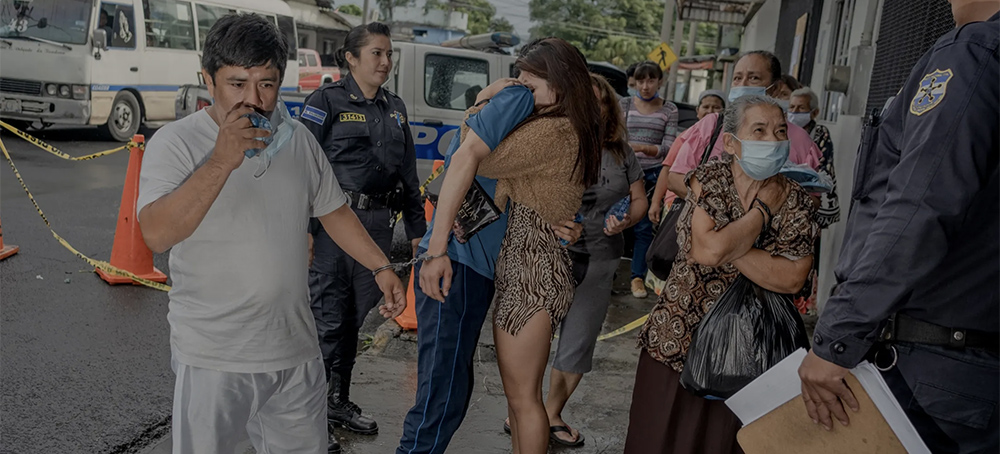 Outside El Penalito, the little jail. El Salvador has long been ravaged by gang violence. In recent months, Bukele’s government has declared a state of emergency and detained some fifty thousand people. (photo: Fred Ramos/New Yorker)
The budding strongman has ridden Bitcoin schemes and a repressive crackdown on gangs to become Latin America’s most popular leader.
Toward the back of the line, wearing a long denim skirt and a red T-shirt, was a middle-aged woman with dark, lined skin and deep-set eyes. Her name was Yanira, and her son, she said, was a twenty-year-old with autism. He’d been arrested three days earlier, at home, where the two had been working throughout the pandemic, cleaning and reselling discarded plastic sleeves that hold bottles of hand sanitizer. Yanira rarely leaves him alone, but she had to run an errand. When she returned, thirty minutes later, the police had taken him away. “Sometimes he’ll wander into the street without his shoes,” she told me. “All the neighbors know him. But someone who doesn’t might think he’s a criminal, or crazy.”
A week before, members of El Salvador’s largest gang, MS-13, had murdered eighty-seven people in three days. The country has long been ravaged by gang violence, but these killings were unusual in their ruthlessness. People with no ties to crime were targeted: a fruit seller, a surf instructor, a homemaker, a cobbler. The gangsters went after everybody, but their message was directed at one person—the country’s President, Nayib Bukele, who has promised to radically reduce crime and to change El Salvador’s image abroad. Gang members left a corpse on the road leading to Surf City, a stretch of beachfront real estate on the Pacific Coast which Bukele had refurbished and renamed to attract international tourists.
In recent decades, every Salvadoran President has contended with the gangs. One administration sent soldiers to poor neighborhoods and filled the country’s prisons, under a policy it called mano dura, or “strong hand”; another reprised it as super mano dura. When Bukele was the mayor of San Salvador, he called these responses “immoral” and “impractical.” But now he declared war. Just after midnight on the second day of the homicide spike, the National Assembly, which Bukele’s party controls, instituted a “state of exception,” under which authorities could arrest anyone they considered suspicious. Detainees were not entitled to a legal defense. The right to gather in groups larger than two was suspended, and all minors would be tried as adults. On his Twitter account, Bukele, who is forty-one years old and has an approval rating of more than eighty per cent, shared a running tally of the arrests that followed, along with scabrous commentary, posting photographs of tattooed men in handcuffs and underwear (“little angels”), some of whom appeared to have been roughed up (“He must have been eating fries with ketchup”). Critics of the new policy—whether common citizens, journalists, or foreign governments—supported “the terrorists,” he wrote.
Yanira’s son was one of six thousand people arrested in the first week. By the time I met her, the total had risen to about nine thousand. A month and a half later, it would reach thirty thousand. Bukele conceded that one per cent of the roundups might result in wrongful arrests, but the public could only take his word for that figure. “As we continue arresting more gangsters, more people are going to protest,” Bukele said. “Because there will always be a mother of a gangster, a family member, or a friend who isn’t going to like that we are cleansing that cancer.”
Yanira was joined in the line by her daughter, who’d been missing work at a clothing shop to help locate her brother. The previous day, the daughter told me, they’d spent six hours visiting courthouses, searching for him. “We’re not the kind of people who have any experience in these sorts of places,” she said. She crossed the street while Yanira held their place in line. A bodega in front of El Penalito offers food and hygiene packages for detainees, ranging from a single meal ($2.50) to basic toiletries ($7.00) or a change of underwear ($15.50). (Prisoners without this assistance eat only intermittently.) Yanira’s daughter returned just in time to press a receipt for three meals into her mother’s hand before they reached the window. Farther down the block, a group of soldiers armed with rifles had stopped a public bus and were ordering the male passengers to step out and lift up their shirts. They were checking for tattoos that might indicate gang membership.
As the official at the window examined her son’s records, Yanira stood ramrod straight. Suddenly, she recoiled; when she turned away from the window, her eyes were wide. “Izalco” was all she could say, and she staggered off, sobbing. It was the name of a maximum-security prison that houses hardened gangsters. Her son had been sent there earlier that morning.
While the women waited outside El Penalito, another crowd was gathering, at the Miami Beach Convention Center. It consisted of investors and tech entrepreneurs, who were there to see Bukele, a keynote speaker at an annual Bitcoin conference. Last summer, he announced that El Salvador would be the first country in the world to accept bitcoin as legal tender. Within a few months, there were some two hundred special A.T.M.s set up across the country, and the government had launched an app, called the Chivo Wallet, on which each Salvadoran was given thirty dollars’ worth of bitcoin. At the conference, Bitcoiners, techno-utopians, and libertarians assembled to hear about a series of ambitious projects that Bukele had been promising ever since. They would have to wait a little longer. The conference, Bukele wrote in an apologetic note, was “one of the biggest celebrations of the power of freedom, decentralization, and human ingenuity in its fight against ignorance, centralization, and dogma.” But, owing to the state of exception, he needed to stay put. “Everything happens for a reason,” he went on. “Hopefully we’ll be able to learn soon why this had to happen this way.”
When Bukele was elected President, in 2019, he was the youngest head of state in Latin America and embodied a new national beginning. At his inauguration, his heavily pregnant wife stood beside him as he instructed crowds of ecstatic voters to raise a hand along with him after he swore the oath of office. Three of his recent predecessors had been either arrested or indicted, and all of them came from El Salvador’s two main political parties, which had governed without interruption for more than two decades. It had been a period of chronic poverty, violence, and mass emigration. “If you left to live in the United States and returned twenty years later, you’d find the same politicians,” Amparo Marroquín, a professor at the Central American University, in San Salvador, told me. “They were dinosaurs.” Bukele, who’d defected from one of the main parties, pitched himself as an anti-corruption reformer. His campaign slogan—“There’s enough money to go around as long as no one steals”—is a line that he has used for almost as long as he’s been in public life. He began his career at the age of thirty, as the mayor of a town of fewer than ten thousand people. After a single term, he ran for mayor of San Salvador. Fresh off that job, at thirty-seven, he was elected President.
Bukele, who wears leather jackets and backward baseball caps and has a beard, invokes Alexander the Great and Steve Jobs, and his brand is meant to be a bit of both: a potentate with an anti-establishment streak. At the United Nations General Assembly in 2019, he took a selfie from the dais, mid-address, reminding the world leaders in attendance that a “couple of images on Instagram can have a greater impact than any speech in this assembly.” Social media, he once said, “has shown us what people really are.” Before, “everybody was pretending.”
During the years of his ascent, the public heard from him constantly—on Twitter and Facebook, and in a continual procession of ribbon cuttings and other public appearances. As the mayor of San Salvador, he cleaned up parts of the city’s ramshackle downtown; renovated a trio of historic plazas; opened a high-end market, which has escalators and rooftop restaurants, in addition to a library equipped with computers and play areas for children. At one point, he unveiled a twenty-four-million-dollar public-works project, called 100% Iluminado, to install lamps on every street corner. “You can call it PR if you want to be a little cynical. But I’m talking about inspiration,” he told the Virginia Quarterly Review, in 2016. “I’m talking about something sublime.”
Usually, public adoration dims as the realities of governing set in, but Bukele’s support has grown. He is now the most popular leader in Latin America. In part, this is the result of his war on the gangs, his handling of the pandemic, public-infrastructure projects, an increase in the minimum wage, and low gas prices. It is also the product of a mammoth propaganda campaign. But, more profoundly, Bukele has succeeded in generating a palpable sense of collective expectancy and pride: the country is finally getting its act together.
The United States, the European Union, and the Organization of American States have criticized Bukele’s most audacious acts as President. These include threatening members of Congress with troops, and firing Supreme Court magistrates and replacing them with judges who have allowed Bukele to run for a second term despite a constitutional ban. But the foreign criticism has enabled Bukele to unify Salvadorans against a common enemy, and has put him, and his country of six and a half million people, on the map. “Why are they so concerned about a country so small?” he has said. In 2021, Time included Bukele in its list of the world’s most influential people, alongside Narendra Modi, Donald Trump, and Naftali Bennett. “Ok boomers,” he recently tweeted, in English, at members of the U.S. Senate Foreign Relations Committee. “You have 0 jurisdiction on a sovereign and independent nation. We are not your colony.”
For much of his career, Bukele has basked in the limelight of the press: visits to Washington, to address the Americas Society and the Heritage Foundation, interviews with Jorge Ramos and Ben Smith. When the coverage turned critical, however, he stopped engaging with international journalists. I was no exception. As one of his advisers put it, “Why talk to you when he can speak directly to the people?”
Bukele may represent the future, but he talks a lot about the past—the politicians who robbed public coffers, the gangs that sowed terror, the institutions that never worked. “It’s a kind of revanchism,” Juan Antonio Durán, a judge, told me. He was demoted last year, after criticizing the President for forcing a third of the federal judiciary into early retirement. By then, at least fifty government officials and high-profile critics had had to leave the country, according to Revista Factum, a Salvadoran news magazine. Bukele, after many accusations that he was concentrating power, changed his Twitter bio to “the coolest dictator in the world.” A member of his party identified himself on social media as “Minister of Trolls.” Bukele’s voters expected him to have enemies, a member of Congress told me. “What the President is selling the people is revenge.”
All through the nineteen-eighties, El Salvador was a place of obsessive U.S. interest. Ronald Reagan said that it was “on the front line of the battle that is really aimed at the very heart of the Western Hemisphere, and eventually at us.” When fighting broke out between the country’s right-wing government and leftist guerrillas, the U.S. sided with the government; it armed the military, trained and advised its officer corps, and covered up their worst abuses. For twelve years, the guerrillas fought the U.S.-backed government to a stalemate, and some seventy-five thousand civilians died. Eighty-five per cent of the killings were committed by the military and the security forces, which massacred large numbers of the rural poor for sympathizing with the guerrillas. Bukele was ten when peace accords were signed, in 1992. Nearly a quarter of the Salvadoran population ended up moving to the United States.
Bukele grew up in San Salvador, as a privileged outsider. His father was a Muslim businessman of Palestinian descent, who opened the country’s first McDonald’s franchise, ran a textile company, helped build four mosques, and owned a public-relations firm. He was also a polygamist with six wives. Bukele, who has three brothers and seven half siblings, went to a bilingual private school. Most of his well-heeled classmates shared their families’ conservative outlooks. But Bukele’s father was a man of the left and a supporter of the guerrilla forces, called the Frente Farabundo Martí para la Liberación Nacional, or the F.M.L.N., which became one of the two major political parties after the war. Muslim leftists stood out in Salvadoran high society. In the late nineties, after Al Qaeda gained international notoriety, the Bukele family was stopped by customs agents at the airport because of their suspicious-sounding name, according to a deep investigative profile by the journalist Gabriel Labrador. If the incident rattled Bukele, he refused to let on. Popular enough to be elected president of his high-school class, he captioned his yearbook photograph “Class terrorist.”
Bukele’s political apprenticeship began after he dropped out of college and was managing a night club in downtown San Salvador. He took over his family’s public-relations firm, whose key client was the F.M.L.N. The Presidency and the Assembly were controlled by the Alianza Republicana Nacionalista, or ARENA, which was founded, in the early eighties, by a member of a right-wing death squad. The Party catered primarily to the business élite, but its members included ex-military men and religious conservatives. An accumulation of corruption scandals sank ARENA, in 2009, allowing the F.M.L.N. to gain power, which it held on to for the next decade. In 2011, Bukele launched a self-funded bid for mayor of Nuevo Cuscatlán, an old ARENA stronghold outside the capital. “Don’t get involved in politics,” his father had once warned him, according to an interview recovered by the investigative newspaper El Faro. “Politicians who lose are . . . thrown away. You’ll be damaged goods.”
But Bukele already had a plan: he would run on the F.M.L.N. ticket while downplaying his associations with the Party. “I did not live the war,” he said in a television interview during the campaign. “I’m of the postwar generation, a generation that has new ideas.” His politics were leftist—progressive taxes, increased public spending—but he avoided the F.M.L.N.’s hoary pronouncements about revolution. He also rejected the Party’s trademark colors of red and white, instead blanketing the streets with campaign materials that featured his name in white against a backdrop of light blue. “I have friends who are conservative, and they’d never vote for the F.M.L.N.,” he told one of his advisers.
Bukele won by less than two per cent, and governed as if he were still campaigning. He erected a large stone sign with a white “N” engraved in a circle at the entrance to Nuevo Cuscatlán. He also opened a twenty-four-hour medical clinic, a library, and a community center. Each month, seniors received a free basket of food. Bukele vowed to donate his entire salary to a new program funding grants for students to take classes in English and computer science. The town’s debt ballooned, but his popularity soon eclipsed that of the Party elders.
The F.M.L.N. encouraged him to run for mayor of San Salvador, a job widely seen as a stepping stone to the Presidency. “The leader of the Party told everyone that Nayib’s candidacy would get us two or three more seats in Congress,” a former Party official told me. “They all thought that it would help them.”
Bukele, who felt his power growing, shut the Party out of his campaign, relying instead on family members and old friends. One of them was Ernesto Castro, his chief secretary in Nuevo Cuscatlán, who now serves as the president of the National Assembly. Another was his younger brother Karim. In public, Nayib was polished and poised, but in private meetings he tended to be distracted and jittery. He checked his phone constantly, drank four Red Bulls a day, kept odd hours, and struggled to focus on individual tasks. A former associate told me, “If an idea occurs to him, and he thinks it’s brilliant, he does it. Then, afterward, if it’s illegal? Oops!” Karim would sit quietly before making calm, authoritative pronouncements. “It wasn’t a meeting unless Karim was there,” the former Party official said. Together, the brothers reprised the high points of the Nuevo Cuscatlán campaign—the same colors, the same insignia (“N”), and the same slogan (“New Ideas”). By the time Bukele won, he had developed a recognizable brand and had more Twitter followers than the country’s President did.
When journalists dug into Bukele’s accomplishments in office—the market downtown, the revitalization of San Salvador’s historic commercial district—they found evidence of irregularities. The mayor’s office had disregarded permits and zoning ordinances. It paid inflated prices to contractors, and kept information from the city council. One businessman who worked with Bukele at the time told me, “Before Bukele, you’d want to get something done, and when you’d go in to meet with the mayor you’d find a long table full of council members, lots of bureaucracy. With Bukele, you’d sit down at the same long table, but it would just be him with an assistant. On the one hand, it was great because it was just one guy. On the other, you’d leave thinking, Uh-oh, it’s just one guy.”
Bukele came to regard any investigation into his leadership as a personal attack. Edwin Segura, a pollster and a political columnist, told me, “Anytime the media put out something questioning his accomplishments, it was because they were against him.” Bukele started building an alternative media landscape: TV programs, a network of trolls on Twitter, an army of YouTubers, and several publications that posted pro-Bukele stories on Facebook.
Bukele’s portrayal of himself as a contrarian truth-teller was effective, but it was a falling out with the F.M.L.N. that turned him into a political juggernaut. In the fall of 2017, an argument broke out in a San Salvador city-council meeting over the issuance of a building permit for a revitalization project. According to reporting by Labrador, Bukele accused the council’s legal director, a lawyer with the F.M.L.N., of conspiring against him. At one point, she claimed, he threw an apple at her and said, “Take this apple, you witch!”
The incident led to a formal vote expelling Bukele from the Party, but the F.M.L.N. was divided. “The leaders were also scared that Bukele might resign,” the official told me. “He was so popular. He had this huge reach on social media. The breaking point was when he wanted to be President. They used the apple to cover it up.”
Shortly afterward, Bukele, at a gathering in the U.S. with Salvadoran immigrants, said, “ARENA and the F.M.L.N. are really the same.” He announced the formation of a new party, Nuevas Ideas. In February, 2019, he was elected President with fifty-three per cent of the vote.
The arm—bare and handcuffed at the wrist, the hand in a fist—came into view on a two-lane road leading from the capital to San Vicente. It was jutting out from the back of a police pickup truck that was driving past a store called Tulita’s Classic Sweets. A man was lying in the bed of the truck, but all that was visible was his arm, chained to a rack attached to the cab.
One of the strangest aspects of the state of exception was how infrequent sightings like this were, unless you went looking for them. The government was broadcasting its harshest acts, and on Twitter there was a flood of photographs, videos, and menacing announcements. But on the main streets of the country’s biggest cities nothing seemed out of the ordinary. “The state of exception is directed at the poor, marginalized areas,” Rina Montti, the director of investigations at Cristosal, a human-rights group, told me. “These are stigmatized communities with people who are seen as having dudosa confiabilidad ”—“questionable trustworthiness.” She continued, “You hear people say, ‘Surely they must have done something if they’re being taken away.’ ”
On a Saturday night, an old Salvadoran friend of mine proposed that we shoot pool at a billiard hall in San Salvador’s historic downtown. He is a father of three in his mid-forties who runs a small business in the capital. The last time I’d seen him—about six years earlier, at the start of Bukele’s mayoral term—he made trips downtown only during daylight hours, because it was too dangerous after dark. He was encouraged by the President’s actions during the state of exception, as is more than ninety per cent of the population, according to recent polls. “Nayib is fighting,” he said. “Of course he has his critics. He’s doing new things, radical things. It’s all on the up and up. People are always trying to be so down on El Salvador. But I don’t hear Salvadorans talking about leaving, like before.” At the pool hall, it was Eighties Night, and a d.j. played the Sugar Hill Gang and Run-DMC while people danced and ate tapas. We left after midnight. As we strolled through the illuminated downtown plazas, he snapped photos of the Art Nouveau National Theatre.
In the zonas marginalizadas, where the gangs had been in control, however, residents were effectively trapped between them and the government. I arrived in Distrito Italia, a community of ten thousand people about an hour north of San Salvador, on a Monday evening, to find a cordon of some twenty soldiers in combat fatigues and armed with semi-automatic rifles. They had set up a checkpoint for anyone entering or leaving the residential area. Soldiers searched bags and checked I.D. cards, and as people returned from work the line grew long. The commanding officer sought me out as soon as I arrived. “If you haven’t done anything wrong, you’ll be fine,” he said. “People outside El Salvador probably don’t understand.”
A few minutes later, I noticed a woman in a green striped shirt, with dark, frizzy hair, standing at a slight remove from the crowd. Her two sons—ages eighteen and twenty-one—were returning from work, and she was waiting to meet them, so that they could all walk home together. Mostly, she felt alivio—“relief”—she said: “There are soldiers inside patrolling.” When I asked her whether she worried that her sons might get arrested, she shrugged. “Until it happens to you, it doesn’t matter what happens to someone else,” Verónica Reyna, a security expert who works at a nonprofit called Servicio Social Pasionista, told me. “It’s a survival instinct. The more violence people live with, the less they can care about other people. Getting involved in other people’s lives is deadly.”
Gangs have dominated life in El Salvador since the late nineties, but they didn’t originate there. MS-13 and Barrio 18 both began in Los Angeles, at least a decade earlier, as hundreds of thousands of Salvadorans fled the civil war. Many of the teen-agers, adrift when they arrived, turned to crime in the inner city, where Mexican and Black gangs enforced a brutal racial hierarchy. After thousands of Salvadoran youths were arrested, the Clinton Administration saw an opportunity to demonstrate its toughness both on immigration and on crime. It deported violent offenders without telling the Salvadoran government who they were. “The United States lets these dangerous types out and tells them, ‘Go back to where you came from,’ ” the President of El Salvador said in 1997. “But we have no way to try them or jail them . . . and so we must not only let them in but let them go free.”
Cliques from Southern California arrived in El Salvador, bringing their rivalries and their turf wars with them. “They consumed everything in their path,” the anthropologist Juan José Martínez d’Aubuisson has written. “Piecemeal neighborhood gangs saw no choice but to join one of the two for their own survival. The alternative was complete annihilation.” By 2015, there were some sixty thousand gang members in El Salvador, and seventy per cent of the country’s businesses were being extorted, leading to annual losses of four billion dollars, according to estimates by the Salvadoran Central Reserve Bank. The homicide rate was higher than it had been during much of the civil war.
A series of Salvadoran administrations launched dramatic crackdowns that played well with the public but failed to curb the violence. In 2012, David Munguía Payés, who had served as a general during the war and was now the Minister of Security in an F.M.L.N. government, decided that the gangs, like the guerrillas, couldn’t be beaten with force alone. He brought in a former guerrilla, a Catholic bishop, and a representative from the Organization of American States to negotiate with them. A deal was reached, and the homicide rate dropped for almost eighteen months, but revelations of the talks incited public outrage. The next President, who also came from the F.M.L.N., renounced the deal, and the government negotiators were eventually prosecuted for their involvement. In 2020, Munguía Payés was arrested for “unlawful association.” Other members of the F.M.L.N. and ARENA have faced jail time for making ad-hoc deals with the gangs, either to enforce higher turnout at election time or to periodically blunt the death count.
As the mayor of San Salvador, Bukele made an agreement with members of Barrio 18, who controlled the area around the Mercado Cuscatlán, according to El Faro. The government gave them space among the venders’ stalls, and, in return, the gang allowed the market to operate. Bukele has denied this, and as President he adopted visible measures to combat the gangs. He called his policy the Territorial Control Plan; it increased the police presence in some municipalities and declared a state of emergency inside the national prisons, which had the immediate effect of mixing rival populations that had long been kept apart. At the start of the pandemic, the authorities arranged hundreds of bare-chested prisoners in their underwear, pressed tightly together in rows, for a photo opportunity. One of the President’s advisers told me, “Look how he’s treating the gangs. How could he be talking to them?”
But Bukele started negotiating with MS-13 as soon as he became President, according to another story in El Faro. During his first year in office, he didn’t have a majority in the Assembly, and for his fledgling party to win seats he needed the homicide rate to fall. “The big drops in homicides were never just the work of the government,” Verónica Reyna told me. “Bukele learned the lesson from what happened before. He closed ranks. No one had access to the prisons for a year and a half.”
The El Faro story relied on hundreds of pages of prison documents, in addition to logbooks from facilities where secret meetings were held between gang leadership and government representatives. In an intercepted message, one leader of MS-13 told another, “Things are going step by step.” The government, he said, was increasing enforcement to keep up appearances, so that the negotiations could continue. “These measures are just a coverup,” he went on. “They’re looking out for the well-being of us homies.”
Less than a week after the story was published, Bukele announced that the government would investigate El Faro for money laundering. Since then, he has attacked the newspaper relentlessly, sometimes calling out journalists by name. A few of them have been forced into exile; many others have adopted the practice of leaving the country after publishing a story and waiting to return until the threats have died down. The newspaper has a large international following, but inside El Salvador Bukele’s campaign against it has succeeded. Many people have come to see El Faro as partisan and unreliable.
The night before I arrived in El Salvador, the National Assembly passed a sweeping law to block news outlets from reporting on the gang situation. Journalists could now face up to ten years in prison if they “reproduced” or “transmitted” information that might have come from gang sources or could otherwise “panic” the public. The law was ambiguous by design, César Fagoaga, then the president of the Association of Journalists of El Salvador, told me. “This isn’t a legal problem—it’s a political problem,” he said. “They want to control the only thing they don’t have—journalism.” Claudia Ortiz, a first-term congresswoman from a fledgling party called Vamos, told me, “The real opposition right now that’s doing substantive things is outside the Assembly. It’s investigative journalism, the universities, social organizations exposing real problems.”
In the nine days that I spent in El Salvador in April, three more journalists had to leave the country after being falsely accused by the President and members of his party of conspiring with the gangs. One of them—a reporter named Bryan Avelar, who works with the New York Times—was the target of a viral campaign that claimed his brother was a prominent gangster. (He doesn’t have any brothers.) “They know that they can have us arrested if they feel like it,” Julia Gavarrete, a reporter with El Faro, told me. Last year, she was one of thirty-five journalists and human-rights advocates to discover that their cell phones had been infected with the surveillance software Pegasus.
The government could deny press reports, but certain facts remained. Last year, Bukele refused a U.S. request to extradite fourteen top-ranking members of MS-13. The Salvadoran government secretly released some of the men from prison, and they are now at large. According to a joint investigation by La Prensa Gráfica and InSight Crime, one of the gangsters, whose nom de guerre is Crook of Hollywood, walked out of the country’s most secure prison during a crime wave last November. The following month, homicides decreased.
Recently, the journalist Carlos Martínez published a story in El Faro based on seven audio recordings of conversations between members of MS-13 and a government negotiator close to Bukele. The code name they use for the President is Batman. There are explicit references to two years of secret talks, and the official takes pains to describe everything he’s done for the gang to prove his “loyalty and trustworthiness.” What caused the killing spree in March, according to three gang members cited in the story, was the arrest of a group of gangsters who were travelling in a government vehicle. They felt betrayed because they’d been promised “safe passage.”
Uncharacteristically, the government did not attack the article when it came out. In June, 2022, Patrick Ventrell, the American Chargé d’Affaires, gave a press conference in San Salvador at which he said, “The best way for the government of El Salvador to show that it is serious” about fighting the gangs “is to extradite the most dangerous leaders.” Later in the summer, Bukele extradited two of them with little fanfare. This news was eclipsed by the construction of a prison to hold more suspected gang members, which he was calling the Terrorism Confinement Center.
It’s taken as an article of faith that the public cares about such abstract principles as the rule of law and the health of public institutions. But voters also want to see their man win, because it means that they’re winning. Often, authoritarian tactics play better than high-minded poise does. On February 9, 2020, eight months into Bukele’s term, a crowd of a few thousand demonstrators gathered outside the National Assembly, which was not in session. They’d arrived in government vehicles and in buses driven by soldiers, and were there to protest the refusal by members of the Assembly to fund a key plank of Bukele’s security budget. Shortly after 4 p.m., a caravan of S.U.V.s pulled up, and Bukele emerged. Surrounded by bodyguards, he strode to a stage set up at the end of an alley leading to the chamber, and the crowd roared. “Wait here,” he told them, then headed inside. Armed soldiers in combat fatigues followed him.
While the troops fanned out across the gallery, Bukele called a symbolic session to order. “I think it’s clear who’s in control of the situation,” he said into a microphone. He put it down and bowed his head in prayer. After a few seconds, he rose and returned to the crowd outside. This time, when he approached the stage, half a dozen soldiers stood beside him, their rifles drawn.
“I asked God, and he told me, ‘Patience,’ ” Bukele said. He’s never made clear which religion he practices, yet he frequently invokes God, projecting a firm but flexible piety. (“It’s one of his key characteristics,” Marroquín, of the Central American University, told me. “He can seem Catholic or Protestant, Christian, or even Muslim.”) Bukele’s religious rhetoric generally sways the public, but this crowd was expecting something more dramatic. People started to groan. “Patience, patience,” he repeated. “These sinvergüenzas,” he continued, gesturing behind him in reference to the obstructionist congressmen. “We’ll get rid of them democratically. . . . In several months, we’re going to have the Assembly.”
In Central America, the symbolism was lost on nobody: a head of state had just breached another branch of the government with troops. “The whole thing got out of hand,” a former government official told me. But those people who thought Bukele would suffer consequences were mistaken. “The most significant thing wasn’t what happened but what didn’t,” Johnny Wright, a congressman with the party Nuestro Tiempo, told me. “That was the moment when he knew, he tested that he would not have resistance.”
Hours after the incursion, Bukele received a text message from his former attorney Bertha Deleón. “You’ve gone too far,” she wrote. When he didn’t reply, she decided to tweet. His response was swift. “Delete this,” he told her. “You’re attacking us.” Deleón refused, and the government launched a smear campaign against her. She was a trending topic on Twitter for days, accused of protecting the gangs and of abetting criminals. People shouted at her on the street. “I worked for the prosecutor’s office for years on organized crime,” she said. “Old colleagues came up to me saying, ‘Now we’re supposed to be investigating you. Fix this, or leave.’ ” Months later, with multiple corruption charges lodged against her and an Interpol warrant out for her arrest, she told me the story from Mexico, where she had recently been granted asylum.
Bukele’s most conspicuous enabler during this period was the Trump Administration. The American Ambassador to El Salvador was a former mid-level C.I.A. staffer named Ronald Johnson, whose relationship with Bukele was characterized by friendly informality. All Trump cared about, a former Administration official told me, was immigration, and Bukele acted accordingly. In 2019, he was so eager to comply with a deal on asylum processing that his advisers e-mailed a signed copy of the agreement straight to the Department of Homeland Security. U.S. officials had to call them back to explain that the protocol was more involved. In return, Bukele “really wanted the State Department to lower the threat level for travel to El Salvador,” the former Administration official told me. “That was a really big thing to him. He was promoting Surf City.” (Eventually, the U.S. reduced the threat level, which officials claimed to have been reviewing before Bukele pushed for the change in status.)
A few weeks after Bukele’s stunt at the National Assembly, the first case of Covid-19 was detected in El Salvador. On March 21st, Bukele declared a state of exception, issuing strict guidelines for a national quarantine. Those people who violated its terms were arrested and sent to “containment centers.” In theory, the centers were reserved for Salvadorans who’d been travelling abroad and needed to be tested. But they soon became de-facto jails, where returning travellers and anyone accused of ignoring the rules were held indefinitely, in many cases for longer than a month. Ten thousand people were detained in the early months of the pandemic.
The Supreme Court twice declared Bukele’s measures unconstitutional, but he ignored the rulings and accused the judges of threatening public health. “If I really were a dictator, I would shoot all of them,” Bukele said. “You save thousands of lives in exchange for five.” He publicly commanded the police and the military to make more arrests, in contravention of the judges’ orders. “The inflection point was the pandemic,” the former government official told me. “That’s when Bukele really started taking advantage.”
The public was too overwhelmed with its own survival to worry about the finer points of governance, and El Salvador’s infection rate stayed low compared with those of neighboring countries. In June, a gleaming new hospital for Covid patients went up, billed as the biggest such facility in Latin America. (It remains unfinished.) The military distributed food to poor areas, and Bukele gave three hundred dollars in cash relief to more than a third of the country. “The people are seeing that he is working hard and doing things for the public,” a thirty-three-year-old named Gisele de Hernández, who worked in a tortilla shop, told the Spanish newspaper El País. Another person said, “Bukele isn’t dividing El Salvador. The country is already divided.”
The following February, when El Salvador held legislative elections, Nuevas Ideas won fifty-six of the eighty-four seats—a super-majority. The new members of the Assembly were a mixture of true believers and opportunists, but all were united in their loyalty to the person who had brought them to power. “Bukele is the Party,” a senior U.S. official told me.
The new legislators went after their first target on the day of their swearing in. They arrived at nine in the morning, and the session ran past midnight. “We entered without knowing anything,” Claudia Ortiz, of Vamos, told me. The Supreme Court magistrates who had opposed Bukele’s pandemic measures were summarily fired, for acting against the best interests of the public. The Nuevas Ideas bloc also fired the Attorney General, whose term was up at the end of the year. The President’s personal lawyer told an opposition lawmaker in private, “We have to be disruptive. People voted for us for a reason. They wanted us to change things radically. We’re going to change this place for good.” Four days later, the Assembly approved a law blocking all investigations into the government’s pandemic spending and shielding officials from corruption charges.
Bukele had assumed office saying that his relationship with the U.S. was “the No. 1 priority for us.” But the U.S. had a new President, and both countries had changed. “When we tried to normalize the relationship, he felt like we were pulling the rug out from under him,” the senior U.S. official told me. “We didn’t have the red carpets out, so he thought it was a deliberate attempt to embarrass him.” The Biden Administration began drawing up a list of sanctions against members of Bukele’s administration, for actions including corruption and conspiracy with the gangs. Bukele continued to meet Johnson, the previous Ambassador, in Miami, and he retained another American adviser, who shared the view that the Democrats wouldn’t control the White House for long. When Bukele decided to give a big interview in the winter of 2021, it wasn’t to the Salvadoran news media or to CNN but to Tucker Carlson. “He’s trying to ride the culture war,” the senior U.S. official told me. “But El Salvador does not have the luxury of deciding that one party is going to protect its interests forevermore.”
For the past three years, crypto evangelists from all over the world have made a pilgrimage to a rustic beach in El Salvador called El Zonte, where a middle-aged surfer from California named Mike Peterson launched an experimental charity. Its financing came from an anonymous philanthropist who imposed a single condition: the money had to be distributed entirely in bitcoin. Soon, mom-and-pop businesses, markets, and food stalls in the area were accepting the currency. El Zonte came to be known as Bitcoin Beach.
In the spring of 2021, Bitcoin Beach drew a minor crypto celebrity—Jack Mallers, a twenty-seven-year-old tech entrepreneur who was building an app called Strike. The service allows users to make money transfers, with no fees, on Lightning, a high-speed network that is linked to the technology behind Bitcoin. El Salvador fascinated Mallers for reasons that went beyond Bitcoin Beach. Twenty per cent of the country’s gross domestic product comes from remittances sent by Salvadorans living abroad, mostly in the U.S. But when immigrants use Western Union to transfer money they typically pay a hefty fee. “Lightning solves that,” Mallers has said. “It costs nothing to send one dollar or one thousand.” After living in Bitcoin Beach for a month, he started spending time in San Salvador. He was having a sushi dinner with friends one night when he noticed a direct message on Twitter. “Hi, Jack, this is a message on behalf of President Bukele,” it began. A few days later, Karim Bukele, wearing a hoodie, greeted Mallers and introduced him to his brother.
At the Bitcoin Conference in Miami that summer, Mallers presented Bukele, who addressed attendees by video, in fluent English. He announced that El Salvador would begin accepting bitcoin, and presented a heady case for how Bitcoin could solve some of El Salvador’s problems. Seventy per cent of Salvadorans don’t have bank accounts, but more than half of them use cell phones. “El Salvador has not been the country that’s recognized to be the first in innovation,” Bukele later told the podcaster Peter McCormack. “But why not this time?” Championing the currency has turned him into a global cult hero, a crusader against U.S. hegemony. “This is just exercising our sovereign right to adopt legal tenders, like we adopted the U.S. dollar in the year 2001,” he continued. “In 2001, it was probably done for the benefits of the banks, and this decision is done for the benefits of the people.”
Salvadorans found out about the Bitcoin policy from news reports after the Miami announcement. The following September, the Bukele administration presented its Bitcoin Law, which Mallers helped shape, and the National Assembly passed it without debate or modification.
Bitcoiners are skeptical of governments and central banks, but their goal is the universal adoption of the currency, and they need more countries to follow El Salvador’s lead. Even so, some of them were troubled by its example. The rush to create the Bitcoin Law resulted in confusing provisions: one article mandates that all merchants accept bitcoin, but another seems to hedge on that requirement. “The government operated on a startup’s timeline—move fast and break things,” Jill Gunter, the chief strategy officer at Espresso Systems, a blockchain company, told me. “But you’re talking about an actual sovereign nation, with the well-being of millions of people at stake.”
There were some red flags. Bitcoin users need both a public key and a private one to access their money, and many people rely on a “digital wallet” to store these keys. The government created its own—the Chivo Wallet app—but shared virtually no information about who was designing it or how it would work.
One afternoon, I was walking through the main plaza in Usulután, a small city in the country’s southeast, when I saw two soldiers standing guard outside a gleaming blue Chivo A.T.M. The unused machine looked like a monument, or a shrine. The businesses that accept bitcoin tend to be large international corporations (Pizza Hut, McDonald’s, Starbucks); a recent survey by the Chamber of Commerce found that eighty-six per cent of the country’s commercial businesses have never conducted a bitcoin transaction.
Last November, during Bitcoin Week in El Salvador, Bukele made another announcement, this one from a beachfront stage rigged with strobe lights and jets of smoke. The sky lit up with fireworks, and on a giant screen behind him, in neon-blue letters, were the words “El Presidente.” The aesthetic was somewhere between a Kiss concert and an I.P.O. “When Alexander the Great was conquering the world, he established ‘Alexandrias,’ ” Bukele said. “These Alexandrias would be like beacons of hope for the rest of the world. We should build the first Alexandria here, in El Salvador. So we were thinking of building”—a pause for effect—“Bitcoin City.”
Bitcoin City would be an actual municipality, powered by the geothermal energy of a nearby volcano and funded by a new financial instrument called Bitcoin Bonds, or Volcano Bonds, which will pay yields tied to the sale of bitcoin. The issuance of these bonds, according to Bukele, would raise a billion dollars. The rush of investment would help fund schools, hospitals, and public works—in theory, at least. The question was who would invest in the bonds, given that, by most accounts, their returns were no better than those of the alternatives. Matt Levine, a columnist at Bloomberg, wrote, “People who like crypto will buy them and trade them with each other and feel a sense of kinship and community and fun. They are HODLers and whales, they get to hang out with the president of a country on a Saturday night.”
In attendance at the announcement was an American investor and early Bitcoin adopter named Max Keiser, who runs a fund called El Zonte Capital. He’s part of a group of international financiers who are selling the image of a dynamic new El Salvador. When we spoke, Keiser had just dined with Bukele at the Presidential Palace. He had flown in with his wife for the occasion, on a plane belonging to “Uncle Ricky,” the Mexican businessman and TV magnate Ricardo Salinas Pliego, who is a passionate Bitcoiner and a pro-Bukele partisan. Keiser tends to see conspiracies in high places. He suggested to me that the U.S. State Department had been involved in the gang killings in March, but he praised Bukele’s state of exception as “phenomenal.” “Some suggest human rights have been violated. I would say that the human rights of seven million Salvadorans are what matters,” he said. “Imagine J.F.K. if he had Bitcoin to do battle with the C.I.A. and central banks—and what you get is President Bukele today. El Salvador is the new Camelot.”
Since El Salvador adopted bitcoin, the currency’s value has fluctuated wildly. But Bukele continued to buy more of it with state funds, including a hundred coins last November and five hundred more in early May, after the price dropped. “El Salvador just bought the dip!” he wrote on Twitter. The country now holds some twenty-four hundred bitcoins, worth approximately forty-eight million dollars, or roughly half what Bukele paid for them.
Short-term losses are hardly the biggest danger to the Salvadoran economy. The International Monetary Fund, from which El Salvador sought a $1.3-billion loan, considers bitcoin a threat both to the global financial system and to the country’s immediate solvency. In January, 2023, El Salvador will need to make one eight-hundred-million-dollar bond payment, followed by another, in 2025. “The financial markets now see El Salvador as much riskier than before,” the economist Ricardo Castaneda told me. “The reasons are failures of democratic institutions, the adoption of bitcoin, and the lack of certainty about plans for paying off the country’s debt.” The former government official told me, “Bitcoin investment is a cloud that doesn’t exist. The state reserves are the last resource for the government to pay for basic needs. Maybe it can get them to the 2024 elections.”
Nuevas Ideas shows no signs of losing its super-majority in Congress, yet its members live in fear of misspeaking. Late last year, two of the Party’s congressmen were recorded sharing concerns over the phone about losing their travel visas as a result of U.S. sanctions. Both have been forced from their jobs and are currently under investigation.
The only member of the Bukele government willing to speak with me was the Vice-President, Félix Ulloa, Jr. He received me one morning at his official residence, in an upscale neighborhood of San Salvador. He sat in a high-backed wood chair with blue velvet trim. On the wall was a surrealist painting of Lady Justice, blindfolded, with her body floating in three unconnected pieces among the clouds. Ulloa, a short man with long hair and a copper-colored beard, is a constitutional scholar with degrees from universities in three countries. He is thirty years older than the President he serves, and a veteran of left-wing causes.
“I have been a social warrior all my life, and I fought not just with words—we took up arms,” he told me. This was a reference to the war years, when he was a student radical. “We fought against a dictatorship. . . . Those who say this is a dictatorship don’t know what a dictatorship is.” He continued, “We spent the two years of the pandemic clashing with Congress.” It was “an assembly dominated by the two parties which blocked everything the President proposed.”
We spoke for an hour, during which he delivered a litany of economic-growth figures, improved homicide statistics, and news of prominent foreign investors who had visited the country. Tourism was up, and preparations were under way for an international surfing competition. But all topics led back to a fact that no one could refute: the President and his party had won their elections and continued to enjoy overwhelming public support. Until Bukele lost a vote or rigged an election, the rest was academic. At the end of the month, the state of exception was due to expire. Would the Assembly extend it? I asked. “During the war, we lived six years with a state of exception,” he replied. There was “nothing strange” about doing it again.
On a recent night, I was speaking with a woman named Karen, whose husband had been arrested during a work break at a taxi stand in a town near San Salvador. He and his employee were eating pupusas on the street, and, when a cook from the food stall walked over to collect their money, a group of officers converged on the three of them. The charge was “illegal gathering.” A jealous neighbor may have called in a tip—Karen’s husband had never been arrested, and he was a fixture at their local church. He had also enthusiastically voted for Bukele in 2019. Baffled, Karen tried everything, including speaking to local reporters to publicize the case, but nothing changed. When she first told me the story, we were hunched over a small table in the food court of a mall, her face teary.
We stayed in touch as the state of exception kept getting extended. It is still in effect, even though daily homicides have dropped. Each month, when the Assembly has to renew it, the Speaker convenes the body with an announcement on Twitter. Nuevas Ideas members reply enthusiastically, with emojis and updated profile pictures. Most of them retweet Bukele, who routinely announces days with zero homicides. “Seguimos,” he says, at the end of each one—“Onward.” Fifty thousand people have now been detained.
“There’s no official policy beyond giving people blanket sentences and keeping them detained,” Rina Montti, of Cristosal, told me. “We’ve been to hearings where there are between three hundred and five hundred people being tried en masse. But there’s no actual criminal investigation.” Cristosal has been documenting detention conditions based on individual complaints brought by family members of detainees. At least seventy people have died while in custody.
Karen has two small children, and she was now caring for them while working two jobs—her own and her husband’s. In the first weeks after his arrest, she found time every morning to visit Izalco, the prison where he was being held. It was a two-hour trip, and she made it to prove her vigilance, since the prison didn’t allow visitors. The crowds of women who’d once gathered outside small police precincts were now reassembling each day in front of Izalco and Mariona, the two prisons, both overcrowded, where nearly everyone had been sent.
The last time Karen and I spoke, she told me that she could no longer make the trips to see her husband. “Too much work,” she said. Her voice was dry, almost raspy with exhaustion. “Everyone is getting six months” in prison, she added. He was now more than halfway through, though his crime remained a mystery.
 The widemouth blindcat, a type of catfish, has been missing since the 1980s. If it’s not extinct, it can be found more than 1,000 feet below Earth in the Edwards Aquifer in south-central Texas. (photo: Matthew Busch/Vox)
Many animals aren’t endangered or extinct — they’re missing. Species detectives are trying to track them down.
But there’s another hugely important category for species that’s often overlooked. It’s simply called “lost.” Scientists use the term to describe plants, animals, and fungi that they haven’t seen for at least 10 years, or by some definitions, 50 years. In many cases, these animals are threatened with extinction — or even already extinct — but no one really knows because they’re missing.
Scientists are racing to find these lost species, motivated by the idea that they can’t protect what they don’t know exists. And in this week’s episode of Unexplainable, Vox’s podcast that explores big unanswered questions, producer Mandy Nguyen and I join an expedition that’s hunting for one of them. We search for an eyeless salamander that lives in an aquifer, deep below San Antonio, Texas, which is arguably one of the least accessible ecosystems on Earth.
The species hasn’t been seen for more than 70 years.
But the salamander we were after is just one of more than 2,100 lost species, according to the nonprofit group Re:wild, which keeps a running list. Finding them could be the only thing that prevents them from going extinct — from disappearing for good.
Meet some of these “missing” species
Lost species are, on the whole, a strange and not-so-charismatic bunch. In some cases, that’s actually why they’re missing — no one has put in the time or effort to find these animals because they don’t attract a lot of attention.
The missing salamander we went searching for in Texas is a prime example. Last seen in 1951, the Blanco blind salamander not only lacks eyes, it’s also colorless, appearing ghostly white, and in order to conserve energy, it rarely moves. It also lives deep underground in the Edwards Aquifer, an underground structure of caves and porous rock that’s full of water (and home to another lost species, the widemouth blindcat, pictured at the top of this story).
Still, researchers are desperate to find it.
Like other salamanders, the species is an indicator of water quality. It’s sensitive to pollution, so where you find the salamander, you can assume the water is relatively clean. This is important because it lives in an aquifer that supplies drinking water to nearly 2 million people in south-central Texas. Finding the amphibian, or proving it is extinct, would reveal a lot about that critical water source, as I wrote in the feature story below.
Some lost species have been missing for even longer than the salamander. A trapdoor spider native to Europe, for example, hasn’t been seen, definitively, since the early 1900s. An adorable mammal called the Wondiwoi Tree Kangaroo, meanwhile, has been missing since 1928, when it was collected from a forest in Indonesia by the famous evolutionary biologist Ernst Mayr.
There are also plants and mushrooms on Re:wild’s lost species list. Native to the mountains of southern Chile, the big puma fungus hasn’t been seen since 1988, and a type of holly tree endemic to Brazil has been missing for 184 years. (You can find more lost species here.)
Like the salamander, many lost species are now the subject of search expeditions, such as Miss Waldron’s Red Colobus Monkey, and some organizations are even offering rewards for finding them.
Who cares about lost species, anyway?
The herpetologist Andy Gluesenkamp, who works at the San Antonio Zoo, has spent roughly two decades looking for the Blanco blind salamander, an animal that most people have never heard of, let alone will ever see.
“It’s my white whale,” he said of the salamander.
So what makes researchers like him so keen on finding lost animals?
These expeditions contribute to a much bigger scientific mission of understanding what does and does not exist in Earth’s many ecosystems. Documenting life anywhere creates the foundation from which researchers can ask biology’s biggest questions, such as how different animals evolve and why some environments have more diversity than others.
Right now, we know close to nothing about the Blanco blind salamander, for example, such as where it lives and what it contributes to the aquifer. The only specimen on Earth is in a warehouse in Austin, Texas — and it’s not in great shape. Finding and studying this species in the wild could help answer all kinds of questions about this unique ecosystem and life in extreme environments.
Finding lost species can also help save them from extinction. “We can’t conserve something that we don’t know is there,” said Barney Long, senior director of conservation strategies at Re:wild.
And there are already examples of this, which I highlighted in August:
In 2017, after a park ranger in Guatemala spotted a lost species of salamander on the edge of a reserve, Re:wild and other environmental groups helped expand the park’s boundaries to protect the species (which is critically endangered). Two years later, researchers rediscovered a rare rabbit-size deer in Vietnam, and have since developed a program to conserve it, including removing hunting snares in the forest.
Lucky for scientists, there are more tools than ever to find missing species. They can use traces of DNA — the main approach to finding the Blanco blind salamander — or motion-sensing cameras. Ordinary citizens can also get involved, for instance by uploading sightings of animals on a hike to an app like iNaturalist.
“There are so many more technologies out there that are helping us rediscover animals,” Long told me last fall. “Historically, it would have taken months of trudging around wilderness areas to try and find them.”
If nothing else, finding lost species is about injecting a bit of hope into the movement to conserve wildlife. Normally, we hear about species that have gone extinct. But not all rare species are extinct; they might just be missing.
Follow us on facebook and twitter!
PO Box 2043 / Citrus Heights, CA 95611


Comments
Post a Comment