RSN: Garrison Keillor | Tempted to Give Up Politics for Parcheesi

24 September 22
Live on the homepage now!
Reader Supported News

Sometimes I envy my parents’ close-up life. I sit every morning, a hard-hearted man scanning my email inbox, fending off the pitiful pleas of political candidates in tight races, falling behind with the fate of democracy itself in the balance, the future of the planet, but we’re losing (unthinkable!) to a weird opponent who believes COVID is a covert conspiracy of drug companies and is financed by tycoons who plan to relocate on Mars, the good candidate is only asking for a $10 contribution, he pleads, and I snip them off one by one, along with the fabulous 50% OFF THIS WEEK ONLY offers, and an African orphanage asking me to buy a $500 Apple gift certificate and forward it to this address to save kids from starvation. Out they go.
I’ve donated to candidates and so my name has been furnished to other candidates of similar stripe and soon I’m getting appeals from city council candidates in Candle Creek, Colorado. But now and again I detect a human voice in the appeal that touches me and I check the $50 box and move on.
It’s rare that elections can be bought. Two years ago, Democrats found an articulate female Marine combat pilot to run against the despised McConnell in Kentucky and she milked angry Democrats for $94 million and he beat her easily. Money down the drain.
What were they thinking?
Two-thirds of the voters ignore the campaigns and simply vote as they’ve always voted and among the third who are capable of switching, there is powerful sales resistance, a built-in bushwa detector. Everything candidates spend in the last month is wasted: minds are made up, the audience is sick of the whole shebang, they’ve left the building. Money helps imprint your name in the popular subconscious but it does very little for your message. What counts is militant organization and also a rare quality among candidates — you see them and you realize that they actually LIKE campaigning. Hubert Humphrey had that joie de campaign and so did Paul Wellstone and Al Franken. People voted for them who didn’t exactly agree with them. So if you have that ebullient drive and you have some dough in the bank and you’re willing to say the same stuff over and over for a whole year and you don’t have an angry girlfriend in the closet or a 90-day sentence for abusing your sheepdog or a video of you speaking admiringly of Richard Nixon, you stand a chance. But a truckload of money isn’t going to rescue a sinking ship.
The biggest Election Night for my mother was 2008. She was 93. Dad was gone. We sat up late, TV on, looking at the big empty stage at Grant Park in Chicago, and then there was a roar from the crowd and Barack and Michelle and the two little girls walked out and Mother put her hands to her eyes, overwhelmed. With the appearance of that little family came the feeling that the country had cut loose from our dark racial past.
But it was too good to be true. The man set out to reform our wasteful, inefficient, infuriating health care system and he was expertly parried by McConnell and held to a draw and in 2016 Democrats nominated a woman for whom campaigning was a miserable chore and so in came the casino man who won reelection but was cheated out of it, despite what the courts said, and now we have Republican candidates refusing to say they will accept the results in November if they go the other way. This is the point at which we break with reality. Next stop is Happy Acres where we listen to the buzzing of the bees in the cigarette trees by a great big soda fountain. I’m not prepared to go there yet.
 Police officers detain a man after demonstrations broke out around Russia following President Putin's announcement. (photo: Alexander Nemenov/AFP)
Putin announced the decision Wednesday, framing it as a "partial mobilization" that he insisted affects only a small percentage of Russians with a background in military service.
Russian Defense Minister Sergei Shoigu ordered an immediate call-up of 300,000 additional troops — even as multiple news reports suggested the real number could be three times as many.
The Kremlin has tasked regional governors with overseeing the draft and stiffened penalties for refusal of service or desertion to 10 years in prison.
Meanwhile, the decree's impact is increasingly clear. Dozens of videos have emerged on social media showing families and friends seeing off young recruits to fight. These were scenes few Russians could have imagined even last week. (NPR has not independently verified the images and footage.)
In Yakutia, in Russia's far north, a band played the popular World War II-era song "Katyusha" and onlookers applauded as a recruit was presented with cake for a birthday that coincided with his deployment.
In Lipetsk, 300 miles south of Moscow, an Orthodox priest blessed young conscripts in civilian clothes as mothers wailed. "Mom, I'll come back!" yelled one recruit as an officer ordered the group to march.
In Dagestan, in Russia's south, videos showed an argument outside a recruiting station.
"My son has been fighting there since February!" says a women who compares the current conflict to the Soviet Union's war with Nazi Germany in World War II.
"That was a war ... but this is just politics!" a man retorts.
Despite government assurances only those with military service background will be drafted, multiple reports are emerging of draft papers being sent to people with no prior military experience.
Amid uncertainty over the scope of the draft, news reports and social media posts showed long lines of cars backed up on Russia's border crossings with Finland and Georgia, to the west, and Kazakhstan and Mongolia to the south.
Tickets for flights out of Russia to countries with visa-free travel — such as Armenia and Turkey — are either sold out or have soared in price.
In Moscow, a channel on the social media app Telegram claimed to track the movements of recruitment officers throughout the city — even the metro — in real time.
"At Baumanskaya station, officers are standing near the turnstile stopping people," says one post.
At Park Pobedy station, a group of national guardsmen are right near the escalator. Careful friends," says another.
Avtozak Live, a volunteer human rights monitoring group, reported as many as nine arson attacks had been carried out on military recruitment centers or government buildings across Russia.
Rights advocates say police detained more than 1,300 people in protests that erupted in dozens of Russian cities following Putin's address — with crowds yelling "No to war!" and "Putin to the trenches!"
Many now face possible legal troubles — after authorities warned protesters risked violating new laws that criminalize "denigrating" Russia's armed forces with lengthy prison terms.
Several protesters of conscription age claimed they were presented with draft papers while in police custody — a move the Kremlin's spokesman, Dmitry Peskov, defended as legal in a news briefing.
Anti-war activists have called for additional protests against mobilization over the weekend.
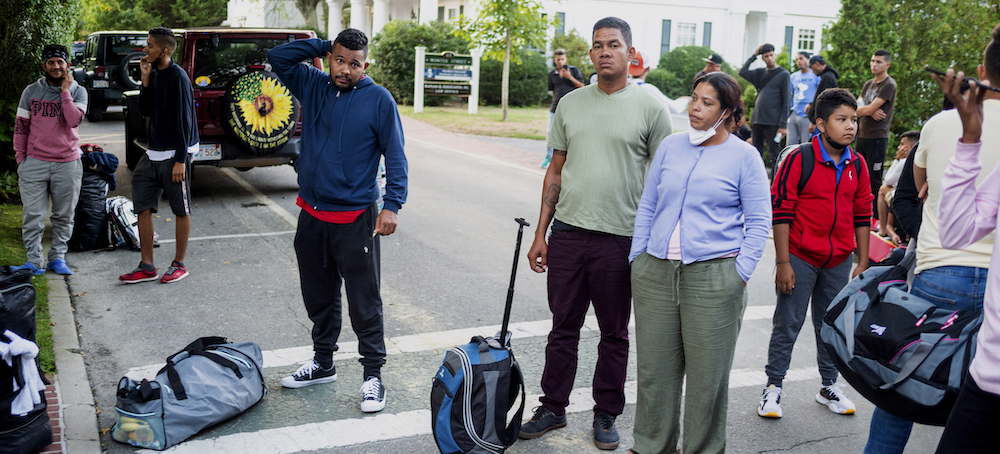 Immigrants gather with their belongings outside St. Andrews Episcopal Church, Sept. 14, 2022, in Edgartown, Massachusetts, on Martha's Vineyard. (photo: Ray Ewing/Vineyard Gazette/AP)
Dozens of Congress members seek inquiry into whether transport of asylum seekers from Florida and Texas broke federal law
The letter from the congressional representatives Gerry Connolly, Sylvia Garcia, Ted Lieu and dozens of other Democrats followed the emergence of a report in which a 27-year-old Venezuelan said he was paid $200 by a mystery figure known as “Perla” to find people outside the San Antonio migrant center to board a flight.
The migrant, who was called Emmanuel, told the San Antonio Report that he gave Perla contact information for 10 other migrants.
“As the federal government retains jurisdiction over cases that involve interstate travel, we request the Department of Justice investigate whether any federal funds were used to operate a fraudulent scheme and request the Department of Justice make a determination as to whether officials in Texas and Florida violated federal law,” the letter said.
At least one criminal investigation has already been opened into the situation by a Texas sheriff, and Connolly and others said the justice department should do the same.
Multiple media reports have depicted how the asylum seekers had been misled once they arrived in Texas and were incorrectly told they were being flown to Boston.
“It is alleged that immigration officials knowingly falsified mailing addresses for the migrants by selecting arbitrary homeless shelters across the United States, with the expectation that migrants would be required to contact the wrong agency,” the letter said.
Details have not yet emerged about the planning and execution of the plan, which was spearheaded by the office of the Florida governor, Ron DeSantis.
DeSantis has defended his administration’s actions and denied that migrants were misled.
The Democrats pointed out that the migrants who were used in what was called a political “stunt” were fleeing communism, authoritarianism and violence, having walked thousands of miles for what they called a “dignified life”.
Justice department officials declined to comment.
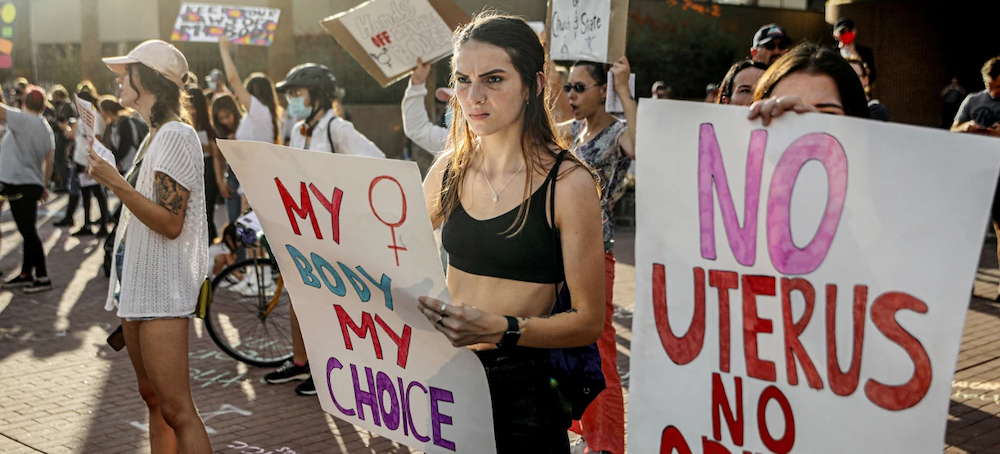 Abortion rights protesters chant during a pro-choice rally at the Tucson Federal Courthouse in Tucson, Arizona. (photo: Sandy Huffaker/AFP/Getty Images)
Pima County Superior Court Judge Kellie Johnson’s ruling was released Friday, a day before a law that restricts abortions after 15 weeks of pregnancy was due to take effect. The conflicting restrictions on abortion had created confusion, with Arizona Attorney General Mark Brnovich (R) pushing to enforce the tougher prohibitions and Gov. Doug Ducey (R) previously insisting that the 15-week ban was the law of the land.
Johnson cited the U.S. Supreme Court’s decision in June to overturn Roe v. Wade, which established a fundamental right to abortion, as rationale for lifting the injunction. Roe had been the basis of the 1973 injunction that prevented bans on abortion from being enforced, Johnson ruled. And because the nation’s highest court had returned decisions on the procedure to Congress and the states, that injunction can also be annulled, she wrote.
The Arizona law threatens abortion providers with between two and five years in prison. It originated from a 1864 law and has no exception for victims of rape or incest. Some states did not update the laws on their books after Roe was decided in 1973, and the overturning of that decision has caused confusion from Michigan to West Virginia as to whether those laws still apply.
Johnson indicated that the older law, which was updated and codified in 1901, supersedes the recently passed law that was to take effect Saturday. “Most recently in 2022, the legislature enacted a 15-week gestational age limitation on abortion. The legislature expressly included in the session law that the 15-week gestational age limitation” does not “repeal” the older ban, she wrote.
Ducey’s office did not immediately respond to a request for comment late Friday. Brnovich thanked Johnson on Twitter, saying that the county court had provided “clarity and uniformity on this important issue. I have and will continue to protect the most vulnerable Arizonans.”
Planned Parenthood Arizona, which was a plaintiff in the case, criticized the court for reviving an “archaic” law that it said would send “Arizonans back nearly 150 years.” The reproductive health organization, which can appeal the ruling, also said it “will never back down.” Democratic gubernatorial nominee Katie Hobbs said in a statement that she was “mourning” the decision and pledged to veto antiabortion legislation if elected.
Johnson’s ruling means the older abortion ban “is no longer unenforceable” and Brnovich’s position as the chief state law enforcement officer “opens the door to prosecutions under that law,” said Kaiponanea Matsumura, a family law professor at Loyola Marymount University who previously taught in Arizona.
Barbara Atwood, a law professor emerita at the University of Arizona, predicted further legal and legislative wrangling over abortion in Arizona. The 1901 law “directly conflicts with many laws regulating abortion in Arizona enacted since 1973,” she said, including those that permit the procedure in emergencies such as pregnancies that can result in the loss of major organ function for pregnant women and other pregnant individuals. “It is an unworkable situation,” she said.
 The Alameda County Community Food Bank in Oakland, California - where one in five people is at risk of hunger - sees a line as inflation pushes into historic territory. (photo: Justin Sullivan/Getty Images)
ALSO SEE: A Left Answer to Inflation
Instead of throwing the most disadvantaged out of work, rises should be paused until the effect of previous hikes plays out
While this is arguably true, it also showed the Fed’s willingness to make the most disadvantaged groups pay the price for slowing a burst of inflation that they did not cause. In effect, Black people, Hispanic people, people with less education and people with criminal records are being forced to sacrifice to end a spurt of inflation caused by the pandemic and Russia’s invasion of Ukraine.
Just to cut through the euphemisms about an “overheated” economy and abstract pain, what we are talking about with the Fed’s rate hikes is throwing people out of work to put downward pressure on wages. The story is that with a slower rate of wage growth, there will be less cost pressure for companies, and therefore they can slow the pace of price increases, bringing inflation down to a more acceptable rate.
But everyone is not equally susceptible to the unemployment created by the Fed’s rate hikes. The unemployment rate for Black people is typically twice the unemployment rate for white people. The unemployment rate for Hispanic people is typically one and a half times the rate for white people. For Black teenagers it is close to six times the unemployment rate for white teens.
In a tight labor market, employers who might otherwise discriminate against these workers are forced to take whoever walks through the door. They also are more likely to hire workers with less education, giving increased opportunities to workers with just a high school degree and even to workers who may have not graduated high school. In a tight labor market, employers are even willing to hire people with criminal records, giving them a chance to earn a decent living.
The idea of whacking those at the bottom might seem more acceptable if their pay increases were the main cause of the recent bout of inflation. But we know that is not true. Prices have been outpacing wage growth for the last year and a half, with inflation averaging more than 8% since February 2021, while the average hour wage has risen at just a 5.1% annual rate.
The gap between prices and wages is attributable to a sharp increase in the profit share of national income. There have been shortages of a wide variety of items due to the pandemic shutdowns, the war in Ukraine and a fire at a huge semiconductor factory in Japan.
These shortages have allowed everyone from oil companies to online retailers to auto manufacturers to increase their profit margins. There is a debate among economists over the extent to which these higher margins are due to excessive monopoly power, but there is no debate that profit margins have risen.
The data is very clear. The profit share of corporate income rose from 23.9% in 2019 to 26% in the second quarter of this year. This is an extraordinary increase in profit shares in a relatively short period.
The most frustrating part of this story is all of these facts are well known to the Fed chair, Jerome Powell. In the years just before the pandemic hit, Powell extolled the benefits of full employment, noting the extraordinary gains that high levels of employment meant for those at the bottom. He broke with decades of Fed policy and recommitted the Fed to taking the full employment side of its mandate seriously, rather than having an exclusive focus on inflation.
This is the reason that many progressives, including me, wanted to see Powell reappointed as Fed chair. We believed that he would be prepared to risk some inflation in order to sustain lower rates of unemployment.
Of course, no one thinks the Fed could just sit on the sidelines as inflation spirals higher, but that is not what is happening. Prices in many sectors are now falling as supply chain problems are being overcome. And the basis for the Fed’s main fear of higher expectations of inflation leading to wages and prices spiraling upward seems to have receded. Measures of inflation expectations have been falling for the last couple of months, not rising.
This should give the Fed the luxury of delaying further rate hikes. We know it takes a long time for monetary policy to have its full impact on the economy. The Fed should pause before it hikes further and see the extent to which its hikes to date, along with supply chain fixes, have quelled inflation.
It is awful that our only tool for controlling inflation is to throw the most disadvantaged workers out of their jobs. It is even worse if we make these people unemployed for nothing.
 Colombian president Gustavo Petro. (photo: AP)
At his United Nations General Assembly address this week, newly elected leftist Colombian president Gustavo Petro denounced the war on drugs and destruction of the planet waged by the United States. We reprint his remarks here in full.
I come from one of the three most beautiful countries on Earth. There is an explosion of life there. Thousands of multicolored species in the seas, in the skies, on the land. I come from the land of yellow butterflies and magic. There, in the mountains and valleys of all the shades of green, flow not just abundant waters but also torrents of blood.
I come from a country of bloodsoaked beauty. My country is not just beautiful — it is also violent.
How can violence and beauty exist side by side? How can the biodiversity of life intertwine with the dances of death and horror? Who is to blame for breaking the charming spell with terror? Who or what is responsible for suffocating life in the routine decisions of wealth and interest? Who leads us to destruction as a nation and as a people?
My country is beautiful, because it has the Amazon rainforest, the Chocó rainforest, the waters, the Andes Mountain range, and the oceans. There, in those rainforests, planetary oxygen is released, and atmospheric CO2 is absorbed. One of those plants that absorbs CO2, among millions of species, is one of the most persecuted on Earth. Wherever it grows, its destruction is sought. It is an Amazonian plant. It is the coca plant, the sacred plant of the Incas.
As if at a paradoxical crossroads, the jungle that we are trying to save is, at the same time, being destroyed.
To destroy the coca plant, you spray poisons, massive amounts of glyphosate that run through the waters, you arrest its growers and imprison them. To destroy or possess the coca leaf, a million Latin Americans are murdered, and two million African Americans are imprisoned in North America.
“Destroy the plant that kills,” you shout from the North, “destroy it.” But the plant is just one more plant of the millions of species that perish when you unleash fire on the rainforest.
“Destroy the Rainforest,” “[Destroy] the Amazon” have become the slogans followed by states and businessmen. The cry of scientists baptizing the rainforest as one of the great climate pillars does not matter. For the power brokers of the world, the rainforest and its inhabitants are to blame for the plague that torments them. The power brokers are plagued by the addiction to money, to self-perpetuation, to oil, to cocaine, and to the hardest drugs in order to be able to anesthetize more.
Nothing is more hypocritical than the discourse about saving the rainforest. The rainforest is burning, distinguished delegates, while you wage war and play with it. The rainforest, the climate pillar of the world, disappears with all its life. The enormous sponge that absorbs the planetary CO2 evaporates. The rainforest — our savior — is seen in my country as the enemy to defeat, as weeds to be eradicated.
The space of coca and of the peasants who cultivate it, because they have nothing else to cultivate, is demonized. My country doesn’t interest you except to fill its rainforests with poison, to take its men to prison, and to cast its women into exclusion.
You are not interested in children’s education but rather in killing the rainforest and extracting the coal and oil from its entrails. The sponge that absorbs the poison is useless; you prefer to spread more poison into the atmosphere.
We serve to excuse the emptiness and loneliness of your own society that lead you to live in your bubble of drugs. We conceal from you your own problems that you refuse to reform. It is better to declare war on the rainforest, its plants, its people.
While you let the jungles burn, while hypocrites obliterate plants with poisons to hide the disasters of their own society, you ask us for more and more coal, more and more oil to calm the other addiction: that of consumption, that of power, that of money.
What is more poisonous for the human being: cocaine or coal and oil? The will of power has ordered that cocaine is the poison and must be prosecuted, even if it only causes minimal deaths by overdose (more due to what it’s mixed with as a result of its imposed illegal status).
Meanwhile, coal and oil must be protected, even if its use can extinguish all of humanity. These are the ways of world power, of injustice, of irrationality, because world power has become irrational.
You see in the exuberance of the rainforest, in its vitality, the lustful, the sinful — the guilty origin of the sadness of your societies is imbued in the deep unlimited compulsion to have and to consume. How to hide the loneliness of the heart — in its drought in the midst of societies without affection, competitive to the point of imprisoning the soul in solitude — if not by blaming the plant, the man who grows it, the liberating secrets of the rainforest. According to the irrational world powers, it is not the fault of the market that cuts down existence; it is the fault of the rainforest and those who inhabit it.
Bank accounts have become limitless. The money held by the most powerful on Earth couldn’t even be spent over the course of centuries. You fill the existential sadness produced by this artificial call to competition with noise and drugs. Addiction to money and possessions has another face: drug addiction in people who lose the competition, the artificial race into which you have transformed humanity.
The disease of loneliness is not cured by spraying glyphosate on the rainforests. The rainforest is not to blame. The culprit is your society educated in endless consumption, in the stupid confusion between consumption and happiness that allows for the pockets of power to be filled with money. The culprit of drug addiction is not the rainforest — it is the lack of rationality of your world power.
Illuminate your power with reason. Turn on once again the lights of the century. The war on drugs has lasted forty years. If we do not correct course and it continues for another forty years, the United States will see 2,800,000 young people die of overdose due to fentanyl, which is not produced in our Latin America. You will see millions of African Americans imprisoned in your private prisons — the imprisoned African American will become the pawn of prison companies. A million more Latin Americans will be murdered; our waters and our green fields will fill with blood. You will see the dream of democracy die, both in my America and in Anglo-Saxon America. Democracy will die where it was born, in the great Western European Athens.
By hiding the truth, you will see the rainforest and democracies die.
The war on drugs has failed. The fight against climate change has failed. You have increased the fatal consumption of drugs. You have gone from soft drugs to the hardest drugs. A genocide has occurred on my continent, and in my country, millions of people have been sentenced to prison. To hide your own social guilt, you have blamed the rainforest and its plants. You have filled your speeches and policies with a lack of reason.
I demand here, from my wounded Latin America, an end to the irrational war on drugs. Reducing drug consumption does not need wars or weapons; it needs all of us to build a better society: a more supportive, more affectionate society, where the intensity of life saves us from addictions and from the new slaveries. Do you want fewer drugs? Think of less profit and more love. Think of a rational exercise of power.
Do not touch the beauty of my country with your poisons. Help us, without hypocrisy, to save the Amazon rainforest to save the life of humanity on the planet.
You gathered the scientists, and they spoke with reason, with mathematics and climatological models. They said that the end of the human species was near, that its time is no longer millennia, not even centuries. Science set off the alarm, and we stopped listening to it. The war served as an excuse for us not to take the necessary measures.
When action was most needed, when discourse was no longer useful, when it was essential to deposit money in the funds to save humanity, when it was necessary to get away from coal and oil as quickly as possible, one war and another and another were invented. Ukraine was invaded but also Iraq and Libya and Syria. You invaded in the name of oil and gas. You discovered in the twenty-first century the worst of your addictions: addiction to money and oil.
Wars have served you as an excuse for not acting against the climate crisis. The wars have shown you how dependent you are on that which will put an end to the human species.
If you observe that the people suffering from hunger and thirst migrate by millions to the North, toward where the water is, you lock them up, build walls, deploy machine guns, shoot at them. You expel them as if they were not human beings, quintuple the mentality of those who created the policies of the gas chambers and the concentration camps; you reproduce 1933 on a planetary scale, the day of the great triumph of the assault on reason.
Do you not see that the solution to the great exodus unleashed on your Northern countries is to return the water filling the rivers and to fill the fields with nutrients again?
The climatic disaster fills us with viruses that work to overwhelm us, but you do business with medicines and turn vaccines into merchandise. You propose that the market will save us from what the market itself has created. The Frankenstein of humanity lies in letting the market and greed act without planning, surrendering the brain and reason, bowing human rationality to greed.
Why war, if what we need is to save humanity? What use are the North Atlantic Treaty Organization and empires, if what is upon us is the end of intelligence?
The climate disaster will kill hundreds of millions of people — and listen well — it is not produced by the planet; it is produced by capital. The cause of the climate disaster is capital. The logic of relating to one another to consume more and more, to produce more and more, so that a few earn more and more, is what produces the climate disaster. You articulated the logic of the expanded accumulation of capital; the energy engines of coal and oil and unleashed the hurricane: the chemical change of the atmosphere that is ever deeper and more deadly. Now in a parallel world, the expanded accumulation of capital is an expanded accumulation of death.
From the lands of the rainforest and beauty, where you decided to make an enemy of an Amazon rainforest plant, extradite and imprison its growers, I invite you to end the war and stop the climate disaster.
Here, in this Amazon rainforest, there is a failure of humanity. Behind the bonfires that burn her, after her poisoning, there is a wholesale civilizational failure of humanity.
Behind the addiction to cocaine and other drugs, behind the addiction to oil and coal, is the true addiction of this phase of human history: the addiction to irrational power, to profit and to money. This is the enormous fatal machinery that can extinguish humanity.
As president of one of the most beautiful countries on earth and one of the most bloodstained and violent, I propose to end the war on drugs — and all wars — and to allow our people to live in peace.
I call on all of Latin America for this purpose. I call on the voice of Latin America to unite to defeat the irrationality that martyrs our body. I call on you to save the Amazon rainforest, in its entirety, with the resources that can be allocated to life worldwide.
If you do not have the capacity to finance the funds for the revitalization of the jungle, if it is more important to allocate the money to weapons than to life, then let us reduce the external debt to free up our own budgets and with them, carry out the task of saving humanity and life on the planet. We can do it ourselves if you, from the North, don’t want to. Only change debt for life; only change debt for nature.
I propose this and summon you in Latin America to do so, to dialogue to end the war. Do not pressure us to align ourselves in the fields of war. It is the hour of peace. Let the Slavic peoples talk to each other; let the peoples of the world do it. War is just a trap that draws us closer to the end of time in the great orgy of irrationality. From Latin America, we call on Ukraine and Russia to make peace.
Only in peace can we save life on this, our common land. There is no “total peace” without social, economic, and environmental justice. We are at war too — with the planet. Without peace with the planet, there will be no peace among nations. Without social justice, there is no social peace.
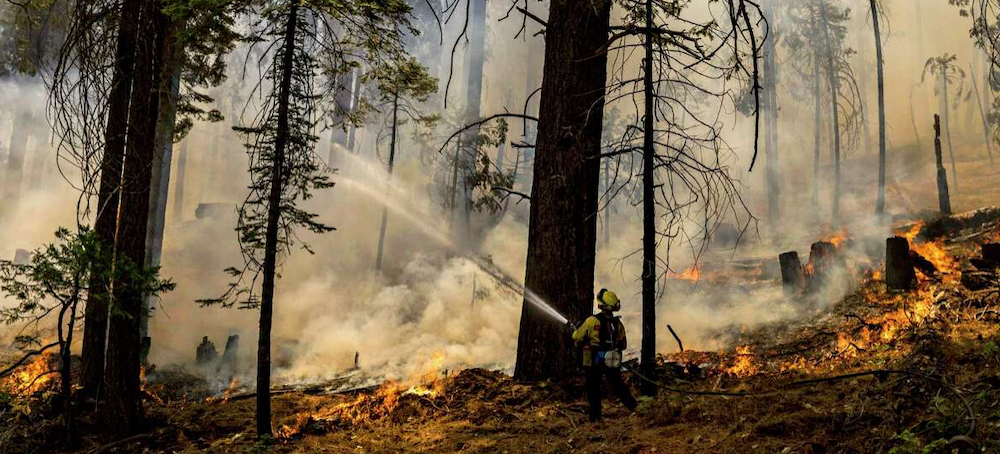 Smoke from the Washburn Fire near Yosemite National Park's southern entrance in Wawona, California. (photo: Stephen Lam/SF Chronicle)
The reason? Smoke from the wildfires that have become more frequent and intense in the region as the climate warms.
“This is the new summer on the West Coast: checking the air quality before going on a hike, getting anxious on a windy day because it means the fires are going to get worse. Scheduling camping trips, swimming lessons and soccer camp and then canceling them as smoke interferes,” Oregonian climate journalist Emma Pattee wrote in a Wednesday guest essay for The New York Times.
The next day, a University of Stanford research team published a study proving that the rise in Western wildfire smoke isn’t just a matter of anecdotal evidence or a few particularly dramatic incidents. The research, published in Environmental Science & Technology, found that smoke has added as many as five micrograms per cubic meter to daily concentrations of particulate matter (PM) 2.5 in the region over the past decade, erasing progress made in reducing the deadly form of air pollution.
“We have been remarkably successful in cleaning up other sources of air pollution across the country, mainly due to regulation like the Clean Air Act,” study co-author and Stanford earth system science professor Marshall Burke told The New York Times. “That success, especially in the West, has really stagnated. And in recent years this started to reverse.”
PM 2.5 is a particularly insidious form of air pollution because the tiny particles can bury themselves in human lungs and in the bloodstream, according to Stanford News. Exposure is associated with heart and lung disease, but also mental health problems and cognitive disorders including dementia. The research team used a mix of artificial intelligence and models to determine how wildfire smoke contributed to PM2.5 pollution on a county-by-county level between 2006 to 2020, Stanford News reported.
What they found was that many more people are now exposed to this danger. The number of people experiencing at least one day of unhealthy air every year, or days when the PM2.5 concentration from smoke was at least 100 micrograms per cubic meter, has multiplied by 27 from less than half a million 10 years ago to more than eight million today.
“That was way higher than I was expecting, and that’s the average over multiple recent years,” Burke told Stanford News. “Many individual years, in particular 2020, have been much worse.”
What’s more, the number of people experiencing at least one day with more than 200 micrograms of smoke per cubic meter has ballooned by a factor of 11,000.
In the U.S., this heightened exposure is concentrated in the West, where it has erased progress from reducing factory and freeway pollution in some places, according to The New York Times. Because fires are concentrated in the West and Southwest, smoke exposure is increasing for both Hispanic people and high-income people, Stanford News said.
Outside of the U.S., wildfire smoke and air pollution are also increasing because of the climate crisis, though this was outside the study’s purview.
“As the globe warms, wildfires and associated air pollution are expected to increase, even under a low emissions scenario. In addition to human health impacts, this will also affect ecosystems as air pollutants settle from the atmosphere to Earth’s surface,” World Meteorological Organization Secretary-General Petteri Taalas, who was not involved in the research, told The Guardian. “We have seen this in the heatwaves in Europe and China this year when stable high atmospheric conditions, sunlight and low wind speeds were conducive to high pollution levels.”
Within the U.S., the study authors pointed out that wildfire smoke is of special concern because it is considered an “exceptional event” by the Clean Air Act and therefore not regulated, according to Stanford News.
How to reduce exposure–both in the U.S. and abroad–is also trickier than installing scrubbers in a smokestack or reducing tailpipe emissions.
“At the end of the day, the best type of policy is to proactively prevent these big fires in the first place,” University of California, San Diego environmental epidemolgilst Tarik Benmarhnia, who was not involved with the study, told The New York Times.
Follow us on facebook and twitter!
PO Box 2043 / Citrus Heights, CA 95611


Comments
Post a Comment