RSN: Garrison Keillor | What If It Does and They Do?

16 September 22
Live on the homepage now!
Reader Supported News

My love and I live on the 12th floor of a building on the Upper West Side of Manhattan, which won’t be so upper much longer and so we’re thinking of buying a kayak so we can still make it to Zabar’s when the streets are flooded. We’ll paddle around the little islands that used to be Central Park and the Belvedere Castle to look in the Guggenheim, which will be turned into a water slide, and when Zabar’s closes with its fabulous cheese section where a shopper gains weight simply by inhaling, then we’ll order a chopper to lift us off the roof and wave goodbye to the old life and be flown to Pittsburgh to fly back to Minnesota. One chapter ends, another begins.
As you can see (to your horror) I am rather benign about the Union of Righteous Republican States (URRS) that the rising seas will create. I face the prospect with equanimity, same as I face the prospect of a monsoon or a ban on Pearson’s Salted Nut Rolls or my laptop computer being crushed under the wheels of a truck, because I am newly out of the OR with a beautiful scar on my chest, I’m walking with a cane, and to me everything is miraculous, walking, conversation, meatloaf, oatmeal, sunshine, prune juice, my daughter’s voice on the phone, even the voice of Tri my physical therapist telling me to stand on one foot with my eyes closed for fifteen seconds. It’s all good.
It helps to be eighty, with a treasury of interesting regrets I can examine if I choose. It also helps to know that a pig saved my life, the donor of a mitral valve, mine having sprung a leak. I dreamed of her last night, singing to me from hog heaven:
I gave you a new lease on life
Gave you a brand-new start
Other people are on your mind
But I am there in your heart
I gave you a piece of my heart, baby
Enjoy the sweet sunshine
Roll in the mud, it’s there in your blood,
The part of your heart that’s mine.
This mitral valve is working very well, according to the Mayo Clinic, and when a pig part is what keeps you going, it is an everyday miracle you never forget.
It also helps to be married to my wife. I’m not a New Yorker, she is, though she was born in the same dinky hospital in Minnesota that I emerged from, but I grew up in a basement, which I took to mean abasement, and she grew up in a home with classics on the shelves and she played violin and listened to Sibelius and Brahms, all of which turned her head eastward. I only went there for the money: The New Yorker was a magazine that paid real dough. In 1974 they paid me $6,000 for a piece about the Grand Ole Opry and I took up a life of self-amusement. Meanwhile, she, a true artist, lived in poverty in tiny fifth-floor walk-ups with three roommates and two cats and heroin addicts sleeping in the entry so that she could play great music. She went for Bach, I went for the bucks. We are opposites who pair up well.
And now, thinking of the life of Elizabeth II, a life of devotion to inherited duty, we see the merits of fidelity and soldiering on. The British Commonwealth shrank severely during her long reign and she remained the same gracious lady, riding in the carriage, waving. Brits of fiercely opposing views could look on her with affection and respect.
And so if the oceans rise and mountains fall and we have mandatory prayer in schools and election of the president by state legislatures and there is a life-size portrait of Himself in every post office, I shall still pledge allegiance to the flag and to the Republicans for whom it stands.
 The former intelligence contractor, Reality Winner, spent more than 4 years in prison after pleading guilty to leaking classified information under the Espionage Act. (photo: NBC News)
The former intelligence contractor spent more than 4 years in prison after pleading guilty to leaking classified information under the Espionage Act.
But on whether Trump should be charged under the Espionage Act or face punishment as she did, Winner told NBC News that she doesn't think he should go to prison based on the evidence made public so far.
"What I did when I broke the law was a political act at a very politically charged time," Winner, 30, said from her home near Corpus Christi, Texas.
She added that it "wasn't hard to believe" Trump might have had a cache of classified documents stored at his Mar-a-Lago estate, as the Department of Justice is now investigating.
"It is incredibly ironic, and I would just let the Justice Department sort it out," she said.
Her more restrained view surrounding the former president, whose administration took a hard line on going after people accused of national security leaks, comes almost 15 months since she was released from prison in June 2021 to a halfway house due to good behavior. Winner was sentenced in 2018 to more than five years on a single count of transmitting national security information — then the longest federal prison sentence imposed for leaks to the news media.
Winner had been working for national security contractor Pluribus International at Fort Gordon in Georgia when prosecutors say she smuggled out a classified report in her pantyhose detailing the Russian government's efforts to pierce a Florida-based voting software supplier ahead of the 2016 presidential election. That information was later reported by The Intercept news outlet.
Winner said she was motivated to act on a belief that the American public wasn't getting the full truth.
When Trump was still in office, Winner's lawyers sought to get her sentence commuted. He had tweeted that her punishment was "so unfair," and was "'small potatoes' compared to what Hillary Clinton did," referencing a federal investigation into her use of a private email server while she was secretary of state. (The FBI in 2016 ultimately determined Clinton had committed no crime in her handling of classified information.)
Winner said she is on probation until November 2024, and remains prohibited from traveling out of southern Texas, must adhere to a nightly curfew and report any interaction with the media.
She says her experience in and out of prison has allowed her to reflect on her actions. On one hand, she believes she was a scapegoat, citing how the FBI director under Trump, James Comey, recalled in a memo that he told the president "about the value of putting a head on a pike as a message" to leakers of classified information. Prosecutors at the time also tried to paint Winner as somebody who may have been sympathetic to anti-American sentiments after they said they found handwritten notes in her home, including one saying, "I want to burn the White House down."
"I was a very introspective individual," Winner said. “I wrote down my thoughts. I didn't act on my thoughts and I would read them later and laugh at them."
But Winner also recognizes that she broke the law and said she wouldn't do what she did again. Instead, she said, she would have gone through "proper channels" to raise her concerns as a whistleblower.
"I have apologized and I'm currently serving that sentence. However, I was treated very harshly and I don't wish that on anybody," she said, adding, "When we see this investigation going on, and the search warrant executed out of the former president's home or his estate, it's a lot of speculation, and I would sit back and let the Department of Justice do what it needs to do."
Winner said she considers the application of the Espionage Act inconsistent and vague, and that it leaves too much leeway for the federal district that has jurisdiction over a case to determine if "national defense information" was truly jeopardized.
Derek Bambauer, a University of Arizona law professor focusing on intellectual property, agreed that the World War I-era law is "badly in need of updating."
"The concern is that the current, rather broad language confers far too much discretion upon prosecutors," he said.
The law, he added, should be clearer about what is considered prohibited conduct while building in free speech safeguards for people engaged in whistleblower activities.
"There's clearly an important difference between showing a redacted version of a document or an assessment of a situation to a journalist or an attorney versus selling technical details of, say, submarine propulsion systems to a foreign country," Bambauer said.
The law also doesn't require that a document be technically considered "classified" to fall under its scope — the information only needs to be related to national defense and be retained or disclosed without authorization.
In July, Democratic Sen. Ron Wyden of Oregon and Rep. Ro Khanna of California, and Republican Rep. Thomas Massie of Kentucky reintroduced a bill under the Espionage Act to reaffirm First Amendment protections for journalists who publish classified information provided by whistleblowers.
Some of the recent high-profile cases of Espionage Act violations have involved people accused of leaking information, and not spying, which Winner points to as examples for why she says the law is "flawed."
Since leaving prison, Winner said, she has worked on her mental and spiritual health, become a CrossFit coach and advocates for transforming the carceral system so that prison is not the default for those who commit crimes. For a person of power, such as a former president, the ability to house them in prison safely becomes especially tricky, she added.
"This is not a case where I expect to see any prison time," Winner said of the accusations involving Trump, "and I'm just fine with that."
 Ukrainian paratroopers drive on the vehicle with Ukrainian flag on the pantone bridge across Siverskiy-Donets river in the recently retaken area of Izium, Ukraine, Wednesday, Sept. 14, 2022. (photo: Evgeniy Maloletka/AP)
Key Facts
More than 400 bodies were found in the graves, according to the Ukrainian government’s Center for Strategic Communication, which shared photos of what appear to be makeshift wooden crosses placed on burial plots in a forest.
Ukrainian President Volodymyr Zelensky said Thursday an investigation into the graves has begun and more information will be available Friday, adding that “Russia leaves death everywhere and it must be held accountable for that.”
Roughly 1,000 bodies have been found in Izium since it was retaken last week, Anton Gerashchenko, an Interior Ministry advisor who traveled with Zelensky to the city, told the BBC Thursday.
Russia has repeatedly denied targeting civilians or committing war crimes in Ukraine.
Surprising Fact
The destruction in Izium is among the worst found by Ukrainian troops in a recaptured city, Gerashchenko said, describing the scene as “even worse than the tragedy in Bucha,” a Kyiv suburb where 458 bodies were found in April. The New York Times documented Russian forces torturing, raping and executing Ukranian civilians in Bucha during their occupation of the city early in the war, and after Russia withdrew from the city and abandoned its push to surround Kyiv, many bodies were found in the streets or in makeshift graves. Russia has also been accused of depositing hundreds of civilians’ bodies in a grave site outside Mariupol, a southeastern city that was under siege for months before eventually being occupied by Russia.
Key Background
Izium was under Russian occupation for more than six months, but was reclaimed by Ukraine last week in a counteroffensive that marked one of the biggest blows to Russia in the seven-month-long war. On Monday, Ukraine said it had reclaimed some 20 towns and villages in Kharkiv in just one day in a blitz that appeared to catch Moscow off guard. Russian troops quickly withdrew from the region in such a rush that some weapons and ammunition were left behind, according to the Associated Press. Losing Izium marked one of Russia’s biggest defeats of the offensive, as the city had become an important supply hub and logistics center for its eastern forces.
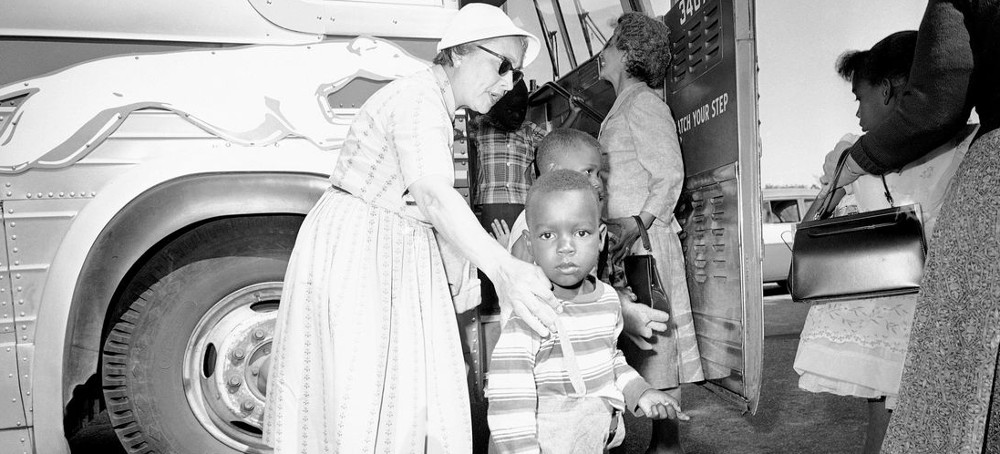 Two unidentified women, residents of Hyannis, Massachusetts, help some of the nine children of Lela Mae Williams (not in photo) off the bus, June 8, 1962, at Hyannis on their arrival from Huttig, Arkansas. (photo: Frank C. Curtin/AP)
ALSO SEE: Migrants Stranded in Martha's Vineyard Say They Were Lied To
In 1962, it was just a bunch of racists; this time the inhumanity comes at the hands of the state.
It didn’t take long for Florida Gov. Ron DeSantis to take credit.
"Yes, Florida can confirm the two planes with illegal immigrants that arrived in Martha’s Vineyard today were part of the state’s relocation program to transport illegal immigrants to sanctuary destinations," the governor’s communications director, Taryn Fenske, told FoxNews.com. She went on to say it was done in response to “the Biden administration’s open border policies.” Fox News ran the story under a banner on its homepage: “EXCLUSIVE: DeSantis flying illegal immigrants to swanky hideaway for the rich and famous.”
It was 60 years ago when this corner of Massachusetts was the center of a similarly cruel stunt. It is a little-told chapter of history called in the media at the time “the Reverse Freedom Rides.” In the summer of 1962, a group of white segregationists and supremacists known as the White Citizens Council passed out leaflets and placed want ads in Southern newspapers to recruit Black families with the promise of jobs up north—and, in particular, in Hyannis, where then-President John F. Kennedy spent summers with his family. The ads read: “President Kennedy’s brother assures you a grand reception to Massachusetts. Good jobs, housing, etc. are promised.”
The deceptive and inhumane plan was a response to the heroic Freedom Rides the year before. Civil rights activists rode buses into the segregated South, and a year later the White Citizens Council sent busloads of Black riders up to the North.
"For many years, certain politicians, educators and certain religious leaders have used the white people of the South as a whipping boy, to put it mildly, to further their own ends and their political campaigns," said Amis Guthridge, one of the White Citizens Council organizers, in footage unearthed by NPR’s Gabrielle Emanuel in 2020. "We're going to find out if people like Ted Kennedy… and the Kennedys, all of them, really do have an interest in the Negro people, really do have a love for the Negro."
Many of the 53 people who arrived at Hyannis—including 33 children—were sent to the Cape Cod Community College, where they were given food and bedding collected by the Cape Cod chapter of the NAACP. “It was one of the most inhumane things I have seen in my years of social action work,” local Cape activist Margaret Mosley said in a 1994 interview.
Yesterday, the undocumented immigrants flown to Martha’s Vineyard were taken to nearby churches for a place to sleep after being given pizza, salad, and soup by local volunteers. One man told the Vineyard Gazette that they were promised housing and jobs when they arrived. “Republicans who call themselves Christians have been plotting for some time to use human lives—men, women, and children—as a political pawns,” Massachusetts Rep. Dylan Fernandes tweeted last night. “It is evil and inhumane.”
When busloads of families were sent to Hyannis, the White Citizens Council made sure the media covered the whole event—reporters were there waiting when the buses pulled up to Hyannis Main Street. The public cruelty was the point. And right after the plane arrived last night in Martha’s Vineyard, where President Obama has spent his summers, DeSantis’s communication’s director said in her statement to FoxNews.com, "As you may know, in this past legislative session the Florida legislature appropriated $12 million to implement a program to facilitate the transport of illegal immigrants from this state consistent with federal law.”
The parallels playing out after six decades are jarring. And this time, the cruelty is state-sponsored.
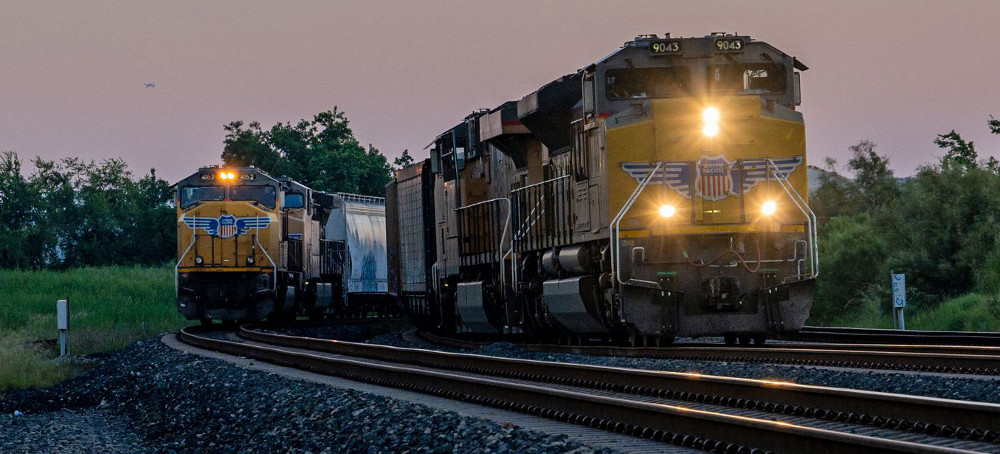 Freight trains travel through Houston, September 14, 2022. (photo: Brandon Bell/Getty)
A strike was likely averted — but it would have been an economic disaster.
Tens of thousands of freight rail workers are prepared to go on strike on Friday at 12:01 am, which could have wide-ranging effects across the economy. It’s already causing some disruptions for rail passengers, freight companies, and others.
The cause is a dispute between the freight industry and the workers who make it run.
Most of the 12 unions representing the workers have already agreed to a proposal put together by a presidential emergency board established by the White House over the summer to try to help resolve the dispute. The proposal includes a 24 percent increase in wages for workers by 2024, but many workers have complained that it fails to address leave, on-call scheduling, and poor working conditions.
The holdout unions’ position is that pay increases aren’t enough to make up for some real downsides — and dangerous aspects — of the job.
The two most powerful unions involved in the negotiations, which represent engineers and conductors, are continuing to resist the proposal, putting both sides in a deadlock. If workers do go on the strike they appear to be hurtling toward, it would be the first such strike in 30 years.
“If they were to strike, all the other unions would respect the picket line,” said Tony Hatch, a transportation analyst and head of the consulting firm ABH Consulting, referring to the engineers and conductors. “We’re in a pressure-cooker time.”
If a freight strike were to occur — and especially if it’s long-lasting — it could have disastrous effects across an already fragile economy still reeling from supply chain disruptions and inflation.
“Rail moves a lot of the foundational, basic goods that we don’t think about day-to-day,” said Rachel Premack, editorial director at FreightWaves, which covers supply chains. “They’ll move sand and gravel that would then be crushed into concrete for roads or for laying home foundations. Railroads move the chemicals used to purify water or to compromise fertilizer for crops, soybeans that could become food for humans or [animals] that are then food for humans. It’s a lot of early-chain-type goods.”
Many passenger trains also run on freight rails, and their service could be suspended. Amtrak has already warned of potential disruptions and canceled cross-country trains in anticipation of a strike, though so far its Northeast service will not be affected.
Federal officials and lawmakers are urging a compromise, recognizing that a national freight strike of tens of thousands of workers is not a good look when the 2022 midterm elections are coming up and, again, the economy is already off-kilter.
Replacing freight with other forms of transportation is not easy if workers do walk out. Mike Steenhoek, executive director of the Soy Transportation Coalition, told Vox in an interview that one train has the freight capacity of 400 semi-trucks. “I don’t know of a shipper who just has 400 semis sitting in a garage ready to be accessed,” he said. He noted that for agriculture, the timing couldn’t be worse because of harvest season, adding more urgency for a deal.
Right now, workers and unions realize they have a labor-friendly administration in place and believe they can squeeze a bit more out in negotiations on what would amount to a five-year deal retroactive to 2020, Hatch said. “All sides are playing out the cards they were given,” he said. “It’s all alarmist, it’s all part of the game.” The Association of American Railroads has projected a strike could cost the economy $2 billion a day — which is why Hatch doesn’t believe that if a strike happens, it will not last for long.
But if it does stretch on, “yes, it would have a huge effect,” he said, impacting anything from agriculture to automobiles, gas to food.
Premack was even more dire in her warning. “We would definitely start to see a lot of key parts of our consumer society really break down,” she said, “which is a little apocalyptic to say.”
Hence the urgency in Washington to get to an agreement. While congressional Democrats have yet to stake out a policy response, the Labor Department is scrambling to shepherd negotiations between labor unions and carriers in a series of last-minute meetings.
If forced to act, Democrats must weigh the political pressure to stop a strike along with the commitment they’ve long espoused to labor unions, who are pushing for basic improvements to working conditions. “It is time for Congress to stand on the side of workers for a change,” Sen. Bernie Sanders (I-VT) said in a floor speech. “Rail workers have a right to strike for reliable schedules, they have a right to strike for paid sick days, they have a right to strike for safe working conditions.”
Politically, this is complicated for many parties involved, given the state of the economy and voting fast approaching. “They need a rail service disruption like they need a hole in the head,” Steenhoek said.
A freight strike would, indeed, not be fun
What happens next for consumers depends on two factors: whether a strike happens at all, and how long it lasts.
Currently, we’re in what could be considered the first phase of the strike: the pre-strike disruptions as companies and shippers prepare. Amtrak cancellations fall into this category. Some freight companies are also pausing the shipment of hazardous or sensitive cargo, such as fertilizer, chemicals for purifying water, or items that need to be preserved at a specific temperature. Railroad companies such as Union Pacific and CSX put an embargo on the shipment of multiple materials, which the Wall Street Journal notes are used commonly in manufacturing and pharmaceuticals.
If you know it’s going to take four to five days for a freight train to get the items you’re shipping from New Hampshire to California, you do not want the cargo stuck on said freight train in the middle of Kansas on day two or three. Knowing a potential stoppage is on the horizon, some companies and shippers aren’t going to load their cargo on that train today.
The first few hours or days of the strike itself is the second phase. Steenhoek compared the situation to thinking about your pantry. If, for whatever reason, you can’t make it to the grocery store for a few extra days, you are hopefully stocked up enough that it’s not the end of the world. But as the days stretch on, the situation gets increasingly dire. If you are an egg farmer, you’ve probably got enough soybeans stored up to feed your chickens for a while.
Still, given that some industries are already suffering from supply chain issues and inflation is already a problem, a short strike will be disruptive. The level of disruption depends on the industry.
Even if the strike ends quickly, transportation and rail isn’t easy to turn on and off like a light switch. “It takes a while to get all that started and resuming and back to full speed,” Steenhoek said.
Companies can try to seek out alternative routes, but switching to trucks and barges is an arduous and complicated process. Plus, the truck driving industry is suffering a shortage of its own.
The scary scenario here is if we hit phase three, where a strike goes on for weeks or longer, costing the economy what could be $2 billion a day. One could envision a scenario where automobile plants have to shut down production because their finished vehicles can’t be shipped out and are piling up. It would mean that the movement of important commodities, such as soy and wheat, could be severely constrained. “A rail shutdown would result in devastating consequences to national and global food security,” the National Association of Wheat Growers said in an emailed statement.
Premack drew a comparison to the delays and bottlenecks at West Coast ports over the last several months — as well as a rather scary distinction. “It isn’t like, ‘Oh, no, my Peloton isn’t coming. It’s like, ‘My bread isn’t going to be made because there’s no grain moving or flour moving,’” she said. “It’s a bit scarier. We can survive without getting our new couch in, but we can’t really survive without purified water.” She added that rail does move e-commerce shipments, but it’s generally earlier in the process than whatever appears on your doorstep tomorrow.
What Congress might do
Under the Railway Labor Act, Congress has the ability to block or end a rail strike. Since 1963, it has passed legislation more than 10 times to intervene in rail disputes.
So far, though, Democratic leaders have been reluctant to commit to doing so, while Republicans have been eager to pressure workers into agreeing to the terms set by the presidential emergency board.
If Congress were to intervene, there are a few routes lawmakers could take. They could require the unions and carriers to accept the presidential emergency board’s conditions, which included a pay increase but no acknowledgment of other demands like sick leave. They could extend the existing cooling-off period so both sides have more time to negotiate. Or they could turn the talks over to independent arbitrators who would be tasked with finding a resolution.
For now, congressional Democrats are waiting to see what might come out of the talks the Labor Department is leading between unions and railroad carriers on Wednesday before they lay out a policy response. “Secretary Walsh continues to lead discussions at the Department of Labor between the rail companies and unions,” a Labor spokesperson told Vox on Wednesday afternoon. “The parties are negotiating in good faith and have committed to staying at the table today.”
Multiple lawmakers including Senate Majority Leader Chuck Schumer and House Speaker Nancy Pelosi have expressed hopes that the two sides will be able to work things out and prevent the need for any legislative response at this time. “I would rather see negotiations prevail so there’s no need for actions from Congress,” Pelosi said at a press conference on Wednesday. Democrats, after all, are in a difficult position: They could well be blamed by the public if there are serious economic consequences from a strike, but any action they take to stifle workers would betray their purported support of unions, an important constituency for the party.
Senate Republicans, meanwhile, have urged Congress to pass a resolution that would require the unions to take the presidential emergency board agreement that the Biden administration previously offered, an outcome that business interests and carriers are pushing for as well. Earlier this week, Sens. Richard Burr (R-NC) and Roger Wicker (R-MS) introduced a measure that would effectively put the PEB conditions into place if passed, ignoring other concerns that workers have expressed. They tried to force a floor vote on the measure on Wednesday, though it was blocked by Sanders.
In lieu of imposing the PEB agreement, some Democrats are discussing proposals that would factor in other union demands, according to The Hill. “If the Burr-Wicker resolution passed, rail workers would be entitled to zero paid sick days and zero unpaid sick days,” said Sanders. “That is clearly unacceptable.”
It’s been 30 years since there was a rail worker strike. Less than 24 hours after the strike began in 1991, Congress approved a bipartisan resolution, which established a new board that had 65 days to find a resolution to any outstanding disagreements the unions and carriers had.
It’s still not clear if they would do the same this time — or if things will even get that far.
Were Congress forced to take action, there could well be a showdown between Republicans’ and Democrats’ approach to the issue, since 10 GOP senators would be needed for any resolution to pass.
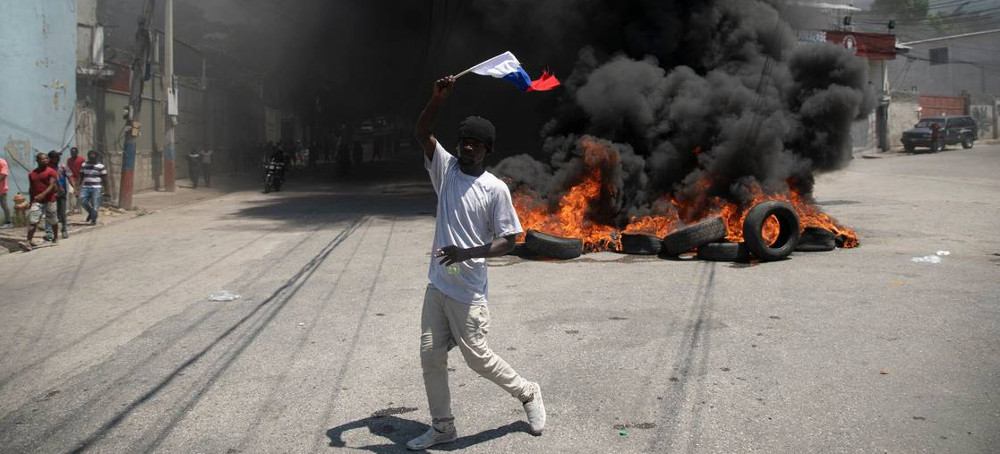 A man waving a flag walks past a burning barricade in Port-au-Prince, Haiti, during a protest to demand the ouster of Prime Minister Ariel Henry on Wednesday, Sept. 7, 2022. (photo: Odelyn Joseph/AP)
Haitian government’s decision to raise fuel costs adds to ongoing anger over gang violence, soaring inflation.
The Haitian authorities announced on Wednesday that the price of gas will more than double, with slightly smaller increases for diesel and kerosene.
The government, which controls the price of gas, did not say when the new prices would come into effect but tweeted that “prices in Haiti are significantly lower than those on the international market”.
The communications ministry also said on Twitter that the cost of importing petroleum products “amounts to 9 billion gourdes [$76.2m] per month, twice as much as the monthly state payroll”.
Protesters blocked roads throughout the capital Port-Au-Prince, closing off usually busy areas of the city to traffic. Schools and businesses closed as streets were blocked with rocks, vehicles, and burning tyres.
The demonstrations are the latest to rock the Caribbean nation, which has been grappling with rising inflation as well as an escalation in gang-related violence.
“It’s a very challenging time for Haiti right now,” Haitian journalist Harold Isaac told Al Jazeera around midday. Haitians also are grappling with soaring inflation, he said, while insecurity has worsened in the aftermath of President Jovenel Moise’s killing in July 2021.
“We’re facing a compounding set of crises, the latest one being the gas crisis that really has made life very difficult for everyday folks here,” said Isaac, adding that some Haitians have had to resort to smugglers to get fuel — often at inflated costs.
“It’s virtually impossible as it is right now to get gas from gas stations,” he said.
The government has justified the price increase by saying that it is no longer tenable to subsidise fuel as much as it used to.
Haiti had previously received its petroleum from Venezuela’s Petrocaribe programme, which shut down several years ago. Since then, it has helped subsidise local distributors who import fuel.
Some have raised concerns that the newly announced price hike, which will see the price of a gallon (3.8 litres) of gas go from about $2 to $4.78, will lead some Haitians to leave the country. Many people in Haiti depend on fuel not only for transportation, but also for electricity and cooking.
Marc Andre, a 28-year-old moto-taxi driver, told The Associated Press news agency that he was considering crossing the border into neighbouring Dominican Republic to seek out work as a construction worker.
“The price I’m going to charge, most people won’t be able to afford it,” he said. “It’s best for me to leave the country.”
Haiti has struggled to cope with an inflation rate of 30 percent, as well as escalating violence from armed gangs. Two Haitian journalists were murdered and their bodies burned as they were reporting on rising violence in a Port-Au-Prince neighbourhood over the weekend.
Prime Minister Ariel Henry had warned in a national address on Monday that fuel prices would rise and urged residents to have patience.
“The country has a lot of problems,” Henry said. “I am calling on everyone to stay calm. The government is working with what it has.”
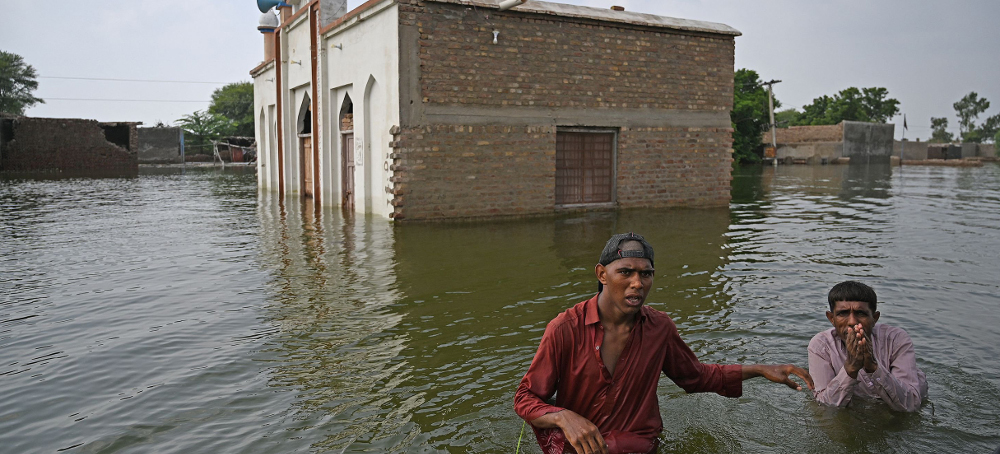 People wade through floodwaters after heavy monsoon rains in the Sindh province of Pakistan on Sept. 7. (photo: Aamir Qureshi/Getty)
A new analysis found such powerful rainfall could now be expected once every 100 years in the current climate and even more often in the future as the world continues to warm.
The dramatic flooding killed nearly 1,500 people and caused an estimated $30 billion in damage, and it has left hundreds of thousands homeless. In August, the Sindh and Balochistan provinces both had their highest rainfall totals ever recorded for the month — about seven and eight times their typical monthly totals for precipitation.
The new analysis found such powerful rainfall could now be expected once every 100 years in the current climate and even more often in the future as the world continues to warm, researchers said at a news conference Thursday held by the World Weather Attribution initiative.
The initiative gathers scientists from around the world to analyze newsworthy weather events as quickly as possible and to help people understand climate change’s role when it’s most relevant. The analysis, which hasn’t undergone outside scientific review or publication in a scientific journal, relies on a methodology that is peer-reviewed and has been applied to many recent high-profile weather events. Such analyses are often published in journals months later.
To understand climate change’s fingerprint on the event, the researchers analyzed the yearly maximum for monsoon season rainfall over 60 days in the Indus River basin, where the flooding was centered. They also looked at the heaviest five-day period of monsoon rainfall in hard-hit Sindh and Balochistan.
The study found that climate change had inflated the chances of heavy rainfall for both geographies and time periods. As much as one-third of the rainfall that fell during the most intense period in Sindh and Balochistan could be attributed to climate change, it found.
The intense monsoon rains “would have been a disastrously high rainfall event without climate change, but it’s worse because of climate change,” said Friederike Otto, a senior lecturer in climate science at the Grantham Institute for Climate Change and the Environment and a co-founder of the initiative. “Especially in these highly vulnerable regions, small changes matter a lot.”
The flooding in Pakistan involves more uncertainty than some other recent attribution studies, because monsoon rainfall is extremely variable, the available climate records only go as far back as 1950, and climate models struggle to represent some of the complex weather processes in the South Asian region.
“Climate models are known to generally struggle to capture monsoon characteristics in this part of the world,” said Mariam Zachariah, a research associate at the Grantham Institute, which is part of Imperial College London. “We saw that there’s a large uncertainty around the results from the models.”
Climate change isn’t the only factor that led to such a profound disaster, the analysis said. Pakistan had catastrophic flooding in 2010, which shared similar climate and weather characteristics.
nalysis suggested.
“This disaster was the result of vulnerability that was constructed over many, many years and shouldn’t be seen ahistorically as the outcome of one sporadic certain event,” said Ayesha Siddiqi, an assistant professor of geography at the University of Cambridge.
Pakistan is responsible for less than 0.5% of the world’s historic greenhouse gas emissions, but it is among the countries most vulnerable to the effects of climate change. The flooding has displaced millions.
World leaders have described aiding the country in terms of justice.
“Pakistan needs today massive financial support to overcome this crisis,” U.N. Secretary-General António Guterres said last week. “This is not a matter of generosity. This is a matter of justice.”
Earlier this year, temperatures soared past 122 degrees Fahrenheit in the county. Researchers performed an attribution analysis of the heat wave and found it was made 30 times more likely to have been due to climate change, according to Fahad Saeed, an Islamabad-based researcher at the Center for Climate Change and Sustainable Development.
Follow us on facebook and twitter!
PO Box 2043 / Citrus Heights, CA 95611


Comments
Post a Comment