RSN: James Verini | Witness to the Massacre in Mariupol

04 August 22
Live on the homepage now!
Reader Supported News

Survivors describe the defining atrocity of the war in Ukraine.
She looked around for her boyfriend. His face emerged from the dust. She could make out his eyes, and they were wide with terror — “like a crazy person’s eyes,” she thought.
They stood up. Another face appeared through the dust, a man’s. It was smeared red. He was yelling. She couldn’t hear him, until she could.
“Everybody get upstairs!”
Her cat was crouched on the floor, its claws digging at the concrete. Her mother pried him up and put him under her arm before the three of them rushed toward the stairwell. They could see only dust and the shapes of moving bodies, but they had gone this way so many times in the last 10 days, since they fled the siege of Mariupol to shelter in the basement of the Donetsk Regional Academic Drama Theater, that they could have found the stairs with their eyes closed.
The stairwell was a welter of whitened people. Some sat, bleeding, dazed, while others struggled to climb. Getting up the stairs felt to Elyzaveta “like forever.” A man on the landing above was screaming. Him she understood at once.
“There is no more theater!”
She stumbled out into the freezing air on the building’s eastern side. Where the roof above the main auditorium had been, there was now a yawning opening to the sky. Minutes earlier, there had been a field kitchen here. A crowd had been around the cooking fires, preparing the midday soup. Elyzaveta’s mother had just been fetching water. Now the edifice was collapsed, and there was a smoking hill of rubble where the kitchen had been. Children stood before it, wailing.
Elyzaveta refused to look at them. She refused to look anywhere, knowing that, if she did, she would pass out: “I was in a stupor, frozen.” She wanted to cover her ears with her hands and block out their wails but realized she was holding the cat. Her boyfriend was next to her; her mother was not.
Elyzaveta forced herself to lift her eyes. She wouldn’t look at the rubble or the children, she told herself, only at the people emerging from the basement, searching for her mother.
More explosions. Shattering glass and whizzing shrapnel. The Russians were shelling around the theater. Someone yelled, “Lie down!” Elyzaveta and her boyfriend dropped to the ground and covered their heads. When they stood up, her mother was there again. They ran around the theater to the main entrance, where they found a chaotic mob of people who had been sheltering alongside them. Some raced away in panic; others wandered in a daze. Smoke seeped from the building’s upper floors and the basement. Elyzaveta’s family and these other evacuees had managed, against every adversity, and with almost no official help, to turn the theater into an outpost of humanity in the midst of the siege of Mariupol. In moments, it was all gone.
No one knows how many Ukrainians were crushed beneath the rubble, burned, killed by shrapnel or blast waves or asphyxiated in and around the theater. The estimates of dead I heard from survivors ranged from 60 to 200, but The Associated Press found that it could be up to 600. With Mariupol in Russian hands, it’s unlikely that a real accounting of the dead, or for that matter any on-the-ground investigation of the bombing, will take place.
Later, Elyzaveta asked her mother where she had disappeared to. Reluctantly, her mother told her: When she got outside, following Elyzaveta, she had seen a woman’s bloodied face in the rubble. The woman was pinned under a slab of limestone. Elyzaveta’s mother went to the woman. She and a boy tried to pry the slab off her. It was too heavy. She had to go.
She looked into the pinned woman’s petrified eyes.
“I’m sorry,” she said, and ran off.
As Russia’s war on Ukraine enters its seventh month and the world’s interest in it inevitably diminishes, the destruction of the Donetsk Regional Academic Drama Theater demands our attention. Before it was bombed, the theater was home to the largest sanctuary in Mariupol for residents fleeing the Russian siege. In the roughly three weeks that this improvised, citizen-led shelter existed, its inhabitants worked together to keep one another alive. As news of what was happening there spread across Ukraine, it became a national symbol of hope and resistance. When it was destroyed, it became the site of the single most lethal act of violence against Ukrainian civilians since Russia invaded on Feb. 24.
The theater stands out from a war that in its short duration has taken thousands of lives. It also stands out from the siege of Mariupol, a city assaulted like no other in Ukraine. Mariupol is the starkest proof yet of Russia’s willingness to commit humanitarian atrocities in the course of a war that it claims is meant to save Ukrainians from themselves, and the theater, the worst known atrocity of the siege, offers an unobstructed view into Russian motives and methods. It is difficult to imagine Russian forces didn’t know what they were doing when they destroyed the theater, where the temporary residents had painted the Russian word for “CHILDREN” so large on the ground outside that it could be seen in satellite imagery. An Amnesty International report calls it “a clear war crime.”
“That day, we realized the Russians had come to kill us,” is how one survivor put it to me. “They didn’t come to fight with Ukrainian soldiers. They just wanted to kill us.”
The Drama Theater, as the people of Mariupol typically referred to the building, was bombed between 10 and 11 a.m. on Wednesday, March 16. The exact time is uncertain, as is the exact means. According to an analysis of photographs taken after the bombing that was included in the Amnesty International report, the most plausible case is that a Russian warplane dropped two 1,100-pound bombs onto the theater. They pierced the roof more or less simultaneously and detonated in the main auditorium, at about stage level, possibly with the aid of delayed-action fuses. The extent of the damage suggests two detonations, which would have sounded like one to the people in the theater. It is possible that there was only one bomb, but the shape and size of two debris fields extending from the theater to the northeast and the southwest would seem to argue against that. Also possible, though much less likely, is that Russian forces launched a cruise missile into the theater.
I began interviewing survivors in March, in a hospital near Mariupol, where they were being treated, and I have continued to interview them since. What follows is an account based on their experiences, as well as those of others who witnessed the theater’s destruction.
Elyzaveta, a sprightly 19-year-old, had lived all her life in Mariupol, which is roughly 40 miles from the Russian border. She shared an apartment with her mother in Zakhidnyi, a small residential district in the western part of the city, and worked in a supermarket, saving for college. In her spare time, she acted in plays. When the invasion began, Elyzaveta believed that the Russians were saber-rattling. Since 2014, when Russia annexed Crimea and backed a short-lived insurgency in Mariupol, the city had been on the front line between Ukraine proper and territory seized by Russia-backed separatists, the so-called Donetsk People’s Republic. For more than half her life, the two sides traded fire. It never amounted to anything. President Vladimir Putin of Russia was tyrannical, Elyzaveta believed, but not reckless — at least not so reckless as to actually invade. It was a conviction she shared with almost every Ukrainian I’ve spoken with.
What Elyzaveta didn’t know was that Russian forces in their thousands were converging on Mariupol from three sides and the skies above. The 810th Separate Naval Infantry Brigade approached by sea, the 150th Motorized Rifle Division crossed the border from Russia and troops descended from the Donetsk People’s Republic. Russian jets flew bombing sorties, and warships launched missiles. Ukrainian fighters from at least four different brigades, battalions and regiments defended Mariupol, but they were outnumbered and outgunned.
By the end of the first week of March, Mariupol was encircled. The Russians pushed in toward the city center, shelling the main railway station, power stations, police and fire stations, water and gas supplies, cellular towers and other forms of infrastructure and survival. They pulverized apartment blocks and homes and shopping districts. Soon there was no running water, electricity, gas, phone service or internet in most of the city. With no water, fires jumped from building to building. The Ukrainian government had declared martial law. Online, the mayor assured residents that the city government would remain intact and protect them. But then he left Mariupol, and the city became, as one theater survivor put it to me, “a vacuum.”
The windows in Elyzaveta’s apartment were blown out. When air-raid sirens sounded, she and her mother raced to the hallway outside their apartment to escape flying glass and shrapnel. The morning of March 5, Elyzaveta’s boyfriend, a university student, came to the apartment. Word had got around that Russia and Ukraine had agreed to open a humanitarian corridor out of the city. Bus convoys were convening in the plaza outside the theater. Her mother put clothing and dry food into handbags. Elyzaveta wrangled her cat, Zhmenia, which means “handful,” into her bag.
The Mariupol they walked through was unrecognizable. Whole streets were charred to cinders, lined with the ashen shells of cars and buses. Shops were shuttered or looted clean. A few brave people huddled around bonfires outside. The rest huddled in basements. The rocket fire was endless.
Elyzaveta had been to the theater many times, but when they arrived at the building, three hours after setting out, she found a scene unlike anything she’d ever witnessed. An immense, nervous mass of people and sputtering cars had assembled in the plaza in the frigid air, waiting on the promise of a humanitarian corridor.
What there was not at the theater was a convoy of buses. There was not a single bus. The crowd waited for hours. In the afternoon, the police arrived and made an announcement: There would be no convoys today. Maybe tomorrow.
Those who could returned to their homes. Others, like Elyzaveta, knew they’d left their homes for good. The theater would have to become their home.
The same day Elyzaveta moved into the theater, March 5, so did several hundred other people. After the police left, she went inside. “I could barely move,” she recalls.
To understand how extraordinary that is, you must know how large the theater was. Built on the site of a church that was destroyed by the Soviet authorities, the theater opened in 1960 after four years of construction. One of the largest and grandest buildings in Mariupol, it was the very picture of Soviet monumental classicism. The exterior was of Crimean limestone. On the facade, which contained the main entrance, was a Corinthian colonnade, three stories high. This was topped by a tympanum containing a pedimental scene of metallurgists, farmers and muses. Inside, a grand atrium gave onto the main auditorium, which, including two loges and opera boxes, sat 800 people in all. From the ceiling hung a 1,500-pound glass chandelier with 121 bulbs. A smaller performance space sat 60 people. In the basement and on the upper floors were dressing rooms, costume and scene shops, offices and storage areas.
Most wartime shelters I visited in Ukraine held a dozen to several dozen people. The largest held a few hundred. The largest shelter for Ukrainian war refugees I ever saw, in a shopping mall in Poland, was home to perhaps 700. According to several survivors, the theater would eventually host as many as 1,500 people.
Outside its main entrance was the plaza, and on its eastern, northern and southern sides was a park. The whole area was known as “Drama.” In the heart of the Tsentralnyi district, it was a popular gathering place. In the summer, there were outdoor concerts. Couples would meet at Drama and walk down to Prymorskyi, the seaside district, with its strand along the Sea of Azov. In the winter, when the theater was strung with lights, there was a Christmas market and an ice-skating rink.
Elyzaveta and her family walked through the theater, stepping around and over people. The atrium, the hallways, the corridors, the dressing rooms and the offices were already full to bursting with people. They sat or lay on the floor. They had dismantled the seats in the auditorium, using the cushions to make mattresses and pillows. Body odors and the must of unwashed clothing thickened the air. The basement, the safest part of the theater, was packed, too, but they found a small niche in a wall. It was stuffed with scrap metal. Elyzaveta and her boyfriend pulled out the scrap and lay down a wooden palette. They covered that with wastepaper and then blankets.
Mykhailo Hrebenetskyi and his wife, Nataliia, arrived at the theater the same day as Elyzaveta. They drove from a town north of Mariupol, where Nataliia worked at the railway station. Mykhailo, who went by Misha, had recently had a tumor removed and wasn’t yet strong enough to return to work as a taxi driver. When shelling began near their home in the first days of the war, Misha and Nataliia didn’t want to wait around to see what would happen next. They drove to Mariupol, where their son, Yevgen, was an assistant machinist in the Azovstal steelworks, in the eastern part of the city. They moved into his apartment near the plant.
After the first rockets rained down around Yevgen’s home, they held out for a week, until the police told them of the humanitarian corridor and the theater. They packed clothing and a small amount of food into Misha’s taxi. As Misha drove, a coolant tube in the car burst. The car stalled outside the theater. Misha tried to find a mechanic in the crowd but couldn’t. When the police came to the theater and made the announcement about the cancellation of the corridor, Misha and his family took their luggage into the theater. They hoped they would leave the next day.
New arrivals at the theater were warned not to stay in the auditorium, which was covered by a stretch of ceiling that would easily collapse if the theater was hit. Unable to find anything else, Misha decided to take his chances. He found a spot in a side aisle, near an exit, hoping that they could make a run for it if they had to. Yevgen looked up at the chandelier. What a disaster it would be if it fell.
Staying near Elyzaveta in the basement was Vira Lebedynska, the musical director at the theater and an opera voice coach at Mariupol Music College. She was from Donetsk, where she had lived under the occupation of Russia-backed separatists before fleeing to Mariupol. On the first day of the war, a friend offered Vira a ride out of Mariupol. She declined, explaining that she couldn’t possibly prepare her cat for the journey at such short notice. She went to work at the theater that morning, believing, like her co-workers, that the fighting would end soon. Three days later, she found herself sleeping in a hallway as her neighborhood fell around her, and she kicked herself for not taking the ride. With her cat, Gabriel, she moved into the theater’s sound-recording studio.
Dmytro Plaksin had found a space in a stockroom. Like Vira, he was a music teacher, though of a less formal sort, giving private lessons around Mariupol and supplementing that with cryptocurrency mining. Dmytro had played in public concerts during the Euromaidan movement that precipitated the Russian invasion of 2014, and when this new war began, he tried, without luck, to join the Ukrainian Territorial Defense Forces. The day he got to the theater, a shell landed nearby, and people bolted in panic. “I saw the fear and confusion in their eyes,” Dmytro told me, “and I realized I could help these people.”
He got his chance when he met Evgenia Zabogonska, a lighting designer at the theater. On the first full night of the invasion, Evgenia and her daughter came to the theater, knowing it would be one of the safest places in the city to sleep. They were two of only a handful of people there that night. Earlier in the day, the city government posted online a list of public shelters that included schools, a cinema, a gym, the philharmonic theater and the drama theater. But no one from the government came to the theater to oversee it. Nor did anyone from the military. The director of the theater was trapped in a village outside Mariupol that was cut off by the Russians.
Evacuees started arriving, some with luggage, others with only the clothes on their backs. Some had driven or gotten rides; others had walked. Many were women, children and the elderly. They were receiving no assistance. Evgenia lived near enough to the theater that she could return home during the day to eat and bathe, but within a few days, she told me, “I realized that someone had to stay and help.”
Evgenia had no experience of caring for people on this scale, never mind for a population of displaced and traumatized people that multiplied by the day. What she did know was the theater, where she had worked since she was a teenager. She knew every room, every closet, every passageway.
Her husband, Sergiy Zabogonskyi, an actor, joined her. The theater’s janitorial manager followed him, moving into the theater with her family. They joined Vira in the recording studio. Next came the office administrator, two security guards and a group of actors. The theater’s chief engineer lived nearby and wanted to pitch in. Dmytro offered his services, as did more volunteers from among the shelterers. Now Evgenia had a staff.
Though the government had left the shelter to fend for itself, police officers and soldiers with the Territorial Defense Forces came often to help. They brought food, medical supplies, mattresses, clothing, toilet paper, toys for the children — whatever they could find. People emptied their cupboards and pantries and root cellars. A volunteer team of shelterers, known as the Searchers, roamed the streets and scavenged among the looted markets, shops and pharmacies.
It was too dangerous to make fires inside the theater, and initially the authorities wouldn’t allow them outside either. The chief engineer had to carry food to his apartment, cook it and carry it back to the theater. But when the theater got crowded, the rule was relaxed. After the bus stop on the plaza was shelled, loosening the paving stones, the theater’s residents built fire pits along the exterior on the building’s eastern side, laying pieces of metal fencing and wire mesh over them. A firewood team collected fallen branches from the park and dismantled the walls of the skating rink. In the basement were filing cabinets full of paperwork and actors’ résumés and headshots. These became bedding as well as kindling.
In the basement were the remains of a restaurant that had been planned for years but never opened. It had been stripped of its furniture and fixtures and cookware, even of its wall tiles. But when he was rummaging in a nearby restaurant, Sergiy discovered a pair of deep freezers. The owner came and gave the freezers to Sergiy with his blessing, along with cookware. Word of what was happening at the theater had spread through Mariupol, and people wanted to help. Soldiers brought a diesel-powered generator to the theater to power the freezers. Now there was a field kitchen. Running water in the theater had gone out with the rest of the city, but the theater had a dedicated mobile water tank in case of fires. It was parked outside the main entrance. When I asked Evgenia whether it had made her nervous, taking on the responsibility of housing and feeding so many people in the midst of a siege, she said that, in fact, it was “exciting.”
A cook offered his services. Ukrainians are great ones for soup at any time of year, and having worked in restaurants in Mariupol for years, he knew his way around a soup. Tradition aside, there are reasons soup is suited to a shelter in the winter: It’s hydrating, warming, can be kept hot for hours, can be eaten without implements and can be soaked up with bread, which the cook was able to bake fresh over a fire pit when he could find flour. Sometimes frozen meat or seafood found their way to him. One day, a load of squid materialized. Another chef, one who’d worked in France and Italy, tried to assist the cook but couldn’t adapt to the conditions and quit.
In the mornings, boiling water was doled out for making tea and coffee. Soup was served at midday. To avoid making people wait outside in the below-freezing air, Evgenia and Sergiy set up a food window in one of the cloak rooms in the atrium, overseen by a team of volunteers. Another team oversaw the registration of evacuees, writing their names in longhand in a ledger. A volunteer ran the supply stockroom, which was moved backstage after overflowing a dressing room, and gathered and organized spare clothing. Volunteers swept up the glass shards from the windows that shattered with the blast waves and plugged the window frames with plywood. The full volunteer corps eventually numbered more than 40. The theater doors were locked at sundown, though the authorities dropped off evacuees at night.
In the scene shop, the trash team found a 200-liter metal drum, a prop from a play, “Maidan Inferno,” about the protest movement. During the play, a bonfire was simulated in the drum. The trash team took it outside and burned garbage in it, an inviting task compared with what faced the toilet team: There were bathrooms in various parts of the theater, but nothing close to enough to serve the needs of the population, especially without running water. The bathrooms were also where people washed their dishes and cups. The toilet team collected snow in plastic bottles and melted it inside the theater in an effort to clean, but as one volunteer bluntly put it, “The toilets were always full with shit.” Vira, the musical director, who was on the team, said, “We could at least clean our feet with wet napkins.”
Between the copious bacteria and the cold temperatures, sickness spread fast. People came down with colds and flus, and there was a coronavirus outbreak. When a physician moved into the theater, she set up an infirmary in a dressing room. In the three weeks between the start of the war and when the theater was destroyed, not one person died, as far as I could find. Victoriia Dubovytska, a mother who was staying in a hallway outside the auditorium, had a 2-year-old daughter who got food poisoning (many people did) and then pneumonia. It could easily have killed her. The physician found her antibiotics and watched over her closely, and the girl survived. To keep her daughter warmer, Victoriia moved her family into a spotlight booth in a loge of the auditorium.
One day, Elyzaveta left the theater to go to a market. A few had stayed open in Mariupol, amazingly, including one about a half-mile from the theater that sold goods through a window. While she was there waiting in the line, a shell landed near the market. Word got back to the theater, and Elyzaveta’s mother began screaming her daughter’s name and collapsed. The physician talked her down and gave her a sedative.
People arrived at the theater with chronic conditions like heart disease and diabetes. Although his tumor was gone, Misha Hrebenetskyi, the taxi driver, was still weak from the surgery. Still, he insisted on volunteering in the field kitchen and brought his wife, Nataliia, and son, Yevgen, extra food when he could. Yevgen and Nataliia took turns waiting in the food line. Leaving the spot in the auditorium aisle, they moved into an opera box to the right of the stage, which they shared with another family.
When he wasn’t working in the field kitchen, Misha was outside at the car, trying to fix the coolant tube and warding off the gas scavengers who roamed Mariupol siphoning tanks. He, Nataliia and Yevgen discussed trying to escape Mariupol on their own. Families were doing this. It was dangerous, but it could be done. Misha thought he could patch the tube enough to carry them about five miles. This would get them out of the city but not much farther, and he admitted that he wasn’t well enough to continue long on foot after that. What would they encounter? The city was surrounded. Any way they went, they would be stopped by Russians. There were stories of abductions and interrogations, of evacuees being forcibly taken to Russia, even shot. They decided against escape for the moment.
A volunteer hung her battery-powered radio outside a dressing room. Yevgen and others gathered around it for news of the war. They also read circulars, printed by the military, that soldiers dropped at the theater. With the wartime restrictions on information, the circulars weren’t terribly informative. The faces of the soldiers said more. “You could see from their mood how the war was going,” Elyzaveta says.
There was a man living in the theater who had studied psychology and who tried to help people with the inevitable panic attacks and depression and insomnia. But he, too, began to burn out. Dmytro Plaksin, the volunteer, recalled the man coming to him overwhelmed, hands shaking.
After that, Dmytro made a point of helping shelterers with their problems. He was always calm and warm. His mood never seemed to dip. When I asked him how he managed this, he explained that 18 years earlier, he left the church and later became a Hare Krishna. “I believe in God and karma and eternal life and reincarnation,” he told me.
Dmytro served variously as a grief counselor, activities coordinator and mediator. He prayed with people. He helped resolve disputes. He played guitar and the concert piano, a half-century-old Estonia, that was on the stage. He asked men to leave spots in safer parts of the theater, like the basement or near load-bearing walls, to make space for women and children, though it fell to the night security guards living in the theater to turn people away. Some showed up belligerent, some drunk. Some visitors asked too many questions. Dmytro thought they might be Russian agents. One day, he was called to the main entrance. A group of oddly dressed people were on the plaza, acting peculiarly. He heard that they were patients who’d wandered over from a nearby psychiatric hospital.
The only differences that didn’t come Dmytro’s way were the political ones. Like most cities in eastern Ukraine, Mariupol is Russian-speaking and had residents who were deeply Russophilic. Even after the war of 2014, many of them favored the government in Moscow over the one in Kyiv. Those who didn’t, including most survivors I spoke with, still tended to have close familial ties to Russia. Vira spoke with her sister in Russia after the invasion began. Vira said to her, “Do you understand that bombs are flying over our heads, that you are killing us like the fascists did?” Her sister refused to discuss it. Vira told me, “She didn’t want to hear the truth.” Another survivor had family in St. Petersburg. When she called them as the war began, they assured her it was a “safety operation.” Her uncle invited her to move to Russia. She would be happier. The Ukrainian government was a puppet of the United States and Europe, and the United States and Europe were bad, he said. Russia was good. When she described the shelling, her uncle replied, “That’s your imagination.”
Some shelterers in the theater took this position, too. These were the “zombies,” as the other residents called them, the people who’d come under the spell of the Kremlin’s propaganda, succumbed to it with such complacence that they disbelieved their own eyes. When people moved into the theater, volunteers asked them not to discuss politics. But, Elyzaveta recalled, “You could just feel it. It was in the atmosphere.” The pro-Russia shelterers were loud and rude, she said. They complained constantly about the conditions in the theater. “Some of them said that if Ukraine had given up on the first day, we would not have to suffer.”
As the theater grew more crowded, the fighting came closer and closer. By the end of the second week of March, Russian forces had taken control of most of the city and were concentrating their fire on the city center, around the theater. The shelling was constant, detonations ringing out all day and night. After a rocket slammed into the park outside the theater, shattering windows on the eastern exterior and sending glass raining down onto the field kitchen, Evgenia found cans of white paint in the scene shop. On the ground in the plaza and in the park behind the theater, volunteers painted “дети” — “CHILDREN.” The letters were perhaps 20 feet tall.
She believed that the signs would dissuade the Russians from targeting the theater. A few shelterers objected. The Russians were obviously intent on killing civilians, they pointed out. There was every reason to fear that the signs might invite bombs, not deter them.
Around the same time the rocket hit the park, the ledger keepers recorded the most inhabitants yet at the theater, nearly 1,500. Food and supplies in the city were running low. So was hope. Every morning, people woke up with the idea that the humanitarian corridor might open that day. And every day, no buses arrived.
Tuesday, March 15, felt odd from the start. In the previous days, a large group of shelterers had given up on the prospect of a corridor. If it had ever existed, it was gone, they decided, and they were now organizing their own convoys out of Mariupol. They knew that the route, which led from the theater down into Prymorskyi and then along the coastal road to the city of Berdiansk, a distance of about 60 miles, was mortally dangerous. But it seemed that their chances of survival were better on it than in the theater.
Lines of cars formed on the plaza. On windshields and windows were handwritten signs reading “CHILDREN” or “PEOPLE.” The physician left, along with other volunteers. Evgenia was offered a ride out, but she refused. Watching the people drive off, those left behind felt more forlorn than ever. “It was the first time I cried,” a survivor told me.
By that night, the population in the theater was down to around 600 or 700 people, Dmytro estimates. This meant that those who were left could spread out more when they went to sleep, but that wasn’t much of a consolation with the nighttime shelling the worst it had ever been. Elyzaveta and her mother were finally able to move out of the wall niche.
Evgenia had never worried until that night, she told me. She’d been too busy to worry. She couldn’t sleep, and she walked around the theater. Everyone else seemed to be awake, too. They were praying by candlelight or listening to the rockets. “Even the children could identify the different types of rockets by then,” she said.
Flames lit the night sky, and smoke wafted into the theater. Around 2 a.m., a department store near the theater was hit. In the spotlight booth, Victoriia Dubovytska jumped on top of her children to cover them. A howling draft entered the theater.
That night, Yevgen had a nightmare. He dreamed he was in the theater. Everyone was panicking. He looked down to find his hands covered in blood. He and his parents got in their car and drove off. People gathered outside their car. They looked like ghosts. He looked at his parents. They were ghosts, too. When he awoke, he told his mother, Nataliia, about the dream. She said, “Don’t say that out loud.”
The next morning, before Misha went outside to the field kitchen, he and Yevgen discussed escaping Mariupol again.
Elyzaveta slept later than usual. While she was still asleep, her mother went outside to get in line for hot water. When she returned to the basement, Elyzaveta was up, and she and her boyfriend shared some leftover boiled fish. They were sitting on the blanket; Elyzaveta’s mother was standing. They were discussing going outside to get more water to wash up with. Then the building convulsed.
Nearby in the recording studio, the musical director, Vira, was with the janitorial manager. She looked at her cat, Gabriel. He seemed on edge. She heard the sound of a plane passing close overhead. She looked back at Gabriel. The cat’s back was arched, his hair standing on end. Vira heard a voluminous, shrill whistle and then a clap. “Everything after that is like a fog,” she says.
She heard the shattering of glass and the heavy metal door of the studio slamming open. Plaster flew from the walls. The air went white. Vira sat frozen. The next thing she recalls is the janitorial manager’s husband stumbling into the studio, covered in dust. It was smeared on his cheeks. He was weeping.
“There is no more theater,” he said.
He told them they had to get out immediately. The building was on fire. Vira looked around for Gabriel. He was gone.
Evgenia was backstage, in the stockroom, when she heard the whistle. It was followed by a flash of light and sparks and the feeling of her cheek burning. She was thrown to the floor and hit with rubble. Sergiy heard an appalling pop and then felt his shoulder smashed by something. A fireproof door had been blown off its hinges and knocked him down next to Evgenia.
“Are you alive?” he asked her.
Her left side had been hit hard by rubble and something had knocked into her ribs, but she answered him: “Yes.”
They realized they had to find their daughter. They’d last seen her in the basement, in the kitchen of the would-be restaurant. They moved to cross the stage, but it was piled over with rubble, the lighting rig and the stage curtain. They split up to take different stairwells to the basement, not knowing which, if either, would be passable. Evgenia could see only a few feet in front of her and looked down at the floor so she wouldn’t trip. The stairs were clogged with whitened people, “like ghosts.” She passed a man on his back on the floor, his wife kneeling over him, weeping.
They found their daughter in the kitchen. Already scared, she grew more so when she saw the state of her parents. Evgenia led her out of the basement, upstairs and outside, onto the eastern side of the theater. Evgenia looked at the smoking rubble where, moments before, the field kitchen had been.
“Close your eyes,” she told her daughter.
People saw Sergiy and asked what they should do, where they should go.
“I don’t know,” he told them.
Misha’s wife, Nataliia, and his son, Yevgen, were in their opera box, to the right of the stage, when the bombs pierced the auditorium. In front of them, the ceiling collapsed, and all 1,500 pounds and 121 bulbs of the chandelier plunged to the floor, shattering over the aisles and Yevgen didn’t know how many people.
“There was a flash,” Nataliia says, “and then everything turned white.”
Yevgen saw a brief glimpse of the sky before squeezing his eyes shut and pressing his hands over his ears. Dust filled his nose. “I thought everything was over.”
He opened his eyes to find that he was still alive. He stumbled through the hole where the door had been and into the hallway. He knelt, coughing out dust, gasping in breath. He went back into the box and found his mother. They moved slowly, holding hands, shapes moving about them in the dust. In the atrium, they heard screams. The basement was disgorging people. Yevgen could smell fire.
Nataliia felt a warm wetness on the back of her head. She reached a hand to it. She brought back bloodied fingers. But she had a bigger concern — she didn’t know where Misha was. Just before the explosion, her husband had been at the field kitchen, which was at its most crowded this time of day, as volunteers prepared the midday meal. She and Yevgen went out of the atrium onto the plaza and then walked around to the eastern side of the theater.
“Misha!” they called out.
Above the opera box, the spotlight booth also looked onto the stage. The blast sent Victoriia Dubovytska against the back wall of the booth face-first, knocking the air out of her. She fell to the floor. Unable to see, she crawled, feeling for her children. She could hear her son crying. She crawled toward the sound. She took hold of his jacket. The booth was full of rubble. She heard her daughter call “Mommy!” from somewhere within it. Holding her son with one hand, she cleared rubble with the other. She found her daughter on her back but unhurt. The blast had toppled a pile of folded blankets onto her, shielding her from the rubble. She wasn’t even dusty.
“I just knew we had to get out of the theater,” Victoriia says. She believed another bomb would come. Carrying her daughter and leading her son by the hand, she hurried toward the stairwell. Bleeding people sat on the stairs. In the atrium, the floor was pooled with blood. She led the children around bodies. “There was nothing I could do to help. I needed to get the children out.”
Her daughter was crying, but her son was calm. He seemed to understand what was happening.
“Are we going to die?” he asked her.
Ascending from the basement, Vira, the musical director, emerged onto the eastern side of the theater where the field kitchen was — or was supposed to be. “Don’t look,” her friend’s husband told her. But she did. She saw limbs protruding from the rubble. She saw a very pale child on the ground — a boy or a girl, she couldn’t tell — the parents kneeling over the body. Shells shook the air. Her memory cut out. “The next thing I can remember, I was running for the sea,” she says.
The entryways into the auditorium were stuffed with rubble, the odd shard of sunlight piercing through. The roof was gone. Smoke wafted from the basement and the upper floors. The theater’s facade was intact, but the plaza was littered with plywood blown from the windows. On the eastern side, the entire edifice had collapsed. Cries and moans emanated from the rubble. Dmytro, unconscious, was being carried away.
Yevgen and Nataliia paced around the rubble, calling out, “Misha!” Yevgen saw a pair of legs. He recognized them. Frenziedly, he wrenched away stones. He found an arm, but it was not his father’s. He dug more. He uncovered his father’s face.
“What is it?” Nataliia called to Yevgen.
“Don’t come here,” he called back.
But she did. She saw her husband’s whitened, drained face. Dark blood dribbled from his lips. Weeping, she yelled his name. He didn’t respond. Yevgen freed an arm. He felt his father’s wrist. Nothing. He pulled off rubble, but with each piece he removed, more pieces poured onto his father. He stopped, not wanting to damage the body anymore. Shells landed around the theater. The fire was rising.
“We have to go,” Yevgen told his mother.
She looked at Misha a final time.
“Goodbye,” she said to her husband, and then she and Yevgen ran from the theater.
Elyzaveta held her cat, waiting for her mother. She refused to look at the rubble. She didn’t open her mouth. She stood there silent, waiting. That’s what she remembered, at any rate. Her boyfriend told her later, as they fled through the streets, that she had been screaming.
On May 17, after 82 days of siege, Mariupol fell. Ukrainian forces made their final stand at the Azovstal plant. Most of the theater survivors I spoke with escaped Mariupol the day of the bombing. The line of cars leading out of the city and along the coastal road stretched for miles. The convoys continued west to Berdiansk, then north to Zaporizhzhia. That city is 140 miles from Mariupol, but gas was in short supply and the road was cratered from shelling, littered with destroyed vehicles and studded with Russian checkpoints. Evacuees were forced to stop for days along the way, sleeping at gas stations and on church floors.
When I was in Zaporizhzhia, in March, the battered convoys streamed into the city. Survivors filled the shelters and the wounded the hospitals. I spoke with a mother in an intensive-care unit. Her 11-year-old daughter lay in the bed, limp and pale, an IV running from her arm, her neck and head bandaged. On the road from Berdiansk, the mother said, they had stopped at a checkpoint and been let through. Then the soldiers opened fire on their car. Her daughter was shot in the face.
A theater survivor I spoke with walked from Mariupol to Berdiansk. When she arrived at the bus station there, she found that the waiting list to board a bus to Zaporizhzhia was days long. She begged a Russian soldier to let her on a bus sooner. He was so young, she remembered, that “he looked like a teenager.” She couldn’t walk anymore, she told him, and she’d run out of her psychiatric medication. His face bore no malice, and he seemed just as baffled at where life had taken him as she did. He found her a seat. Another Russian soldier gave her a chocolate bar. She still has it.
Yevgen and Nataliia made their way to a town in western Ukraine, where Yevgen has found a job in a steelworks. Nataliia is sewing uniforms for the Ukrainian Army. Victoriia Dubovytska is in central Ukraine.
Sergiy’s shoulder is still in pain from the fire door. Evgenia’s left ear suffered a contusion. After fleeing Mariupol, they traveled to Russia, where Evgenia’s father lives. Sergiy left for the Czech Republic, but Evgenia and her daughter stayed in Russia so she could finish the school year there. Her daughter tried to ignore her new classmates when they asked her about the war or, what was more common, told her that there was no war or that Putin was right to wage a war. They didn’t feel safe in Russia, Evgenia told me. In July, they joined Sergiy in the Czech Republic.
The Russia-installed city government in Mariupol claims that it plans to reopen the drama theater. It is impossible to see how that could be true. The building, if it can still be called that, is fit only for demolition.
When we look back at this war years from now, Mariupol may demand comparison to cities whose names we remember mainly for the sieges that leveled and depopulated them. It may be mentioned alongside Guernica and Vicksburg, Tenochtitlan and Dresden. Or Leningrad, if you prefer a more ironic comparison for this most ironic of conflicts. Taking its customary line, the Kremlin insists that Ukrainian forces, not Russian ones, bombed the theater.
The theater lives on, in its way. Vira Lebedynska is in Uzhhorod, Ukraine, at the base of the Carpathian Mountains, where some of the repertory company and staff members have reconvened. In July, they mounted a play. Elyzaveta’s boyfriend is there, too.
Elyzaveta and her mother are in a suburb of Frankfurt, where Elyzaveta is working in an electronics factory.
Dmytro Plaksin regained consciousness in a basement. Around him was a group of people he didn’t know. He was in a bomb shelter beneath an apartment building, they explained. He’d been carried there from the theater and had been unconscious for days. His right arm and left leg were cut up; his teeth were broken, and he was concussed.
After two days more, he summoned the energy to walk. Along ruined streets, he went home. Corpses lay on the pavement. The ceiling of his apartment was stoved in, the windows broken and the kitchen looted. A neighbor came in and confessed. “I had to,” she told him. Dmytro told her not to worry. He understood.
Past enemy soldiers, he walked to the theater. He went to the basement and looked into the dressing room where he’d lived for the last week of the theater’s existence. It was charred black. His clothing, his passport, his laptop: all burned. Now living in Kyiv, Dmytro still has the key. Until recently, he kept it on him wherever he went.
 Medication abortion was legalized in the United States in 2000 and typically involves two drugs: mifepristone, which blocks a necessary hormone, followed by misoprostol, which causes contractions that expel pregnancy tissue. (photo: Kelly Burgess/NYT)
These new efforts, which test the legal boundaries, have sprung up since the Supreme Court overturned Roe v. Wade and many states restricted abortion.
Some are using physician discretion to prescribe pills to patients further along in pregnancy than the 10-week limit set by the Food and Drug Administration. Some are making pills available to women who are not pregnant but feel they could need them someday. Some are employing a don’t-ask-don’t-tell approach, providing telemedicine consultations and prescriptions without verifying that patients are in states that permit abortion.
These changes are easing access to the pills for patients in states that have curtailed abortion, and also in states where it remains legal, but where clinics have longer wait times as patients flood in from restrictive states.
Some of the practices, like not confirming that telemedicine patients are located in states that allow abortion, may run afoul of anti-abortion state laws or fall into uncharted legal territory, but they may also be challenging to police, reproductive health experts said.
“We’re going to see these different approaches by organizations as they assess what the laws say and develop their rationale for how to provide care,” said Elizabeth Nash, state policy analyst for the Guttmacher Institute, a research group supporting abortion rights. “We just don’t have a road map about how to provide medication abortion post-Roe, so it’s all being created right now.”
Abortion opponents criticized the efforts, calling them risky for women. Tessa Longbons, senior research associate at the Charlotte Lozier Institute, an anti-abortion organization, said the method had greater rates of complications and failure after 10 weeks that “could just put women at risk.” Providing pills to women who are not pregnant, she said, creates a risk that a woman “could take it anytime or someone that it wasn’t initially prescribed to could end up taking it.”
Medication abortion, which was legalized in the United States in 2000, typically involves two drugs: mifepristone, which blocks a hormone necessary for pregnancy development, followed 24 to 48 hours later by misoprostol, which causes contractions that expel pregnancy tissue.
Patients with some medical issues, like bleeding disorders, are not prescribed abortion pills. But for the many patients who are medically eligible, data indicates medication abortion is safe and effective, with a small percentage of patients requiring a procedure to fully remove pregnancy tissue and an even smaller proportion experiencing serious complications.
The method is less expensive, less invasive and, especially with telemedicine, more private than surgical abortions. By 2020, it accounted for over half of U.S. abortions and has become even more sought-after since Roe was overturned.
In the fast-changing abortion landscape, new online medication-abortion services are starting, and existing services are expanding, often adopting some of the new practices. Legally, this is a new frontier, both supporters and opponents of abortion rights say. It’s unclear, for example, whether any anti-abortion state laws — which typically target providers, not patients — address providing pills to someone who is not pregnant.
“As these new practices are developing, it is likely that they will be in a legal gray area,” said John Seago, president of Texas Right to Life, who said current Texas laws only involve providing abortion to women known to be pregnant.
Other practices, like those that help patients in states with bans obtain pills, might violate those laws. But questions remain. Most providers using these practices prescribe and distribute pills only within states where abortion is legal. If those legally prescribed pills are then used by residents of anti-abortion states, it’s unclear if those states can prosecute out-of-state providers.
Dr. Seago, who has a doctorate in bioethics, said new legislation would probably be introduced to combat the new practices. “Legislators are committed to figuring out how to enforce these laws,” he said.
Beyond the F.D.A. Threshold
Before Roe was overturned, few American services offered pills beyond the F.D.A.’s 10-week threshold, but many are now.
Abortion Telemedicine, which was started after a draft of the Supreme Court ruling overturning Roe leaked in May, serves patients throughout the first trimester, which is 13 weeks into pregnancy.
That company, and others serving patients at 11 or 12 weeks’ gestation, can legally use medical discretion to do so because studies suggest that abortion pills are safe and effective at that stage. The World Health Organization supports medication abortion through 12 weeks’ gestation.
Dr. Daniel Grossman, a professor of obstetrics, gynecology and reproductive sciences at the University of California, San Francisco, said that late in the first trimester, medication abortion is safe and effective, but that there’s “a somewhat higher risk of some complications, including heavy bleeding,” and an additional dose of misoprostol is often needed to fully expel the tissue.
Some services, including Abortion Telemedicine, automatically send a second round of the four misoprostol tablets for patients undergoing late first-trimester abortions.
Reproductive health experts said patients should be advised that, while earlier in pregnancy, expelled tissue resembles a heavy period, after 10 weeks, it can appear more fetus-like. Dr. Abigail R.A. Aiken, an associate professor at the University of Texas, Austin, who leads a medication-abortion research group, said preparing patients for what the tissue might look like could also help them guard against legal risk in states banning abortion — for example, in a situation where a patient is surprised by what they see and “then is disclosing that to someone who’s like ‘Well, I’m going to report you.’”
Joann, 23, a single mother, was already 10 weeks pregnant when she decided to abort, so she contacted Abortion Telemedicine. She said she initially planned to carry her pregnancy to term, but then her 3-year-old son was diagnosed with autism and her employer, the U.S. military, decided to transfer her to another state. Joann, who asked to be identified only by her first name to protect her privacy, was in Colorado at the time, where abortion is legal, but her community was conservative.
The service’s nurse practitioner told her that since she’d be taking the pills after 10 weeks’ gestation, she should expect more pain and bleeding, and counseled that the expelled tissue might resemble a fetus “so that I would be prepared for it,” Joann said.
At 11 weeks and two days pregnant, she took the mifepristone, followed by the first four-tablet dose of misoprostol the next day and the second round six hours later. The cramping hurt, but “it was bearable,” she said.
Providing Pills Before Pregnancy
Some services are offering “advance provision” of abortion pills to patients who aren’t pregnant. Christie Pitney, a midwife who works with Aid Access, a medication-abortion service based in Europe that works with U.S. providers, likened it to travelers who “get medication for traveler’s diarrhea or for altitude sickness before you actually need to use it.” She said patients completed medical consultations before receiving prescriptions and were asked to contact the service again for an evaluation before taking the pills. Mifepristone’s shelf life is three to five years and misoprostol’s is 18 to 24 months, experts say.
Several reproductive health experts have recently endorsed advance provision, suggesting that safety risks are low if patients are medically screened before being prescribed pills and before taking them, and if they have access to medical care if needed. Still, providers acknowledge that in an environment where many states restrict abortion, some patients may not follow appropriate guidelines. An article supporting advance provision, co-written by Dr. Grossman at U.C.S.F., noted that patients could take the pills in inappropriate circumstances or give them to others, and recommended further study.
Ms. Pitney said Aid Access, which began offering advance provision in the United States in September 2021, was receiving about 40 requests per day earlier this year, but that the week after the Supreme Court decision, over 10,000 requests poured in.
Hana, 31, said she sought advance provision because she lives in Arizona, a conservative state where a ban or other restrictions could take effect, and which is one of 19 states prohibiting telemedicine abortion. Hana, a claims researcher for a health insurer, who asked to be identified by only her first name to protect her privacy, said she tried to order from Aid Access the day the Supreme Court overturned Roe, but couldn’t get onto the website because traffic was so heavy. Two days later, she succeeded.
After patients complete medical consultation forms, Aid Access ships from within the United States to patients in states with legal telemedicine abortion, while patients in restrictive states, like Hana’s, receive pills from a pharmacy in India. In 2019, the F.D.A. tried unsuccessfully to get Aid Access to halt overseas shipping. The organization’s founder, Dr. Rebecca Gomperts, a Dutch physician, said that U.S. Customs had occasionally stopped packages, but that most arrived without incident.
“I have it hidden in my closet,” said Hana, who lives alone, but doesn’t want guests to stumble upon the medication. “I’m a little nervous,” she said, but added, “It’s really nice to have it just in case.”
An Honor System for Patients’ Location
Some services check IP addresses to ensure that during telemedicine-abortion consultations patients are located in states where the practice is legal, but a growing number have decided not to verify location.
“We don’t have any barriers such as an ID verification or GPS validation,” Dr. Jayaram Brindala, the founder of Abortion Telemedicine, said. His company arranges video consultations in 17 states where telemedicine abortion is legal and its appointment-booking form asks patients where they live, but “it’s on their honor,” he said.
Some patients indicate they reside in states with abortion restrictions and are traveling to states where abortion is legal to receive pills at an address there, where the company can legally ship them, Dr. Brindala said.
Ms. Pitney, the midwife with Aid Access, who also runs a service based in the United States called Forward Midwifery, said a shipping address was the only geographical information those services required. Only if patients mention they are doing the medical consultation from a state that prohibits telemedicine abortion or shipping of pills will she say she cannot legally treat them and refer them to Plan C, an online clearinghouse for information about medication abortion.
Plan C recently added information about “virtual mailboxes” with commercial mail-forwarding companies: addresses in states where pills can legally be shipped and forwarded to patients in restrictive states. Forwarding companies are most likely unaware of the contents of the nondescript packages.
“You’re using a legal mailing service and you’re using a legal telehealth service and you’re getting F.D.A.-approved products from a clinician with a prescription and the providers are fully compliant with the rules,” said Elisa Wells, co-founder and co-director of Plan C, which tested mail-forwarding companies by shipping bottles filled with garbanzo beans to approximate the rattling of pill bottles.
Some medication-abortion providers are trying to broaden access while following F.D.A. guidelines and verifying patients’ locations.
Abortion on Demand, which serves patients only up to nine weeks’ gestation, checks that patients do their video consultations from one of 22 states or Washington, D.C., all locations where telemedicine abortion is legal, and it will not ship to mail-forwarding companies or P.O. Boxes.
“We very explicitly say that we’re sort of banning anything that may not just put us in legal jeopardy, but really put patients and put patients’ friends who are helping them in legal jeopardy,” Leah Coplon, director of clinical operations, said.
Still, she said, her organization recently expanded to Pennsylvania. That state allows telemedicine abortion, but since Abortion on Demand has no office in Pennsylvania, state law prevents it from shipping pills there. Instead, Pennsylvania patients pick up pills at FedEx sites in New Jersey or Maryland.
“We’ve had a lot of interest,” she said. “If the Pennsylvania model works well, there may be the potential to expand it in other areas.”
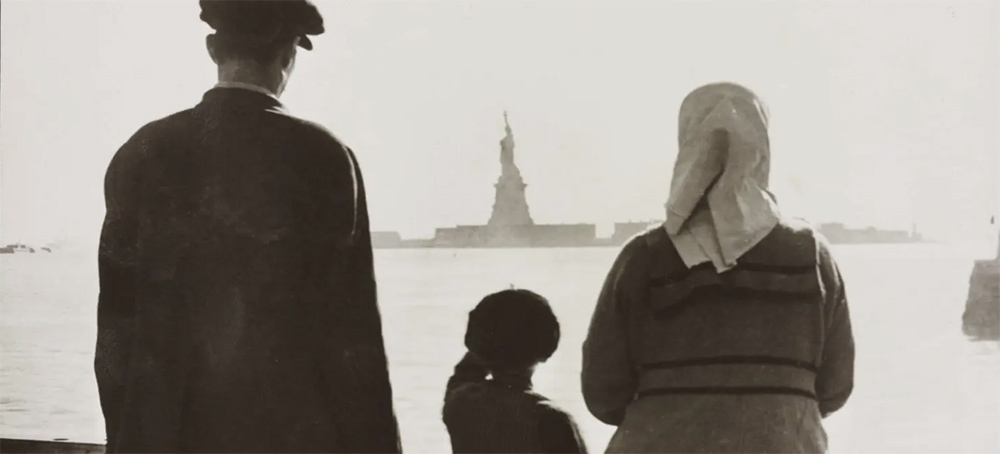 'The U.S. and the Holocaust' is Ken Burns's latest deep dive into America's past. (photo: Library of Congress/PBS)
“The U.S. and the Holocaust,” coming to PBS Sept. 18, examines the reasons behind the country’s inadequate response to Germany’s persecution of Jews.
So why would a six-hour film that offers fresh illuminations about America’s response to the Holocaust begin with such well-worn images? The answer is likely to surprise even those who know all about the arrest and eventual deaths of Anne, her sister and their mother. Their deaths, the documentary argues, were also a stain on the United States and the foundational myth of its benevolent open door for “huddled masses” of immigrants and refugees.
As recounted in “The U.S. and the Holocaust,” Ken Burns’s latest deep dive into America’s past, Otto Frank tried desperately to seek sanctuary in the U.S. for his family “only to find,” the narration says, “like countless others fleeing Nazism, that Americans did not want to let them in.” Seeing no other recourse, he arranged for the construction of the Franks’ ill-fated hide-out in Amsterdam.
Premiering on Sept. 18 and airing over three nights on PBS, “The U.S. and the Holocaust” aims to upend other longstanding historical assumptions as well, and also draw a thematic line connecting past tragedies and current struggles.
It highlights the racism and antisemitism that was laced through the nation’s purportedly democratic institutions and led to their inaction in response to Germany’s persecution of Jews. Modern footage points up how these failings stubbornly endure. This includes clips from the 2017 white-supremacist rallies at Charlottesville, Va., where marchers chanted “Jews will not replace us,” and the Jan. 6, 2021, attack on the Capitol, where rioters sported pro-Nazi emblems like a much-discussed Camp Auschwitz sweatshirt.
“It’s been very eerie to see the past echoing louder and louder throughout the time that we made the film,” said Lynn Novick, who co-directed and produced the film with Burns and Sarah Botstein.
The film also foregrounds parallels between America’s past and present hostilities toward immigrants and refugees.
“We remind people that it’s important that these impulses are not relegated to a past historical event,” Burns said in a telephone interview. “It’s important to understand the fragility of our institutions and the fragility of our civilized impulses.”
True, as the documentary chronicles, for a good portion of its history the U.S. took in millions of Irish fleeing famine, Jews fleeing pogroms and Italians fleeing poverty. But a fierce backlash against unrestricted immigration arose in the late 19th century abetted by a specious eugenics movement that downgraded entire nationalities and racial groups as potential pollutants of the American gene pool.
Lady Liberty’s golden door shut to Chinese laborers in 1882, then, with the watershed 1924 immigration act, to people from Eastern and Southern Europe and virtually all Asians. (A telling statistic: While 120,000 Jews immigrated in 1921, five years later the number dwindled to 10,000.) During World War II, first European refugees seeking to escape the murderous Nazi juggernaut were denied entry, then the skeletal survivors of the concentration camps.
Pieces of this story have been told in books, including David S. Wyman’s “The Abandonment of the Jews,” about the American government’s failure to rescue imperiled refugees; Daniel Okrent’s “The Guarded Gate,” about the genesis and impact of the 1924 immigration law; and David Nasaw’s “The Last Million,” about the treatment of displaced persons after the war. Burns and his team weave those threads into a seamless whole.
The story is enhanced by many trademarks of the Ken Burns aesthetic: haunting and substantiating film clips and photographs, plaintive music, lucid reflections from scholars, testimonies from engaging witnesses, personal letters read by actors like Meryl Streep. The erudite script was written by Geoffrey C. Ward.
The stories by survivors who were children in the 1930s are particularly poignant, told with an air of lingering disbelief that such horrors could happen in the 20th century.
Guy Stern, a 100-year-old scholar of German literature, recounts how, as a teenager, he was sent by his desperate German-Jewish parents to St. Louis, where he lived with an aunt and uncle while he searched for someone willing to sponsor the family’s entry into the country, a requirement of immigration laws at the time. The one person who agreed to put up the necessary $5,000 was a gambler, so immigration authorities rejected him as financially unstable. At the war’s end, Stern learned that his parents, brother and sister were deported to the Warsaw Ghetto and died there.
The filmmakers sought to emphasize the story’s ambiguities and complications, Burns said. For one thing, the U.S. let in more Jewish refugees than any other country — roughly 200,000 between 1933 and 1945 — the result partly of efforts by rule-benders like the journalist Varian Fry and the Swedish diplomat Raoul Wallenberg, whose clandestine dealings were financed by the War Refugee Board, under the direction of John W. Pehle.
The documentary, which was inspired by an exhibition on the same topic at the U.S. Holocaust Memorial Museum, also softens somewhat the unfavorable portrait of President Franklin D. Roosevelt drawn by many historians for having done little to rescue Jews and stop the slaughter.
Focusing on two of the better known critiques, it suggests Roosevelt was restrained from admitting the over 900 Jewish refugees on the passenger ship the MS St. Louis because of the quotas legislated by an immigration-resistant Congress. And drawing up plans to bomb the rail lines to Auschwitz would have been wasteful, one featured historian contends, because bombing was highly inaccurate and the Germans were able to replace damaged tracks overnight.
Despite pleas from his wife, Eleanor, and from Jewish leaders, Roosevelt chose to devote his attention to defeating the Axis.
“The U.S. and the Holocaust” undermines the frequently heard rationale that Americans in the 1930s did not know how ugly the persecution of Jews had become. It offers newsreels and newspaper headlines that trace how Americans saw or read about random attacks by Nazi thugs and punitive laws that targeted Jewish-owned business and denied Jewish citizens access to parks and theaters. It notes that the restrictions emulated Jim Crow race laws in the American South.
But the majority of Americans, encouraged by antisemitic voices like those of the radio preacher Father Charles Coughlin, the automobile magnate Henry Ford and the lionized aviator Charles Lindbergh, scarcely altered their views, even after Kristallnacht — the brutal “Night of Broken Glass” in 1938 — during which 1,400 synagogues were torched, hundreds of Jewish businesses ransacked and at least 91 were killed.
State Department mandarins, particularly Breckinridge Long, devised or rigorously enforced immigration hurdles that required letters from sponsors, exit visas and transit visas and payments of thousands of dollars. Even well-connected people like Otto Frank could not assemble all the paperwork in time.
In a video interview, Botstein noted that the survival of those who made it to America validated a well-known quote by the journalist Dorothy Thompson: “For thousands and thousands of people, a piece of paper with a stamp on it is the difference between life and death.”
Americans continued to oppose loosening immigration even as Hitler overran Europe and herded Jews into ghettos, then turned to systematic murder with so-called Einsatzgruppen — mobile killing squads — and human slaughterhouses like Treblinka.
The film includes a radio dispatch by Edward R. Murrow, from December 1942, that described the campaign in plain language. “What is happening is this,” he said. “Millions of human beings, most of them Jews, are being gathered up with ruthless efficiency and murdered.”
But such revelations failed to sway most Americans or their government. Two of every three of Europe’s estimated 9 million Jews would perish.
Even after the war ended and newsreels showcased American liberators stunned at encountering walking skeletons and piles of corpses, antisemites in the State Department and Congress continued to resist. As a result, tens of thousands of Jewish survivors idled in spartan displaced persons camps into the 1950s even as Nazi collaborators in Ukraine, Lithuania, Estonia and Latvia were admitted because they were considered dependably anti-Communist.
Making the film left its creators with feelings of both anger and sadness. Burns reflected on “all the symphonies that weren’t written, all the great literature that wasn’t written, all the children that weren’t raised right with love.”
Botstein is the daughter of Leon Botstein, the orchestral conductor and president of Bard College, whose parents lost most of their relatives in the war. She was surprised by “how little I knew or understood of the family history until I made this film.”
For the writer Daniel Mendelsohn, who appears in the film, the feelings were even more intimate. He tells the story of his great-uncle Shmiel Jäger, a butcher who in 1912 left his village of Bolechow, then in eastern Poland, for America along with Mendelsohn’s grandfather and other siblings. Disenchanted with the squalor of the Lower East Side, Jäger returned within a year. With the rise of antisemitism in the 1930s, Jäger sought to move back to the U.S. but there was by then a 10-year waiting list of Poles seeking visas, and Jäger, his wife, Ester, and four daughters got snared in the Nazi extermination maw.
“All those people you just saw — I would have known those people,” Mendelsohn said at an event to promote “The U.S. and the Holocaust,” referring to photos of his relatives that appeared in the documentary. “Some of them would have been alive today. And the reason they’re not alive is because the United States basically did its absolute utmost to make it as difficult as possible for Jewish refugees to escape the maelstrom that was engulfing them.”
 Jane Fonda. (photo: Getty Images)
"This is a very treatable cancer," the actress says. "80 percent of people survive, so I feel very lucky"
“So, my dear friends, I have something personal I want to share. I’ve been diagnosed with non-Hodgkin’s Lymphoma and have started chemo treatments,” she wrote. “This is a very treatable cancer. 80 percent of people survive, so I feel very lucky.”
She shared that she has been undergoing chemo for six months and is “handling the treatments quite well,” noting that she has no plans to let cancer slow down her or interfere with her climate activism.
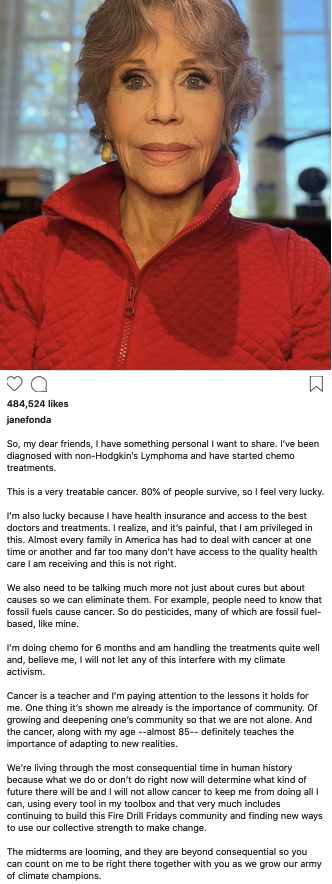
Fonda also went on to call herself “lucky” to “have health insurance and access to the best doctors and treatment,” acknowledging her “privilege” as a wealthy celebrity. “Almost every family in America has had to deal with cancer at one time or another and far too many don’t have access to the quality health care I am receiving and this is not right,” she continued.
Keeping her outlook positive, she said she is choosing to see cancer as a “teacher” and is “paying attention to the lessons it holds for me.”
“One thing it’s shown me already is the importance of community,” she wrote. “Of growing and deepening one’s community so that we are not alone. And the cancer, along with my age –almost 85– definitely teaches the importance of adapting to new realities.”
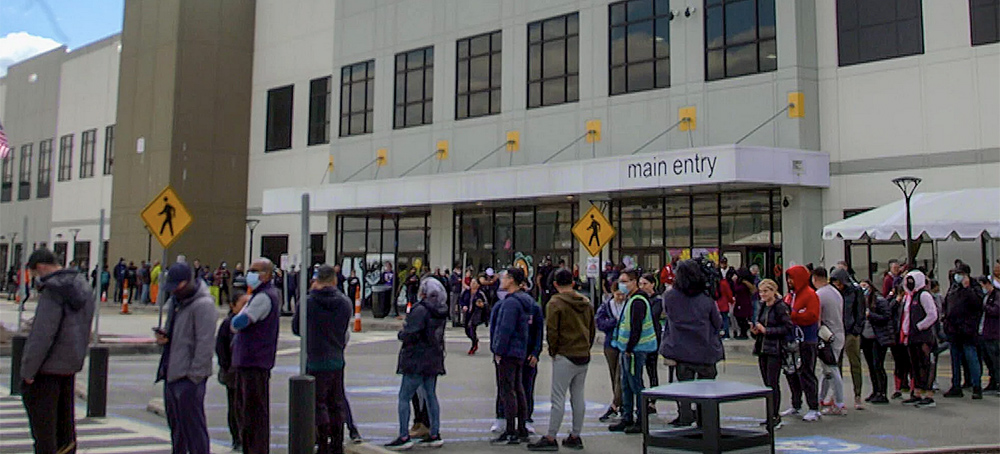 Workers line up to vote on unionization at Amazon's warehouse in Staten Island on March 25. (photo: Robert Bumsted/AP)
The decision is a victory for organizers in what could be a very long battle for recognition.
Shortly after the spring vote, in which workers at the warehouse known as JFK decisively won a union election in April, creating the first unionized Amazon facility in the U.S., the company filed more than two dozen objections with the National Labor Relations Board. In those filings, the mega-retailer claimed the election was tainted by organizers and Region 29, the agency's regional office in Brooklyn that oversaw the election. The case was then transferred to another regional office, based in Phoenix, Arizona, at Amazon's request.
The 24-day long hearing, which Amazon had unsuccessfully sought to close to the public, was marked by tense exchanges between attorneys for both sides on what documents could be submitted for evidence and which witnesses could testify.
On Thursday, Lisa Dunn, the agency officer who handled the company's case, concluded that Amazon's objections should be entirely overruled and the union be certified as a bargaining representative for the warehouse, a spokesperson for the NLRB wrote in an email.
"Employer has not met its burden of establishing that Region 29, the Petitioner, or any third parties have engaged in objectionable conduct affecting the results of the election," the spokesperson said, offering a summary of Dunn's recommendation.
Thursday's win is a relief for the Amazon Labor Union, the grassroots group of former and current workers whose unexpected victory in April followed weeks of aggressive campaigning from both sides.
"The people have spoken and it's time for amazon to recognize the Amazon Labor Union and negotiate a contract," Derrick Palmer, a leader of the Amazon Labor Union, said on Twitter.
Amazon spokesperson Kelly Nantel said the company plans to file another appeal.
"While we're still reviewing the decision, we strongly disagree with the conclusion and intend to appeal," Nantel said in a statement. "As we showed throughout the hearing with dozens of witnesses and hundreds of pages of documents, both the NLRB and the ALU improperly influenced the outcome of the election and we don't believe it represents what the majority of our team wants."
Amazon, the union and the agency's office in Brooklyn have until September 16 to file any exceptions to the report, which would send the case to the regional director, who will issue an order to either certify the election results or order a rerun vote. The company could still appeal that order to the five-person labor board, whose Democratic majority is expected to be sympathetic to the union.
Even when the agency upholds a union victory, experts say companies who don't want a unionized workforce often refuse to negotiate. That move can trigger protracted legal battles in federal court, which companies can use as a backdoor attempt to thwart labor victories.
Union loses separate election, dampening spirits
In May, the nascent union lost a separate election at a neighboring warehouse, which dampened enthusiasm elsewhere. At the same time, it was devoting more time and resources to defend its initial win from the e-commerce giant.
Other campaigns have kicked off at Amazon warehouses in North Carolina, Kentucky and elsewhere, as workers attempt to gather enough signatures to qualify for a union election. The Amazon Labor Union recently filed for an election at an Amazon warehouse near Albany, New York.
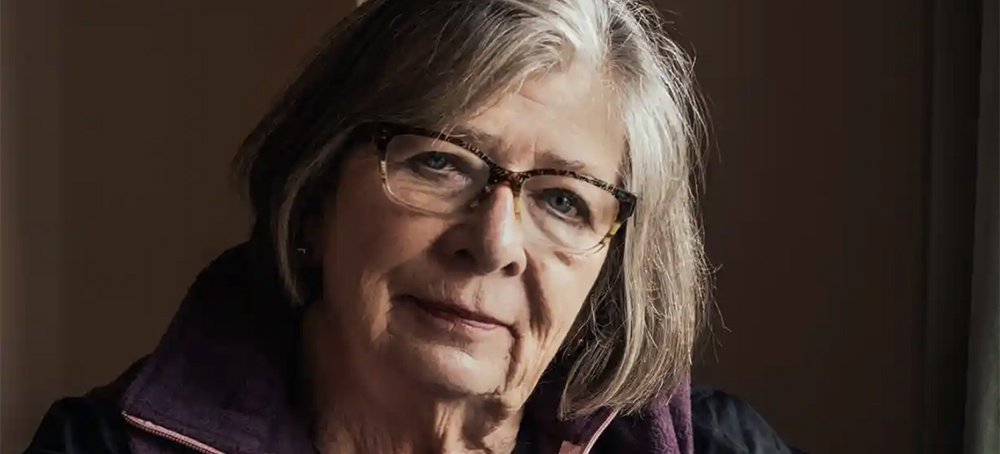 Barbara Ehrenreich in 2018. (photo: Stephen Voss/Guardian UK)
Writer of the 2001 bestseller Nickel and Dimed died on 1 September, her son announced
The news that Ehrenreich had died on 1 September was released by her son, Ben Ehrenreich, on Friday. He accompanied the announcement with a comment redolent of his mother’s spirit: “She was never much for thoughts and prayers, but you can honor her memory by loving one another, and by fighting like hell.”
Ehrenreich battled over a half a century as a writer committed to resisting injustice and giving a voice to those who were typically unheard.
Her first book, published in 1969, Long March, Short Spring, was an account of the student uprising against the Vietnam war.
In Nickel and Dimed: On (Not) Getting By in America, her 2001 bestseller, she wrote an immersive experience of living as a low-waged worker in Key West, Florida.
The book helped spread awareness of an economy in which it was necessary to work two or three jobs to survive, and acted as a catalyst of the minimum wage movement.
Later, she used her name and energy to try to give low-income and other disadvantaged groups a direct voice to tell their own stories.
She founded the Economic Hardship Reporting Project which supports independent journalists to write about their lives including in poor rural areas of the US.
Ehrenreich, who acquired a doctorate in cell biology before she turned to social activism and writing, was diagnosed in 2000 with breast cancer. She wrote an award-winning essay Welcome to Cancerland about the experience.
She brought her trademark clear-eyed reporting to the subject of her own mortality. In 2018 she published Natural Causes: An Epidemic of Wellness, the Certainty of Dying, and Killing Ourselves to Live Longer, in which she described coming to the realization that she had lived long enough to die.
“That thought had been forming in my mind for some time,” she told the Guardian at the time. “I really have no hard evidence about when exactly one gets old enough to die, but I notice in obituaries if the person is over 70 there’s not a big mystery, there’s no investigation called for. It’s usually not called tragic because we do die at some age. I found that rather refreshing.”
Announcing his mother’s death on Twitter, Ben Ehrenreich echoed that point. “She was, she made clear, ready to go,” he said.
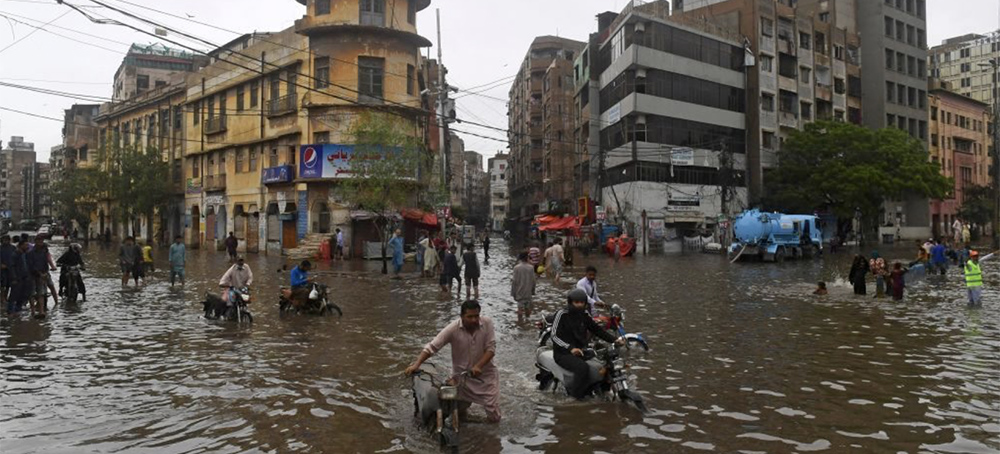 People wade across a flooded street after heavy monsoon rainfall in Karachi, Pakistan on July 25, 2022. (photo: Asif Hassan/AFP/Getty Images)
Monsoon rains and melting glaciers have driven tens of millions of Pakistanis from their homes. The disaster shows that the poor Global South populations who do least to cause climate change are the people who pay most for its consequences.
Both locally and internationally, remarkably little media coverage was given to the floods that began hitting Balochistan province in July. Instead, public discussion was dominated by the power struggle between ousted leader Imran Khan‘s party and the Pakistan Democratic Movement (PDM) coalition government — including the crucial by-elections in the Punjab province. In August, both sides began filing politically motivated cases against their opponents; the arrest of Shahbaz Gill, chief of staff in Khan’s Pakistan Tehreek-e-Insaf (PTI) party, further polarized the political landscape, with expectations of more showdowns in the coming weeks.
Yet while political commentators in Islamabad and abroad were busy reporting every detail of the political gossip generated in the center, faint cries of help began circulating on social media from people affected on the peripheries of Pakistan. Soon, floods began overwhelming areas in Sindh and south Punjab. The first time floods became the main headline on a Pakistani channel was August 23. By this time, more than twenty million people had already been affected, making it the worst natural disaster in the country’s recent history.
The media’s delayed response to the climate catastrophe is partly explained by the fact that the narrative around “natural disasters” does not easily offer a neat categorization of heroes and villains. This turns them into a tragedy that can invoke global pity but is unable to generate political contestation. Yet, politics really is at the heart of the tragedy today unfolding in Pakistan. It is thus imperative to nominate the villains responsible for the needless suffering of millions of people.
Erasure of Politics
The unprecedented monsoon rains (which followed an unprecedented heat wave across the country) that caused flooding in Pakistan are the predictable horrors of climate change, the result of a fossil-fueled political economy of capitalism. It is widely understood that colonialism and imperialism thwarted the development of poor countries, allowing the Global North to benefit from exploiting the former. According to economic historian Utsa Patnaik, the damage done to the Indian economy alone by the British equaled $45 trillion, thus creating islands of prosperity in the metropole while subjecting millions in the colonies to poverty, unemployment, and starvation.
This exploitative relation is exacerbated when we examine how greenhouse emissions in the Global North are leading to a climate breakdown, affecting countries that are not only vulnerable to climate change but also do not have the financial capacity for rehabilitation or building climate resilient infrastructure. For example, the Global North had already exceeded its share of safe emissions in 1939, almost eight decades before the current flooding we are witnessing.
Pakistan has not even used its fair share of safe emissions (since 1959, the country has contributed 0.4 percent to total greenhouse gasses) whereas countries in the Global North have exceeded their quotas by 90 percent. We also know that a hundred companies are responsible for 71 percent of emissions, while the top twenty polluters have caused one-third of greenhouse gasses in the atmosphere. The ghosts of the past are coming back to haunt those who played no role in nurturing them.
The time and spatial lag between the causes and effects of climate change is one of the primary reasons why it is easy for liberals to present such disasters as “humanitarian” issues, erasing the political roots of the tragedy. As Fredric Jameson reminds us, this amnesia is built into the logic of capitalism, as the accumulated exploitation of the past is deployed to control the present. But since this past is rendered invisible in the commodities exchanged on the market, it appears as if this exchange is equal. In other words, capitalism appears natural, but presupposes a history of violence and exploitation — a history that capital negates and suppresses in its own development.
The erasure, from public discourse, of polluters who are primarily responsible for the suffering of millions of people and for threatening planetary catastrophe, is itself part of this process of exploiting the time and spatial lag between greenhouse emissions and their deadly consequences. The result is an attempt to depoliticize this suffering and obstructing accountability of countries and companies in the Global North — giving the false impression that we are “all in this together” as one threatened human family.
The Debt Juggernaut
Pakistan was already dealing with a dire economic crisis when the floods hit the country. There was an acute balance of payment crisis when PDM ousted Khan’s government in April while the external debt was estimated at $28 billion. As the new government sought International Monetary Fund (IMF) assistance, one of the key demands of the financial institution was to end subsidies on oil and to increase tariffs on electricity consumption. As the PDM government capitulated to these demands, inflation reached up to 27 percent. While the poorest and the middle class were hit the hardest, elite privileges, which were estimated to be $17.4 billion in a United Nations Development Programme (UNDP) report, remained untouched. In other words, we witnessed a grotesque example of austerity for the poor but socialism for the rich.
In early August, the government announced another exorbitant increase in electricity tariffs, leading to spontaneous protests across the country. The government was then forced to reverse some terms of the hike due to public pressure, but the overall dismal living conditions continue to haunt ordinary citizens; 40 percent of deaths are due to waterborne diseases, around 40 percent of children are malnourished, and twenty million are deprived of schools. While the future looks bleak for the public, the IMF expects Pakistan to continue “restructuring” its economy in tune with market forces.
It is pertinent to remember that Pakistan’s debt has been used to fuel an elite-driven economy controlled by feudal elites, real estate tycoons, and military businesses. In fact, most of Pakistan’s loans were doled out to military dictators who played a key role as the strategic allies of the United States in the Cold War and the “war on terror.” Yet, it is the public that is forced to pay the price of US imperialism’s alliance with Pakistan’s ruling elites.
History’s Debt
Even before the floods, it was clear that Pakistan’s economy could no longer sustain the exorbitant taxes demanded by the IMF, particularly without touching the privileges of the elites. With floods that have caused over $10 billion in damages, it is clear that Pakistan will require unprecedented support from the world. It is perhaps also an ideal time to open debate on correcting historical wrongs, including cancellation of debt, as part of global efforts toward climate justice.
Fortunately, this demand is now gaining momentum in mainstream discussions. Many organizations, including the Committee for the Abolition of Illegitimate Debt, have long argued that loans acquired due to colonial plunder and military dictatorships must be declared “odious” and be canceled. Now, there are growing calls by activists, frontline communities, and academics to cancel debt as part of climate reparations for countries in the Global South. The Intergovernmental Panel on Climate Change has also accepted the role of colonialism in deepening global warming, further strengthening the case for reparations.
Activists in Pakistan are also demanding that creditors in the Global North cancel Pakistan’s debt, provide investment and technological transfer for building climate resilient infrastructure, and hold their fossil fuel companies responsible for polluting the planet. This is on top of the $100 billion dollars committed to poor countries in the Paris Accords, a commitment that has not been honored as yet. These demands should not be confused with a nationalist claim in which South and North become reified categories. Rather, as suggested earlier, the role of the ruling elites in Pakistan (and arguably across the Global South) in handling economic and climate issues has been dismal.
Instead, these demands are meant to be a point of departure for a politics that takes questions of historical injustice, imperialism, and capitalism seriously in order to create an alternative order. It can provide the glue that connects socialists in the Global North fighting militarism, jingoism, and fossil companies with socialists in the Global South who are fighting back the exploitative nexus between local elites, foreign countries, and international financial institutions. In other words, it is a call to begin a shared international project that presents a bold vision for the future rather than limiting the realm of possibilities to philanthropic endeavors.
Corporate greed and financial speculation have proven incompatible with the sustainability of life. The twin crisis of indebtedness and climate catastrophe in Pakistan gives us a blueprint for a dystopian future, but also provides an opportunity to change the course of history. No poor country can rebuild itself after facing the scale of destruction we have seen in Pakistan. Either this will lead to the intensification of walls, violence, and censorship as frontline communities become sacrifice zones for corporate greed and recklessness, or we will witness global solidarity where we assert our common humanity by redistributing resources and mitigating historical wrongs. Internationalism or apartheid are the options which the climate crisis presents to humanity. It is time we all choose a side.
Follow us on facebook and twitter!
PO Box 2043 / Citrus Heights, CA 95611


Comments
Post a Comment