RSN: Patience With Putin May Be Ebbing Among Friendlier Countries

23 September 22
Live on the homepage now!
Reader Supported News

Turkey, India and China respond cooly to news of planned referendums in Ukrainian regions occupied by Russia
Turkey, which has been at the centre of mediation between the west and Russia, issued a sharp rebuke, saying in a statement that it was concerned by attempts to stage unilateral referendums.
“Such illegitimate fait accomplis will not be recognised by the international community. On the contrary, they will complicate efforts to revitalise the diplomatic process and deepen instability,” the statement said.
“We renew our support to Ukraine’s territorial integrity, independence and sovereignty, which we have been emphasising since the illegal annexation of Crimea in 2014, and reiterate our readiness to extend all necessary support to resolve the ongoing war … through peaceful negotiations.”
At a briefing in New York, the Turkish president, Recep Tayyip Erdoğan, said he had always supported the territorial integrity of Ukraine.
Erdoğan appeared to have been blindsided by Vladimir Putin’s mobilisation of troops on Wednesday, given that he said in an interview with the US Public Broadcasting Service on Monday that he was under the impression that his Russian counterpart was in the mood to make concessions.
Reflecting on a recent discussion he had with Putin , he told PBS: “He is actually showing he is willing to end this as soon as possible. That was my impression because the way things are going is quite problematic.”
Erdoğan is not the first world leader to end a meeting with Putin with a misleading impression, but Turkey is also facing other pressures.
The country’s banks are under growing sanctions pressure from the US to decouple from Russia. Two private institutions, DenizBank and Isbank, suspended use of the Russian payment system Mir this week after Washington expanded its sanctions on Russia, including targeting the head of the entity that runs Mir. Turkey is never going to be cut off from Russia economically, but business as usual is over.
India’s prime minister, Narendra Modi, whom the the French president, Emmanuel Macron, praised lavishly this week for telling Putin to his face that this was not a time for war, is being urged to follow his comments up with concrete action.
There has been a lot of impatience with India’s refusal to take sides, or what Delhi likes to call juggling balls on a high wire. Jen Psaki, then the White House press secretary, urged the country in mid-March to reflect on “where you want to stand when history books are written at this moment in time”.
India’s external affairs minister, S Jaishankar only referred to Ukraine tangentially at a session at Columbia University this week, but suggested his country had reappraised its attitude toward the US.
“For almost 50 years, for various reasons – I’m not saying we were at fault, or the US was at fault – but the fact was we regarded the US with suspicion, with a lot of wariness,” he said. “It was a very substantive relationship, but the overall foreign policy assessment of the US was of deep caution, if not of deep suspicion.
“It has taken us a lot of effort to overcome the earlier assumptions in order to forge a different relationship with the US and one of the big differences which PM Modi has made … he has not carried ideological baggage, he’s not a person who is rooted in a certain worldview which makes you fundamentally distant from the US.”
That has been reflected in India’s approach to Ukraine, where it has taken small steps away from neutrality. It continually refers to honouring the UN charter, has condemned war crimes committed in Bucha and voted for the Ukrainian president, Volodymyr Zelenskiy, to be allowed to address the UN security council by video link.
China is a tougher nut to crack, and its often opaque statements are open to contradictory interpretations. It may still think its alliance with Russia is necessary to keep Washington in check, but the statements coming from the Chinese foreign ministry spokesperson this week hardly endorsed Putin’s gamble.
One former British foreign minister said Russia had retained deep links to countries around the world, with allies who were still willing to push back against the west and find reasons to excuse Moscow’s actions.
Of the neutral camp, he said: “I think they will extra hedge against a Russian defeat, so they should be open to western engagement. It is clear now Russia can’t win, but that is obviously not the same as losing.”
READ MORE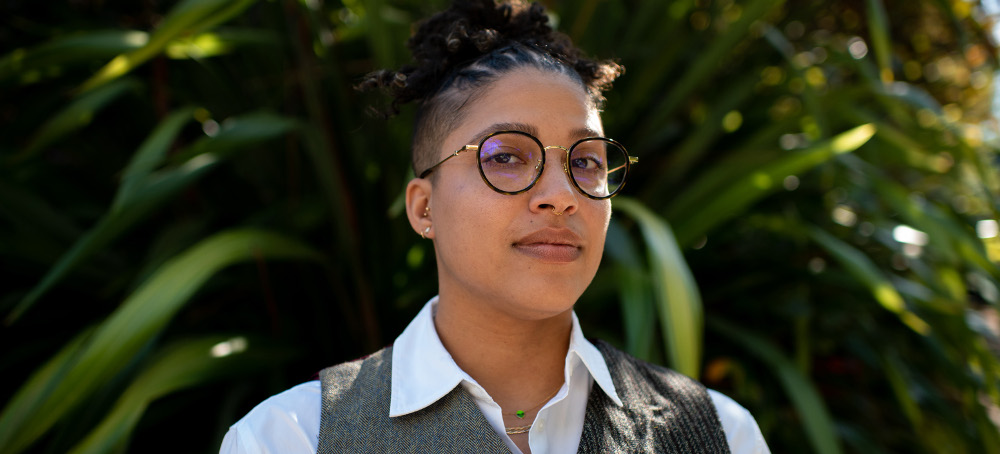 Navaroli, who was a policy official on the team designing Twitter's content moderation rules, testified to the House select committee investigating the Jan. 6, 2021 attack. (photo: Marlena Sloss/The Washington Post)
In an exclusive interview with The Washington Post, a former Twitter official explains what motivated her startling Jan. 6 committee testimony
Now, in an exclusive interview with The Washington Post, the whistleblower, Anika Collier Navaroli, reveals the terror she felt about coming forward and how eventually that fear was overcome by her worry that extremism and political disinformation on social media pose an “imminent threat not just to American democracy, but to the societal fabric of our planet.”
“I realize that by being who I am and doing what I’m doing, I’m opening myself and my family to extreme risk,” Navaroli said. “It’s terrifying. This has been one of the most isolating times of my life.”
“I wouldn’t be doing this if I didn’t believe the truth matters,” she said.
Twitter banned Trump two days after the Jan. 6, 2021, attack on the U.S. Capitol, citing fears he could incite further violence. By that time, he had sent more than 56,000 tweets over 12 years, many of which included lies and baseless accusations about election fraud. One month earlier, he had tweeted, “Big protest in D.C. on January 6th. Be there, will be wild!”
Navaroli, a former policy official on the team designing Twitter’s content-moderation rules, testified to the committee that the ban came only after Twitter executives had for months rebuffed her calls for stronger action against Trump’s account. Only after the Capitol riot, which left five dead and hundreds injured, did Twitter move to close his 88 million follower account.
Tech companies traditionally require employees to sign broad nondisclosure agreements that restrict them from speaking about their work. Navaroli was not able to speak in detail about her time at Twitter, said her attorney, Alexis Ronickher, with the Washington law firm Katz Banks Kumin, who joined in the interview.
But Navaroli told The Post that she has sat for multiple interviews with congressional investigators to candidly discuss the company’s actions. A comprehensive report that could include full transcripts of her revelations is expected to be released this year.
“There’s a lot still left to say,” she said.
Navaroli is the most prominent Twitter insider known to have challenged the tech giant’s conduct toward Trump in the years before the Capitol riot. Now in her 30s and living in California, she worries that speaking up about her role inside Twitter on Jan. 6 could lead to threats or real-world harm.
Committee member Rep. Jamie B. Raskin (D-Md.) cited those concerns to explain why Navaroli’s voice had been distorted to protect her identity in the segment of her testimony played during a nationally televised hearing in July. Raskin unveiled her name in a tweet Thursday, thanking her for her “courageous testimony” and “for answering the call of the Committee and your country.”
“She has constantly had to say to herself: This is important for the world to know, but it can compromise my safety. And she continually makes the patriotic choice,” Ronickher said. “The folks who do come forward and are willing to take these risks make such an impact for the rest of us.”
The hearings, which have been watched by millions, are expected to resume next week. The committee’s chairman, Rep. Bennie G. Thompson (D-Miss.), said Tuesday that the hearing could feature “significant witness testimony that we haven’t used in other hearings.”
Twitter for years dismissed calls to suspend Trump’s account for posts that many people argued broke its rules against deceptive claims and harassment; as a political leader, Twitter executives argued, Trump’s tweets were too newsworthy to remove.
But if Trump had been “any other user on Twitter,” Navaroli told the committee, “he would have been permanently suspended a very long time ago.”
The banning has helped fuel a conflict over tech companies’ rules that is likely to be settled in the Supreme Court. More than 100 bills have been proposed in state legislatures that would regulate social media platforms’ content moderation policies, and on Wednesday, Florida asked the Supreme Court to determine whether the First Amendment prevents states from doing so.
Twitter executives have argued that Navaroli’s testimony leaves out the “unprecedented steps” the company took to respond to threats during the 2020 election. The company said it worked to limit the reach of violent extremist groups and ban accounts from organizers of the Capitol riots.
The company is “clear-eyed about our role in the broader information ecosystem,” Jessica Herrera-Flanigan, Twitter’s vice president of public policy for the Americas, said in a statement Thursday.
A Trump representative did not respond to a request for comment Thursday.
In the interview with The Post, Navaroli, who is Black, said she still remembers the first time she thought about the constant conflict between Americans’ rights of safety and free expression. She was a middle-school student, walking with her mother to a Publix grocery store near their home in Florida, when a man swerved his truck onto the sidewalk toward them, shouting racial slurs and demanding they go back to where they came from.
After the police arrived, she said, the officers refused to file charges, saying that no one had been hit and that his speech had been protected by the First Amendment.
“It was the first time I was understanding my identity could cause someone to … try to murder me,” Navaroli said. “And I was being told this man that tried to kill me did nothing wrong because this was his constitutional right. It didn’t make sense. So for a lot of my career and a lot of my life, I have been trying to understand this interpretation of this amendment and this right in a way that makes sense.”
In high school, she said, she became fascinated by constitutional questions in her debate class, which simulated mock congressional hearings — one of which took her, for the first time, to Washington, where years later she would sit and give congressional testimony.
In the years afterward, she graduated from the University of North Carolina’s law school and got her master’s degree at Columbia University, where in 2013 she wrote a thesis titled “The Revolution will be Tweeted” on how constitutional legal principles had expanded to social media.
She later helped study issues of race and fairness with a technology research group in New York, worked on media and internet privacy campaigns for the civil rights advocacy group Color of Change, and taught basic principles of constitutional law to high school students in Harlem.
As the power and prominence of social media expanded during those years, she said she grew fascinated with how online content moderation rules were helping shape real-world social movements, from the inequality campaigns of Occupy Wall Street to the protests over racial justice and police brutality.
She had a strong bias for protecting speech, she said, but she often questioned where some companies were drawing the lines around speech and privacy and what effect that could have on people’s lives.
“Regulating speech is hard, and we need to come in with more nuanced ideas and proposals. There’s got to be a balance of free expression and safety,” she said. “But we also have to ask: Whose speech are we protecting at the expense of whose safety? And whose safety are we protecting at the expense of whose speech?”
By 2020, Navaroli was working on a Twitter policy team helping the company design rules for one of the internet’s most prominent gathering places for news and political debate, according to congressional testimony revealed this summer.
By then, Trump had become Twitter’s inescapable force, capturing global attention and news cycles with a constant stream of self-congratulatory boasts and angry tirades.
Starting in 2011, he used the site as a major propellent for the racist “birther” claim that former president Barack Obama was born in Kenya. In one 2014 tweet, Trump asked cybercriminals to “please hack Obama’s college records (destroyed?) and check ‘place of birth.’ ”
During the 2016 campaign, his jotted-off insults helped undermine his critics and sink his political rivals as he captured the Republican nomination and then the presidency. And once in the White House, his tweets became a constant source of surprise and anxiety for even his own administration.
He used Twitter to fire people and belittle America’s geopolitical antagonists, including tweeting in 2018 to North Korean leader Kim Jong Un that “I too have a Nuclear Button.” He also used it to announce sweeping executive actions, including his (failed) push to ban transgender people from the military. “Major policy announcements should not be made via Twitter,” the late Sen. John McCain (R-Ariz.) said then.
Navaroli had argued that Twitter was acting too reluctantly to hold Trump to the same rules as everyone else and, by 2020, she had begun to worry that the company’s failure to act could lead to violent ends, she told congressional investigators.
After Trump told the Proud Boys, a far-right group with a history of violence, at a September 2020 presidential debate to “stand back and stand by,” Navaroli pushed for the company to adopt a stricter policy around calls to incitement.
Trump “was speaking directly to extremist organizations and giving them directives,” she told the committee. “We had not seen that sort of direct communication before, and that concerned me.”
She had also seen how his tweets were quickly sparking replies from other accounts calling for “civil war.” After Trump’s “will be wild” tweet in December, she said, “it became clear not only were these individuals ready and willing, but the leader of their cause was asking them to join him in … fighting for this cause in D.C. on January 6th.”
The company, however, declined to take action, she told the committee. She pleaded with managers, she said, to face the “reality that … if we made no intervention into what I saw occurring, people were going to die.”
On Jan. 5, 2021, as pro-Trump forums lit up with excitement about the coming day, she said she was deeply unnerved by the company’s failure to take stronger action against messages from “a violent crowd that was locked and loaded,” she told congressional investigators. She said she wrote that night in an internal Slack message, “When people are shooting each other tomorrow, I will try and rest in the knowledge that we tried.”
On Jan. 6, Trump resisted calls for hours to calm the mob after it had stormed into the Capitol. At 2:24 p.m., Trump tweeted that his then-vice president, Mike Pence, whom members of the mob had been calling to be hanged, “didn’t have the courage to do what should have been done.”
At 2:38 p.m., hours after the riots had started, he acknowledged them for the first time, tweeting, “Stay peaceful!” Later that evening, following a brutal skirmish between rioters and the police, Trump tweeted, “These are the things and events that happen when a sacred landslide election victory is so unceremoniously … viciously stripped away from great patriots … Remember this day forever!”
Twitter suspended Trump’s account that evening for 12 hours, but he continued tweeting the next day, even as some Twitter employees began receiving threats. Five people died on the day of the insurrection or in the immediate aftermath, and 140 police officers were assaulted.
On Jan. 8, Trump tweeted that the “great American Patriots who voted for me … will not be disrespected or treated unfairly in any way, shape or form!!!” In his final tweet, at 10:44 a.m., Trump said he would not be attending President Biden’s inauguration.
Twitter’s decision to “permanently suspend” Trump that day followed internal deliberations and emergency meetings. In a statement that evening, Twitter said his tweets could be used to “incite violence” and showed that he planned to “support, empower, and shield those who believe he won the election.”
But in philosophical tweets after Trump’s ban, Twitter’s then-chief executive, Jack Dorsey, expressed some reservations about having to take Trump’s megaphone away. These actions “fragment the public conversation,” he wrote, and “limit the potential for clarification, redemption, and learning.”
Navaroli said she is still broadly hopeful about the internet’s “amazing” ability to connect people, but she worries companies are still struggling to “find the right interventions and levers” around online expression that won’t “lead us to this dystopian future I see ahead.”
“I’ve just really wanted to do my job well,” she said. “This is what I do.”
The Jan. 6 committee’s announcement Thursday follows months of questions about her identity. Her name and details of her work have been fiercely guarded by the committee, which has said its work could lead to criminal referrals of Trump over his role in the attack.
Navaroli left Twitter last year and is now researching the impact of hate-speech moderation through a fellowship at Stanford University. She said she hopes the testimony she gave the committee will help inspire more Silicon Valley insiders to speak publicly about their companies’ failures to fight viral misinformation and extremist speech.
“My fear within the American context is that we have seen our last peaceful transition of power,” Navaroli said. But “the same playbook,” she added, is being used around the world, “teeing up the idea that if an election is not in someone’s favor, it’s been rigged. Without intervention we really are on this path to catastrophe.”
READ MORE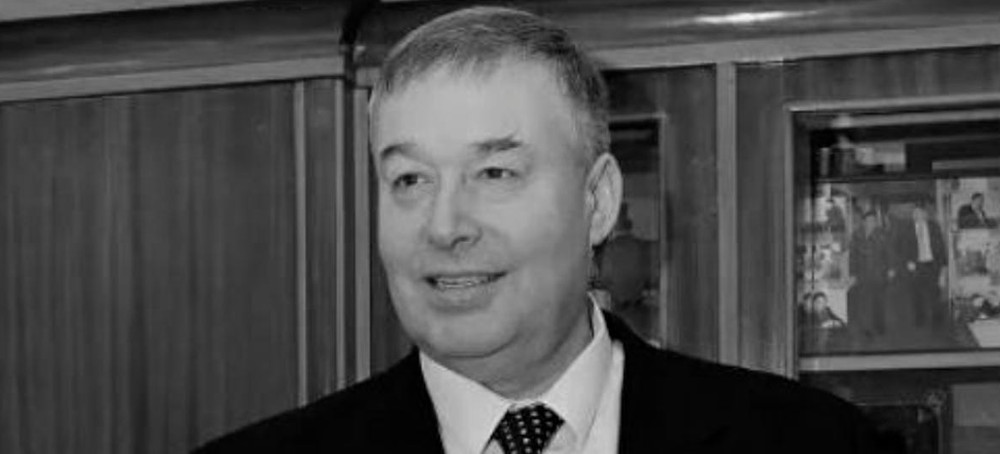 Anatoly Gerashchenko, the former rector of the Moscow Aviation Institute. (photo: Moscow Aviation Institute)
The Moscow Aviation Institute (MAI) university announced the death of Anatoly Gerashchenko, 72, saying he died "as a result of an accident."
An unnamed source told Russian newspaper Izvestia that he died on the university's grounds, by falling "from a great height" down several flights of stairs.
Gerashchenko was the institute's rector until 2015, and at the time of his death was acting as an adviser to the current rector, according to Russian state-controlled news service RIA Novosti.
He had received multiple top state accolades, including a first-class Order of Merit for the Fatherland, the institute said.
The institute, calling it a "colossal loss," said that it would launch an investigation into the death, involving representatives from MAI, the Russian Ministry of Education and Science, and the State Labor Inspectorate in Moscow.
The university develops several technologies with military applications — such as AI, drones, avionics and aerospace research — and has ties with Russia's Ministry of Defense.
Gerashchenko's death comes as part of a string of deaths of highly-placed Russian figures in the Kremlin's orbit, particularly those connected to the technology and energy sectors.
On September 13, the body of Ivan Pechorin washed up more than 100 miles from where he had fallen off a speeding boat in Vladivostok three days earlier. Pechorin headed up aviation for Russia's Far East and Arctic Development Corporation, and had recently spoken at a conference where Putin gave the keynote address.
The corporation also lost its CEO, 43-year-old Igor Nosov, who died of a stroke in February.
Energy executive Ravil Maganov, 67, died after he "fell out of the window" of a hospital on September 1, according to a source cited by the state-controlled news agency Interfax.
Maganov's company, Lukoil, is one of Russia's major energy providers, and six months earlier had taken the highly unusual step of criticizing the war in Ukraine.
Another of Lukoil's former executives, Alexander Subbotin, was found dead of what state media called an apparent heart attack at the premises of a Moscow shaman in May.
Prior to that,a further five executives or bosses — most of whom had links to the energy industry — have died in suspicious circumstances since the beginning of the year.
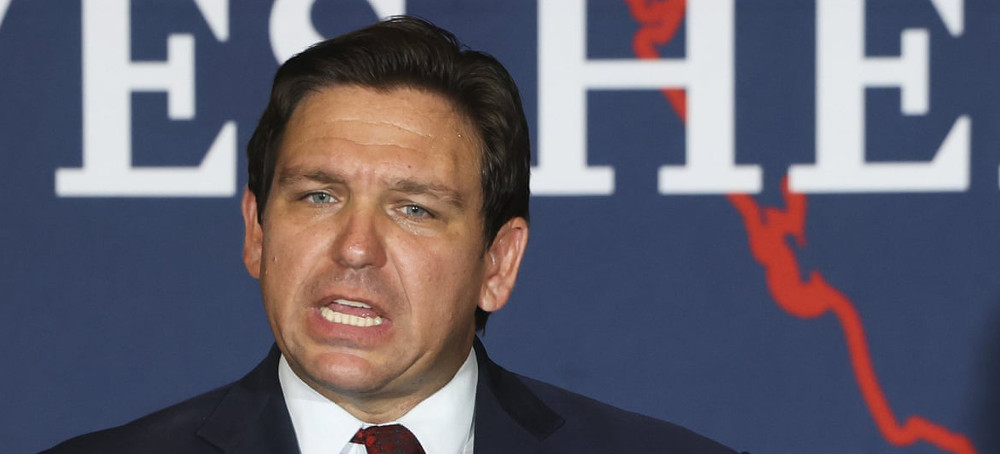 It's a clear warning that, as president, Ron DeSantis would view the rule of law as a principle that is expendable when political expediency calls. (photo: Luis Santana/AP)
The Florida governor’s use of vulnerable migrants as props is disgusting and criminal
The Florida governor, Ron DeSantis, took this despicable practice of using vulnerable men, women and children as political props to a new low this week when he paid for two planeloads of Venezuelan migrants to be sent to Martha’s Vineyard, Massachusetts. As has been reported, the Venezuelans that DeSantis paid to transport were actually recruited by a co-conspirator in San Antonio, Texas, not in Florida. As reported, this co-conspirator, “Perla”, promised the migrants transportation to Boston and expedited work permits. All of it was a lie.
Various news entities have described DeSantis as engaging in a “stunt”. That characterization is a troubling understatement of the gravity of DeSantis’s conduct.
The truth is that DeSantis – apparently unconcerned about the immorality of his actions – and those conspiring with him appear to have acted criminally under Texas law. Title 5, section 20 of the Texas penal code defines the crime of unlawful restraint. Under the statute, a person is restrained if their movement is restricted without their consent by, among other means, moving the person from one place to another. Restraint is without consent “if it is accompanied … by deception”. Under the statute, the violation is a class A misdemeanor, unless the person restrained is younger than 17, in which case it is a felony. According to reporting, there were children among those criminally transported to Martha’s Vineyard.
That’s not to say that DeSantis and other Republican governors have not violated a host of other state or federal laws by deceptively transporting migrants across the country.
Some have called for Merrick Garland to open an investigation. The US attorney general should. Unfortunately, while describing DeSantis’s conduct as shameless, the White House refused to commit to a thorough investigation of the abduction of the Venezuelan migrants, the violation of their civil rights and whether DeSantis, the Texas governor, Greg Abbott, and Arizona governor, Doug Ducey, acted unconstitutionally by interfering with the federal government’s authority to manage immigration.
The Texas state attorney with jurisdiction should also open an investigation and impanel a grand jury. The fact that DeSantis is the governor of a sister state is no defense for breaking the law in Texas. And while they are at it, they should investigate whether Governor Abbott engaged in any similar deceit or other illegal conduct. He is also not above the law. The same is true for state attorneys in other affected states.
And where are the Republicans who only recently were asking that Venezuelan migrants in the United States have their temporary protected status extended? The hypocritical silence of figures like Marco Rubio is deafening.
Finally, for all the Democrats who are so afraid of the immigration issue, this is not about whether one supports or opposes this or that immigration policy. Like Donald Trump’s family separation policy, this issue runs much deeper. It’s about inhumane and illegal conduct toward vulnerable people that is an affront to the values of every decent human being.
Progressives owe the country – which endured four years of lawlessness under Trump – to tell the truth about Ron DeSantis, an aspirant to the highest office in the land. He has demonstrated that, like Trump, he is willing to break the law to gain political power.
What DeSantis did is not a political “stunt”. It’s a clear warning that, as president, he, like his Republican predecessor, would view the rule of law as a principle that is expendable when political expediency calls. And it’s a crime. He should be prosecuted for it.
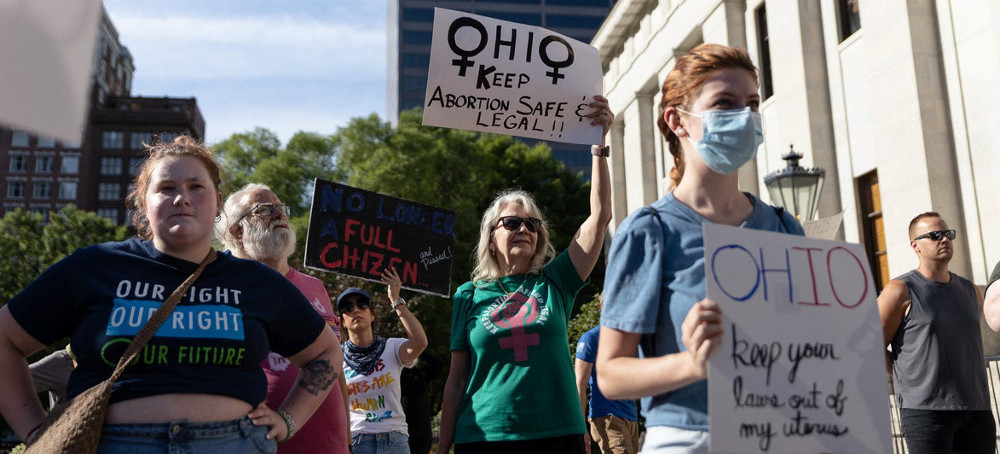 Ohio changed its abortion laws hours after Roe v. Wade was overturned. Now, two more children are forced to travel out of Ohio for abortions after being raped. (photo: Megan Jelinger/Reuters)
In some instances, cancer patients who were denied treatment because of their pregnancies were also unable to receive abortions, an affidavit alleges
The accounts, first reported on by the Ohio Capital-Journal, have emerged more than three months after the case of a 10-year-old Ohio sexual assault victim made national headlines when it was revealed she had to travel to Indiana to get an abortion. The Indianapolis Star reported that the girl was six weeks and three days pregnant and couldn’t get an abortion due to the state’s Heartbeat Law, which prevents medical staff from performing the procedure if a heartbeat is found.
The law was signed in 2019 by Ohio Attorney General Dave Yost but only came into effect when the landmark Roe v Wade was overturned in July by the Supreme Court. Now, medical officials have attested in court filings to the catastrophic effects of the Heartbeat Law on women seeking abortions, especially on at least two other minors who were sexually assaulted and had to travel out of state to terminate their pregnancies.
Doctors also brought up cases in which women who were denied abortions later attempted suicide. In some instances, cancer patients who were denied treatment because of their pregnancies were also unable to receive abortions, the affidavit stated.
Although the Heartbeat Law allows health professionals to perform abortions in cases of medical emergencies and when the life of the mother is in danger, the exceptions are not thoroughly explained and could lead to criminal penalties and licences being revoked, oftentimes leaving staff stuck in a dilemma.
The affidavits were filed in the ongoing case between reproductive health clinic Preterm-Cleveland and the attorney general.
According to the Ohio Capital-Journal’s report, more than 600 abortion appointments had to be cancelled in the aftermath of the Roe v Wade overruling.
“We have had at least three patients threaten to commit suicide. Another patient said she would attempt to terminate her pregnancy by drinking bleach,” medical director of Planned Parenthood Southwest Ohio Sharon Liner said in one of the affidavits, the Ohio Capital-Journal reported.
“Another asked how much Vitamin C she would need to take to terminate her pregnancy.”
In one of the cases, a minor travelled to Michigan to access abortion care, which “further exacerbated [her trauma] by needing to wait over three weeks for her appointment.”
“In each step of this process, she felt the complete denial of bodily autonomy and safety, something all people, especially children, should unequivocally have at all times,” read the affidavit by Adarsh E Krishen, chief medical officer for Planned Parenthood of Greater Ohio, according to the Ohio Capital-Journal report.
An operation manager at a women’s health centre in Dayton also filed an affidavit stating that a 16-year-old had to travel to Indianapolis, Indiana, to get an abortion after she was raped by a family member.
“I am concerned that Ohio’s ban and the need to travel increasingly far distances to obtain abortion care not only causes unimaginable harm to these young victims, but could also hamper law enforcement’s ability to investigate and prosecute these cases in the future,” Aeran Trick wrote in his affidavit.
The Heartbeat Law has been temporarily halted for the second time by a county judge — this time the provision will last until mid-October, and abortions before the 20-gestational-week mark will be allowed.
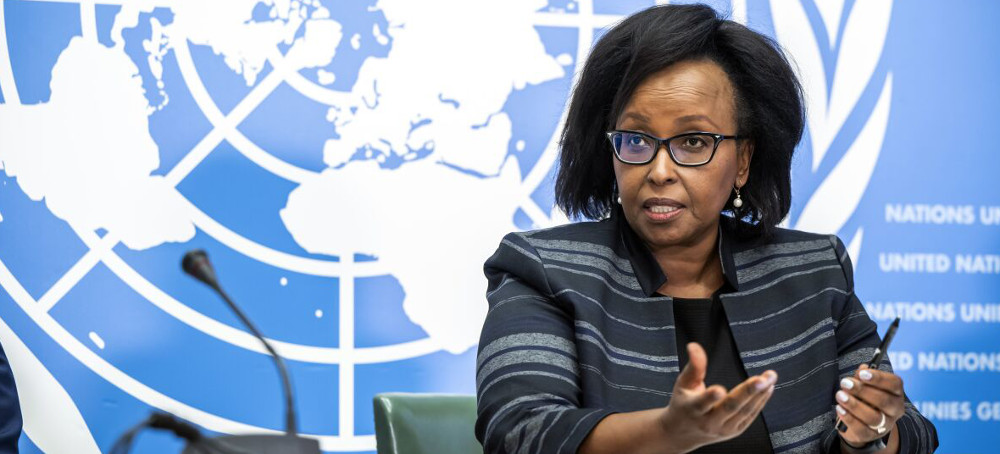 Kaari Betty Murungi, Chair of the International Commission of Human Rights Experts on Ethiopia, speaks about the presentation of the first report of the International Commission of Human Rights Experts on Ethiopia during a press conference at the European headquarters of the United Nations in Geneva, Switzerland, Thursday, Sept. 22, 2022. (photo: Martial Trezzini/AP)
The Commission of Inquiry on Ethiopia, which is working under a mandate from the U.N.'s Human Rights Council, attributed a litany of war crimes on all sides, but said the government forces of Ethiopia had also resorted to “starvation of civilians” as a tool of war. It also said both Ethiopian and Eritrean forces were found to be responsible for “sexual slavery” — while Tigray forces were not.
After a cease-fire ended last month "the fighting seems to be escalating, and we have received credible information that there is an escalation in drone attacks which are employing explosive weapons with wide-area effects in populated areas,” said commission chair Kaari Betty Murungi.
“The consequences of this new renewed war has potential to affect not just the stability of Ethiopia, but of the entire Horn of Africa region,” she told reporters.
Murungi was presenting details of an initial report based on interviews with 185 survivors, witnesses and others, as well as other sources. The team was not granted access to Ethiopia.
The findings, in a recent report, shed new light on widely-chronicled moves by the federal government to deny access to basic services including telecommunications, banking and access to humanitarian aid to the population of Tigray during the fighting.
“We also made findings relating to very — really barbaric — attacks by use of rape and other acts of sexual violence that was committed by parties to the conflict that include (Ethiopia's military forces), but also to the Tigray forces," Murungi said.
The report cited “reasonable grounds to believe” that the Ethiopian government had committed the crimes against humanity of murder, torture, rape and sexual violence, and that both it and allied regional state governments continue to commit crimes against humanity on ethnic grounds and “other inhumane acts” designed to cause suffering or injury.
The Ethiopian government has rejected the report, Murungi said, because it believed the team exceeded its mandate.
Eritrean forces fought on the side of Ethiopian federal troops in Tigray when war started in November 2020, and have been implicated in some of the worst atrocities committed in the conflict — charges they deny. On Wednesday, Tigrayan authorities said Eritrea has launched a full-scale offensive along its border with northern Ethiopia, in an apparent escalation of fighting.
Tens of thousands of people are believed to have been killed and millions displaced in Ethiopia's Tigray, Amhara and Afar regions.
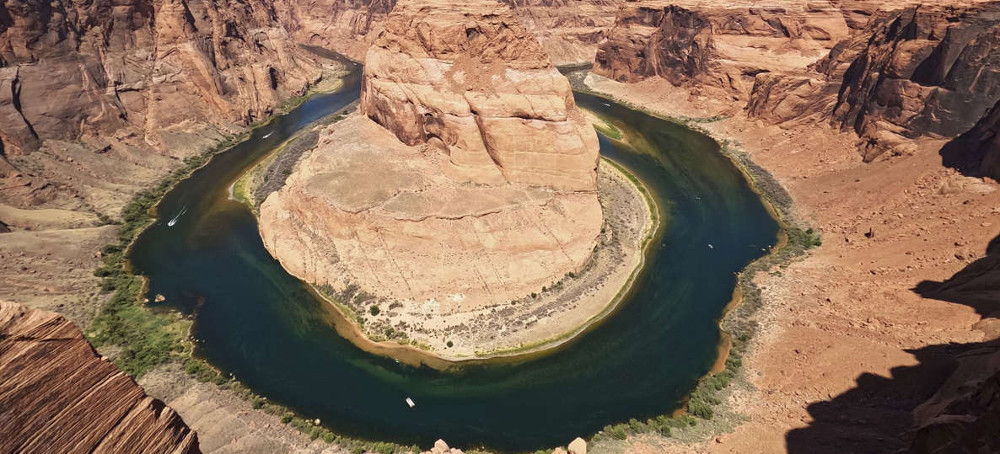 The Colorado River at Horseshoe Bend in the Glen Canyon National Recreation Area on June 8, near Page, Arizona. (photo: Brittany Peterson/AP)
An epic drought in the West is drying up the river. But that’s only part of the story.
The river’s flow is down by about 20 percent, compared to the 1900s, and the two largest reservoirs it feeds are less than a third full. The water in Lake Mead, the nation’s biggest reservoir, has dropped more than 150 feet in the last two decades, leaving little water for the more than 40 million people who depend on the river.
Part of the reason why the Colorado River is shrinking is the dwindling amount of snow and rain. The West is in its 23rd year of drought, which research suggests could be the driest period in the last 1,200 years, made worse by climate change.
Then there is the sheer number of cities and farms that are sucking down water. About three-quarters of all water that humans consume from the Colorado River goes toward irrigating farms, which, among other things, supply nearly all of the nation’s winter veggies.
But a key reason why the Colorado River is running out of water has more to do with math than anything — bad math.
One hundred years ago, government officials divvied up water in the Colorado River among the seven states that rely on it including Arizona, California, Colorado, Nevada, New Mexico, Utah, and Wyoming. The agreement, known as the Colorado River Compact, was based on one critically important number: the total amount of water that the Colorado River can supply yearly.
Ignoring the best science of the time, officials claimed the river could provide about 20 million acre-feet per year (an acre-foot is the amount of water needed to fill an acre with one foot of water), according to the 2021 book Science Be Dammed: How Ignoring Inconvenient Science Drained the Colorado River. That number was way too high, the authors write, meaning that officials promised states water that simply didn’t exist.
“They had conjured up a larger Colorado River than nature could actually provide,” wrote authors Eric Kuhn, a retired water official, and John Fleck, a writer and former director of the University of New Mexico’s Water Resources Program. “The twenty-first century’s problems on the river are the inevitable result of critical decisions made by water managers and politicians who ignored the science available at the time.”
I spoke to co-author John Fleck about how officials in the past miscalculated so badly, and where we go now. Our conversation has been edited for length and clarity.
How much water is left in the Colorado River?
Benji Jones
For anyone not following what’s happening with the Colorado River, catch us up: How much water has the river lost and how close is it to drying out?
John Fleck
Twenty years ago, the big reservoirs that hold most of the river’s water were close to full. But two decades of drought, amplified by climate change — combined with the fact that we’re continuing to use a whole lot of water — have largely emptied the reservoirs.
We’ve reached the point where the reservoirs are no less than a third full in terms of the available water supply that we might use. We’re at the danger point.
Benji Jones
You’re talking about the reservoirs Lake Powell and Lake Mead?
John Fleck
There’s also a cluster of other reservoirs that help support the operation. But yes, it’s mainly Lake Powell and Lake Mead, the two biggest reservoirs in the nation. They have the ability to store five times the river’s annual flow, which we burned through in the last 20 years.
Benji Jones
Are there parts of the river that are totally dry, where you could see, say, cracked earth?
John Fleck
Yes, and this was a stunning revelation for me. The very bottom of the river, where it leaves the United States and enters Mexico, used to be this vast delta — wild and wet and full of beavers and marshes and estuaries. But the river now stops at a place called Morelos Dam, on the US-Mexico border.
Downstream from the dam there’s a little trickle of water that’s maybe 10 to 15 feet wide, and then it peters out into the sand. Then you just have dry riverbed. That’s because we’ve taken all the water out of the river upstream to use in our cities and farms.
Benji Jones
The Bureau of Reclamation, the federal agency that manages water in the US, has announced cuts related to the level of water in the reservoirs, known as Tier 1 and 2 shortages. How does that work?
John Fleck
Over the last 15 years, river managers have faced a looming problem: We’ve been taking more water out of the river than it can provide. So they negotiated a series of agreements that say if, for example, Lake Mead drops to a certain level, there’ll be cutbacks. If it drops even more, the cutbacks will get bigger.
Those cutbacks are now kicking in. But what we’ve since realized is that the cutbacks weren’t made soon enough and they weren’t deep enough, so the bottom is dropping out.
Bad math and ignoring science helped dry the river out
Benji Jones
How did we get here? There’s climate change and drought. But you write about some historical oversights. What happened?
John Fleck
In the early 20th century, the US Geological Survey sent out this guy named Eugene Clyde LaRue to try and measure the Colorado River. LaRue started to see that, beyond the time horizon that we’d been measuring the river so far [a couple of recent decades], there were some really big droughts. He concluded in a 1916 report that the river is subject to big droughts on timescales of 10-to-20 to 50-to-100 years. It doesn’t just stay wet.
The negotiators of the Colorado River Compact — the foundational document for figuring out how to divide up the river and decide who gets what — needed this information. They needed science. But they came together to figure this out without LaRue. They sidelined him. They ignored his science that said there’s been big droughts.
Instead, the negotiators looked at a much more recent period [of time] that had been extraordinarily and unusually wet. They said the river’s got plenty of water to build all these farms and to build all these cities. They just ignored the science because it was inconvenient.
Benji Jones
Why was it so inconvenient to be realistic about the amount of water in the river?
John Fleck
The promise of a lot of water made the political deal-making easier. You could divide up the river and say to each of the seven states: “You want to irrigate a whole bunch of acres? Plenty for you. You want to pump a bunch of water across the desert of California? Plenty for you.” You didn’t have to have hard conversations about what life under limitation was going to be like.
Benji Jones
How big was the difference between what LaRue measured and what the negotiators ultimately used to divvy up the river’s water in the 1922 Colorado River Compact?
John Fleck
Negotiators believed — and negotiated a deal that said — there was as much as 20 million acre-feet flowing from the river each year. LaRue’s estimate was closer to 15 million. Today, we know it’s 12 million. But that’s the climate change world. It was a big gap.
Benji Jones
Is that gap ultimately why we’re in this position today? Basically, 100 years ago, regulators over-allocated water of the Colorado River, based on faulty numbers?
John Fleck
Yes. You have communities across the West who made good-faith decisions to build cities, farms, canals, and dams based on what they thought was a promise of water. They were told that there was enough water. That turns out to have been bogus.
Then, during the drought of the 1930s, and during the drought of the 1950s, it became clear that LaRue had been right [about how much less water there is]. People who are still trying to insist on their “paper” water allocations [based on the compact] are making the same mistake that the compact negotiators made 100 years ago.
Cities have learned to use less water — but there’s still not enough
Benji Jones
Are regulators now taking into account what science says about the river?
John Fleck
I would like to just say yes. There’s a whole bunch of people in the system who understand the importance of using the best available science. My favorite example of this is Las Vegas, Nevada, and the Southern Nevada Water Authority, which really has been taking climate change seriously.
The difficulty is at the political interface. It is difficult for a hypothetical governor to go before their voters and provide them with bad news about water. What a governor really needs to say is: “We have a lot less water, we have to change.”
[The 100-year-old Colorado River Compact, wrong numbers and all, is still the primary agreement upon which management of the Colorado River is based.]
Benji Jones
How about communities and cities along the river? Are users getting realistic about how much water they can consume?
John Fleck
Different communities approach risk differently.
Big cities tend to be the most realistic. It’s hard to find a major city in the West that has not gone to enormous lengths to invest in the necessary conservation programs. Almost every major metropolitan area that depends on the river’s water is seeing their total water use go down, even as their populations rise.
Agricultural communities face a harder time because, really, the only thing you can do to use less water is to farm less. So you’re asking them to give up both a portion of their economic livelihood and also their cultural identity as farmers.
Even though most communities can adapt to use less, they’re afraid they can’t. That fear leads to this winner-take-all, fight-over-water approach rather than collaboration. That’s why we have not been able to reduce our use fast enough to halt the decline of reservoirs.
Benji Jones
Is demand for water increasing? I’ve always thought that was a problem, too.
John Fleck
It’s actually not. Water use is going down. The upper part of the Colorado River Basin is, on paper, entitled to 7.5 million acre-feet a year. That was always an unrealistically large number. After building out all our projects by the late 1980s, the water use there has been relatively stable at around 4 million [acre-feet per year], though it fluctuates wildly year to year.
If you look at the lower Colorado River Basin, water use peaked in 2002, and has been steadily declining. There’s been substantial reductions in a couple of the major agricultural areas. The Imperial Irrigation District of California is the largest farm district and their use has dropped dramatically. Urban use has also been going down. We’ve seen water use decoupled from population growth.
Who loses when the water runs out
Benji Jones
Earlier this summer, the Bureau of Reclamation asked the seven states that depend on the river to cut an additional 2-4 million acre-feet per year. How much water is that and how disruptive will it be?
John Fleck
That’s between one-sixth and one-third of the average annual flow of the Colorado River right now. It’s a lot of water.
What we mean when we say “the flow of the river” depends on which period of time you’re looking at, because it’s constantly varying. When I say, “one-sixth to one-third,” that’s of the river’s flow in the 21st century, when we’ve been experiencing drought and climate change.
There’s going to be a really big disruption, and it’s going to happen one of two ways. Districts and states could figure out now how to come up with those 2-4 million acre-feet, voluntarily, working from the bottom up. Or the disruption is going to come within a year — or two or three — when the reservoirs are just freaking empty. Those are the two options.
The lovely third option is we have a few years of monstrous snowpack [melting snow in the spring feeds the river]. I’m not beyond hoping for that third option.
Benji Jones
Who will suffer the most as cuts continue?
John Fleck
The most important set of users is tribal communities who were promised water by the nation when we were busy stealing their land. We haven’t given it to them yet. Even the language I use is problematic. It’s not about giving them water that’s ours but acknowledging that this water was theirs to begin with.
There are tribes who don’t have their water allocations — or who have water allocations but not the federal largess to use it in the same way as all the Anglo communities, like my own. It’s a significant issue across large parts of the basin.
Then there’s the environment. Long ago, we decided that we didn’t care about the environment, but now, as a society, our values are shifting. So figuring out how to claw back some of that water for the environment is one of the really big challenges.
Benji Jones
What is your most brilliant solution for solving this water shortage?
John Fleck
I always punt on this question. It doesn’t matter what I think and it doesn’t matter what I say. For a solution to be effective, it has to emerge from the people who are using water themselves. What I can do is make clear the scope and the scale of the problem. You can’t impose solutions on people. It just doesn’t work.
Follow us on facebook and twitter!
PO Box 2043 / Citrus Heights, CA 95611


Comments
Post a Comment