RSN: Paul Krugman | The Nightmare After Gorbachev

05 September 22
Live on the homepage now!
Reader Supported News

What I’ve been reading has placed less emphasis on the economic failures of post-Gorbachev Russia. Yet those failures were spectacular and surely helped pave the way for Putinism. So let’s talk about how badly things went wrong in the 1990s.
First, some background: Nowadays everyone views the old Soviet Union, with its centrally planned economy, as an abject failure. But it didn’t always look that way. Indeed, in the 1950s, and even into the 1960s, many people around the world saw Soviet economic development as a success story; a backward nation had transformed itself into a major world power. (Killing millions in the process, but who’s counting?) As late as 1970, the Soviet Union’s success in converging toward Western levels of wealth seemed second only to Japan’s.
Nor was this a statistical mirage. If nothing else, Soviet performance during World War II demonstrated that its industrial growth under Joseph Stalin had been very real.
After 1970, however, the Soviet growth story fell apart, and by some measures technological progress came to a standstill.
Economic stagnation may not fully explain the rise of Gorbachev. But the increasingly obvious failure of centrally planned economics surely helped set the stage for reform. The Soviet Union crumbled; Russia turned away from socialism and toward a market economy.
And the results were disastrous.
I don’t know if it’s widely appreciated just how poorly the Russian economy performed during the Boris Yeltsin years. But the numbers are sobering. Real gross domestic product per capita fell more than 40 percent:
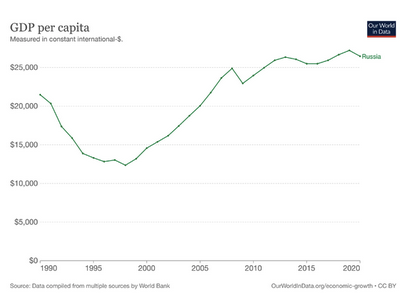
That’s substantially worse than America’s decline during the worst of the Great Depression:

In the early 1990s, Russia also suffered from extreme inflation, reaching a peak of more than 2,000 percent at an annual rate. No, I didn’t accidentally add extra zeros:
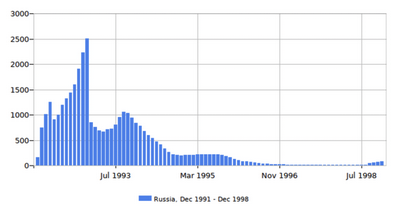
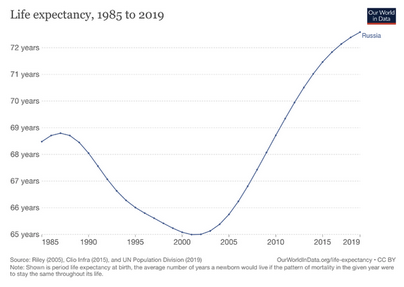
I’ve seen some suggestions that the economic plunge in Russia and other formerly planned economies wasn’t as bad as the numbers say, because statistics from the Communist era, when the economy may have been producing a lot of stuff nobody actually wanted, may have inflated the true level of output. But there’s plenty of other evidence for a collapse in living standards. Among other things, there was a plunge in life expectancy:
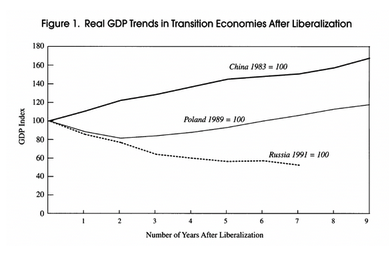
Nor can we say that these short-run costs were an inevitable consequence of the transition from socialism to capitalism. As a 2001 I.M.F. paper pointed out, Russia’s performance after liberalization was far worse than that of other “transition” economies:
So what went wrong? There were intense debates about that issue in the late 1990s and early 2000s, which as far as I can tell never reached a consensus; then everyone moved on to other issues. But there were a few plausible stories, not mutually exclusive. They include the following:
- At first, Russia only moved partially to a market economy, and the partial privatization wasn’t systematic. The result was an awkward mix of government and private enterprise that was the worst of both worlds.
- Where it did privatize, Russia did so without the institutions — things like security regulation, rules against predatory behavior and general rule of law — a market economy needs to function.
- Haphazard privatization created a proliferation of monopolies, whose efforts to extract as much as possible from everyone else turned them into the modern equivalent of robber barons — the old barons, not Gilded Age industrialists — who hobbled commerce across the board.
- Chaotic privatization also created a class of oligarchs, men with vast, unearned wealth. “Property is theft!” declared the anarchist Pierre-Joseph Proudhon; well, in Yeltsin’s Russia, much of it really was. And the power of the oligarchs surely distorted economic policy.
How much did each of these factors contribute to the post-Gorbachev economic disaster? I don’t know, and suspect few, if any, other people do either. But Russia in the 1990s clearly offers an object lesson in how not to transition to a market economy.
The problems of the 1990s culminated in a financial crisis in 1998. After that, the Russian economy finally stabilized and resumed growth; unfortunately, it did so under the leadership of a guy named Vladimir Putin. It’s doubtful whether economic recovery required the fall of democracy, but that’s how it worked out.
This story may not be over. (Are such stories ever over?) I hope, of course, that Ukraine will defeat this invasion; if it does, one large part of the former Soviet Union may finally have achieved a durable democracy. And it’s possible to imagine a democratic Ukraine growing increasingly integrated with the European economy, showing a way to combine democracy with prosperity.
But that’s for the future. The sad historical truth is that Gorbachev’s political legacy was, to an important degree, poisoned by Russia’s economic failure.
 Conservative Republicans in Congress are seeking to clear a path for a constitutional convention. (photo: Haiyun Jiang/NYT)
A new book by a former Democratic senator warns of the risks of allowing states to call for a convention. Some in the G.O.P. see it as the only way to rein in the federal government.
“I think the states are due a convention,” said Mr. Arrington, who in July introduced legislation to direct the archivist of the United States to tally applications for a convention from state legislatures and compel Congress to schedule a gathering when enough states have petitioned for one. “It is time to rally the states and rein in Washington responsibly.”
To Russ Feingold, the former Democratic senator from Wisconsin and president of the American Constitution Society, a liberal judicial group, that is a terrible idea. Mr. Feingold sees the prospect of a constitutional convention as an exceptionally dangerous threat from the right and suggests it is closer to reality than most people realize as Republicans push to retake control of Congress in November’s midterm elections.
“We are very concerned that the Congress, if it becomes Republican, will call a convention,” said Mr. Feingold, the co-author of a new book warning of the risks of a convention called “The Constitution in Jeopardy.”
“This could gut our Constitution,” Mr. Feingold said in an interview. “There needs to be real concern and attention about what they might do. We are putting out the alert.”
While the rise of election deniers, new voting restrictions and other electoral maneuvering get most of the attention, Mr. Feingold rates the prospect of a second constitutional convention as just as grave a threat to democratic governance.
“If you think this is democracy’s moment of truth, this is one of those things,” he said.
Elements on the right have for years been waging a quiet but concerted campaign to convene a gathering to consider changes to the Constitution. They hope to take advantage of a never-used aspect of Article V, which says in part that Congress, “on the application of the legislatures of two-thirds of the several states, shall call a convention for proposing amendments.”
Throughout the nation’s history, 27 changes have been made to the Constitution by another grindingly arduous route, with amendments originating in Congress subject to ratification by the states.
With sharp partisanship making that path near impossible, backers of the convention idea now hope to harness the power of Republican-controlled state legislatures to petition Congress and force a convention they see as a way to strip away power from Washington and impose new fiscal restraints, at a minimum.
“We need to channel the energy to restore and reclaim this country’s traditional values and founding principles of limited government closest to the people and individual freedom and responsibility,” Rick Santorum, the former Republican senator from Pennsylvania who has become a convention champion, told a conservative conference this spring in the state.
Mr. Santorum was pushing for Pennsylvania to become the 20th state to formally call for a convention in recent years, out of the 34 states required. But it is not clear exactly how many states have weighed in, since not all have adopted the same language and some petitions were submitted decades or longer ago and may even have been rescinded.
Mr. Arrington believes that when pending petitions are fully tallied, the 34-state goal might already have been exceeded. His legislation would require the archivist to “authenticate, count and publish” applications by the states, forcing Congress to act.
“The problem is that they haven’t had a ministerial, clerical mechanism for the archivist to keep a count and report to Congress,” Mr. Arrington said. “I do believe we have crossed that threshold, and it is not congressional discretion — it is a constitutional mandate — that Congress should pick a date and a place for the convention.”
Like others, the proposal by Mr. Arrington, a deficit hawk who hopes to become Budget Committee chairman next year, would seek to confine the convention to consideration of fiscal matters to serve as a check on federal spending and taxation.
But Mr. Feingold and his co-author, the constitutional scholar Peter Prindiville, say the problem is that there is no certainty that the convention could be forced to stick to a defined agenda. They say that a “runaway” proceeding would be a distinct possibility, with delegates seizing the opportunity to promote wholesale changes in the founding document and veer into areas where they would seek to restrict federal power governing the environment, education and health care, among other issues.
“A convention by its very definition is a free-standing, distinct constitutional body,” Mr. Prindiville said. “It would be the ultimate high-risk gathering.”
They say that the reliance on language calling it a “convention of the states” is misleading — “ahistoric” in the view of Mr. Feingold and the book, which lays out the history behind Article V and previous attempts to invoke it.
“Despite convention proponents’ claims of legal certainty, the most important questions about how a convening held under Article V would be called and how it would function are unsettled,” the authors write in the book. “The framers left no rules. In this uncertainty lies great danger and, possibly, great power.”
What also worries the authors is that the leading proponents of the convention idea come from the right and include representatives of the Tea Party movement, the Federalist Society, grass-roots right-wing activists and figures allied with former President Donald J. Trump such as John Eastman, the lawyer who wrote a memo for Mr. Trump outlining how he could seek to overturn the 2020 election.
But support and opposition for a convention do not break completely along partisan lines. Some Republicans have resisted appeals at the state level to pass resolutions in support of a convention, worried that such a gathering could open the door to a weakening of the Second Amendment and a rollback of gun rights.
And some liberals have welcomed the idea of a convention as a way to modernize the Constitution and win changes in the makeup and power of the Supreme Court, ensure abortion rights, impose campaign finance limits and find ways to approach 21st-century problems such as climate change.
“There are smart people and a few on the progressive side who are willing to roll the dice,” Mr. Feingold said. “For me, it is crazy to take the chance.”
Mr. Arrington said he saw the fears of a runaway convention as overblown and noted that even if the gathering were to arrive at a set of contentious changes, they would still require approval by 38 states — a daunting task in itself. He said his hope was that the threat of a convention could force Washington to get more serious about fiscal responsibility.
“Ultimately, just having the conversation, having it become more real in the minds of Congress, I hope will light a fire,” he said.
Mr. Feingold and Mr. Prindiville say they hope the prospect of a convention engineered by conservatives sparks a different kind of fire — one aimed at finding a better way of altering the Constitution to meet the contemporary moment.
While a convention is a bad idea, they say, accepting that the Constitution remains chiseled in stone is almost as troubling. They argue for a discussion on new ways to move forward with constitutional change.
“The time has come to begin a serious national conversation regarding the future of the Constitution in American public life,” their book says. “We must reclaim the founding generation’s belief in bloodless revolution, reforming Article V to provide an amendment procedure fit for a modern, democratic society.”
 The infamous Wagner Group, which some have called Vladimir Putin’s 'private army.' (photo: Luis G. Rendon/The Daily Beast/Getty Images)
Witnesses are pointing a finger at the Wagner Group over a series of gruesome killings that allegedly involved disemboweling several women.
While having a conversation with a female friend under a mango tree about 50 meters away from his home, and having a good view of his compound from where they both stood in the western CAR village of Bèzèrè, the 32-year-old said he watched from afar as about a dozen Russian paramilitaries, who appeared from nowhere, dragged the wives of two of his neighbors out of the compound, stabbed them in their abdomen and then disemboweled the two women.
“The women were screaming and begging for mercy,” Ali, who now lives as a refugee in Cameroon, told The Daily Beast. “The white soldiers [as many in CAR refer to Wagner mercenaries as] didn’t listen. They killed the women and removed their stomach and intestines.”
The incident, according to Ali and another witness, occurred on Dec. 6 last year. They said at least six other women in Bèzèrè were killed in the same manner across the village.
“As I was leaving the village, I saw the body of a woman who was pregnant,” Malik Tete, a 29-year-old bricklayer who fled Bèzèrè to Cameroon after the incident, told The Daily Beast. “They had cut her open, removed her baby and her intestines and left them on top of her dead body.”
Following the violence in Bèzèrè, thousands of people, according to Ali and Tete, fled the village to Bocaranga, about 27 kilometers southeast of Bèzèrè. Many others, including the witnesses, sought refuge in settlements for refugees in the eastern part of Cameroon.
“We were scared that these white soldiers would return and kill all of us, so we had to leave the village,” said Ali, who fled to Ngaoundere town in the central Adamawa region of Cameroon. “If we didn’t run away, we probably would have been dead by now.”
It wasn’t only in Bèzèrè that women were said to have been slaughtered by the Russians last December. In the nearby Létélé community, locals told The Daily Beast that they found the disemboweled bodies of four women lying dead in different locations on the day Russian mercenaries stormed the village in search of rebels from the Return, Reclamation, Rehabilitation (3R) group.
“I saw with my eyes when a white soldier stabbed a woman with a knife on her belly,” Bissafi, a 30-year-old farmer now living in CAR's capital city of Bangui, told The Daily Beast. “They said she was being punished for marrying a man working for a rebel group.”
Given the manner in which the victims were allegedly killed, the Russians “clearly wanted to torture the women to death,” said Sylvestre, who—like other witnesses residing in CAR—The Daily Beast is choosing to identify by his first name to protect him from possible retribution.
Those who recognized some of the alleged victims in both Bèzèrè and Létélé said they were women residing in areas in the two villages where rebels of the 3R faction, one of CAR’s most powerful armed groups—which presents itself as a self-defense militia—have been active.
“They [Russian mercenaries] believe all the men in the areas where 3R rebels are present are part of the rebel group,” Souleyman, a local vigilante in Létélé, told The Daily Beast. “Each time they meet people from these areas, they accuse them of supporting the rebels and even physically attack them.”
Some of the victims, according to Souleyman, who has been in touch with their families as well as persons who witnessed the killings, are wives of young men accused of being “too friendly” with 3R militants.
Made up of mostly Muslim cattle herders, the 3R group was originally formed in 2015 to protect the minority Puehl population in northwestern CAR, where conflicts with farmers are common. In December 2020, the group joined the Coalition of Patriots for Change (CPC), an alliance of CAR’s armed groups that began an offensive just before the country’s presidential election to stop the re-election of President Faustin Archange Touadéra and overthrow his government. The rebels constantly target CAR forces and allied Russian paramilitaries who, in response, have been conducting a counter-offensive against the militants. But, as a number of locals have alleged, the Russians may now be taking war to civilians who live in the exact communities where these rebels operate.
“It is sad that they [Russian mercenaries] are now targeting our women,” Djibril, a Bèzèrè-born artisanal miner based in the southwestern city of Berbérati, told The Daily Beast. “I know two people whose wives were brutally killed in December by these [Russian] soldiers.”
Neither the CAR government nor Yevgeny Prigozhin, a close friend of President Vladimir Putin who reportedly runs the Wagner Group, responded to The Daily Beast’s request for comments on the alleged disemboweling of women in Bèzèrè and Létélé. Emails sent to the spokesperson of CAR’s Ministry of Communication and Media and to Concord Management, a company majority-owned by Prigozhin, went unanswered.
A local official in Ouham Prefecture, which covers Bèzèrè and Létélé, told The Daily Beast the prefecture’s government was aware of the alleged incidents in the two areas and had informed authorities in Bangui about them.
“No one [in Bangui] has even condemned what was done to the women in the communities involved,” said the official who spoke on condition of anonymity as he wasn’t authorized to speak on the subject. “This is so unfortunate.”
There have been reports of Russian-linked forces targeting women in CAR before now. In May, The Daily Beast reported how Wagner mercenaries allegedly stormed a hospital in the capital Bangui the previous month and attacked mothers recovering from childbirth, as well as medical personnel looking after them, on multiple occasions. One of the victims, according to a local independent news outlet which spoke to an eyewitness, was allegedly sexually assaulted for hours by the mercenaries.
Sources who spoke to The Daily Beast about the alleged incidents said they were appalled that the victims may not even be related to those whose crimes they were being punished for.
“Watching helpless women beg for their lives and seeing them slaughtered like animals is the worst thing a man can do to a fellow human being,” said Ali. “I have no words to describe what these [Russian] soldiers have done.”
 Britain's Prime Minister-elect Liz Truss pledged to deliver on a range of issues after being named the new Conservative Party leader on Monday. Truss will be the U.K.'s third female prime minister, following Margaret Thatcher and Theresa May. (photo: Adrian Dennis/AFP/Getty Images)
Britain's Conservative Party has announced its new leader is Liz Truss, who has served as foreign minister for the past 12 months. She will be formally appointed as the next prime minister by Queen Elizabeth, likely on Tuesday afternoon.
The result follows a nationwide vote by the party's grassroots members that lasted several weeks this summer. Truss will become the country's fourth leader in a politically turbulent six-year period.
It marks only the third time in history that a woman will assume power in 10 Downing Street, but the third time in recent years that a change of prime minister has occurred without a national general election.
"We will deliver, we will deliver, and we will deliver," Truss said, echoing a key campaign theme. "And we will deliver a great victory for the Conservative Party in 2024" — when the next national elections are slated to be held.
Truss replaces Boris Johnson, who was laid low by a succession of scandals that crescendoed in the first half of this year. After losing support of not only the majority of his fellow Conservative legislators, but also many of his own ministers, he was forced to resign.
Truss spent the summer campaigning against Rishi Sunak, the U.K.'s former finance minister who was her rival for the Conservative leadership. The contest was decided by the votes of almost 142,000 party members. Truss secured more than 81,000 of those votes, the lowest proportion of any leader in recent history.
Johnson has continued to serve as a caretaker leader for the past few months, and he is expected to meet with the monarch in Scotland on Tuesday to tender his official resignation.
As new leader, Truss will likely make a statement outside 10 Downing Street later Tuesday. She will immediately face responsibility for a rapidly escalating energy crisis in Britain, with both consumers and companies facing record high gas and electricity costs thanks to the war in Ukraine, and the corresponding rise in inflation threatening to tip the country into a major recession.
Truss, who had already been dubbed "PM in waiting" by one British newspaper, said in an interview with the BBC this weekend that she will formulate proposals to combat this economic challenge within days, and is aiming to "act immediately."
Earlier in the leadership contest, Truss did not command as much support among fellow Conservative legislators as her opponent Sunak. And even though Sunak has promised to support a new government even if he is not leader, political analysts have said it will be difficult for Truss to unify her divided Conservatives, who still enjoy a sizable majority in the country's parliament — thanks, ironically, to Johnson's huge success as a campaigner during the last national elections.
At the announcement, the party's co-chairman, Andrew Stevenson, said the long, drawn-out contest this summer — involving the two "fantastic" candidates fielding hundreds of questions from tens of thousands of members — showed that the party remained "in good voice and good strength." He also drew a long round of applause when he thanked Johnson, who "rose to the challenge and delivered," throughout the COVID-19 pandemic and more recently the conflict in Ukraine. Truss also thanked Johnson, describing him as a friend who was "admired from Kyiv to Carlisle."
Before announcing the result, Sir Graham Brady, who oversees the committee of Conservative legislators responsible for selecting a new leader, said the ballot had been "free and fair," thanked the party members and all candidates, and said both Truss and Sunak were "outstanding" and had run "excellent campaigns."
 A pedestrian passes the Longwood Avenue exterior of the Boston Children's Hospital. (photo: Lane Turner/Boston Globe/Getty Images)
 The high price of gas, food and rent is straining students' access to higher education. (photo: Keith Birmingham/The Orange County Register/AP)
Several state university systems, including those in California, Hawaii, Massachusetts and New Jersey, are offering students free bus passes, gas cards and clothes.
“One of our students stood up and said. … ‘I live off campus. I can’t afford food some days,’” Artis said in an interview.
About a dozen more of the football players at the historically Black college in South Carolina — half community college transfers and half first-time freshmen who live off campus — also said they were food insecure. While their rent is cheaper because they can split it with as many as five roommates, Artis said, it also means they have other expenses like utilities, groceries and transportation — all which saw stark increases from inflation.
The high price of gas, food and rent is straining students’ access to higher education. In response, institutions like Benedict College are using the infusion of one-time federal Covid relief dollars, grants and philanthropy to ramp up offerings of free clothes, financial aid and other necessities to keep lower-income students on track to earn degrees. But with that cash running out, it’s leaving some college leaders worried about how they’ll sustain many of the programs they’ve built to act as a lifeline for their students.
“We’re seeing colleges across the country take on a variety of supports for students to help them enroll or stay enrolled in college,” Carrie Warick-Smith, vice president of public policy at the Association of Community College Trustees, said in an interview. “Campuses are providing services such as food pantries, help applying for [Supplemental Nutrition Assistance Program] benefits, housing partnerships, textbook exchanges and in some cases, even offering tuition freezes.”
In Pennsylvania, first lady Frances Wolf and acting Secretary of Education Eric Hagarty announced a Hunger-Free Campus Initiative in August to help food-insecure students access free meals on college campuses across the state. Several states and their university systems, including California, Hawaii, Massachusetts and New Jersey, are working on solutions to ensure their students’ needs are met. Some institutions are also giving students free bus passes and gas cards to get to campus.
These programs will be crucial to student success, experts say, especially as the class of 2022’s federal student aid application completion rate — an early indicator of how many first-time freshmen could be headed to college this fall — was 4.6 percent higher than the year prior. The uptick was driven by an application boost from those enrolled in both low-income and public schools with large populations of Black and brown students, which faced the largest application declines during the pandemic.
“Our population, which is overwhelmingly low-wealth, first-generation kids of color, tend to get hit harder when there are challenges, whether it was Covid-19 or now the economic downturn,” Artis said. “So when you see spikes in gas prices, you see inflationary increases in groceries and food, it really hits these kids pretty hard.”
Inflation challenges
Inflation has been exacerbating the cost for students, said Jessie Hernández-Reyes, a policy analyst for the nonprofit The Education Trust, which advocates for equity in education, especially when it comes to the cost of food, rent and tuition.
“It’s making it more difficult for students to figure out how they’re going to get to class every day when they’re struggling to figure out if they’re going to have their next meal or where to live,” she said.
Expanding nutrition benefits has been key to meeting students’ needs, Hernández-Reyes said, and several states, including Virginia and California, have passed state laws to expand eligibility requirements so more students can access SNAP. When it comes to housing, institutions are trying to make room for more students by incentivizing local alumni to house students and turning conference areas or local hotel areas into temporary dorms, she said.
The Education Trust has been advocating for access to SNAP benefits to be expanded, including when it comes to the employment requirements. Students enrolled more than half-time are ineligible for SNAP, unless they meet an exemption, including working at least 20 hours a week, and meet all other SNAP eligibility requirements.
“It’s one of the many barriers that students have to face,” she said. “Often students may not meet one of those exemptions. And that makes it difficult for them to meet the eligibility requirements.”
Despite the intent of these programs, for low-income and Black and brown students, barriers like verification of their income and their parents’ income can get in the way. Many students at Benedict College, Artis said, have received free and reduced lunch “their entire school lives, and now between June of their 12th grade year and August, when they start college, we want them to prove they’re poor?”
“We look at an 8-year-old boy who’s hungry and we all start to open up,” she said. “But when you look at my 18-year-old football player, you see a grown man who is capable of working and earning his own keep.”
How colleges fund their programs
Federal Covid relief dollars helped some colleges survey their students’ to better understand what bills may keep them from finishing their degrees. A number of states also used state funding and grants to help low-income students get to class.
The California State University system has been bolstering its basic needs initiative for several years as part of a graduation initiative to eliminate achievement gaps. Last year, the large public university system received $15 million in recurring dollars from the state Legislature to meet students’ basic needs. The allocation was increased to $25 million this year.
Community colleges, which also serve large numbers of the nation’s lowest-income students, have been looking at how to ensure their students’ basic needs are met — especially when students stopped out for a variety of reasons during the pandemic, Warwick-Smith said.
“The place that I’m most concerned about is getting students to start again after taking a pause,” she said. “For students who have maintained enrollment, it’s making sure that their needs are being met financially so that they’re able to focus academically.”
Rio Hondo College in California received a $1 million Education Department grant to target basic needs, like mental health staffing, child care, food and housing. The school also relies on partnerships with local agencies to take care of students. It hosts food drives and collaborates with their regional transportation system for no-to-low cost bus transportation. The college also partnered with a nearby four-year college to use dorms for students who may be facing housing insecurity.
Other colleges relied on Covid relief funds to offer these services. Benedict College used the funds to launch an application where students could apply for grants and get stipends.
From the applications, the college learned 31 percent of its students were housing insecure, allowing the college to help its students negotiate leases and pay for deposits and rent. It also learned 12 percent of their students came from areas that didn’t have broadband and 14 percent of their students were parents.
“We have this rich database now of all of the things that disrupt students’ matriculation: A car repair bill, food insecurity, child care issues, homelessness, access to internet,” Artis said, adding that she saw a 12 percent increase in student retention during the first year of the pandemic. Without the additional funding, the college is looking for ways to maintain their programs and Artis is advocating for doubling the Pell Grant, one of Biden’s campaign trail promises.
“When you’re able to eliminate barriers to persistence … [students are] successful, they persist,” she said.
 Neonicotinoids and pyrethroids are highly toxic to bees and aquatic insects. (photo: Earth.com)
EPA Approvals Highlight Decades-Long Misuse of Exemptions
Emergency exemptions allow the spraying of pesticides not otherwise approved on specific crops. The approvals, made from July 2021 to June 2022, allowed for the spraying of thiamethoxam on rice paddies in Arkansas and bifenthrin on peach, apple and nectarine orchards in Pennsylvania, New York, Maryland, Virginia and West Virginia.
“The EPA is using this backdoor approval process to ramp up otherwise unlawful use of dangerous pesticides,” said Nathan Donley, environmental health science director at the Center for Biological Diversity. “Declaring an emergency for 10 consecutive years demonstrates that EPA officials have taken the abuse of emergency exemptions to the point of absolute absurdity.”
This marks the 10th straight year that emergency exemptions for bifenthrin have been granted in Pennsylvania, New York, Maryland, Virginia and West Virginia, where it would otherwise be illegal to use the potent insecticide to target the brown marmorated stinkbug on pome and stone fruit trees, which are highly attractive to bees. Bifenthrin is known to be highly toxic to bees. It is a restricted-use insecticide of the pyrethroid class that is linked to autism, Alzheimer’s and Parkinson’s diseases. It is a highly persistent pesticide that is considered a Per- and Polyfluoroalkyl Substance, or PFAS.
This is also the second consecutive year that the highly toxic insecticide thiamethoxam has been approved for use on rice fields in Arkansas. The maker of thiamethoxam, Syngenta, applied for a general approval of thiamethoxam on rice and other crops in 2017. Nearly five years later the EPA has yet to approve or deny that application, indicating there are high risks that prevent the agency from granting approval through its normal processes.
The so-called emergency approval will allow the pesticide, which is incredibly toxic to aquatic invertebrates, to be sprayed on a crop that is grown in standing water throughout much of the year. Arkansas is home to 20 species of freshwater fish, mussels and crawfish listed under the Endangered Species Act that require clean freshwater habitat for their survival.
“Big Ag knows that when a pesticide can’t make it through the normal review process, it can always exploit the emergency exemption process,” said Donley. “The absurd ‘emergency’ approvals for these dangerous poisons show that the EPA often succumbs to pressure to shrug off proper consideration of what’s safe for people or wildlife.”
The EPA has routinely allowed emergency exemptions for predictable and chronic situations that occur over many consecutive years. The agency has consistently abused the authority of granting emergency exemptions, as chronicled in the Center’s report, Poisonous Process: How the EPA’s Chronic Misuse of ‘Emergency’ Pesticide Exemptions Increases Risks to Wildlife.
In 2019 the EPA’s Office of the Inspector General released a report finding that the agency’s practice of routinely granting “emergency” approval for pesticides across millions of acres does not effectively measure risks to human health or the environment.
The Center has filed a legal petition calling for EPA to limit emergency exemptions to two years as a way to prohibit some of the more egregious abuses of this process. The EPA has not taken any substantive action in response to the petition.
Follow us on facebook and twitter!
PO Box 2043 / Citrus Heights, CA 95611


Comments
Post a Comment