RSN: Robert Reich | Trump's Latest Threat Is a Doozy

19 September 22
Live on the homepage now!
Reader Supported News

And what we must do about it
These words followed on last month’s threat by Senator Lindsey Graham that if Trump is prosecuted, there would be “riots in the street.” Trump appeared to endorse Graham’s threat, sharing a video link on his Truth Social platform.
Trump’s latest threat requires four responses:
1. Trump is daring the Justice Department to prosecute him, in effect asserting he is above the law. He is not above the law. The Justice Department is methodically and carefully sifting through evidence and presenting it to a grand jury.
Neither the Department nor the grand jury should be intimidated by Trump’s latest threat.
2. Trump’s rhetoric is dangerous. We have already seen the consequences of what happens when Trump invites a mob to the streets. Five people died on January 6, 2021. Many more – including members of Congress and the former Vice President – could have been killed on that day. Since the FBI search of Mar-a-Lago, Trump’s incendiary words have fueled death threats to numerous federal officials, judges, and lawmakers.
All Americans should condemn Trump’s latest threat and incitement to violence.
3. We are dealing with a sociopathic narcissist who wants nothing more than to divide the nation over himself. This is not a matter of left versus right, liberal versus conservative, Democrat versus Republican. It is a question of the Constitution and the rule of law versus authoritarianism and tyranny. If Trump prevails — if he intimidates law-enforcement officials from doing their jobs over his attempted coup or his theft from the White House of secret documents — we lose our democracy.
The media must stop covering this as if there are two sides to this story. There are not.
4. The time has come for Republican lawmakers, candidates, and rightwing media owners and personalities to show some backbone and vigorously repudiate Trump. Their failure to do so before now has created a monster that threatens to consume this country. It is up to them to tell their constituents, followers, readers and viewers that there is no place in America for Trump’s threats to law enforcement and his incitements to violence.
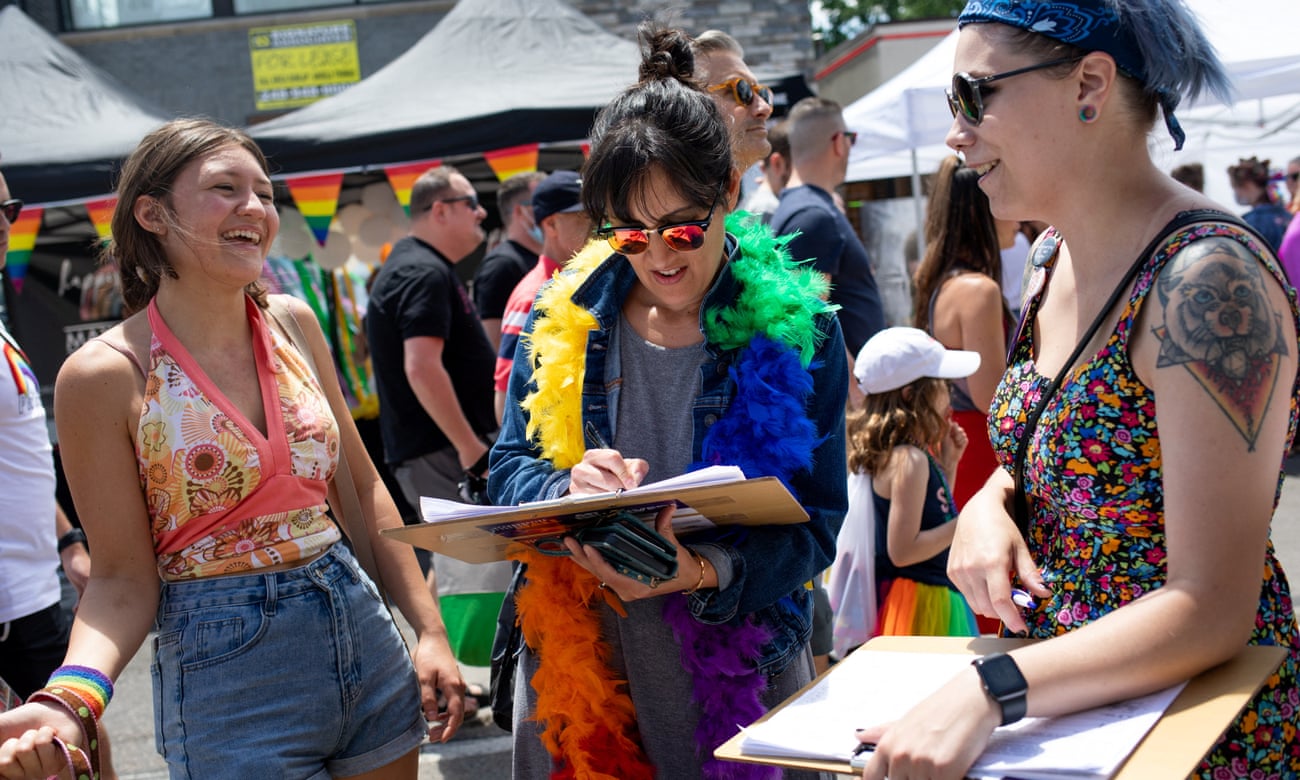
Huge bloc of women expected to turn out in November midterms to protect abortion rights – could it alter the election outcome?
“Being in college, I hear stories all the time of women getting drugged at parties, or just walking down the street, and something unfortunate can happen,” says Koenig, a freshman at Michigan State University. “A guy can walk away, but [these abortion bans] mean the woman has to choose: ‘Do I want to give this baby up … or raise this child with no help from anybody?’ That’s a really hard decision.”
In August, a week after her 19th birthday, Koenig signed up to vote. She is one of many women registering in droves since the supreme court overturned the constitutional right to an abortion on 24 June.
“My brain is constantly on fire. I can’t relax. I just want this election to be over with,” says Koenig, who plans to vote to protect abortion rights in a Michigan ballot as well as voting Democrat come November.
People such as Koenig threaten to be a hugely pivotal voting bloc as the midterms loom, with organizers focusing on women and young people in voter registration drives all over the country. The first hints of that bloc’s voting power came in early August, when women in Kansas came out overwhelmingly to protect abortion rights. That election saw huge turnout, with women representing 70% of newly registered voters. They ultimately protected abortion rights in a state where Donald Trump had a 15% lead in the 2020 presidential election that he lost to Joe Biden.
That trend seems to be continuing in other states – a threat to Republican lawmakers, who in recent weeks have quietly removed abortion-related election pledges from their websites and softened their anti-abortion messaging.
For instance, the Republican gubernatorial candidate for Minnesota, Scott Jensen, had previously said he would ban abortion outright. But more recently, Jensen released a video saying he supports abortion in the cases of rape, incest, and threat to life of the pregnant person.
That pivot might not be enough to hide the party’s hardline agenda: this week, Senator Lindsey Graham of South Carolina proposed a nationwide ban on abortions after 15 weeks of pregnancy, despite months of Republican rhetoric about putting the question back to the states.
Perhaps women are unconvinced. Target Smart analyzed new voter registration from 45 states following the supreme court decision that reversed federal abortion rights – the group said female registration shot up 12%.
In Wisconsin, a battleground state that voted for Biden by a margin of just 30,000 votes in 2020, women are out-registering men by 16%. New registrants also skew hugely Democratic: 52% of newly registered voters in Wisconsin, compared to just 17% of new registrations by Republicans.
“In my 28 years of analyzing elections, I had never seen anything like what’s happened in the past two months in American politics,” Tom Bonier, chief executive of Target Smart, wrote in the New York Times. “Women are registering to vote in numbers I never witnessed before. I’ve run out of superlatives to describe how different this moment is.”
This week, the Michigan supreme court agreed to put the question of abortion rights directly to voters in November, after 730,000 Michiganders signed a petition requesting a vote. Initially, Republicans on the state’s board of canvassers tried to block the call for a referendum, complaining about spacing errors.
“I tend to do the bigger elections … I’m disabled, and standing in line for a long time is not the best for me,” says Diamond Doré, 30, from Detroit. “But seeing [the supreme court] decision, I was like, I have to vote. I’m Black and queer, and I know this means a lot of Black women are gonna die. I couldn’t stay silent.”
A grassroots activist, Doré phone canvasses, and says she has seen anti-abortion voters suddenly wanting to protect abortion. “When this happened, a lot of people sat back and said, ‘Oh, dang, this is for real. It’s not just about me, this is about tons of other women and pregnant persons around America,’” says Doré.
News of a 10-year-old girl from Ohio traveling 200 miles to Indiana to get abortion care after being raped was one thing Doré has seen sway voters. Add to that list people being forced to carry unsuccessful pregnancies to full term, at risk to their own lives, and the threat of criminalization.
“A lot of Black people feel like we are going back to what our ancestors went through,” says Doré.
William Wojciechowsk, 35, who hails from what he calls “Trump country, Michigan” (St Clair), says abortion bans across the country mean he will be voting Democrat in November for the first time.
“All the way up until the last primary election, I voted very conservatively. But I’m a transgender male, and abortions can affect me directly because I haven’t had a hysterectomy.”
Asked if he felt abandoned by his party, Wojciechowsk responded: “They’re too extreme. They’re out of their minds. These bans are putting women and trans men back into the dark ages.”
Bonier says the gender gap in voter registration seems more pronounced in some states than others.
“There’s a general sense that even though Dobbs fell, that [some of the electorate still feels] abortion is protected. In states like Oregon, where they’ve been trying to protect abortion in their state constitution, you don’t really see gender gaps [in those registering to vote] since the decision,” says Bonier. But in Republican-dominated states such as Alaska, Idaho, Kansas and Louisiana, and competitive midwestern swing states – such as Wisconsin, Pennsylvania, Ohio and Michigan – the gap is clearer, he says.
“[In those] races, governors and senators have certainly focused pretty extensively on [abortion]. And so I think voters generally have a sense of the stakes.”
Those stakes include control of Congress at a pivotal moment for American democracy – control that until recently looked like it could pass into Republican hands. The party in power has historically tended to struggle in the midterms.
“Just a few months ago, if you were to watch any of the cable news shows or read any of the political columnists, there seemed to be a universal agreement that Republicans were on their way to an inevitable wave election, where they were going to take back the Senate and take back the House. Now that doesn’t seem so sure,” Bonier says.
Now, surprise races are being won for candidates putting abortion at the centre of their campaigns. Republicans lost Alaska’s special House election at the end of August – a surprise victory for Mary Peltola, who was running against Alaska’s former governor, Sarah Palin, and against Nicholas Begich, a Republican who comes from a lineage of Alaskan Democrats.
Younger people, in particular, are playing a key role in the surge in women voting. Usually, voter turnout is particularly low for young people in midterms and primaries. But in Kansas, voters under the age of 30 comprised over 14% of ballots cast, surpassing their vote share for each of the past three general elections in Kansas.
Katharine from Minnesota, who just turned 18 and did not give her surname for privacy, will vote for the first time in November. She remembers the moment she heard about the Dobbs decision: she was sitting in history class.
“Somehow, in my mind, I still thought it wouldn’t happen, that once [the draft opinion] was leaked, maybe the public would somehow sway the decision,” she says.
She had written many school assignments about the importance of judicial precedent – and here she was seeing it all torn down.
“That’s when I knew I had to vote,” she says. “To see a lot of things I’ve grown up viewing as basic rights being taken away was very jolting.
“I am ready to put these politicians in their place. We’re tired of the older guys in office telling us what to do with our bodies.”
Bonier cautions that young people usually surge in voter registration closer to midterms, and that first-time voters make up a tiny proportion of those who are registering to vote.
But, he says, past election cycles indicate that when a group shows a greater level of intensity at a particular point – registering to vote for the first time in increased numbers – those numbers translate to a higher level of turnout overall for that group.
In Michigan, Koenig recalls feeling stirred when she heard Ruth Bader Ginsburg, one of her idols, talk about abortion as a human right, rather than simply an issue of gender.
“Forcing a woman to have a child, it affects everything,” Koenig says. “It’s not just an issue of abortion. It’s a racial issue. It’s a women’s rights issue. And I feel like a lot of these politicians are so concerned with their power, they don’t think about how we going to support babies that are going to be born.
“If something terrible happens to me, I want to have a choice in the matter.”
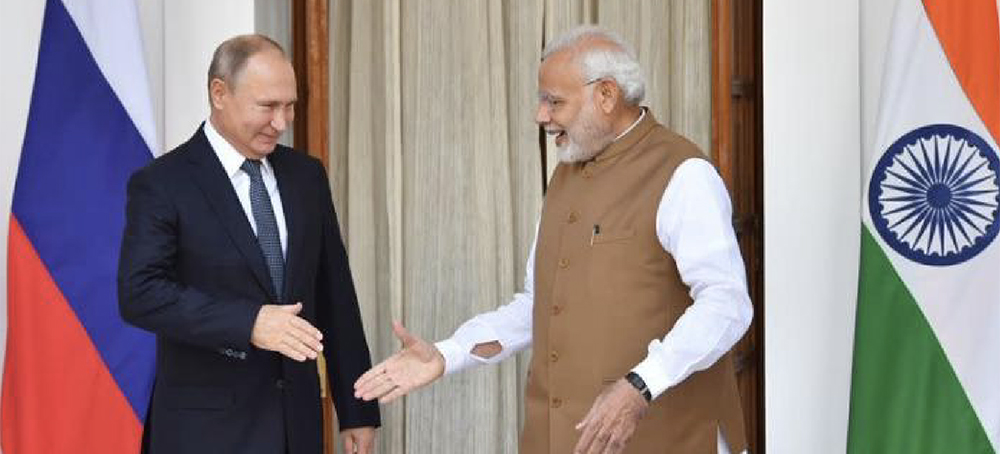 Indian PM Modi welcomes Russian President Putin prior to their meeting at Hyderabad House in New Delhi. (photo: Reuters)
"I know that today's era is not an era of war, and I have spoken to you on the phone about this," Modi told Putin on the sidelines of a regional security bloc summit in Uzbekistan, adding that democracy, diplomacy and dialogue keep the world together.
Putin said that he understood Modi's concerns about the Ukraine war. "I know about your position on the conflict in Ukraine, and I know about your concerns. We want all of this to end as soon as possible."
Putin, who met Chinese President Xi Jinping at the summit, acknowledged on Wednesday Beijing's concerns about the war.
Modi and Putin spoke on the sidelines of the Shanghai Cooperation Organisation (SCO) meeting, whose permanent members, besides India, include China, Russia, Pakistan, Kazakhstan, Kyrgyzstan, Tajikistan and Uzbekistan.
"Our trade is growing, thanks to your additional supplies of Russian fertilisers to the Indian markets, which have grown more than eight fold. I am hopeful that this is going to be of huge help of the agricultural sector of India," Putin said.
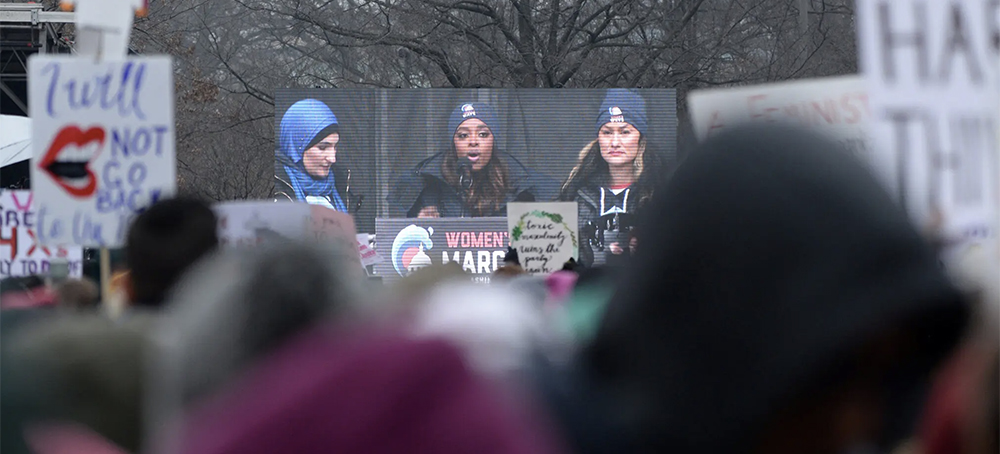 Progressive groups distanced themselves from Ms. Sarsour, left, and her fellow march co-chairs Tamika Mallory and Carmen Perez. (photo: Erin Scott/Reuters)
As American feminists came together in 2017 to protest Donald Trump, Russia’s disinformation machine set about deepening the divides among them.
The weekend before, she had stood in Washington at the head of the Women’s March, a mobilization against President Donald J. Trump that surpassed all expectations. Crowds had begun forming before dawn, and by the time she climbed up onto the stage, they extended farther than the eye could see.
More than four million people around the United States had taken part, experts later estimated, placing it among the largest single-day protests in the nation’s history.
But then something shifted, seemingly overnight. What she saw on Twitter that Monday was a torrent of focused grievance that targeted her. In 15 years as an activist, largely advocating for the rights of Muslims, she had faced pushback, but this was of a different magnitude. A question began to form in her mind: Do they really hate me that much?
That morning, there were things going on that Ms. Sarsour could not imagine.
More than 4,000 miles away, organizations linked to the Russian government had assigned teams to the Women’s March. At desks in bland offices in St. Petersburg, using models derived from advertising and public relations, copywriters were testing out social media messages critical of the Women’s March movement, adopting the personas of fictional Americans.
They posted as Black women critical of white feminism, conservative women who felt excluded, and men who mocked participants as hairy-legged whiners. But one message performed better with audiences than any other.
It singled out an element of the Women’s March that might, at first, have seemed like a detail: Among its four co-chairs was Ms. Sarsour, a Palestinian American activist whose hijab marked her as an observant Muslim.
Over the 18 months that followed, Russia’s troll factories and its military intelligence service put a sustained effort into discrediting the movement by circulating damning, often fabricated narratives around Ms. Sarsour, whose activism made her a lightning rod for Mr. Trump’s base and also for some of his most ardent opposition.
One hundred and fifty-two different Russian accounts produced material about her. Public archives of Twitter accounts known to be Russian contain 2,642 tweets about Ms. Sarsour, many of which found large audiences, according to an analysis by Advance Democracy Inc., a nonprofit, nonpartisan organization that conducts public-interest research and investigations.
Many people know the story about how the Women’s March movement fractured, leaving lasting scars on the American left.
A fragile coalition to begin with, it headed into crisis over its co-chairs’ association with Louis Farrakhan, the Nation of Islam leader, who is widely condemned for his antisemitic statements. When this surfaced, progressive groups distanced themselves from Ms. Sarsour and her fellow march co-chairs, Carmen Perez, Tamika Mallory and Bob Bland, and some called for them to step down.
But there is also a story that has not been told, one that only emerged years later in academic research, of how Russia inserted itself into this moment.
For more than a century, Russia and the Soviet Union sought to weaken their adversaries in the West by inflaming racial and ethnic tensions. In the 1960s, K.G.B. officers based in the United States paid agents to paint swastikas on synagogues and desecrate Jewish cemeteries. They forged racist letters, supposedly from white supremacists, to African diplomats.
They did not invent these social divisions; America already had them. Ladislav Bittman, who worked for the secret police in Czechoslovakia before defecting to the United States, compared Soviet disinformation programs to an evil doctor who expertly diagnoses the patient’s vulnerabilities and exploits them, “prolongs his illness and speeds him to an early grave instead of curing him.”
A decade ago, Russia’s president, Vladimir V. Putin, oversaw a revival of these tactics, seeking to undermine democracies around the world from the shadows.
Social media now provided an easy way to feed ideas into American discourse, something that, for half a century, the K.G.B. had struggled to do. And the Russian government secretly funneled more than $300 million to political parties in more than two dozen countries in an effort to sway their policies in Moscow’s favor since 2014, according to a U.S. intelligence review made public last week.
What effect these intrusions had on American democracy is a question that will be with us for years. It may be unanswerable. Already, social media was amplifying Americans’ political impulses, leaving behind a trail of damaged communities. Already, trust in institutions was declining, and rage was flaring up in public life. These things would have been true without Russian interference.
But to trace the Russian intrusions over the months that followed that first Women’s March is to witness a persistent effort to make all of them worse.
‘Refrigerators and Nails’
In early 2017, the trolling operation was in its imperial phase, swelling with confidence.
Accounts at the Internet Research Agency, an organization based in St. Petersburg and controlled by a Putin ally, had boasted of propelling Mr. Trump to victory. That year, the group’s budget nearly doubled, according to internal communications made public by U.S. prosecutors. More than a year would pass before social media platforms executed sweeping purges of Russian-backed sock-puppet accounts.
For the trolls, it was a golden hour.
Under these auspicious conditions, their goals shifted from electoral politics to something more general — the goal of deepening rifts in American society, said Alex Iftimie, a former federal prosecutor who worked on a 2018 case against an administrator at Project Lakhta, which oversaw the Internet Research Agency and other Russian trolling operations.
“It wasn’t exclusively about Trump and Clinton anymore,” said Mr. Iftimie, now a partner at Morrison Foerster. “It was deeper and more sinister and more diffuse in its focus on exploiting divisions within society on any number of different levels.”
There was a routine: Arriving for a shift, workers would scan news outlets on the ideological fringes, far left and far right, mining for extreme content that they could publish and amplify on the platforms, feeding extreme views into mainstream conversations.
Artyom Baranov, who worked at one of Project Lakhta’s affiliates from 2018 to 2020, concluded that his co-workers were, for the most part, people who needed the money, indifferent to the themes they were asked to write on.
“If they were assigned to write text about refrigerators, they would write about refrigerators, or, say, nails, they would write about nails,” said Mr. Baranov, one of a handful of former trolls who have spoken on the record about their activities. But instead of refrigerators and nails, it was “Putin, Putin, then Putin, and then about Navalny,” referring to Aleksei Navalny, the jailed opposition leader.
The job was not to put forward arguments, but to prompt a visceral, emotional reaction, ideally one of “indignation,” said Mr. Baranov, a psychoanalyst by training, who was assigned to write posts on Russian politics. “The task is to make a kind of explosion, to cause controversy,” he said.
When a post succeeded at enraging a reader, he said, a co-worker would sometimes remark, with satisfaction, Liberala razorvala. A liberal was torn apart. “It wasn’t on the level of discussing facts or giving new arguments,” he said. “It’s always a way of digging into dirty laundry.”
Feminism was an obvious target, because it was viewed as a “Western agenda,” and hostile to the traditional values that Russia represented, said Mr. Baranov, who spoke about his work in hopes of warning the public to be more skeptical of material online. Already, for months, Russian accounts purporting to belong to Black women had been drilling down on racial rifts within American feminism:
“White feminism seems to be the most stupid 2k16 trend”
“Watch Muhammad Ali shut down a white feminist criticizing his arrogance”
“Aint got time for your white feminist bullshit”
“Why black feminists don’t owe Hillary Clinton their support”
“A LIL LOUDER FOR THE WHITE FEMINISTS IN THE BACK”
In January 2017, as the Women’s March drew nearer, they tested different approaches on different audiences, as they had during the run-up to the 2016 presidential election. They posed as resentful trans women, poor women and anti-abortion women. They dismissed the marchers as pawns of the Jewish billionaire George Soros.
And they derided the women who planned to participate, often in crudely sexual terms. In coordination, beginning on Jan. 19, 46 Russian accounts pumped out 459 original suggestions for #RenameMillionWomenMarch, a hashtag created by a right-wing podcaster from Indiana:
The Why Doesn’t Anybody Love Me March
The Strong Women Constantly Playing the Victim March
The Lonely Cat Lady March
The Cramp Camp
The Bearded Women Convention
Broken Broads Bloviating
The Liberal Trail of Tears
Coyote Ugly Bitchfest
In the meantime, another, far more effective line of messaging was developing.
‘It Was Like an Avalanche’
As one of the four co-chairs of the Women’s March, Ms. Sarsour came with a track record — and with baggage.
The daughter of a Palestinian American shopkeeper in Crown Heights, she had risen to prominence as a voice for the rights of Muslims after 9/11. In 2015, when she was 35, a New York Times profile anointed her — a “Brooklyn Homegirl in a Hijab” — as something rare, a potential Arab American candidate for elected office.
In 2016, Senator Bernie Sanders featured her at a campaign event, a stamp of approval from one of the country’s most influential progressives. That troubled pro-Israel politicians in New York, who pointed to her support for the Boycott, Divestment and Sanctions movement, which seeks to secure Palestinian rights by isolating Israel. Critics of the movement contend that it threatens Israel’s existence.
Rory Lancman, then a city councilman from Queens, recalls his growing alarm as she began to appear regularly at events for left-wing causes unrelated to Israel, like fair wages, where, he felt, “her real agenda was trying to marry an anti-Israel agenda with different progressive causes.”
The news that Ms. Sarsour was among the leaders of the Women’s March, said Mr. Lancman, a Democrat, struck him as “heartbreaking — that’s the word — that antisemitism is tolerated and rationalized in progressive spaces.”
That was politics as usual, and Ms. Sarsour was accustomed to it: the long-running feud among Democrats over the implications of criticizing Israel.
But 48 hours after the march, a shift of tone occurred online, with a surge of posts describing Ms. Sarsour as a radical jihadi who had infiltrated American feminism. Ms. Sarsour recalls this vividly, because she woke to a worried text message from a friend and glanced at Twitter to find that she was trending.
Not all of this backlash was organic. That week, Russian amplifier accounts began circulating posts that focused on Ms. Sarsour, many of them inflammatory and based on falsehoods, claiming she was a radical Islamist, “a pro-ISIS Anti USA Jew Hating Muslim” who “was seen flashing the ISIS sign.”
Some of these posts found a large audience. At 7 p.m. on Jan. 21, an Internet Research Agency account posing as @TEN_GOP, a fictional right-wing American from the South, tweeted that Ms. Sarsour favored imposing Shariah law in the United States, playing into a popular anti-Muslim conspiracy theory that Mr. Trump had helped to popularize on the campaign trail.
This message took hold, racking up 1,686 replies, 8,046 retweets and 6,256 likes. An hour later, @PrisonPlanet, an influential right-wing account, posted a tweet on the same theme. The following day, nearly simultaneously, a small army of 1,157 right-wing accounts picked up the narrative, publishing 1,659 posts on the subject, according to an analysis conducted by the online analytics firm Graphika on behalf of The Times.
Vladimir Barash, Graphika’s chief scientist, said the pattern of interference was “strategically similar” to troll activity targeting the vast anti-Putin protests of 2011 and 2012, with sock-puppet accounts “similarly trying to hijack the conversation, sometimes succeeding.”
“There is some circumstantial evidence that they learned in a domestic context and then tried to replicate their success in a foreign context,” Dr. Barash said.
Things were changing on the ground in New York. At the Arab American Association of New York, the nonprofit immigrant advocacy organization Ms. Sarsour ran in Bay Ridge, hate mail began to pour in — postcards, handwritten screeds on notebook paper, her photo printed out and defaced with red X’s.
“This was an entirely new level, and it felt weird, because it was coming from all over the country,” said Kayla Santosuosso, then the nonprofit’s deputy director, who remembers bringing the mail to Ms. Sarsour in shoe boxes. Ms. Sarsour, worried that she had become “a liability,” stepped down from her position there that February.
By the spring, the backlash against Ms. Sarsour had developed into a divisive political sideshow, one that easily drowned out the ideas behind the Women’s March. “It was like an avalanche,” she said. “Like I was swimming in it every day. It was like I never got out of it.”
When she was invited to appear as a graduation speaker at the City University of New York’s graduate school of public health, the furor began weeks in advance. It caught the attention of the far-right polemicist Milo Yiannopoulos, who traveled to New York for a protest that attracted, as a Times reporter wrote, “a strange mix, including right-leaning Jews and Zionists, commentators like Pamela Geller, and some members of the alt-right.”
“Linda Sarsour is a Shariah-loving, terrorist-embracing, Jew-hating, ticking time bomb of progressive horror,” Mr. Yiannopoulos told the crowd.
Ms. Sarsour recalls the period leading up to the graduation speech as particularly stressful. As it approached, she had visions of a figure coming out of the shadows to kill her, “some poor, like, deranged person who was consumed by the dark corners of the internet, who would be fueled by hate.”
Russian troll accounts were part of that clamor; beginning more than a month before her speech, a handful of amplifier accounts managed by Russia’s largest military intelligence agency, the G.R.U., circulated expressions of outrage at her being selected, often hashtagged #CancelSarsour.
When Mr. Yiannopoulos spoke, @TEN_GOP tweeted the juiciest phrases — the “ticking time bomb of progressive horror” line — and racked up 3,954 retweets and 5,967 likes.
Her graduation speech passed without incident. Then the trolls waited, it seems, for her to say or do something divisive. And that happened in early July, when, emboldened after her C.U.N.Y. appearance, she urged a Muslim audience outside Chicago to push back against unjust government policies, calling it “the best form of jihad.”
In Islam, the word “jihad” can denote any virtuous struggle, but in the American political context it is inextricable from the concept of holy war. A more pragmatic politician might have avoided using it, but Ms. Sarsour was feeling like her old self. “That’s who I am in real life,” she said. “I’m from Brooklyn, and I’m Palestinian. It’s my personality.”
To the Russian trolls, it was an opportunity.
The following week, Russian accounts dramatically increased their volume of messaging about Ms. Sarsour, producing 184 posts on a single day, according to Advance Democracy Inc.
Once again, the audience responded: When @TEN_GOP tweeted, “linda sarsour openly calls for muslims to wage jihad against trump, please look into this matter,” it received 6,222 retweets and 6,549 likes. The accounts sustained an intense focus on her through July, producing 894 posts over the next month and continuing into the autumn, the group found.
And once again, the backlash spilled out from social media. Protesters camped outside the kosher barbecue restaurant where her brother, Mohammed, worked as a manager, demanding that he be fired. He left the job, and, eventually, New York.
Her mother opened a package that arrived in the mail and screamed: It was a bizarre self-published book, titled “A Jihad Grows in Brooklyn,” that purported to be Ms. Sarsour’s autobiography and was illustrated with family photographs.
“I mean, just imagine,” Ms. Sarsour said, “every day that you woke up, you were a monster.”
Chasing Ghosts
It is maddeningly difficult to say with any certainty what effect Russian influence operations have had on the United States, because when they took hold they piggybacked on real social divisions. Once pumped into American discourse, the Russian trace vanishes, like water that has been added to a swimming pool.
This creates a conundrum for disinformation specialists, many of whom say the impact of Russian interventions has been overblown. After the 2016 presidential election, blaming unwelcome outcomes on Russia became “the emotional way out,” said Thomas Rid, author of “Active Measures: The Secret History of Disinformation and Political Warfare.”
“It’s playing a trick on you,” said Dr. Rid, a professor at Johns Hopkins University School of Advanced International Studies. “You become a useful idiot if you ignore effective info ops. But also if you talk it up by telling a story, if you make it more powerful than it is. It’s a trick.”
The divisions within the Women’s March existed already.
Internal disputes about identity and antisemitism had strained the group from its early days, when one of its organizers, Vanessa Wruble, who is Jewish, was pushed out after what she described as tense conversations with Ms. Perez and Ms. Mallory about the role of Jews in structural racism. Ms. Perez and Ms. Mallory have disputed that account.
And discomfort with Ms. Sarsour had dampened enthusiasm among some Jewish progressives, said Rachel Timoner, the senior rabbi of Congregation Beth Elohim in Park Slope, Brooklyn.
She recalled stepping up to defend Ms. Sarsour against “racist and Islamophobic” attacks, only to find, each time, that a new firestorm would arise, often resulting from something inflammatory and “ultimately indefensible” Ms. Sarsour had said.
As the months wore on, Rabbi Timoner said, Jews began asking themselves whether they were being excluded from progressive movements.
In 2018, a new internal crisis was triggered by Ms. Mallory’s attendance at Saviours’ Day, an annual gathering of the Nation of Islam led by Mr. Farrakhan.
Ms. Mallory grew up in Harlem, where many viewed the Nation of Islam and its founder positively, as crusaders against urban violence. Pressured to disavow Mr. Farrakhan, she refused, though she said she did not share his antisemitic views. After her son’s father was murdered, she explained, “it was the women of the Nation of Islam who supported me.”
“I have always held them close to my heart for that reason,” she said.
After that, the fabric of the coalition tore, slowly and painfully. Ms. Sarsour and Ms. Perez stuck by Ms. Mallory, and before long, progressive groups began distancing themselves from all three. Under intense pressure to step down as the leaders, Ms. Sarsour, Ms. Perez, and a third co-chair, Bob Bland, did so in 2019, a move they say was long planned.
Russian accounts boosted their output around Mr. Farrakhan and the Women’s March leaders that spring, posting 10 or 20 times a day, but there is no evidence that they were a primary driver of the conversation.
Around this time, we largely lose our view into Russian messaging. In the summer of 2018, Twitter suspended 3,841 accounts traced to the Internet Research Agency, preserving 10 million of their tweets so they could be studied by researchers. A few months later, the platform suspended and preserved the work of 414 accounts produced by the G.R.U., the military intelligence agency.
With that, a chorus of voices went silent — accounts that, for years, had helped shape American conversations about Black Lives Matter, the Mueller investigation and NFL players kneeling during the national anthem. The record of the messaging around the Women’s March breaks off there, too, frozen in time.
Russia’s exploitation of Ms. Sarsour as a wedge figure should be understood as part of the history of the Women’s March, said Shireen Mitchell, a technology analyst who has studied Russian interference in Black online discourse.
Russian campaigns, she said, were adept at seeding ideas that flowed into mainstream discourse, after which, as she put it, they could “just sit and wait.”
“It’s the priming of all that, starting from the beginning,” said Ms. Mitchell, the founder of Stop Online Violence Against Women. “If those thousand tweets hit a division between the groups that matter, if they open and allow that division, it’s no longer a crack. It becomes a valley.”
Others saw Russia’s role as marginal, tinkering around the edges of a necessary American discussion.
“It’s a shame that Linda Sarsour damaged that movement by trying to inject into it noxious ideas that had no reason to be part of the Women’s March,” said Mr. Lancman, the former city councilman. “Unfortunately,” he added, Russians “seem very adept at exploiting these fissures.”
Rabbi Timoner sounded sad, recalling all that had happened. The wounds that opened up between progressives that year have never quite healed, she said.
“There is so much Jewish pain here,” she said. “Those Russian bots were poking at that pain.”
The Women’s March continued under new leadership, but during the months of controversy, many women who had been galvanized by the first march drifted away.
“I can’t remember all the negative stories, I just remember that there were so many of them,” said Jennifer Taylor-Skinner, a Seattle woman who, after the 2017 march, quit her job at Microsoft and founded “The Electorette,” a podcast geared toward progressive women. She hasn’t ever recaptured that feeling of unity.
“Just thinking about it, I still feel a bit unmoored from any central movement,” she said. “There was a coalition possibly forming here that has been broken up.”
An Aftershock
Ms. Sarsour, 42, was back in her old office in Bay Ridge this past spring, five years after the first Women’s March, when she learned, from a reporter, that the Russian government had targeted her.
She is seldom invited to national platforms these days, and when she is, protests often follow. Whatever buzz there was around her as a future political candidate has quieted. She knows how she is seen, as a polarizing figure. She has adjusted to this reality, and sees herself more as an activist, in the mold of Angela Davis.
“I’m never going to get a real job,” at a major nonprofit or a corporation, she said. “That’s the kind of impact that these things have on our lives.”
Data on Russian messaging around the Women’s March first appeared late last year in an academic journal, where Samantha R. Bradshaw, a disinformation expert at American University, reviewed state interference in feminist movements.
She and her co-author, Amélie Henle, found a pattern of messaging by influential amplifier accounts that sought to demobilize civil society activism, by pumping up intersectional critiques of feminism and attacking organizers.
Movements, Dr. Bradshaw argues, are fragile structures, often unprepared to weather well-resourced state-backed sabotage campaigns, especially when combined with algorithms that promote negative content. But healthy social movements are essential to democracies, she said.
“We’re not going to have a robust public sphere if nobody wants to organize protests,” she said.
Ms. Sarsour isn’t an academic, but she understood it well enough.
“Lord have mercy,” she said, glancing over Dr. Bradshaw’s findings.
Ms. Sarsour tried to get her head around it: All that time, the Russian government had been thinking about her. She had long had a sense of where her critics came from: the American right wing, and supporters of Israel. A foreign government — that was something that had never occurred to her.
“To think that Russia is going to use me, it’s much more dangerous and sinister,” she said. “What does Russia get out of leveraging my identity, you know, to undermine movements that were anti-Trump in America — I guess —” she paused. “It’s just, wow.”
Understanding what Russian trolls did would not change her position.
Still, it helped her understand that time in her life, when she had been at the center of a storm. It wasn’t just her fellow countrymen hating her. It wasn’t just her allies disavowing her. That had happened. But it wasn’t the whole story.
She placed a call to Ms. Mallory.
“We weren’t crazy,” she said.
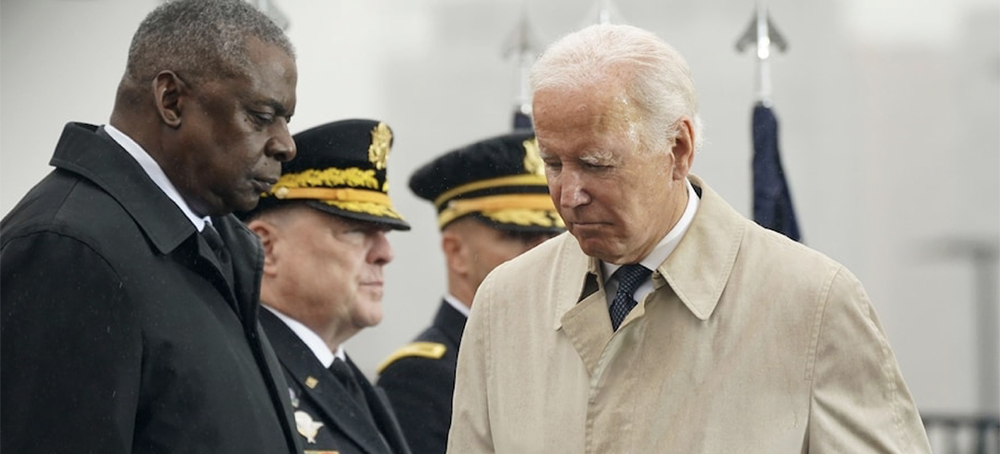 President Biden, right, Defense Secretary Lloyd Austin, left, and Chairman of the Joint Chiefs of Staff Gen. Mark A. Milley attend a Pentagon ceremony to remember the victims of 9/11. (photo: Leigh Vogel/Bloomberg)
Complaints about the U.S. military’s influence operations using Facebook and Twitter have raised concern in the White House and federal agencies.
Colin Kahl, the undersecretary of defense for policy, last week instructed the military commands that engage in psychological operations online to provide a full accounting of their activities by next month after the White House and some federal agencies expressed mounting concerns over the Defense Department’s attempted manipulation of audiences overseas, according to several defense and administration officials familiar with the matter.
The takedowns in recent years by Twitter and Facebook of more than 150 bogus personas and media sites created in the United States was disclosed last month by internet researchers Graphika and the Stanford Internet Observatory. While the researchers did not attribute the sham accounts to the U.S. military, two officials familiar with the matter said that U.S. Central Command is among those whose activities are facing scrutiny. Like others interviewed for this report, they spoke on the condition of anonymity to discuss sensitive military operations.
The researchers did not specify when the takedowns occurred, but those familiar with the matter said they were within the past two or three years. Some were recent, they said, and involved posts from the summer that advanced anti-Russia narratives citing the Kremlin’s “imperialist” war in Ukraine and warning of the conflict’s direct impact on Central Asian countries. Significantly, they found that the pretend personas — employing tactics used by countries such as Russia and China — did not gain much traction, and that overt accounts actually attracted more followers.
Centcom, headquartered in Tampa, has purview over military operations across 21 countries in the Middle East, North Africa and Central and South Asia. A spokesman declined to comment.
Air Force Brig. Gen. Patrick Ryder, the Pentagon press secretary, said in a statement that the military’s information operations “support our national security priorities” and must be conducted in compliance with relevant laws and policies. “We are committed to enforcing those safeguards,” he said.
Spokespersons for Facebook and Twitter declined to comment.
According to the researchers’ report, the accounts taken down included a made-up Persian-language media site that shared content reposted from the U.S.-funded Voice of America Farsi and Radio Free Europe. Another, it said, was linked to a Twitter handle that in the past had claimed to operate on behalf of Centcom.
One fake account posted an inflammatory tweet claiming that relatives of deceased Afghan refugees had reported bodies being returned from Iran with missing organs, according to the report. The tweet linked to a video that was part of an article posted on a U.S.-military affiliated website.
Centcom has not commented on whether these accounts were created by its personnel or contractors. If the organ-harvesting tweet is shown to be Centcom’s, one defense official said, it would “absolutely be a violation of doctrine and training practices.”
Independent of the report, The Washington Post has learned that in 2020 Facebook disabled fictitious personas created by Centcom to counter disinformation spread by China suggesting the coronavirus responsible for covid-19 was created at a U.S. Army lab in Fort Detrick, Md., according to officials familiar with the matter. The pseudo profiles — active in Facebook groups that conversed in Arabic, Farsi and Urdu, the officials said — were used to amplify truthful information from the U.S. Centers for Disease Control and Prevention about the virus’s origination in China.
The U.S. government’s use of ersatz social media accounts, though authorized by law and policy, has stirred controversy inside the Biden administration, with the White House pressing the Pentagon to clarify and justify its policies. The White House, agencies such as the State Department and even some officials within the Defense Department have been concerned that the policies are too broad, allowing leeway for tactics that even if used to spread truthful information, risk eroding U.S. credibility, several U.S. officials said.
“Our adversaries are absolutely operating in the information domain,” said a second senior defense official. “There are some who think we shouldn’t do anything clandestine in that space. Ceding an entire domain to an adversary would be unwise. But we need stronger policy guardrails.”
A spokeswoman for the National Security Council, which is part of the White House, declined to comment.
Kahl disclosed his review at a virtual meeting convened by the National Security Council on Tuesday, saying he wants to know what types of operations have been carried out, who they’re targeting, what tools are being used and why military commanders have chosen those tactics, and how effective they have been, several officials said.
The message was essentially, “You have to justify to me why you’re doing these types of things,” the first defense official said.
Pentagon policy and doctrine discourage the military from peddling falsehoods, but there are no specific rules mandating the use of truthful information for psychological operations. For instance, the military sometimes employs fiction and satire for persuasion purposes, but generally the messages are supposed to stick to facts, officials said.
In 2020, officers at Facebook and Twitter contacted the Pentagon to raise concerns about the phony accounts they were having to remove, suspicious they were associated with the military. That summer, David Agranovich, Facebook’s director for global threat disruption, spoke to Christopher C. Miller, then assistant director for Special Operations/Low Intensity Conflict, which oversees influence operations policy, warning him that if Facebook could sniff them out, so could U.S. adversaries, several people familiar with the conversation said.
“His point‚” one person said, “was ‘Guys, you got caught. That’s a problem.’ ”
Before Miller could take action, he was tapped to head a different agency — the National Counterterrorism Center. Then the November election happened and time ran out for the Trump administration to address the matter, although Miller did spend the last few weeks of Donald Trump’s presidency serving as acting defense secretary.
With the rise of Russia and China as strategic competitors, military commanders have wanted to fight back, including online. And Congress supported that. Frustrated with perceived legal obstacles to the Defense Department’s ability to conduct clandestine activities in cyberspace, Congress in late 2019 passed a law affirming that the military could conduct operations in the “information environment” to defend the United States and to push back against foreign disinformation aimed at undermining its interests. The measure, known as Section 1631, allows the military to carry out clandestine psychologic operations without crossing what the CIA has claimed as its covert authority, alleviating some of the friction that had hindered such operations previously.
“Combatant commanders got really excited,” recalled the first defense official. “They were very eager to utilize these new authorities. The defense contractors were equally eager to land lucrative classified contracts to enable clandestine influence operations.”
At the same time, the official said, military leaders were not trained to oversee “technically complex operations conducted by contractors” or coordinate such activities with other stakeholders elsewhere in the U.S. government.
Last year, with a new administration in place, Facebook’s Agranovich tried again. This time he took his complaint to President Biden’s deputy national security adviser for cyber, Anne Neuberger. Agranovich, who had worked at the NSC under Trump, told Neuberger that Facebook was taking down fake accounts because they violated the company’s terms of service, according to people familiar with the exchange.
The accounts were easily detected by Facebook, which since Russia’s campaign to interfere in the 2016 presidential election has enhanced its ability to identify mock personas and sites. In some cases, the company had removed profiles, which appeared to be associated with the military, that promoted information deemed by fact-checkers to be false, said a person familiar with the matter.
Agranovich also spoke to officials at the Pentagon. His message was: “We know what DOD is doing. It violates our policies. We will enforce our policies” and so “DOD should knock it off,” said a U.S. official briefed on the matter.
In response to White House concerns, Kahl ordered a review of Military Information Support Operations, or MISO, the Pentagon’s moniker for psychological operations. A draft concluded that policies, training and oversight all needed tightening, and that coordination with other agencies, such as the State Department and the CIA, needed strengthening, according to officials.
The review also found that while there were cases in which fictitious information was pushed by the military, they were the result of inadequate oversight of contractors and personnel training — not systemic problems, officials said.
Pentagon leadership did little with the review, two officials said, before Graphika and Stanford published their report on Aug. 24, which elicited a flurry of news coverage and questions for the military.
The State Department and CIA have been perturbed by the military’s use of clandestine tactics. Officers at State have admonished the Defense Department, “Hey don’t amplify our policies using fake personas, because we don’t want to be seen as creating false grass roots efforts,” the first defense official said.
One diplomat put it this way: “Generally speaking, we shouldn’t be employing the same kind of tactics that our adversaries are using because the bottom line is we have the moral high ground. We are a society that is built on a certain set of values. We promote those values around the world and when we use tactics like those, it just undermines our argument about who we are.”
Psychological operations to promote U.S. narratives overseas is nothing new in the military, but the popularity of western social media across the globe has led to an expansion of tactics, including the use of artificial personas and images — sometimes called “deep fakes.” The logic is that views expressed by what appears to be, say, an Afghan woman or an Iranian student might be more persuasive than if they were openly pushed by the U.S. government.
The majority of the military’s influence operations are overt, promoting U.S. policies in the Middle East, Asia and elsewhere under its own name, officials said. And there are valid reasons to use clandestine tactics, such as trying to infiltrate a closed terrorist chat group, they said.
A key issue for senior policymakers now is determining whether the military’s execution of clandestine influence operations is delivering results. “Is the juice worth the squeeze? Does our approach really have the potential for the return on investment we hoped or is it just causing more challenges?” one person familiar with the debate said.
The report by Graphika and Stanford suggests that the clandestine activity did not have much impact. It noted that the “vast majority of posts and tweets” reviewed received “no more than a handful of likes or retweets,” and only 19 percent of the concocted accounts had more than 1,000 followers. “Tellingly,” the report stated, “the two most-followed assets in the data provided by Twitter were overt accounts that publicly declared a connection to the U.S. military.”
Clandestine influence operations have a role in support of military operations, but it should be a narrow one with “intrusive oversight” by military and civilian leadership, said Michael Lumpkin, a former senior Pentagon official handling information operations policy and a former head of the State Department’s Global Engagement Center. “Otherwise, we risk making more enemies than friends.”
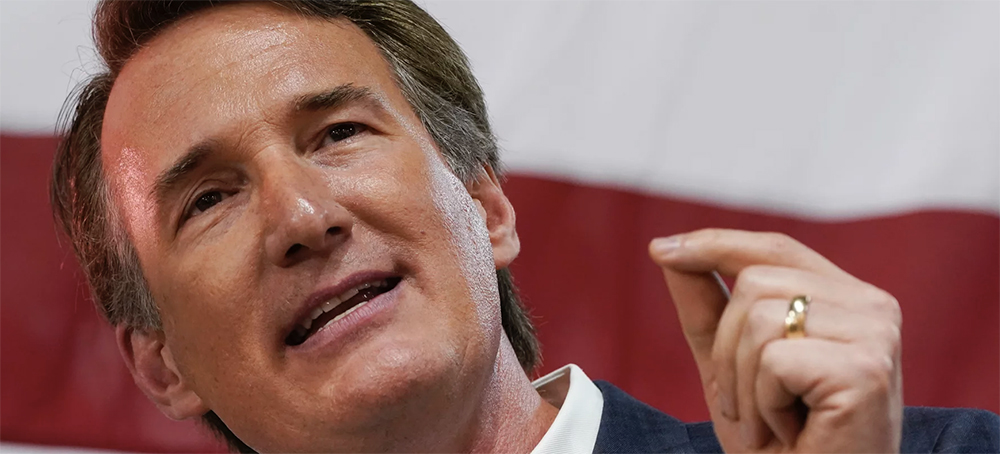 The administration of Republican Gov. Glenn Youngkin is working to adopt new restrictions for transgender students in the Virginia public school system. (photo: Steve Helber/AP)
The Virginia Department of Education released its 2022 Model Policies online Friday, effectively rolling back the work of Youngkin's predecessor, Democrat Ralph Northam. The new rules will effected the more than 1 million children enrolled in the state's public school system.
The revamped rules explicitly state that students must only use bathrooms and locker rooms associated with the sex assigned to them at birth. If a student wants to participate in a sport or other extracurricular activities, they must, again, only participate in teams that align with the sex assigned at birth.
Further, the legal name and sex of a student can't be changed "even upon written instruction of a parent or eligible student" without an official legal document or court order. Teachers and other school officials can only refer to a student by their pronouns associated with their sex at birth. But they also don't have to refer to a student's preferred names regardless of paperwork if they feel doing so "would violate their constitutionally protected rights."
Virginia now joins a growing number of state legislatures across the U.S. that have adopted new restrictions on gay and transgender students. Like Virginia, these policies often limit conversations about sexuality and gender identity in schools.
There have been more than 200 anti-LGBTQ bills introduced at the state level this year alone, according to the LGBTQ rights group, Freedom for All Americans. Some go as far as to restrict access to gender-affirming medical care.
The Virginia Department of Education says the basis for these new rules is to support "the rights of parents" to determine their child's exposure to LGBTQ issues.
The department says that by adopting these new standards, Virginia "reaffirms the rights of parents to determine how their children will be raised and educated. Empowering parents is not only a fundamental right, but it is essential to improving outcomes for all children in Virginia."
The agency said the policies adopted under Northam's leadership "promoted a specific viewpoint aimed at achieving cultural and social transformation in schools."
Democrats and advocacy groups have swiftly condemned the proposals from the state's Republican governor.
Virginia Delegate Danica Roem, a Democrat representing Prince William County, called out Youngkin for violating the state's human rights law.
"[Youngkin's] action should be contested in court under the Virginia Human Rights Act," she tweeted this weekend.
The public can still comment on the draft model policies later this month on the Virginia Regulatory Town Hall website.
 A mudslide blocks a road in Cayey. (photo: Stephanie Rojas/AP)
Category 1 storm damage ‘catastrophic’, says governor, while it continues to strengthen and barrels toward Dominican Republic
Hurricane Fiona was causing “catastrophic flooding” in Puerto Rico early on Sunday evening, the National Hurricane Center (NHC) said.
Several landslides had been reported, government officials said. The storm forced the closure of roads while a highway bridge in Utuado town in the island’s center had been washed away by a flooding river.
Lights went out across Puerto Rico just after 1pm, leaving only those households and businesses with rooftop solar or functioning generators with power.
Electricity was initially completely out across the island, said Luma Energy, operator of the island’s grid. Some power had begun to be restored on Sunday night, with priority given to hospitals and other critical community services, energy officials said, but reconnecting the whole island would take several days.
“This has been catastrophic,” Puerto Rico’s governor, Pedro Pierluisi, told reporters in San Juan on Sunday night. “We are responding to the emergency as weather conditions permit.”
The health minister confirmed earlier that a major cancer hospital in the capital of San Juan was without power after its backup generator failed. An emergency shelter in Sabana Grande in the south-west, where dozens of locals including some infirm residents had sought refuge, was also without power after its generator failed, according to Ruth Santiago, an environmental lawyer and campaigner for Queremos Sol, a grassroots movement to transition the island away from a centralized energy grid to rooftop solar.
“The only thing that can save us this time is that Fiona is not as strong as Maria because so little has changed – the whole transmission system is down,” Santiago said from Salinas, a town being battered by gusty winds and torrential rains. “The Fema money [federal funds to rebuild the energy system after Maria] should have been spent on rooftop solar … if people die, the Biden government will have blood on its hands.”
Fiona’s center made landfall on Puerto Rico’s south-western coast near Punta Tocon at 3.20pm ET (19.20 GMT) on Sunday with maximum sustained winds of about 85mph (140km/h), the NHC said. The storm was upgraded from a tropical storm to a hurricane on Sunday morning.
Ports are closed and flights out of the main international airport have been canceled. Flash floods, landslides and high winds have already damaged crops in the south of the island, with more dangerous conditions forecast through Monday.
Torrential rains and mudslides were also forecast for the Dominican Republic, where the hurricane made landfall in the early hours of Monday morning as it progressed north-westward. The Turks and Caicos Islands likely face tropical storm conditions on Tuesday, the NHC said.
By Sunday night aid agencies in the Dominican Republic began evacuating residents from high-risk areas in the country’s east. President Luis Abinader postponed a trip to New York to participate in the United Nations general assembly.
Puerto Rico is a tropical archipelago and US territory located a thousand miles or so south-east of Miami. The main island is mostly mountains surrounded by narrow coastal plains where the majority of the 3 million habitants reside in towns and cities. It is one of the most vulnerable places on the planet to extreme weather caused by the climate crisis.
It was devastated by Hurricane Maria in 2017, when the delays in federal government help contributed to the high death toll and slow recovery.
The US president, Joe Biden, has already declared a federal disaster for Puerto Rico, mobilizing the delivery of aid to the island.
Parts of Puerto Rico could see up to 25 inches of rain on Monday, which the NHC warned “pose an extreme life-threatening flooding risk”. Storm surges could cause flooding of 1-3 ft above normally dry ground along the eastern and southern coast of the main island and the smaller ones of Vieques and Culebra, according to the NHC, which is part of the national weather service.
Fiona is likely to further damage Puerto Rico’s fragile centralised electricity grid, which Hurricane Maria exposed and exacerbated, and continues to fail residents with frequent power outages and extortionate bills.
It headed to US territory after battering several eastern Caribbean islands, with one death reported in the French territory of Guadeloupe late last week. On Sunday, the French president, Emmanuel Macron, said France would recognise a state of natural disaster for the island.
Meanwhile, almost 5,000 miles away in Alaska, residents were waking up to a trail of destruction caused by a historic storm that impacted almost 1,000 miles of Alaska’s coastline over the course of Friday and Saturday.
The governor, Mike Dunleavy, issued a disaster declaration on Saturday after the powerful storm, the remnant of Typhoon Merbok, forced hundreds of people to evacuate their homes as seawater surged as high as 50ft in some areas, with heavy rainfall and wind gusts up to 90mph. No loss of life has been reported.
On Sunday, Dunleavy said the state needed to move quickly to assess and repair damage to infrastructure like roads and bridges, as freezing Arctic temperatures are likely to hamper efforts within a few weeks.
Follow us on facebook and twitter!
PO Box 2043 / Citrus Heights, CA 95611


Comments
Post a Comment