RSN: Tom Nichols | Ukraine Stands, Fights, and Wins

14 September 22
Live on the homepage now!
Reader Supported News

A lesson for the rest of us about dealing with extremism
Contain and Defeat
Last weekend was full of grief and glory. Queen Elizabeth II died, and like many Americans, I felt the pang of loss. The Queen, a seemingly eternal part of our world, was a stalwart ally of the United States, and a model of dignity and duty. But while focusing on the mourning and pageantry, we might have lost track of another potentially world-changing story in Ukraine.
The Ukrainians, using a combination of clever strategy, military fortitude, and Western weapons, have routed the Russians from a series of positions around Kharkiv. These were not merely defeats; the Russians were abandoning their posts and leaving behind their equipment even before the Ukrainians could reach them. Apparently, Russian soldiers do not want to die for President Vladimir Putin’s pathetic dream of reestablishing a state that had already perished before some of them were even born.
This is an immense humiliation for the Russians and for Putin personally, and Russian pundits are already yelling at one another in panic on state television. The Russian state’s newspaper of record, Rossiskaya Gazeta, is, as the analyst Mark Galeotti noted, stammering and contradicting itself trying to wave away yet another Russian military disaster.
So what happens next? In some quarters, we might expect calls for the Ukrainians to negotiate. But to what end? As my Atlantic colleague Anne Applebaum wrote, there’s nothing to discuss. Putin “has put the destruction of Ukraine at the very center of his foreign and domestic policies, and at the heart of what he wants his legacy to be.” Negotiation, from the first day of the war, was impossible. The only answer was to stand and fight, which the Ukrainians have done with valor and tenacity.
There is a lesson for all of us here as we face the global attack on democracy. Americans, generally, are the products of a legalistic, free-market, democratic society, so we prize negotiation and dealmaking. We think almost any problem is amenable to rational discussion and good-faith exchanges. Each side gives something and gets something. But what if the person across the table has no interest in compromise?
Yesterday was the 21st anniversary of 9/11. I recall how the attack generated debates about how we might have avoided such hostility, how we should have understood that we were paying the price for our policies, how we didn’t hear the voices warning us.
Policies have consequences, but I never believed in such recriminations. Subsequent terrorist incidents over the years, to my mind, proved that we were being attacked for reasons we could not control. There was never a chance of averting violence from al-Qaeda, or from the lost and pathetic men engaging in mindless slaughter in places such as London, Madrid, Paris, and Brussels. (The Tsarnaev brothers, who attacked my beloved city of Boston, were poster boys for nihilism masquerading as a cause. These supposed Muslim warriors were, in reality, a young man described by a friend as “a normal pothead” and his narcissistic older brother, a would-be boxer who was an early suspect in a triple homicide before the Boston Marathon bombing.) Over the years, we learned the lesson that compromise was impossible, and that we would just have to fight groups such as al-Qaeda and the Islamic State and their assorted cast of violent losers.
We then made the same mistake after the January 6 riot at the Capitol. Republicans and others engaged in hand-wringing about how the insurrectionists were expressing “legitimate” grievances. Once again, we were told that we should have been paying more attention to the voices of the unheard—as if somehow, we could have accommodated and satisfied those of our fellow citizens whose minimal demand was the suspension of the Constitution (to say nothing of those who wanted to see the execution of senior elected officials of the United States government).
Extremism, however, defeats compromise and dealmaking. There was nothing Ukraine could have done, short of immediate surrender, that would have stopped Putin’s invasion. The profusion of violent jihadists, particularly in Europe, is a complex social phenomenon that cannot be reduced to a reaction against U.S. policy. The rioters at the Capitol wanted to nullify an election and hang the vice president of the United States. Sometimes, there’s nothing left on the table to discuss.
Last week, my colleague Pete Wehner—a man of greater faith and patience than I could ever hope to be—wrote this in The Atlantic:
But even though we shouldn’t give up on individuals, I can’t escape concluding that the time for mollifying grievances is over. In our political endeavors, the task is now to contain and defeat the MAGA movement, shifting away from a model of psychological amelioration and toward a model of political confrontation.
Contain and defeat. If we really are to be partisans of democracy, the rule of law, human rights, and basic decency, then this is a painful truth. Policy has its limits. Negotiations must be grounded in not only good faith but reality, and not lies or myths.
The demands of extremists are meant to be impossible to fulfill: America must convert to Islam, Ukraine must accept Moscow’s rule, the election must be overturned and Mike Pence hanged. People issuing such demands are not interested in discussion or compromise; indeed, they’d be disappointed if they got what they wanted, because their anger sustains them and gives meaning to their lives. When faced with such movements and their demands, there is only one response: Contain and defeat.
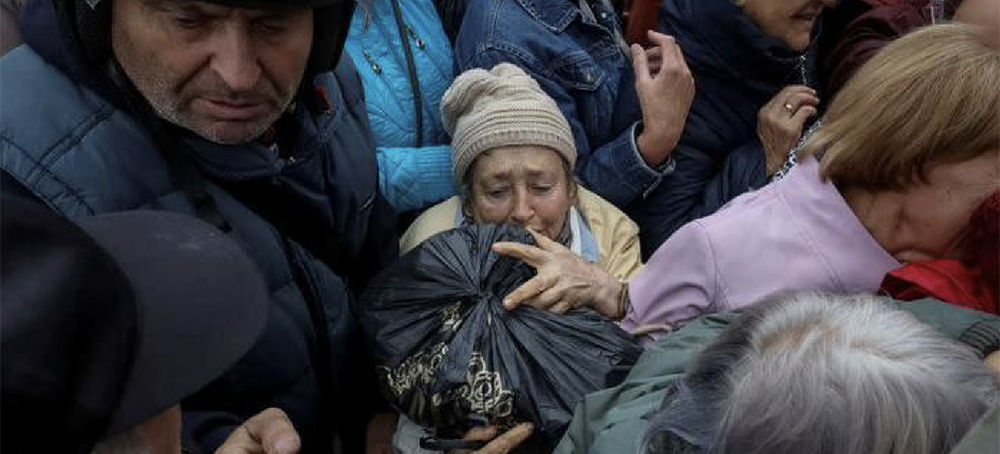 In liberated Ukraine town, locals sob with relief, relate harrowing accounts. (photo: Reuters)
"I was walking away... when I saw an armoured personnel carrier coming onto the square with a Ukrainian flag: my heart just tightened up and I began to sob," the 43-year-old resident said, her voice trembling with emotion.
On Tuesday, she was among a crowd of residents receiving food parcels from a van at the same square where the Ukrainian flag was dramatically hoisted last week in one of the first images of Ukraine's extraordinary northeastern counteroffensive.
The town - which had a population of 27,000 before the war - is one of a chain of key urban outposts that Ukraine has recaptured over the last week after a sudden collapse of one of Russia's principal front lines.
On Tuesday, the streets around Balakliia's main square were eerily quiet. The Ukrainian flag flew above a statue of national poet Taras Shevchenko in front of the regional government building.
A short walk away, regional police officers led reporters to the burial place of two people. The bodies had been exhumed and were laid out on the grass in open body bags.
The two men, they said, were civilians who had been shot dead at a checkpoint in the town on Sept. 6 when the town was still under Russian control. Locals had buried them there because they had nowhere else to do so.
At the site of the exhumed grave, Valentyna, the distressed mother of one of the dead men, 49-year-old Petro, cursed the war and Russian President Vladimir Putin.
"No one can return my son to me," she said.
Reuters could not independently verify the details of what happened in Balakliia. Russia has denied targeting civilians in what it calls a "special military operation" in Ukraine.
ROUBLES AND RUSSIAN SOLDIERS
Tymofiyeva said it had been clear to her that Russia, which invaded Ukraine in February, had planned to annex the town and surrounding territory.
Prices in shops were being given in both Russian roubles and the Ukrainian hryvnia; pensioners were paid in roubles, she said.
The town was almost completely isolated from the outside world. There was no television, internet or mobile phone coverage from late April, she said, apart from one place where residents would try to find a faint signal.
She said the Russian soldiers would stop residents in the street and take their phones to check them for pro-Ukrainian slogans or to see if they were subscribed to pro-Ukrainian social media channels.
At one point, her husband was made to strip to his underwear in the street to make sure he had no pro-Ukrainian tattoos and had not served in the Ukrainian army fighting Russian-backed forces in the Donbas region, she said.
Artem Larchenko, 32, said Russian forces searched his apartment in July looking for weapons. After they found a photograph of his brother in military uniform, they took him to a police station where they held him for 46 days, he said.
He said he was kept in a tiny cell with six other people.
His captors at one point used wires to give him electric shocks in his hands as they interrogated him, asking him the whereabouts of other former military servicemen in the town, he said.
He could sometimes hear screams from his cell, he said.
The accusations could not be independently verified, but police led reporters to several windowless cells with rudimentary beds that were strewn with old clothes and other rubbish.
Larchenko said he and other captives were taken to the toilet twice a day with a bag over their heads and were fed a diet of tasteless porridge.
"Occasionally there was soup - if the soldiers didn't eat it, it was a kind of celebration," he said.
VILLAGE JOY
The road to Balakliia through liberated areas was littered with charred vehicles and destroyed military hardware.
Groups of Ukrainian soldiers smoked, grinned and chatted beside the road. One soldier was stretched out on the top of a tank like it was his living room sofa.
In the nearby village of Verbivka, emotional but cheery residents, many of them of retirement age, recounted the fearful existences they led under almost seven months of Russian occupation.
"It was scary: we tried to walk around less, so they'd see us less," said Tetiana Sinovaz.
She said they had listened from hiding to the ferocious fighting to liberate the village and had been astonished to find many buildings still standing when they emerged, although the school that the Russians had made their base was destroyed.
"We thought there'd be no village left. We came out and it was all there!" she said.
Nadia Khvostok, 76, said she and fellow villagers in Verbivka had met arriving soldiers with "tears in our eyes".
"We couldn't have been happier. My grandchildren spent two and a half months in the cellar. When the corner of the house was torn off, the children began to shudder and stutter."
The children had since left with her daughter, she said, to an unknown destination.
In the rubble of the village school, Kharkiv regional Governor Oleh Synehubov told reporters they were trying to register and document evidence of war crimes.
"We have found some places of the burial of civilians. We are continuing with the process of exhumation. So far we know of at least five people, but unfortunately this is not the end, believe me," he said.
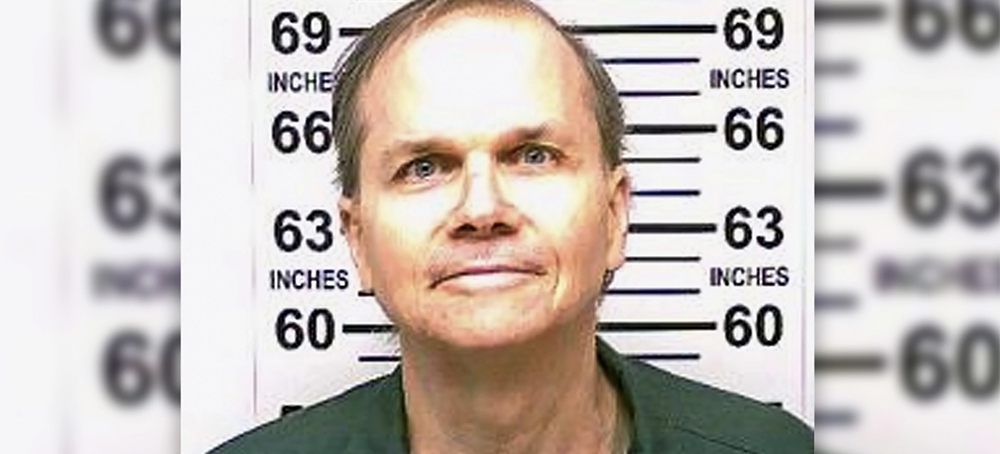 This Jan. 31, 2018 photo, provided by the New York State Department of Corrections, shows Mark David Chapman, the man who killed John Lennon. Chapman, 63, who is serving 20-years-to-life in the Wende Correctional Facility in western New York, is scheduled to go before New York's parole board the week of Aug. 20, 2018, in what will be his 10th attempt to win release. (photo: AP)
Chapman has been denied release every two years since first becoming eligible for parole in 2000
Chapman’s latest parole hearing took place at the end of August, though no transcripts from the board interview have been made available yet. In a statement, the New York Department of Corrections and Community Supervision said, “Following an interview with the Board of Parole on August 31, 2022, Mr. Chapman was denied release with a hold of 18 months. His next appearance date is scheduled for February 2024.” This marks the 12th time that Chapman’s attempt at parole has been denied.
Chapman shot and killed Lennon outside the musician’s Manhattan apartment on Dec. 8, 1980. The following year, Chapman pleaded guilty to second-degree murder. He was sentenced to 20 years to life at Green Haven Correctional Facility in New York. He was first up for parole in 2000 and has had hearings every two years since.
In past parole hearings, as The Associated Press notes, Chapman has expressed remorse for killing Lennon, stating that he has felt “more and more shame” for his crime over the years. During his last parole interview in 2020, he called his actions “despicable” and said, “I assassinated him … because he was very, very, very famous and that’s the only reason, and I was very, very, very, very much seeking self-glory. Very selfish.”
Lennon’s widow, Yoko Ono, has repeatedly argued against Chapman’s release, expressing fears for her own safety, as well as that of Lennon’s sons, Julian and Sean. “One thing I think is that he did it once, he could do it again, to somebody else — you know,” Ono told The Daily Beast in 2015. “It could be me, it could be Sean, it could be anybody, so there is that concern.”
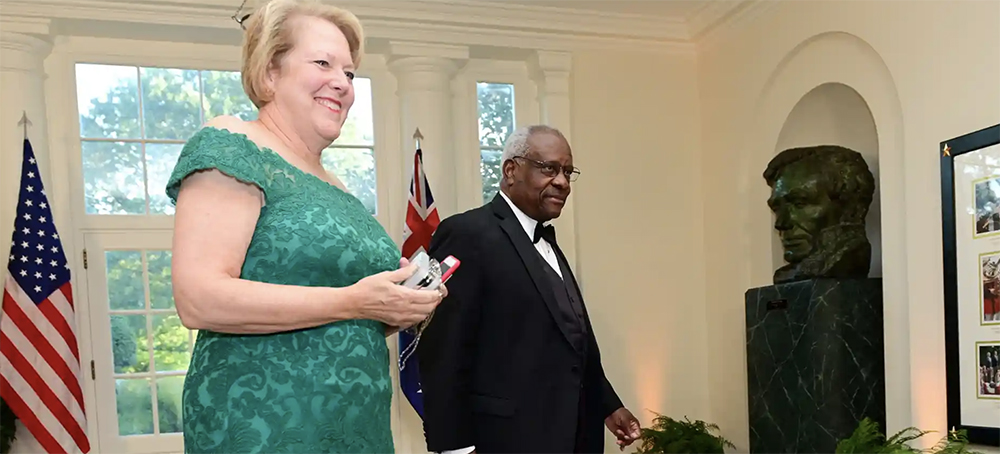 Ginni Thomas with Clarence Thomas, her husband, at the White House in September 2019. The findings raise concerns about a possible conflict of interest at the highest levels of the US judiciary. (photo: Erin Scott/Reuters)
Analysis of ‘amicus briefs’ shows how closely Clarence Thomas’s wife was entwined with rightwing effort to reverse 1973 ruling
A new analysis of the written legal arguments, or “amicus briefs”, used to lobby the justices as they deliberated over abortion underlines the extent to which Clarence Thomas’s wife was intertwined with this vast pressure campaign.
The survey found that 51% of the parties who filed amicus briefs calling for an end to a federal abortion right have political connections to Ginni Thomas, raising concerns about a possible conflict of interest at the highest levels of the US judiciary.
The six-to-three rightwing majority of the court, supercharged by Donald Trump’s three appointed conservative justices, in June overthrew the constitutional right to an abortion. Clarence Thomas was among the six who voted for the hotly contested ruling, Dobbs v Jackson.
The ruling was one of the most consequential in the supreme court’s 233-year history. It has triggered the lightning spread of partial or total abortion bans across Republican-controlled states, affecting almost one in three women aged 15 to 44.
The Dobbs case, brought by Mississippi which sought to ban abortions after 15 weeks of pregnancy, attracted an almost unprecedented 130 amicus briefs from both sides of the legal argument. Of those, 74 were filed in favour of overturning the right to an abortion, enshrined in 1973 in Roe v Wade.
In turn, the new analysis shows that 38 of the 74 anti-abortion amicus briefs – 51% – were produced by entities and individuals with links to Ginni Thomas. They included rightwing groups, religious interests, prominent conservative individuals and lawyers.
“The Thomases are normalizing the prospect of too close an association between the supreme court and those who litigate before it,” said Melissa Murray, a law professor at New York University and co-host of the Strict Scrutiny podcast. “This isn’t the first time that Mrs Thomas has had dealings with those who come before the court and seek her husband’s vote.”
The revelation that there is substantial overlap between Ginni Thomas and the anti-abortion lobbying effort focused on her husband and the other conservative justices will intensify the growing sense of unease surrounding her hyper-energetic conservative activism. In recent years she has placed herself in the thick of some of the most bitterly contested political controversies that have come – or could come – before the court.
Earlier this year, the New Yorker published an investigation into the mounting evidence of possible conflicts of interest under the headline: ‘Is Ginni Thomas a threat to the supreme court?’
Thomas has been dubbed a “radical insurrectionist” for her role in backing Trump’s attempt to subvert the 2020 presidential election. Yet her husband has refused to recuse himself from cases relating to the insurrection, including one in January in which he became the only justice to dissent in an 8-1 decision over allowing hundreds of documents held by the National Archives to be reviewed by the House committee investigating the January 6 storming of the US Capitol.
Five weeks after that decision, it was revealed that leading up to January 6 Ginni Thomas exchanged 29 text messages with Trump’s White House chief of staff, Mark Meadows, urging him to block Joe Biden’s victory. It is very possible that those text messages were among the documents that the committee had been seeking, with Clarence Thomas the sole justice opposing disclosure.
The January 6 committee has said it wants to interview Ginni Thomas over her anti-democratic antics around the 2020 election. Last week the Washington Post revealed that she applied pressure on lawmakers in Wisconsin to block Biden’s win, having previously done the same in Arizona.
The analysis of the amicus briefs was carried out by Advance Democracy Inc, a non-partisan organization specializing in public-interest research and investigations. It shared its findings with the Guardian.
They show an intricate web of connections between many of the most influential groups and figures on the conservative hard right, with Ginni Thomas at the centre of it. Several of the links run through her consultancy, Liberty Consulting, which she set up in 2010 and which brags that it can “give access to any door in Washington”.
Another major route is through the Council for National Policy (CNP), a secretive Christian conservative networking group that the New York Times described as a “little-known club of a few hundred of the most powerful conservatives in the country”. The binding mission of the members is “limited government, strong national defense, and support for traditional western values”.
Ginni Thomas is listed as a board director of the lobbying arm of the group, CNP Action, in a 2020 tax filing obtained by the investigative watchdog Documented. In a speech to a CNP event in 2019 she described her role within the conservative movement as that of “a convenor – I find the talent and I put them in the room and have them talk to one another”.
A leaked CNP directory from this year lists as Thomas’s fellow members several prominent conservatives involved in filing amicus briefs to the supreme court in the abortion case. They include Marjorie Dannenfelser, president of the anti-abortion group Susan B Anthony List, who led a discussion at a CNP conference in February titled: After Roe, Then What?
Leonard Leo, the founder of the rightwing Federalist Society, with which Clarence Thomas is intimately associated, sits on the board of the Ethics and Public Policy Center, which filed an amicus brief. Leo was arguably the key strategist behind Trump’s packing of the supreme court to obtain its current supermajority; he shares CNP membership with Ginni Thomas and is a close collaborator of hers.
Other CNP members who have been involved in filing amicus briefs in the abortion case include: Jay Sekulow, Trump’s former lawyer at his first impeachment trial, who is chief counsel for the American Center for Law … Justice; David Nammo of the Christian Legal Society; Tony Perkins, president of the anti-abortion Family Research Council; Margaret Hartshorn, chair of Heartbeat International; and many more.
There are several other overlapping connections to the amicus briefs through separate networks such as Groundswell, a conservative advocacy group of which Ginni Thomas described herself as chairman in 2019. Groundswell was formed in 2013 to foment “a 30-front war seeking to fundamentally transform the nation”.
John Eastman, the conservative lawyer who is heavily implicated in the effort to block certification of Biden’s presidential victory, filed an amicus brief in the abortion case on behalf of the Claremont Institute’s center for constitutional jurisprudence, of which he was founding director. Eastman acted as law clerk to Justice Thomas in 1996 and has been described by the New York Times as a “close friend” of Clarence and Ginni.
Thomas herself has denied any conflict of interest between her activism and her husband’s jurisprudence. She told the Washington Free Beacon earlier this year: “We have our own separate careers, and our own ideas and opinions too. Clarence doesn’t discuss his work with me, and I don’t involve him in my work.”
Whether that is true is perhaps a moot point, given that the mere appearance of conflict of interest can in itself damage an institution’s reputation. Already, the supreme court is viewed unfavourably by 44% of the American people according to a Pew Research Center poll, with only 16% thinking they do an excellent or good job keeping their personal political views out of their decisions.
“The supreme court is unlike any other branch because it only has its legitimacy to make the public adhere to what it does. Lose that and the court loses the kind of institutional pull that makes the law come together and bind us,” Murray said.
Unlike all other federal judges in lower appeals and district courts who are obliged to recuse themselves in cases of potential conflict of interest involving their spouses, the nine justices of the supreme court are entirely unfettered by any code of judicial ethics. They in effect police themselves.
Every year Clarence Thomas has to file a financial disclosure, but the detail given is minimal. He lists under his spouse’s income “Liberty Consulting, Inc – salary and benefits”, but does not reveal her clients or her board positions on groups such as CNP or Groundswell.
The lack of controls have led to a rising chorus calling for reform. “At the very least the justices need to adopt a formal code of conduct that they commit to following,” said Gabe Roth, executive director of the non-partisan group Fix the Court. “That code would take on board potential conflicts of interests involving their spouses.”
Ginni Thomas’s ties with groups responsible for the whirlwind lobbying campaign over abortion could have serious ramifications in future cases that come before the court. Clarence Thomas made it clear in his concurring opinion in Dobbs that he intends to use exactly the same arguments that were deployed in overthrowing Roe v Wade to challenge the constitutional right to same-sex marriage, same-sex relations and contraception.
Many of the interests to which Ginni Thomas was connected who filed anti-abortion amicus briefs have a parallel track record of anti-LGBT agitating. The founder of CNP, Tim LaHaye, was an evangelical Christian minister and a virulent homophobe.
His 1978 book The Unhappy Gays depicted gay people as “militant, organized” and “vile”. “Homosexuality is a blight on humanity,” he wrote. “Many parents would prefer the death of their child to his adopting the unhappy wretchedness of homosexuality.”
 Donald Trump. (photo: Spencer Platt/Getty Images)
“President Trump himself is making it UNDENIABLE that he is 100% aligning with the Q operation,” one QAnon follower said.
Trump shared a picture of himself wearing a Q lapel pin, overlaid with the QAnon phrases “The Storm is Coming” and “WWG1WGA,” on his Truth Social account on Monday evening. The post was originally shared on Truth Social by an account called “Patriots in Control,” before Trump re-shared it.
“How much more obvious can it get?” one QAnon follower asked in the QAnon-focused Great Awakening forum.
In QAnon world, the “storm” is the moment when Trump will reveal his secret plan to dismantle the deep state and the group of elites QAnon followers believe are operating a global child sex trafficking ring. The “storm” will also, they think, trigger Trump’s return to power and the public executions of those who’ve acted against him, from former Secretary of State Hillary Clinton to current President Joe Biden.
The post comes just weeks after the ex-president went on a QAnon-filled posting spree on Truth Social. “It's almost like Trump is trying to tell us something,” one popular QAnon influencer wrote, referencing Trump’s increasing embrace of the QAnon conspiracy. Trump’s influence is undeniable: As he continues to hint at another run for president in 2024, Trump is using his huge sway within the Republican Party to endorse a slate of candidates for the November midterms who openly support the lie that the 2020 election was rigged.
The QAnon movement has been in flux since Trump’s 2020 election defeat coupled with the lack of any communication from Q over the last 18 months. But Monday’s post by Trump has once again invigorated his most loyal base of supporters.
Telegram channels and message board threads lit up on Monday night with supporters who believed that once again, this was a sign that “it’s happening” and that “there's certainly no doubt now that Trump is openly endorsing Q.”
“Just in case it wasn’t abundantly CLEAR at this point, President Trump himself is making it UNDENIABLE that he is 100% aligning with the Q operation,” John Sabal, the organizer of QAnon-focused conferences, wrote on his Telegram channel which has over 60,000 subscribers.
Some of the members of a QAnon-focused message board claimed that Trump posting this photo just days after the death of Queen Elizabeth II—an incident that QAnon supporters had a lot of thoughts about—was an indication that this time the “storm” really is coming.
But for some QAnon supporters who have believed for a long time, it’s all getting to be too much:
“I hope we are almost there…. I am so tired… and broke,” one wrote on Telegram. On the QAnon message board, another simply wrote: “ I'm exhausted.”
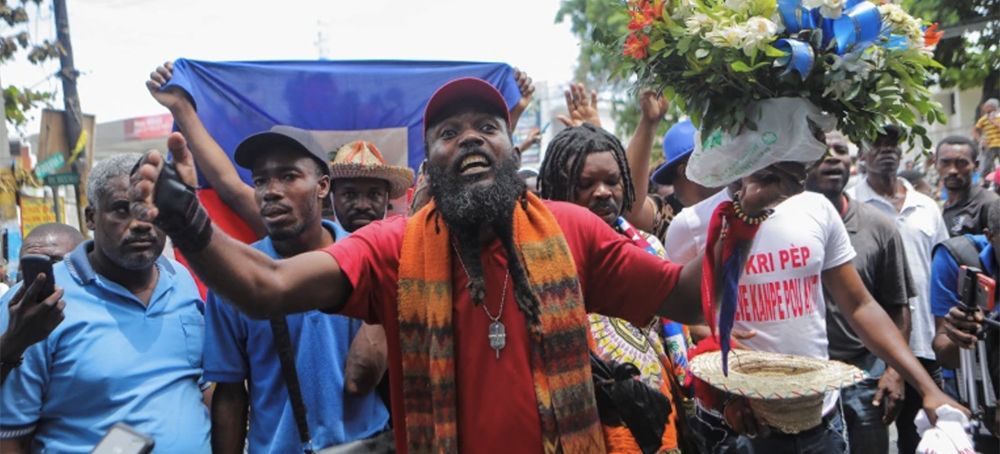 Protesters demonstrate last month against rising costs of living and violence in Haiti, where gangs have grown more powerful since the assassination of former President Jovenel Moise last year. (photo: Ralph Tedy Erol/Reuters)
Fatal shooting of two Haitian journalists in Port-au-Prince draws condemnation as gang violence continues to soar.
The two reporters were fatally shot and their bodies burned on Sunday while they were reporting on violence in the impoverished neighbourhood of Cite Soleil, which has suffered from heightened gang activity in recent months. Their bodies have not been recovered.
The victims were identified as journalists Tayson Latigue, who worked for digital publication Ti Jenn Jounalis, and Frantzsen Charles, a reporter with FS News Haiti.
“We announce with great sorrow the death of our journalist and reporter Frantzsen Charles and another colleague. They were killed by bandits while reporting in Cite Soleil. We demand justice for our colleague,” FS News Haiti said in a statement.
Their deaths come amid rising violence in Haiti, where rival gangs have been battling for control of territory in and around the capital as instability worsened after President Jovenel Moise’s assassination in July of last year.
The reporters had been investigating violence in Cite Soleil, including the recent killing of a 17-year-old girl, when they were attacked on Sunday, according to a statement from Haiti’s Association of Independent Journalists.
“The journalists were just doing their job,” the group said. “They didn’t commit any crime.”
Dieudonne St-Cyr, a reporter with the association, told radio station Metropole Haiti that seven journalists were ambushed by two warring gangs. Five of the reporters were able to escape unharmed.
The association has called on Haiti’s government to address rising instability, calling the murders “further proof of the inability of the state to protect lives and property, which is nothing other than a violation of human rights”.
It also described the killings as a “villainous and odious act”.
Haitian Prime Minister Ariel Henry said he was “deeply shocked” by the deadly attack on the reporters. “We strongly condemn this barbaric act, while sending our heartfelt thoughts to the families of the victims and their colleagues,” he wrote on Twitter on Monday night.
Henry has called for assistance as the island nation struggles to cope with rising violence, inflation, and fuel shortages. “The country has a lot of problems,” he said in a televised speech earlier this week. “I am calling on everyone to stay calm. The government is working with what it has.”
Haitians have taken to the streets to demonstrate against rising costs of living and to call for the removal of Henry, who has pushed back against accusations that he is trying to hold onto power.
Residents of Port-au-Prince sheltered at home on Tuesday as gun fire rung out, road blocks and burning tires were placed along city streets and protesters threw stones in an angry response to expected new fuel price hikes and crime.
Previous calls for accountability for killings of Haitian journalists have largely gone unanswered.
In January, two Haitian journalists, Wilguens Louissaint and Amady John Wesley, were killed by gangs on the outskirts of Port-au-Prince.
Louissaint and Wesley were also reportedly burned alive by armed groups in Laboule 12, a neighbourhood that has been the site of violence between various gangs.
The April 2000 assassination of Haitian journalist Jean Dominique, the island nation’s most famous reporter at the time, also remains unsolved.
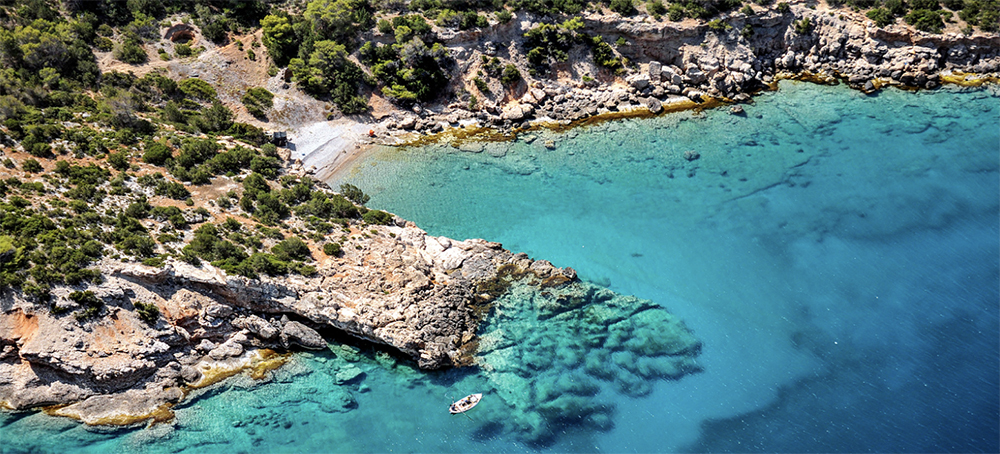 The satellite data from the study showed that the Mediterranean's average surface temperature has risen by 1.2°C (2.2°F) since the mid-1980s. (photo: Katerina Katopis/Ocean Image Bank)
Surging sea surface temperatures, at times up to 5° Celsius (9° Fahrenheit) above normal and driven by climate change, triggered “unprecedented” die-offs among dozens of species in each of the five years of the study period, the authors reported July 18 in the journal Global Change Biology.
“What is happening is quite dramatic,” Joaquim Garrabou, a marine conservation ecologist at Spain’s Institute of Marine Sciences and the study’s lead author, said in an interview. “It’s like having a forest fire in the marine habitat.”
But unlike the visible destruction that comes with a forest fire, the tranquil surface of the sea belies the upheaval just below, Garrabou said, with little outward sign of “what’s going on under this blue layer.”
What’s going on is the shocking loss of the superlative biodiversity found in the Mediterranean, he said. Though small compared to the world’s great oceans, the Mediterranean Sea is home to 7-10% of all marine species, many of them found nowhere else on Earth. What’s more, seafood harvests from that biological bounty support many of the 400 million people living in the region.
To bring the changes to these coastal ecosystems into sharper focus, Garrabou led an effort to bring together research on the effects of climate change from around the Mediterranean Sea. Ultimately, he said, he hopes this evidence will convince leaders and policymakers of the importance of protecting the basin’s ecological communities.
“If the people understand that what is going on is so serious and that we need to provide solutions, maybe the implementation of these measures will be much easier,” Garrabou said.
The research team began by evaluating sea surface temperatures using satellite data going back to the 1980s, along with localized temperature readings from 75 sites in 11 Mediterranean countries from the online database T-MEDNet. They then analyzed the results of coastal biological surveys from 33 research teams, looking at when, where and what species were involved in large die-offs — what scientists call “mass mortality events.”
The satellite data showed that the Mediterranean’s average surface temperature has risen by 1.2°C (2.2°F) since the mid-1980s, and the five years of the study period were the warmest recorded over that time. In part, that rise is due to the buffer that bodies of water like the Mediterranean have provided against the planet’s warming atmosphere. The world’s marine systems have absorbed 90% of the heat stemming from greenhouse gas emissions, and they’ve also drawn in around one-third of the excess carbon added to the atmosphere by humanity since the beginning of the Industrial Revolution.
Marine heat waves have hit more than three-quarters of the Mediterranean’s surface in the past decade, laying bare the consequences of sponging up that much carbon and heat.
The research by Garrabou and his colleagues shows that those surging temperatures impact a staggering breadth of marine species, with documented mass mortality events between 2015 and 2019 affecting 50 taxonomic groups from categories across the animal kingdom.
Many Mediterranean marine species hail from the higher-latitude, temperate — and in some cases, colder — regions of the Atlantic Ocean as a result of the connection through the Strait of Gibraltar that opened more than 5 million years ago. Through this conduit, the Atlantic has been a critical source of biodiversity for the Mediterranean, allowing the entrance at different times of species with an affinity for cold or warm water depending on climatic fluctuations. Today, Mediterranean marine biodiversity still carries a strong signature of the last glacial age that ended about 17,000 years ago, with many species unable to withstand current warming rates.
This research “starts to uncover the biological mechanism behind the loss of [Mediterranean] biodiversity due to global warming,” said Paolo Albano, a senior scientist at Italy’s Stazione Zoologica Anton Dohrn.
Species migrations northward or deeper down have occurred, but the confines of the Mediterranean Sea mean there’s only so far they can go.
The researchers report the occurrence of mass mortality events along “thousands of kilometers of coastline” down to depths of 45 meters (148 feet).
That’s “quite deep,” Albano said, “but still, this depth is not enough to buffer benthic communities from the effects of warming.”
Thomas Wernberg, a professor of marine botany at the University of Western Australia, said Garrabou’s comprehensive study reveals that the patterns of biodiversity loss due to heat waves are “extensive.”
“It is really scary and mind-blowing,” said Wernberg, who also was not involved in the research. “We are not talking about individual isolated effects in some rare corner of the planet on some particularly sensitive critter. We’re talking about whole ecosystem impact.”
Around the world, climate-warming greenhouse gas emissions from fossil fuel use, deforestation and agriculture continue apace, forcing average global atmospheric temperatures upward. And the Mediterranean happens to be a climate change hotspot, with atmospheric warming increasing nearly twice as quickly as the rest of the world; the region has already warmed by more than 1.5°C (2.7°F) over pre-industrial levels.
Scientists recently projected in the journal Reviews of Geophysics that if global emissions continue at the current rate — the so-called business-as-usual scenario — a total spike of 5°C (9°F) in atmospheric temperatures by 2100 in the Eastern Mediterranean and Middle East is possible.
Garrabou said ongoing climate change means marine heat waves — and their effects on life in the Mediterranean — will continue, and there’s no time to spare to avoid the worst effects.
Stopping the heat waves will require a swift drawdown of the amount of carbon emitted by humans. Even then, reversing the warming in the Mediterranean Sea would take a century or more, Wernberg said. But society has yet to fully make strides toward such a bold step.
“The tragedy here really is that we have known about these potential changes for about 30 years,” he said. Had humanity acted as the first signs of global warming were coming into focus, “We would not have been facing a future where the train had already left the station.
“Now, it just takes a long time to stop that train,“ Wernberg added.
Still, investing now in preserving and expanding marine protected areas (MPAs) in the hardest-hit parts of the sea could help ecological communities weather heat waves, Garrabou said. Currently, MPAs cover only about 8% of the Mediterranean.
But while boundaries of a protected area can’t hold back destructive surges of warm water, Wernberg said, well-protected MPAs could help ensure that ecosystems aren’t confronted by numerous assaults. If MPAs reduce overfishing or chemical pollution, for example, it could give species a better chance to survive the impacts of warming, he said.
“It’s about simply not adding multiple stresses onto these ecosystems,” Wernberg said.
Albano said he favors stringent protections for deeper areas, down to perhaps 150 m (492 ft). These deep-down assemblages of native plants and animals survive intact below the thermocline, where the tendrils of warmer waters have yet to reach. The hope is that these species, many of which can also live in shallower waters, will repopulate the waters above — if they somehow do cool down in the future.
Human-led restoration of degraded marine habitats is also worth pursuing, Garrabou added. But he acknowledged that such efforts are costly and “limited” in scale compared to the impacts of the basin-wide battering by heat waves that he and his colleagues have documented.
Still, we must use every tool at our disposal to maintain what remains of the Mediterranean’s remarkable biodiversity, he said.
“There is no magic solution for this,” Garrabou added. But, “If we keep the ecosystems or the habitats in the best condition possible, they can face these climate change effects in a better way.”
Citations:
Garrabou, J., Gómez‐Gras, D., Medrano, A., Cerrano, C., Ponti, M., Schlegel, R., … Harmelin, J.-G. (2022). Marine heatwaves drive recurrent mass mortalities in the Mediterranean Sea. Global Change Biology, 28(19), 5708-5725. doi:10.1111/gcb.16301
Zittis, G., Almazroui, M., Alpert, P., Ciais, P., Cramer, W., Dahdal, Y., … Lelieveld, J. (2022). Climate change and weather extremes in the Eastern Mediterranean and Middle East. Reviews of Geophysics, 60(3), e2021RG000762. doi:10.1029/2021RG000762
This article was originally published on Mongabay.
Follow us on facebook and twitter!
PO Box 2043 / Citrus Heights, CA 95611


Comments
Post a Comment