RSN: Andy Borowitz | Student-Loan Forgiveness Inspires Giuliani to Apply to Law School

31 August 22
We are fighting to hold on to our budget and serving our readership with dedication while doing it. It can be a thankless assignment.
Ask yourself why you trust RSN.
It requires support.
Now is the time.
Marc Ash
Founder, Reader Supported News
If you would prefer to send a check:
Reader Supported News
PO Box 2043 / Citrus Heights, CA 95611
Follow us on facebook and twitter!
30 August 22
Live on the homepage now!
Reader Supported News

 Former U.S. president Donald Trump. (photo: Saul Loeb/Getty)
Tony Ornato, who reportedly told aide Trump lunged for steering wheel as Capitol attack was starting, was key figure to committee
Ornato was thrust into the center of the January 6 furor as an eyewitness to some of the most critical incidents involving Donald Trump in the hours leading up to the deadly assault on the US Capitol.
He began as head of Trump’s Secret Service detail but in an unprecedented move in December 2019 became deputy chief of staff in the White House.
In that capacity, he was drawn into the sights of the January 6 committee in its investigation of Trump’s role in inciting the Capitol insurrection. A former White House aide, Cassidy Hutchinson, in June testified publicly to the committee that Ornato had told her Trump had become “irate” when his security detail refused to drive him to the Capitol as the assault on Congress was beginning.
The attack aimed to prevent the congressional certification of Trump’s defeat to Joe Biden in the 2020 presidential election.
When his Secret Service driver insisted it was not safe to go, Trump lunged for the steering wheel and then grabbed the agent’s throat, Hutchinson testified Ornato had told her. Ornato reportedly denied the account through unnamed sources.
Hutchinson also revealed to the committee that Ornato had briefed top White House aides on January 6 itself that weapons were being carried among the crowd at the Capitol, including guns, knives and spears. Ornato has not denied that allegation.
On Monday, he confirmed that he had retired from the Secret Service, saying in a statement that he wanted to work in the private sector. He has already been interviewed twice by the January 6 committee, though the contents of his testimony have not been made public.
Among the areas of interest that the committee is likely to be pursuing is Ornato’s knowledge of how Trump’s vice-president, Mike Pence, was handled by Secret Service agents on January 6. As armed rioters were milling through the Capitol, shouting “Hang Mike Pence!”, the vice-president’s security detail tried to persuade him to evacuate the area.
“I’m not getting in the car,” Pence told the lead special agent, according to Philip Rucker and Carol Leonnig in their book I Alone Can Fix It.
At the White House, Ornato, who as deputy chief of staff had oversight over Secret Service decisions, told Pence’s national security adviser, Keith Kellogg, that the vice-president was going to be moved to the Maryland military facility Joint Base Andrews. Had he been evacuated, Pence would no longer have been able to certify Biden’s electoral victory, and Trump’s goal of postponing his defeat would have been fulfilled.
When Ornato said that the Secret Service would move Pence, Kellogg was adamant, Rucker and Leonnig reported. “You can’t do that, Tony,” Kellogg said. “Leave him where he’s at. He’s got a job to do. I know you guys too well. You’ll fly him to Alaska if you have a chance. Don’t do it.”
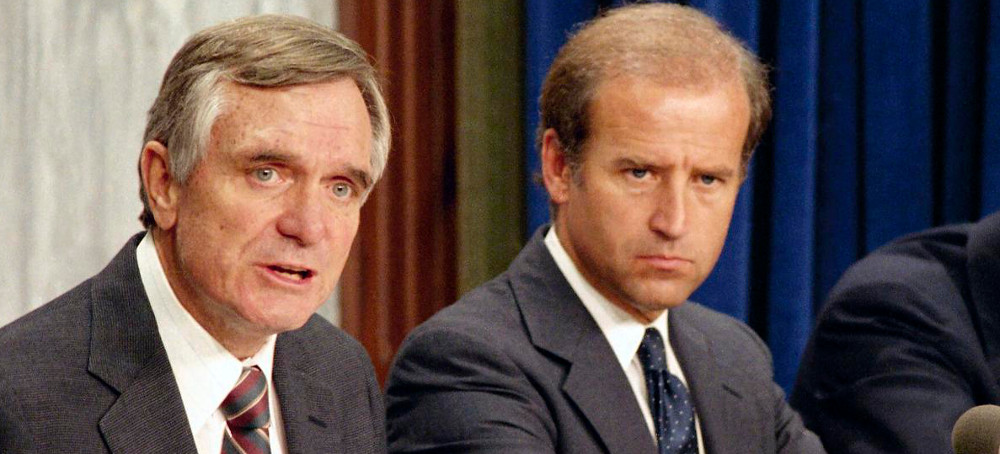 Sen. Lawton Chiles, D-FL, left, and Sen. Joseph Biden, D-DE, right, talk to reporters about a legislative package to address the problem of crack cocaine on Aug. 5, 1986, on Capitol Hill in Washington. (photo: Scott Stewart/AP)
As part of the “war on drugs” — a consequential, anti-crime legislative agenda that Biden championed as a U.S. senator — an estimated hundreds of thousands of convicted drug offenders had their access to federal financial aid delayed or denied, including Pell Grants and student loans. If they wanted to go to college after their prison terms ended, these offenders had to take on larger, often predatory, private student loans.
Some were discouraged from seeking federal aid by a requirement to disclose their drug record on financial aid applications, while others put off attending college or dropped out entirely.
The people most harmed by these policies: Black and Latino men, thanks to drug laws in the 1990s with harsh punishments for crack cocaine and marijuana offenses. Incarceration rates for men of color skyrocketed. The policies remained in place for 25 years, until Congress repealed the Pell Grant ban in 2020.
America’s student loan debt burden, which now tops $1.6 trillion, “is especially heavy on Black and Hispanic borrowers, who on average have less family wealth to pay for it,” Biden said last week as he announced the forgiveness plan.
The administration has offered to forgive up to $10,000 in student debt for individuals earning annual incomes of less than $125,000, or less than $250,000 for families. And its offer doubles the debt relief to $20,000 for borrowers who also received Pell Grants, a federal program that gives the neediest undergraduates aid that they don’t have to repay.
Studies show that Pell Grants — one of the nation’s most effective financial aid programs — routinely help more than half of Black students and almost half of Hispanic students afford college. According to the White House, among the 43 million borrowers who are eligible for debt relief under Biden’s plan, more than 60% are Pell Grant recipients.
The White House said in a statement to The Associated Press that the student debt relief plan will wipe away about half of the average debt held by Black and Hispanic borrowers, not counting the additional $10,000 cancellation for Pell Grant recipients.
Amid debate over whether Biden’s forgiveness plan goes far enough for disproportionately indebted communities, criminal justice reform advocates say the president’s solutions to the student debt crisis must be as comprehensive as the anti-drug laws were.
“I think there’s a particular onus on this administration and on this president to be part of the solution for issues that he was very deeply involved in,” said Melissa Moore, the director of civil systems reform at Drug Policy Alliance.
There’s a generation of former drug offenders who borrowed to pay for school, but don’t have Pell Grants or federal loans, and won’t have any of their student debt forgiven. According to a Student Borrower Protection Center report on private loan debt, Black students are four times as likely as white students to struggle in repayment of private loans.
“For people who previously would have had to check that box, there should be some mechanism by which, if you were excluded in the past, you are prioritized now for relief,” Moore said.
An AP review last year of federal and state incarceration data showed that, between 1975 and 2019, the U.S. prison population jumped from 240,593 to 1.43 million Americans, as a result of the war on drugs that President Richard Nixon declared in 1971. About 1 in 5 people were incarcerated with a drug offense listed as their most serious crime.
Nixon’s Democratic and Republican presidential successors would go on to leverage drug war policies, responding to an alarming national surge in violent crime linked to the illegal drug trade, cementing the drug war’s legacy.
Following the passage of stiffer state and federal penalties for crack cocaine and other drugs, the incarceration rates for Black and Hispanic Americans tripled between 1970 and 2000. By comparison, the white incarceration rate only doubled in that same timespan.
Biden's Violent Crime Control and Law Enforcement Act of 1994 put in place the ban on Pell Grants and other federal financial aid for people incarcerated in federal or state prison. However, then-Sen. Biden reportedly opposed the amendment that added the ban to his bill. At the time, his spokesperson said Biden believed education programs could break the cycle of recidivism among formerly incarcerated individuals.
Ultimately, Biden worked passionately to pass the crime bill he sponsored. Academic programs in federal and state prisons, which had been robust, dwindled severely nationwide.
Later, in 1998, Congress expanded the ban to exclude any student with a state or federal drug conviction from receiving Pell Grants and federal student loans, for as little as one year or indefinitely, depending on the number of convictions. Biden voted in favor of the measure, although his opinion on the Pell Grant provision was unclear.
In just the five years after the expanded ban took effect, the measure cost more than 140,000 would-be college students between $41 million and $54 million in Pell Grants per year, and between $100 million and $164 million in federal student loans per year, according to an estimate by the federal Government Accountability Office.
However, in 2006, Congress changed the ban on grants to drug offenders. It applied only to students whose convictions happened while they were receiving federal student aid, narrowing its effect significantly, although experts say the law still forced hundreds of enrolled students to drop out of college when they lost their aid. The ban on Pell Grants for incarcerated individuals was fully repealed when Congress passed the omnibus spending and COVID-19 relief legislation in December 2020.
Drug convictions no longer affect a student’s financial aid eligibility, although the question still appears on the Free Application for Federal Student Aid, or FAFSA. In April, the U.S. Department of Education expanded its Second Chance Pell Program, which provides grants to incarcerated students to help them enroll in academic programs. A further expansion of Pell Grants to incarcerated students begins in July 2023, according to the Department of Education.
For DeAnna Hoskins, the legacy of the war on drugs nearly cost her much-need Pell Grants and student loans. She attended college after her incarceration and, by happenstance, just after Congress lifted the ban on aid to people with drug convictions.
“The ’94 crime bill was so comprehensive in the destruction that it did," said Hoskins, the president of JustLeadershipUSA, a criminal justice reform group. She questions how Biden’s debt relief plan was crafted. “I feel like you’re piecemealing our liberation back to us.”
There are tens of thousands of people who had to get private student loans at high interest rates, because of the ban on Pell Grants, Hoskins added.
“This is why it’s so important, when decisions like this are being made, that the voices of people with lived experiences are present,” she said. “We can help you obtain the equity you’re seeking.”
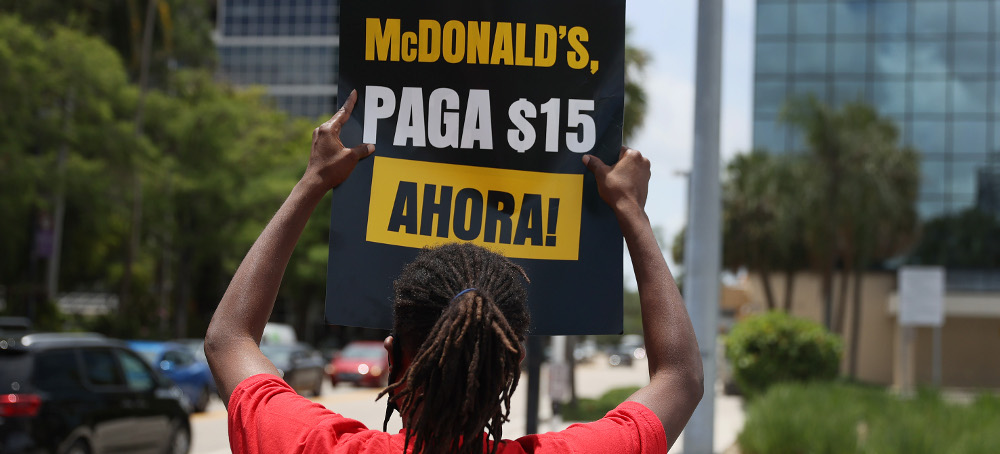 McDonald's workers and labor activists protest against the restaurant chain on may 19, 2021 in Fort Lauderdale, Florida. (photo: Joe Raedle/Getty)
A new bill would give fast-food workers a seat at the table setting labor standards.
Twenty-three years later, on July 8 this year, she was fired from her job. Luna alleges she was let go was in retaliation for speaking up in defense of a co-worker who was allegedly being sexually harassed as well as for her own dispute with McDonald’s over quarantine wages, which got her involved in the Fight for $15 and a Union, the SEIU-aligned movement of food and retail workers that’s been instrumental in improving local and state minimum wage and other labor laws around the country over the past decade.
The now ex-shift manager still hasn’t found another job, and she grew emotional while speaking about her current situation.
“It’s been very hard for me and my family. Now they left me without a job,” Luna told VICE News via a translator. “They don’t know or understand the consequences. They’ve left me without a salary, and now I can’t pay my bills or rent.”
In a statement obtained through McDonald’s corporate offices, the franchise’s owner/operator Lee Ann Freeman told VICE News that Luna’s claims of retaliation and harassment are “false. My organization is committed to providing a safe and respectful workplace, and we do not tolerate harassment or retaliation of any kind.”
But while it’s too late to save her job, Luna believes that a bill pending final legislative approval in California will give workers in similar situations stronger protections, and fast-food workers in general a more active role in determining standards in an industry infamous for mistreating workers.
The bill, AB 257, would pave the way for a Fast Food Council, comprising workers and union representatives, as well as fast-food corporations and franchisees and state officials. If the bill is signed into law and 10,000 California fast-food workers sign a petition in support of creating the council, the council would mandate working conditions within the industry, including wages, hours, health and safety standards, and “the right to be free from discrimination and harassment in the workplace.”
The fast-food industry and other business interests have thrown the full force of their lobbying efforts into defeating the bill. The National Restaurant Association warned that success would mean that other bills could follow in states like New York and Oregon and that it was “imperative for the industry to focus its efforts” on California, Vox reported earlier this month.
The bill is also opposed by Democratic Gov. Gavin Newsom’s Department of Finance, and Newsom himself has been silent on whether he’d sign or veto the bill if it hits his desk. He’ll be forced to choose soon, however: The proposal passed the California Senate on Monday, and is expected to receive final legislative approval from the state Assembly Tuesday.
The legislation has the potential to transform the worker-employer relationship in the fast-food industry, and advocates—like the corporations fighting the bill—believe its impacts could stretch out beyond California and even the fast-food industry.
But for workers like Luna, the intended impact—to put California’s fast-food employees on equal footing with their bosses in determining standards—would be enough.
“We’re fighting so that people like myself who stayed silent out of fear of retaliation have a place where our voices can be listened to, and where we can fight for all of our rights.”
“They’re gaslighting you”
The fast-food industry has long been used as a cudgel by conservatives and business interests who’ve argued for lower wages and other labor standards. High schoolers “flipping burgers,” so the argument goes, don’t deserve livable wages or the same labor standards as other professions. Studies show the vast majority of fast-food workers are not teenagers, and that fast-food workers’ duties include much more than that, according to restaurants’ own job descriptions (also, high schoolers deserve fair treatment on the job).
But fast-food work has also become synonymous with rampant worker exploitation. The SEIU-backed advocacy group Fight for $15 released a survey of fast-food workers in California earlier this year, in which 85 percent of workers said they’d experienced at least one form of wage theft while working in fast-food restaurants. In 2020, McDonald’s settled $26 million wage-theft lawsuit with more than 30,000 California workers at corporate-owned stores in 2020, for violations dating back to 2013.
Luna told VICE News that she first became involved with the Fight for $15 after she had trouble getting McDonald’s to pay her for quarantining, a violation of the Families First Coronavirus Response Act signed into federal law in 2020. (As of August 2020, owners of six McDonald’s franchises and nearly 700 companies total had been cited for violating the law, according to a 2020 Center for Public Integrity report.)
“I got paid for my quarantine time, but I got a call from my supervisor, and that’s when he said he didn’t want third parties speaking for me,” Luna said. (Management typically refers to unions as “third parties” that attempt to drive a wedge between employer and employee, rather than the voice of workers themselves.)
“That’s when they started reducing some of my hours… when I brought it up to the store manager, they said they had enough labor and needed to reduce hours. But everyone else had their same schedules and some were working six days out of the week.”
Workers have also alleged that the industry is rife with sexual harassment. Last year, McDonald’s workers across the country participated in a one-day walkout in protest of the company’s handling of sexual harassment, and in July, a franchise owner of 10 McDonald’s franchises in Vermont and New England settled for $1.6 million after the U.S. Equal Employment Opportunity Commission (EEOC) and Vermont sued over claims a store manager had groped workers, including teenagers.
Sandro Flores told VICE News that he’s worked at three Carl’s Jr locations in California over the last five years. Flores, who is gay, says he’s been subjected to homophobic harassment from co-workers, including name calling, and said that one of his peers once threw a hamburger at him.
But rather than resolving the harassment, Flores says, management has retaliated against him by cutting his hours and even transferring him to other locations that are farther away from where he lives. During rush hour, he says, it can take him up to an hour to get to work.
“When you try to speak to management about it, it’s a sense of retaliation, that it’s your fault. They’re gaslighting you,” Flores said. “This is a story you hear with many workers that want to try to speak up, it’s the fear of retaliation and that they’re going to get punished for speaking up.”
Workers at the restaurant went on strike earlier this month in support of Flores.
CKE Restaurant Holdings, Carl’s Jr’s parent company, did not respond to a request for comment on Flores’ claims Monday.
A ‘radical proposal’
At the federal level, there’s little recourse for even unionized workers who’ve alleged retaliation—only back pay, or lost wages, and reinstatement to the position. “In an unfair labor practice case, the only monetary damages the [NLRB] can possibly order is back pay,” Jeff Hirsch, a labor law professor at the University of North Carolina’s School of Law, told VICE News earlier this year.
The Protecting the Right to Organize (PRO Act), a bill that would overhaul federal labor law in favor of workers for the first time in decades, passed the House last year with nearly unanimous Democratic support. But it has stalled in the Democratic-controlled Senate, and provisions in Build Back Better strengthening enforcement of labor law violations were stripped out of the Inflation Reduction Act that President Joe Biden signed earlier this month.
With almost no movement in Congress—even the federal minimum wage hasn’t risen in more than a decade—the onus has been on progressive local and state governments to improve standards for their own workers, says Ken Jacobs, the chair of the Labor Center at University of California, Berkeley.
“The state and local level is where much of the policy innovation has taken place. Many of the kinds of standards laws we’ve seen spread started at the city level, then spread to other cities and eventually states,” Jacobs said.
The Fast Food Council created by California’s AB 257 would, after amendments from the Senate passed last week, comprise 10 members, appointed by the Governor and state legislative leaders. Two of those members would be fast-food workers, another two would be representatives of “advocates” for fast-food employees, two each would be fast-food franchisors and franchisees, and two more would be state-level bureaucrats. Rules and regulations would need a simple majority of six votes to pass.
An earlier version of the bill would have made the corporation that owns the brand “responsible for ensuring its franchisee complies” with state labor laws, and “jointly and severally liable for any penalties or fines for the violation.” The version passed by the Senate stripped this provision, but the amended version allows the state Labor Commissioner to issue citations and file civil actions against corporations as well as franchisees.
If Newsom signs the legislation into law, the council would be tasked setting a “minimum standard” for fast-food workers in terms of wages, maximum hours of worker, and “other working conditions” including health, safety, and anti-harassment and discrimination protections.
Though domestic workers in Seattle have a similar board, the California Fast Food Council would be the first of its kind at the state level in the country, and would more closely resemble the sectoral bargaining that’s common in Europe, as Bloomberg Law reported earlier this month.
“Overall, it creates a framework where fast-food workers will have a strong voice in establishing the conditions under which they work,” Jacobs told VICE News. “SEIU and others have been talking about working on various forms of sectoral bargaining, and this effectively is a form of sectoral bargaining using public institutions.”
Big business has almost uniformly lined up against the bill. Last week, the U.S. Chamber of Commerce called it a “radical proposal to manage the fast-food industry.” Even after the amendments weakening some of the most pro-labor provisions in the bill, the California Chamber of Commerce described the bill Monday as “highly problematic,” and giving an “unelected” body “overly broad” powers.
It’s also likely that opponents of the bill will attempt to challenge it via either the courts or a ballot measure akin to Proposition 22, which repealed a law designating app-based delivery and rideshare drivers as employees as opposed to independent contractors.
“They’ve been rattling their sabers, saying that if we prevail in the California legislature they’re going to figure out a way to block it,” SEIU President Mary Kay Henry said at a Monday press conference in response to a question from VICE News.
“This is an opportunity for franchisees to link arms with their frontline workers and to make good jobs… we’re going to use the continued organizing and advocacy to help them come to their senses and see how much sense this makes for their own interests as well.”
Republican state Sen. Brain Dahle, one of just nine Republicans out of 40 members in the Senate, said during the floor debate Monday that there are “no slaves working for California businesses,” and said the bill is “setting up another bureaucracy so that in a few years we have a unionized workforce.” Another Republican state senator, Shannon Grove, claimed that McDonald’s representatives came to her office and said it would entirely leave the state of California—where the first McDonald’s restaurant was founded—if the bill was signed into law.
But the amendments last week won over key holdouts such as state Sen. Dave Min, a Democrat from Orange County whom workers had lobbied. Though Min said the bill “has given me a fair amount of indigestion,” he added that his “major concerns have been satisfied” and that the bill is “transformative.”
State Sen. Sydney Kamlager, a Democrat from Los Angeles, said that the bill would also give workers a voice in making their workplaces safer from violence. “It is no exaggeration that giving workers in this industry a seat at the table and a voice in setting the rules can be a matter of life and death,” Kamlager said, saying there have been more than 100,000 911 calls from fast-food workers over the past three years “because of threats of violence.”
Newsom, fresh off a resounding victory in an attempt to recall him earlier this year, has attempted to increase his national profile as a progressive governor in recent months. He’s taken out ads against Florida Gov. Ron DeSantis and Texas Gov. Greg Abbott, fueling speculation he’s planning an eventual run for president.
But Newsom has clashed with labor in the past, including the building trades. He also vetoed a bill last year that would have allowed farmworkers to vote by mail in union elections, and after the United Farm Workers led a 300-plus mile march across California to the state capital of Sacramento in support of another version of the bill, Newsom said last week he couldn’t support the bill in its current form. (The state Senate passed a new version of the bill on Monday, saying it satisfied Newsom’s concerns.)
Newsom’s office declined to reveal its position Monday. “We don’t typically comment on pending legislation,” a spokesperson for the governor said in a statement. “The Governor will evaluate the bill on its merits if it reaches his desk.”
Flores said that becoming financially “vulnerable” due to his reduction in hours has pushed him to fight for more protections. “I don’t even have savings, my car barely had an accident, and I don’t even have the money [to fix] it,” he told VICE News. “And even then I prefer to go out and protest and try to do something, because to not do anything is to be complacent, and it’s not possible to live with what we have right now.”
Flores said he believes Newsom is “almost there,” but that more pressure is needed for the governor to “do the right thing,” or sign the bill into law.
“It’s nice to have a reminder from time to time.”
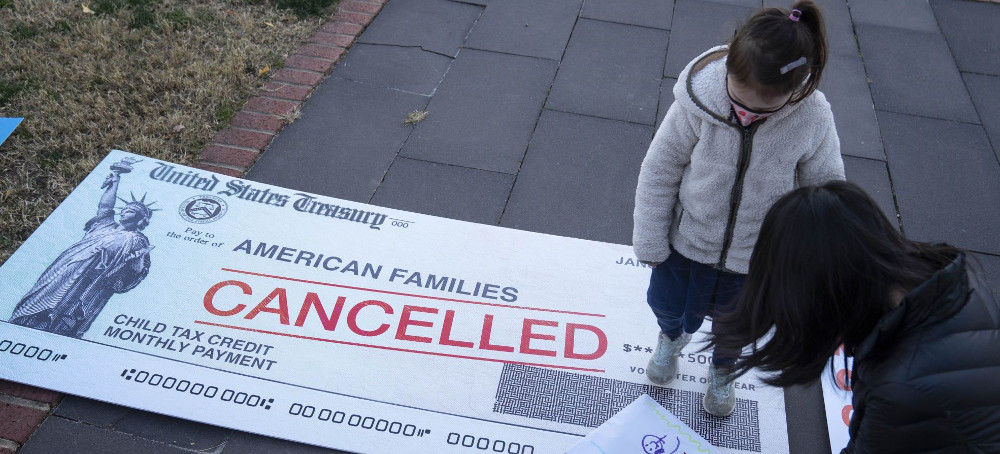 Protesters prepare to rally in support of the child tax credit in Washington, D.C., Dec. 13, 2021. (photo: Sarah Silbiger/Bloomberg)
But in Congress, at least, Republicans are now in the driver’s seat.
The expansion, passed as part of President Joe Biden’s pandemic relief program, delivered hundreds of dollars into parents’ bank accounts every month in 2021, ultimately helping 65 million children and keeping 3.7 million of them out of poverty. A year ago, the expanded CTC was heralded as one of the most significant policy achievements of the Biden era, so important to the broader Build Back Better negotiations that House Speaker Nancy Pelosi described its upcoming expiration as “really important leverage” for getting the rest of their agenda through.
It wasn’t enough. By January 2022, it was clear that any attempt to pass Biden’s agenda would likely exclude the child tax credit due to irreconcilable differences between West Virginia Sen. Joe Manchin and his Democratic colleagues over whether tax credit recipients should be required to work. When the Inflation Reduction Act passed last month, it didn’t include the CTC.
Now advocates for the CTC say they’re looking ahead to next steps. The first opportunity for new legislation could come at the end of the year, when Congress negotiates extensions on expiring business tax breaks. Advocates are also looking at new administrative solutions at the IRS, and thinking more seriously about state-level reform, amid state budget surpluses and new research detailing just how much families benefited from the now-expired expanded federal credit.
“It was very unfortunate that we didn’t get the expansion that we wanted in reconciliation, but it still is a very live issue,” said Brayan Rosa-Rodríguez, a senior policy analyst at UnidosUS, a national Latino advocacy group. “We’re going to focus on it over the next couple months to see if we can get it included in a tax extender bill.”
During the past year, as inflation wreaked havoc on bank accounts and eroded the value of existing family benefits, lawmakers have faced pressure to offer relief. In the wake of the Supreme Court overturning Roe v. Wade, conservatives have also been facing more pressure to support families, and a proposal introduced in June by Republican Sens. Mitt Romney (UT), Richard Burr (NC), and Steve Daines (MT) to distribute monthly cash payments to parents has garnered a lot of attention. Notably, this Republican proposal includes a requirement that families earn at least $10,000 to receive its full benefit, the kind of work requirement progressives rejected during reconciliation. Virtually every Republican has said that some “connection to work” is essential for any family policy they’d vote for.
To reach a bipartisan deal at the end of the year, advocates recognize they will have to entertain terms they rejected with Manchin.
“It’s obviously easier to get to 50 votes than it is to get to 60 votes, and that’s what it is,” said Zach Tilly, a policy associate with the Children’s Defense Fund, which co-led a coalition that pushed for the expanded CTC. “I think the way we’re looking at this opportunity at the end of the year is basically just as one where we may still have some leverage to get something done.”
Progressives are looking to an end-of-the-year compromise
Romney’s new child tax credit proposal — the Family Security Act 2.0 — is a modified version of a child allowance policy he introduced in 2021. One of the major differences between the two proposals is that the new one has a work requirement, something his Republican colleagues demand and which Manchin demanded last year during reconciliation.
The FSA 2.0 would increase the maximum annual child tax credit from $2,000 to $4,200 for each child under age 6 and $3,000 for each child ages 6 through 17, paid out in monthly installments. Expecting parents could also qualify for an additional $2,800 credit during the final four months of pregnancy. The “phase-in” of Romney’s plan — meaning the time at which families could start receiving their benefit — is much faster compared to the status quo. Right now the first $2,500 of earnings does not count toward CTC eligibility, while Romney’s plan would phase in the credit beginning with a family’s first earned dollar. This expansion would all be financed by consolidating other tax benefits, including a significant revamp of the earned income tax credit.
The left-leaning Center on Budget and Policy Priorities estimates that the number of children living in poverty would decline by 1.3 million under the Romney proposal, and that roughly 20 million children in families making less than $50,000 would be better off. But the CBPP also argues that roughly 10 million children would be worse off under the Romney plan, due in part to its proposed cuts to the EITC and its elimination of the “head of household” tax filing status, which millions of single parents use when they file their income tax returns.
The Niskanen Center, a centrist think tank that helped Romney craft his new proposal, pushed back on the CBPP’s analysis and defended the elimination of the “head of household” filing option, something conservatives have long argued disincentivizes marriage by imposing financial penalties on couples who tie the knot.
Niskanen agreed some families would be worse off, but said some of CBPP’s concerns could be addressed by increasing the phase-in and phase-out rate of the Romney proposal, to account for inflation. Niskanen also said the CBPP understates the benefit of making tax refunds administratively simpler for both recipients and the government.
As recently as this spring, progressive tax wonks and the Biden administration told Democrats in Congress that they should not consider any possible work requirement for expanding the child tax credit in reconciliation. But left-leaning groups are now acknowledging a compromise on this will likely be needed.
The Family Security Act doesn’t include any of the more politically popular exceptions to work requirements, such as exempting families with very young children, or families where the primary caregiver is disabled, elderly, or a student.
“If policymakers move toward a compromise on a Child Tax Credit expansion, the highest priority should be to make the credit fully refundable,” the CBPP said, meaning eligible to all regardless of whether they’re earning a certain amount of income. “But if that isn’t politically possible,” the CBPP concedes, “and an earnings requirement is included, important exemptions should be included as well.”
Writing earlier this month in The Hill, University of California Berkeley public policy professor Bruce Fuller urged Biden to step up and find a compromise with Romney, such as a work requirement that starts when children enter school. “Romney’s bid has drawn deafening silence from the White House and leading Democrats,” Fuller wrote.
Josh McCabe, a family policy analyst at the Niskanen Center, thinks most advocacy groups were waiting for reconciliation negotiations to finally be over and are now starting new discussions. “I think people are more open to things that they weren’t before, and everyone’s feeling out what’s possible,” he told Vox. “So with the FSA 2.0 there’s a more generous phase-in, which is unattractive relative to the fully refundable CTC from 2021, but it’s very attractive relative to the status quo.”
Tilly, of the Children’s Defense Fund, acknowledged that it will take 60 votes to get anything done on the child tax credit at the end of the year. “So that limits what’s possible,” he said, though he emphasized that advocates have some leverage, as they recognize it will be politically difficult for Republicans to extend federal business tax cuts without offering any economic relief to families. An open letter published in March from 133 economists also made the case that an expanded CTC would be too small to meaningfully increase inflation, but large enough to help offset inflation’s toll, particularly for lower-income households.
“There’s a big gap between where we and most Democrats are and where the most CTC-sympathetic Republicans in the Senate are,” Tilly said. “So that’s obviously going to be the focus for us and a lot of the people that we work with in the fall, to try to bridge that gap and make improvements.”
New ideas for reform are cropping up at the state level
While Democrats and activists were not successful in expanding the federal CTC, the flurry of organizing, research, and media coverage on the policy’s success has had spillover effects, prompting more local policymakers to think about opportunities for state-level CTC reform.
In 2021, Colorado passed a new state child tax credit, which families will get to claim for the first time next year. Maryland recently passed a new child tax credit for families with children with disabilities, and New Mexico recently created a fully refundable tax credit worth up to $175 per child.
Last year, Massachusetts also converted two existing tax deductions for dependents into fully refundable child tax credits, and this year the state’s Republican Gov. Charlie Baker proposed doubling the value of those credits. In Vermont, Republican Gov. Phil Scott just signed a tax cut package that will send $1,000 for every child 5 and under to Vermont households making $125,000 or less, a program state lawmakers say was modeled on the expanded federal CTC.
McCabe, of the Niskanen Center, says the big difference between state CTCs and the expanded federal CTC right now is the states have tended to target their aid toward lower-income families, though exceptions exist, as in Massachusetts and Vermont. States are also tending to focus their CTCs on families with younger children, whereas the federal CTC supported families with older teens, too. One reason for this is means-testing state CTCs and limiting them to younger children helps keep the overall cost of the program down. Another reason is that there’s mounting evidence that the cost of raising younger children, compared to older teens, is more difficult for parents to afford.
The CBPP recently put out an analysis encouraging states to create their own CTCs, and noted that the cost of enacting or improving existing ones is “typically small enough that states may be able to absorb them without raising additional revenue.”
In a new report published by the People’s Policy Project, a crowdfunded leftist think tank, founder Matt Bruenig proposes reforming state-level tax credit programs (both CTCs and EITCs) to counteract the exclusion of low-income children from the federal tax credits. In other words, states could step up to push for what advocates were not able to get passed on the federal level during reconciliation negotiations.
“Minor and inexpensive tweaks to state tax credit programs could effectively extend the federal child benefit regime to poor families,” Bruenig writes. “This kind of state-level policymaking is where child benefit advocates should focus their attention over the next few years.”
Bruenig notes 29 states currently have these kinds of programs, and there will be 32 states that have them beginning in 2023. He identifies 14 states and Washington, DC, that have full Democratic control and could be more easily persuaded to make progressive tax policy reforms.
Bruenig told Vox there could also be a scenario where Romney’s proposed child tax credit was passed but gave states the option to effectively opt out of the work requirement, by allowing states to contribute money to the federal government so that the federal benefit would not phase in for their own residents.
“This would make the state supplement more administratively simple since you wouldn’t have to administer a separate state CTC,” Bruenig added, noting that the supplemental security income (SSI) program also works like this.
Rodriguez, from UnidosUS, said he thinks it’s a good time for state legislators to try to plug weaknesses in state versions of federal programs, particularly as states are experiencing historical budget surpluses from Covid-era investments. Rodriguez says he and his colleagues have also been encouraging states to allow immigrant workers with Individual Taxpayer Identification Numbers (an alternative to Social Security numbers) to collect state EITC benefits, something eight states currently allow. Eighteen percent of US citizen children in poverty — more than 1.63 million kids — are currently excluded from the EITC because they live in mixed-status families with undocumented members.
“This is a moment where we could have an inclusive and generous EITC at the state level, and the same goes for state-level CTCs,” Rodriguez said.
McCabe said one issue with Bruenig’s proposal is states may be hesitant to design their CTC programs around federal policy, as federal policy can change pretty quickly. States may also not want to wait around for federal enabling legislation if they were to opt for the idea that more closely resembles how SSI is administered. Moreover, if Republicans in Congress opposed the expanded CTC last year for being fully refundable, they very well may oppose making it easier for states to blunt the pain of their federal work incentives.
“I think states might be better off with creating entirely new infrastructure,” McCabe said. “I think Massachusetts is right to do it much broader, more limited by age, and then slowly grow their credit over time.”
The expiring Trump tax cuts present opportunities for CTC advocates through 2025
Advocates for the expanded child tax credit see opportunities to build on and improve the child tax credit as Trump-era tax cuts expire over the next few years. “We’re looking at the tax extenders at the end of the year, and as we’re doing that, we’re trying to think through what we need to do to really build momentum to pass something more permanent,” said Elisa Minoff, a senior policy analyst with the Center for the Study of Social Policy.
Advocates also see opportunities to push for administrative improvements at the IRS, to make the tax filing process easier and less costly for families. The IRS will have a new Biden-tapped commissioner next year, and the agency will have new money flowing in from the Inflation Reduction Act, some of which can be used to upgrade the agency’s technology.
Much of what CTC advocates say they will push for next in Congress depends on how the elections shake out this November. If Democrats win deeper majorities in the midterms, then they might be able to pass a more generous expanded federal CTC, like the House passed in its $1.85 trillion Build Back Better package last fall.
If Democrats lose seats in Congress, or even if they hold their number of seats steady, advocates may have to rethink their strategy around negotiating with Republicans or Manchin. Manchin’s demands for the CTC included limiting the number of affluent families who could claim the credit and having some form of work requirement. He also disliked the idea of only expanding the credit for one year, but worried about the cost of a big permanent expansion.
Climate advocates were able to win big priorities in the reconciliation deal this year only by ceding to all the main legislative priorities of the West Virginia Democratic senator.
“I think if we wound up in a position where now the entire future of the CTC turns on Joe Manchin’s approval, then I think the lesson of this reconciliation bill is that you have to tailor the process to him,” said Tilly. “Because he obviously has no qualms about letting it die.”
 Pro-choice demonstrators in Buenos Aires, Argentina, celebrate after lower house representatives approve a bill to legalize abortion on December 11, 2020. (photo: Ricardo Ceppi/Getty)
Despite strict laws, activists point to a number of legal wins in recent years.
"It was just too much for me," she told ABC News. "I just couldn't handle that. I don't want to become like many women with many kids."
Her mother worked as a maid for a wealthy family who offered to pay for a doctor, but, not wanting to incur any debt, she said she instead found a cheaper option where she could buy abortion medication on the black market.
"I was not scared to take it," she said. "I wanted to be released from this pregnancy. I couldn't afford [a baby]. It was impossible."
"Of course, I would have preferred to go to a hospital but this option was not even possible for me. I didn't even think of it," she added.
Fabiana's story plays out across the continent every year, though she admits she was lucky not to have any complications. Brazil's old penal code has remained untouched since 1940, prohibiting abortion in all cases except when the pregnancy is a result of rape or endangers a mother's life, and activists fear that the country could -- like in parts of the U.S. -- move to enact stricter laws.
As a region, South America has some of the strictest abortion laws in the world, yet, according to one study in the Lancet, ranks among the highest estimated frequency of abortions administered. Despite Brazil's restrictive legislation, around 500,000 illegal abortions are believed to take place annually for women between the ages of 18 and 39, according to one 2019 study.
That pattern has played out across the continent, highlighting a trend that activists in the U.S. have long observed -- criminalizing abortion does not lower the number of abortions, it merely makes them more unsafe for women.
Yet, while the continent has long been known for its restrictive reproductive rights practices, human rights groups and lawyers point to a number of crucial developments that may be turning the tide, and, in an unfriendly political environment, may provide lessons for their counterparts in the U.S.
'A system of guilt for pregnant women'
The severity of abortion laws varies from place to place in Latin America and the Caribbean, but in six countries -- El Salvador, Honduras, Nicaragua, Dominican Republic, Haiti and Suriname -- abortion in any instance carries a criminal penalty.
While that does not mean abortions do not happen there, criminalization has led to women turning to underground means to get abortions and has disproportionately impacted the poorest in society, activists say.
In the case of El Salvador, abortion was decriminalized for a brief period between 1973 and 1975, but a penal code instituted in 1978 engendered a total ban -- including in the case of incest or rape.
"I had no other choice than turning activist," Mariana Moisa, a campaigner in El Salvador, told ABC News. "And now that the U.S. has reversed Roe v. Wade, most conservative groups in Salvador and other countries who always denied women's rights do see it as a validation of continuing women's rights violations."
Doctors run a huge risk in providing abortions in secret, and the criminalization of the procedure has led to cases where non-induced miscarriages have led to convictions, Mariana Moisa, a campaigner in El Salvador, told ABC News.
This year, a woman known as "Elsy" was finally released after a decade in prison, having been sentenced to 30 years for aggravated homicide after she suffered a miscarriage.
"There is a system of guilt for pregnant women. Women are constantly afraid," she said. "Most women do not have the economic means to find a doctor to get a safe abortion. But for rich women this is not an issue."
While El Salvador's policies are stricter than those faced by the likes of Fabiana in Brazil, the risk women face of running into the judicial system when seeking an abortion are just as real.
"Very often, in hospitals woman cannot have an abortion without entering into the judicial system," Gustavo Scandelari, a criminal law professor at the Federal University of Paraná. "We need so many improvements in our legal system. It has not changed since 1940. We are so backward."
In the 2020 case of one 10-year-old girl in Espíro Santo State, Scandelari said, a judge initially denied her request for abortion before a media campaign helped overturn the decision. A similar ordeal faced an 11-year-old rape victim this year, who was initially refused an abortion because she was in the 22nd week of her pregnancy.
"There is no improvement in the abortion discussion in Brazil," Luciana Temer, president of the human rights organization Institute Liberta, told ABC News. Even worse than that, what happened in the U.S. could happen here sooner than we think. It would be even worse than in America as the Law would be national, states could not make individual exceptions."
"Now that the U.S. has reversed Roe v. Wade, most conservative groups in Salvador and other countries who always denied women's rights do see it as a validation of continuing women's rights violation," Moisa said.
The 'green wave' movement
Catalina Martínez Coral, the regional director for the U.S. based Center for Reproductive Rights, said that while the continent is home to strict abortion laws, there is cause for optimism.
"I think in Latin America, the Caribbean, we have been seeing very important victories in the last couple of years, even though this continent has some of the most restrictive abortion laws," she told ABC News. "In the last couple of years we have been seeing how a movement has grown across the region, this green wave movement of women mobilizing for reproductive rights."
This started in Argentina, she said, which after years of grassroots pressure legalized abortion up to 14 weeks in 2020, and has been followed up by the Supreme Court in Mexico's decision to recognize the right to abortion in 2021, and the constitutional court of Colombia decriminalizing abortion up to 21 weeks, the continent's most progressive ruling to date.
That, Coral said, has been followed up in Chile. While the country's Congress has moved to restrict reproductive rights in recent years, keeping them on par with Brazil, the election of progressive Gabriel Boric, and his proposals for a new constitution, recently saw the right to abortion added to a draft text that is set to go to a public vote in September.
"Judges and lawmakers have played a very important role in Argentina, Congress in Mexico, Colombian Judges," Coral said. "We cannot deny that was important, but I think that the most important role was played by civil society organization and feminist movements as these movements have understood that, in Latin America, a legal win is not enough, that we really need to create a public conversation around these matters so that we can really implement these decisions. The strategy of the movement in Latin America has been to be able to socially decriminalize abortion."
The lessons to be learned from Latin America, Coral said, is that a combination of legal and grassroots pressure is required to improve, as well as uphold, reproductive rights.
Even with those successes, 97% of women of reproductive age in Latin America live in countries with restrictive abortion laws, according to the Center for Reproductive Rights.
And both Temer and Moisa fear the overturning of Roe v Wade has helped embolden conservative feeling in the region, and could lead to even more restrictive practices.
 A view of the underwater world of the Philippines, Pacific Ocean. (photo: Giordano Cipriani/Getty)
The treaty would have established regulations for the protection of biodiversity in two-thirds of the world’s non-territorial waters.
“We’re disappointed that governments at the UN did not bring the High Seas Treaty over the finish line this week. However, it has been uplifting to witness the global momentum for ocean action steadily build throughout these negotiations. Communities across the world are asking for decisive ocean action to protect marine life and safeguard the vital role the ocean plays for the climate, global food security and the overall health of our planet. States must now build on the progress made and deliver on their promise for an ambitious Treaty by the end of 2022,” said senior strategic advisor to the High Seas Alliance Sofia Tsenikli, a press release from The Nature Conservancy said.
The failure of countries to come to an agreement leaves the world without a cohesive strategy to stop and reverse marine biodiversity loss. A rich array of marine life is integral to the health of our planet and vital to many people’s livelihoods.
“Regardless of where you live, the high seas is contributing to the oxygen you breathe and is one of the climate regulators of the planet,” said coordinator of the High Seas Alliance Peggy Kalas, as Bloomberg reported. “The ocean absorbs our carbon emissions and is really making our existence possible on Earth while providing food for billions of people.”
The inability of 100 world leaders from the High Ambition Coalition for Nature and People, the Global Ocean Alliance and Leaders’ Pledge for Nature to agree on how to reverse biodiversity loss at sea and on land illustrates the gap between promises made by world leaders and the action needed to make these changes, The Nature Conservancy press release said.
“In a process which was started at the Rio+20 UN Conference in 2012, States have tried to negotiate a Treaty for the conservation and sustainable use of Biodiversity Beyond National Jurisdiction (BBNJ) — the ocean beyond Exclusive Economic Zones, which makes up 70% of the ocean. The work needed to reach the final Treaty could be completed relatively quickly if States are willing to cooperate, keeping the 2022 deadline alive. This is essential if the world is to achieve the goal of protecting 30% of the ocean by 2030 — something which cannot be achieved without the Treaty,” Tsenikli said in the press release.
Scientists have said the goal of 30 percent protection of the world’s oceans by 2030 is necessary to protect wildlife and help lessen the effects of climate change, Greenpeace has said.
“We got very close on the conservation elements of the treaty. I am confident we can get a strong treaty over the finish line if countries come together and resolve the remaining issues in 2022,” said Lisa Speer of the Natural Resources Defense Council in the press release.
Solidifying these agreements would provide the “whole-ocean” strategy the world needs to tackle the biodiversity crisis.
Environmental advocates put the blame on the U.S. and other wealthy countries for failing to compromise quickly enough after years of intermittent talks.
“While progress has been made, particularly on ocean sanctuaries, members of the High Ambition Coalition and countries like the USA have moved too slowly to find compromises, despite their commitments,” said Laura Meller of Greenpeace’s Protect the Oceans campaign, as reported by The Guardian.
Some of the main issues hindering the treaty’s progress are environmental impact assessments and coming to an agreement on a procedure for the creation of protected areas.
According to Meller, some of the groups participating in the negotiations were closer to solidifying the agreement than others, like the Caribbean group and the Pacific islands, while the world’s northern countries had only just begun progressing toward compromise in the latter part of the talks.
“Time has run out,” Meller said, as The Guardian reported. “While countries continue to talk, the oceans and all those who rely on them will suffer.”
Meller said Russia had been unwilling to take part in the talks and had obstructed the process.
“Russia has also been a key blocker in negotiations, refusing to engage in the treaty process itself, or attempting to compromise with the European Union and many other states on a wide range of issues,” said Meller, as reported by The Washington Post.
Talks will resume automatically in 2023 unless the UN General Assembly schedules a special emergency session before the end of this year.
“Clearly significant progress towards the treaty was made during this fifth session, but I am disappointed that despite growing evidence of [devastating] impacts to marine life and calls for much higher ambition we did not reach a treaty. Time is not on our side and we must accelerate our efforts to protect the largest ecosystem on our planet,” said President of the Marine Conservation Institute Lance Morgan in the press release.
Leaders will have another chance to protect the world’s oceans and address the biodiversity and climate crises at the UN Biodiversity Conference (COP 15), to be held in Montreal in December of this year.
Follow us on facebook and twitter!
PO Box 2043 / Citrus Heights, CA 95611


Comments
Post a Comment