RSN: Hilton Als | A Portrait of David Bowie as an Alienated Artist

13 September 22
Live on the homepage now!
Reader Supported News

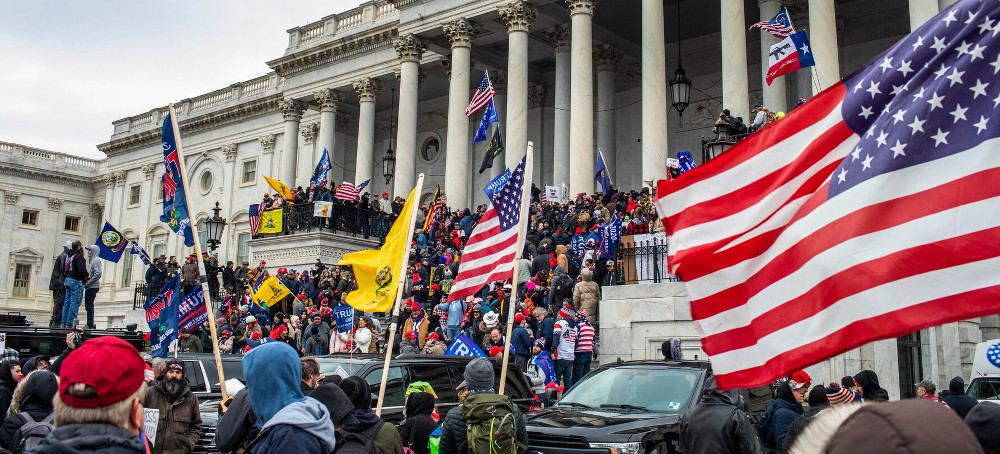 The mob at the Capitol on Jan. 6, 2021. The Justice Department has spent more than a year focused on investigating rioters at the Capitol but has more recently been issuing subpoenas to figures closer to former President Donald J. Trump. (photo: Jason Andrew/The New York Times)
A lawyer for former New York City Police Commissioner Bernard Kerik said he is among those who received subpoenas.
It also seized two telephones, the sources said.
The subpoenas and phone seizures, first reported by The New York Times, are the latest developments in the sprawling investigation into the former president.
The Times, citing people familiar with the investigation, reported that Trump adviser Boris Epshteyn was one of the people whose phone was seized. A source who spoke to Epshteyn confirmed to NBC News that his phone was taken last week.
The House committee investigating the Jan. 6 Capitol riot subpoenaed Epshteyn and three other Trump associates — Rudy Giuliani, Jenna Ellis and Sidney Powell — in January.
Former New York City Police Commissioner Bernard Kerik’s lawyer confirmed to NBC News that he received a subpoena last week.
Kerik’s attorney, Timothy Parlatore, called it “the widest and most obtuse subpoena I have seen in my years practicing criminal law.”
Parlatore said he also represents Trump in the investigation.
The Justice Department declined to comment Monday night.
Separately, the department is engaged in a legal battle with Trump and his counsel over documents retrieved during the FBI’s search of the former president's Florida estate on Aug. 8.
Trump lawyers asked a judge Monday to continue blocking the Justice Department from reviewing the documents, some of which bore classification markings.
 Russian president Vladimir Putin is seen on a screen broadcasting Russian TV news programs at a humanitarian aid distribution point during the Ukraine-Russia conflict in the southern port city of Mariupol, Ukraine, May 30, 2022. (photo: Alexander Ermochenko/Reuters)
The narrative has shifted since September 6, when Ukraine began a counteroffensive in the Kharkiv region.
Overall, compared with the first few months of war, the subject has faded into the background.
According to a recent study, state TV mentions the war less and less while “de-Nazification”, one of the stated goals of Moscow’s “special operation”, barely gets mentioned at all.
More airtime is devoted to simple entertainment, as opposed to the persistent political programming seen in February and March.
However, on September 6, Ukraine began a counteroffensive in the Kharkiv region, recapturing several key towns and occupied territory. This reportedly followed a weeks-long, purposeful, Ukrainian disinformation campaign of “leaked, exclusive reports”, designed to trick Russia into thinking the plan was to retake Kherson, to the south.
At first, pro-Russian bloggers and outlets played down Ukraine’s advance.
“There is no panic in Balakliya,” the Telegram channel Veteran’s Notes, which boasts 192,000 subscribers, wrote on September 6.
A number of pro-Russian feeds, including that of famous talkshow host Vladimir Solovyov, reposted that message.
By the following day, however, there was a more sullen tone.
“Don’t expect good news today,” Veteran’s Notes warned.
Pro-Kremlin journalist and politician Andrey Medvedev, meanwhile, wrote a solemn, yet motivational post.
“It’s been a tough day,” he told his 122,000 readers on Telegram. “But now it has probably become clearer what it was like for our grandfathers and grandmothers in the Great Patriotic War [WWII] … It will be difficult. Very difficult in places. But we don’t really have a choice.”
Speaking on the loss of Izyum, the host of a political talk show on Match TV, a sports channel, urged his viewers to “pray for our guys”.
The government and its friendly voices in the media have acknowledged that Russian forces have withdrawn from previously held positions, but have avoided outwardly calling it a loss.
Ministry of Defence spokesman Igor Konashenkov, for example, announced said the decision was made in order to redeploy forces from Balakliia and Izyum and reinforce the Donetsk region, which is being held by separatists.
Pro-Kremlin blogger Yuri Podolyaka, meanwhile, described it as an opportunity to regroup.
“The adversary is throwing its main forces into battle,” he told the state-controlled Channel One TV channel. “Yes, we’ve of course withdrawn to new positions and given up quite significant territories, but if we gather a good force and hit them from the north, Izyum and the north, our initial problems may turn into big problems for the Ukrainian armed forces.”
The state-owned Rossiyskaya Gazeta newspaper made no mention of the gains by Ukraine on Sunday, instead claiming that Ukraine suffered 4,000 fatalities between September 6 and 10.
There are some news reports of Ukrainian incursions being thwarted on the Kharkiv oblast’s Oskil river and though a curious reader might infer from that just how far the Ukrainians have come, this fact is not dwelt upon.
Instead, Rossiyskaya Gazeta and other pro-Kremlin commentators have suggested that Ukraine’s push may have been boosted by outsiders joining the fray.
A post shared by Solovyov to his 1.2 million Telegram followers says foreign mercenaries in Kharkiv were heard speaking English.
“Either the Ukrainian Armed Forces suddenly switched to this language, or before the advance on Kharkiv the khokhli [slang for Ukrainians] were reinforced by a large detachment of foreign mercenaries,” the post reads. “I believe it’s the second.”
However, others warned this narrative undermines Russian morale.
“Yes, thanks to eight years of efforts by Western countries, the Ukrainian army has become more combat-ready. But by no means immortal,” war correspondent Alexander Simonov, of the Russia-funded Federal News Agency, wrote on the Kharkiv advance.
After the initial shock of the Russian retreat, Kremlin supporters were quick to return to a combative pose.
On Sunday night, Solovyov appeared on his talk show and called for attacks on civilian infrastructure.
“American strategy during wartime implies the destruction of infrastructure, including civilian,” he said. “It’s a part of NATO’s strategy. Why don’t we do this?
“I think it’s time to start tinkering!”
That same night, Russian missiles aimed at Kharkiv knocked out the city’s power supply.
However, the government has also come under fire from hardliners for not being committed enough to the fight.
The loudest of these voices has been Igor Girkin, nom de guerre Strelkov (Shooter), a Russian leader of Ukrainian separatists who once claimed he “pulled the trigger” on the 2014-2015 Donbas war.
On his popular Telegram channel, Girkin analyses troop movements using open sources and his informers on the ground.
He earlier warned that without partial mobilisation in Russia, the campaign in Ukraine was doomed to fail.
“I do not expect any more major success from the Russian armed forces for the next 2-3 months,” he posted in September.
“It will only be possible if the Kremlin stops flying on blue clouds around the planet of pink ponies, and finds the strength to face the truth and start fighting for real (with martial law, the mobilisation of the army and economy, etc.)”
Regarding the ongoing Ukrainian counterattack, Girkin compared the situation to the Russo-Japanese war over Manchuria.
“Only one word comes to mind – Mukden,” he wrote, referring to the decisive Japanese victory in 1905 which humiliated the Russian Empire.
On NTV, liberal politician Boris Nadezhdin said during a televised debate that defeating Ukraine was impossible and called for peace talks.
In a clip that has been widely shared on social media, Nadezhdin avoided blaming President Vladimir Putin himself, instead accusing the president’s advisers of misinforming him about the situation in Ukraine before and during the invasion.
The word “war” is used extensively throughout the segment, as opposed to the officially mandated “special operation”, including by both Nadezhdin and politician Alexander Kazakov, who took issue with Nadezhdin’s dovish tone.
“We need to win the war in Ukraine,” Kazakov said. “We need to liquidate the Nazi regime there. After that, whoever wants to can talk to us.”
“And how many years will we keep doing this?” Nadezhdin asked.
“However long it takes, because this special military operation …” Kazakov replied, only to be interrupted by Nadezhdin, who said: “So my 10-year-old kids will eventually get the chance to fight, right?”
 IronNet co-CEOs William Welch, center left, and Keith Alexander, center right, ring the opening bell of the New York Stock Exchange to celebrate their company's listing on Sept. 9, 2021. (photo: Richard Drew/AP)
A lawsuit alleges that retired Gen. Keith Alexander misled investors while selling off over $5 million in IronNet stock.
Alexander, a current board member for Amazon who previously served as the head of U.S. Cyber Command and as director of the National Security Agency under Presidents George W. Bush and Barack Obama, allegedly misled investors through a pump-and-dump scheme that enriched him with at least $5 million.
In a securities lawsuit filed in April, investors in IronNet, a cybersecurity company co-founded by Alexander after he left the Obama administration in 2014, claim that the former general gave false promises of government contracts and inflated revenue numbers, all while selling off his shares in the company.
IronNet, which advertises systems to help public and private clients defend against a variety of hackers and other forms of electronic intrusion, relies heavily on Alexander’s image and reputation as a former intelligence official. “As commander of U.S. Cyber Command, we had responsibility for defending the nation,” says Alexander in a promotional video that runs on the company’s homepage.
Joseph Depa, a spokesperson for IronNet, declined to comment.
Plaintiffs in the U.S. District Court in Alexandria, Virginia, allege that IronNet made lofty promises as a cover for company insiders to quickly unload stock on clueless retail investors.
In August 2021, IronNet went public through a “special purpose acquisition company.” The SPAC process allows private companies to go public by leapfrogging the traditional initial public offering process through a merger with a “blank check” corporation. The trend skyrocketed over 2020 and 2021, with over 3,000 listings last year, though the investing craze has died down in recent months following a wave of investor fraud scandals associated with SPAC mergers.
On September 14, shortly after IronNet successfully completed its merger and transition into a publicly traded company, the company issued a press release projecting $75 million in annual recurring revenue for the following fiscal year through an expanded customer base. Alexander, quoted in the release, said that the company stood to take advantage of the “explosive increase in adversary activity that we are seeing.” The company website details specific cyber threats from Russia and Iran.
The next day, according to the complaint, IronNet’s stock swelled from $23.32 to $32.12, as Reddit and other platforms frequented by retail investors buzzed with enthusiasm over the role of a former NSA chief at the helm of a security contractor promising dazzling revenue growth. The 38 percent surge in price was so quick that the New York Stock Exchange briefly halted trading.
On September 20, according to the lawsuit, the chief financial officer, James Gerber, promised that “large transactions” were progressing at a company event with Wells Fargo, leading to another surge in stock price.
Then between October 18 and November 22, Alexander sold over 85 percent of his stock, according to the Securities and Exchange Commission’s Form 4 reports, making more than $5 million. The complaint alleges that “IronNet securities were artificially inflated by Defendants’ material misstatements and omissions about the Company’s Guidance and near-term growth” and that Alexander’s stock sales “were all in a compressed and suspiciously timed five-week period.”
On December 12, 2021, IronNet reversed its projections, reducing its guidance to $30 million annual recurring revenue, a 60 percent reduction. On the news of the revised guidance, IronNet’s stock went down 31 percent that day, trading at $6.80. It now trades at slightly above $2.
The IronNet lawsuit also names chief executive William Welch and the chief financial officer, Gerber, alleging they made false statements. According to the complaint, the contracts promised by Gerber did not materialize. Neither did the “new customer momentum” promised by Welch, the lawsuit says. (Matthew Olsen, a co-founder of IronNet now serving as the assistant attorney general for the National Security Division of the Justice Department, was not named in the lawsuit.)
Alexander also serves on a number of corporate boards, the most prominent of which is cloud and e-commerce giant Amazon. At Amazon, Alexander is a member of the company’s audit committee, responsible for reviewing financial statements and maintaining compliance with legal and regulatory requirements.
SPAC fraud has become a feature of pandemic-era investing, with dozens of scandals and lawsuits creating a damning picture of the industry.
Electric vehicle company Nikola Corp., one of the largest early pandemic companies to go public via a SPAC, minting an overnight billionaire of founder Trevor Milton, paid $125 million to settle charges that the company misled investors with false information about its products and technical capabilities. A number of celebrities, including Jay-Z, have been criticized for lending star power to the value of SPACs, only for insiders to cash out.
But the proverbial “deep state” has also harnessed investor interest around lucrative defense contracts and government access to jump on the SPAC bandwagon. As The Intercept previously reported, officials tied to the CIA launched a SPAC at the height of investor interest last November.
IronNet stands out among other companies that went public last year with one of the most prominent former government insiders leading it.
“Because it is a former SPAC, the identity of the company is more closely tied to the expertise and influence of one individual or a small handful of individuals,” said Usha Rodrigues, a professor of law at the University of Georgia.
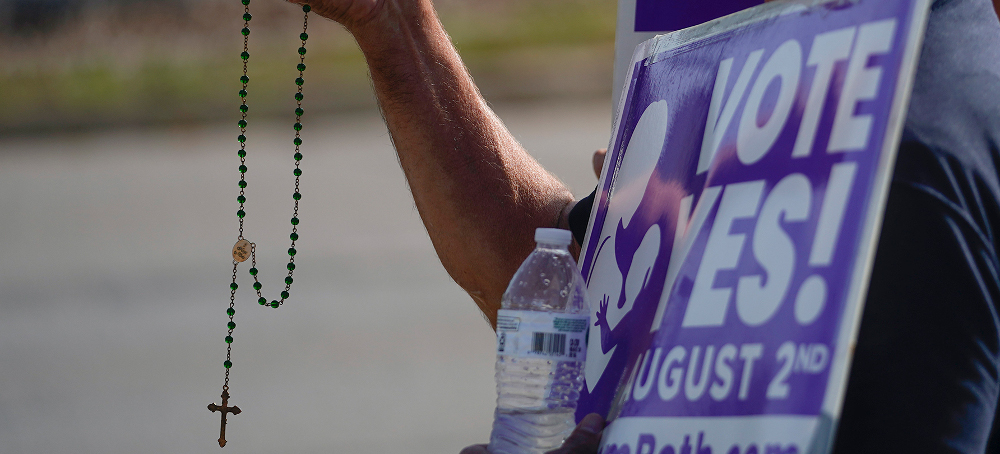 A Catholic Deacon holds an anti-choice sign and the rosary in the run-up to Kansas' August abortion vote. (photo: Kyle Rivas/Getty)
A majority of Catholics support a woman's right to choose, but dioceses are funding campaigns for state-level abortion bans across the country
The Roman Catholic Archdiocese of Kansas City contributed $3.18 million, the Catholic Diocese of Wichita, $652,355; $175,000 came from the Diocese of Salina; tens of thousands more from smaller churches scattered around the state. The Kansas Catholic Conference threw in $275,000. Together, the donations amounted to well over half of the Value Them Both Association’s total haul — an “absolutely stunning” amount of money, says Jamie Manson, the president of the advocacy group Catholics for Choice.
Come November, though, the exorbitant sum spent in Kansas may represent just a fraction of the Church’s political outlay this year. A record number of referendums on abortion will be put to voters around the country this fall. And in each of the states where an abortion measure is on the ballot, the effort to strip women of their reproductive rights is being largely bankrolled by the Catholic Church and its affiliates.
In Michigan, the Catholic Conference has committed $200,000, the largest donation by far to the campaign opposing the Right to Reproductive Freedom Initiative. The Michigan Knights of Columbus, a Catholic men’s organization, has pledged an additional $50,000 to the committee leading the charge against Proposal 3, “Citizens to Support MI Women and Children.”
The Roman Catholic Diocese of Burlington is the second biggest donor to the campaign opposing Vermont’s Right to Personal Reproductive Autonomy amendment. The church’s contribution — $50,000 — represents one fifth of the total raised to date by the group, “Vermonters for Good Government.”
The Kentucky Catholic Conference is the single biggest donor to “Yes for Life.” “Yes for Life” is the group working to add an amendment to the Kentucky constitution clarifying that the document does not protect a right to abortion. The KCC has given $36,000 to that effort so far.
Churches and religious organizations, by virtue of their tax-exempt status, are prohibited from campaigning on behalf of candidates for public office. But “issue advocacy” — carried out through ballot initiatives and lobbying efforts — is allowed. It can be difficult to ascertain how much churches and their affiliates spend on those political efforts, though, because in addition to not being required to file tax returns, they are, in many cases, exempt from disclosing lobbying activity as well.
A report commissioned by Catholics for Choice found that between 2014 and 2021, the U.S. Conference of Catholic Bishops and their affiliates spent at least $10 million dollars lobbying state lawmakers in a handful of states, including Montana. There, the organization found the Montana Catholic Conference lobbied on behalf of five bills. Four of them were abortion related, including the “Referendum to adopt the Montana Born-Alive Infant Protection Act,” a bill that paved the way for a ballot measure voters will weigh in on this fall that would extend legal rights to infants “born alive at any stage of development.”
What makes the Church’s disproportionate spending on anti-abortion advocacy so remarkable, Manson says, is the degree to which it goes against a majority of Catholics’ own views on the issue. A 2019 Pew Research poll found that 68 percent of U.S. Catholics opposed overturning Roe v. Wade, while more than half of Catholics — 56 percent — believe that abortion should be legal in all or most cases. Catholics, Manson also points out, make up one quarter of abortion seekers in the United States, according to data from the Guttmacher Institute.
“Catholics are always well left-of-center on all of these issues having to do with sexuality, and they are governed by church leaders who are fringe hard-right,” Manson says. “These issues of sexual reproductive health are profound issues of social justice. And the Catholic laity see it, but the bishops just refuse to see it.”
Church leaders, ultimately, are the ones who decide how the collection plate money is spent.
“Do parishes have finance councils, and all of those things? Sure they do. But do they ultimately have decision-making authority on how money is used? No,” Manson says. “This whole structure is set up to have lay people completely disempowered.”
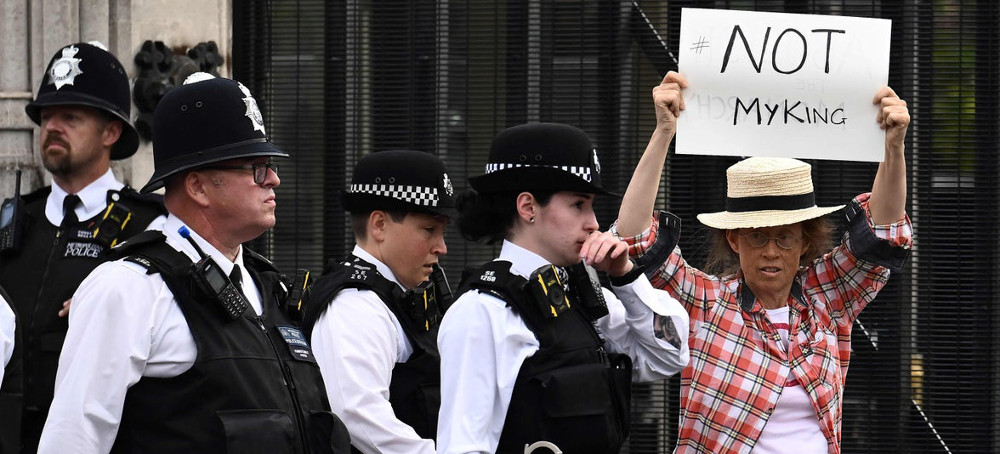 An anti-monarchy protester outside the Houses of Parliament ahead of King Charles address to parliament on September 12. (photo: Chris J Ratcliffe/Getty)
ALSO SEE: Not Everyone Mourns the Queen.
For Many, She Can't Be Separated From Colonial Rule
Series of incidents in Edinburgh, London and Oxford include woman being charged after protest outside St Giles’ Cathedral
The advocacy group Liberty said that new powers recently given to the police to curtail protest, and how they were being enforced by officers, were a cause for deep concern.
The Labour MP Zarah Sultana said in response to incidents in Edinburgh, London and Oxford: “No one should be arrested for just expressing republican views. Extraordinary – and shocking – that this needs saying.”
Police Scotland said a 22-year-old man and a 52-year-old man had been arrested in connection with a breach of the peace on the Royal Mile in Edinburgh shortly before 3pm on Monday.
It came after police were seen pulling a man out of a crowd of people, some of whom appeared to push him, after he was seen shouting at the procession accompanying the Queen’s coffin as King Charles, the Princess Royal, the Duke of York and the Earl of Wessex marched behind the hearse.
Earlier, a woman was charged after being arrested by police in Edinburgh on Sunday as she staged a protest during the accession proclamation for the King. Police said the woman, 22, had been arrested on Sunday outside St Giles’ Cathedral in connection with a breach of the peace and would appear at Edinburgh sheriff court at a later date.
The woman, called Mariángela and who had been seen holding a sign that said “Fuck imperialism, abolish monarchy”, was arrested moments before the reading of the proclamation. The incident took place outside the cathedral, where the Queen’s coffin lay on Monday.
On Monday night Global Majority Vs Campaign, the group Mariángela represents, released a statement following the arrest, saying it “condemned the centuries of colonial injustice, genocide, and unlawful extraction that have been – and continue to be – carried out in the name of the British Crown”.
It added: “Calling for the abolition of the monarchy is as old as the monarchy itself and is a cornerstone of freedom of speech in the UK.”
In London, a barrister and climate activist who had held up a blank piece of paper in Parliament Square said he had been threatened with arrest by a police officer under the Public Order Act.
“He confirmed that if I wrote, ‘Not My King’ on it, he would arrest me under the Public Order Act because someone might be offended,” the lawyer, Paul Powlesland, said on Twitter.
“A period of quiet mourning for the Queen is fine, but using that period to cement Charles’ accession as King and cracking down on any dissent to the accession as disrespectful is outrageous.”
Powlesland told the Guardian on Monday night that he had had quite a long discussion with the police who had stopped him, who were from Norfolk’s force. “I speak in a certain way, was dressed in a certain way and understood the law, but someone else might have been in a different situation,” he said.
“Normally, you can get into trouble for shouting, but if you have something written that is super-factual and which is not abusive, then you would normally think that you are protected. It’s pure free speech.”
“I think the idea that he could arrest me and that there could be a conviction under the Public Order Act was ludicrous, but interventions like that are having a chilling effect,” Powlesland added. “I didn’t hold up the sign in the end because I have to work tomorrow and could not afford to be detained. A lot of other people might simply be chilled into not protesting.”
Powlesland tweeted a video recording of an exchange that he appeared to have had with the officer, who could be heard telling him that someone might be offended if the lawyer were to write, “Not my king” on the piece of paper he was carrying.
Jodie Beck, policy and campaigns officer at Liberty, identified an incident in Oxford on Sunday in which a man was arrested on suspicion of a public order offence, under section 5 of the Public Order Act 1986.
Thames Valley police said they had subsequently de-arrested Symon Hill, who said he had been arrested for shouting, “Who elected him?” when the proclamation of the new king was read out in Oxford.
Hill, 45, said he had come across the event by chance as he walked home from church. The history tutor said that after he shouted the words, some people nearby told him to “shut up” and he responded by saying: “A head of state has been imposed on us without our consent.”
Beck said: “The number of cases we have seen in the last couple of days comes at a time when the police have just been given a bunch of new powers, which range from being able to impose conditions on public assemblies and moving protests or act in the case of other gatherings which are viewed to have created lots of noise.
“Given the context we are in at the moment and where the landscape for protest is really being shrunk continually, it’s not surprising that the police are interpreting certain pieces of legislation in a completely warped way.” She added that the police also had a duty to facilitate protest.
The Metropolitan police on Monday night appeared to acknowledge the reaction to Powlesland’s tweets after they had gone viral, issuing a statement saying it was was aware of video showing an officer speaking to a member of the public at the Palace of Westminster.
“The public absolutely have a right to protest and we have been making this clear to all officers involved in the extraordinary policing operation currently in place and we will continue to do so,” said the deputy assistant commisioner, Stuart Cundy.
 The Cedar Creek Fire on Sept. 9, 2022, the day officials ordered the evacuation of the towns of Oakridge and Westfir. (photo: Justin Wood/U.S. Forest Service)
At least 21 wildfires are burning across Oregon and thousands of people have been forced to evacuate or experienced preventative power shutoffs as several days of “red flag” warnings led to “extreme fire growth” across the state.
The Cedar Creek Fire had burned nearly 87,000 acres and was completely uncontained as of Sunday evening. More than 60,000 homes and businesses had their power temporarily shut off to prevent winds from sparking more fires.
Smoke from the blazes blanketed wide swaths of Oregon, Washington, and Idaho, subjecting residents to dangerously unhealthy air quality levels, as 92 large fires across seven states burned nearly 728,000 acres on Sunday alone.
Wildfire smoke can cause and exacerbate significant respiratory illness and is especially dangerous for the elderly.
As reported by The Associated Press:
Pacific Power, another major utility in Oregon, said the shutoffs Friday were the first the company has ever done. The company put a wildfire mitigation plan in place in Oregon in 2018 that includes studying wind and weather patterns to predict high-risk areas.
The utility was sued last year by residents in two towns that burned to ashes in the 2020 wildfires who blamed the company for not shutting down power in advance of the devastating wind storm.
Pacific Power has since hired a team of meteorologists to make fire weather forecasts and is spending more than $500 million to “harden” its electric grid in high-risk areas by replacing wooden poles with carbonized ones and encasing power lines and conductor boxes to reduce the chances of a spark, said Drew Hanson, a Pacific Power spokesman.
“You can look at the West in general and climate change has impacted areas from Southern California, and then Northern California and now up into this region as well, we’re seeing those same conditions,” he said.
Follow us on facebook and twitter!
PO Box 2043 / Citrus Heights, CA 95611


Comments
Post a Comment