RSN: Mike Giglio | The Oath Keepers' Radical Legal Defense of January 6th

02 October 22
Live on the homepage now!
Reader Supported News

Legal experts say the interpretation of the Insurrection Act put forward by Stewart Rhodes and his lawyers would dangerously expand the power of the President.
In the trial, Rhodes’s lawyers will attempt to sway the jury using an argument rooted in Rhodes’s version of right-wing militancy. The Oath Keepers, they will argue, were not at the Capitol to fight with law enforcement on January 6, 2021. They were acting more as an extension of law enforcement, awaiting orders from Donald Trump, whom Rhodes had urged to invoke the Insurrection Act, to prevent Joe Biden from taking power. He implored Trump to call up members of the Oath Keepers and other armed Americans to serve as part of a Presidentially sanctioned militia. “When [Rhodes] believed that the President would issue an order invoking the Insurrection Act, he was prepared to follow it,” his lawyers wrote, in a pretrial motion. “The Government would like this Court to believe that is sedition, when in fact, it is the opposite. It is loyalty to an oath taken in defense of the Country.”
Prosecutors accuse Rhodes of trying to use the Insurrection Act’s vague wording to cover his actions with a veneer of legality. The statute, which combines a series of laws passed between 1792 and 1874, is surprisingly broad. It authorizes the President to call in “the militia or the armed forces, or both, or by another means,” if the President believes the action necessary to suppress “any insurrection, domestic violence, unlawful combination, or conspiracy” that is hindering the execution of federal or state laws or depriving people of rights. A coalition of advocacy groups recently recommended to the January 6th Committee that Congress revise the act so that “a would-be autocrat who wished to carry out an insurrection would not be able to exploit the law for that purpose.”
Based on information from coöperating witnesses and the fact that the Oath Keepers stockpiled weapons in hotels in northern Virginia, prosecutors say that Rhodes and his co-defendants planned to forcibly block the transfer of Presidential power. In an online meeting recorded ahead of a planned protest in November, 2020, according to prosecutors, Rhodes discussed stationing an armed “quick-reaction force,” or Q.R.F., outside of Washington, D.C., and contended that Trump had the power to invoke the Insurrection Act and call the armed group into action. “That Q.R.F. will be awaiting the President’s orders. That’s our official position,” Rhodes explained, to members of the group. “And the reason why we have to do it that way is because that gives you legal cover.” Prosecutors rejected the defense’s interpretation of the Insurrection Act as unconstitutional: “no government official, including the President, has authority to authorize an attack on the Capitol or the government more generally.”
If the jury convicts Rhodes and his co-defendants of seditious conspiracy—attempting to overthrow the government or opposing, by force, any execution of its laws or authority—they would face up to twenty years in prison. Rhodes, who has a law degree from Yale, is likely to testify in his own defense.
Over the past three years, I’ve interviewed Rhodes several times. He can be genial and engaging, but also pugnacious when discussions turn to politics or ideology. He’s proud of his law degree, which he received in 2004, after being medically discharged from the Army following a parachute accident. After he founded the Oath Keepers, in 2009, he largely abandoned his legal career, and was disbarred six years later.
I last met Rhodes in early January, in a Dallas hotel room, days before his arrest. In the year since the Capitol attack, more than a dozen alleged members or associates of his group had been arrested, and he had been described as “Person One” in indictments. At least five of those facing charges were coöperating with Justice Department prosecutors. Perhaps most damaging was that critics on the right, asking why Rhodes had yet to be arrested, had begun accusing him of being a federal informant. Trump and his Stop the Steal allies had abandoned the Oath Keepers, Rhodes said, and he was struggling to pay his legal bills. I got the sense that he was anxious about the prospect of going to prison. At the same time, he mused, being indicted would “probably improve my standing in the Patriot community, frankly.”
After Rhodes’s arrest, Phillip Linder, a well-regarded Dallas attorney, and his partner, James Lee Bright, became his defense lawyers. Sidney Powell, the lawyer who’d spread Trump’s false claims about the 2020 election, reportedly hired Linder and Bright via her new foundation, as well as paid defense bills for another Oath Keeper charged alongside Rhodes; a senior member of the Proud Boys; and other defendants in January 6th cases. (Linder told me that he and Bright had no prior relationship with Powell, and that Powell would play no role in their defense of Rhodes.) Last month, Rhodes attempted to replace the two attorneys and delay his trial; Judge Amit Mehta, of the D.C. district court, denied the motion, but the new lawyer Rhodes had selected, Edward Tarpley, was added to the defense team. Linder and Bright continue to direct Rhodes’s defense. Opening arguments are expected on Monday.
Linder and Bright will not dispute key facts found in Rhodes’s indictment. Yes, they’ll say, Rhodes gathered with fellow Oath Keepers at the Capitol on January 6th. Yes, some of his members entered the building. Yes, Rhodes published two open letters before January 6th urging Donald Trump to invoke the Insurrection Act and use it to call up the Oath Keepers and others to assist the then President as what Rhodes called “the militia.” And, yes, Rhodes bought tens of thousands of dollars’ worth of firearms and other equipment. What they’ll argue, however, is that these acts were not only legal on Rhodes’s part. They were patriotic.
To make this case, they plan to present an aspect of Rhodes’s world view that is little understood by those outside his movement. It centers on his conception of the Oath Keepers not as “a militia” but as a vanguard of “the militia”: the force of armed Americans, drawn from the wider population. Rhodes roots this notion in his reading of the Second Amendment’s enigmatic militia clause: “A well-regulated Militia, being necessary to the security of a free State, the right of the people to keep and bear Arms, shall not be infringed.” To the Founders, militias were established by state statute. Enrolled citizens could serve in times of need; the militia system was incorporated into the National Guard in 1903.
In Rhodes’s hands, however, the militia are a self-selected, amorphous force that—though he denies this—is partisan in nature. This is “the militia” that Rhodes, in his open letters, was asking Trump to call up with the Insurrection Act. Before his arrest, Rhodes told me that he was disappointed that Trump had failed to do this. “I wish Trump would have done what I said he should do,” Rhodes said. “Call us up. Look at the Insurrection Act. It says he can call—he can use either the U.S. military or the militia of the states, right? That’s us.”
The Oath Keepers and their allies are often called “anti-government” by their critics, but it may be more accurate to say that they want to be the government. Rhodes has long dreamed of a broader militia structure with political and legal sanction. One of the Oath Keepers’ intended roles is to help make this dream a reality—preparing and conditioning the public while being ready, should such a structure emerge, to blend into it. At gatherings where I’ve watched Rhodes speak, he has urged people not to join the Three Percenters or even the Oath Keepers but instead to form their own militias and name them after their towns or counties.
Rhodes’s ideas are influenced by Edwin Vieira, Jr., a Harvard Law School graduate who has written two obscure tomes on the militia concept, and also a short book called “Thirteen Words,” a reference to the opening passage of the Second Amendment. His thesis is that the United States lost its way when it abandoned the universal militia system, and that the country needs to enact laws to reconstitute it. He believes that, as in the days of the Founders, every able citizen should serve in the militia. Unfettered access to military-standard guns is a prerequisite. Vieira promises myriad benefits, including the declines of both the military-industrial complex and corruption. The militia system seems designed, however, to enforce Vieira’s far-right views. In “Thirteen Words,” he writes that it can “provide every type of protection—whether political, economic, social, or even cultural in character.”
In another of his books, published in 2012, Vieira envisions a scenario in which a U.S. President creates a new militia “at one stroke”—by invoking the Insurrection Act. Once he has thousands of militiamen “under his personal command,” this hypothetical President could then embark upon what Vieira calls “the Eight ‘I’s Policy: illuminate, investigate, interrogate, implicate, indict, inculpate, incarcerate, and infame.” This prescription echoes the plan that Rhodes promoted ahead of January 6th: on top of asking Trump to use the Insurrection Act to “call forth the militia”—including veterans and Americans “still loyal to the Constitution”— Rhodes also urged him to conduct a “mass declassification” and create a task force to prosecute “all traitors in all branches, and all levels.”
I sent a copy of Rhodes’s proposal and the Vieira passage to the historian Robert Churchill, who called them ahistorical and inconsistent with past interpretations. Churchill, the author of a book on American militias, told me that the Insurrection Act is meant to be invoked in a situation of widespread civil unrest, when laws can no longer be enforced. “This was the basic problem with the whole enterprise that the wackos surrounding Trump were embarked on,” he said. “There were no crowds in the street and the courts were operating.”
Linder, Rhodes’s attorney, is a fifty-six-year-old Texas native. When I visited his Dallas firm this summer, he wore a blue suit, quilled ostrich boots, and clear-rimmed glasses. He projects a slow and steady calm that the case has clearly tested. He and Bright, a fifty-two-year-old veteran Dallas criminal-defense attorney, have acted as an organizing force for the attorneys for all the co-defendants in Rhodes’s trial. This has meant trying to keep up with terabytes of discovery files from a sprawling F.B.I. investigation of January 6th as well as the televised hearings of the congressional January 6th Committee. The committee has used clips from recorded interviews to build its narratives, allowing no time for counter-arguments or cross-examinations; Linder and Bright complained that the committee suggested that Rhodes took part in a conspiracy without providing conclusive evidence. I asked if Rhodes, with his law degree and desire to play an active role in his defense, had complicated things further by being a difficult client. “I think he trusts our judgment, but he also wants to be very involved in this case,” Linder replied. “He will be a handful for the prosecutor.”
Something the defense will highlight is that Rhodes never actually entered the Capitol on January 6th. They will also stress that the Oath Keepers are not charged with illegally possessing guns or bringing them to the Capitol and that their weapons remained in hotels in northern Virginia. They will also contend that Rhodes never gave a direct order for other Oath Keepers to enter the Capitol. In a memo to the court, Linder and Bright claimed that those who entered the building did so “on their own accord” after learning that shots had been fired and because “there was a need for medical assistance within the building.” Some Oath Keepers, the lawyers argue, even “provided security and escort to overwhelmed Capitol police officers.”
Alan Rozenshtein, a professor at the University of Minnesota Law School who served as a Justice Department attorney in the Obama and Trump Administrations, told me that, if prosecutors can’t definitively show that Rhodes personally directed the incursion into the Capitol, they may rely on a “broader pattern of planning” that shows a “willingness and intent” to commit seditious conspiracy. The charge doesn’t require that the conspiracy be successful—only that some action was taken to advance it. To prove that, Rozenshtein added, prosecutors could zero in on Rhodes’s stockpiling of weapons outside of Washington and invocations of armed violence, and his open letters. This is where Rhodes’s arguments about the Insurrection Act could come into play. Rozenshtein said he was “exceedingly skeptical” of this defense. It amounts, he warned, to a misinterpretation of the Insurrection Act which would allow the occupant of the Oval Office to unilaterally create an armed force outside the standard military chain of command—what Rozenshtein termed a “Presidential army.”
Linder conceded that presenting Rhodes’s theory to jurors could fail: “Of course, it’s risky. It has never been tried before.” But even if the argument doesn’t persuade the jury, it could be used in the future as a justification for another attack on U.S. democracy. Bright told me he understood the danger. “We’re not blind to that,” he said. He was clear-eyed, as well, about how much worse things could have been on January 6th, and “how dangerous Trump was in that moment to America.” Trump, he added, was able to incite his followers even without giving them a clear command. “Isn’t that where Trump is kind of a genius? He knew what to tell people. He figured it out,” Bright told me. “He used the hell out of these people. He knew their fears. He knew their dreams.”
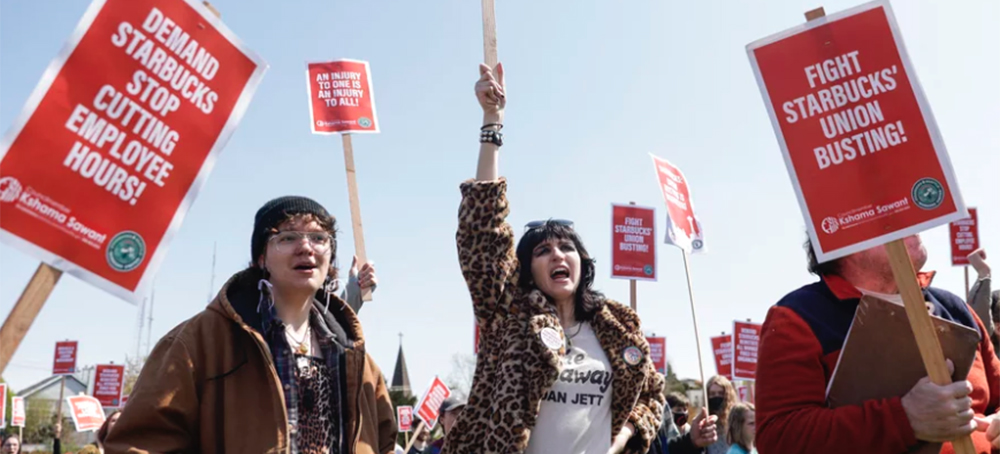 Marchers raise picket signs during a 'Fight Starbucks' Union Busting' rally held in Seattle in April. (photo: Jason Redmond/AFP/Getty Images)
So far, more than 300 Starbucks stores in close to three dozen states have had union elections — a stunning number, given not a single company-owned store had a union at this time last year. Even more remarkable is that 80% of them, or around 245 stores, have gone in favor of forming a union.
In the past week, Starbucks locations in Washington, D.C., Albuquerque, N.M., and Westlake, Ohio, became the latest to join the national union Workers United.
The impressive numbers showcase how Starbucks baristas have turned a grassroots campaign into a national labor movement with lightning speed.
But they hide another plain truth, which is that unionized stores make up less than 3% of the 9,000 company-operated Starbucks stores around the country. What's more, the number of stores petitioning to hold union elections has dropped dramatically in recent months. The flood of activity in the first half of the year, with a high of 71 petitions filed in March, gave way to a summer lull, with eight petitions filed in August.
Starbucks is facing more than 325 unfair labor practice charges
Organizers blame the slowdown in their momentum on what they call Starbucks' "scorched-earth" campaign to crush the union.
Under its legendary CEO Howard Schultz, who returned to lead Starbucks in April, the company has taken a wide array of measures to aggressively fight the union — from blanketing employee communications with anti-union messaging, including in one-on-one meetings, to announcing raises and benefits for nonunion stores only, to firing workers identified as union leaders.
Starbucks has forged ahead with these actions despite being charged with violating the federal labor law that protects workers' rights to organize. The National Labor Relations Board (NLRB) is tasked with investigating the more than 325 unfair labor practice charges brought by the union.
So far, NLRB regional offices around the country have issued 35 formal complaints against Starbucks, citing the company for coercing, threatening and firing employees over their union activities and withholding wage increases and benefits from unionizing stores.
Starbucks denies any wrongdoing.
"We respect our partners' right to organize but believe the best future is created directly with partners and not a third party," company spokesman Reggie Borges said in a statement.
Union organizers say that the company's tactics are working: Starbucks' sustained campaign has had its intended chilling effect.
Added benefits for nonunion stores have led newcomers to question the union
Starbucks has one clear and consistent message: Employees don't need a union because the company has always provided for them — with competitive wages, health care, free college tuition and other benefits.
To prove the point, back in May, Schultz announced raises and a slate of new benefits for Starbucks employees, including faster sick time accrual, expanded training opportunities and credit card tipping.
(Many baristas cite tipping as a central issue in their demands, because unlike at many cafes and dine-out restaurants, credit card machines at Starbucks do not allow or prompt customers to add tips.)
But there was a catch. Schultz said the newly announced raises and benefits would apply only to nonunion stores.
"We do not have the same freedom to make these improvements at locations that have a union or where union organizing is underway," Schultz told shareholders at the time.
Almost immediately, Workers United filed an unfair labor practice charge against Starbucks, accusing the company of misleading employees and violating labor law by threatening benefits amid a union campaign.
But those complaints and others have done nothing to deter Starbucks. Since then, Starbucks has unveiled even more benefits — including financial tools aimed at helping employees build savings and manage student loan debt — again, for nonunion stores only.
The company has posted flyers about these new benefits in back rooms of stores, including unionized ones. What should be good news for workers has muddied the union's messaging and its efforts to expand to more stores. It's led new workers at unionized stores to question the point of a union.
"They kind of get a little angry because they're like, 'Well, how come we're not getting these benefits?'" says Gailyn Berg, who works at a unionized Starbucks in Falls Church, Va.
Berg, a shift supervisor who uses the pronoun "they," transferred to the Falls Church store after spearheading a failed union drive at another Starbucks location 10 miles away. Since then, turnover at the new store has been high. A lot of the original union supporters left for college or other jobs soon after the election. They've been replaced by newcomers who don't know much, if anything, about the organizing effort.
"So we really have to start from the beginning," Berg says.
Disheartened, Berg has backed away from the "gung-ho — gotta unionize them all!" attitude they'd embraced earlier in the year. But they haven't abandoned the fight.
Berg is now more distrustful of Starbucks than ever before. They believe the raises and benefits that Starbucks is giving nonunion stores could be taken away at a moment's notice. They're fighting not only to get everything that's been granted to nonunion stores, but to have all of it written into a union contract.
"There's definitely some security in having that union," says Berg. "It's like insurance."
Even at unionized stores, fear of retaliation is prevalent
Meanwhile, those still pushing for a union at Starbucks say they remain fearful that they could lose their jobs at any time.
"We're scared. We're terrified," says Jasmine Leli, a barista and union leader in Buffalo, N.Y. "We just want to go to work like everybody else and do our jobs and not have to worry [about] when the other shoe is going to drop."
She has good reason to be worried. Workers United says Starbucks has fired more than 100 union leaders. Federal labor officials investigating the dismissals have concluded that some employees were indeed wrongfully terminated, including seven in Memphis.
A federal judge in western Tennessee ordered the company to reinstate the seven workers. Starbucks said it disagreed with the judge's ruling, maintaining that those fired had violated company policies.
Penalties for violating federal labor law are weak
Beyond issuing complaints, the NLRB has little power to change the company's behavior. Congress prohibits the NLRB from assessing monetary penalties for unfair labor practices. Starbucks faces no fines, only "make whole" remedies such as back pay for reinstated workers and compensation for medical, legal and moving costs associated with firings.
"The penalties for breaking the National Labor Relations Act are quite weak, and that's a huge problem because it doesn't really serve as a deterrent," says Rebecca Givan, associate professor of labor studies at Rutgers University. "Employers decide that it's just worth it to break the law because the consequences are fairly mild."
Amid the union fight, coffee sales have risen
At the store level, union supporters have concluded that Starbucks just doesn't care about labor laws.
"I don't really think it matters to them," says Leli.
For Berg, it's more personal.
"They don't seem to really care about us at all," Berg says. "Howard Schultz, in particular, seems very busy trying to just continue on doing his thing, and not not really acknowledging the fact that he has lost faith of so many of us that really believed in him."
Indeed, Schultz continues to be very good at the very thing that Starbucks is known for: selling coffee. All the negative publicity surrounding the company's anti-union activity doesn't appear to have hurt its sales.
Starbucks' revenue rose in the third quarter of this year, exceeding expectations. Customer loyalty — measured through the growing number of Starbucks rewards members — remains strong. In August, the company projected net new U.S. store growth of 3% to 4% annually over the next few years.
Schultz seems satisfied with all this progress and is preparing to exit the company once again. Starbucks announced that his successor Laxman Narasimhan, who officially joined the company Oct. 1, will take over as CEO next spring.
The workers will soon get their chance to collectively bargain for a contract
After growing criticism from the union, which alleged delay tactics, Starbucks last week said it had sent letters to 234 unionized stores, offering three-week windows in October for members of the bargaining teams to come to the table. To date, only three Starbucks stores have begun contract negotiations, and no store is close to settling on a contract.
"We look forward to these negotiations and hopefully setting dates and securing locations for contract bargaining," Starbucks said in a statement.
The union, too, says it's ready.
A national bargaining committee made up of about 50 Starbucks employees is meeting weekly, mapping out strategies ahead of the talks. They've begun unveiling a set of noneconomic proposals addressing topics such as health and safety and nondiscrimination in the workplace.
"We've been planning for months," says Leli, who sits on the committee and has worked to gather input from thousands of employees around the country. "We want to make sure everyone feels seen and heard."
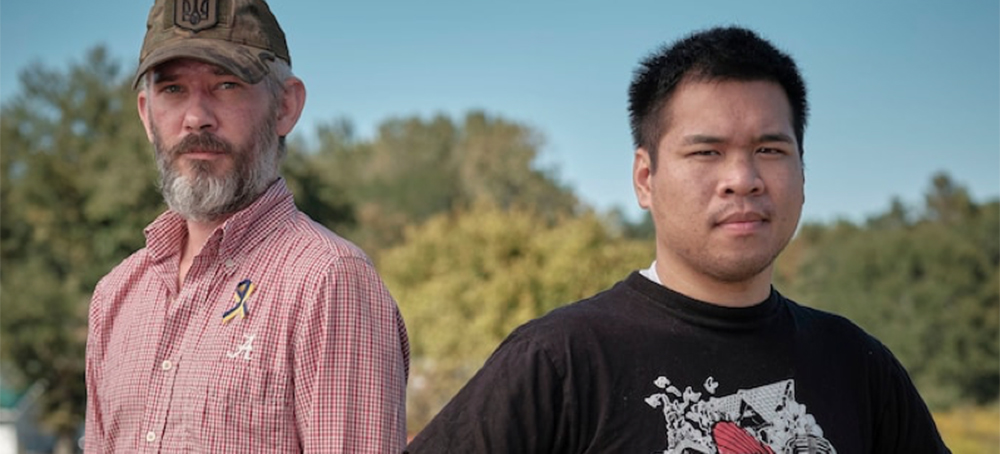 Alex Drueke, left, and Andy Tai Huynh were freed from captivity Sept. 21. In their first extensive media interview since their release, the pair say they were interrogated, subjected to physical and psychological abuse, and given little food or clean water. (photo: William DeShazer/WP)
In their first extensive interview since being freed, Alex Drueke and Andy Tai Huynh recount the physical and psychological abuse they endured over 104 days in captivity
What followed was an excruciating, often terrifying 104 days in captivity. They were interrogated, subjected to physical and psychological abuse, and given little food or clean water, Drueke and Huynh recalled. Initially, they were taken into Russia, to a detention complex dotted with tents and ringed by barbed wire, they said. Their captors later moved them, first to a “black site” where the beatings worsened, Drueke said, and then to what they called a more traditional prison run by Russian-backed separatists in the Donetsk region of eastern Ukraine.
Drueke, 40, and Huynh, 27, met with The Washington Post for three hours at the home of Huynh’s fiancee, Joy Black, in this rural town of about 2,500 outside Huntsville. It was their first extensive media interview since being freed on Sept. 21 as part of a sprawling prisoner exchange between Russia and Ukraine.
Each man lost nearly 30 pounds during the ordeal, they said, suffering injuries most evident in the red and purple welts still present where their wrists were bound. Their account provides disturbing new insight into how Russia and its proxy forces in Ukraine treat those taken off the battlefield.
The Russian Embassy in Washington did not respond to requests for comment.
Drueke and Huynh, who met in Ukraine, went to the country despite stern warnings from the U.S. State Department that taking up arms against Russian forces was unsafe and ill-advised. They joined the International Legion of Territorial Defense of Ukraine, a force comprising hundreds of Americans, Europeans and other foreign nationals who responded to public entreaties from the country’s president, Volodymyr Zelensky.
Drueke and Huynh said they are grateful to be alive and free, and to have had each other’s support and friendship through their captivity. They expressed no regret. Their goals now, they said, are to draw attention to Ukraine’s military needs, and raise awareness about another American veteran with whom they were imprisoned, Suedi Murekezi, who shared a cell with them for weeks but was not included in the prisoner swap. He’s among the handful of U.S. citizens detained by Russia for whom a diplomatic breakthrough has so far proved elusive.
“Alex and I never did this to become famous,” Huynh said. “We never wanted to become famous.”
One day of combat
Drueke, a U.S. Army veteran, and Huynh, who served in the Marines, said they were compelled to act after seeing images, early in the war, of Ukrainian families fleeing their homes as Russian forces leveled cities in their savage but ultimately failed bid to seize the capital, Kyiv, and topple Zelensky’s Western-backed government.
Drueke had been living with family members in Tuscaloosa, Ala., after being diagnosed as a 100 percent combat disabled veteran with post-traumatic stress, he said. He’d grown enthusiastic about long-distance mountain hiking. Huynh, a California native, had moved to northern Alabama to be with his fiancee, taking community college classes and working as a delivery driver for O’Reilly Auto Parts.
Huynh left the United States on April 8 to join a humanitarian group helping in Ukraine, he said. Drueke left four days later, believing that his experience during the Iraq War and familiarity with Western weapons could prove helpful to Ukrainian forces, he said.
Within days, they signed contracts with the foreign legion in Lviv, in western Ukraine near Poland’s border, joining the same battalion and receiving AK-74 rifles for training far from the fighting. They had brought their own camouflage uniforms and other equipment.
Both adopted noms de guerre. Drueke was named “Bama,” in honor of his home state. Huynh went by “Hate,” a shortened version of “Reaper of Hate,” a moniker he used in online video games.
“It was kind of a satire name because I’m not really a hateful person,” Huynh said. “Quite the opposite.”
“We called him Care Bear,” Drueke interjected with a laugh.
The men decided that “their skills could be better applied elsewhere” in the war, and requested a release from the contract they had signed with their first unit, Drueke said. For the next few weeks, they traveled the country by bus and train in what they called “vacation mode,” meeting with Ukrainian military officials about possible opportunities and marveling as civilians returned to their homes in and around the capital.
With time running out on their 90-day visas, they connected in Kyiv with a representative from Task Force Baguette, a military unit affiliated with the foreign legion that included French soldiers and other Westerners. The unit promised a Ukrainian military contract, allowing them to stay in the country and fight. This time, they were sent east and issued Czech-made CZ 208 rifles, to a base close to Russia’s border.
Their first mission, on June 9, would be their last.
That morning, the unit left Kharkiv in a pickup truck and two small sport-utility vehicles, heading north. Their assignment was to launch small drones, watch for Russian military forces and report what they saw, Drueke said.
But the unit was ambushed, and in the ensuing firefight everyone scattered, the Americans said. Drueke, Huynh and their team leader began searching for a machine-gunner and sniper who’d gone missing, only to learn that other members of the unit had taken their vehicles — and most of their food and water — and returned to base without them, Drueke said.
A representative for Task Force Baguette denied that Drueke and Huynh were left behind, saying the team scattered in five groups and that each had to make it back to safety on their own “as nobody knew what happened to the others.” He declined to elaborate. In a tweet, the unit celebrated the Americans’ release, thanking them for their service and calling Drueke and Huynh “heroes.”
Drueke and Huynh declined to detail the precise location or nature of their capture, but acknowledged opening fire during the ambush. After they were taken into custody, they were stripped of their gear and weapons, and bound. As they crossed the border into Russia, Drueke said, their captors noted their new location, slugged them in the gut, and said “Welcome to Russia.”
The beatings
The Americans were blindfolded for most of the next few days, they said. Occasionally, their captors would take the blindfolds off, allowing them to catch a glimpse of their surroundings. The Russians hid their faces behind tan balaclavas.
The camp, the Americans said, was a “tent city,” with six or seven prisoners of war held in each tent, Huynh said. Twin chain-link fences and barbed wire surrounded the compound.
The interrogations there, Drueke said, were “horrible.” The Russians appeared to doubt that they were rank-and-file members of a Ukrainian military unit. They asked Drueke and Huynh repeatedly if they were with the CIA, the Americans recalled. They ordered them onto their hands and knees, leaving them like that until their feet grew numb. If they moved, they were beaten, they recalled. At night, Drueke and Huynh were forced to remain on their feet for hours at a time to prevent them from sleeping.
“They really thought that we had been sent by our government, or had a large amount of government support,” Drueke said. “They really wanted to make sure we weren’t lying about that — and they had their ways of doing that.”
Most of the prisoners appeared to be Ukrainian, the Americans said. One who spoke English appeared to possibly be a British national. In the Sept. 21 prisoner swap, five British citizens also were freed, along with individuals from Morocco, Sweden and Croatia, more than 200 Ukrainians, 55 Russian troops and a close acquaintance of Russian President Vladimir Putin.
Four days later, the Americans were on the move again, they said, taken to a black site detention center in the Donetsk region of eastern Ukraine, where Russian separatists have power. The prisoners traveled for hours with bags over their heads, the Americans said, and swapped vehicles four times.
Drueke realized Huynh was with him only because he was tossed on top of him in one of the vehicles, prompting Huynh to respond with an “ouch” that Drueke recognized, he said. In such a dire situation, it was a relief.
Inside the black site
Their treatment worsened at the next location, they said.
Most of the detainees were kept in a cold basement divided into tiled cells, each about 5 feet long and 2 feet wide, Huynh recalled. They received a loaf of bread each day, along with water that often appeared to be contaminated. Huynh said he could hear screams — and cries of pain — as interrogations were conducted.
“That was one of the worst parts,” Huynh said. “Hearing people being hurt and not being able to do anything about it.”
Upstairs, a slightly larger room was used for solitary confinement. Huynh spent the first two days there before Drueke was put there for several weeks. About 80 songs of popular music, including from the rapper Eminem and the German metal band Rammstein, were pumped into the room on rotation for days, they said, shattering the peace but allowing them to mark the passage of time.
“They really, really kept us separate there,” Drueke said. “There were times where I would go days without hearing anything about Andy, and a lot of times I was, like, ‘Man, they killed him.’ ”
Beatings continued, which some of their captors seeming to relish dispensing more than others. A British man, Paul Urey, suffered beatings at the same facility and died there, Drueke and Huynh said. Ukrainian Foreign Minister Dmytro Kuleba announced Sept. 7 that the Ukrainian government had recovered Urey’s body and that it had “signs of possible unspeakable torture.”
Many of the questions posed by interrogators seemed nonsensical, asking the Americans to identify photographs of people they did not know and detail events in which they had no involvement. One of the men spoke near-fluent English, while another knew only some, Drueke said. He believes they were Russian intelligence officials.
In the upstairs room, Drueke and Huynh each were ordered to make phone calls to seemingly random organizations in the United States, many not equipped to help them.
At one point, the captors told Drueke to call the Veterans Crisis Line, a service that provides mental health support to American military personnel after they leave the service. Drueke said he tried to dissuade them from doing it because it made no sense, but his captors insisted.
“They look at me and go, ‘You are a veteran. This is a crisis!’ ” Drueke recalled, imitating their accent.
Many of the phone calls went nowhere, getting lost in a maze of telephone switchboards, voice-mail boxes and Americans who appeared to question whether the pleas for help were legitimate. But a representative on the crisis hotline offered Drueke numbers for the State Department and another federal agency, possibly the Federal Protective Service, a law enforcement outfit affiliated with the Department of Homeland Security. Someone picked up on the second number, Drueke said, and they took his information and promised to help. It was a glimmer of hope.
A State Department official, speaking on the condition of anonymity under ground rules set by the agency, said it takes seriously its commitment to assist U.S. citizens overseas, with U.S. diplomatic facilities putting after-hours duty officers on staff to deal with life-or-death emergencies.
“When U.S. citizens are being held in active war zones, it is impossible to provide in-person assistance,” the official said. “Regardless of the challenges, we make every effort to provide assistance to U.S. citizens and their families.”
The captors, who were armed, ordered Drueke and Huynh to appear in propaganda interviews that appeared on Russian state media, and observed as they were recorded, Drueke said. In one published June 17, they expressed frustration with corruption in the Ukrainian military and warned other Americans to “think twice” about joining the war effort. Drueke said it still bothers him that he had to say such things.
‘I actually prayed for death’
The Americans, along with several other prisoners, were moved again about four weeks later, Drueke and Huynh said. Joining them was Murekezi, a U.S. Air Force veteran who was sent to the black site after being detained in the southern city of Kherson in June. He had been living and working in Ukraine when Russia invaded, and declined to leave the country. Russian-backed separatists abducted him and accused him of a hate crime, said Sele Murekezi, Suedi’s brother, who lives in Minnesota.
There were no beatings at the next facility, but conditions were still abysmal, the Americans said. Bedbugs gnawed at their skin, leaving the walls of their cell streaked with blood, Huynh said. His arms and back remained heavily scarred by the insects more than a week after he was released.
The Americans had no idea that a prisoner swap was under discussion, and questioned if it was true even after they were removed from their cells and told they were going home. Their hands and eyes were bound excruciatingly tight with packing tape for their flight to a small Russian airstrip, in circumstances that they described as agonizingly painful but declined to detail fully.
“For me personally, it was the absolute worst,” Drueke said. “I realized a lot of times throughout that I could die, or that I was close to death, or that I probably was going to die. But that was the only time that I actually prayed for death.”
When they landed, they were greeted by Saudi medical personnel. They were whisked from there to Riyadh, where they met with State Department personnel and called loved ones.
The two men are still receiving medical care. Both have numbness in their hands, a possible symptom of nerve damage, they said. Drueke believes he may have cracked four ribs. Huynh is struggling with short-term memory loss and said that his mind “deteriorated” in captivity.
The pair are interested in helping the U.S. government by relating their experiences at the hands of Putin’s forces, they said. Other Americans, including WNBA star Brittney Griner and Marine Corps veteran Paul Whelan, are incarcerated inside Russia on what the Biden administration considers bogus criminal convictions unrelated to the war.
“It sounds trite, but we were given a second chance on life,” Drueke said. “I feel like our experiences, if we handle them the right way, we potentially have a lot to give the world.”
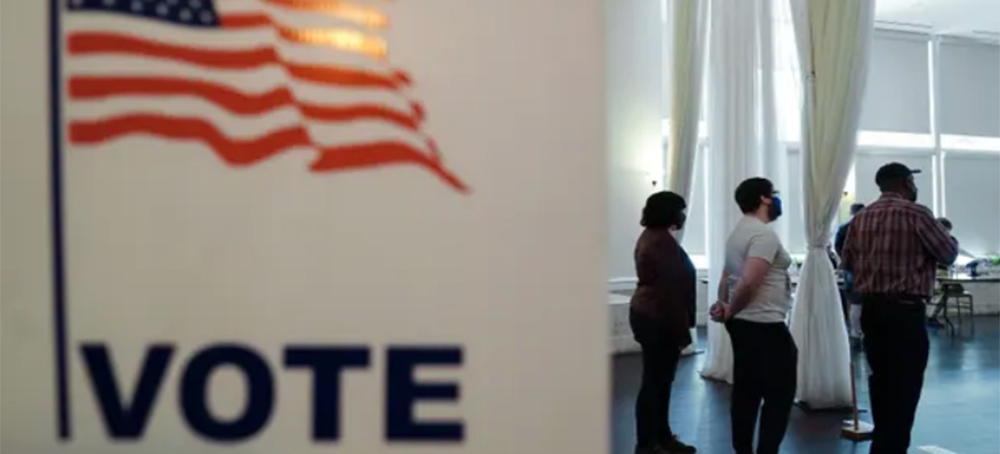 The broader effects of SB202 are being felt across Georgia as communities prepare for midterm elections. (photo: Brynn Anderson/AP)
SB202 is forcing officials and voting rights groups to use every resource to ensure elections run smoothly
The 98-page bill, also called SB202, impacts a litany of election elements ranging from voter ID laws to the distance at which food and water can be distributed to voters waiting in line. Election officials say they are being forced to use every resource at their disposal to navigate the bill and ensure this election season runs smoothly. But there is widespread concern that the new law will create fresh barriers to voters of color and the changing Georgia electorate.
“Internally, we are taking a multifaceted approach, strengthening leadership and expertise throughout departments, and working to beef up skillsets,” said Dele Lowman Smith, chair of the Dekalb county voter registration and election board. “Externally, we are expanding poll worker training and modernizing it to help better address voter concerns when they come up.”
Lowman Smith, who was appointed to the position in July 2021, said it will take an all-out approach to ensure elections run smoothly in her county of more than 500,000 active voters.
Although there were once 31 ballot drop boxes across the county in the 2020 election season, they are now allowed only six for the entire county as the bill prescribes one drop box per 100,000 voters. The time to request and return absentee ballots has dropped from 176 days to 59 days – more than 50% – forcing election officials to contend with a much quicker turnaround. Additionally, rather than completing absentee ballot applications solely online, voters must now include an original signature on their application, requiring access to a printer.
Liza Conrad, deputy executive director of Fair Fight, a voting rights organization based in Georgia, said SB202 significantly burdens voters. “For voters who wish to vote by mail, many are now overcoming these barriers while attempting to make their voices heard,” she said. “If we look back to Georgia’s primary election in May, the rate of rejected vote by mail applications was much higher than that of 2020.”
And while voter education once focused on civic engagement and political education, voting rights organizers such as Helen Butler, executive director of the Georgia Coalition for the People’s Agenda, says engaging voters now has to include education around technology and intricacies of the law out of necessity.
“What we have to do now is canvassing to really educate people about the process. We are trying to make sure people are still able to exercise their right to vote,” said Butler. “Every little thing seems to have had some kind of change. Even the secretary of state ‘my voter’ page [website] has changed, and now voters have to navigate through tabs instead of just having it all on one page, so we’re having to train voters on that now too.”
Conrad, Butler, and Lowman Smith all think it is critical to note that the full breadth of the law goes well beyond absentee ballots, voter IDs and drop boxes. SB202 also limits poll workers’ ability to work at polls outside their county, limiting the capacity of many counties in Georgia as they struggle to find an adequate number of already dwindling poll workers.
Shanice Amira Bennerson worked as a precinct manager for multiple elections between 2020 and 2022. However, after witnessing the impact SB202 changes had on voters during the May primaries, Bennerson decided not to continue her work as a poll worker.
“Trying to help voters who were just so confused and dejected is heartbreaking. When you have limited precincts and voters who are confused by these changes, some voters just left. Tensions are high, and voters were understandably frustrated,” said Brennerson. “When you couple this with all of the new rules from [SB202] and the limited training we get, it almost feels like a disaster waiting to happen.”
Voting organizations such as the Georgia Coalition for the People’s Agenda and Fair Fight have sought ways to engage and encourage poll workers and election boards across the state to address capacity and education on a larger scale. Fair Fight is hosting a “Vote Gold Georgia” tour calling for intentional and expanded voting sites and voting times.
Still, some voting rights organizations hope to call attention to the many changes prompted by SB202 by highlighting the voters most impacted by the law.
“Anti-voter bills like SB202 are a response to Black, brown and young voters turning out and claiming their power in 2020,” says Conrad. “And so, we are working to continue to make sure that these communities continue to participate and make their voices heard and that the poll workers who keep our democracy functioning are empowered and protected.”
Meredyth Yoon, litigation director for Asian Americans Advancing Justice Atlanta, also thinks the bill unjustly targets voters of color, and hopes to bridge the gap in access it could create.
Her group is reallocating resources and shifting its voter education approach to fully educate its communities around changes in timelines, requirements and other recent election changes.
“Overall, the impact of the bill is on voters of color, and it was not an accident or unknown to legislators that these communities would ultimately be affected,” says Yoon. “These sorts of tactics are traditionally the types of restrictions that are intended to impact voters of color on the assumption of how voters of color will vote.”
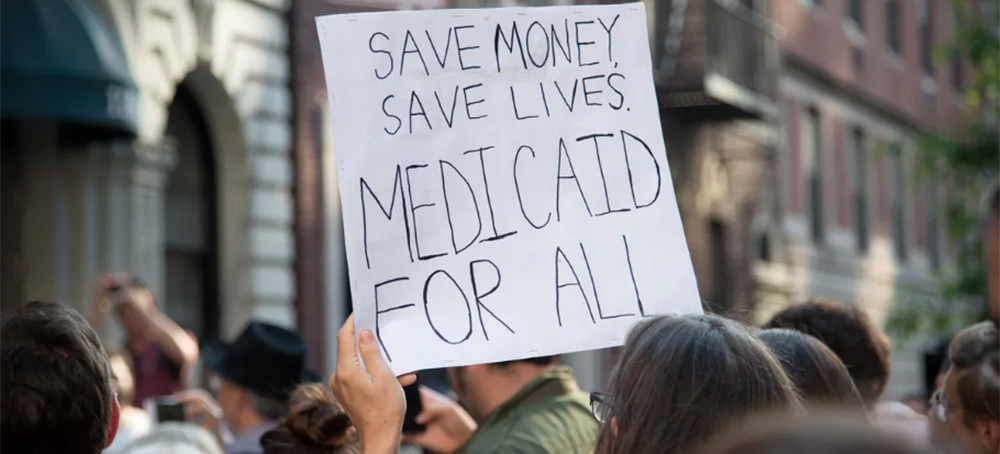 Pro-Medicaid activists rally in New York City in 2017. (photo: Zach D Roberts/NurPhoto/Getty Images)
Medicaid expansion is 6-for-6 with voters on ballot initiatives. South Dakota could make it seven in a row.
That undefeated streak could extend to seven wins in South Dakota this November.
On Election Day, voters will decide on a constitutional amendment that would extend Medicaid eligibility under the Affordable Care Act. If it passes, anybody making less than 133 percent of the federal poverty level (about $18,000 for an individual or $36,900 for a family of four) would qualify for Medicaid coverage. Right now, 5 percent of the state is uninsured. Childless adults of working age can not qualify for coverage at all. Pregnant women, children, and the elderly can currently receive Medicaid benefits, but working parents must have a very low income — less than 63 percent of the federal poverty level, about $17,500 for a family of four — to enroll.
An estimated 45,000 South Dakotans would be covered by the expansion, adding to 20.4 million low-income Americans nationwide already insured by the Medicaid expansion since the program took full effect in 2014. Many of those who would qualify for Medicaid in South Dakota — about 14,000 — are Native Americans currently ineligible for coverage. The ballot initiative appears to have a good shot at passing in November: Polling commissioned by the American Cancer Society Cancer Action Network found 62 percent of South Dakota voters said they support the measure.
Initially, the Affordable Care Act was meant to expand Medicaid coverage to low-income adults nationwide. The law offered a good deal: expand eligibility and receive a generous federal funding match, 90 percent of the cost in perpetuity. But a 2012 Supreme Court decision made Medicaid expansion optional for states, and a dozen states still have not accepted the expansion a full decade later, leaving 4 million people without Medicaid coverage who would otherwise be eligible.
In the face of that obstruction from Republican state officials, health care advocates have taken the issue directly to voters in largely Republican states, with remarkable success.
Across the six states that have expanded Medicaid through a ballot measure — Idaho, Maine, Missouri, Nebraska, Oklahoma, and Utah — an estimated 811,000 people have either enrolled or become eligible for Medicaid coverage. It’s a new frontier for expanding access to health insurance in America. I asked Paul Starr, a Princeton University sociologist and the preeminent historian of the American health system, whether there was any precedent for direct democracy leading to significant coverage expansions.
“The history of health insurance protection until the Supreme Court’s decision on the ACA in 2012 was almost entirely a history of legislation and administrative decisions,” he told me. “Ballot measures weren’t very significant.”
But ballot initiatives have become, in the last few years, almost exclusively the path for Medicaid expansion to keep advancing. In the first few years after the Supreme Court’s decision, a number of Republican state leaders decided to adopt Medicaid expansion on their own, driven by the financial benefits and lobbying from local health care groups. The Obama administration accepted waivers — including one from future Vice President Mike Pence, then governor of Indiana — to tweak the program to make it more amenable to these GOP politicians.
But by 2017, with Donald Trump entering the White House, the prospects for future action by Republican governors and legislatures looked grim. So the Fairness Project, an offshoot of an SEIU health care workers union in California that was supporting minimum wage ballot initiatives at the time, started coordinating with local organizers to put Medicaid expansion directly on the ballot.
“Direct democracy has been a path for important change and also a path of last resort,” Kelly Hall, a former Obama administration health official who is now the executive director of the Fairness Project, said. “Expanding Medicaid anywhere helps protect it everywhere.”
The last few years have been a revelation of Medicaid’s political potency. Concerns about ending the expansion and cutting Medicaid spending helped doom the Republican plans to repeal and replace the ACA. And these six expansion ballot initiatives have all passed since 2017, with South Dakota poised to become the seventh.
Hall said the campaign’s goal has been “helping to place Medicaid alongside the other third rail public programs like Medicare and Social Security.”
“Medicaid has a much wider base of support than many people appreciate,” Starr told me. “It’s not just the poor who benefit. It’s also people with disabilities and seniors, plus their families and the providers that benefit from Medicaid payment.”
GOP leaders have still tried — unsuccessfully to date — to stop or subvert these ballot initiatives, first in Utah and Missouri, and now in South Dakota. For the primary election in June, the state legislature put up a ballot measure that would have required a 60-percent supermajority for any future ballot initiatives to be adopted, with the intent of making it harder for the Medicaid expansion measure to pass. But it was rejected by two-thirds of South Dakota primary voters.
Why does Medicaid expansion keep finding success with red-state voters, if not their elected representatives? Hall pointed to three successful messages: hearing from neighbors who will benefit, bringing federal tax dollars back to the state, and protecting the solvency of rural hospitals and health clinics. One of the ads running in South Dakota features a farmer who says he wants to keep his family farm running but can’t afford health care right now.
To date, Medicaid expansion ballot initiatives have been an unqualified success. But their usefulness might soon be running out. Only about half of states allow citizen-initiated ballot measures and, of the 12 states that haven’t expanded Medicaid, only four of them permit such initiatives: South Dakota — which is already voting on it this fall — plus Florida, Mississippi, and Wyoming.
Florida is the second biggest state, after Texas, that is still refusing Medicaid expansion. Those two states are home to more than half of the 2.2 million people nationwide who have been left without a viable option for coverage because their state has not expanded Medicaid. But while ballot initiatives are permitted there, they require a 60-percent supermajority and the state legislature has shown a willingness to undermine ballot measures after their passage.
The entire Mississippi ballot initiative process, meanwhile, was upended by a state court decision in 2021; advocates are working to restore the rights of citizens to collect signatures and put issues directly to voters. In Wyoming, there is some hope that the legislature and governor may yet get on board with Medicaid expansion as the state faces budget woes.
So while ballot measures could still make more gains in expanding Medicaid coverage, expansion advocates are running out of opportunities. Texas, for example, is one of the states that does not allow citizen-sponsored ballot initiatives. Neither do Georgia or North Carolina, the next biggest states after Florida not to expand it.
“We’re pretty close to working ourselves out of a job on this topic,” Hall said.
But the work will still be unfinished, until Republicans in these other states come around, Democrats can win in statewide elections, or Congress decides to take action to close the Medicaid expansion gap for good.
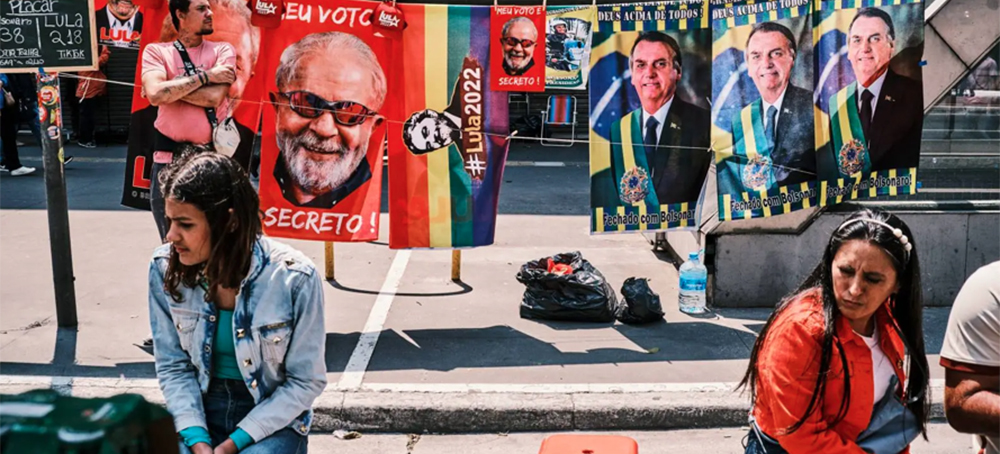 Brazil. (photo: Gustavo Minas/Getty Images)
Polls show left-wing former president Lula ousting incumbent Jair Bolsonaro on October 2.
After a tumultuous first term, Bolsonaro, commonly referred to in the media as the “Trump of the tropics,” faces an uphill battle for reelection — with major implications for the Amazon rainforest and climate policy worldwide.
According to recent polling from the group IPEC, Lula has been picking up steam in the final days of the campaign, solidifying a significant lead. Some 48 percent of polled voters said they currently support Lula; just 31 percent back Bolsonaro. If no candidate receives more than 50 percent of the vote on October 2, the election goes to a runoff on October 30. IPEC’s polling indicates that if the election were to take place today, Lula would likely receive 52 percent of the valid vote — after deducting null ballots — which points to a possible first-round victory.
Elected in 2018, Bolsonaro ran on a platform of pro-extraction, anti-Indigenous initiatives. Since taking office, he has stopped all Indigenous land titling, promoted land grabbing, and encouraged the opening of lands to mining, drilling, and agribusiness. He also appointed anti-environmentalist staff to regulatory agencies across the federal government and prevented enforcement of environmental policy.
“What Bolsonaro did was completely dismantle Brazilian environmental protections and rendered the environmental ministry all but useless,” said Claudio Angelo, head of climate policy and communications at Observatório do Clima, a group of 77 organizations that do research and advocacy around climate change in Brazil.
Deforestation rates in the Brazilian Amazon have gone up during Bolsonaro’s time in office, jumping 73 percent above 2018 levels by 2021 — a trend expected to continue, if not escalate, again this year. Between 2010 and 2021, illegal mining increased on Indigenous lands by 632 percent, with the most drastic increases occurring under Bolsonaro’s watch.
This environmental legacy, combined with high inflation rates and unemployment, soaring fuel prices, and the country’s widely criticized response to the COVID-19 pandemic, left Bolsonaro vulnerable to losing his reelection.
Lula was the president of Brazil for two terms between 2003 and 2010, and is generally viewed as having a better track record on environmental issues, though not without some flaws.
During his tenure, government agencies coordinated to reduce deforestation in Brazil by over 70 percent. Under Lula, the country also advocated for climate mitigation and adaptation funding from wealthy members of the United Nations, and secured international funding for Amazon conservation efforts. He was imprisoned for corruption charges in 2018, but in March of last year, the country’s Supreme Court annulled the convictions against him, ruling that the court that convicted him did not have jurisdiction to try him, thus restoring his political right to run for office.
In his current campaign, the former president has spoken out against the destruction of the Amazon, promising to put an end to illegal mining and fight organized networks driving deforestation. But he will face challenges — many ranchers, farming companies, loggers, miners, and land speculators have been emboldened by Bolsonaro’s rhetoric and policies. Plus, Angelo adds, in contrast to his first tenure, they are now heavily armed as Bolsonaro has relaxed gun control laws.
“I think that Lula is very cautious to understand that this is a huge challenge and is completely different than it was in the past,” Izabella Teixeira, Lula’s campaign adviser on environmental issues and Brazil’s former environment minister, told New Scientist.
While Lula has voiced support for the transition to clean energy, he has also said he would expand oil production, particularly of the “pre-salt,” a reserve of petroleum off the coast of Brazil. While Brazil gets most of its electricity from hydropower, it is also Latin America’s top producer of oil.
During his presidency, environmentalists criticized Lula and his successor, Dilma Roussef, also of the Workers’ Party, for building the Belo Monte hydroelectric dam, which displaced and impacted water flows for the Juruna tribe and several other Indigenous communities that had lived in the region for generations. More recently, activists decried Lula’s support for reconstructing the BR-319 highway through the Amazon. Two weeks ago, the former president’s environment minister, Marina Silva, who resigned in 2008 over objections to hydroelectric dam permitting, endorsed his candidacy after he agreed to implement a list of environmental policies that she proposed.
“Lula in 2022 is a different animal,” said Angelo. “He understands that Brazil’s international credibility relies on being a leader in the climate arena. And with Marina Silva’s proposals, we can now say that he is the candidate with the most advanced environmental package.”
As the country heads into election weekend, and threats against female, Indigenous, and Afro-Brazilian candidates intensify, many residents and policy experts have expressed concerns that Bolsonaro and his supporters might refuse to accept electoral defeat.
“Bolsonaro represents the continuation of authoritarianism and of people who think like him, that share a love of the military dictatorship and were not happy with democratization,” Lilia Schwarcz, a senior lecturer of anthropology at the University of São Paulo, told the Washington Post. “Now they are emboldened to express these views.”
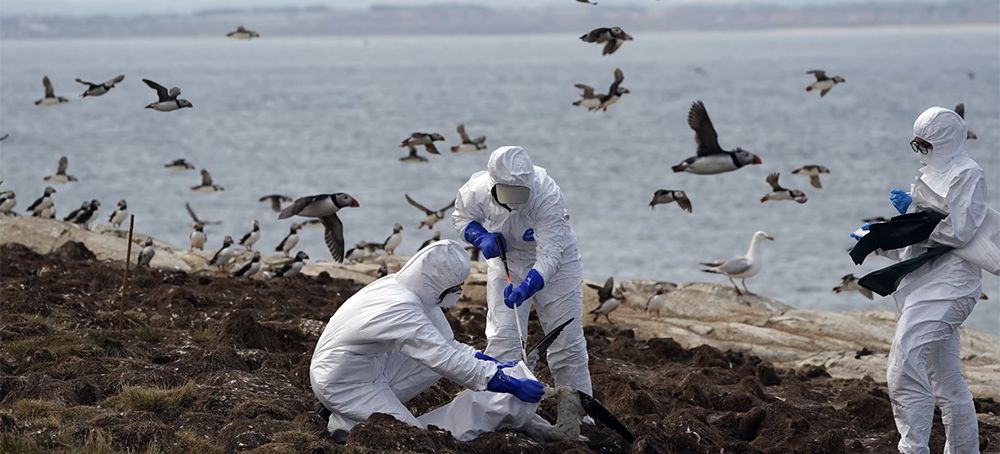 The National Trust team of rangers clear deceased birds from Staple Island, one of the Outer Group of the Farne Islands, off the coast of Northumberland, where the impact of Avian Influenza (bird flu) is having a devastating effect on one of the UK's best known and important seabird colonies with 3104 carcasses recovered by rangers so far. Picture date: Wednesday July 20, 2022. (photo: Owen Humphreys/PA Images/Getty Images)
Scientists are concerned for North American wildlife as the worst avian flu outbreak since 2015 rages on.
That day, the biologists carefully collected several carcasses, including those of two Canada geese and two American white pelicans, and sent the remains on to the U.S. Geological Survey’s National Wildlife Health Center lab for routine testing. Days later, the lab and then the U.S. Department of Agriculture confirmed: The avian flu’s H5N1 strain had finally reached California.
This year’s avian-flu outbreak—the first in North America since 2015—is caused by a version of this virus unlike any that virologists and wildlife managers have ever seen. “It’s behaving by a different set of rules,” says Bryan Richards, the emerging-disease coordinator at the National Wildlife Health Center. Now it’s spreading widely among wild birds, which has far-reaching implications for wildlife and human health.
Wildlife already face unprecedented stressors, from drought to wildfire to habitat loss. Now emerging and widely infectious forms of avian influenza are yet another serious threat—one that wildlife biologists say requires a new approach to disease management on farms, refuges, and landscapes nationwide. “We are in the midst of a completely unprecedented wildlife disease outbreak in North America,” says Rebecca Poulson, a University of Georgia research scientist who’s been studying bird flus for 15 years. “We’ve never seen anything like this.”
Before 1996, it was widely assumed that highly pathogenic avian influenzas only infected commercial poultry farms: These were virulent but contained outbreaks caused by on-farm mutations of a wild-bird-origin flu virus. Although devastating to those farms, the mutated strains seemed not to affect wild birds. This made outbreaks simple to manage with biosecurity prevention, isolation of exposed flocks, and swift culls.
In 1996, virologists first detected the H5N1 strain in a domestic goose in Guangdong, China. That virus received global attention in 1997 when it sickened 18 people in Hong Kong, killing six. The outbreak prompted international fears of a human pandemic, but the virus never mutated in a way that enabled human-to-human transmission. International media paid less attention to the fact that, by 2002, H5N1 had acquired the ability to move from domestic flocks to wild birds. The virus has continued to evolve ever since.
Today, several variants of HPAI are associated with “sporadic mortality events” in wildlife. In Newfoundland and Labrador this past summer, the current strain emptied seaside cliffs of thousands of gannets, puffins, and murres. This August, it killed 700 black vultures at a Georgia sanctuary. Waterfowl, shorebirds, raptors, and scavengers are some of the creatures at highest risk. In Western states most recently hit by the virus, such species include threatened and endangered birds such as the California condor and the snowy plover, though agencies have not yet documented infections in either species. Common urban- and suburban-dwelling Canada geese and crows and nationally symbolic bald eagles are also at risk, as are the millions of waterfowl whose migrations are beginning to peak now in northern states and will continue south through the season.
The last major outbreak—caused by a related strain, H5N8—reached North America in 2014, causing approximately $3 billion in losses to U.S. farmers, who had to cull 50 million chickens and turkeys. This year’s outbreak has so far affected a similar number of commercial birds, but it is orders of magnitude larger in wild landscapes. Via wild-bird transmission, it has reached nearly 10 times the number of backyard poultry, and while the 2014–15 outbreak was documented in just 18 wild-bird species across 16 states, this year, it’s been confirmed in at least 108 wild-bird species, with cases in nearly every state. In another unusual development, many mammal-crossover cases and deaths have also been confirmed in foxes, skunks, opossums, raccoons, bobcats, minks, harbor seals, a juvenile black bear, and one bottlenose dolphin. Labs are so overwhelmed that one wildlife official says they’ve stopped submitting carcasses of species that have already been documented in their county. They’re also submitting only a few birds per mortality event, making the official wild-bird death figures a gross underestimate.
The next few months could be even worse. Flocks across the continent are migrating now toward Central and South America, home to the largest diversity of bird species on Earth. “I think we’re just at the tip of the iceberg,” Poulson says. “We’re just sort of holding our breath to see what’s going to happen.”
Among Western states this fall, California is most likely to feel the brunt of the impacts: It’s one of the nation’s largest egg producers, and commercial poultry meat is the state’s sixth-largest commodity, worth $1 billion annually. California’s Central Valley provides essential migration and wintering grounds for wild birds: The Sacramento National Wildlife Refuge Complex alone is visited by hundreds of thousands of migrants each fall. It supports a large number of the continent’s northern pintails (one of the most numerous duck species in the world) and is a critical habitat for overwintering waterfowl.
This year’s drought means wintering flocks may be both unusually crowded and especially mobile, heightening the risk of viral spread, says Michael Derrico, the refuge’s lead wildlife biologist. Because the refuge’s wetlands are half their normal size, birds will be forced into closer proximity and may move frequently to find resources, which Derrico thinks may also push birds farther south.
Derrico’s concern for birds in the Pacific Flyway is somewhat tempered by the fact that, so far, the country’s westernmost migratory channel doesn’t seem to have as much of the virus as other regions do. But he and other wildlife managers are also very limited in what they can do to mitigate potential impacts.
“Once a disease becomes established in a free-ranging population, then you really lose the upper hand,” Richards says from his USGS home office near Madison, Wisconsin. “We’re really, really good at documenting disease on the landscape, but we’re less good at altering disease outcomes.” Instead, he says, “some of us are beginning to pivot towards a conversation of wildlife health as opposed to wildlife disease.”
For Derrico, at the Sacramento refuge complex, promoting health instead of preventing disease might involve investing more in wetland management to ensure that birds have access to the largest habitat possible, and minimizing human disturbance to prevent scattering birds to new areas. In many parts of the country, bald eagles and other raptors are already experiencing widespread mortality from lead poisoning by bullets and fishing tackle, and Richards says that addressing that issue might be a better use of resources.
“That’s something we can control, right?” he says. Combined with improving biosecurity measures on farms, by tackling environmental factors that are within human reach, Richards believes wildlife managers may be able to increase bird resilience even in the face of deadly new diseases.
The pressure to change wildlife-disease management is only increasing. “When you look globally at emerging infectious diseases, we’ve seen some pretty interesting trends,” Richards says. “We have seen more new diseases, larger disease outbreaks, more frequently and with larger impacts.” That includes some with the potential to cause species extinction, and, as seen recently with COVID-19, ones that could mutate to become widely infectious and transmissible in humans. Virologists believe the risk of that happening in this H5N1 strain is low but recommend that hunters, farmworkers, and other bird handlers take extra precautions this year anyway. Of all the emerging diseases that threaten people, Richards says, a majority have originated in wildlife.
Follow us on facebook and twitter!
PO Box 2043 / Citrus Heights, CA 95611


Comments
Post a Comment