RSN: ‘It’s a Deal With the Devil’: Outrage in Appalachia Over Manchin’s ‘Vile’ Pipeline Plan

29 August 22
You Are the Best of the Progressive News Sources
I wish I could afford more, but I'm 84 and on limited income. I hope that you'll be able to continue your excellent work!
Bryce
RSN Reader-Supporter
If you would prefer to send a check:
Reader Supported News
PO Box 2043 / Citrus Heights, CA 95611
Follow us on facebook and twitter!

29 August 22
Live on the homepage now!
Reader Supported News

The fossil-fuel friendly senator has resurrected the Mountain Valley pipeline, leaving residents with a bitter pill to swallow
So when news broke earlier in August that the state’s fossil-fuel friendly senator Joe Manchin had resurrected the beleaguered pipeline, Crabtree, a high school science teacher who teaches students about the climate crisis, felt “numb”.
Manchin, a conservative Democrat who receives more campaign financing from the fossil fuel industry – including pipeline companies – than any other lawmaker in Congress, had agreed to back his party’s historic climate legislation before the crucial midterm elections. But only after he negotiated a side-deal to fast-track the MVP.
“It’s the unfairness that makes me so angry. It’s a deal with the devil,” said Crabtree, 68, who owns a 30-acre sheep farm in Lindside, Monroe county.
The deal is a sweet one for the pipeline’s supporters. Democratic leaders agreed to advance separate legislation in September that would “require the relevant agencies to take all necessary actions to permit the construction and operation of the MVP and give the DC circuit jurisdiction over any further litigation”.
This could help the pipeline company circumvent judges who have suspended construction and overturned permits over environmental concerns, and have future legal cases heard in an appeals court in Washington, which is considered more favourable to developers.
It’s part of a broader set of concessions negotiated by Manchin to diminish environmental protections and expedite permits and construction of pipelines and other energy infrastructure, limiting legal challenges by concerned communities and environmental groups.
It also mandates new oil and gas drilling deals in Alaska and the Gulf of Mexico – places that environmentalists have also fought in court to preserve. Any public lands given over to solar and wind developments must be accompanied by millions of acres handed to oil and gas – tying the US to planet-heating energy projects for decades.
Brett Hartl, a campaigner at the Center for Biological Diversity, said the side-deal was a “vile tribute” to the fossil fuel industry. “These companies are wrecking our climate and raking in record profits, and more federal help is the last thing they deserve.”
Campaigners also warn that the slew of concessions will sacrifice another generation of Black, Latin, Indigenous and low-income communities, who will bear the brunt of air pollution, noise and displacement from the new projects.
Still, many experts argue that the concessions were worth it to secure the country’s first ever climate legislation, which provides $369bn for the transition to electric vehicles and renewable energy – a historic investment that scientists estimate will lead to net reductions of 40% by 2030, compared with 2005 levels.
For those who will be directly affected, the trade-off is a bitter pill to swallow.
Crabtree, who was arrested in 2018 after trying to stop construction on her property by chaining herself to her old Ford Pinto, said: “I understand how compromises work, and I’m glad that we finally got some action on climate change. But our communities and the environment are being sacrificed for Manchin and his friends, and that’s painful.”
The Mountain Valley pipeline would stretch 303 miles across steep forested Appalachian mountains, farmland and a thousand or so streams, rivers and wetlands, transporting liquified shale gas from north-western West Virginia to southern Virginia.
It will cut through karst terrain – complex geological structures created by the breakdown of soluble rocks like limestone and dolomite – characterised by springs, creeks, caves and sinkholes. This Swiss-cheese like underground landscape has blessed the area with abundant water sources, but the porous, unstable nature of the land makes it vulnerable to contamination, according to the US Geological Survey. Recent heavy rains led to mudslides and slippage across the region, and pipeline opponents argue that putting anything volatile in the ground is too risky.
The company said it had “worked diligently to identify a route that poses the least overall impact on communities, cultural and historic resources, and environmentally sensitive areas, including karst topography regions”.
Of big concern is Peters mountain – a sprawling peak covered in oak, maple and hickory trees with sheer drops, endangered species and breathtaking views that straddles state lines to Virginia. The pipeline would cut across the imposing mountain, which supplies clean drinking water to just over half of Monroe county residents.
“Just because Joe Manchin wants to fast-track this fossil fuel infrastructure, the facts haven’t changed. The violations, inconsistencies and holes in the permitting are still there. This land is very vulnerable, the threat to our water supply hasn’t changed,” said Howdy Henritz, 82, a clean-water advocate and small landowner in Greenville, Monroe county, who relies on spring water.
“Hearing the news was like getting sucker-punched. I will never vote for Manchin again.”
But others such as Bill Shiflet, a real estate agent, farmer and chair of the Monroe county building commission, support Manchin’s deal, and believe environmental concerns are “unfounded”.
He said: “We have pipelines all over this country. Once the gas is flowing, Mountain Valley will bring in game-changing amounts of money through severance and property taxes, and will allow us to sell West Virginian gas to our allies in Europe … Shutting off fossil fuels now would be very bad news, we’re not ready.”
The project is over budget, behind schedule and currently at a standstill because it does not have the necessary permits to cross waterways and wetlands – which Manchin wants to sidestep. Earlier this week, the company was granted a four-year extension, until October 2026, to complete the project. (The company claims that roughly 94% of work on the MVP is complete, but according to calculations by environmental groups the true figure is closer to 55%.
On the other side of Peters mountain in Giles county, Virginia, Georgia Haverty, 82, owns 500 acres with pick-your-own apple orchards, a restaurant, a wedding venue and doggy daycare. In recent years, extreme and unpredictable weather patterns have led to crop failures, which Haverty believes underscores the urgent need to transition away from fossil fuels. “Sacrificing the planet for bigger corporate bank accounts is not a reasonable tradeoff. The problem is we’re Appalachian, [and] we don’t have any political influence,” he said.
The pipeline industry’s financial influence in Washington, however, is growing.
So far this year, the industry has donated $331,000 to Manchin – up from $20,000 in 2020, according to federal campaign finance disclosures tracked by Open Secrets. Four Democrats are among the top 20 industry beneficiaries, who include Manchin, who has received more than the next five lawmakers put together, as well as Kyrsten Sinema of Arizona and Chuck Schumer, the Senate leader from New York who negotiated the deal for Manchin’s vote. Since 2017, Schumer has also raised at least $281,000 from the country’s largest utility, NextEra Energy, a stakeholder in MVP.
A spokesperson for Manchin said he has “always been in full compliance with ethics and financial disclosure rules’’ and “always had West Virginia’s best interest in mind”. Schumer’s office did not respond.
Haverty said that if she’s learned one thing from fighting the pipeline, it’s that money matters. “If you own something and someone with more money wants it, they will take it – and the facts, regulations and fairness don’t matter. It’s the opposite of the American dream,” said Haverty, who was among 300 residents in Virginia sued using eminent domain powers to force the pipeline on her land. A lawsuit challenging the use of eminent domain for private gain – which under the constitution is restricted to the government taking private property for public use – is ongoing.
But it’s not over till it’s over, and the next stage of this struggle will be over permitting – which the company believes the fourth circuit court in Richmond, Virginia, that has overturned crucial permits suspending construction has got “wrong” and Manchin wants to bypass.
While some Democrats point out lengthy permitting procedures have also slowed renewable energy projects and the transmission of clean electricity across the country, the party’s progressive wing is reluctant to fulfil Manchin’s bargain.
“Polluting industries may have won that promise in a deal with a select few, but I intend to do everything in my power to convince the rest of my colleagues to break it,” said Raúl Grijalva, chairman of the House’s natural resources committee and a congressman from Arizona. Rashida Tlaib, another progressive Democrat, added that given Manchin’s previous political manoeuvrings around the climate bill “we owe him nothing now” on permits.
Like the Dakota Access pipeline on Indigenous lands at Standing Rock, the MVP could become a national call to protest, and will then come down to how much political capital and force leaders are willing to deploy. On Wednesday, more than 650 groups sent a letter to congressional leaders, calling on them to abandon Manchin’s fossil fuel side-deal.
In Montgomery county, it was a wealthy rural neighbourhood on the outskirts of the city of Blacksburg, where residents first mobilised against the MVP almost eight years ago, creating pipeline monitoring networks and legal strategies that morphed into a regional and national movement.
David Seriff, 64, a telecoms account executive, and his wife Bridget Simmerman, 60, a psychotherapist, hosted the first meetings, and over time the pipeline route shifted to avoid some of their properties. “This is a wealthy neighbourhood, we have more influence than others, but we’ve seen outrageous abuse of individual and property rights, it’s so un-American,” Seriff said.
Less than half a mile up a wooded fire access road, piles of the 43in carbon steel pipeline are visible up and down the mountainside, rusting on the deforested corridor since construction was suspended a couple of years back.
Seriff said: “The bottom line is that we don’t need more methane infrastructure. We need to move forward not back. This deal is an outrage but it’s not over. We’re organised and ready, and we’re going to stop this.”
 In this handout image courtesy of the US Navy taken on August 27, 2021, the guided-missile destroyer USS Kidd transits the Taiwan Strait during a routine transit. (photo: US Navy/AFP)
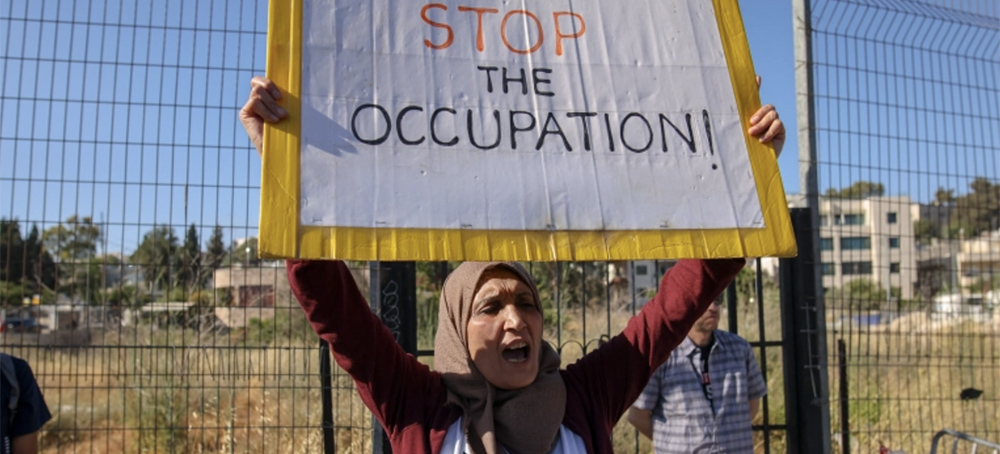 A woman holds up a sign reading 'stop the occupation' as Palestinian, Israeli, and foreign activists gather for a demonstration against Israeli occupation and settlement activity in the Palestinian territory, in Jerusalem's Palestinian Sheikh Jarrah neighbourhood, on June 4, 2021. (photo: Ahmad Gharabli/AFP)
It feels personal when I hear that the US embassy in Jerusalem will be built on land stolen from Palestinians.
The descendants of the original owners include Palestinian residents of East Jerusalem, as well as Palestinian Americans. Adalah, along with these descendants, shared in their report original documents serving as proof of ownership of the property in Jerusalem. The parties have demanded that the Biden administration cancels the plan to build a diplomatic mission on stolen land.
The revelations and the struggle of Palestinians to reclaim their land feel personal to me. They echo a similar battle for our past that my grandfather – and many others – waged.
After 1948, Israel legalised the systematic theft of Palestinian homes and properties in West Jerusalem, in particular through the Absentee Property Law. That 1950 legislation declared Nakba refugees “absentees” even if they were in the eastern part of Jerusalem and allowed the Israeli government’s Custodian of Absentee Property to take over their property.
Back then, the Americans themselves recognised this fact in a cable sent by the US consul general in Jerusalem in December 1948. The consul general wrote to the US secretary of state, stating that Israel was trying to “eliminate” the possibility of Palestinian refugees returning home, in defiance of a United Nations resolution passed earlier that month and supported by the US.
My family was one of the many Palestinian families that were denied the right to our homes in Jerusalem’s west side.
Our oasis
Before Israel, my grandfather owned a house in al-Qatamon, a modern and affluent neighbourhood of Jerusalem, located 2km (1.2 miles) south of the Old City. Established in 1860, Al-Qatamon included 204 Palestinian homes on land that spanned 20 hectares (49 acres). It was established to accommodate middle to upper-class Jerusalemite families who found life within the walls of the Old City too crowded.
The population of the neighbourhood was mainly Muslim and Christian, along with a few foreign families who lived there during the time of the British Mandate. Growing up, Palestinian writer and doctor Ghada Karmi brought al-Qatamon alive for me through her 2002 memoir, In Search of Fatima. In her book, Karmi described her family’s stone house and its garden full of citrus and olive trees. Karmi and her family were forced out of the neighbourhood when she was eight years old, during the Nakba.
Later, I came to hold documents that my grandfather and father had carefully kept, proving the ownership of our house in al-Qatamon. The papers showed that my grandfather had registered the property on April 21, 1939. He had bought it from another Palestinian Jerusalemite family, the Zmourrods.
Everything changed in 1948, following my family’s expulsion to East Jerusalem. My grandfather, though just 1km (0.6 miles) away from al-Qatamon, was suddenly an “absentee” under Israeli law.
The land registry deeds in my hands showed how on July 28, 1957, the Custodian for Absentee Property sold my family’s house to Israel’s Development Authority, so it could be taken over by new Jewish tenants. The same land registry deeds that listed my grandfather as the owner of this property now had another party selling it away.
Legal discrimination
In 1970, the Israeli Knesset passed the Legal and Administrative Matters Law, which effectively meant that Jewish owners who had to flee their property in East Jerusalem in 1948 would not be considered “absentees” in the then-newly occupied part of the city. They could return to claim their homes. That same law, however, did not extend similar benefits to East Jerusalem residents who once owned property in West Jerusalem. Those Palestinians, like my grandfather, remained “absentees”.
Still, my grandfather decided he wanted to claim his home. On March 28, 1972, as a resident of a Jerusalem “unified” under Israeli authority, he wrote a letter to the Custodian of Absentee Property. He requested that his house be returned to him since he was now a resident of Jerusalem and no longer “absent”. He finished his letter with these emphatic words: “This house is my private property and no one else has any connection with it.”
Nearly a month later, the Custodian of Absentee Property in Jerusalem wrote back, citing the Absentee Property Law as cause to turn down my grandfather’s plea.
With the documents in my hand, and relying on what my father knew, I pinpointed the exact location of the house and took my dad for a visit in the summer of 2021. We were not surprised to find it was still there, and that it was occupied by a Jewish Israeli family. The building had two extra stories added on top of the original one-storey house. Everywhere I looked in the neighbourhood, I saw evidence of our Palestinian existence, and I felt the heartache of our erasure.
The 1970 law enabled Jewish groups to claim ownership of property in East Jerusalem, most prominently in the areas of Sheikh Jarrah and Silwan. To date, Palestinians displaced by Israel do not enjoy that right in West Jerusalem.
As Palestinians in Sheikh Jarrah, Silwan, and other neighbourhoods of East Jerusalem face eviction orders in favour of Jewish settlement, I cannot stop thinking about the sheer injustice of it all.
They claim Jerusalem is an undivided city, yet there are two laws governing two peoples in the most unequal manner. They claim we have rights, yet I believe they merely tolerate our existence. We lack the right to vote, the right to housing, the right to property – and with our ancestral homes stolen, the right to our history.
 Oligarch Ihor Kolomoisky is accused by federal prosecutors of amassing a real estate empire in the U.S., with millions in stolen funds from Ukraine bank. (photo: Vladyslav Musienko/Unian/AFP/Getty Images)
It was 2008, and the city had fallen over the edge of a massive foreclosure crisis. Cleveland was hurting, and Optima (which has used different versions of its name) eventually became its largest holder of commercial real estate. And Cleveland was not alone. In communities from West Virginia to Kentucky, a desperate need for investors led elected officials in struggling cities and towns to roll out the red carpet for Optima, which bought up steel plants, factories and commercial real estate.
But things that seem too good to be true often are. In 2019, a Ukrainian bank filed a lawsuit in Delaware alleging that Optima was a front for two Ukrainian oligarchs who used it to launder hundreds of millions of dollars of stolen money. The Federal Bureau of Investigation raided Optima’s offices the following year. In 2021, the State Department issued sanctions against one of the oligarchs, Ihor Kolomoisky.
Cleveland has now become a poster child for the need for more transparency in the U.S. real estate industry. A raft of new anti-money laundering laws and regulations is aimed at the industry, which has attracted more than $2 billion in illicit funds over a recent five-year period, according to one report. Chipping away at the culture of anonymous ownership is a good thing, and is long overdue. But the new rules won’t address the elephant in the room: Many cities and small towns, especially in the American Midwest, badly need investment, and sometimes shadowy foreign money is the only kind that comes calling.
“Over and over again, Kolomoisky and his network allegedly turned to Middle America — overlooked towns, forgotten areas, regions that needed an economic lifeline, whatever the source — for their massive laundering needs,” Casey Michel, the author of “American Kleptocracy: How the U.S. Created the World’s Greatest Money Laundering Scheme in History,” wrote recently in Foreign Policy magazine. “Those on the receiving end had no incentive to look this foreign gift horse in the mouth, even when the signs of money laundering were clear.”
Mr. Schochet, Mr. Kolomoisky and their associates have denied the allegations against them and have repeatedly appealed rulings against them in court that aim to strip them of their assets. One by one, Optima’s properties are being sold off to new owners.
Cleveland is still struggling to recover from the 2008 foreclosure crisis, which made it particularly vulnerable to secretive strangers with deep pockets. Local officials and an economic development fund saw a ray of hope in Optima and lent the company at least $42 million in 2011 to fix up a hotel that anchored a block near City Hall. But after the construction wrapped up, it was clear that the company wasn’t holding up its end of the bargain. It defaulted on loans and failed to pay taxes. In the end, it didn’t even bother to change the light bulbs in the hotel parking garage when they went out, according to a former hotel employee.
The Pittsburgh Post-Gazette published an investigative series last year with a story about how elected leaders in Ohio and West Virginia helped Optima keep some of the factories it had purchased open, despite environmental and safety violations. As Ukrainian officials began investigating Mr. Kolomoisky for stealing billions of dollars, Optima stopped paying bills in the United States. Municipalities were left with shuttered factories, neglected properties, injured workers and unpaid tax bills. Making good on these investments was, apparently, less important than being able to park whatever money they could in the U.S. Money-launderers are like false lovers. They promise the moon, but then they leave you high and dry.
The ordeal has sparked soul-searching in Cleveland and beyond about what went wrong and how to fix it. Scott Greytak, director of advocacy for Transparency International U.S. and a Cleveland native, told me that one of the biggest problems is that many American professionals aren’t required to do due diligence into their foreign clients. “Ihor Kolomoisky could not have raided Cleveland without the help of American enablers,” he said. “The middlemen who incorporate companies and who close on properties should have to ask basic questions about their clients before taking their money.”
He has been pushing for the ENABLERS Act, which the House passed in July. It would empower the Treasury Department to require so-called “gatekeepers” to the U.S. financial system — including certain lawyers, accountants and registered agents — to look into their clients and report suspicious activity, just as banks are required to do. It’s not clear whether the Senate will pass it, but the principle behind it is an important one: Americans who make a business model out of money laundering shouldn’t be allowed to get away with it.
Another big problem that the saga of Optima reveals is the secrecy of the U.S. real estate industry itself, which encourages the use of limited liability companies, shell companies and land trusts that often end up protecting the privacy and the holdings of the wealthy. Jay Westbrook, a retired city councilman in Cleveland, told me that Ukrainian oligarchs aren’t the only ones who hide their identities. Mr. Westbrook, who now works with land banks to clean up abandoned and neglected properties, said it is not uncommon for out-of-town investors to buy property under the names of various L.L.C.s and then walk away from their responsibilities at the first sign of trouble, leaving unpaid taxes and messes behind. In many jurisdictions that have not been deemed at “high risk” for money laundering, cash buyers can essentially purchase property anonymously, without anyone involved in the transaction recording and verifying their true identities.
His solution? To hold the wealthy to the same disclosure standards that working stiffs have to go through to get a mortgage.
Congress took a small but important step in this direction when it passed the Corporate Transparency Act in the waning days of the Trump administration, overriding a presidential veto. The new law directs the financial crimes bureau of the Treasury Department, known as FinCEN, to collect information from companies about their true ownership and keep it in a massive, confidential database that can be used by law enforcement for money laundering investigations. Eventually, this law could touch millions of businesses, forcing them to file an additional form. As long as the filing process isn’t onerous, the benefits of greater transparency should outweigh the hassle.
But this database won’t be available to the public, and it’s unclear exactly how accessible it will be for people in cities like Cleveland who may want to use it to figure out if a potential investor is a deadbeat or a kleptocrat. It’s also far from clear that FinCEN has the capacity to build and manage the massive database it has been ordered to create. A Government Accountability Office report found that the agency can take years to make use of other ownership information that it collects and inform law enforcement agencies about the information’s existence. Unless this data is used effectively, there’s no point in collecting it.
To be clear, these steps to combat money laundering are important. The United States has been ranked the most secretive financial jurisdiction in the world. A 2016 report by the Financial Action Task Force, an intergovernmental group that combats money laundering, gave the United States some embarrassingly low rankings, although some improvements have been made since then. To have strong credibility on the world stage in the fight against international corruption, the United States must continue these efforts. This is especially crucial now that the Biden administration has called corruption a core national security interest.
But it’s not clear that any of these new rules — as necessary as they might be — would stop another Optima.
Stephen Strnisha, the chief executive of the Cleveland International Fund, which pairs foreign investors with local business opportunities, lent the lion’s share of the package that Optima received to revamp the hotel. He has spent nearly two years in court trying to get that money back through a sale to a new owner. Greater transparency “would be a good thing,” he told me. But it might not have prevented Optima from buying up so much of Cleveland.
Even if he had known that Optima was owned by an oligarch, no allegations had been made public against Mr. Kolomoisky at the time, so the loan might have gone through anyway.
Mr. Strnisha assured me that neither the saga of Optima — nor the new rules that are being adopted to combat similar situations — will stop Cleveland’s comeback. “Cleveland doesn’t need dirty money,” he said, and the city will survive this. But smaller communities that have been more reliant on Optima’s investments have been hit far harder, he added. The cautionary tale of what shadowy money can do to struggling communities could prove to be the most effective anti-money laundering tool yet.
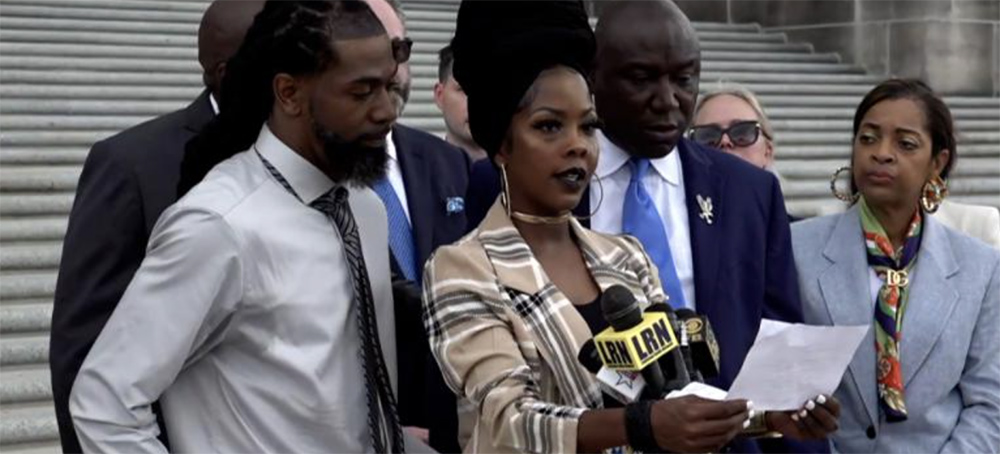 Nancy Davis, in front of microphones at a press conference on Friday, says being denied an abortion in Louisiana was 'not fair to me.' (photo: CNN)
Nancy Davis said she is planning to get an abortion in another state after a Louisiana hospital allegedly chose not to perform the procedure even though her baby was diagnosed with acrania, a rare congenital disorder in which a fetus' skull does not form inside of the womb.
Acrania is a lethal condition with death within the first week of life, according to the Fetal Medicine Foundation.
Davis' case reflects the confusion and wrenching decisions faced by mothers and health care professionals after the June 24 US Supreme Court ruling to overturn the constitutional right to an abortion.
Laws that ban abortion or severely restrict the procedure have subsequently gone into effect in about a dozen states -- Louisiana among them.
"I want you to imagine what it's been like to continue this pregnancy for another six weeks after this diagnosis," Davis said at a news conference on the steps of the Louisiana State Capitol in Baton Rouge. "This is not fair to me and it should not happen to any other woman."
Davis, who said she learned of the baby's fatal condition 10 weeks into her pregnancy, was joined at the news conference by the baby's father and her attorneys, including Ben Crump.
"The doctors told me that my baby would die shortly after birth," Davis said. "They told me that I should terminate the pregnancy. Because of the state of Louisiana's abortion ban they cannot perform the procedure. Basically, they said I had to carry my baby to bury my baby. They seemed confused about the law and afraid of what would happen to them if they perform a criminal abortion, according to the law."
In a statement last week, a spokesperson for Woman's Hospital in Baton Rouge, Caroline Isemann, said the hospital cannot comment on a specific patient but said navigating an unviable pregnancy is extremely complex.
"We look at each patient's individual circumstances and how to remain in compliance with all current state laws to the best of our ability," Isemann told CNN.
"Even if a specific diagnosis falls under medically futile exceptions provided by (the Louisiana Department of Health), the laws addressing treatment methods are much more complex and seemingly contradictory."
Crump called on the state to hold a special session of the Louisiana legislature to address the "public health catastrophe" created by "vague and confusing" abortion laws.
The attorney said Louisiana lawmakers have "inflicted unspeakable pain, emotional damage and physical risk" by stepping between his client and her doctors. He said other women and healthcare providers will endure a similar plight because state law has "created an environment of confusion and fear."
Isemann told The New York Times that Louisiana's multiple abortion bans, which use different terminology, complicate matters.
"There is currently no guidance on which law controls" the situation, she said, adding that the hospital was struggling to ensure that a doctor who terminates a pregnancy after a diagnosis of acrania was safe from prosecution.
The lawmaker who wrote the state's abortion law, state Sen. Katrina Jackson, told CNN affiliate WAFB that Davis should have been allowed an abortion based on a list of 25 exclusive exceptions from the Louisiana Department of Health.
"This woman is seeking a medical procedure for a pregnancy that is not viable outside of the womb," Jackson told WAFB.
It's unclear which state Davis will go to for the abortion.
"Davis and her family are very grateful to all of those who donated to her to be able to arrange for travel," Crump said. "By the time Ms. Davis has the procedure she needs next week, she would have carried this unsustainable pregnancy for an additional month and a half," with "risks and emotional tolls."
The father of the baby, Chedrick Cole, said, "From afar it's very easy to have an opinion about something but until you're actually in this situation and going through it, you don't understand how complex it is. I also want to say that we must continue to raise consciousness and awareness about situations like this because it's happening all over. ... And it's so much bigger than us and our family."
Follow us on facebook and twitter!
PO Box 2043 / Citrus Heights, CA 95611


Comments
Post a Comment