RSN: Bob Bauer | Politics and Prosecutorial Discretion in the Trump Case

08 September 22
Simply Ignoring Funding Kills an Honest Organization
People will pay a number of big corporations for “services”, but they see an information watchdog as an unwelcome expense. Even as they come to learn on a daily basis.
If you only support the corrupt institutions then only the corrupt institutions will remain.
The September funding-drive needs attention.
Marc Ash
Founder, Reader Supported News
If you would prefer to send a check:
Reader Supported News
PO Box 2043 / Citrus Heights, CA 95611
Follow us on facebook and twitter!

08 September 22
Live on the homepage now!
Reader Supported News

To avert these dangers, Linker calls for putting aside thoughts of prosecution and focusing instead on what is necessary to let the political process do the work of determining what will become of Trump’s political career. Douthat argues that in the event that the department nonetheless brings charges, its case should be nothing short of a “slam dunk.” Only such a prosecution—one that is absolutely compelling on the merits and “easy to explain”—might limit or mitigate furious Republican blowback.
These concerns seem developed in a vacuum, without regard to an overall framework for thinking about presidential accountability under the law. The problem with the absence of any such framework is twofold. First, we are now in a “rule of law” dead-end: Executive branch law insulates presidents from accountability while in office, while “norms” and prudence generally counsel against prosecuting them after their term ends. And second, the question much contemporary commentary fails to address in these circumstances is what it would mean for prosecutorial discretion to be shaped to this degree by what are, in essence, political considerations.
In fairness, these considerations do overlap and sometimes seem to resemble “national” or “public interest” factors of the kind that prosecutors might well bring to bear in deciding whether to bring a case. There is, however, a critical difference to be drawn between two very different contexts: the prosecution of a sitting president and its impact on the functioning of the executive branch of government, and the prosecution of a former president who may seek the office again, and its impact on political candidacies, political campaigns, and feared cycles of political retribution.
So the Department of Justice might properly consider, as it did in the 2000 immunity opinion, how a prosecution might “compromise the President’s ability to fulfill his constitutionally contemplated leadership role with respect to foreign and domestic affairs” or how “the mental and physical burdens of assisting in the preparation of a defense for the various stages of the criminal proceedings ... might severely hamper the President’s performance of his official duties.” These burdens, the department concluded, “must be assessed in light of ... the ‘unique position in the constitutional scheme’ that this office occupies.” In effect, these are “constitutionalized national or public interest” concerns about the effect of criminal prosecution of an incapacitated executive.
Contrast this set of concerns with those raised by Linker in previewing the “nightmare” of a prosecution:
What if Mr. Trump declares another run for the presidency just as he’s indicted and treats the trial as a circus illustrating the power of the Washington swamp and the need to put Republicans back in charge to drain it? It would be a risible claim, but potentially a politically effective one.
Note the reference to what might be “politically effective” in this response to an indictment. Should this sort of Trump strategy, and the likelihood of its success, figure into an attorney general’s judgment of whether prosecution is warranted? Or, as Linker writes, that Trump “might well continue this campaign even if convicted, possibly running for president from a jail cell,” and in this way “reviving an old American archetype: the folk-hero outlaw who takes on and seeks to take down the powerful in the name of the people”?
It is far from clear what in the background and experience of duly qualified attorney generals would equip them to weigh these kinds of considerations in making a prosecutorial judgment.
Moreover, the Justice Department’s principles of prosecution and policies cut in the other direction: that it should keep its distance from electoral politics. It is committed to “non-interference with elections,” which is defined by a disregard of the effects of a prosecutorial judgment on the electoral process. As an example, the department generally avoids as a norm or practice taking overt investigative steps that could potentially if not foreseeably affect voter choice in the period immediately prior to an election, roughly 60 to 90 days before.
The department’s policies also restrict concern with the political impact of its investigations and prosecutorial deliberations in cases “involving an extremely popular political figure” where public reaction might raise the question of whether a jury would convict. In such a case, despite a negative assessment of the likelihood of a guilty verdict (based on factors extraneous to an objective view of the law and the facts), the prosecutor may properly conclude that it is necessary and appropriate to commence or recommend prosecution and allow the criminal process to operate in accordance with [department prosecution] principles.”
This same principle would logically operate in reverse: that the department not take into account that the political figure was extremely unpopular, at least with some sizable share of the electorate, and that the jury would be sure to convict. And in a communication to Congress during the Obama administration, confirming that an investigation into the George W. Bush administration firing of U.S. attorneys was concluded without charges, the department distilled these principles into the proposition that that “principles of fairness and justice” required the department to eschew “undue sensitivity to politics.”
The department labors, then, under two limitations that do not leave room for the considerations urged by Douthat and Linker. It attempts to steer clear of “undue sensitivity to politics” in its actions and deliberations. This means that the attorney general and those involved in making prosecutorial judgment should not, as matters of institutional role, capacity, and accountability, build political or electoral assessments into the exercise of their discretion to proceed, or not to proceed, with a prosecution.
This question of “who decides” is also illuminated by comparing the current circumstances with another in which the issue of accountability under the law arises: a presidential pardon. One can disagree with Gerald Ford’s preemptive pardon of Richard Nixon in the Watergate affair, but Ford was exercising clemency authority committed to him by the Constitution and not a prosecutorial judgment. The pardon power plainly encompasses the considerations Ford cited, which ranged from bringing to a close the Watergate episode and the ugly passions it unleashed to the Christian mercy he believed he should show to a disgraced predecessor. All these cases fell squarely within the responsibilities of the decision-maker. The same cannot be said of the department placing heavy weight on its decision-making about the effects of a prosecution on the political strengths or weakness of a former president, now very much a private citizen, or on its predictable effects on our politics in both the short and long runs.
Of course, the political context of the case calls for some good judgment: that any charges involve matters of real consequence. No one is (or should be) seriously arguing that the department should bring any case it plausibly can just because the defendant would be Trump.
To accept that the case has to be one of consequence, such as one involving serious national security matters, is not the same as the very different standard skeptics of any prosecution have proposed: the case has to be a “slam dunk” and “easy to explain.”
The problem with this standard is twofold.
First, there is no accepted, realistic definition of a “slam dunk.” Douthat surmises that the documents case may be “more serious than just some notes to Kim Jong Un but that the potential incrimination falls short of Trump literally selling secrets.” In short, a range from the possibly most trivial to the most serious—from a memento of a bizarrely prized relationship with the North Korean dictator, to the gravest of betrayals of the country. But the “everything in between” could include very serious offenses that, for any number of reasons, no prosecutor would blithely characterize as a “slam dunk.”
Second, what in these times, awash in the production of alternative reality such as rampant election denialism, would be so convincing as alleged and “easy to explain” that it would overcome the mutually distrustful, bitter partisan divide? The case may be “easy to explain” in one sense and, in another, entirely unpersuasive to a large share of the public tuning into the vast channels of disinformation available to them. The disinformation specialists will have their own “easy-to-explain” reasons why the department’s explanation is a fraud. The suggestion that the FBI planted evidence at Mar-a-Lago, which Trump set into motion, is just the beginning.
In his remarks to the press about the Mar-a-Lago search, Attorney General Merrick Garland stated that he would proceed in this or any other case within the competence and authority of the department: “Upholding the rule of law means applying the law evenly, without fear or favor. ... All Americans are entitled to the evenhanded application of the law, to due process of the law, and to the presumption of innocence.” The president nominated and the Senate confirmed him in the belief that this would indeed be his view of the job. It is also the job that his professional credentials and experience qualify him to do.
Inviting or urging Garland to subordinate these principles to political judgments and conjectures takes him far outside this sphere of clear responsibility and competence. It weirdly achieves, if indirectly, the very politicization of law enforcement that Garland is committed to avoiding.
There is no denying that Trump’s legal problems present, in various ways, profound risks for our politics in the year or years ahead. But this is not only about Trump. Like any large question about the rule of law in a liberal democracy, our thoughts about presidential accountability under the law should be abstracted as much as possible from the immediate political controversy. We should be thinking about the right way to think about institutional responsibilities for the rule of law as it would affect any former president—a Trump, not just this Trump.
It would also be prudent to resist the temptation to get ahead of the evidence, most of which is not known and likely still in development. Douthat worries with some justification about “legal experts cobbling together complex theories out of fragmentary information, exciting Twitter speculation about espionage and treason, a ‘this time we’ve got him’ spirit unseen since the days of Robert Mueller devotional candles.” There are reasons to suspect, as I do, that Trump is in serious legal trouble and, sad to say, I would not be surprised if some of the darker suppositions about his conduct turn out to be true. But we don’t know because we don’t and cannot know. It is not helpful to the department and the broadest possible public credibility that he doubtless hopes to preserve that this or that legal violation is declared to be clear as day and the department must proceed accordingly, any more than the process is well-served by attacks on the FBI and suggestions that the attorney general is a political hack who cannot be trusted. It has been reasonably noted that while “there was much we didn’t know before this affidavit was unsealed[, t]here’s much we still don’t know now.” Benjamin Wittes’s call for calm in this respect—“So sit back, take deep breaths, and pour yourself another cup of tea. We’re going to be here for a while”—is well taken.
And a final note: Commentators who fear what, if he ever returns to the White House, Trump might do to advance his autocratic view of the presidency, have good reason to worry. But it is a problem that we could face with any like-minded aspirant to the office who, in the name of “populism,” is prepared to subvert institutions for personal or political purposes. That is all the more reason why it is a shame that reforms to protect against politicization of the law enforcement process, or to clarify the application of the obstruction statutes to the president, or to limit abuses of the pardon power, have stalled out.
We may—most likely will—look back on this inaction with deep regret.
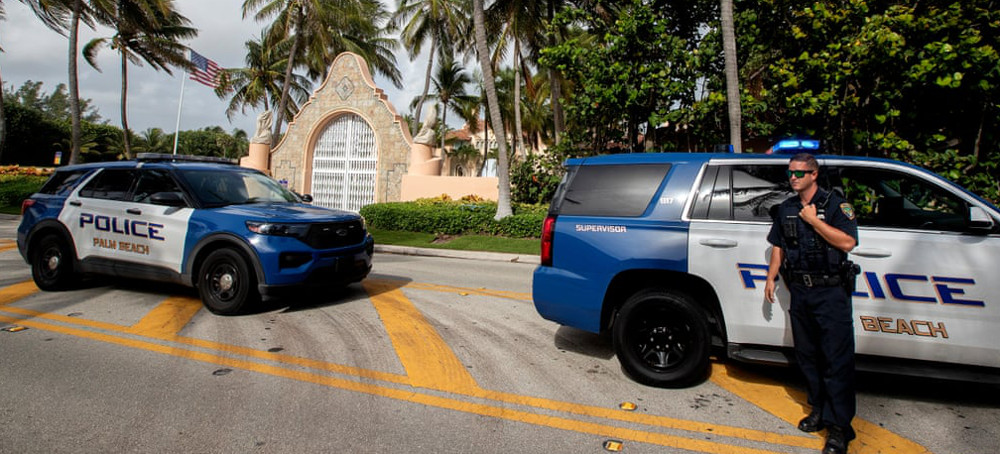 The FBI raid at Donald Trump's Mar-a-Lago residence. (photo: Cristobal Herrera/EPA)
An independent arbiter’s review of government documents seized at the former president’s home could significantly delay the criminal inquiry.
In granting Mr. Trump’s request, the judge, Aileen M. Cannon of the Southern District of Florida, gave the so-called special master expansive powers, with the authority to evaluate documents not only for those covered by attorney-client privilege, but also for those potentially protected by executive privilege.
Judge Cannon has yet to select someone for the job, and the Justice Department is still mulling whether to appeal part or all of her decision.
Here is a closer look.
What is a special master?
A person appointed by a judge to assist the court with its proceedings. A special master is selected to help with a particular matter or case, in contrast to a standing master, who is installed to help on a continuing basis. Masters can hold proceedings and then make reports and recommendations, which the judges can accept or reject.
Why are special masters appointed?
There are various reasons. Sometimes a case raises a complex problem that requires specific expertise, such as computing damages owed to different people in large-scale lawsuits. They may also be appointed to perform tasks that are so time-consuming that a judge or a magistrate judge does not have the bandwidth to handle them.
For example, judges may instate special masters to sift through seized records when the F.B.I. has carried out search warrants targeting lawyers or law firms. In those cases, there is a strong possibility they will seize a significant amount of material that is subject to attorney-client privilege that agents working on an investigation should generally not see.
What is this special master for?
Judge Cannon said the special master’s role would be “to review the seized property, manage assertions of privilege and make recommendations thereon, and evaluate claims for return of property.”
The Mar-a-Lago case does not target a lawyer or a law firm, and the magistrate judge who approved the warrant allowed the F.B.I. to instead use its normal procedure: A so-called filter team, made up of agents who are not involved in an investigation, sets aside any documents it sees as potentially shielded by attorney-client privilege.
But Judge Cannon decided that “the interests and appearance of fairness” justified having a more independent arbiter go through the materials, emphasizing Mr. Trump’s status as a former president.
Her decision to include materials potentially protected by executive privilege — meaning communications between Mr. Trump and his advisers when he was still the president — drew significant controversy.
Who can be a special master?
“It is usually an appointment given to people who have some independent reputation in the bar,” said Sam Issacharoff, a New York University law professor. “Frequently it can be retired judges. It can be people who may have stepped down as partners in big law firms, things of that sort. Sometimes it’s academics when all else fails.”
For example, Barbara S. Jones, a former federal judge, was appointed as a special master to weed out files protected by attorney-client privilege after the F.B.I. conducted searches targeting two of Mr. Trump’s personal lawyers, Michael D. Cohen in April 2018 and Rudolph W. Giuliani in April 2021. She took on the same job in a case involving Project Veritas, which is under scrutiny for its role in obtaining a stolen diary of President Biden’s daughter.
How will classified materials play into this?
That many of the documents the F.B.I. seized were marked as classified significantly narrows the pool of people Judge Cannon might appoint. That in turn could slow the process of identifying an appropriate person, and the process could be slowed further if that person’s ability to receive assistance from aides is limited.
After the search, Mr. Trump claimed that he had declassified everything he happened to take from the Oval Office, a questionable claim for which no credible evidence has emerged and which his lawyers have not repeated in court. They have instead agreed that “it would be appropriate for the special master to possess a top secret” security clearance.
Notably, federal judges are exempt from needing a security clearance to see classified material relevant to their cases, though their clerks and assistants must still receive clearances.
How long will the review take?
That is an open question. Judge Cannon has not yet issued an order specifically laying out the duties and deadlines for the special master.
This particular situation is unusual partly because Mr. Trump’s lawyers did not immediately ask a judge to appoint a special master. Investigators have already reviewed the records taken from Mar-a-Lago, and an F.B.I. filter team has already set aside about 500 pages as potentially covered by attorney-client privilege.
Brandon Fox, a Jenner … Block partner who until last year was the head of the criminal division for the federal prosecutor’s office in Los Angeles, said the F.B.I. has likely already created a log describing each document. He said the judge should use that log as a starting point, letting Mr. Trump’s legal team flag specific files for the special master to review.
“You don’t want the special master looking at every single document,” he said.
But Mr. Fox also predicted that Mr. Trump’s legal team was likely to “argue to the judge that you can’t trust the government in the descriptions of those things and so the special master needs to look at everything.”
“How credible the judge finds that argument to be will determine whether this gets slowed down,” he added.
Judge Cannon has hinted that she was inclined to direct the special master to start from scratch and examine every file. In her ruling, she said a special master was appropriate in part because she did not have time herself to quickly sift through the more than 11,000 government documents and 1,800 other items the F.B.I. seized.
What are the short-term effects of such a review?
It seems very likely to slow down the investigation. In addition to saying she would appoint a special master, Judge Cannon temporarily barred the government from making further use of the seized documents in its investigation.
That order likely shuts down investigators’ ability to continue working. Even if they could avoid using the fact that documents were found at Mar-a-Lago as a premise when questioning witnesses, any new information they gather could give defense lawyers an opening to accuse them of violating the judge’s order and put the investigation under a microscope.
The review could also disrupt the inquiry if the special master eventually recommends to Judge Cannon — and she agrees — that there are documents in the trove that are protected by executive privilege. Judge Cannon could rule that the entire investigative team must be replaced because they were tainted by exposure to the information they should not have seen.
The Justice Department would surely appeal — as it noted in arguing against giving any special master that mandate, no court has ever held that a current or former president may use the privilege to shield evidence from criminal investigators who are part of the executive branch. But the appellate process, even if successful, could mean many months of further delay.
What about the longer-term effects?
There are perhaps not many, some legal scholars say. Ultimately, if the Justice Department decides to bring charges in its investigation into Mr. Trump’s handling of sensitive government documents, it would need only a few of the records as representative evidence. And there is no serious argument that intelligence reports marked as top secret and produced by agencies like the Pentagon or the C.I.A. are privileged.
Appearing on Fox News on Tuesday, former Attorney General William P. Barr — who used his power to shield Mr. Trump while in office — said Judge Cannon’s ruling was wrong and the department should appeal it. But he also predicted it was more likely to cause delay than derailment.
“I don’t think the appointment of a special master is going to hold up, but even if it does I don’t see it fundamentally changing the trajectory,” Mr. Barr said, adding: “Documents were taken, classified information was taken and not handled appropriately, and they are looking into — and there is some evidence to suggest — that they were deceived. And none of that really relates to the content of documents. It relates to the fact that there were documents there.”
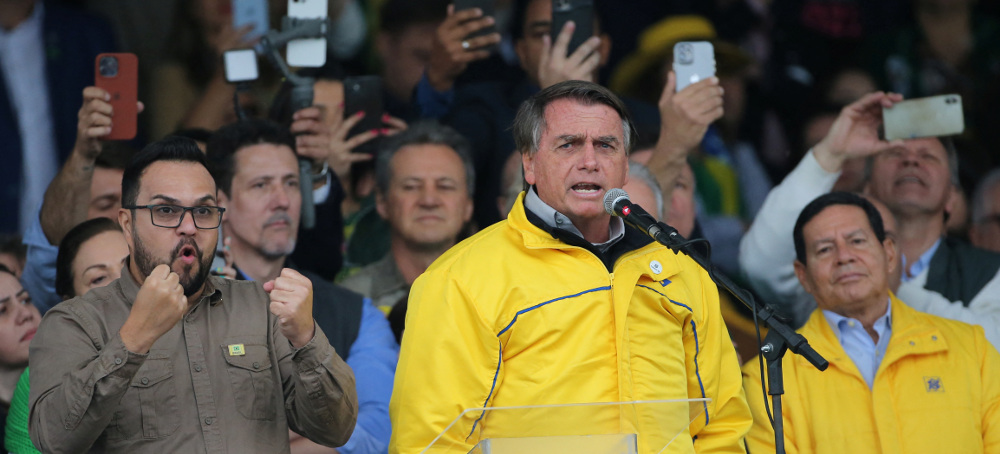 Brazil's President Jair Bolsonaro speaks during the 45th Expointer agricultural fair in Esteio, Brazil September 2, 2022. (photo: Diego Vara/Reuters)
Yet Jair Bolsonaro, the country’s far-right president, stands apart. While his challengers have spent months looking forward to the election, he has sought to preemptively discredit it. He has questioned the role of the Supreme Court and cast doubt, volubly and often, on the electoral process. He speaks as if the election is an encumbrance, an irritation. He says he will not accept any result that is not a victory.
To some, this looks like the groundwork for a coup. In this view, Mr. Bolsonaro intends to refuse any election result that does not please him and, with the help of the military, install himself as president permanently. The reading is half right: Mr. Bolsonaro doesn’t intend to leave office, regardless of the election results. But it’s not a coup, with its need for elite consensus and eschewal of mass mobilization, he’s after. It’s a revolution.
Since the beginning of his term, Mr. Bolsonaro has behaved more like a revolutionary leader than a president. In his first month in office, he said that his role was not to build anything, but to “undo” everything. Rather than run a government, he’s tried to disrupt it. He refused to fill roles in crucial regulatory agencies, placed supporters with no technical expertise in high positions, underfunded social programs, punished civil servants for doing their jobs and neglected to provide a coordinated response to the pandemic, which killed over 680,000 Brazilians.
It’s not destruction for its own sake, however. Dismantling the state is how Mr. Bolsonaro galvanizes his supporters. By identifying clear enemies and antagonizing them, he excites his followers and, crucially, enlists their support. Everything he does — decrees, bills, pronouncements, demonstrations, alliances — is framed for the digital infrastructure of YouTube, Telegram and WhatsApp. The more radical his actions and words, the more engagement he generates.
Support for Mr. Bolsonaro may start online, but it leads to the streets. For the past year, Mr. Bolsonaro has conducted a bimonthly “motociata,” a march with thousands of motorcycles that looks very much like a brute show of strength. His presidency, in fact, aspires to be a permanent rally. On Sept. 7 last year, Brazil’s Independence Day, he gathered almost half a million people to protest against the Supreme Court. On the same day this year, he has promised a big military parade to show the army’s support for his government.
It’s not just the military. Many of Mr. Bolsonaro’s most fervent supporters are notable for their power over common citizens. He is popular among police officers — a 2021 study estimated that 51 percent of Brazilian street-level police officers were active members of pro-Bolsonaro groups online — and he is also a favored candidate among gun owners. Of those who approve of his government, 18 percent say they already have a gun at home and almost half would like to have one.
They may get their wish. One of the major achievements of the Bolsonaro administration has been to weaken gun control, flooding the country with firearms. In 2018, there were around 115,000 people with special licenses to carry a gun in the country. Now there are over 670,000 people holding these licenses — more than in the police and the armed forces. A substantial number of them adore Mr. Bolsonaro and are organized into a vast network of nearly 2,000 gun clubs.
Militant and committed, these are the foot soldiers of any future revolution. There’s a lot we don’t know about how that might come about. But it’s clear that if a contingent of supporters, armed and determined to keep Mr. Bolsonaro in power, burst into Brasília, the capital, it would create chaos. In many major cities, it’s not impossible to imagine an insurrection led by police forces — while truck drivers, overwhelmingly pro-Bolsonaro, could block the roads as they did in 2018, creating havoc. Evangelical pastors, whose congregants by large margins support the president, could bless those efforts as part of the fight for good against evil. Out of such anarchy, Mr. Bolsonaro could forge dictatorial order.
Who will stop him? Probably not the army. Mr. Bolsonaro, after all, has many supporters in the military and over 6,000 military personnel working in his government, filling civilian roles. For its part, the army seems to be relatively relaxed about a possible takeover and has — to put it mildly — no special attachment to democracy. There is no sign, as far as can be seen, that the armed forces could be protagonists of a coup. But neither is there a sign that they would resist an attempt at revolution.
Democratic forces are unlikely to fare much better. For all Mr. da Silva’s popularity, left-wingers seem to have lost their capacity to rally the masses. The 13 years of a left-led government that ended in 2016 did much to disperse and weaken social movements, and they have struggled in the years since to recover their dynamism. Demonstrations against Mr. Bolsonaro, for example, have been poorly attended. And political violence is on the rise: A member of Mr. da Silva’s party, for example, was recently killed by a Bolsonaro supporter. People would certainly think twice before going to the streets to defend a Lula victory.
The best bulwark against a revolution, curiously, might be the United States. The Biden administration could make clear the profound costs, in the form of sanctions and international isolation, that would follow any seizure of power. That in turn could frighten big Brazilian businesses — which, as influential backers, can exert considerable pressure on Mr. Bolsonaro — into defending democracy. If the difficulties of executing a revolution are too great and the rewards seem slim, it’s conceivable that Mr. Bolsonaro will back down — or simply stage a performance, as former President Donald Trump did, to maintain control over his followers and prepare the ground for the next election.
The last time Brazil experienced similar political chaos was in 1964, when a military coup removed a democratic government that was trying to carry out progressive reforms. It took just a few hours for the United States, then led by Lyndon Johnson, to recognize the new government of Brazil.
A lot hinges on the hope that the United States now values democracy a bit more.
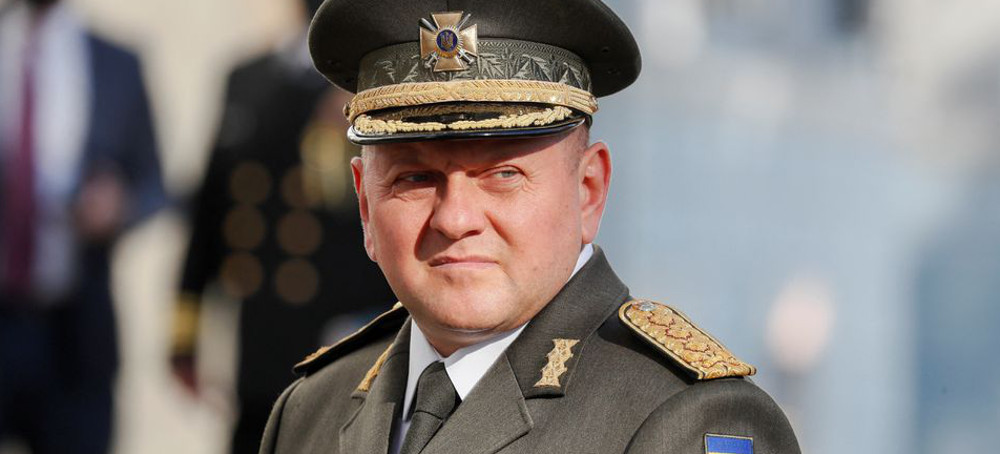 Commander-in-Chief of the Armed Forces of Ukraine Valeriy Zaluzhnyi waits before a meeting with U.S. Defense Secretary Lloyd Austin and other officials in Kyiv, Ukraine October 19, 2021. (photo: Gleb Garanich/Reuters)
The war in Ukraine that began with Russia's invasion on Feb. 24 was likely to rage on into next year, General Valeriy Zaluzhnyi said in an article co-authored by lawmaker Mykhailo Zabrodskyi and published by state news agency Ukrinform.
The article contained by far the Ukrainian commander-in-chief's most detailed assessment of the war to date, and gave starkly contrasting messages to those given by top Ukrainian officials.
"There is a direct threat of the use, under certain circumstances, of tactical nuclear weapons by the Russian Armed forces," Zaluzhnyi said.
"It is also impossible to completely rule out the possibility of the direct involvement of the world's leading countries in a 'limited' nuclear conflict, in which the prospect of World War Three is already directly visible," the article said.
Moscow has in the past denied speculation of potential nuclear or chemical weapons use.
TURNING TIDE
Ukraine will need to match the strike range of Moscow's weapons in order to turn the tide of the war, Zaluzhnyi and Zabrodskyi wrote.
"The only path to a cardinal change in the strategic situation is undoubtedly a series of several consecutive, or ideally simultaneous, counterstrikes by Ukraine's armed forces during the 2023 campaign," they said.
The United States has supplied the Kyiv government with sophisticated long-range weapons on the condition Ukraine would not use them to hit targets inside Russia, according to U.S. officials.
The article contained Ukraine's first acknowledgement that it was responsible for what the authors said were rocket strikes on Russian air bases in annexed Crimea, including one that damaged the Saky military base last month.
Until now, Ukraine refused to publicly acknowledge its involvement, with a senior official speaking on condition of anonymity citing fears of Russian retaliation.
"We are talking about a series of successful rocket strikes against the enemy's Crimean air bases, first of all, the Saky airfield," the article said, using language that did not clarify whether that meant unguided rockets or missiles.
The Saky strike took 10 Russian warplanes "out of action" on Aug. 9, the article said.
Ukraine is not publicly known to have weapon systems in service with a sufficient range to hit Saky, which lies at least 200 kilometres from the front lines.
NO PEACE THIS YEAR
The article's tone contrasted with often optimistic statements by senior Ukrainian officials.
"The length of the war is already measured in months, and there is every reason to believe that this time period will extend beyond 2022," it said.
Zaluzhnyi and Zabrodskyi conceded that Ukraine was positioned "extremely unfavourably" on two eastern frontlines, around the towns of Bakhmut and Izyum.
Foreign-supplied weapons will make up the backbone of Ukraine's defence next year, they said.
"In 2023, the material base of Ukraine's resistance must remain significant volumes of military aid from our partner nations," the article said.
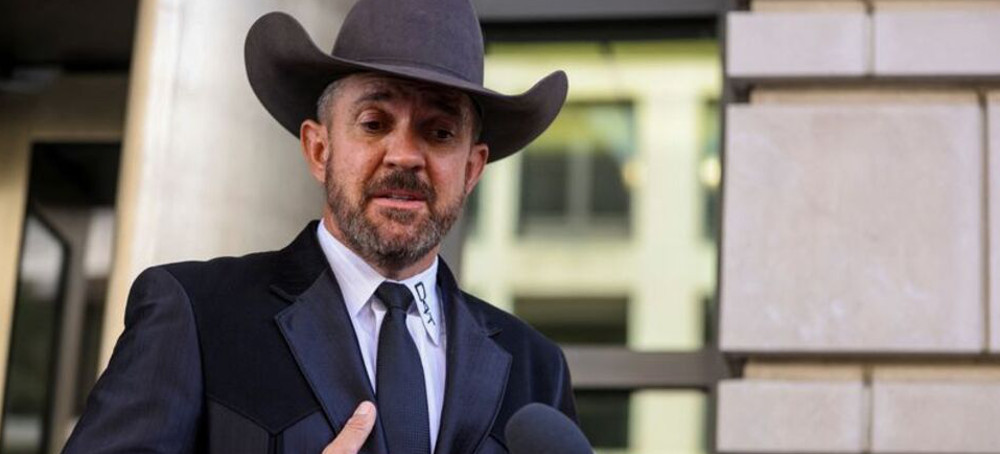 Couy Griffin, the founder of Cowboys for Trump, led the crowd in prayer on January 6. He is now barred from ever holding public office. (photo: asos Katopodis/Reuters)
Couy Griffin, the founder of Cowboys for Trump, led the crowd in prayer on January 6. He is now barred from ever holding public office.
“I’m done. They said I’m out,” Griffin told VICE News on Tuesday morning.
A lawsuit, filed by three New Mexico residents with the aid of a liberal watchdog group Citizens for Responsibility and Ethics in Washington (CREW) against Griffin, cited Section 3 of the 14th Amendment of the Constitution, which has been called the “Disqualification Clause.” It bars elected officials who participate in an insurrection or rebellion against the government from holding office again. It is not a criminal penalty.
In a press release, CREW wrote that Griffin’s removal “marks the first time since 1869 that a court has disqualified a public official under Section 3, and the first time that any court has ruled the events of January 6, 2021 an insurrection.”
In videos and images from that day, Griffin is seen standing on the western side of the Capitol building within the restricted area. He scaled a wall to reach the inauguration stage, according to the ruling. Griffin grabbed a bullhorn and spoke to the mob and tried to lead them in prayer, which the ruling says further riled up the crowd.
Griffin said he was informed of his removal by the county manager, who told him his laptop had been seized from his desk at the county building. The county manager did not immediately respond to VICE News’ request for comment.
Griffin had no lawyer, and defended himself in a bench trial last month. In a 49-page ruling, the judge concluded that Griffin’s testimony characterizing the events and violence of January 6 “has evolved over time in this litigation and is fundamentally inconsistent.” The judge determined that January 6 was, in fact, an insurrection, and that Griffin’s participation in the event disqualified him from holding any public office. Griffin has been previously tried and convicted for his participation in the insurrection. Still, he says he doesn’t regret going to the Capitol on January 6.
“If I felt like my intent justified this measure, then yeah maybe I would say I regret,” he told VICE News. “For them to say that I was there on that day to stop the transition of power, it’s all slanderous. It’s all built on lies. I was concerned election laws had been broken.”
An effort to recall Griffin last year fell short by 345 votes—something he says has now been overturned by three New Mexico residents who do not live in his county.
“I’m disappointed in the tyranny of one judge can remove the will of the people,” he said, referring to the failed recall. “It makes mistrust the government even more.”
Griffin made national news in June, when he refused to certify the June primary results in Otero county. The state Supreme Court ordered the county commission to certify them, and Griffin’s two colleagues on the commission complied, but he did not.
“All they’re doing with me is laying the groundwork to do this with other people, including President Trump,” he told VICE News of Tuesday’s ruling.
Griffin says lawyers for President Trump, including Sidney Powell, knew of his legal turmoil, and didn’t offer any help.
“I asked her for help and her response to me was ‘I’m too busy, you need to find someone licensed in New Mexico,’” he said.
The next Otero County Commission meeting will be held next Thursday, September 8th. The two remaining commissioners did not respond to a request for comment.
ADDED FROM ROBERT REICH:
Today, a state court ruling with huge implications was issued: A New Mexico state district court judge disqualified Otero, New Mexico, county commissioner Couy Griffin (the leader of “Cowboys for Trump”) from holding public office because Griffin participated in the insurrection at the U.S. Capitol on Jan. 6, 2021
 |
.
The ruling immediately removes Griffin from his position as a county commissioner. It also permanently bars him from serving as a presidential elector and from holding or seeking any future local or federal office.
State District Court Judge Francis Mathew based his decision on Section 3 of the 14th Amendment to the Constitution, which states that
No person shall … hold any office … under the United States, or under any State, who, having previously taken an oath … to support the Constitution of the United States, shall have engaged in insurrection or rebellion against the same.
Matthew’s ruling marks the first time a court has removed an elected official from office for participating in the January 6 attack on the U.S Capitol. It’s also the first time a judge has formally ruled that the events of January 6, 2021, amounted to an "insurrection."
Couy Griffin was at the Capitol on January 6. He was convicted by a federal court of entering the Capitol grounds illegally (a misdemeanor for which he was sentenced to 14 days, with credit for time served).
At his trial over whether he should be disqualified from holding public office, Griffin invoked his First Amendment right of free speech. He also argued that removing him from office would violate the will of the people and set a “dangerous precedent.”
But as Judge Matthew pointed out,"the irony of Mr. Griffin's argument that this Court should refrain from applying the law and consider the will of the people … as he attempts to defend his participation in an insurrection by a mob whose goal, by his own admission, was to set aside the results of a free, fair and lawful election by a majority of the people of the entire country.”
Griffin’s arguments, said Matthew, “disregard that the Constitution itself reflects the will of the people”
Judge Matthew noted that Griffin’s efforts to overturn the result of the 2020 election began before the January 6 attack and continued after it. Griffin spent "months normalizing the violence that may be necessary to keep President Trump in office" the Judge wrote, and urged supporters to travel to Washington, DC, on January 6. Griffin’s efforts included several inflammatory public speeches in which he likened the “Stop the Steal” movement to a "war" to keep Trump in office.
This year, Griffin voted twice as a county commissioner against certifying New Mexico’s June 7 primary election, in a standoff over election integrity fueled by conspiracy theories about the security of voting equipment in the Republican-dominated county. Two other commissioners eventually agreed to certify, but Griffin cast the lone dissenting vote while acknowledging that he had no basis for questioning the results of the election. He attributed his decision to “my gut feeling and my own intuition.”
So where does today’s ruling leave other lawmakers involved in the January 6 attack who had sworn an oath of allegiance to the Constitution – lawmakers such as Representative Marjorie Taylor Greene, Madison Cawthorn, Paul Gosar, Andy Biggs, Josh Hawley, and … Donald J. Trump?
Unlike Griffin, none of them has yet been charged or convicted of crimes associated with the attack, making it difficult to argue that they “engaged in insurrection” against the United States.
(In Georgia, a state administrative law judge found insufficient evidence to back claims that Greene engaged in the insurrection. In North Carolina, a federal judge blocked the state elections board from formally examining whether Cawthorn (who spoke at the rally that preceded the riot) should remain on the state’s primary ballot, but the lawsuit was dismissed after he lost that election. Arizona state courts have kept Gosar and Biggs and a state legislator on the ballot amid efforts to disqualify them.)
But over time, more public officials will be charged and convicted – either of directly participating in the attack or of encouraging and inciting it or covering it up (e.g., refusing to respond to a subpoena from the congressional committee investigating it). All are forms of “engaging in insurrection.”
Hopefully, Trump will be among them.
Which means they’ll be disqualified from holding office under Section 3 of the 14th Amendment.
What about the will of the people who elected them? As Judge Matthew points out in today’s historic ruling, “the Constitution itself reflects the will of the people.”
READ MORE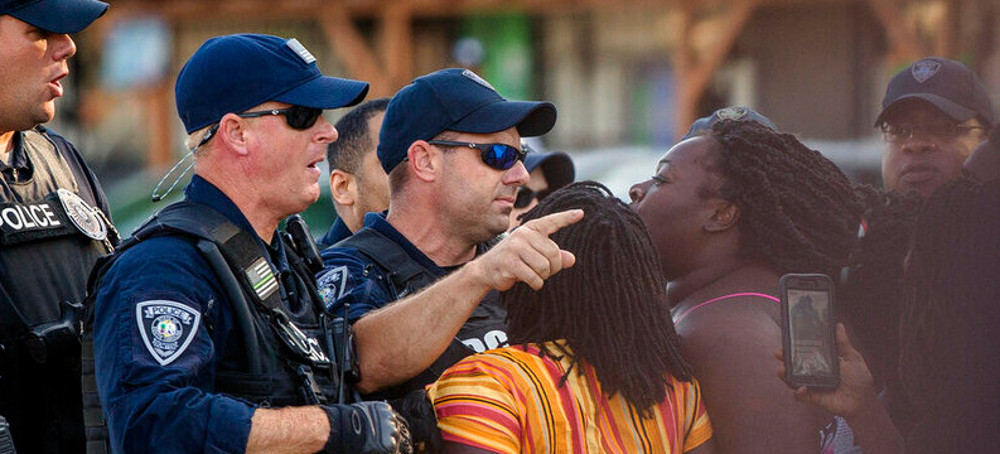 Brittany Martin, center, confronts police as demonstrators march in protest of George Floyd's death May 2020 in downtown Sumter, S.C. (photo: Micah Green/AP)
Raising questions about free speech and equal justice, Brittany Martin, 34, was found guilty this spring of breaching the peace in a high and aggravated manner over comments she made to police. Her lawyers have been pushing for a lesser sentence amid increasing concerns about her health and that of her baby, due in November.
Advocates with Black Voters Matter have been circulating a petition calling for her release. Civil rights attorney and former state lawmaker Bakari Sellers will tell the judge on Sept. 12 that the punishment is unjust.
"She's in jail because she talked in America," said Sybil Dione Rosado, her trial attorney. "She's a dark-skinned Black woman who is unapologetically Black and radical."
Martin moved with her four younger children to Sumter, South Carolina, from Iowa in spring 2020 and was "ready to go and protest" after the police killings of Breonna Taylor and George Floyd sparked a nationwide movement that year, her sister said.
But Martin also had someone else on her mind: In 2016, Sumter police fatally shot her brother-in-law 19 times when officers said he fired a gun after a chase in a stolen car. When she took to the streets, she carried grief over her family's past.
In court, prosecutors presented police body camera recordings including snippets of those demonstrations. Shared with the AP, they don't show her laying hands on any officers. Videos from May 31, 2020 show Martin chanting "No justice, no peace," in an officer's face. Police donned riot gear and discussed using tear gas before letting the crowd disperse.
Martin used stronger language days later.
"Some of us gon' be hurting. And some of y'all gon' be hurting," Martin told officers. "We ready to die for this. We tired of it. You better be ready to die for the blue. I'm ready to die for the Black."
The jury acquitted Martin of inciting a riot and reached no verdict on whether she threatened officers' lives. Her legal team was "elated" when jurors found her guilty only of breaching the peace, punishable by no more than a $500 fine and 30 days in jail, investigator Tony Kennedy recalled.
State law defines breachers of the peace as any disturbers, "dangerous and disorderly persons" or people who utter "menaces or threatening speeches." But prosecutors presented the charge as a "high and aggravated" crime, which carries up to 10 years imprisonment. Rosado said Judge Kirk Griffin did not allow her to explain the distinction, and the possibility of a much stiffer penalty, to the jury.
Prosecutors did not respond to interview requests. Sumter police said it would be inappropriate to comment, given the potential for additional action.
Sellers called the sentence "beyond the pale."
"The fact is you have people who stormed the Capitol, who led to the death of law enforcement, who tried to overturn an election and fracture democracy. And they're getting two months, three months, six months," Sellers said. "And Brittany Martin gets four years."
Of the roughly 850 people charged with federal crimes related to the Jan. 6 insurrection, more than 330 have pleaded guilty to receive lesser sentences, mostly misdemeanors punishable by no more than a year.
In a court filing, Sellers points to others convicted under the same charge who had their sentences reduced. A more high-profile case involved an intoxicated University of Alabama football fan who punched a University of South Carolina fan unconscious after the Gamecocks upset the Crimson Tide. The man was pronounced dead after a motorist unknowingly drove over his body. The fan got three years in prison, the rest of his 10-year sentence suspended.
Martin said her body "can't get comfortable with the baby" and as of July, she lost 12 pounds while incarcerated, despite the pregnancy. She was taken twice by ambulance to a hospital that month, once after experiencing contractions and again after entering preterm labor at 25 weeks, according to her sister Whitney Martin and Rosado. Martin's prison report shows she went to eight outside medical appointments throughout July and August.
Martin recently got sent to solitary confinement for refusing to cut her dreads, a violation of a policy Rosado called "racially biased." According to the grooming policy, which seeks to "promote safety," the prison allows neatly braided, corn-rowed hair only when worn straight back and individual braids but not dreadlocks or twists.
Martin said she's been verbally harassed by guards and injured by inmates. Rosado reported seeing scratches on Martin's face and a bloody right eye during a recent visit. Martin's prison report shows she was sent to detention for 35 days on June 5 over threatening to inflict harm on an employee and again for 22 days on July 28 over refusing or failing to obey orders.
National Racial Justice Network President Dr. Candace Brewer wants to ensure Martin "does not end up where Sandra Bland" did, referring to the Black Chicago woman who died in a Texas jail after a trooper said she failed to signal a lane change.
A lot changed during the two years since the protests.
In November 2020, Martin received 7 years probation for willful intent to injure and leaving a crime scene in Iowa, where in August 2019, her teenage son had accused her of purposely hitting him with her SUV and driving away. Iowa court documents allege that Martin told her son — who wound up hospitalized with minor injuries — that she hoped he would die. Rosado said the South Carolina judge — who did not respond to an interview request — did not mention the Iowa conviction in his sentencing decision.
In 2021, Martin co-founded Mixed Sistaz United, a local group that served meals for homeless people, organized voter registration drives and hosted a Juneteenth celebration.
This January, Martin's 18-year-old son was shot and killed in his car outside a Waterloo, Iowa convenience store — a loss Martin and her family are still mourning.
Martin's sister has been caring for the younger children, who she said are "missing their mom." The 5-year-old hasn't sounded like his happy self on the phone, Martin said.
"It's been times in this prison where I have started giving up for a second, mentally and emotionally," Martin said. "It seemed like the Holy Spirit just put that spoon in my mouth, like 'Come on, you've got to eat. You've got to get up.'"
"I had to think about my babies. I had to think about my love for them, which is why I'm even in this situation," she said.
 A bachelor group of male elk, called bulls, stands on reclaimed coal mine land in Buchanan County, Va. (photo: Mike Roberts)
Elk once roamed the eastern part of the United States in the 1600s but were nearly wiped out by over-hunting
Now — a decade after wildlife officials reintroduced them in southwest Virginia — there’s a herd of more than 250 elk in the region.
“It’s a wildlife success story for this species,” said Jackie Rosenberger, elk project leader for the Virginia Department of Wildlife Resources. “A lot of folks think elk are just a species that’s found in the Western part of the U.S., but that’s not the case. That’s not their history, and through a large restoration effort we’ve managed to bring them back.”
Starting from late August to October is the best — and most interesting — time to see elk, experts said. They start their mating season around the early fall, and male elk, called bulls, let out a unique “bellowing call” when trying to attract a female.
“When you hear that bugling, it’s the most wild sound ever,” Rosenberger said. “It defines nature.”
She said the bulls also make the bugle sound to “warn other males that ‘I’m big and bad. Stay away from me.’ ”
In the fall, she said, it’s a good time to see — and hear — the elks because they’re so focused on breeding that they care less about people being around: “They’re only focused on one thing.”
For those who want to make the trip, there are three viewing spots in Virginia’s Buchanan County, about six hours from D.C. and west of Blacksburg. There are also several options for guided tours.
Elk are large animals and require shade to keep their body temperature regulated, so experts advise the best time for seeing them is early mornings after sunrise and evenings at dusk.
Rarely are they seen during the middle of the day, especially in warmer weather. They tend to bed down in forested areas or dense vegetation. As the daytime temperatures get cooler, they’re likely to come out and roam more, looking for food, experts said. If lucky, a viewer can see 50 elk in a herd together.
Officials with Virginia’s wildlife agency recently launched an elk webcam that allows viewers to watch the herd. For the past few years, the webcam has attracted about 50,000 views per year, officials said. The camera typically runs until late December and allows viewers a unique chance to see female elk, or cows as they’re called, come back from their “calving areas” with their young to more open fields.
Elk were once common before the 1600s across eastern North America, and in Virginia they were found mainly west of the Blue Ridge Mountains. But they were over-hunted and their habitats were destroyed by the late 1800s. The last known elk to be harvested in Virginia was in 1855, according to Virginia wildlife authorities.
As with a lot of other species, there was no regulated hunting, “so it was just ‘willy-nilly’ on harvesting elk,” Rosenberger said. “People were just hunting with no limits.”
She said people also drastically altered the elk habitats, further contributing to their near demise.
In 2012, an effort was launched — involving more than a half-dozen partners, including the Rocky Mountain Elk Foundation, Southwest Virginia Sportsmen and landowners in Buchanan County — to bring elk back in Virginia. Seventy-one adult elks and four calves were brought from nearby southeastern Kentucky to the Buchanan County area.
Elk need forested areas to protect themselves from heat and people, as well as nearby access to fields of grass and plants to eat.
So experts in Virginia worked to clean and restore about 2,600 acres previously used for coal mines to create a good habitat for the herd. Elk are on reclaimed mine land in other parts of the country as well, including in West Virginia, Kentucky, Pennsylvania and parts of Tennessee.
Strip mining for coal involves clearing a mountaintop of trees and vegetation. Experts said there are strict rules in place for making sure mining companies follow regulations after they’re done mining in an area for it to be cleaned and reused for other purposes. The mining, or mountaintop removal as it is commonly called, “involves removing earth to expose the coal beds and later putting the earth back where it was,” said Rosenberger. She said the land, once reclaimed, is safe for elk and other wildlife to inhabit.
“Mining doesn’t look pretty when it’s actively occurring but after it’s reclaimed,” she said, “it has made for some excellent early successional habitat.”
In Virginia, the rehabilitated land, with partly wooded areas, has provided an ideal spot for wildlife — including white-tailed deer, birds, wild turkeys, insects and black bears — and the elk herd, which roams more than 10,000 acres, stretching across Buchanan, Dickenson and Wise counties.
Follow us on facebook and twitter!
PO Box 2043 / Citrus Heights, CA 95611


Comments
Post a Comment