RSN: Neil Young | Break the Chain

07 September 22
Fighting Budgets a Thousand Times Ours
Each Day we face the challenge of rebutting, challenging falsehoods promulgated by organizations with budgets a thousand times the size of RSN’s budget. Trump, Murdoch, the NRA you name it we confront it.
Yeah it’s a fight that’s worth your donation.
We make a difference.
Marc Ash
Founder, Reader Supported News
If you would prefer to send a check:
Reader Supported News
PO Box 2043 / Citrus Heights, CA 95611
Follow us on facebook and twitter!

06 September 22
Live on the homepage now!
Reader Supported News

Even family gatherings spread the virus.
Traffic was way down and all our roads cleared substantially. The skies were empty of big commercial planes. Airports were empty, their parked cars gone from the lots. Things like that happened around the world as we all grappled with our common threat.
Charts were on big screens, updating us every day. How many people would die? A lot of people died. Our friends died. Family members also. The numbers grew.
We faced it together. There was no vaccine. How could we break the chain without a vaccine?
Then we started to see more birds in the skies. We noticed the air was cleaner than at any time in our recent memory. The sky was a beautiful blue in downtown Los Angeles and other big cities. Water got cleaner in our shared rivers and lakes.
We need to remember that.
love,
be well
neil
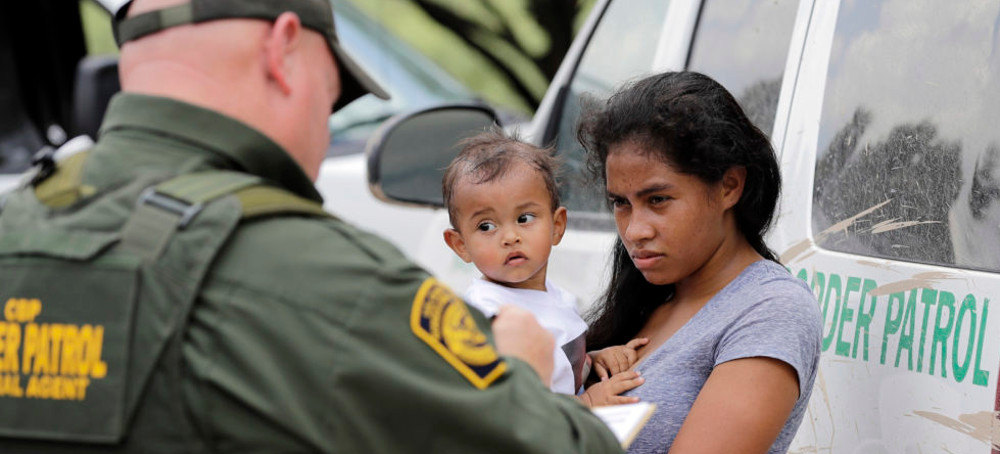 In this June 25, 2018 file photo, a woman from Honduras and her 1-year-old child surrender to U.S. Border Patrol agents after crossing the border, near McAllen, Texas. (photo: David J. Phillip/AP)
The border policy violated international law – and prosecuting those responsible may be the best way to prevent it from happening again
The theory behind the policy was that inflicting excruciating pain on thousands of parents and children separated at the border would deter migration to the US. It was another example of the Trump administration’s calculated cruelty.
We now know something about why officials throughout the government went along with the family separation policy. They “were under orders from Trump”, Kevin McAleenan, the Department of Homeland Security’s commissioner of Customs and Border Protection, told Caitlin Dickerson of the Atlantic. McAleenan was “just following directions”, as Dickerson puts it. Those directions came from Stephen Miller, Trump’s fiercely anti-immigrant enforcer.
Just following orders. We’ve heard that before from perpetrators of great wrongs.
Whatever their reasons, the actions government officials took in pursuit of the family separation policy demand a response. Doing justice for the victims of the policy demands accountability for those who designed and implemented it. And deterring such conduct in the future is only possible if there are consequences for engaging in it.
International law offers a framework for accomplishing those goals and for seeing the family separation policy for what it was: a crime against humanity.
But before exploring that framework, let’s examine what we know about why government officials would go along with Trump and Miller’s calculated cruelty.
In 1963, the Yale psychologist Stanley Milgram offered the best-known answer. Milgram enlisted subjects in a “learning experiment”. Their job was to apply what they thought were increasing levels of electrical shock to “learners” whenever they gave incorrect answers.
Unknown to subjects, the “learners” were Milgram’s collaborators. They intentionally gave wrong answers and feigned excruciating pain as the voltage seemingly increased to severe shock. Under the direction of a “research administrator”, who became increasingly firm when subjects hesitated to apply more pain, two-thirds of them ended up administering the maximum dose of “electricity”.
As Milgram put it: “The extreme willingness of adults to go to almost any lengths on the command of an authority constitutes the chief finding of the study.”
Evil, it turned out, was as banal as Hannah Arendt, the famed political theorist, described it in her celebrated chronicle, Eichmann in Jerusalem. This is the evil done by those without whose complicity Trump’s family separation policy could not have been carried out.
Eichmann’s 1961 conviction, and those at Nuremberg, established the principle that individuals who claimed to be “just following orders” are as culpable for crimes they commit as those who give the orders.
And the 1998 “Rome statute” created a forum that can provide accountability for the people who designed and implemented the family separation policy – the international criminal court.
The Rome statute authorized the ICC to prosecute individuals who commit crimes against humanity, including “inhumane acts … [that] intentionally caus[e] great suffering, or serious injury to body or to mental or physical health.”
There is no question that systematic actions separating parents from children meet that definition.
While the United States is one of only seven countries not to have ratified the Rome Statute, this fact should offer little solace to those who violate its principles. Here is why.
First, under the “principle of complementarity”, the ICC may exercise its jurisdiction when a country is either unwilling or unable to investigate and prosecute crimes within its territory.
Applying the complementarity doctrine, in 2011 the ICC initiated prosecution of Libya’s one-time dictator Muammar Gaddafi, though his country never ratified the Rome statute.
Second, the Nuremberg principles that the United States wrote before the trials began justify prosecuting crimes against humanity in the complete absence of any agreement by an accused violators’ country. That Germany did not ratify those principles was no barrier to prosecution of Nazi officials at Nuremberg.
Third, the US has signed other international agreements incorporating protections against crimes such as the ones implicated by Trump’s policy to separate families. For example, in 1992, President George HW Bush signed the International Covenant on Civil and Political Rights (ICCPR), which Congress had ratified, making it the law of the land.
Article 24 of the ICCPR provides that “[e]very child shall have, without any discrimination as to race, … national or social origin … the right to such measures of protection as are required by his status as a minor.” As the UN high commissioner for human rights emphasized in a 2010 report, “the principal normative standards of child protection are equally applicable to migrant children and children implicated in the process of migration.”
Another relevant treaty under which American officials could be charged is the Convention against Torture and Other Cruel, Inhuman or Degrading Treatment or Punishment, ratified by the US in 1988. It defines “torture” as “any act by which severe pain or suffering, whether physical or mental, is intentionally inflicted … for such purposes as … punishing him for an act he or a third person has committed … when such pain or suffering is inflicted … at the instigation of a public official.”
While the Biden administration has made considerable progress reuniting families, it has not moved quickly enough to completely end the policy. It is up to the public to ensure that result and to demand that Trump administration officials answer for making crimes against humanity a centerpiece of US immigration policy.
There is more than enough binding law and precedent for bringing charges against those officials. They should have their day in court, where they can offer their legal defenses and explain to the world why they did what they did.
Prosecutors at The Hague should bring before the bar of justice Trump officials who instituted the policy of separating children from their mothers and fathers. Humanity and history require it.
 A woman in Wisconsin got an abortion out of state. When she realized the abortion was incomplete, and she needed medical assistance, help was delayed. (photo: Getty)
“It's the first time in my life I was denied care by a medical professional.”
She’d already had to beat an obstacle course just to get one. A. lives in Wisconsin, which has banned almost all abortions in the weeks since the Supreme Court overturned Roe v. Wade. So when A., whom VICE News is calling by an initial for privacy reasons, realized she was pregnant, she said she headed to Illinois to terminate her pregnancy.
She took pills to induce the abortion and expected to bleed heavy clots. But that didn’t happen, she said. Instead, as she watched Disney movies and snacked on Sour Patch Kids, trying to endure the cramping, A. had only light bleeding.
That's when the 24-year-old started to worry that the abortion had not completely worked. A visit to the OB-GYN back in Wisconsin confirmed her fear: There was still tissue from the pregnancy in her uterus.
Then, A.’s doctor told her that they could not immediately deal with that tissue—which, if left in A.’s body, could send her into deadly sepsis or lead her to hemorrhage.
In order for the doctor to help A., they had to prove through days-long testing that the incomplete abortion had rendered the pregnancy non-viable. If the pregnancy was viable, under Wisconsin’s abortion ban, an abortion is permissible only if it’s to “save the life of the mother.” And A.’s case, although it could potentially land her in the hospital, was not yet life-threatening enough to qualify. VICE News spoke to both A. and her doctor multiple times.
“That was the part that was really incredible, that they couldn't trust the expertise of a doctor that has trained and has been working in her field and has accreditations, passed her boards—that her opinion wasn't enough,” A. told VICE News in August, before she found out if her pregnancy was still viable. “This is so stupid. This is a massive nightmare.”
In Wisconsin, if someone performs an abortion when it’s not life-saving, they could be fined up to $10,000 and face six years in prison. There are no exceptions for rape or incest.
“America's an amazing country with all these amazing developments in technology, and yet you can't figure out how to get access to healthcare to your community,” A. continued. “Are you kidding me?”
A. first realized she was pregnant roughly four weeks into her pregnancy. She had stopped using hormonal birth control because of its “insane” side effects, and instead tried to rely on a fertility awareness-based birth control method.
It didn’t work. Normally an avid gym-goer who wakes up at 5 a.m. to work out, A. said she started to struggle to get out of bed. Her breasts felt tender. When her pregnancy test turned out positive, A. said that she booked an appointment for an abortion that same day.
“I don't think we are ready financially at all for the cost of giving birth, the cost of daycare, the cost of the child care,” A. said. “We also have long-term plans to move abroad, to move to another country, and other things that are incredibly difficult to do with any child and would be a lot more difficult if we had a kid right now.”
“I can barely do my laundry,” A. added. “I don’t think I should really be taking care of a child.”
A. said she and her partner drove to Illinois because it was the closest and quickest option. A. chose to undergo a medication abortion, where an abortion is induced using doses of two different drugs spread out over several hours. It’s an incredibly popular method: In 2020, more than half of all U.S. abortions were carried out using medication, according to preliminary data from the Guttmacher Institute, which tracks abortion restrictions and trends.
Medication abortion is generally safe and effective. One 2013 study, which examined how nearly 50,000 women responded to medication abortions, found that only about 5 percent of medication abortions failed. (Typically, failure meant that the patient needed surgery to complete the abortion.) The study also found that only 119 women ended up hospitalized, with 45 receiving blood transfusions.
In other words, the risks are minimal, but they exist. And A., it turned out, was among the people for whom the risks became all too real.
After the abortion, A. went to her usual OB-GYN, Dr. Jill Masana. She wanted to double-check that her abortion had worked and get back on more reliable birth control. Initially, A. said, she told Masana that she’d had a miscarriage, because she worried that she could jeopardize her doctor’s license by revealing the truth.
But A. said that when Masana picked up on the fact that she wasn’t too upset about supposedly miscarrying, A. admitted she’d had an abortion.
“It felt good, telling someone that you've gone through something like this,” A. said. “Every time you tell someone, especially someone that you trust or that it is a provider, someone that you care about, you take a little bit of the weight off your shoulders because you feel less alone.”
If a patient has tissue from a pregnancy in her uterus, Masana first determines whether the pregnancy is still viable. That process can take days, especially if the patient’s pregnancy is in its early stages, like A.’s was.
Before Roe was overturned, Masana said, “especially in the case that it was a non-desired pregnancy and most likely the signs were pointing towards it [had] failed, we’d intervene right way.”
Now, under Wisconsin’s abortion ban, if a pregnancy is viable, Masana can’t help.
“It's crazy for me to ship my patients out of the state and then they come back, have a complication from it or something else, and then even still have my hands tied,” Masana said. “It just feels wrong. It just feels against that Hippocratic oath of ‘Do no harm.’ By waiting, I feel like I’m doing harm.”
Have you struggled to get an abortion since Roe v. Wade was overturned, or had your medical care delayed or denied because of Roe's overturning? Reach out to carter.sherman@vice.com, or DM her on Twitter at @carter_sherman for Signal.
At least 16 states currently have some kind of abortion ban on the books that would have been illegal under Roe; 12 of those bans are near-total. All have some type of exceptions for medical emergencies, but what counts as an emergency can differ from state to state.
This varying, often imprecise language, crafted by anti-abortion activists and politicians who tend to lack medical degrees, has left doctors struggling to help patients navigate the complex reality of pregnancy and the dangers that come with it. They’ve been forced to watch as patients combat health conditions that, prior to the overturning of Roe, they could have helped.
In reporting this story, VICE News spoke to multiple physicians who shared outlines of patients’ stories and encouraged patients to reach out to VICE News on their own. Some doctors told VICE News that they feel like they are expected to simply watch patients edge closer and closer to death—and once they prove a condition is serious enough that they won’t be liable for helping, grab them back from it.
“We’re waiting for patients to get sick, or get sicker, to be sick enough as to be able to intervene,” said Dr. Tani Malhotra, a maternal fetal medicine specialist in Ohio, who did not treat A. In Ohio, abortion is banned as early as six weeks into pregnancy, unless it’s necessary to “prevent the death of the pregnant woman or to prevent a serious risk of the substantial and irreversible impairment of a major bodily function of the pregnant woman.”
“We have the medical education, the training, and the experience to know what to do in which situations for keeping it patient-centered, making sure we center our decisions with the patient around the patient and their desires,” Malhotra added. “And now our decisions are centered around the law.”
The difference between a ban that allows abortions only in potentially fatal cases and a ban that permits them to preserve a patient’s health may seem small. But it could be a matter of life or death.
In cases like A.’s, patients run the risk of starting to hemorrhage or contracting an infection, which can lead to sepsis, both Masana and Malhotra told VICE News. Although the chance of these conditions occurring is relatively small, they can turn deadly serious very quickly.
“Is the likelihood that she’s going to have crazy-bad bleeding or an infection super high? No, but the risk from it is just so great, and the possibility of what could happen from that is bad,” Masana said. “Someone can go from looking, clinically, in front of you, fine, talking to you, maybe appearing overall pretty well—and then all of a sudden their vitals can just tank and they can really get sick fast.”
Malhotra also pointed out that although these conditions are rare in the United States, that may change now that Roe is no longer the law of the land.
“They’re rare because people have always been adequately and appropriately treated,” Malhotra said. Asked if maternal mortality will increase, now that Roe is gone, Malhotra said, “I have no doubt in my mind.”
Many of the abortion bans also now specify that the procedure is only permitted in cases when a pregnant person’s physical health is at stake—not their mental health. Before the Supreme Court decided Roe v. Wade in 1973, pregnant people could sometimes secure legal abortions by convincing doctors that they would die of suicide if they were not allowed to have the procedure. Now, even that avenue to an abortion is cut off.
Ultimately, A. said that Masana was able to determine that her pregnancy was not viable, clearing the way for her to have a procedure to remove the rest of the tissue. As she waited for word on the pregnancy’s viability and then for the procedure itself, A. said she bled heavily, leaving her lethargic and feeling unable to move on with her life. She watched romantic movies, like When Harry Met Sally and the Netflix drama “Purple Hearts,” to distract herself. She bled through a box of 20 pads in a week.
“It's hard when you're on hold and then you also, at the same time, are trying to get to where you're going to receive care,” A. said. “I'm truly relieved and excited to know that I can receive care and that I can move forward with finding and having care nearby instead of having to go across state lines.”
The day of the procedure, A. said, she learned she had lost so much blood that she’d become anemic. Within a few days of the procedure, however, she felt much better, both physically and emotionally.
“I’m right as rain. I feel great. It feels kind of like a dream, the whole thing,” she told VICE News. But, A. added, “It was a really intense experience, and I don’t know if I’m really recovered from it yet.”
As a woman with a supportive family, a partner who was willing to split the cost of the abortion, and a job flexible enough to accommodate her medical needs, A. said that she likely had an easier experience than most people confronting an unwanted pregnancy and all its possible complications. She felt educated enough to advocate for herself and her healthcare. But all of those privileges still weren’t enough to shield her from the fallout of the end of Roe v. Wade.
“It's the first time in my life I was denied care by a medical professional, and that is arguably one of the most traumatic things a woman will ever go through,” A. said. “I'm really angry, I think is the best way to put it. I have this fury and rage towards the systems that have created such a horrible situation.”
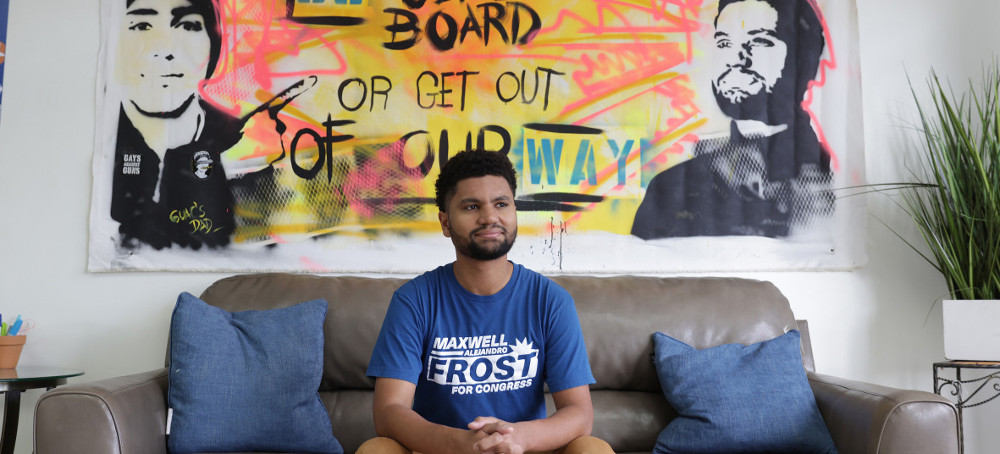 Maxwell Alejandro Frost sits in his campaign office. (photo: Gary Bogdon/POLITICO)
Plans to ride roller coasters with his girlfriend in Tampa were scrapped due to unpredictable stormy weather, and now Frost was deciding between rerouting to Miami or Charleston in South Carolina. He wasn’t convinced any of it was a good idea.
“There’s so much to do because I just want to hit the ground running in January,” he said during an interview earlier this week at his quiet campaign office in downtown Orlando. “But a lot of the advice I am getting is, you can do all that and not go as hard as you had to go in the campaign essentially.”
Frost, who turned 25 in January, had just overcome the biggest hurdle in his quest to get to Congress, winning a grueling primary in a reliably Democratic district that will probably end with him coasting to victory in November.
But House Democrats had already warned him to take a break. Rep. Ruben Gallego (D-Ariz.) had even given him an ultimatum, Frost recalled: “You got to text me by Monday where you’re going.” “I actually need to do that,” Frost said, promptly looking down at his phone and beginning to type.
Frost was a relatively unknown name outside of his hometown before last month, when he won a 10-way Democratic primary against some rivals who had served in office before he was born. He has no political experience and no college degree, but interest in his candidacy — and his personal story — has skyrocketed as pundits openly wonder whether his perspective is a necessary injection of energy for a party that remains largely under the leadership of octogenarians.
As he remains cognizant of maintaining the right work-life balance, Frost is also trying to find his footing as an expected new member in a chamber he describes as having “a lot of structural problems.” That means staying true to his political identity as a young liberal, but he is also pushing back against the perception that he would frequently challenge or fully rebel against leadership, as other fresh House Democratic faces before him have done.
“I got a call from the speaker, who congratulated me and she said she thinks it will be very refreshing to have my presence on the Hill,” Frost said, referring to Democratic lawmaker Nancy Pelosi of California, who is roughly 60 years his senior. “So we’ll see.”
Unconventional path to Capitol Hill
If elected in November, Frost will become the first member of Congress to hail from Generation Z, the term bestowed upon those born after 1996. Like many in his generation, Frost is a good multitasker, keeping up with conversation without missing a beat while often texting with one hand as he holds a red Solo cup in the other.
Wearing a crisp blue suit and white button down, Frost looked overdressed in what now looked like an abandoned office as his team moves to a larger space shared with national Democratic campaigns. He often made sarcastic jokes or quipped about what was left, at one point gesturing to his district map and saying the tacks on it marked the best restaurants in the area.
But unlike many in his generation, he admits not being great at TikTok, which he barely used in his campaign. And he does not shy away from his Southern Baptist faith, talking about it openly as a motivator for him politically, though he understands “the skepticism around organized religion.”
Born to a mother who already had several children and often experienced violence around her, Frost was hospitalized for weeks as a newborn, his small body shaking from withdrawals to his mother’s use of crack cocaine. He was adopted at birth and raised in a Cuban American household where Spanish was primarily spoken. His adoptive mother and grandmother left Cuba for the United States during the Freedom Flights in the early 1960s. He wishes Republicans “good luck” with trying to paint him as a socialist, saying, “My family fled that.”
Frost has faced discrimination as an Afro Latino, recalling the “racial hate” he received while protesting the killing of George Floyd in 2020. He described counterprotesters’ racism as “traumatic.” He quit his job as an organizer to run for Congress, which he acknowledged “has been very difficult both financially and emotionally.”
At night, Frost drives for Uber, his yellow Kia Soul serving as a conduit that provides him a source of income and a place to quickly persuade a rider to vote for him. He said he might continue the gig after he is in office. “I think those experiences give me an insight that maybe, you know, some other folks have not had, especially White folks, you know, in Congress,” he told The Washington Post.
The school shooting at Sandy Hook Elementary in Newtown, Conn., sparked his activist spirit at 15. It motivated him to protest and organize against gun violence as shootings continued across the country, including at Pulse Nightclub in Orlando, which is now in his district. He took online college classes while working for the ACLU, helping mobilize Florida voters to pass two amendments that would raise the minimum wage to $15 an hour and restore voting rights to people with felony records who have served their sentence. Frost is about a year shy of graduating college, which he intends to do.
Frost was working as a national organizer for March for Our Lives, the gun violence prevention group created by students who survived the high school shooting in Parkland, Fla., when activists nudged him to consider running for office as rumors swirled that Rep. Val Demings (D-Fla.) would campaign for the Senate. Kevin Lata, his campaign manager, said Frost spoke with about 200 union, community and faith leaders about a possible candidacy.
But it took reconnecting with his birth mother in June 2021 to fully persuade him to run. It was then that he learned of the extreme hardships she experienced without any path to help break the cycle of violence, poverty and drugs she often found herself in. It pushed him to realize that in Congress, he could help those suffering like her, but he often reminds people he is “not a savior” for everyone’s top issue. “One dude from Orlando is not going to fix that,” he said.
Frost officiallly launched his campaign in August 2021, before he was constitutionally eligible to hold office at 24. Besides running to end gun violence, Frost hopes to help enact Medicare-for-all, pass more climate reforms and provide more housing, among other issues. He campaigned on redefining what it means to be a politician, telling those in his community that he would remain close to them while fighting to ensure justice for all.
An ‘unusual’ 25-year-old candidate
It was Frost’s life story and desire to give back that caught the eyes of several high-profile liberals including Sens. Bernie Sanders (I-Vt.), Elizabeth Warren (D-Mass.) and Edward J. Markey (D-Mass.), who all cited his activist roots in the gun violence space as a necessary addition to the House.
Rep. Mondaire Jones (D-N.Y.), a fellow organizer who is 10 years Frost’s senior and also Black, followed Frost on Twitter before seeing him on MSNBC a month after launching his campaign. He was struck by Frost’s message and poised delivery, which he said is “really unusual for a 25-year-old.”
“His political sophistication, maturity and commitment to values, it eclipses those of many of his future colleagues, young and old,” Jones said. “I am impressed with how he has navigated many of the pitfalls that some of my progressive colleagues succumb to, and his ambition to be not just a rank-and-file member of our caucus but a leader among us.”
Frost said Jones was the first sitting member of Congress to contact and give him advice. Over the past year, they have often spoken on a daily basis. Jones has counseled Frost on how to navigate the House Democratic Caucus and the importance of establishing a hard-working staff who will not be afraid to disagree with him.
Jones’s recent reelection loss means he will not be able to mentor Frost within the halls of Congress, something both friends regret. But Frost said he is already building a close relationship with other Democrats running for office.
He talks often with Greg Casar, who probably will be elected to represent a new Democratic district in Texas. Delia Ramirez, who is running in a district north of Chicago, stopped by to see Frost on his primary Election Day while she was vacationing here. The political community Frost is building is also helping him sort out what kind of politician he would like to be. But for now, he is not making promises.
“I think one of the reasons there is so much voter apathy is because for generations we have had politicians tell us, ‘If you vote for me, everything will be okay,’” he said. “I feel like the only thing representatives can really promise to their people is what they believe in and what they will fight for, and the way in which they are going to govern in their community. But to tell people, to promise results, I think, is disingenuous.”
Being a liberal member of Gen Z often brings with it stereotypes, including the presumption Frost will join “The Squad,” a group of Millennial liberal lawmakers who have remained unapologetically outspoken against Democratic leadership.
But Frost skirted questions about whether he sees himself joining the group, noting “there is not one way to do everything,” though he admired Rep. Cori Bush (D-Mo.) for sitting on the House steps to successfully prevent an eviction moratorium from lapsing. “I’m not saying I’m going to be doing sit-ins every week in Congress. I’m not saying that. But there is a time and place for everything,” he said.
Though he still has to win the general election, where he also plans to play a major role in turning out voters in an effort to defeat Sen. Marco Rubio (R-Fla.) and Florida Gov. Ron DeSantis (R), Frost sees himself influencing the party by helping recruit young members like him to run for national office. After what he candidly described as “the hardest year of my life,” Frost wants to make it known how difficult it is for someone without the financial means to run for office.
“I don’t want someone to hop into this and end up with no resources and in a worse position because they just wanted to help their community,” he said. Those trials, however, have helped him understand the tough decision-making many Americans are facing in an unreliable economy. “So maybe it is also important for people to go through it,” he said about future lawmakers.
In the meantime, Frost is preoccupied with questions many face when they are on the cusp of starting a new job. Like how to impress colleagues on his first day. During a recent meeting with House Democratic Caucus Chairman Hakeem Jeffries (D-N.Y.) and a member of his staff, Frost noticed both were wearing dress shoes with a sneaker sole, a popular style on Capitol Hill that alleviates standing hours on hard marble floors while also looking professional.
“I have to get some,” Frost decided, before debating whether to just buy comfortable inserts for his dress shoes. “I’m young. I feel like if I show up there in tennis shoes, there is going to be some talk of, ‘Oh the Gen Z-er, disrespecting the decorum of Congress,’” Frost said with a laugh. “I think only time will tell how my presence on the Hill and me being a member of Gen Z is different.”
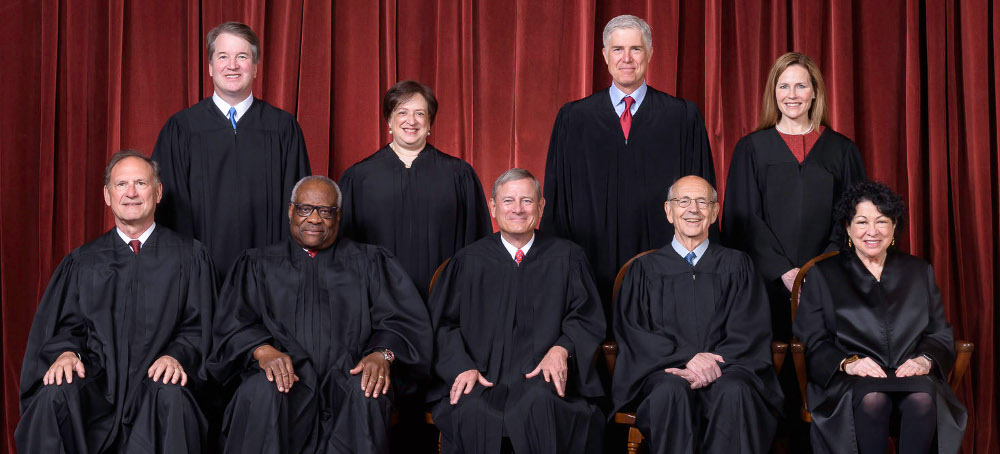 The Supreme Court as composed October 27, 2020 to June 30, 2022. (photo: Fred Schilling/Collection of the Supreme Court of the United States)
Try to take this in for a moment. Only recently, as ProPublica reported, a Chicago electronics mogul gave the largest political donation in American history, $1.6 billion. (Yes, you read that right!) To put such a sum in perspective — if that’s even conceivable — the New York Times pointed out that it’s “slightly more than the total of $1.5 billion spent in 2020 by 15 of the most politically active nonprofit organizations that generally align with Democrats.” As it happens (don’t be shocked!), that gift didn’t go to the Democrats. It was given to the Marble Freedom Trust, a new nonprofit run by Leonard Leo, a key adviser to Donald Trump. Long involved in trying to create a deeply conservative court system, Leo helped The Donald definitively shape a right-wing super-majority from hell on the Supreme Court, one that’s slated to be in place for years to come and is now moving to transform our country in a staggering fashion, starting, of course, with abortion rights.
Once upon a time, such a donation would have been inconceivable. However, thanks to a series of court decisions, chiefly the Supreme Court’s 5-4 2010 Citizens United one that wiped out century-old campaign finance restrictions, corporations and other outside — or as they’re known, “dark-money” — groups can now essentially sink unlimited funds into electing those they believe will benefit them most. In this case, that money will assumedly help Leo and his nonprofit further reshape both American politics and our courts.
In such a context, TomDispatch regular and historian Steve Fraser reminds us of something that’s been all too easily forgotten by those (like me) who grew up in the years of a Supreme Court run by liberal justice Earl Warren. Historically speaking, Trump’s Supremes are anything but an extreme aberration. In fact, they’re eerily closer to the norm of American history when it comes to the top court in the land. In the end, you’ll have to decide whether knowing that offers you a kind of grim relief or a sense of even deeper horror. But first take a little trip through time with Fraser and consider the long history of America’s rogue court. Tom
-Tom Engelhardt, TomDispatch
The Trump Supreme Court Is Nothing New
A History of the Tyranny of the Supremes
A woman’s right to get an abortion? Gone (at least as a constitutionally protected civil right). Meanwhile, voting rights are barely hanging on, along with the 1965 Voting Rights Act that gave them life. State legislatures, so the court ruled, may no longer rein in the wanton availability of firearms and so the bloodshed will inevitably follow. Climate catastrophe will only get closer as the Supremes have moved to disarm the Environmental Protection Agency’s efforts to reduce carbon emissions. Religion, excluded from the public arena since the nation’s founding, can now invade the classroom, thanks to the court’s latest pronouncement.
This renegade court is anything but finished doing its mischief. Affirmative action may be next on the chopping block. Gerrymandering, long an ignoble tradition in American political life, could become unconstrained if the Supremes decide to exempt such practices from state court judicial review. And who knows what they are likely to rule when every election not won by the Republican Party may be liable to a lawsuit.
Donald Trump’s three appointments to the court — Neil Gorsuch, Brett Kavanaugh, and Amy Coney Barrett — cemented in place a rightward shift in its center of gravity that had begun decades earlier. Ever since, in 1986, President Ronald Reagan appointed William Rehnquist, a staunch conservative, as chief justice, the court has only become ever more averse to regulating business, even as it worked to reduce the power of the Federal government.
Don’t forget that it essentially appointed George W. Bush president in 2000 by ruling that Florida couldn’t conduct a recount of the vote, though it seemed likely that Al Gore would prevail and enter the Oval Office. And even after Rehnquist passed away, the court’s 2010 Citizens United decision granted corporations the same free speech rights as people, further eroding democracy by removing limitations on their campaign contributions.
This march to the right was in stark contrast to the earlier deliberations of the court led by Chief Justice Earl Warren. The Warren court was, of course, best known for its landmark 1954 Brown v. Board of Education decision striking down public school segregation. It would also become the judicial centerpiece of a post-World War II liberal order that favored labor unions, civil rights, government oversight of business, and the welfare state.
Historically speaking, however, the Warren Court was the exception, not the one cobbled together by Donald Trump and effectively, if not officially, presided over by Justice Clarence Thomas. The Supremes were born to be bad.
Enshrined in the Constitution
From the beginning, the Supreme Court was conceived as a bulwark against excessive democracy, as indeed was the Constitution itself.
During the years leading up to the 1787 constitutional convention in Philadelphia, the country was in a chronic state of upheaval. Local insurrections against heavy taxation, land and currency speculators, and merchant-bankers had called into question the security and sanctity of private property. Local legislatures proved vulnerable to take-over by the hoi polloi who felt free to cancel debts, print paper money, stop evictions, and oust elites from their accustomed positions of power.
Various impediments to this kind of “mobocracy” were baked into the Constitution, including the electoral college for presidential votes and the indirect election of senators by state legislatures (until the 17th amendment was ratified in 1913). The Supreme Court was just another such obstacle.
Founding Father James Madison typically saw that court as protection against “factious majorities” at the state and local level that might threaten the rights of property-holders. Fearing “passionate majorities,” he went so far as to propose a joint executive-judicial council with veto power over all legislation.
That idea went nowhere. Still, the principle of “judicial review” — the power of the court to have the last say on the constitutionality of legislation — although not made explicit in the Constitution was implicit in the way the founding fathers sought to reign in democratic impulses. French author Alexis de Tocqueville in his nineteenth-century classic, Democracy in America, typically recognized the special status accorded to judicial elites, describing them as America’s “high political class.“
At first, the Supreme Court’s services weren’t needed as a guardian of vested interests and its presence was muted indeed. It met in the basement of the Capitol and, between 1803 and 1857, struck down only two federal statutes. (Compare that to the 22 it struck down between 1992 and 2002 alone.)
The court would, however, establish an enduring reputation for conservatism thanks to its infamous 1857 Dred Scott decision. By a 7-2 majority, the justices declared all Black people — free or enslaved — to be non-citizens. They also ruled that, even if a slave made his or her way to a free state, he or she would remain the property of the slave owner and declared that no territory under U.S. jurisdiction could prohibit slavery.
Dred Scott is generally considered to be the most egregious decision in the court’s 250 year history. That ruling was, however, in keeping with its basic orientation: to side with propertied interests, not the unpropertied; slave-owners, not slaves; and industrialists and financiers rather than with those who worked for and depended on them.
Gatling-Gun Injunctions and Yellow Dog Contracts
After the Civil War, the court became ever more aggressive in defending the interests of the powerful. There was a need for that as, once again, the powerless threatened the status quo.
Reconstruction — the period immediately after the Civil War when the Federal government imposed martial law on the former Confederate states — empowered ex-slaves to militantly exercise their rights to full civil and political equality under the 14th and 15th amendments. Desperate farmers in the Midwest, on the Great Plains, and in the South were then mobilizing to protect themselves from predatory banks, railroads, and commodity speculators. Industrial workers were engaged in pitched battles with their employers, confrontations that elicited widespread sympathy in cities and towns across the country.
“Passionate majorities” needed chastening and the court met the challenge. It launched an era, much like our own, of “judge-made law” that would last from the late 1880s into the 1920s.
Early on, the Supremes declared a civil rights act unconstitutional. Later, in Plessy v. Ferguson, they made segregation constitutionally legitimate via the doctrine of “separate but equal” and so helped restore elite white rule in the South. By ensconcing segregation, they also ended the hopes aroused by the Populist movement for an alliance of black and white rural poor against predatory banks and landlords.
The populist fervor of that era led some state legislatures to adopt laws regulating railroad rates and the fees charged by grain-elevator operators, while challenging corporate monopoly power over the vital necessities of life. Initially, the court tread carefully. Soon enough, however, the justices shed that reticence, using the power of judicial review to wipe such laws off the books. With a distinct touch of irony, they concluded that, in the eyes of the law, corporations were indeed persons and so entitled to the very civil rights guaranteed to ex-slaves by the 14th amendment (“rights” presumably denied them under state regulatory statutes).
Regulating business, the justices suggested, was tantamount to confiscating it. As one railroad lawyer had argued before the court, such regulation was “communism pure and simple.” From that same perspective, the court found a federal law establishing an income tax unconstitutional. (It took the 16th amendment, passed in 1913, to make the income tax national law.)
Industrial capitalism accumulated its wealth by subjecting the lives of millions of workers to abject misery: poverty, overwork, danger, disease, and profound indignity. It would prove a bloody affair, igniting confrontations between workers and their bosses more violent than anywhere else in the western world. As those workers began organizing collectively, their middle-class allies occasionally succeeded in passing relevant laws for minimum wages, outlawing child labor, putting a ceiling on the work hours an employer could enforce, and making the workplace safer or, at least, compensating those injured on the job.
The justices of the Supreme Court, some of whom had once been lawyers for the railroad, iron, and steel industries, knew just what to do in response to such democratic challenges to the prerogatives of capital. While the right to strike might be honored in theory, the court issued injunctions to stop such strikes from happening so often that the era became known (after the early machine gun of that time) for its “gatling-gun injunctions.” That term was used in part as well because such rulings could be enforced by the Army or its state militia equivalents, not to mention the imprisonment and heavy fines often involved. During one such bloody encounter, William Howard Taft, then an Ohio judge, later president, and finally chief justice of the Supreme Court, complained that federal troops had “killed only six of the mob as yet. This is hardly enough to make an impression.”
To rub yet more salt in the wound, such injunctions were often justified under the Sherman Anti-Trust Act of 1890. Originally designed to break up monopolies, it would be used far more frequently to bust strikes (and sympathy boycotts) on the grounds that they were “conspiracies in restraint of trade.” The court repeatedly enjoined “secondary boycotts“; that is, supportive actions by other unions or groups sympathetic to striking workers. It also struck down a Kansas statute that banned “yellow dog contracts” — agreements promising that they would never join a union that many workers were forced to sign on being hired.
Laws that attempted to ameliorate the harshness of working-class life were treated with similar disdain. New York state, for example, passed one banning cigar making in tenement workshops as a danger to workers’ health. The court saw otherwise, treating such tenement dwellers as independent contractors who had freely chosen their way of life.
New York also tried to limit the hours bakers could work to 10 a day and 60 a week. At the time, they were normally compelled to work 75 to 100 hours weekly in ill-ventilated cellars of tenement bakeries where breathing in the flour was a danger to their lungs. The justices begged to differ. In Lochner v. New York — named after the bakery owner who sued the state — they refused to recognize any threat to the well-being of bakers who, in the eyes of the court, had freely contracted to work on those terms. They were after all as free as their employers to strike a bargain or choose not to work.
The freedom of contract was then the reigning judicial orthodoxy, inherited ironically enough from the long struggle against slave labor. Unlike slavery, free labor allegedly enjoyed an equality of standing in any contractual relationship with an employer. Laws or unions which interfered with that “freedom” were rendered nugatory by the Court and it didn’t matter how obvious it was that the imputed equality between owners of capital and the men and women compelled to work for them was illusory.
The only laws of that sort which passed muster were those protecting women and child laborers. The justices considered such workers inferior and dependent, and so, unlike men, unable to freely enter into relations of contractual equality. In the case of women, there was the added danger of jeopardizing their maternal role. Still, consider it an indication of just how reliant businesses had then become on child labor that even a federal law that controlled the ages and hours children could work was, in the end, struck down by the Supreme Court.
The Court v. the People
By the turn of the twentieth century, the outcry against “judge-made law,” the willful manipulation of the Constitution to shore up endangered bastions of wealth and power, had grown ever stronger. Some more recent scholars have found the court’s rulings then not as one sided as its reputation suggests, but contemporaries certainly didn’t share those doubts.
When the Supreme Court overturned an income tax law, a dissenting justice vividly described its decision as a “surrender to the moneyed classes.“
Similarly, in 1905, Supreme Court Justice Oliver Wendell Holmes broke with his colleagues when they ruled in the Lochner case, noting that “the 14th amendment does not enact Mr. Herbert Spencer’s Social Statics.” (Spencer was then the world’s foremost proponent of social darwinism and a staunch defender of free-market economics.) A few years later, future Supreme Court Justice Louis Brandeis cuttingly noted that “to destroy a business is illegal. It not illegal to lower the standard of the working man’s living or to destroy the union which aims to raise or maintain such a standard. A business is property… A man’s standard of living is not property.”
Other voices were also being raised in alarm over the coming of a “judicial oligarchy.” Politicians from former president Theodore Roosevelt to perennial Socialist Party presidential candidate Eugene Debs began denouncing “the rogue court.” When he ran again for president in 1912 as the candidate of the Bull Moose, or Progressive Party, Roosevelt declared that the people are “the ultimate makers of their own Constitution” and swore that Americans would not surrender that prerogative to “any set of men, no matter what their positions or their character.” His rival for the party’s nomination, Wisconsin senator Robert LaFollette, typically offered this observation: “Evidence abounds that… the courts pervert justice almost as often as they administer it.” There existed, he concluded, “one law for the rich and another for the poor.“
Calls for reform back then should sound eerily familiar today. Populist presidential candidate James Weaver urged that Supreme Court justices be elected and lifetime terms abolished. A bill introduced in Congress proposed that a majority of both houses should have the power to recall and remove a judge from office. Another demanded a super-majority of justices — seven out of nine — be required to invalidate a law. Roosevelt argued that there should be popular referenda on the court’s decisions. The Socialist Party demanded that the Supreme Court’s power to review the constitutionality of federal laws be done away with and all judges elected for short terms.
Still, the court prevailed until the Great Depression of the 1930s. President Franklin Roosevelt, however, passed new laws regulating business and finance, as well as a national minimum wage and maximum-work-hours statute, while legalizing the right to join a union. Together with yet another uprising of beleaguered industrial workers in those years, this would shift the balance of power. Even then, the Supreme Court justices at first succeeded in nullifying key pieces of Roosevelt’s economic recovery legislation, while Democrats at the time, (as today), talked about adding new justices to the court.
In the end, however, the national trauma of a capitalism seemingly on the verge of collapse, the weight of changing public opinion, and the aging out of some of the justices ended the dominion of the Lochner court.
“The Race Question”
During the long years of opposition to that court, little of the criticism touched on “the race question.” How to account for that? From the Gilded Age of the late nineteenth century to Roosevelt’s New Deal, Americans were preoccupied with “the labor question” (as it was then called) — that is, how to deal with the great social divide between capital and labor opened up by industrialization.
The silence when it came to the no less striking racial bias of the Supreme Court speaks to a ubiquitous national blindness on matters of racial justice then. Of course, segregation was settled law at the time. In the words of a justice deciding the Plessy case, white supremacy was “in the nature of things.” (Sound familiar?) So, too, the relative weakness of mass movements addressing the racial dilemma during the Lochner court years was striking, making the issue easier to ignore.
The Supreme Court’s original responsibility was, as James Madison once put it, to guard against the “tyranny of the majority.” African-Americans were, of course, a long-tyrannized minority.
However, on that subject the Lochner court went AWOL, even by its own standards. If the “minority” in question happened to be a corporation, it, of course, needed the court’s protection. Not so fortunate were millions of ex-slaves and their descendants.
Eventually, a different Supreme Court, the one overseen by Chief Justice Earl Warren, faced the “race question.” Indeed, it expanded civil rights and civil liberties generally by making racial segregation illegal in public schools, increasing the constitutional rights of defendants, outlawing state-sponsored school prayer, and creating the groundwork to legalize abortion.
Times had changed. Civil rights for African-Americans (about which Roosevelt’s New Deal did little) became an increasing concern during and after World War II. Growing civil rights organizations and a then-powerful labor movement began to press the issue ever harder. By the time the Warren Court made its celebrated 1954 Brown v. Board of Education decision, race had become a “question,” just as the “labor question” had in the New Deal era.
Before then, pressure alone, however muscular, had not produced a shift in the high court’s approach as the Lochner court so amply demonstrated. Segregation had, after all, become entrenched as a way of life endorsed by local white legislatures. Southern commercial interests in particular — plantation owners, textile manufacturers, and raw material producers — depended on it.
Beyond those circles, however, segregation had become increasingly repellent in a culture ever more infused with the multi-ethnic sympathies and cosmopolitanism of the New Deal era. In beginning the dismantlement of legal segregation, the Warren court would not, in fact, threaten the country’s central institutions of power and wealth which, if anything, had by then come to find American-style apartheid inimical to their interests.
Justice is supposed to be nonpolitical, but that has never been the case. What was once termed the “counter-majoritarian” mission of the court — to discipline “passionate majorities” — produced great wrongs in the era of the gatling-gun injunction as had also been true earlier. The Warren court, however, was the exception. It achieved the very opposite results, even as it relied on the same constitutional logic (the civil rights enshrined in the 14th amendment) the Lochner court had in thwarting mass movements for justice and equality.
Today’s Supreme Court is more than Donald Trump’s creation. It’s the result of a long counter-revolution against the political, economic, and cultural reforms of the New Deal, as well as of the labor, civil rights, women’s, and gay liberation movements of the last century.
Sadly, those are the “passionate majorities” the court now seems all too determined to squelch and in that it stands in a long American tradition, though one most of us had forgotten in the Warren years. One thing should be obvious by now: if the country is ever to live up to its democratic and egalitarian promise, the tyranny of the Supreme Court must be ended.
Follow TomDispatch on Twitter and join us on Facebook. Check out the newest Dispatch Books, John Feffer’s new dystopian novel, Songlands (the final one in his Splinterlands series), Beverly Gologorsky’s novel Every Body Has a Story, and Tom Engelhardt’s A Nation Unmade by War, as well as Alfred McCoy’s In the Shadows of the American Century: The Rise and Decline of U.S. Global Power, John Dower’s The Violent American Century: War and Terror Since World War II, and Ann Jones’s They Were Soldiers: How the Wounded Return from America’s Wars: The Untold Story.
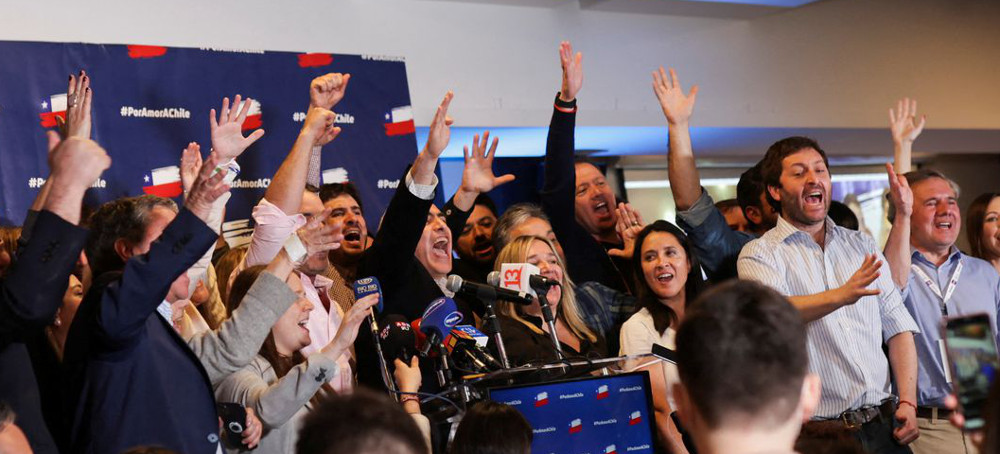 People react to early results of the referendum on a new Chilean constitution in Santiago, Chile, September 4, 2022. (photo: Pablo Sanhueza/Reuters)
While nearly 80% of Chileans voted to draft a new constitution in 2020, nearly 62% of voters rejected the new text with 99.74 percent of ballot boxes counted.
Karol Cariola, spokeswoman for the approval campaign, conceded defeat late on Sunday night in downtown Santiago but said the mandate to draft a new text remains in force.
"We are committed to creating conditions to channel that popular will and the path that leads us to a new constitution," Cariola said.
President Gabriel Boric, whose government is largely tied to the new text, said cabinet changes were coming and the government would work to draft another constitution.
"We have to listen to the voice of the people. Not just today, but the last intense years we've lived through," Boric said. "That anger is latent, and we can't ignore it."
The president said he would work with congress and different sectors of society to draft another text with lessons from Sunday's rejection.
Center-left and right wing parties that promoted the reject campaign, have also agreed to negotiate to prepare a new text.
"I think there are two things that explain what has just happened. One is a rejection of the Boric government," political analyst Cristobal Bellolio told Reuters, adding that the other was identity politics in regards to indigenous and other issues.
The proposed text that voters rejected was a response to widespread violent protests that gripped the nation in late 2019 and focused on social rights, the environment, gender parity and indigenous rights, a sharp shift from its market-friendly constitution dating back to the Augusto Pinochet dictatorship. read more
MASSIVE TURNOUT IN MANDATORY VOTE
Nearly 13 million of 15 million Chileans and residents who were eligible to vote cast ballots across more than 3,000 voting centers. These included the national stadium in Santiago, where Rosemarie Williamson, 54, and her mother, 85, voted to reject the new constitution.
Williamson, who had voted 'yes' in 2020, cited worries over several proposals.
"The main one is (indigenous) plurinationality and then pension funds," she said. "I've worked my whole life and I'm not willing to share that."
Diego Uribe, 35, a father of two who does not normally vote because he has lost faith in political parties, voted 'yes' in Puente Alto, a lower-income region in southern Santiago.
"This one is different," Uribe said, noting he would have voted even if it was not mandatory. "Approval is real change for the future, free education, dignified healthcare and more rights."
The latest polls before a two-week blackout showed rejectors ahead at 47%, compared with 38% for 'yes' and 17% undecided, but Sundays result beat polls by wide margin.
 The Baytown Exxon gas refinery in Baytown, Texas. (photo: Benjamin Lowy/Getty)
The oil giant’s own reports show thousands of emissions from its Houston petrochemical complex violated the Clean Air Act, affecting the health of nearby communities, but the company has continued to appeal the 2017 judgment.
The Fifth Circuit Court of Appeals in New Orleans upheld a $14.25 million fine—thought to be the largest-ever fine resulting from citizen enforcement of environmental law—in a lawsuit brought by environmental organizations against Exxon’s massive complex in Baytown, some 25 miles outside Houston.
The decision still doesn’t guarantee a conclusion to the long-running case, which Exxon may be able to appeal further.
“It’s frequently in the interest of a company to drag out cases for as long as possible to try and get the other side to give up, but we are not giving up,” said Josh Kratka, senior attorney at the National Environmental Law Center, which represented the plaintiffs in the trial. “We hope this is the end of it.”
The suit was first filed in 2010 by Environment Texas and the Sierra Club under the citizen suit provision of the Clean Air Act, which empowers civilians to sue polluters for violations of federal environmental law.
The plaintiffs originally alleged that 16,386 illegal air emissions events, which Exxon disclosed in its own reports, affected the health of communities around the Baytown refinery. A district court in 2017 ordered the Texas-based energy giant to pay almost $20 million.
Exxon appealed, arguing that not all of those violations could be directly traced to specific health problems. Upon review, the court reduced the number of actionable violations to 3,651 and reduced the fine to $14.25 million. Exxon appealed again, contesting the court’s legal standing and the size of the fine.
“This is a standard tactic. It just goes to show the lengths that polluters will go to to prevent true justice from coming forward,” said Stefania Tomaskovic, director of the Coalition for Environment, Equity and Resilience in Houston. “It’s always a struggle to protect our air when companies have so much money to hire lawyers and citizens are not as well resourced.”
On Tuesday, a federal judge rejected Exxon’s latest appeals. The judge upheld the high fine in part due to elements of the Clean Air Act designed to ensure that paying emissions fines isn’t a cheaper alternative for polluters than building adequate facilities.
“The company delayed implementation of four emission-reducing projects mandated by a 2012 agreement between Exxon and state regulators,” said the court opinion issued this week. “Exxon needed to invest $11.75 million dollars in improvements to comply with its Clean Air Act obligations.”
Founded in 1919, Exxon’s Baytown refinery has the fourth largest production levels in the U.S. and is the second largest Exxon refinery in the world (after the company’s Singapore facility).
Exxon calls its Baytown campus the “largest integrated petrochemical complex in the U.S.” and “one of the most technologically advanced petroleum and petrochemical complexes in the world.” It includes a refinery, two chemical plants, an engineering office and a technology center.
The facility was the site of a major explosion and fire in late December 2021, prompting another lawsuit from local community members.
Exxon did not immediately respond to requests for comment on Thursday.
“Exxon’s Baytown complex is the largest polluter on the Houston Ship Channel,” said Neil Carman, clear air program director for the Lone Star chapter of the Sierra Club, a plaintiff in the case. “Exxon still needs to do more to create cleaner air in the Houston area.”
Follow us on facebook and twitter!
PO Box 2043 / Citrus Heights, CA 95611


Comments
Post a Comment