RSN: Bill McKibben | Watching Trump Embrace QAnon From the Historical Jewish Quarter of Kraków

22 September 22
Live on the homepage now!
Reader Supported News

Centers hold, until they don’t.
The point, or so it seems to me, is that we can be lulled into believing that truly terrible things won’t happen because they haven’t quite happened, and then they do. Even now, six years into the era of Trump, it’s hard to believe that he’s serious. The event he held on Saturday, in Youngstown, Ohio, was theoretically to rally voters behind candidates he has endorsed, including J. D. Vance, the Republican nominee for Senate, but, in fact, Trump used the occasion to demonstrate his dominance, remarking to the crowd, “J. D. is kissing my ass. He wants my support so bad.” As usual, Trump seemed to really be campaigning to soothe his own wounded ego; now that he’s been caught lifting classified documents from the White House, he needs to up the rhetorical ante if he wants to change the subject. And so he’s stopped saying that he knows nothing about what the QAnon conspiracy theory is and, instead, has begun to embrace it. Earlier in the week, he’d been ReTruthing (this, apparently, is what retweeting is called on Truth Social, his rickety social-media platform) images of himself wearing a Q lapel pin overlaid with the words “The Storm is Coming.” As the “PBS NewsHour” explained, “In QAnon lore, the ‘storm’ refers to Trump’s final victory, when supposedly he will regain power and his opponents will be tried, and potentially executed, on live television.”
At Saturday’s rally, Trump also decided to play music that reminded many observers of the QAnon theme song, “Wwg1wga”—which stands for “Where we go one, we go all.” Trump’s aides claimed that the song was “Mirrors” and said that it had been used in a video played by the former President before, but the Times described it as “all but identical” to the QAnon song. A Trump spokesman, with customary aggression, told the paper, “The fake news, in a pathetic attempt to create controversy and divide America, is brewing up another conspiracy about a royalty-free song from a popular audio library platform.” In any event, the crowd responded to the music by raising their index fingers—a gesture that has been interpreted as a reference to the “1” in the QAnon song’s title—in a scene that looked like something out of a Leni Riefenstahl film. Meanwhile, at another event last week, in Post Falls, Idaho, Eric Trump and Michael Flynn were joined by a pastor, Mark Burns, who has introduced the elder Trump at rallies, and who this time insisted, “I’m coming here to declare war on every demonic, demon-possessed Democrat that comes from the gates of Hell!” It all sounds so preposterous that one wants to turn away, but the message of Kraków’s Galicia Jewish Museum is: Don’t you dare. At the moment, Trump’s pitches sound a little desperate—the Ohio arena wasn’t full (the rally was at the same time as an Ohio State football game), and his Senate candidates are struggling—but we may be just one more bad bout of inflation, or one unexpected global crisis, away from enough people in certain states deciding that we better have his hand back on the wheel. Hitler lost an election, too, and then he came to power; and, as the new Ken Burns documentary series reminds us, America was fatally slow to respond to the full threat of fascism the last time around.
And that was before social media. Now, among even some people who perceive the threats to democracy, it’s been hard to maintain solidarity, and a Times investigation this weekend reports that the manipulation of social media is part of the reason why. The paper examines how Russian disinformation experts at the Internet Research Agency and other trolling operations used the Women’s March, in January, 2017, to try to sow division. First, the trolls tried to exploit race, with posts such as “Aint got time for your white feminist bullshit” and “A LIL LOUDER FOR THE WHITE FEMINISTS IN THE BACK.” America’s racial divisions are raw enough that they’re always playable, and, as the Times notes, there were some tensions and divisions in the movement early on. Still, according to estimates, more than four million people around the country participated in the Women’s March. Undaunted, that same month, Russian trolls targeted Linda Sarsour, a Muslim woman who was one of the march organizers. A tweet purportedly from a right-wing Southerner, claimed that Sarsour wanted to impose Sharia law in the United States. The Times reported that the post was picked up by “a small army” of right-wing accounts and that, by the spring, the backlash “had developed into a divisive political sideshow, one that easily drowned out the ideas behind the Women’s March.” The process was repeated when Sarsour, speaking at the annual Islamic Society of North America convention, in Chicago that July, called peaceful resistance to anti-Muslim government policies (this was at the time of Trump’s travel ban) “the best form of jihad.” “Jihad” is an Islamic term that, the Times said, “can denote any virtuous struggle,” but, online, such nuance can be easily overcome. By the time all was tweeted and done, the Women’s March was no longer the powerhouse it had been.
In the summer of 2018, Twitter suspended nearly four thousand accounts traced to the Internet Research Agency, and a few months later it suspended more than four hundred accounts produced by the G.R.U., Russia’s military-intelligence agency. According to the Times, “With that, a chorus of voices went silent—accounts that, for years, had helped shape American conversations about Black Lives Matter, the Mueller investigation and NFL players kneeling during the national anthem. The record of the messaging around the Women’s March breaks off there, too, frozen in time.” In truth, though, Russian professionals are only part of the endless rumbling of social-media thunder; there are plenty of American amateurs eager to join this storm.
So, as Trump continues campaigning, those who fear what could happen in this country will need to be vigilant against all ongoing efforts to divide it. Postwar Poland is a reminder of what Solidarity can accomplish, and the Kraków museum is a stark reminder of how quickly the center can stop holding. The fact that we’ve survived Trumpism so far is no guarantee of anything.
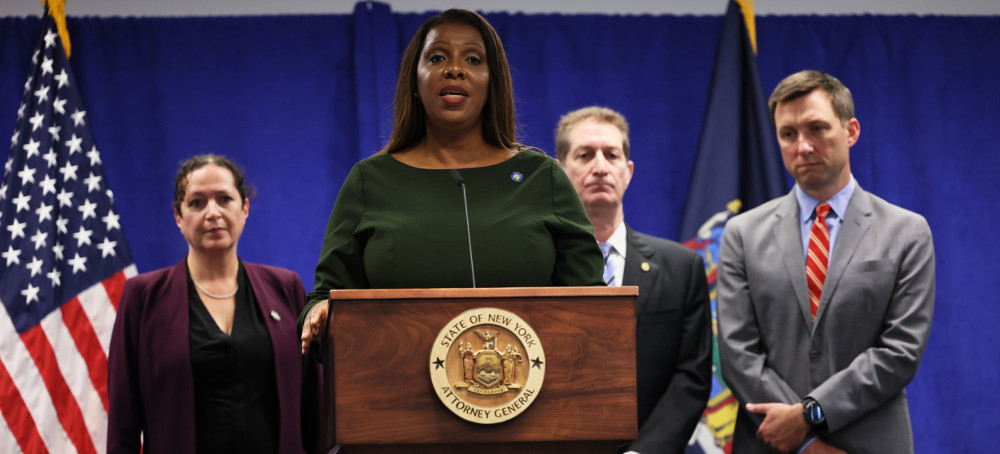 'Trump thought he could get away with the art of the steal, but today that conduct ends,' Letitia James said. (photo: Michael M Santiago/Getty)
Restrictions sought by Letitia James include bans on Trump and his children that would tear his real estate empire from his control
The former US president, as well as Donald Trump Jr, Ivanka Trump and Eric Trump, were named as defendants in a sprawling 214-page complaint filed by New York attorney general Letitia James for allegedly falsely inflating his net worth by billions to enrich himself and secure favorable loans.
“For too long, powerful, wealthy people in this country have operated as if the rules do not apply to them. Donald Trump stands out as among the most egregious examples,” James said in a statement. “Trump thought he could get away with the art of the steal, but today that conduct ends.”
The restrictions being sought by the New York attorney general include permanent bans on Trump and his three children from serving as executives in any company in New York, a move that would tear the Trump Organization away from his personal control.
The other penalties being sought would prevent Trump from attempting to circumvent that principal restriction to establish his business under a different guise: James is also seeking to bar Trump from acquiring commercial real estate and applying for loans in New York for five years.
Trump could also lose two loyal executives named in the suit – Trump Organization’s chief financial officer, Allen Weisselberg, and its controller, Jeffrey McConney – with James asking the New York state supreme court to bar them from serving in top roles of any company in New York.
The New York attorney general may not succeed in securing all the penalties. But even some of the restrictions would spell the end of Trump’s family business – headquartered in New York and run alongside his children – while any federal charges would complicate re-establishing it elsewhere.
At a news conference on Wednesday, James confirmed that her office had made a criminal referral to justice department prosecutors with the southern district of New York and the Internal Revenue Service to investigate what she believed to be violations of federal statutes.
“We believe the conduct alleged in this action also violates federal criminal law, including issuing false statements to financial institutions and bank fraud,” James said, though she did not clarify the exact nature of potential bank fraud specified in the referral.
The referral to federal prosecutors involved the New York attorney general’s office compiling evidence of those specific alleged crimes in a “package” that would be sufficient to immediately open a criminal investigation, according to a person directly familiar with the matter.
The suit marks the culmination of a years-long investigation by James and though it is not a criminal prosecution, the referral to the justice department marks additional, unforeseen legal peril for the former president and his three adult children.
It adds to the lengthening list of legal woes facing Trump – from the justice department probe into his unauthorized retention of government records at his Mar-a-Lago resort to the January 6 investigation – as he has repeatedly suggested he will seek to run again for president in 2024.
The former president and his attorneys have castigated the New York attorney general’s investigation as a politically motivated witch-hunt, a refrain that has become his default position whenever he comes under scrutiny, and insist that the Trump organization did not operate illegally.
“Today’s filing is neither focused on the facts nor the law – rather, it is solely focused on advancing the attorney general’s political agenda,” Trump’s lawyer, Alina Habba, said in a statement. “We are confident that our judicial system will not stand for this unchecked abuse of authority.”
In the 214-page complaint, James outlined an extensive record of alleged wrongdoing, such as fraudulently inflating the value of 23 Trump-owned properties, including his Mar-a-Lago resort in Florida, Trump Tower in New York and what was previously the Trump International Hotel in DC.
The sprawling suit, which stems from the 2018 testimony to Congress by Trump’s former personal lawyer Michael Cohen, alleges decades of deceptive practices that amounted to more than 200 examples of false or misleading asset valuations that were knowingly used on financial statements.
Among myriad examples detailed in the suit, the state alleged the former president falsely inflated the square footage of his triplex apartment in Trump Tower from 10,996 to just under 30,000, which allowed him to claim it was worth $327m.
But, James said in a statement, “that price was absurd given the fact that at that point, only one apartment in New York City had ever sold for even $100m … In the 30-year-old Trump Tower, the record sale at that time was a mere $16.5m.”
The suit also alleged that Trump’s Mar-a-Lago resort was valued at $739m on the false premise that it was unrestricted property that could be developed for residential use, even though Trump had himself signed deeds donating those rights, meaning it should have been valued closer to $75m.
 Donald Trump claimed in a Fox News appearance that documents taken to Mar-a-Lago were declassified while he was in office. (photo: Jorge Silva/AFP)
Donald Trump claimed in a Fox News appearance that documents taken to Mar-a-Lago were declassified while he was in office
“There doesn’t have to be a process, as I understand it,” Trump told Fox News host Sean Hannity. Prosecutors have said that about 100 of the documents taken from Mar-a-Lago were marked classified, including some labeled top secret.
“If you’re the president of the United States, you can declassify just by saying it’s declassified,” the former president added.
“You’re the president — you make that decision.”
Trump’s comments were made ahead of a Wednesday appeals court decision that the FBI can use the seized documents in its criminal investigation. His appearance also followed an announcement earlier in the day that New York Attorney General Letitia James was filing a lawsuit accusing him and his three children of manipulating property values to deceive lenders, insurance brokers and tax officials.
On Hannity’s program, Trump called the lawsuit part of a politically motivated “witch hunt” that has been brewing since he first ran for office. He asserted that if there were discrepancies about his property values, the banks should have done more diligence, adding that his company provided a disclaimer on financial documents saying as much.
With regard to the FBI’s investigation into the possible mishandling of classified documents, Trump said he “declassified everything.” He also said he personally did not pack any boxes as he left the White House. The task was mostly performed by General Services Administration employees, he said, referring to the office that plays a prominent role in presidential transitions.
A GSA spokesperson disputed that, saying while the office assisted with shipping boxes to Florida, it did not pack any. “GSA did not examine the contents of the boxes and, accordingly, had no knowledge of the contents prior to shipping,” the spokesperson said in an email.
Trump’s legal team has so far not produced evidence that the documents at Mar-a-Lago had been declassified, the three-judge panel of the appeals court noted in the Wednesday ruling. His lawyers have resisted doing so in front of special master Raymond Dearie, the U.S. district judge who pressed the team this week to provide such evidence, the panel wrote.
“For our part, we cannot discern why [Trump] would have an individual interest in or need for any of the one-hundred documents with classification markings,” the court wrote.
Presidents do have the authority to declassify information — though typically there’s a process for doing so, which can include coordinating with the agencies or Cabinet members from which the information originated to prevent possible national-security risks.
Following the court-authorized search of Mar-a-Lago on Aug. 8, the former president’s office said in a statement that Trump issued a “standing order” while in office that documents taken to his residence would instantly be declassified. But Trump’s lawyers have avoided making a similar claim in court or in their legal filings, saying on Tuesday that to address the issue would mean revealing a potential defense that could be used if the criminal probe results in an indictment.
In an interview with CNN in August, John Bolton, Trump’s former national security adviser, called the assertion from the former president’s office about the standing order to declassify documents “complete fiction.”
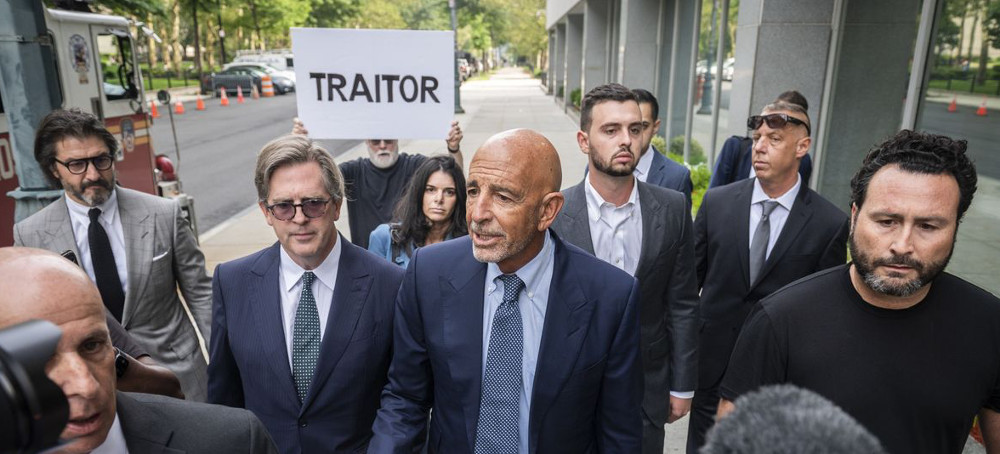 Tom Barrack Jr., center, arrives at criminal court in New York, in July 2021. (photo: Mark Kauzlarich/Bloomberg)
Thomas J. Barrack also appears to be on trial for being a horrible boss.
That was the big takeaway Wednesday inside a federal courtroom in Brooklyn, where one of Barrack’s personal assistants, Matthew Grimes—who faces some of the same charges as his old boss—is laying the blame for the illegal influence campaign solely on Barrack.
Federal prosecutors said Barrack, who helped put together Trump’s presidential inauguration-turned-enrichment scheme in 2017, used his privileged position of power and influence to secretly lobby on behalf of the United Arab Emirates.
And Grimes may prove to be essential to the case.
The defense attorney for Grimes told jurors on Wednesday afternoon that the young man was merely the billionaire’s “gofer” who would “go for this and go for that,” picking up his boss’ coffee and making spa reservations while “el jefe”—as the young assistant would call Barrack in Spanish—was really the one meeting Arab royalty and cutting controversial deals.
The attorney even recounted one time when Barrack pulled Grimes away from his family over the winter holidays—forcing him to fly from California to Hawaii at the last minute just because his rich boss had forgotten to pack some gifts.
“A foreign agent is not the one who packs the luggage… and babysits the children,” attorney Abbe David Lowell told jurors during his opening statements, singling out Barrack as the true powerbroker.
The courtroom tactic is having the effect of forcing Barrack to defend himself on all sides.
The trial has barely gotten started, and it's already mired in talk of national security secrets and diplomatic entanglements. Barrack’s lawyers delivered opening statements to jurors that sought to minimize the idea that he betrayed the United States by schmoozing with the UAE, claiming that the country was “an important ally” whose soldiers fought and died alongside U.S. troops in Afghanistan and Iraq.
When jurors stepped out, federal prosecutors objected to that portrayal, “which is not accurate,” they said.
U.S. District Judge Brian Cogan called out the way Barrack’s lawyers “appealed to their sympathy,” noting that “there was a strong suggestion the UAE was a good guy.” The judge also had to stop Barrack’s legal team from referencing classified materials, shooting down their intended plan to argue that Barrack is innocent merely because of the government’s reluctance to use any spy evidence possibly gathered by the Central Intelligence Agency or National Security Agency.
“You may not speculate there is any such information… that's not necessarily true,” Cogan said.
Previously, Barrack had been caught teaming up with another criminal Trump associate, disgraced Army Gen. Michael Flynn, to use their White House relationships to advance the interests of a nuclear firm called IP3. They were involved in a deal that would export nuclear energy technology to Saudi Arabia without the diplomatic safeguards that would prevent the authoritarian regime there from misusing that to develop an atomic bomb.
Barrack, who is Lebanese-American, has long been friendly with Saudi royalty dating back to his time as an attorney, and he was forced to apologize in 2019 for minimizing the Saudi crown prince’s killing of Washington Post columnist Jamal Khashoggi.
In the coming days, Barrack will be defending himself alongside Grimes, his former right-hand man at the real estate investment giant Colony Capital. Grimes, who started out as an analyst and moved up to vice president, is accused of playing along with the scheme to get cozy with the UAE through a secret corporate backchannel that should have gone through the State Department.
The Department of Justice investigation initially started with a seven-count indictment last summer, but a federal grand jury replaced that in May with an expanded nine-count indictment, levying additional criminal charges for lying to the feds.
That 55-page superseding indictment documented how Barrack also abused his influential perch by quietly tweaking the GOP platform at the 2016 Republican National Convention to avoid pissing off Saudi Arabia. According to the feds, Barrack intervened to keep Republicans from mentioning the Saudi royal family’s connection to the 9/11 hijackers.
 Senate investigation finds DOJ undercounted nearly 1k deaths in jails or prisons in 2021. (photo: Getty)
The findings, which were part of a 10-month probe by the Permanent Subcommittee of Investigations, found that the DOJ failed to effectively implement the Death in Custody Reporting Act of 2013 — a reauthorized version of a law passed in 2000 — that requires states that accept certain federal funding to report deaths in their state prisons and jails to the Justice Department.
“DOJ’s failure to implement DCRA has deprived Congress and the American public of information about who is dying in custody and why,” a portion of the report shared with Yahoo News reads.
“This information is critical to improve transparency in prisons and jails, identifying trends in custodial deaths that may warrant corrective action — such as failure to provide adequate medical care, mental health services, or safeguard prisoners from violence — and identifying specific facilities with outlying death rates.”
The investigation concluded that the federal agency missed incarcerated death totals dating back to 2019 that were readily available in arrest databases and public sites. This is something, they say, that could have prevented other “avoidable deaths.”
At a hearing Tuesday afternoon to publicly unveil the investigation, Justice Department officials welcomed the report's findings, but emphasized the significant burden that collecting the data involves.
"We believe that gathering data on deaths in custody is a noble and necessary step towards a transparent and legitimate justice system," Maureen Henneberg, the Justice Department's deputy assistant attorney general for operations and management, said. "As I know this committee appreciates, it is a major undertaking to gather this information from 56 states and territories, who in turn rely on reports from thousands of prisons, local jails, and law enforcement agencies. But we firmly believe that it is well worth the effort.”
Overall, the subcommittee, with the help of the U.S. Government Accountability Office, also identified that 70% of records supplied to the DOJ in 2021 were missing at least one field of information related to the deaths and that at least 40% did not include a description of the circumstances of death.
At Tuesday's hearing, the subcommittee's chairman, Sen. Jon Ossoff, D-Ga., called the DOJ’s lack of oversight a “moral disgrace.”
“Despite a clear charge from Congress to determine who is dying in prisons and jails across the country, where they are dying and why they are dying, the Department of Justice is failing to do so,” Ossoff said. “This failure undermines efforts to address the urgent humanitarian crisis ongoing behind bars across the country.”
For nearly two decades, Ossoff noted, the DOJ collected and published the death and jail data, which was a readily available resource for Congress. Then, in 2019, it abruptly stopped.
According to NBC News, the Justice Department from 2001 to 2019 used its Bureau of Justice Statistics to analyze the data it collected. But just before 2020, that responsibility shifted to the Bureau of Justice Assistance.
“The crisis in America’s prisons, jails and detention centers is ongoing and unconscionable,” Ossoff said. “The Department of Justice and the Congress must treat this as the emergency for constitutional rights that it is.”
The committee's ranking member, Sen. Ron Johnson, R-Wis., was even more pointed in his critique.
“The American people deserve the truth,” Johnson said. “We lost the transparency, and it doesn’t look like the DOJ is providing it. … Hopefully, we can do more than pass laws, and hopefully, we can save lives.”
Human rights groups expressed how disappointed they are in the DOJ’s oversight.
“Being jailed in the United States should not mean being condemned to die in the shadows of the criminal legal system,” a statement from the Vera Institute of Justice, an independent nonprofit national research and policy organization, said.
Andrea Armstrong, a law professor at Loyola University New Orleans, spoke at Tuesday’s hearing about the importance of sound data collection. Armstrong and her students created a website, which collects, publishes and analyzes deaths in custody in Louisiana jails, prisons and detention centers — something she said she started because the information was not readily available anywhere else.
“There are a lot of reasons to be concerned when a death in custody occurs,” she said. “It is impossible to fix what is invisible and hidden.”
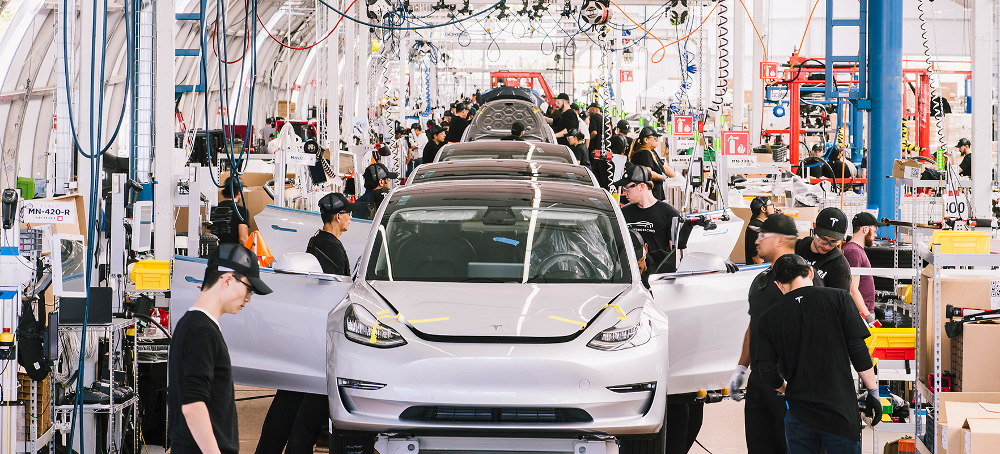 The assembly line at the factory in Fremont, California, where more than half the world's Teslas are made. (photo: Justin Kaneps/The New York Times)
Seven women are suing the Elon Musk-led company, alleging sexual harassment
This is not in dispute.
This summer was a busy one for Musk. He decided to buy and then decided not to buy Twitter. He fathered children Number Nine and Number 10 with a female executive at another of his companies. (Simultaneously, Musk’s father, Errol, admitted to having fathered a second child with his stepdaughter.) His third child disowned him. He denied concurrently that he broke up the marriage of the co-founder of Google and that he offered to buy a flight attendant a horse in exchange for an erotic massage.
The flight attendant received a settlement that was billed to SpaceX, Musk’s rocket company. It hasn’t been a great year for women at SpaceX. In December, former SpaceX engineer Ashley Kosak published an essay meticulously detailing alleged sexual harassment at the company. That was followed in June by a group of SpaceX employees releasing a statement saying Musk’s frattish behavior was “a frequent source of distraction and embarrassment” and asking Musk to stop being, well, a creep. SpaceX investigated their complaints for 24 hours, and then announced that SpaceX had “terminated a number of employees involved.”
On a not-unrelated note, Musk continued his longstanding love affair with “69” memes, often tweeting them to his 105 million Twitter followers. This is not an accident. Musk has made geek loucheness his personal brand and a component of Tesla’s marketing strategy. It may have even helped to save his company. By 2016, Tesla had released two models, the S and the X; both were critically acclaimed and massive hits for the previously tiny electric-vehicle market, but not enough to keep a giant company afloat. The next car would make or break Tesla. After building a roadster and an SUV, Tesla’s third car was going to be a sensible sedan, but Musk had to make it edgy. His plan was to name the crossover version the Model Y and the sedan the Model E, completing his “S-E-X-Y” line of cars that he had hinted at in tweets and speeches for years.
Alas, Ford, the historical home of the Model T, rumbled about trademark infringement and possible litigation. So Musk changed the car’s name to the Model 3. The company began selling T-shirts and coffee cups with a logo reading S3XY. Get it? (It wasn’t just about the cars’ torque and acceleration.) Wordsmiths groaned but Musk loved it. “We just trademarked ‘sexy,’ ” boasted Musk in an interview.
With increased public demand for EVs and backed by the S3XY campaign, the Model 3 was a megahit. Since the car was released in July 2017, Tesla has sold 3 million 3s, and the company’s stock has risen from $62 at the beginning of 2018 to a high of more than $1,200 a share on Nov. 1, 2021. The 3 is the bestselling electric vehicle in the world and is as omnipresent in America’s affluent neighborhoods as lacrosse sticks.
Musk became the richest man in the world and continued his frat-boy-as-businessman strategy. He announced in July 2020 the sale of a limited number of red satin short-shorts with the word S3XY written across the ass, ostensibly tweaking Tesla short sellers who lost billions as the stock rose. “Only $69.420,” tweeted Musk. (He is also big into weed memes.) They sold out in minutes.
Alisa Blickman didn’t know any of this in 2021 — she just needed work. She had been laid off from her job in Oakland as the pandemic crushed the Bay Area’s economy. What Blickman did know was that she was the sole provider for her child and Tesla was offering $21 an hour, with the promise of overtime.
Blickman applied online last fall and was quickly hired. A few days later, she made the 50-mile drive from her Pittsburg apartment to a Marriott near the Fremont plant for orientation. She alleges that the sketchy vibe began the moment she walked into a conference room. A man in a S3XY T-shirt welcomed her and the other new hires. The man soon began talking about the company, telling the new employees that “Teslas are so sexy” and “These are some sexy cars.”
Blickman wasn’t a Tesla fangirl, so she didn’t understand why there was so much talk of sexy at an onboarding session for a global corporation.
“I just thought it was very weird,” Blickman tells me. We are sitting in the deserted pool area of her apartment complex. It’s June, but she’s in a puffer jacket and occasionally shivers. I wonder whether it was because of the morning chill or talking about her experiences working at Tesla.
A year after being hired, Blickman is one of seven former Tesla workers who have filed sexual-harassment lawsuits against Musk’s car company in the past 10 months. The women, most of whom were let go, allege a level of sexual harassment that paints Tesla as more like one of William Blake’s dark “Satanic Mills” than a high-flying Silicon Valley corporation saving the environment.
The following story is based on court documents, including those filed on behalf of the women, and Tesla’s filings in these cases, as well as interviews with five of the women, their friends, and co-workers. In their lawsuits and their interviews, the women describe a workplace rife with sexual harassment and a culture of indifference or hostility to their concerns and complaints.
Tesla, which has not had an active public-relations department since 2020, does not typically respond to press inquiries, and did not respond to multiple requests for comment for this story. In its court filings in the women’s cases, Tesla invoked the arbitration clause in its employment agreement and has denied the women’s claims. “Tesla has always and continues to strictly prohibit its employees from engaging in any form of sexual harassment,” Tesla asserts in filings in one of the cases. The company emphasizes that it works to ensure “a safe and respectful work environment,” backing this up with multiple declarations by employees in various roles. And it cites its anti-harassment training and “See Something Say Something” and “Take Charge” programs that “empower employees to report any issues,” and claims it “promptly and thoroughly investigates . . . sexual harassment and, if substantiated . . . takes appropriate disciplinary measures, up to and including termination.” When reached by phone, the company’s lead lawyer, Sara A. Begley of Holland … Knight, acknowledged that she had received Rolling Stone’s inquiries, and then offered a terse “no comment.”
Tesla didn’t answer questions about Musk’s sexually charged public persona and how it might trickle down in potentially damaging and unforeseen ways.
In Blickman’s case, she claims, problems started at her onboarding session. She recalls the man in the S3XY T-shirt starting to read in a monotone about Tesla’s various policies. Eventually, he came to the company’s policy on sexual harassment. According to Blickman, he played an instructional video. Many of the examples in the video were of women harassing men. She couldn’t believe it.
“I thought, ‘If I’m sexually harassed, they’re not going to care,’ ” Blickman says.
On her first day at work, Blickman alleges she watched a male Tesla worker take photos of a woman’s backside as other men watched quietly, as if the man was hunting big game. The photos were soon circulating around the factory. On a break, Blickman says, she went up to the woman and asked if she was OK. The woman just shrugged.
“I’m used to it,” Blickman says the woman told her. “Shit like that happens all the time here.”
At first, Blickman says, she kept her mouth shut. Almost every day, she alleges, she heard the male workers in the factory sizing up women: “Oh, I’d do her.” “I’d fuck her.” “Her ass is a 10.” She had spent many years working in a predominantly male world as a delivery driver, and knew how to maneuver around a bad seed or two. The problem at Tesla, she says, was there were too many bad seeds.
A few weeks into her time at Tesla, she alleges, a male worker inched into her workspace and began intentionally touching her with his arm and then his leg. The man walked up to Blickman on a break and smiled. “You’re a pretty little white girl.”
She also alleges the man lied and told her he was a “lead,” a.k.a. a supervisor, which dissuaded her from complaining about him. On another occasion, she says, she told the man to back off. She claims the man told a couple of co-workers that he wanted to kill her and another employee. Eventually, management moved him to a different part of the factory, but Blickman still had to see him on a regular basis.
Blickman tried to focus on her work, but says that she remained afraid.
“It’s awkward, and I’m not an idiot,” Blickman tells me. “I’ve just started, what’s it going to look like if I say I’m being sexually harassed right away?”
Blickman began commuting with another worker, Jessica Brooks, one of the seven women who have filed suit against Tesla, who claims she eventually began piling boxes around her workstation so Tesla workers couldn’t gawk at her body, and confirms Blickman’s story. Brooks and Blickman talk about how all the catcalls and awful behavior made them want to call in sick. Daily, they both allege, they heard men talk about female employees, debating which ones were fuckable. Blickman claims she heard one male worker shout about another woman employee.
“I’d like to bend her over and spread her cheeks.”
Another man blurted out his sexual preferences: “I like to spit on a girl’s face when I’m fucking her.”
Blickman’s first supervisor wouldn’t help because, she alleges, he was one of the worst offenders. Each day, she claims, he approached Blickman from behind and gave her an unwanted massage on her lower back. Blickman just gritted her teeth under her Covid mask and waited for it to be over. (In another one of the women’s lawsuits, Tesla filed a sworn statement from a female worker who allegedly worked close to Blickman and Brooks, saying she didn’t hear or see any sexual harassment at the factory, and multiple other Tesla employees submitted declarations along the same lines, insisting that if they had, they would have reported it.)
Tesla requires its workers to do a few minutes of stretching every morning before their shift. One day, Blickman alleges, her supervisor came up behind her and whispered in her ear.
“I hear you don’t like to scream loud enough.”
Blickman says she broke for a moment and turned toward her supervisor.
“What?”
The man backed away and rephrased his statement, she claims.
“Uh, I hear you don’t like to scream ‘teamwork’ loud enough.”
Later, that supervisor was transferred to a different part of the factory. His parting gift? According to Blickman, he told his replacement that she was not “a valuable team member” and suggested she be exiled to a harder job outside in the “tents,” one of the factory’s least desirable areas to work.
Outside of work, Blickman says, she ran into a female Tesla worker. They talked a bit and Blickman confided to her that she was a lesbian. Blickman says the woman then aggressively came on to her, but Blickman told her she wasn’t interested in going on a date. The woman grew angry, and Blickman alleges she outed her to the rest of her Tesla workers.
Blickman says this resulted in a new wave of harassment. The woman who outed her would, Blickman claims, get her attention by making thrusting motions. She says the woman followed her into the bathroom and dropped to the ground and looked under the stalls for her.
Blickman says Tesla’s HR was less than useless. (From a statement issued by Tesla and from its filing in the women’s cases, the company claims it later amped up some of its sexual-harassment training and processes.) Blickman says she did find one male worker who was sympathetic to her. He’d listen as she detailed her complaints. “He was definitely not a pig,” remembers Blickman. “But he was only one in a sea of pigs. There were just too many in there.”
The months passed and Blickman found it increasingly difficult to drag her body out of bed at 4:30 a.m. to make the 90-minute commute to her 12-hour shift. She was drinking and smoking too much. Every break, she had an urge to bolt the factory. Blickman tells me that in the fall of 2021, she asked to be transferred to one of Tesla’s service centers. There was a problem with her paperwork — she doesn’t know if this was done on purpose or was just incompetence.
In October, Blickman took Covid leave. She emailed Tesla HR while away and told them she needed to take stress leave. She detailed some of the harassment she claims that she and others had suffered. HR replied about meeting in person, but then, Blickman says, she didn’t hear anything else, so she didn’t go back to the factory. She was fired when she didn’t return to work after getting a letter from Tesla in November saying that company policy might result in the termination of employees if they didn’t come to work for two days in a row without notification.
After remaining stoic through most of our conversation, Blickman’s eyes fill with tears: “I was just looking for a place where I can work and not be bothered, not be harassed. Is that too much to ask?”
I ask her if she thought Musk’s slavish devotion to frat-boy humor contributed to Tesla workers saying whatever they wanted to women.
“Of course,” she says. “There are people in that factory who see him as a god. If he talks like that, they know they can, too.”
There is no evidence suggesting that Musk knew about the alleged harassment going on at Tesla’s Fremont factory before the women filed their lawsuits. But for a guy who claims to be so hands-on, it’s hard to imagine he wouldn’t have picked up on complaints about the allegedly pervasive culture. And if he didn’t know, why didn’t he know?
THERE IS A COMMUNITY coming to life on the once desolate land adjacent to Tesla’s Fremont factory. For years, the Warm Springs neighborhood was a dreary industrial area that had become a haven for folks dumping trash and junking cars while participating in other unsavory activities. Now, there’s a new elementary school, the first one built in Fremont in 25 years. It’s just a 15-minute walk on freshly paved sidewalks to a recently opened Bay Area Rapid Transit stop connecting the blue-collar town to San Francisco. The boulevards are wide, and the charging stations are plentiful. Townhouses at the corner of Innovation Way and Synergy Street are going for $1.4 million.
Currently, Fremont produces more than half of the Teslas in the world. The factory is on the grounds of a former General Motors plant that was bought by Tesla for $42 million in 2010. Just 12 years later, Fremont has become the most productive auto plant in the country, building almost 8,550 environmentally friendly electric cars a week in 2021. The numbers are trumpeted as further signs of Musk’s genius.
However, Tesla isn’t a stranger to litigation about its work culture. In 2021, a jury held the company liable in a racial-discrimination suit filed by a Black worker who alleged the use of the n-word was common at the factory and that racial slurs were scrawled on the walls. (Tesla disputed the judge’s findings after the verdict and assured its employees that the facts didn’t justify the jury’s verdict.)
This spring, 15 Tesla workers filed a suit against the company alleging that Black workers were often greeted by white bosses with comments of “Welcome to the plantation.” The suit also alleges that Black workers were given the most daunting physical assignments. “Race plays no role in any of Tesla’s work assignments, promotions, pay, or discipline,” lawyers for the company said in a statement. “Tesla prohibits discrimination, in any form.”
This followed a February lawsuit filed by the California Department of Fair Employment and Housing against Tesla for racial discrimination and harassment at the Fremont plant. (In a statement, Tesla called the lawsuit “misguided” and denied the allegations, dubbing the proceedings “unfair and counterproductive, especially because the allegations focus on events from years ago.”)
Tesla’s defenders would argue that every large company will at times face lawsuits, HR challenges, and disgruntled employees. However, Tesla seems to be an extreme case both in the quantity of legal actions brought in quick succession and the consistent nature of the allegations. And most companies don’t have a rule-defying leader like Musk, what with his tweets floating the idea for a new school whose acronym just happens to spell out TITS — “Am thinking of starting a new university: Texas Institute of Technology … Science. … It will have epic merch.”
The women’s legal filings detailed alleged incidents ranging from being asked for hand jobs to being stalked by drunk-on-the-job employees in the parking lot. While the cases make their way through the system and Tesla pushes back against the allegations, the fallout has been catastrophic for the women. One couldn’t leave her bedroom for weeks. Some feel ashamed, a common reaction among sexual-harassment victims. And many are having trouble jump-starting their careers after their time at Tesla left a black hole on their résumé. The women tell Rolling Stone they can’t understand why the kind of behavior they claim they experienced was, and possibly still is, being tolerated by Tesla and Musk. They believe Musk should be held accountable.
The never-modest Musk recently proclaimed that he would jack up Fremont’s production by 50 percent in the near future. That means more jobs. Musk is offering something to workers who could never buy a $60,000 entry-level Tesla, much less a million-dollar home: a $21-an-hour wage. This is manna for blue-collar workers in America, where most of the factory jobs that used to support manual labor have been shipped overseas or down to Mexico. Men and women from economically distressed towns like Antioch, Stockton, and Modesto talk excitedly about doubling their take-home pay. Yes, 90-minute commutes each way — exponentially longer if you are relying on public transportation — are a nightmare. And, yes, you are standing on your feet for 12-hour shifts in a nonunion shop where you can be fired without cause. And, yes, there was a killing in the parking lot last December, when one worker allegedly laid in wait for another worker and gunned him down. Still, there is optimism in the air. Even the women bringing the lawsuits tell me they had been excited about working at a place with cool tech that was making our air a little better.
Then, they say, reality settles in.
ALIZE BROWN THOUGHT that if she covered her body head-to-toe in oversize clothing, she would be left alone.
It was November 2020 and most of the Bay Area economy was still on Covid shutdown. She was 21, had a three-month-old son, and her partner was out of work. Brown didn’t hesitate when a recruitment agency offered her a job casting metal parts for Tesla. She tells Rolling Stone she had heard from a female cousin who had worked at Tesla that it was a tough place for a woman to work. Brown says she thought they were being dramatic.
According to Brown, she kissed her baby goodbye a few days later and left for work at 4:30 a.m. At 6 a.m., she clocked in and learned her station wasn’t in the factory but outside in an area commonly known as the “tents,” where she would be dunking metal parts into a hot chemical liquid to prepare them for shaping. She was given work gloves to protect her hands from the toxic liquids, but tells me she soon noticed other workers had burns on their forearms where the gloves ended. She was then required to “grind” the pieces into shape with a tool.
She says she also soon learned that there were other dangers. First there were catcalls from male workers. Her court filing detailed some of them:
“Are you single?”
“No, I have a partner and a baby.”
Brown alleges the men would just laugh.
“Whatever man you’re with doesn’t care about you because you’re working.”
(Tesla filings include a sworn statement from one of Brown’s supervisors claiming that he had not seen or heard any sexual harassment targeting Brown.)
Brown tells me that she informed her Tesla supervisor that she was breastfeeding and would need to pump during her 12-hour shift. She says that information spread throughout the department. This quickly became a subject of sport with her co-workers, particularly one male worker who became obsessed with her. He started making comments about her breastfeeding, often referring to her as a “cow,” or saying that she was “milking.” She says that when her breast milk leaked and stained her shirt, he would say things like, “I see you’re milking today.” According to her complaint, the man would spend most of the workday bothering Brown, following her around. And he was always talking, she claims.
“You’re looking hella thick today.”
Brown decided to do what she could to deter the unwanted attention. That’s when she bought an extra-large mechanic’s jumpsuit to envelop her body, and started wearing a wool hat to cover her hair and a big scarf for making her neck invisible. Other than her face, hardly an inch of her skin was exposed.
“I just wanted to blend in and somehow disappear,” Brown tells me at a Starbucks not far from her apartment. She’s wearing a jaunty straw hat and has an easy smile, but her fists keep clenching in anger. “I just wanted to do my job and go home. They wouldn’t let me.”
After a month or so, she says, she went to her male supervisor and complained about the creepy co-worker. “He is saying very inappropriate comments to me. I’m feeling uncomfortable. Can you say something to him?”
According to Brown’s court filing, her supervisor, who she claims frequently looked her body up and down, brushed it off. (In a filing by the supervisor in another one of the cases, he claims none of the employees he supervised ever complained to him about other employees using harassing language, and that he would have escalated any such complaint to HR.)
Things somehow got worse. The Tesla factory is immense, with 10,000 employees. Besides lunch, workers receive two 15-minute breaks during their 12-hour shifts. Brown would have to walk quickly just to reach a toilet and get back in time. Brown alleges the co-worker followed her to the bathroom. She says she begged him to stop harassing her. He just laughed and went back to his crude talk. Brown alleges she went to her supervisor and asked him to move her to a different part of the factory, but, she claims, the man soon moved there, too, and continued harassing her.
“In my heart, I wanted to strangle him,” she says. “Like with both hands and both feet. But I knew I had a baby and I’d go to jail. So I couldn’t do anything.”
Brown says he wasn’t the only man to bother her, and alleges that she pleaded with her co-workers to knock it off. “We’re not at a party, we’re here to work,” Brown says she told the men. “I’m not here to flirt with you. I need this job. Please leave me alone.”
Brown tells me a story that is also in her court filing. There was another male worker who reeked of booze and began asking her personal questions about her life and what she liked in a man. One night, she finished her shift before dawn (the Tesla factory runs 24/7) and started making her way to her car in the vast parking lot. The lot wasn’t a picnic in the best of times — this is where the worker allegedly shot another employee. That night was worse, Brown says. She heard the drunken man shouting for her to give him a ride home. He staggered after her. Brown started running in a jagged pattern trying to lose him, but the task was made harder because she was wearing so many layers of clothes. She eventually lost the man and slipped into her car. She let out a scream of rage before driving home.
“I grew up in Oakland, and I know how to avoid people on drugs or drinking, but I didn’t think I’d have to do it at work,” Brown tells me. “It was Covid. I needed the money for my baby.”
She brought the workplace home and would yell at her partner to not touch or comfort her. He suggested she quit, and Brown snapped back that they needed the money. So she kept going to Tesla. About two months later, Brown went to work and found out her badge would not let her enter. She called a co-worker, who asked a supervisor about it, and they reported back to Brown that her contract had been terminated. The reason? She says Tesla argued that she had been away from her workstation too much. She was crushed.
“I was just trying to get away from the men who were harassing me,” Brown says. “I begged them to move me or them. They never listened. Instead, they fired me.”
That was 18 months ago. Since then, Brown says, she has battled anxiety and gets nervous about leaving her house to run routine errands. She now has a job in a San Francisco hair salon, but she says she has trouble riding the BART train to work. “I can’t handle anyone sitting behind me or getting on and sitting next to me,” Brown says. “I’m working on it.”
Now, that fear and depression seem to have turned to anger. At the end of our conversation, I ask Brown if people would buy Musk’s car if they knew what she alleges happened in his company’s plants. She lets out a little laugh and considers what she would do if someone gave her a Tesla.
“I’d drive that Tesla down to the factory,” Brown says. “And I’d burn it.”
EDEN MEDEROS DIDN’T LIKE to fight traffic, so she often spent 14 hours a day working at the Centinela Tesla service center in suburban Los Angeles. Arriving around 6:30 a.m., she liked the first hour in the morning twilight. Mederos wasn’t getting paid for that first hour, but she got a lot done, unlocking the place, scheduling appointments, and getting keys ready for customers picking up their cars. The other thing she says she cherished about her morning time was that no one was harassing her.
She claims it started early in her time at Tesla. Mederos’ job title was “concierge,” but her responsibilities ran from organizing maintenance appointments to dealing with Tesla owners grappling with the latest update to their car’s digital dashboard. Mederos doesn’t have kids, so there were no cute snapshots to personalize her desk, but dinosaurs take her to a happy place. “I’m a big Jurassic Park nerd; that’s my guilty pleasure,” Mederos tells me. “I just love them; they make me smile.”
So she brought in some dinosaur figurines to decorate her desk one morning. She placed the dinosaurs and went off to help a customer. A half-hour later she came back, and claims she could hear many of the almost-all-male staff giggling: The dinosaurs had been rearranged in sexual positions. This wasn’t a huge surprise to Mederos, she alleges, since Musk had ground the “69” meme into dust, captioning a screenshot with “Nice” after his twitter followers hit 69 million. Mederos and the other women Rolling Stone spoke with say male Tesla workers found it hilarious, the female workers did not. She restored her dinosaurs to their original positions, but every time she stepped away, she alleges, someone fucked with them, so she took them home at the end of the day.
By that point, Mederos felt that complaining wouldn’t do any good. She says she’d already stopped eating at work because whether it was a banana or yogurt, someone would make sex noises and ask her “How much more can you fit into your mouth?” Mederos claims co-workers passed the time throwing coins and crumpled paper at her and other women, aimed to go down their shirts.
Mederos recently moved from Los Angeles to the Portland, Oregon, area. She likes the laid-back feel and says she had mostly healed from working at Tesla between 2016 and 2019. But after talking to her I’m not so sure. She was stoked when she was hired by Tesla after working for 10 years with special-needs kids. “I thought I was pretty tough,” says Mederos. “I’ve been knocked down a flight of stairs at work.” Mederos says she was psyched to be working for Tesla, a company trying to reduce carbon-dioxide emissions. “We are watching our planet dying. It was great wanting to be a part of something doing something about that.”
But there were warning signs. The center had about 30 employees, and only three were women. (The other women Rolling Stone talked to also cite a rough 10-to-one male-female ratio at Tesla.)
Shortly after starting, Mederos says, she told her boss that she had problems hearing certain tones and voices with her right ear. This got around, and apparently many of the men she worked with thought she was deaf. A technician allegedly called out “I’ve never seen a white girl with an ass like her.” The same tech guy eventually learned that Mederos was half-Cuban. One day, she claims, he sidled up to her. “That explains why you have an ass.” This atmosphere encouraged two other workers to ask her if she could hold a cup up with just her butt. The tech guy, per Mederos’ legal filing, also once remarked on the breasts of a girl visiting the center, and was unfazed when he was told the girl was 12. “Those tits are not 12,” he allegedly said.
“The place was toxic before Eden got there,” says a former Tesla employee who worked with Mederos and left company feeling the culture was inappropriate and obnoxious. “A guy would start there and seem like a nice guy, but then he wanted to be part of the group and just started being awful. Other women got harassed — Eden just got it more.”
Mederos says her first supervisor was sympathetic but useless, telling her that’s just how men talked at Tesla. Occasionally, employees would be compelled to watch videos on sexual harassment. That only made things worse, according to Mederos. Men would touch Mederos’ arm and leg, and say in a mocking tone, “Oh, no, I’m sexually harassing you.” After the announcement of the S3XY line, the men at the service center started calling everything “sexy” — “This pen is so sexy, this stapler is so sexy.”
“There were conversations about it,” says Mederos. “They would say, ‘Well, [Musk] says it, so why can’t we say any of this stuff?’”
Her second supervisor, according to her filing, was even more of a nightmare. He would block doorways as she tried to enter offices, she claims. One day, Mederos alleges, she and that supervisor took a Tesla for a test drive. She claims that before they pulled out of the parking lot, her supervisor placed his hand on her shoulder and told her that her strong personality was holding her back at the company.
“You should be calmer; that is what is expected of a woman.”
Mederos says she jumped out of the car at the first red light and walked back to the center. Eventually, Mederos alleges, she reached out to HR to plead her case. The HR rep listened and agreed to meet with her. Mederos says she was somewhat optimistic as she arrived for the meeting in a conference room. That was immediately crushed. She opened the door, and her boss was sitting at a table with the HR rep. Mederos couldn’t believe it. She felt like she was going to throw up.
“You’ve made some aggressive accusations,” she says the HR rep told her.
Mederos tried to explain her side of things. But she says her supervisor shouted her down.
“Everything you say is complete bullshit!”
He kept yelling until he stalked out of the room, she claims.
Mederos couldn’t stop crying. The HR rep told her to take the rest of the day off.
She pauses when she tells me this part of the story. It’s been two years, but she still blames herself.
“First I was shocked,” recalls Mederos. “And then I was just so angry at myself. Everybody had told me that if I go to HR, this sort of thing would happen. I knew from then on, I was gonna be so screwed.”
She tried to transfer to another Tesla service center. Her supervisor slow-walked it for months, she says. Eventually, she moved to a Tesla center in nearby Torrance. Things were better for a while. Then, according to her court filing, her old boss showed up without any reason. He allegedly sat on Mederos’ desk menacingly. She tried to avoid eye contact. He began to speak to her.
“What are you doing?”
“Working.”
“That’s a change.”
He then stalked away, but would occasionally return so she knew he was watching her. She claims she told her new supervisor about the incident, but he took no action. In a separate conversation, she asked him why men doing her same job were making more money than her, and why she had not been promoted despite excellent reviews. He gave her an impassive look and said, “If you are only in it for the money, you should quit now.”
Mederos began dreading going to work. She would leave her house in the morning and get increasingly anxious the closer she got to the service center.
In November 2019, her supervisor allegedly began screaming at her for his own mistake. Mederos ran to her car and never set foot in a Tesla office again.
“I just broke down in tears and told the assistant manager that I was leaving, and I couldn’t come back. I’ve never walked out on a job, ever,” says Mederos, who has been working since she was 14.
Mederos is doing better now that she is in Portland. But sometimes anger creeps in. Recently, Mederos and her boyfriend ordered a car service to take them to the airport. Her boyfriend was excited when the car picking them up was a Tesla. He talked
about how he had always wanted to ride in one. Mederos got angry at her partner. She laughs about the experience for a second. But then she turns grim.
“I loved those cars,” says Mederos in a monotone. “Now, if I see one, it just makes me anxious and sad.”
CHANGE ALWAYS STARTS with one step. One worker not willing to accept things as they are. One worker with the courage to speak up. That woman in this case was Jessica Barraza. One day, San Francisco attorney David Lowe received a voicemail from Barraza. In a shaky but strong voice, the 39-year-old mother of two detailed her three years of hell at Tesla. Lowe set up a meeting with her. After hearing her account, Lowe asked her a difficult question. He was sure that other women had similar experiences. Would Barraza be willing to go public and do some interviews? Barraza said yes.
Within a month, Lowe’s law firm had heard from the other six women it now represents. They have never been in the same room together partly because of the pandemic and partly because many of them now fear social situations. Still, two of them tell me that they would have not come forward if Barraza had not taken that first step.
“It took courage for her to do that,” Lowe tells me. “We might not have heard from the other women. Jessica let them know they were not alone.”
It has not come without a cost to Barazza.
One summer day at Lowe’s office, the quiet of a San Francisco afternoon suddenly ends as a screaming motorcycle rips up the street. Eight floors up, Barraza’s body jerks and recoils in a conference room. Her hands shake. Her arm features tattoos with her parents’ names and cradles a clear plastic bag filled with prescription bottles for depression, anxiety, and insomnia (she is on medical leave from Tesla). Barraza has done nothing wrong, but still she apologizes. “I’m so sorry.” Her lip quivers. “Ever since Tesla, loud noises scare me.” She begins to cry. “I just feel ashamed they made me feel like this.”
Barraza’s father had run a transmission-repair shop in San Jose. As a child, she had heard men talk in macho terms about their rides. Entering the predominantly male world of Tesla didn’t faze her. Besides, in 2018, she and her husband, Perfecto, had two sons who were nearing college age. They needed the money. She was making only $10 an hour at a Modesto boutique. Tesla was offering $19 an hour.
“That’s Bay Area pay compared to Central Valley pay,” says Barraza. “There was no question I’d do it. I’m not a big save-the-Earth person, but I thought this was something that would make my children’s and grandchildren’s world a little better.”
She lets out a bashful smile. “I knew a lot of the work involved robots, and that sounded cool.”
Barraza began work at Tesla installing cooling fans. She’d assemble the fan, and when a car rolled toward her, she’d take the fan and rivet it into place, and do it again and again for 12 hours.
The hard work didn’t bother her, it was the alleged behavior of her fellow Tesla workers that did. Barraza had to walk across the factory floor to reach her workstation. She alleges she could hear workers shouting about her as she walked by.
“That bitch hella thick.”
“She’s got fat titties.”
“She has a fat ass.”
“Oh, man, I want to fuck the shit out of her.”
She says she was reminded of movies where new prisoners are dropped at jail and paraded before ravenous long-timers.
(Tesla filed a motion to compel arbitration and dismiss or stay Barraza’s case, disputing Barraza’s account, which Tesla alleges “relies on an embellished and disputed account of past events.” In support of its defense, Tesla offered up numerous sworn declarations from current Tesla workers who claimed that they never heard Barraza complain about this sort of behavior, and asserted that they did not hear catcalls or other obscene remarks, and that they would have reported them if they had. In its filings, Tesla also alleges that Barraza had problems with attendance, and one supervisor claims that Barraza often talked to him about not wanting to work.)
For the first year, Barraza claims, she endured the behavior she insists happened. She needed the job and, she reasoned, no one wanted to hear a new employee complain about working conditions. So, she says, she put up with it. Besides, like Blickman, she claims some of her bosses were the worst offenders. There was the lead in her section who, she alleges in the complaint, had her phone number for work purposes, and began texting her.
“I just think you sexy asf and wanted to kick it … you know I always had a crush on yo fine ass.”
Barraza says she told him that she was married, something he already knew. He texted back: “You know that only makes me want you more, right?”
Like many of the women I talk with, in addition to the alleged verbal abuse, Barraza also claims in her suit that she dealt with other workers touching and rubbing against her “accidentally” as she tried to do her job. One worker wouldn’t let her pass in tight quarters, she alleges. Instead, he picked her up by the hips and moved her whole body. Later, a female worker came up behind her and put her hand on the small of Barraza’s back and asked her a question.
“Is your butt real?”
Barraza marched over to a supervisor.
“If she touches me again, I will fuck her shit up.”
According to her court filing, the supervisor said he wouldn’t take any action, and chalked up the touching to “cultural differences.” (In its filings, however, Tesla claims that Barraza’s account is false, including alleging that it was Barraza who didn’t want to file an HR report and that the woman was an elderly Filipino woman and English isn’t her first language. Tesla also claims Barraza’s supervisor had another supervisor speak with the woman in her language and explain that it’s never appropriate to touch others at work.)
After a while, Barraza says, she stopped reporting other alleged incidents to her supervisors, as she felt they did not care. She was tough, but after two years, she was starting to fall apart. At home, she told herself that she was doing this for her sons. Still, she couldn’t sleep at night.
One day, she alleges in the complaint, she scanned her badge and turned to leave, but a man had stepped up behind her and put his leg between her legs and rubbed his groin against her. She screamed.
“What the fuck?”
The stranger smiled.
“Oh, my bad.”
He disappeared into the factory.
Barraza went back to her workstation, but started having a panic attack, she says.
“She called me early that morning,” a Tesla co-worker who says she witnessed much of what Barraza endured tells me. “She was just completely distraught. She was just broken.”
Barraza bolted the factory, and says she told her supervisor over the phone what happened. They told her to take her scheduled days off and they’d look into it. (According to Tesla’s filings, her supervisor and a co-worker dispute her account. Both say they offered to help her, and also told her she shouldn’t have left the factory without telling someone.)
Barraza tells me she took the extra step of emailing an HR director the next day, but says she felt stonewalled. After two days off, she went back to work. Her hands began to tremble when she was told it was time for the morning stretches. She couldn’t bear to have strangers behind her as she bent and stretched her body. Instead, she went to her workstation and began stacking all the materials she would need that day. But, she says, her body rebelled, her throat constricted, and she couldn’t breathe. She barely remembers driving home. (Tesla workers admit they heard from a distressed Barraza after she fled the factory.)
Barraza says she didn’t leave her bedroom for three weeks. Her husband brought her meals and had to help her shower. Her sons whispered at the door to see if she was OK. She and Perfecto talked about what they should do. They decided to get a lawyer.
Taking on the world’s richest man and his company hasn’t come without a cost. She used to be able to take her kids down to L.A. on a whim; now, she says, she needs someone to watch her as she goes out to get the mail. “I’m just a blue-collar worker,” she says. “He has everything. I just get so afraid.”
I ask her if she felt pride or a sense of solidarity when other women started filling suits alleging the same kind of abuse. She shakes her head.
“No, I feel sad for them. Some of them are 18 or 19, and it’s their first job. I’m pretty tough, so if I can’t handle it, what do you think those girls will do?”
One of those young women was 19-year-old Samira Sheppard, who filed a harassment suit after Barraza. In its filings, Tesla emphasizes that Sheppard has returned to work at Tesla and hasn’t lodged any complaints since. But according to Sheppard’s filings, there was a good reason she went back: economic desperation — a condition most of the women said was a factor in staying at Tesla longer than they otherwise would have. “I found a job working as a hostess at Applebees, but the pay was meager,” claimed Sheppard. “I was on the verge of not being able to afford a place to live, so I applied to work at Tesla.”
These days, Barraza doesn’t see a lot of Teslas in working-class Modesto. But when she does, she’s struck with the same feeling: “I just wonder how many women were abused to make that one car.”
IT COULD TAKE YEARS for the women’s lawsuits to find their way to a courtroom, if their lawyers succeed in keeping them out of arbitration. According to their lawyers, a common tactic in these types of cases is to delay until the complainant goes away, or accepts a settlement and signs an NDA. Tesla has already filed motions to have the cases moved to binding arbitration and dismissed from court. A judge denied that request in Barraza’s case, but Tesla has filed the same motion in the other six cases. Lowe guesses the cases might not hit trial until 2024.
Tesla’s lawyers, in their motion to dismiss Barraza’s case, disputed her claims, calling them “false” and pointing to a slew of policies and procedures to combat harassment, including recent advancements in HR procedures: “[Tesla] has made significant changes to its harassment policies, practices, and procedures over the past year.” One of the programs, “Respectful Recharge,” was started in December 2021, a month after Barraza’s suit was filed.
Musk recently sent a tweet in the hours after The Wall Street Journal ran a story accusing him of breaking up the marriage of Google founder Sergey Brin by sleeping with Brin’s wife. It wasn’t a denial of the affair; that would come later. Instead the richest man in the world tweeted a meme about a criminal being sentenced to 68 years in jail and asking the judge for one more year so he could reach the hallowed “69.”
A week later, a Tesla stockholder made a motion at a shareholders meeting requesting that the company issue an annual report on its efforts to prevent sexual harassment. Musk currently owns 14 percent of Tesla after selling $6.9 billion in Tesla stock — get it? — in preparation for his pending lawsuits against Twitter. His support would have carried the day. Instead, Tesla released a statement: “The Board continues to oppose initiatives that seek to direct Tesla’s strategic business decisions and day-to-day operations in ways that are not critical to or in furtherance of Tesla’s core mission.” The motion failed.
Elon Musk remains on-brand.
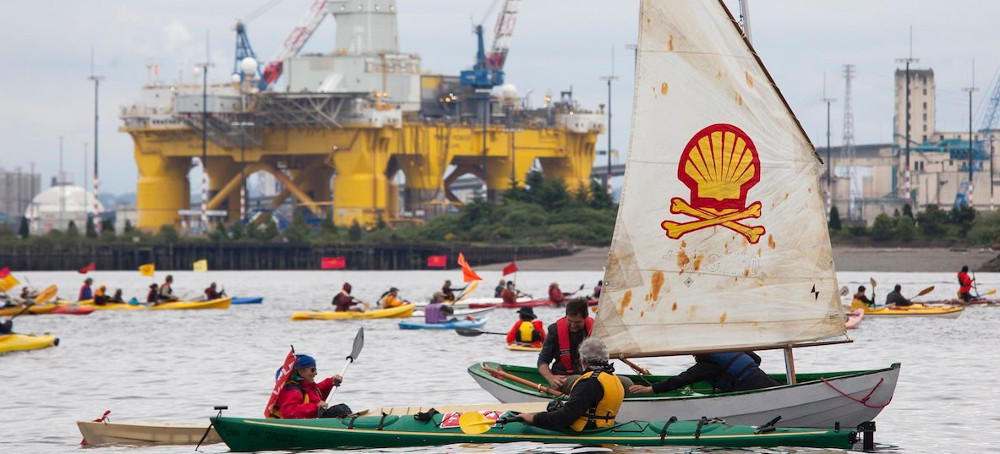 Activists in Puget Sound, Washington, demonstrate in 2015 against Shell's Arctic drilling plans. The company acknowledged divesting from places such as Washington, where it saw political pressure to do so, in favor of business as usual in places such as Louisiana where it perceived less resistance. (photo: David Ryder/Getty)
Now, new internal documents subpoenaed as part of a House Committee on Oversight and Reform investigation reveal how the fossil fuel industry has updated its misinformation playbook for the 21st century by publicly touting net-zero plans and renewable technologies it dismisses behind closed doors.
“As we face more deadly, extreme weather around the globe, fossil fuel companies are reaping record profits and ramping up their misleading PR tactics to distract from their central role in fueling the climate crisis,” committee chairwoman Rep. Carolyn B. Maloney (D-NY) said in a press release. “My Committee’s investigation leaves no doubt that, in the words of one company official, Big Oil is ‘gaslighting’ the public. These companies claim they are part of the solution to climate change, but internal documents reveal that they are continuing with business as usual.”
The documents were subpoenaed as part of a year-long House investigation into the fossil fuel industry’s attempts to mislead the public about the risks of their business model in a warming world and announced to the public in a memo published September 14. They feature internal communications from major oil companies BP, Shell, ExxonMobil and Chevron that reveal the companies are not willing to put their money where their mouths are when it comes to reducing emissions and shifting away from fossil fuels.
“The Committee’s investigation has shown that, rather than outright deny global warming, the fossil fuel industry has ‘greenwashed’ its record through deceptive advertising and climate pledges — without meaningfully reducing emissions,” the memo said.
For example, Shell has promoted its “Sky scenario” to achieve net-zero greenhouse gas emissions, but internal emails affirm that it has “nothing to do with our business plans.”
Further, Shell communications guidelines tell employees they should make clear that reaching net-zero emissions is a worldwide goal, not a Shell-specific one.
“Please do not give the impression that Shell is willing to reduce carbon dioxide emissions to levels that do not make business sense,” the guidelines said.
Fossil fuel companies also spend a lot of effort advertising alternative technologies that they have less confidence in internally. Exxon launched a $68-million ad campaign on its research into making biofuels from algae but admitted in private that the technology was “decades away from the scale we need.”
DeSmog pointed out that oil companies have expressed similar skepticism about carbon capture and storage. In October 2019, a Shell official told another to “be cagey about project specifics” regarding the technology before a Washington, DC event.
Finally, BP — despite rebranding itself Beyond Petroleum — said that carbon capture would “enable the full use of fossil fuels across the energy transition and beyond.”
“What these documents are is an insight into how these technologies are viewed inside the companies,” Union of Concerned Scientists accountability campaign director for climate and energy Kathy Mulvey told DeSmog.
The documents also revealed a lack of respect for local communities and climate activists. Shell said it was divesting of greenhouse-gas intensive assets in areas where there was political pressure to do so, such as California or Washington. However, it would keep them in places where there was less pushback, including “China, Singapore, Malaysia, Louisiana…”
This statement raised the hackles of community activists on the Gulf Coast, who have long fought to keep their homes from remaining a sacrifice zone to the industry.
“If industry doesn’t see the efforts of frontline fighters in these communities it’s because they don’t want to. It’s because they are in the pockets of our elected officials and they don’t care about the communities they invade,” Healthy Gulf organizing director Roishetta Ozane told DeSmog.
Internal memos also complained about writer and activist Bill McKibben, the Sierra Club’s Beyond Dirty Fuels campaign and the Sunrise Movement. A Shell staffer even wished that members of the latter would experience “bedbugs” on a traveling campaign.
“First they ignore you, then they laugh at you, then they wish bedbugs on you, then you win,” Sunrise executive director Varshini Prakash said in response, as The Guardian reported.
Prakash’s response underscores that the documents show how climate activism is having an impact on the companies, in some cases prompting some surprisingly honest reflection. When Shell sent a tweet asking the public what they were doing to reduce emissions, it received a massive wave of internet backlash that a communications executive admitted was “not totally without merit,” The Guardian reported. The executive even agreed that the tweet could be interpreted as “gaslighting.”
In response to the release of the documents, however, the companies doubled-down on their greener public image and criticized the committee for cherry-picking the most inflammatory comments.
“[The] selective publication of dated emails, without context, is a deliberate attempt to generate a narrative that does not reflect the commitment of ExxonMobil and its employees, to address climate change and play a leading role in the transition to a net-zero future,” a company spokesperson said, as The Guardian reported.
A Shell spokesperson similarly said that the communications published were taken from almost half a million pages about the company’s efforts to move away from fossil fuels.
“Within that pursuit are challenging internal and external discussions that signal Shell’s intent to form partnerships and share pathways we deem critical to becoming a net-zero energy business,” the spokesperson said.
BP, meanwhile, reaffirmed its commitment to reaching net-zero emissions by 2050 to DeSmog.
“We provided hundreds of thousands of pages of documents to the committee. Some of the emails referenced contain inartful attempts at humor that do not reflect the values of bp and should not distract from our actions,” the spokesperson said.
But the congresspeople behind the investigation pointed out that the companies’ internal statements fit with their long-standing pattern of behavior when it comes to the climate.
“It’s well established that these companies actively misled the American public for decades about the risks of climate change,” investigation co-lead and Chairman of the Subcommittee on Environment Rep. Ro Khanna (D-CA) said, as The New York Times reported. “The problem is that they continue to mislead.”
Follow us on facebook and twitter!
PO Box 2043 / Citrus Heights, CA 95611


Comments
Post a Comment