RSN: FOCUS: Garry Kasparov and Michael McFaul | The Sanctions Against Russia Still Have Holes. Here’s How to Plug Them.

09 September 22
Live on the homepage now!
Reader Supported News

They have certainly weakened the Russian economy. But only the most optimistic believed that sanctions would persuade Putin to change his mind and withdraw his army from Ukraine. Instead, the purpose of these sanctions should be to limit Russia’s capacity to wage this war against Ukraine — to compel, not persuade, Putin to end his invasion. To date, there have been some successes, but the experience of the past six months also shows that there is much more to be done. We have several suggestions for measures that we think are worth taking.
Targeted export controls on sensitive technology have proved especially effective by limiting Russia’s ability to replenish precision weaponry. Over time, this disruption of sophisticated technology components, including first and foremost chips that Russia cannot make, will weaken Moscow’s military capabilities.
Now the democratic world must impose additional import restrictions on technologies such as aircraft parts, sonar systems, antennas, spectrophotometers, test equipment, GPS systems, vacuum pumps and oil-field equipment. Russia should be completely unable to obtain any high-tech imports, as ultimately most technology is dual-use. Any technology that helps the Russian economy also helps Putin kill more Ukrainians.
Over the long run, the exodus of tens of thousands of Russian high-tech workers triggered by Putin’s war also will further diminish Russia’s military industrial base. Moving forward, the West should do more to facilitate a massive Russian brain drain. Democratic countries should make it easier to accept Russian immigrants with technological expertise through a variety of residency and economic incentives. Europe and the United States must also make it easier for political and media opponents to Putin’s regime to immigrate, to help further divide Putin from the Russian people.
Sanctions also have interrupted foreign direct investment, causing food, drug and material shortages. Impressively, roughly a thousand foreign companies have exited Russia; most will never come back. This doesn’t just affect the range of available goods and services; it will also diminish technology transfer and innovation in a wide range of industries throughout Russia, especially in the energy sector.
But more should be done. Democratic governments must put more pressure on their companies that have not left Russia yet. Foreign enterprises helping Putin’s war machine, even through the simple act of paying taxes, should face sanctions, too. The international community also should compel countries such as Turkey, Georgia and Kazakhstan — which are currently helping to bypass existing sanctions — to halt ongoing smuggling operations.
Sanctions on Russian individuals have produced real and lasting results. The lengths to which Russian oligarchs have gone to circumvent or get off the sanctions list suggest that sanctions are working.
Yet sanctions have still not been imposed on thousands of Russian officials, party leaders, regional government heads, board members of Russian state-controlled enterprises, propagandists and celebrities supporting the war. It’s time to add them to the list. Individuals in third countries helping Putin — such as former oligarch Bidzina Ivanishvili, the de facto ruler of Georgia – should know they, too, will face sanctions unless they stop supporting Putin’s barbaric invasion. Any individual supporting Russia’s war in Ukraine, even if indirectly or passively, should pay a cost.
To date, sanctions have been ineffective in targeting Russia’s fossil fuel exports, the primary source of income for Russia’s war effort against Ukraine. Tragically but predictably, Putin’s war dramatically pushed up global energy prices, producing short-term windfall profits for the Kremlin. Western leaders also consciously left in place loopholes in the sanctions regime so that that governments and companies could keep purchasing Russian energy. (Left untouched, for example, was Gazprombank, a key financial institution for Russia’s state-controlled natural gas corporation.)
The good news here is that more is already planned. By the end of the year, the European Union plans to make drastic cuts in fossil fuel imports from Russia, and the Group of Seven aims to implement an innovative idea of capping the price of Russian oil exports worldwide. The prospect of this price cap is already compelling Russia to sell oil at discounted prices. Democratic government leaders around the world must credibly signal their readiness to pressure their banks, insurers and shipping companies to enforce the price cap. Consumers living in the free world have to stop financing Putin’s war by buying Russian oil and gas.
Finally, democracies must signal their intention to maintain sanctions for as long as it takes to achieve three outcomes: Ukraine must regain all of its territory, including Crimea; Russia must pay war reparations to Ukraine in full; and Russian war criminals must be brought to justice. Leaders of the free world must avoid the temptation to offer partial sanctions relief for incremental changes in Russia’s war efforts, and they should never do anything regarding sanctions relief without endorsement from Ukraine’s government.
Expanding and sustaining sanctions will be costly to the United States, Canada and Europe. But this is the price we must pay for decades of failure to act against Putin’s authoritarian and imperial ways. Fortunately, nations of the free world pay this cost solely with money; Ukrainians are paying with blood.
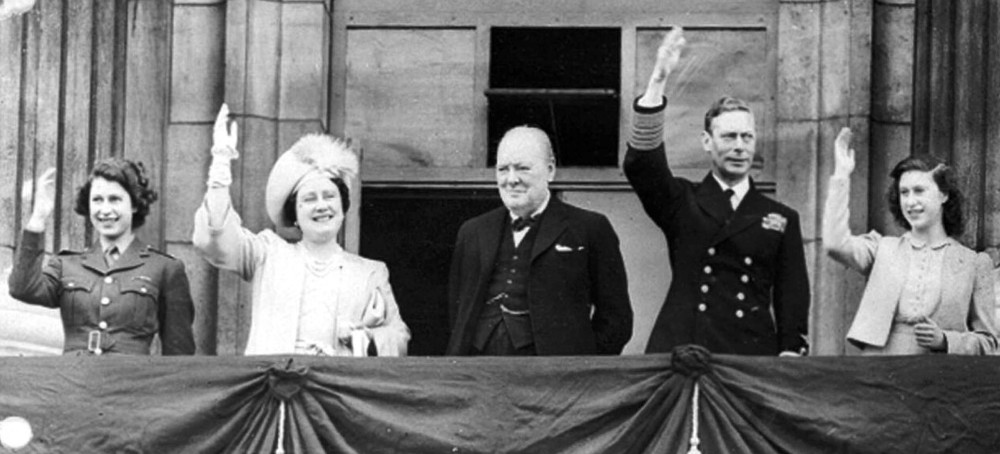 Princess Elizabeth, Queen Elizabeth, Winston Churchill, King George VI and Princess Margaret on the balcony of Buckingham Palace on VE Day, 8 May 1945. (photo: AP)
The one element in our collective life that stayed reliably the same has gone. We enter a new future now
Of course, we knew the moment was coming. When a photograph was released on Tuesday showing the monarch welcoming her newest prime minister – her 15th – at Balmoral, her face looked unfamiliarly gaunt. The Queen was in her 90s and we are all mortal, even those whose blood flows deepest blue. And yet the announcement that she had died on Thursday afternoon will shake this country very deeply, for reasons we may not fully grasp.
Plenty will say the nation has lost its grandmother, that we are a family bereaved of its matriarch – and that comparison is not so wide of the mark. Not because everyone knew or loved the Queen like a relative, because obviously that is not true. But the comparison holds in this much narrower sense: she was a fixed point in our lives, a figure of continuity when all around was in constant flux. Everything has changed since the day in 1952 when she inherited the throne. That country – of black-and-white television, gentlemen in hats, and Lyons Corner Houses – and this one would barely recognise each other. The one thing they have – had – in common was her.
She was woven into the cloth of our lives so completely, we had stopped seeing the thread long ago. It was not just the coins, the banknotes and the post boxes. It was the fact that you could hear a song called Her Majesty, from a different lifetime, written by a group that broke up half a century ago, and the majesty they were serenading was the same person who still reigned. Longevity plays strange tricks like that. My grandmother was born in 1906 and died nearly 30 years ago, and yet the monarch for most of her adult lifetime was this same queen. Elizabeth was the head of state of this country for more than 70 years.
As with parenting, so with serving as the national figurehead: a big part of the job is simply showing up. Elizabeth understood that very deeply, realising that continuity amid turbulence was the great value that a monarchy could add to a democratic system. That was why she never countenanced an abdication, no matter her age or infirmity. In her view, the 1936 disavowal of the throne by her uncle Edward VIII after a mere 325 days was a trauma that was never to be repeated. The monarch’s job was to stay put, a steady centre in a swirl of chaos.
Of course, there was more to it than that. She made scrupulous neutrality appear easy, a simple matter of doing and saying nothing. But, as her son – the new king – demonstrated through his long, long apprenticeship, it’s harder than it looks. To locate the neutral ground requires not only a self-restraint that has always eluded Charles, but also an intimate familiarity with the terrain. The Queen’s diligence with her red boxes was well known, but those Westminster hands who had dealings with her insisted that she had an unusually canny grasp of politics and diplomacy.
Footage that surfaced a year or so before the Queen’s death showed her working the room at a G7 reception in 1991. Watching her move from Helmut Kohl to George Bush the elder, gently managing Ted Heath even as he, and several other men, talked over her, left little doubt that she was a first-rate operator.
The proof of her achievement was in how little her subjects knew her, or at least her convictions. The precursor of the TV series The Crown was Peter Morgan’s West End play The Audience, imagining her private weekly meetings with multiple prime ministers. Naturally, the dramatist longs for conflict, and the strongest clash Morgan generated was between the sovereign and Margaret Thatcher over apartheid South Africa, with Elizabeth siding with the Commonwealth and against her prime minister in seeking sanctions. The same episode was recounted in The Crown. It stood out, in part, because it was so rare: over seven decades there were almost no other public clashes between the sovereign and her governments, and vanishingly few intrusions by the monarch into politics. (Even the South Africa incident was based on a 1986 report in the Sunday Times that was sourced to anonymous advisers to the Queen, rather than anything Elizabeth herself ever said out loud.)
The result was that an epoch that witnessed enormous social upheavals, a shift to the demotic and democratic in manners and mores and an end to deference – an age that could have proved disastrous, if not terminal, for a feudal institution such as monarchy – instead saw royalty cement its position. Republicanism was a lost cause in the Elizabethan era, even as the notion of allocating any other role in public life according to genetic bloodline would have been dismissed as an indefensible throwback.
Advocates of an elected head of state struggled to gain traction for the simple reason that the Queen did the job so well. Republicans could only argue that it was a fluke, that although the lottery of heredity had thrown up a winner this one time, there was no guarantee it would do so again. But it was no good. For as long as she was there, the monarchy seemed to make sense – an illogical, irrational kind of sense, but sense all the same.
And what was the core of this appeal? Self-restraint, a conspicuous sense of duty and an old-fashioned work ethic – manifested most recently in her determination to play a part in her platinum jubilee celebrations, despite what were discreetly referred to as “episodic mobility problems” – were admirable, but they do not explain the emotional hold Elizabeth held over the nation she served so long. The key lies instead in an event that predated her becoming queen, that predated even her adulthood.
For what is the foundational event of modern Britain, the moment that functions as our national creation myth? It is the second world war, and specifically 1940, when Britain stood alone against fascism. It’s been said that that story – Churchill against Hitler – has replaced the Christian gospels as the bedrock narrative of good and evil by which our society orients itself. Every moral predicament, every ideological dispute, is ultimately viewed through it or measured against it.
Mostly, that period has passed from memory into history. The last human link with the war, the last person in British public life who played a role in it, was the Queen. She was on the balcony, in uniform, alongside Winston Churchill on VE Day. Her husband fought in the Royal Navy. Watch the Oscar-winning film The King’s Speech and you’ll see that after George VI delivers his landmark address, girding the nation to be steadfast in the face of the Nazi menace, the teenage Elizabeth is there to embrace him.
The Queen connected us to the defining event in our modern national life, the event from which we still draw pride and purpose. That connection did not need spelling out; even the merest nod in its direction exerted enormous power. Recall her TV message to the nation at the start of the Covid pandemic in 2020, just as the first, unfamiliar lockdown began. She counselled that we had endured greater hardships before and come through them. Invoking the definitive wartime anthem, she promised: “We will meet again”.
This was a mighty bond and it endured through the entire postwar era, a period that perhaps ends only now with her death. She reminded us of our finest hour.
We enter a new future now. There will be a different head on the coin, different words for the national anthem. The one element in our collective life that was consistently, reliably the same – tying the Britain of Vera Lynn and ration books to the Britain of Dua Lipa and Twitter – has gone.
Many will be mourning a woman they once saw visit a school or open a hospital; the sender of a birthday telegram to a parent or grandparent; the incarnation of the crown to which their son or daughter swore an oath and risked their life to defend. There will be talk of the national values she embodied.
But millions will now be mourning something more intimate and more precious: the loss of someone who has been a permanent fixture for their – our – entire lives. Her death will prompt memories of all that has passed these last 70 years, and all those others who we loved and lost. There is grief contained within grief. Today we mourn a monarch. And in that very act, we also mourn for ourselves.
Follow us on facebook and twitter!
PO Box 2043 / Citrus Heights, CA 95611


Comments
Post a Comment