RSN: Susan B. Glasser | What if We're Already Fighting the Third World War With Russia?

30 September 22
Live on the homepage now!
Reader Supported News

Putin’s latest provocations once again put Washington in an awful bind.
Throughout seven awful months of war in Ukraine, President Joe Biden has held to a steadfast line when it comes to the Russian invasion: his goal is to help Ukraine win while also insuring that victory does not trigger a Third World War. But as Russian forces have experienced U.S.-aided battlefield setbacks in recent days, Putin has reacted by ratcheting up the pressure. It’s far from clear how Washington will be able to continue to pursue both goals simultaneously, given that Putin is holding Ukraine—and the rest of the world—hostage to his demands. On Friday, Putin plans to affirm the results of what the Biden Administration has sternly termed “sham ‘referenda’ ” as a pretext to declare Russian-occupied territories in Ukraine part of the Russian state. How could Biden, or the Ukrainian President Volodymyr Zelensky, or anyone else who believes in international order agree to that?
And yet Donald Trump and the growing faction of pro-Putin cheerleaders in the conservative media—Tucker Carlson, I’m thinking of you—are demanding still more concessions to Russia in response to Putin’s escalating threats. The other night, Carlson, citing no evidence, blamed the United States for somehow playing a role in attacks on the Nord Stream gas pipelines. Charlie Kirk, one of the most outrageous of the junior Trumpists, speculated that it was “a potential midterm election operation” and that U.S. intelligence agencies should be considered “guilty until proven innocent”—an appalling smear gleefully parroted on Russian state TV. The ex-President—who during his time in office did so much to weaken NATO and undermine American allies while also praising Putin—even offered himself up as a mediator. On Wednesday, in a post on Truth Social, his Orwellian-named social-media platform, he insisted, “get a negotiated deal done NOW.”
Which, of course, is exactly what Putin wants Trump to say. After a Ukrainian counter-offensive in the eastern Kharkiv region this month pushed Russian forces back to their own border, Putin responded with new provocations designed to force the West to the bargaining table, since his exceptionally brutal yet inept application of military force failed to do so. That, at least, is the consensus view of many of America’s smartest Kremlin watchers.
As Alexander Vershbow, who served as the U.S. Ambassador to Moscow during my tenure there as a correspondent for the Washington Post, put it to me: “Having failed to stop the Ukrainians on the battlefield, Putin is trying to snatch victory from the jaws of defeat by political means.” Russia’s leader, Vershbow added, hopes that “he can weaken the Alliance consensus and scare the West into scaling back its military support for Kyiv for fear of precipitating Russian use of nuclear weapons to defend the ‘homeland.’ The sabotage of the Nord Stream pipelines further reinforces the image of Putin as madman, which might persuade some allies to push for a ceasefire and negotiations that would inevitably mean Ukraine giving up significant amounts of territory.” Talk about a bad deal.
It seems clear that negotiating now would be an extraordinary concession in and of itself to Putin’s barbarism and willingness to threaten nuclear conflict. Yet it’s not just Trumpists who have been calling with more urgency for a negotiated peace ever since Putin vowed, in early September, to “make use of all weapons systems available to us” and warned, “This is not a bluff.”
Or is it? Over the weekend, Biden’s national-security adviser, Jake Sullivan, promised a “catastrophic” response if Putin were to deploy battlefield nuclear weapons in Ukraine. American military officials have no doubt produced many serious options for the United States to consider in such a scenario, including directly entering the war on Ukraine’s side—just the Third World War scenario that Biden has been so determined to avoid.
Watching all of this, it’s hard not to think of how often over the past two decades the West has collectively failed to get Putin right—or to get him at all. Over the summer, the Aspen Strategy Group asked me to give a presentation about Russia at war, and what stood out to me in my research was the number of times, and variety of ways, in which the U.S. and its allies had missed the mark in understanding Putin at critical junctures in his long tenure as Russia’s modern tsar.
Again and again, Putin has profited from the application of military force to achieve otherwise unattainable political gains. He came to power by promoting war in the separatist Russian province of Chechnya. He sent Russian troops to Georgia and Syria and, in 2014, to Ukraine. Each time, there were endless rounds of speculation in Western capitals about how to create an “exit ramp” that would finally entice Putin to end his incursion. Putin just kept barrelling down the highway.
So, yes, I’m skeptical when I hear the latest round of “exit ramp” talk. If there’s one thing I’ve learned from watching Putin all of this time, it’s that he is not one to walk away from a fight or back down while losing—escalation is his game, and by now he is very, very practiced at it. As the Moscow Times put it, in a fascinating piece of reporting from inside the Kremlin, “Putin always chooses escalation.”
On Thursday, I spoke with the Russia expert Fiona Hill. She told me she believes there’s an element of self-delusion to much of the current commentary about the possibility of Washington and the West continuing to back Ukraine while avoiding conflict with Putin—who, after all, launched his war against Ukraine not in February but eight years ago when he invaded the country and illegally annexed the Crimean Peninsula. As far as Hill is concerned, we are already fighting in the Third World War, whether we acknowledge it or not. “We’ve been in this for a long time, and we’ve failed to recognize it,” she said.
Her chilling thought raises a searing question about U.S. policy: If the goal is to avoid a conflict in which we are already fighting, then does the rest of Washington’s approach to Russian aggression need to be reconsidered? Hill’s line of thinking is one reason why there are increased calls from many Russia watchers not to kowtow to Putin’s demands at a moment when both his weaknesses and those of his system have been so clearly revealed.
There is also the matter of Putin getting the West wrong. We in Washington hardly have a monopoly on misguided assumptions being a driving factor in international affairs. Many indicators suggest, in fact, that they were a major reason why this war happened. Putin not only failed to understand that Ukrainians would stand and fight against his aggression; he also failed to foresee the U.S. and its NATO allies remaining united and funding the Ukrainian resistance. Moscow’s bogus annexations of more Ukrainian territory seems likely to produce only more Western sanctions—and the possible extension of the war that Putin looks increasingly like he is losing. “The problem is, of course, us misreading him, but also him misreading us,” Hill observed.
Nuclear brinksmanship between a wounded, sulking Russian dictator and an increasingly alarmed NATO alliance—with Ukraine trapped in the middle—is just about a worst-case scenario for a world that hardly needs another crisis. Will Washington stay the course?
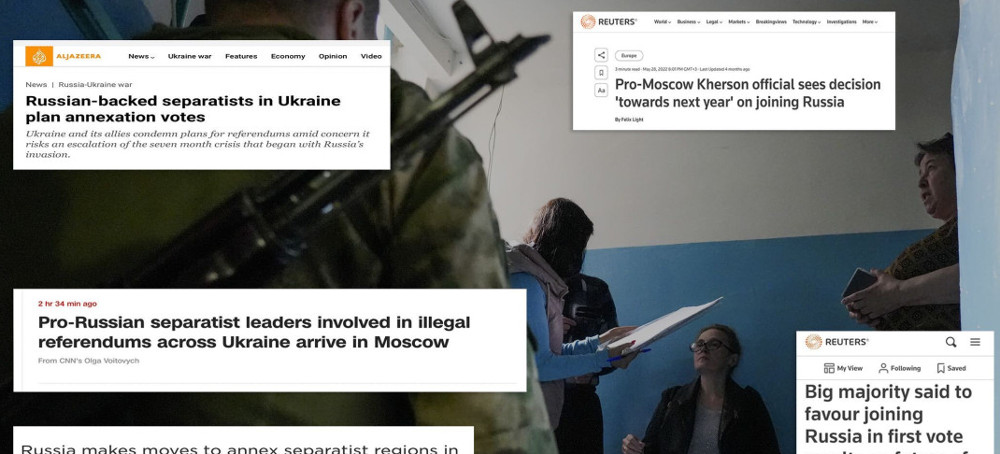 International headlines reporting on war in Ukraine. (photo: Kyiv Independent)
Unfortunately, some global media and other actors have chosen to act irresponsibly when talking about Russia’s war in Ukraine.
On Sept. 23-27, Russia held what it dubiously calls referendums in Kremlin-occupied parts of Ukraine.
If one listens to Russia, they will hear that Ukrainians living in these territories were given a fair choice: vote for their region to secede from Ukraine and become part of Russia, or against it.
Yet if one has common sense, a pair of eyes, and memory, they would know that:
- There were numerous reports from inside occupied territories about how the vote was conducted: Collaborators making house calls accompanied by armed Russian soldiers.
- Staged secession referendums are a staple in the Russian invasion textbook: Russia used them in 2014 in Crimea and eastern Ukraine.
- Russia is an authoritarian state that doesn’t give its people the right to freely choose their president or government. It would be foolish to assume that Russia would suddenly respect democratic processes and hold free and fair elections in occupied territories it took by force while refusing to grant its own citizens the same basic right.
- Even regardless of everything above, no vote organized in invaded territories by an occupying force known for extreme brutality can be considered a real vote.
This didn’t stop one of the world’s biggest news agencies, Reuters, from publishing a story headlined, “Big majority said to favor joining Russia in first vote results on future of occupied Ukraine regions.”
One would never know from this headline, or from a similar tweet that Reuters shared to its 25 million followers, that the so-called vote was a sham referendum, held at gunpoint in areas devastated by the invasion, where remaining locals are scared and powerless.
Following a backlash online, Reuters changed the headline to a somewhat better version: “Moscow's proxies in occupied Ukraine regions report big votes to join Russia.” While it doesn’t openly legitimize the referendum, it nonetheless cowardly omits pointing at its staged nature.
Reuters wasn’t the only media that made the mistake of reporting the “referendum” as the real thing. Radio France Internationale did a news story, from Moscow, that reported the results without mentioning the obvious fakeness of the referendum.
Unfortunately, these are not one-off mistakes, but rather, part of a pattern. Global media have been prone to use the language suggested to them by the Russian regime when talking about Ukraine.
The biggest, most irresponsible language mistake of this invasion was made on Feb. 24, when dozens of the most respected international media outlets reported the beginning of the full-scale invasion as the start of a “special military operation.”
“Putin announces special military operation in eastern Ukraine,” was the headline that ran on the Wall Street Journal as missiles began raining down all across Ukraine.
“Putin authorizes special military operation in Ukraine,” was the headline Reuters found appropriate.
The correct words, of course, were “war” and “invades.” Vladimir Putin, a dictator whose regime is built on lies, may choose to call it whatever he wants. But it’s our duty as media professionals to not take it at face value, not to amplify or legitimize it.
Proponents of blind journalistic objectivity may decry our attempt to set the record straight. But we believe that no rule should be applied mindlessly. A simplistic approach is to report Putin’s words as is – but are we really serving our audience’s best interests when we do so? Can anyone seriously claim that the words that come straight out of Putin’s mouth – the head of Russian aggression against Ukraine – are objective? We hardly think so.
In Ukraine, we are all too familiar with the world parroting Kremlin propaganda. We have been witnessing the world call Kremlin-led militants in eastern Ukraine “separatists” since 2014 knowing fully well there were no such “separatists” in Ukraine’s Donbas until Russia decided there should be.
“Russia makes moves to annex separatist regions in Ukraine,” said a recent headline on NPR. The “separatist regions” in it are Ukrainian territories invaded by Russia.
The truth, based on hard facts, is simple: There are no separatists or separatist regions in Ukraine. Ukraine has never had any real secession movements until Russia staged one in early 2014 to masquerade its invasion of Ukraine.
If you don’t believe us, we implore you to do your research. The eastern Ukrainian Luhansk and Donetsk oblasts, the regions making up the Donbas, voted over 80% “yes” in Ukraine’s 1991 referendum for the country’s independence from the Soviet Union. According to Ukraine’s first President Leonid Kravchuk, who told the story in the interviews, the vote prompted Russia’s Boris Yeltsin to ask: “What, even the Donbas voted yes?” Yes. Full stop.
Now Russia claims these regions have always been Russian and is trying to annex them. The Russian regime will use any lies on its malicious course to preserve its corrupt existence at the cost of disrupting the world – but we shouldn’t help it by accepting and using its deceitful language.
This is why we don’t refer to the territories occupied by Russian proxies as “breakaway republics” or by their self-proclaimed names of “Donetsk People’s Republic” or “Luhansk People’s Republic.” These are Ukrainian territories. Calling them otherwise legitimizes the pseudo-formations that are actually nothing but militant groups installed there by Russia.
This is also why we don’t call Russia’s invasion of Ukraine “the Ukraine crisis” or “the Ukraine conflict” – weak and vague terms that dilute the meaning of the events.
We abstain from using all these terms not because we aren’t objective, but because they are factually incorrect.
We refrain from using them not because we are Ukrainian journalists and have skin in the game – no, we do so because anything else would mean misinforming readers. In other words, failing at our jobs as journalists.
Since this war is fought on the information battlefield along with the real one, using the correct language that reflects reality is of utmost importance.
Reporting the results of sham referendums without pointing at their nature is tantamount to joining the fight – on Russia’s side.
__________________________________________
Here’s a cheat sheet for filtering out the Kremlin propaganda from one’s language:
There is no Ukraine conflict or Ukraine crisis, there is Russia’s war against Ukraine.
There is no Vladimir Putin’s war, there is Russia’s war against Ukraine.
There is no Russia’s special military operation, there is Russian aggression against Ukraine.
Russia’s war against Ukraine didn’t start in 2022, it started in 2014 when Russia invaded and occupied Ukraine’s Crimea and Donbas. In 2022, Russia launched a full-scale invasion of Ukraine or an all-out war against Ukraine.
There is no Donetsk People’s Republic (DNR) and no Luhansk People’s Republic (LNR), there are Russian-occupied territories in Ukraine’s Donetsk and Luhansk oblasts.
There are no Ukrainian separatists, there are Russian-installed proxies/militants in occupied Ukrainian territories.
There are no pro-Russian officials (governors, mayors, prosecutors) in occupied Ukrainian territories, there are Russian-installed proxies in occupied Ukrainian territories.
There are no separatist regions in Ukraine, there are Ukrainian territories invaded and occupied by Russia.
There are no referendums and votes on joining Russia, there are sham referendums and voting at gunpoint in Russian-occupied Ukrainian territories.
The mass protests following the announcement of mobilization in Russia were not anti-war protests, they were anti-mobilization protests in Russia.
 The U.S. State Department is demanding "an immediate and thorough investigation" into the killing of a seven-year-old Palestinian child. (photo: Rian Suleiman)
The boy's uncle says that he died of a heart attack when Israeli soldiers came to his West Bank home over alleged stone-throwing by his brother
“We are heartbroken by the death of an innocent child," Deputy Spokesperson Vedant Patel said.
The boy, Rian Suleiman, was frightened and "suffered a heart attack" when soldiers came to arrest his brothers in his family's home in the Palestinian town of Teqoa, near Bethlehem, according to the deceased boy's uncle.
A defense official told Haaretz that the soldiers arrived at the home to question the boy's parents about a stone-throwing incident that happened earlier. The Palestinian Health Ministry had initially published a contradictory claim, saying the boy fell to his death while being chased by the Israeli army.
The Palestinians added that Rian was taken to hospital in critical condition and pronounced dead soon after. The Israeli army is investigating the case. In a statement released later on Thursday, the army said "the claims about the minor's death are known. An initial investigation found no connection between his death and the activity of soldiers in the area."
Mohammed Suleiman, the boy's uncle, said Rian was at home with his parents and two brothers when soldiers loudly knocked on the door. He added that the army wanted to arrest the two brothers, ages 8 and 10, for allegedly throwing rocks at soldiers. "Rian's father opened the door and the soldiers entered. Then, there was a commotion and a lot of screaming. Out of fear, [Rian] collapsed and had a heart attack," Suleiman said, adding that the child did not have any prior medical conditions. "He was a completely healthy boy filled with happiness, and within minutes we lost him," he said.
An Israeli army source said that soldiers were chasing a group of kids who were throwing stones, when they lost sight of them. "Near one of the houses, the soldiers saw a father standing with his children and identified them as the kids who threw rocks, though it's unclear if they were the same kids. The army officer spoke to the father without the kids being present, and after he left the house the man began to yell, causing the officer to realize that the child is in danger. According to the officer, he did not know that the child was injured."
On Wednesday, four Palestinians were killed, including two militants wanted by the IDF, during clashes in the West Bank city of Jenin. According to Palestinians, 44 people were wounded during the exchange of gunfire.
The army said that soldiers were sent to the Jenin refugee camp to arrest Abed Fathi Hazem, the brother of Palestinian terrorist Raad Hazem who killed three people in Tel Aviv in April before being shot by security forces in Jaffa.
Several hours later, Fatah called for a "day of rage" across the West Bank. Palestinian President Mahmoud Abbas's spokesperson, Nabil Abu Rudeineh, said after the deadly raid that "the Israeli occupation still undervalues the lives of our Palestinian people, and is tampering with security and stability by continuing its policy of escalation."
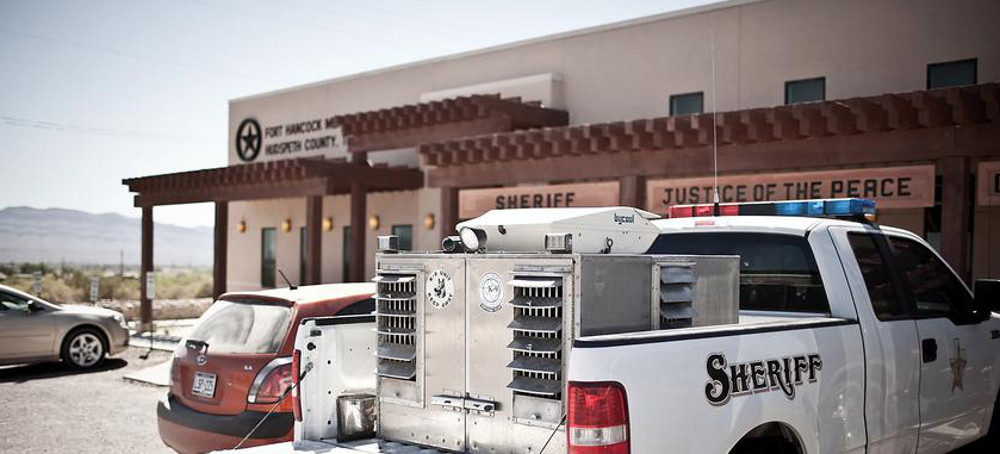 A K-9 unit sits outside the Hudspeth County Sheriff's Office in 2010. Two men are accused of manslaughter after two migrants were shot in Hudspeth County this week. (photo: Pierre Aguirre/The Texas Tribune)
“The preliminary investigation shows that a truck with two men inside pulled over and shot at a group of illegal immigrants standing alongside the road getting water,” said DPS Lt. Elizabeth Carter.
Carter said two men were arrested in Sierra Blanca on Thursday in connection with the shooting.
TPR confirmed the identity of the men, Mike and Mark Sheppard. The brothers were charged with manslaughter and booked in the El Paso County Jail without bond.
Mike Sheppard was a jail warden for the West Texas Detention Center in Sierra Blanca — a privately owned detention facility that used to contract with the federal government to detain migrants. A spokesman for Immigration and Customs Enforcement said that facility hasn't held detainees in federal custody since 2019.
Louisiana-based LaSalle Corrections confirmed to TPR that Mike Sheppard no longer worked with the company.
“The warden at West Texas Detention Center, Sierra Blanca, TX, has been terminated due to an off-duty incident unrelated to his employment,” said Scott Sutterfield, a spokesperson for LaSalle, in a statement.
Sheppard's termination was first reported by the San Antonio Express-News.
On Wednesday morning, there was another shooting in Hudspeth County that appeared to also target migrants.
26-year-old Erick Garibaldi of Fort Hancock was accused of shooting a man in the face. The victim taken to Del Sol Medical Center.
It was not clear if the two shootings were connected.
The Democratic Party of Texas said in a statement that it blamed the shootings on political rhetoric around immigration policy, which has been stalled in Congress for decades.
“This killing in West Texas is the direct result of Texas Republicans’ violent fearmongering of undocumented migrants: when you continuously use language like ‘invasion’ to describe what is happening at our border, the only logical conclusion is that you want migrants and asylum-seekers to be treated like ‘invaders,’" said Gilberto Hinojosa, chair of the Texas Democratic Party.
Hinojosa pointed out that the same rhetoric led to the Wal-Mart shooting in El Paso that killed 23 people. The shooter said he was "targeting Mexicans."
“We saw this in El Paso, when a racist monster drove hundreds of miles just to slaughter innocent shoppers at a Wal-Mart, ginned up by the bigoted language that Texas Republicans use to rally their base," Hinojosa added.
LULAC, the nation's largest Latino civil rights organization, named Texas Gov. Greg Abbott and Florida Gov. Ron DeSantis specifically.
"LULAC is outraged by this execution-style gunning down of innocent people, like hunting for human beings to kill. We lay the blood of these migrants directly at the feet of Governors Abbott and DeSantis, who have fed the worst type of hatemongering against migrants in our recent history," said Domingo García, LULAC National President.
DeSantis and Abbott did not respond to TPR's requests for comment.
On Friday, Abbott’s Democratic challenger Beto O’Rourke called the West Texas shooting a “predictable result” of Abbott’s language about immigration.
Abbott and O’Rourke were scheduled to take part in their one and only debate ahead of the November election Friday at 7 p.m. in Edinburg, a city in the Rio Grande Valley.
Abbott did not tweet about the shootings but did continue his immigration rhetoric on Thursday, He touted his controversial Operation Lone Star program, which uses Texas DPS and National Guard to arrest migrants on state trespassing charges.
Earlier this year, he also began bussing migrants from the Texas-Mexico border to New York, Washington D.C. and Chicago.
DeSantis recently conducted his own operation in Texas, using Florida’s taxpayer dollars to deceive migrants into boarding a chartered flight to Martha’s Vineyard in Massachusetts.
Immigration falls under the purview of the federal government, not the states.
U.S. Customs and Border Protection continues to encounter a rise in migration at the Southern border. In July, CBP reported 200,195 encounters.
There have been 748 migrant deaths reported this fiscal year since October 2021, mostly attributable to extreme heat and drownings.
READ MORE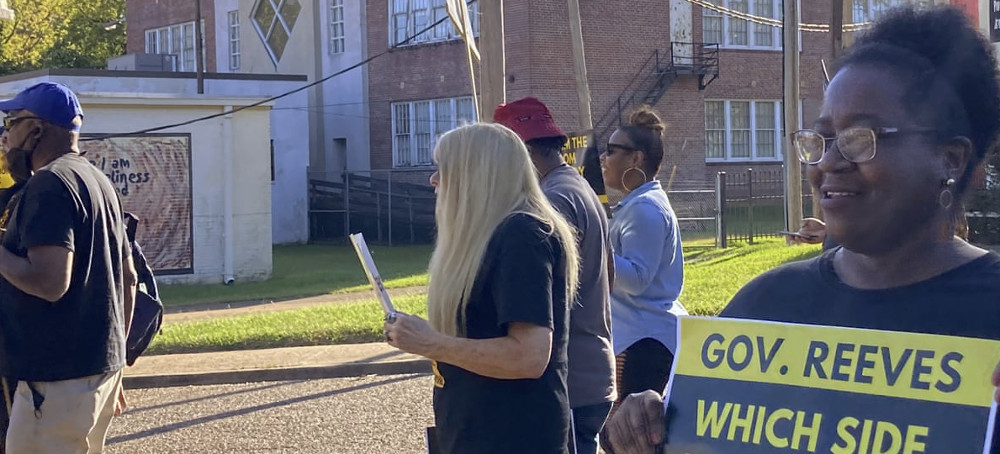 A protest in Jackson, Mississippi, over the water crisis on Monday. (photo: Michael Goldberg/AP)
State officials accused of violating civil rights, which resulted in ‘persistently unsafe and unreliable drinking water’ for residents
Their conduct amounted to racial discrimination and a devastating loss of access to drinking water for more than a month for residents in Jackson, where more than 80% of residents are Black and a quarter are in poverty.
“The result is persistently unsafe and unreliable drinking water and massive gaps in the access to safe drinking water that are intolerable in any modern society,” Jackson residents allege in the complaint. “Nearly all of the residents of Jackson have watched brackish, dirty, impure, and undrinkable water trickle from their taps. At times, some have had no water at all.”
The complaint, filed to the Environmental Protection Agency, amplifies pressure on officials in Mississippi and Jackson to address longstanding water infrastructure woes that recently forced Jackson to shut down its water supply in late August and maintain a boil water notice for weeks.
Last week, a group of Jackson residents also filed a federal class-action lawsuit against current and former city and state officials as well as an engineering firm seeking monetary damages for neglect by officials.
The NAACP’s complaint to the EPA, which has 25 days to decide whether to investigate it, notes that Jackson’s leaders have “repeatedly requested” aid from officials in the Republican-controlled state to “provide funding solutions”. Instead, “Jackson’s majority-Black population has been repeatedly ignored, spurned, or ridiculed,” the complaint states.
In the last 25 years, the city has received federal funds toward addressing safe drinking water just three times. At the same time, since 2016, the city has imposed more than 750 notices for residents to boil their water, roughly 40% of which came in the last two years.
Derrick Johnson, president of the NAACP and a Jackson resident, blamed “racist funding policies” by Governor Tate Reeves, a Republican, and state officials that prevented critical and preventive infrastructure from being built. Johnson described in the complaint how he and his family often used boiled and bottled water even when the city wasn’t under an advisory notice because he “cannot entrust his family’s health to the crumbling water system”.
The city, where more than 80% of residents are Black and a quarter are in poverty, depends on federal funding in part because it has suffered from a shrinking tax base since white residents fled the area in the decade following the integration of public schools. Since Mississippi is one of 49 states where the EPA allows the state to decide how water systems are funded, it leaves the authority over whether those funds are equally distributed up to the state. The EPA’s inspector general announced in mid-September that it would investigate Jackson’s “drinking water emergency”, Politico reported.
The complaint notes that state officials have exacerbated the funding gap by repeatedly denying Jackson the ability to fund improvements to its drinking water system. In March 2021, when, after a previous water shutdown, Jackson’s mayor, Chokwe Lumumba, requested $47m in emergency aid, and the state legislature approved just $3m .
“The people of Jackson, Mississippi, have lacked access to safe and reliable water for decades,” the EPA administrator, Michael Regen, who visited the city on Monday and met with the city’s mayor, said in a statement. “These conditions are unacceptable in the United States of America.”
In the past decade, such conditions have become part of the disparate plight of communities of color in other cities like Flint, Michigan, and Newark, New Jersey, where lead-ridden water has plagued ailing water infrastructure systems. Abre’ Conner, director of environmental and climate justice for the NAACP, said that the mishandling of Jackson’s water crisis is part of a “longstanding history of mistreating, and neglecting Black communities, putting the lives of men, women, and children at risk.
“As our infrastructure continues to age and the effects of climate change worsen, we will continue to experience crises such as the one in Jackson, not only in Mississippi but in predominantly Black communities throughout the country,” she said in a statement.
READ MORE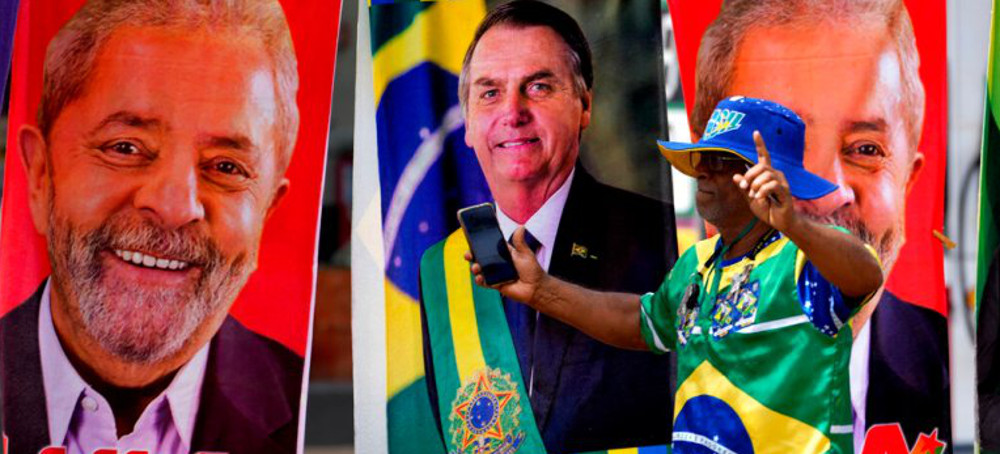 U.S. senators and European lawmakers say fair election results must be respected in Brazil before first-round vote on October 2. (photo: Eraldo Peres/AP)
President Jair Bolsonaro’s unfounded claims of electoral fraud raise concerns he may reject October 2 vote results.
Right-wing incumbent Jair Bolsonaro has suggested that he may reject the results if he loses, as most opinion polls have shown him trailing his left-wing rival, former President Luiz Inacio Lula da Silva.
The US Senate late on Wednesday passed a resolution backing a free election in Brazil and denouncing “efforts to incite political violence and undermine the electoral process”.
The symbolic measure, adopted unanimously, calls on the United States government to “immediately” recognise the outcome of the October 2 vote if it is determined to be fair by international observers.
It also urges the Biden administration to “review and reconsider the relationship between the United States [and] any government that comes to power in Brazil through undemocratic means, including a military coup”.
The vote on Sunday pits Bolsonaro against Lula, who an opinion poll this week showed held a commanding, 13-percentage-point lead.
Several other candidates are also seeking the presidency. If none wins a majority of the votes, a second round of voting is scheduled for October 30. The candidates are a set for a final debate later on Thursday.
Reporting from Rio de Janeiro on Thursday, Al Jazeera’s Manuel Rapalo said the election has sharply polarised the country, with Bolsonaro’s supporters painting his rival as a communist and Lula’s backers viewing the president as a right-wing radical.
“One thing that voters here do have in common is that many … see this election as a critical battle over the future of Brazilian democracy,” Rapalo said.
For months, Bolsonaro has been making unfounded allegations that Brazil’s electronic voting system is vulnerable to widespread fraud – charges that rights groups fear may be setting the stage for him to dispute the results to stay in power.
Other experts also have raised concerns that Bolsonaro’s supporters could take to the streets in large numbers should he fail to be re-elected, and that political violence could break out.
On Wednesday, US lawmaker Bernie Sanders, a lead sponsor of the Senate resolution, said the measure aimed to send a message that Congress supports democracy in Brazil.
“It would be unacceptable for the United States to recognize a government that came to power undemocratically, and it would send a horrific message to the entire world,” Sanders said in a statement.
“It is important for the people of Brazil to know we’re on their side, on the side of democracy.”
This week, dozens of European lawmakers also urged the EU to “take additional steps to make it unequivocally clear to President Bolsonaro and his government that Brazil’s constitution must be respected and attempts to subvert the rules of democracy are unacceptable”.
In a letter to European Commission President Ursula von der Leyen and the bloc’s foreign policy chief Josep Borrell, the parliamentarians said it was “crucial” to dissuade Brazil’s military leadership from supporting “a coup”.
Brazil was under authoritarian military rule from 1964 to 1985, and Bolsonaro – a former army captain – has expressed admiration for the former regime, which has been described as a “brutal dictatorship” by rights groups.
“The EU should state that it will use different levers, including trade, to defend Brazil’s democracy and human rights,” the European lawmakers said.
With nearly 215 million people, Brazil is the second-most populous country in the Western Hemisphere after the US.
It is home to huge parts of the Amazon rainforest, frequently called “the lungs of the planet”, which has been under increased threats of deforestation.
Climate advocates have criticised Bolsonaro’s government for weakening environmental regulations and supporting mining in the Amazon.
Lula has promised to protect the rainforest and crack down on illegal mining and logging if elected.
Last week, United Nations experts denounced threats, intimidation and political violence in the lead-up to the elections in Brazil. “We call on the authorities to protect and duly respect the work of the electoral institutions,” they said.
In August, Human Rights Watch pointed the finger at Bolsonaro for “using a mixture of insults and threats to intimidate independent media and the Supreme Court”.
Amnesty International earlier this month also accused Bolsonaro of using “anti-human rights discourse” in advance of the elections.
READ MORE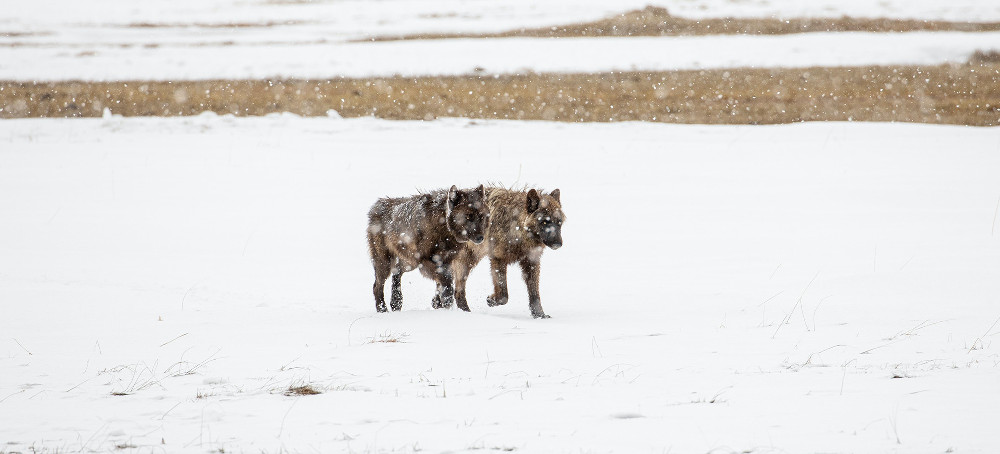 Wolves on Fountain Flats at Yellowstone National Park, in 2020. (photo: Jim Peaco/NPS)
As head of the U.S. Fish and Wildlife Service, Williams is reviewing whether the hunting rules she helped foster adequately protect wolves.
The circumstances would be delicate for any director. While the presence of wolves has been a battle in the West’s culture war for generations, the fight has taken on an intensity unlike anything the region has seen since the animals were first reintroduced there in the 1990s. For Williams, the assessment has added significance requiring her to delve into her own past as the head of Montana’s game agency.
Williams’s review is probing the conduct, regulations, and science of a department she once led and shaped, in a state she still calls home. As a top attorney and later as a director, Williams’s career is defined by her years in Montana’s Fish, Wildlife and Parks, better known as FWP. Across a decade and half of service, Williams earned respect on both sides of the wolf wars and helped craft a legal framework for protecting the state’s most political animal. Now a top federal official, Williams’s supporters are pulling her in divergent directions, while critics are questioning her credentials and calling on her to step down entirely.
Last year’s changes in wolf hunting and trapping regulations were felt particularly hard in Yellowstone National Park, which weathered its deadliest season in living memory. With a new Montana wolf hunting season underway and park researchers studying the unprecedented levels of human-caused mortality, the deadline for the federal government’s review has now passed, and environmental groups have filed suit demanding that Williams take action.
Two policy decisions from Williams’s Montana years are central to the assessments she is making in her Endangered Species Act review. The first has to do with how wolf populations in the region are estimated. The second is the unique category that wolves occupy under Montana law: Originally designed as a protection during Williams’s years as an FWP attorney, the special category paradoxically made wolves more vulnerable to controversial hunting techniques following her tenure as FWP director.
“What Montana has done is they basically turned that regulatory mechanism on its head, and they are now using it effectively as a threat to wolves, not as a protection,” Dan MacNulty, associate professor of wildland resources at Utah State University, told me. “That’s very concerning, and I think it should concern the Fish and Wildlife Service in terms of whether or not Montana is living up to the commitment it made with respect to that delisting rule.”
Fish and Wildlife Service announced the review of a petition to relist wolves in the Northern Rockies in September 2021, eight months after Williams had become the agency’s acting leader. The review followed dramatic regional changes in state hunting and trapping regulations. Under pressure from environmental organizations to appoint a confirmed leader at FWS, President Joe Biden nominated Williams the following month. The nomination was celebrated by both environmental groups and an array of hunting interests. Sen. Jon Tester, a Montana Democrat, and Sen. Steve Daines, a Montana Republican, both urged their colleagues to vote for confirmation.
Dave Parsons, a retired wildlife biologist who led the FWS reintroduction of wolves in the Southwest in the 1990s, was one of the few voices of public dissent. For nearly a year, Parsons, along with Bob Aland, a retired attorney and environmental activist, have been waging a two-man campaign to remove Williams from the position. The reason, they argue, is that she is unqualified under the law. Federal statute requires that the director of FWS have “scientific education and experience” and be knowledgeable in “the principles of fisheries and wildlife management.”
While Williams’s experience is undeniable, her educational background is in philosophy and law, not science. “My primary concern on the surface is not her as an individual,” Parsons told me. “My interest is saving the agency from this now dark path, where the precedent has been set that you can put in a person without biological credentials in violation of the law.”
The issue has come up before. In 2018, Greg Sheehan stepped down as principal deputy director of FWS under President Donald Trump after then-Interior Secretary Ryan Zinke sought to have him take full leadership of the agency. Zinke’s effort failed due to Sheehan’s lack of a science degree. How Williams navigated the requirement is unclear. (FWS declined to make the director available for an interview or to comment on the appointment.)
In December, Parsons wrote an op-ed describing how every FWS director going back to the Nixon administration had met the scientific education requirement. “I’m trying to save my old agency, for crying out loud,” he said. “Try to imagine Trump Act II and that law just thrown under the rug.”
In the weeks leading up to Williams’s confirmation hearing, he and Aland informed aides on Capitol Hill that Williams lacked a scientific background. They contacted the White House, the Department of the Interior, and FWS.
When Williams appeared before lawmakers in November, the issue never came up. She was confirmed in a bipartisan 16-to-4 vote in February.
Williams’s confirmation was the culmination of a long career enmeshed in the legal wrangling surrounding wolves and the Endangered Species Act.
Wolves were reintroduced to Yellowstone National Park and central Idaho under the law in 1995, after a government extermination campaign led to their near-total extirpation decades before. Williams joined Montana’s game agency three years later and, over the next decade and a half, represented the state in its delisting efforts.
Under the terms laid out by FWS, wolves in the Northern Rockies — Montana, Idaho, and Wyoming — would be considered recovered once there were 30 breeding pairs raising at least two pups each for three consecutive years. In 2002, the agency announced that the criteria had been met. Before the transfer of management authority could happen, however, the states needed to prove that they had a regulatory framework in place to support continued wolf recovery.
In Montana, the solution Williams and her colleagues came up with was to categorize wolves as a “species in need of management.” The special designation had surfaced a year before, in a bill passed by the Montana Senate, which aimed to carve out a space for wolves once they were removed from the state’s endangered species list.
Categories are key to wildlife governance. Generally, “game” animals, like elk or deer, can be hunted but not trapped, while “furbearers,” like otters or bobcats, can be trapped but not hunted. In many states, “predators,” like coyotes, can be killed anytime, anywhere without a license or a defined season. In a 2003 environmental impact statement that Williams consulted on, Montana made the case that wolves would stand apart as a “species in need of management,” receiving “full protection” as a non-game animal. Once wolves were recovered, the state’s game commissioners would decide which of Montana’s more conventional categories fit the animals best.
In 2009, the Obama administration announced the delisting of wolves in Montana and Idaho, but not Wyoming, which continually failed to come up with a plan that didn’t involve treating the animals as predators that could be shot on sight. “Montana did an outstanding job of describing, in detail, its regulatory framework and its commitment to wolf management,” FWS noted in its rule.
The delisting was immediately challenged and in 2010 struck down by a federal judge.
Williams was recruited to her first Interior Department stint the following year. She had once again joined a government agency facing a historic moment for wolves. That same year, Tester, the Democratic senator from Montana, attached a rider to a federal budget bill that reversed the court’s decision to reject delisting and prohibited any other judge from undoing the reversal. The move was unprecedented and political: Tester was up for reelection in one of the most important races of 2012, facing an opponent who claimed that he was out of touch with rural voters on the wolf issue.
Tester won the race, and wolves have been off the Endangered Species List in Montana ever since. Williams returned to her home state as a law professor at the University of Montana soon after. In 2017, she was nominated by then-Montana Gov. Steve Bullock to serve as director of Montana’s FWP, the first woman in the position.
Williams created a review committee in 2018 to study whether the array of hunting and trapping regulations that FWP produced each year were in line with state law. She also presided over the implementation of a new model for estimating wolf populations in the state. Both efforts would play key roles in the wolf review she is now overseeing as director of the nation’s most important wildlife agency.
Aimee Hawkaluk was a staff attorney at FWP from 2012 until January of this year. She served on the committee that Williams convened to review regulations. Speaking in a personal capacity and not as a representative of her former or current employer, Hawkaluk said the committee ultimately determined that years of wolf hunting and trapping regulations in Montana misrepresented the law, and that the problem related to the “species in need of management” categorization developed in the early 2000s.
The original idea was that wolves would have a higher degree of protection until they were recovered, at which point they would be reclassified as a furbearer or game animal. “That’s never happened,” Hawkaluk told me, “so they’re just kind of stuck in limbo as a species in need of management.”
The upshot was significant. Following the 2009 delisting, FWP issued regulations each year explaining to hunters and trappers what they could and could not do in pursuit of wolves. Among the prohibitions were the use of aircraft and radio telemetry equipment — the kind of gear biologists use to find and monitor wildlife. Those prohibitions, however, were effectively copied from the state’s game animal regulations. As a non-game species in need of management, wolves did not have those protections, Williams’s committee determined. In the department’s view, the warnings amounted to an ongoing, decadelong mistake.
The review committee conducted its work over two years, reaching some of the critical conclusions on the technology that could be used to hunt wolves after Williams packed up for her return to Washington in 2021. The timing was critical. Despite the many opportunities already offered under the law, Republican lawmakers and a subset of hunters and trappers had long argued that Montana’s regulations did not go far enough. They agitated for wolves to be treated as predators that could be killed with little restriction.
“I had a bill that was going to place wolves on the predator list — make them a predator, just treat them as predator,” Bob Brown, a Montana state senator, said at an FWP Committee hearing last year. But after speaking with the governor’s office, FWP, and others, he concluded it was not the right approach “because it could lead to relisting.” Instead, the senator introduced legislation to slash Montana’s wolf population by giving hunters and trappers the authority to kill an unlimited number of wolves using bait, snares, and, on private land, authority to hunt at night with bright lights and night-vision goggles.
It was the kind of extreme proposal that normally died on the governor’s desk in Montana, but things had changed the previous fall. Voters elected Greg Gianforte as Montana’s first Republican governor in a decade and half. Gianforte stacked the most important posts in Montana’s wildlife decision-making apparatus — from Williams’s old job atop FWP to the commissioners who create policy for the department — with campaign contributors, a former running mate, and representatives of aggressively pro-wolf hunting interests. He then went on to sign Brown’s bill and a half dozen other measures targeting the state’s most iconic predator.
In response, nearly three dozen veteran Montana wildlife managers, many of them Williams’s former FWP colleagues, published an essay decrying Montana’s “anti-predator hysteria” and the “partisan political intervention that overturned decades of sound wildlife policy.”
Despite the pushback, Gianforte’s commissioners approved the most aggressive regulations in recent Montana history for last winter’s wolf hunt. At the same time, the results of Williams’s review committee came to fruition in the form of the state’s 2021 wolf regulations.
Advocacy organizations soon noticed the prohibition on aerial hunting had disappeared and called on a Montana judge to issue an injunction to stop the practice. At a court hearing in February, Hawkaluk described how Williams’s review committee concluded that wolves were not in fact protected from aerial hunting under state law. (The practice remained illegal under a federal statute, though FWP’s regulations omitted that fact.)
The original idea of a “species in need of management” had been twisted beyond recognition. Instead of bestowing protections, the designation made the animals vulnerable to a tactic used for the culling of feral hogs. “It doesn’t seem to fit what that law was created to do,” Hawkaluk told me, reiterating that she was speaking for herself.
For Hawkaluk, the trajectory of wolves within Montana’s bureaucracy reflects the contentious politics that surrounds the animals. “I think it’s just so convoluted now that it would take an overhaul to crack that, and I think a lot of folks of whatever view on wolves are probably a bit concerned about opening the can of worms,” she said. “And so here we stand.”
Aerial hunting wasn’t the only tactic to disappear from Montana’s regulations last year. Without public notice, the prohibition against using radio telemetry equipment was also gone. There is at least some evidence that hunters may have attempted to take advantage of the new opportunity.
Early one morning last February, a group of ecotourism guides gathered with their clients north of Yellowstone National Park’s boundary line. They were hoping to spot a mountain lion when a flash of unusual human activity caught their attention instead.
A man had pulled up in a pickup truck. He parked, stepped out of the vehicle, and raised above his head what looked like a radio antenna. He had neither the uniform nor the vehicle of a government official. As the truck pulled away, a third guide recognized the driver as one of the area’s most well-known proponents of aggressive wolf hunting north of Yellowstone.
The guides were concerned. By that point, hunters and trappers had killed an unprecedented 19 of the park’s wolves, many in and around the area where they now stood. The guides sent witness statements to an FWP game warden. When I visited Yellowstone in late May, word of the incident had spread among the park’s research and touring community. I interviewed the guides and reviewed their statements to FWP, then asked the department about the claims and whether hunting wolves with telemetry equipment was now legal.
“FWP game wardens looked into the report and found no functional telemetry equipment or evidence of violation,” Morgan E. Jacobsen, a spokesperson for FWP’s southwest region, said in an email in July. As for using telemetry in wolf hunts, Jacobsen added: “This would not be lawful while in the act of hunting under Montana’s statute on two-way communication.”
The following week, The Intercept published an investigation revealing that the final Yellowstone wolf to die in last winter’s hunt was a radio-collared animal, killed by a veteran backcountry park ranger in the same gulch where the guides had seen the hunter with the antenna. The ranger told me that, following his kill, he became the subject of a National Park Service investigation in which he and other Yellowstone law enforcement officials were accused — falsely, he said — of sharing location information on collared wolves with hunters outside the park. NPS declined to comment on the claims, citing an ongoing investigation. FWP, meanwhile, said its Helena-based special investigations unit was conducting a separate investigation into the wolf’s killing.
The day before the story broke, Brian Wakeling, FWP’s game management bureau chief, wrote to the guide who had recognized the hunter and explained that hunting wolves with telemetry gear was legal in Montana — contradicting the statement his colleague gave to The Intercept just six days earlier. “The department cannot enforce laws that are not applicable and did not wish to imply that the regulation applied to wolves,” Wakeling wrote.
Ecotourism guides weren’t the only ones concerned about the issue. On July 20, the day The Intercept’s wolf investigation went live, Cam Sholly, the superintendent of Yellowstone National Park, sent a letter to Montana’s game commissioners arguing that using telemetry to hunt wolves violated the fair chase principle, which holds that human hunters do not take unfair advantage of nonhuman prey, and requested that “this prohibition be re-inserted into your regulations.”
Montana’s wolf season was over by that point. In the portion of the state that abuts Yellowstone Park — where longstanding quotas on wolf kills were eliminated entirely — the death toll of 19 wolves marked a 342 percent increase from the previous decade’s annual average of four.
At a Montana House hearing last spring, Republican state Rep. Paul Fielder voiced support for Brown’s legislation to slash the state’s wolf population, pointing to a “new and improved model” for estimating those numbers, which he claimed showed an increase of approximately 300 animals.
Montana had “about” 1,164 wolves — a problem, Fielder argued, since the state’s wolf management plan referred to just 15 breeding pairs and 150 individual animals. “Basically, we have four times as many wolves in Montana as the wolf management plan calls for,” he said. “So what this bill does is it gives us some more tools to manage wolves, and we’re not talking about necessarily ethical management of them. We want to reduce wolf numbers.”
Fielder failed to note that the figures cited in the state’s management plan reflect a minimum threshold for the state’s wolf population. An official liaison between the Montana Trappers Association and FWP, the state lawmaker was in the middle of passing his own legislation expanding the “tools” — like indiscriminate neck snares — that could be employed in Montana’s not “necessarily ethical” campaign to kill hundreds of wolves.
How many wolves roam the Northern Rockies and whether state policies promote recovery are the central questions Williams’s endangered species review must consider. Few people have had as close a relationship to those questions as David Ausband.
As part of the U.S. Geological Survey’s Cooperative Fish and Wildlife Research Units Program, which partners graduate students and state fish and wildlife agencies for research and technical assistance purposes, Ausband is both a federal employee and a faculty member at the University of Idaho. Prior to taking the job in 2018, he was a senior wildlife research biologist for the Idaho Department of Fish and Game. Before that, he worked in Montana in a USGS unit focused on wolf recovery post-delisting.
In the early days, Ausband explained, monitoring wolves in the Northern Rockies was straightforward. There were fewer packs and the ones that were on the landscape usually had collared members, which made them easier to find. As time went on, things got complicated. Wolves learned to avoid the traps researchers used and, with the legalized hunting, the breakup of packs became increasingly common. “It just got harder to keep collars out,” Ausband said.
With delisting, Montana and Idaho entered a five-year period of federal supervision to ensure the states were complying with the Endangered Species Act. Ausband was among a group of officials from Idaho, Montana, and Yellowstone National Park who gathered each year to sort out which packs belonged to which jurisdictions. Though the work was tedious, it was also critical. In annual reports required under the act, the experts highlighted the existence of “border packs” — as opposed to “resident packs” — whose potential for double-counting could throw off the accuracy of population estimates. There was a lot of wrangling to figure out whose packs were whose, Ausband said, but “they were explicitly accounted for.”
During the transition to state wolf management, Montana and Idaho relied on millions of dollars from the U.S. FWS for the resource-intensive work of monitoring radio collars in the field. As the supervisory period wore on, however, the money ran dry. “It was like a slow decay,” Ausband said. He added, “The states were trying to come up with new, cheaper ways to keep monitoring their population but that wouldn’t break the bank.”
The supervised delisting period and the resources that came with it ended in 2016. Williams returned to FWP as director the following year. With end of federal supervision, the efforts to sort out border packs ended too. “Each state estimates their own population and there’s really none of those debates about border packs anymore,” Ausband said. The question is not whether wolves migrating across state and international borders are being double-counted by the states, it’s to what degree and whether the double-counting has meaningfully impacted the statistics being trotted out by lawmakers to justify extraordinarily aggressive wolf hunts.
“It’s a great question, and I honestly can’t answer it,” Ausband said. “It’s a source of bias. How big it is, I don’t know.”
In 2020, during Williams’s final year as FWP’s director, Montana began using a new system to estimate its wolf population: the “integrated patch occupancy model” — iPOM, for short. Used only in Montana and only for wolves, iPOM was the state’s answer to the problem of diminished resources, supplementing reduced radio-collar tracking with an increased reliance on hunters reporting wolf sightings in the wild.
“The problem is that they don’t know if the hunters are sighting resident packs or nonresident packs,” said MacNulty, the Utah State University researcher. For the past year, MacNulty has delved deep into the modeling system that served as the basis for politicians’ calls to make deep cuts to the wolf population. If you don’t know how many wolves there are on the land, he asked, “then how are you going to evaluate the threats to that population?”
MacNulty is not the only one concerned. In his letter over the summer, Sholly, the Yellowstone superintendent, described a “lack of scientific data and low confidence” in Montana’s wolf-counting methodologies. Scott Creel, a large carnivore population ecologist with Montana State University, has also found problems in the state’s model, describing “considerable doubt about the accuracy of population estimates from the iPOM” in a critique published last year.
In March, Daines, the Republican senator and proud backer of last winter’s wolf hunt, urged Williams to take bold action on the Endangered Species Act — not to relist wolves but to delist grizzly bears. In August, the Center for Biological Diversity filed a lawsuit against the director for failing to meet the deadline in the wolf status review. Both Daines and the center supported Williams’s nomination, and both have vastly divergent expectations of the director now that she’s in power. Together their demands reflect the contentious state of predator politics in the Northern Rockies. At the center of that fight is the highly anticipated conclusion of Williams’s review.
For years, MacNulty believed that the region’s wolf population was secure. Right-wing politicians could push for predator-style management, but they were likely to fail. That’s no longer the case. Montana and Idaho now under legal obligation to reduce their wolf populations, and lawmakers have made clear their intent to cut those numbers to the bone.
“We can’t take wolf recovery for granted,” MacNulty said. “Because the people who want to see a reduction in the wolf numbers are very serious about it, and they’re using these flawed outputs to support their positions.”
Time will tell if Williams, another veteran of the West’s wolf wars, agrees.
Follow us on facebook and twitter!
PO Box 2043 / Citrus Heights, CA 95611


Comments
Post a Comment