"Trump and Musk’s DOGE 'saved' $15 million by cutting a program dedicated to preventing the spread of screwworm," said Rep. Pramila Jayapal. "Now, there’s an outbreak infecting our beef and the administration is spending $1 billion." |
|
When Elon Musk’s “Department of Government Efficiency” took its chainsaw to the federal bureaucracy last year, it created bottlenecks that may have hampered the fight against the screwworm infestation currently menacing the southwest while making it much more expensive.
The annual US Department of Agriculture (USDA) spending to combat the flesh-eating insects only amounted to about $15 million per year. But along with about $382 million aimed at combating animal-borne illnesses around the globe, it was terminated in March 2025 as part of DOGE’s effort to root out what it described as government “waste.”
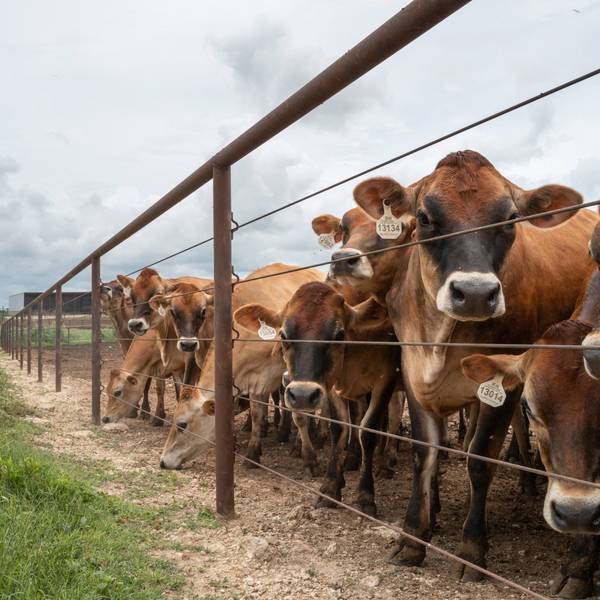
But now, with the pests bearing down on Texas and New Mexico, and at least 12 infections already identified in the US as of Tuesday, the Trump administration is spending at least $1 billion to fight the outbreak.
Last week, during a Senate hearing, Secretary of Agriculture Brooke Rollins attempted to shift blame for the screwworm outbreak onto the Biden administration, while portraying herself and President Donald Trump as proactive in response to reports last spring that the insects were rapidly climbing through Central America.
Rollins said she asked Trump for “$1 billion to build a significant facility” in Texas that would breed hundreds of millions of sterilized male screwworm flies, a method that had been used to keep them contained in South America for decades. “Without hesitation, a couple questions, he said, ‘go.’”
That facility is expected to release around 300 million sterile flies per week. But it is not expected to be fully operational until the end of 2027.
In addition to the $15 million cut to monitoring the spread of the bugs from Panama, the Houston Chronicle reported that DOGE paused plans for a facility in Mexico that the Biden administration had authorized in 2024 as part of a $165 million emergency package to fight screwworm.
Amid mass layoffs at the USDA, it reported that funding for the facility—which was supposed to produce between 60-100 million sterile flies per week—was not announced until May 2025.
While the USDA’s Animal and Plant Health Inspection Service (APHIS) still says fly production at the facility is expected to begin “as early as summer 2026,” it is still listed as “under construction.”
Kevin Shea, who served as administrator of APHIS under the Obama administration and retired from the agency in January 2025, told the Chronicle that efforts to contain the screwworm were put on hold at the start of Trump’s second term.
“This administration came in so skeptical of the career people, they didn’t really want to listen,” he said. “The hold up in the money going to Mexico for the sterile fly facility was most likely caught up in the whole DOGE thing. It probably looked like some sort of foreign aid.”
Journalist Christopher Collins wrote in the Texas Observer on Tuesday that, additionally, “deep staffing cuts” to APHIS, which lost nearly 1,900 employees during Trump’s first year back in office, eliminated “the first line of defense against incoming parasites,” who are responsible for “inspecting the cattle awaiting import from Mexico to ensure no screwworms are hitching a ride.”
As the spread of screwworm across cattle country threatens to further drive up beef prices that have already increased by over 20% since Trump returned to office, critics of the administration are seizing on it to highlight the failure of the president’s so-called “efficiency” initiative, which—despite the grandeur of Musk’s cost-cutting claims—ended up costing taxpayers an estimated $165 billion, according to an April 2026 report from the nonpartisan Partnership for Public Service.
Rep. Pramila Jayapal (D-Wash.) called the screwworm saga a prime example of DOGE’s “peak incompetence.”
“Trump and Musk’s DOGE ‘saved’ $15 million by cutting a program dedicated to preventing the spread of screwworm,” she said. “Now, there’s an outbreak infecting our beef and the administration is spending $1 billion.”
Reacting to the news that the government was spending at least $1 billion to confront the screwworm crisis, Drop Site News co-founder Ryan Grim wrote on social media, “Not joking but Elon Musk should have to pay for this right?”
“You broke it,” he said, tagging the man who recently became the world’s first trillionaire. “Why do we all have to pay for it?”
WARREN BUFFETT CALLED CRYPTO RAT POISON SQUARED!
"For the first time in history, a president is leaning on a bank regulator to give his private enterprise the implicit backing of the federal government," said one critic. |
|
Critics expressed alarm on Tuesday amid a new report suggesting that President Donald Trump’s cryptocurrency firm is about to get federal banking privileges.
As reported by NOTUS, the Office of the Comptroller of the Currency (OCC) in the coming weeks is expected to approve a national trust bank charter for World Liberty Financial, the crypto startup founded by members of the Trump family and the family of Trump Middle East envoy Steve Witkoff.
Were it to receive the charter, NOTUS explained, World Liberty Financial would receive “significant legal and financial benefits,” including being able “to settle financial transactions akin to Venmo or PayPal on the World Liberty Financial platform, through which the Trump family could receive a cut.”
David Wachsman, a spokesperson for World Liberty Financial, dismissed concerns about conflicts of interest, telling NOTUS that “none of [the company’s] leadership or employees work for the US government,” even though the president and his entire family stand to personally benefit from the charter’s approval.
Corey Frayer, director of investor protection for Consumer Federation of America, told NOTUS that here was simply no precedent for a sitting president being granted such privileges for a company he founded by a comptroller whom he personally appointed.
“For the first time in history, a president is leaning on a bank regulator to give his private enterprise the implicit backing of the federal government,” Frayer explained. “It’s outrageous.”
Diana Henriques, a veteran financial journalist best known for her extensive coverage of the Ponzi scheme run by disgraced financier Bernie Madoff, also expressed horror at the prospect of the OCC carrying out the president’s bidding.
“The guardrails continue to fall,” Henriques wrote. “It is functionally impossible to regulate a bank owned by the president. Yet it can imperil the entire banking system if it runs off the rails. For heaven’s sake, this has to be stopped.”
Derek Martin, vice president at Focal Point Strategy Group, wrote that there is “no other way to interpret” the NOTUS report “than Trump using the government to advance his own firm’s interests.”
“World Liberty Financial’s entire brand—and reason for existence, basically—is ‘We are affiliated with Trump,’” Martin added. “This is just the latest way they’re leveraging it.”
Government watchdogs for months have been raising alarms about the president having his own cryptocurrency firm, which has received massive investments from foreign governments since its founding in 2024.
According to NOTUS reporter Jeff Stein, Trump has reported personally earning $57 million from World Liberty Financial so far, a number that could get significantly higher if the firm is granted its charter.
An analysis published by Forbes last month estimated that Trump has nearly tripled his wealth since returning to office, going from a net worth of $2.3 billion in 2024 to $6.5 billion in 2026.
"This broken political and economic system takes from the vast majority of Americans and consolidates wealth in the hands of a privileged few. It cannot stand." |
|
The collective wealth of US billionaires reached a record $9.24 trillion this month—an increase of around $2.2 trillion compared to the same time last year—while millions of Americans struggled to afford groceries, healthcare, and other basic necessities as inflation driven by President Donald Trump’s illegal Iran war eroded their wages.
Americans for Tax Fairness (ATF) published an analysis Tuesday detailing the explosion of billionaire wealth and noting that “over the last 12 months, US GDP (unadjusted for inflation) rose just 6%, meaning this wealth expansion is not trickling down to broad-based prosperity.” AFT’s billionaire wealth total includes the net worth of Elon Musk, who reached trillionaire status last week with the public debut of his rocket company, SpaceX.
According to AFT’s analysis of Forbes data, Musk’s wealth has grown by nearly 205%—roughly $863 billion—over the past year. Larry Page, the co-founder of Google, is the second-wealthiest billionaire in the US, with a net worth of roughly $301 billion—up 118% compared to last year.
In addition to the growing chasm between the richest Americans and everyone else, AFT observed that wealth is increasingly concentrated at the very top even among the wealthiest, whose fortunes are largely tied up in stock appreciation that is not taxed unless shares are sold.
“America’s 15 centi-billionaires and now one trillionaire alone make up 43% of all billionaire wealth—an astounding $4 trillion—and their wealth is growing over twice as fast as fellow billionaires in the past year,” the group noted. “Just these top 16 billionaires hold more wealth today than every US billionaire combined in September of 2020, less than six years ago.”
AFT attributed skyrocketing billionaire wealth in part to tax cuts that Trump and congressional Republicans showered on the ultra-wealthy in 2017 and again in 2025.
“Nearly halfway into Trump’s second administration’s second year in office, with GOP majorities in the House and Senate, the ultra-wealthy and billionaires have been rewarded with massive tax giveaways and policies funded with cuts to affordability programs that has resulted in millions losing access to healthcare and food,” David Kass, ATF’s executive director, said in a statement.
“This broken political and economic system takes from the vast majority of Americans and consolidates wealth in the hands of a privileged few,” Kass added. “It cannot stand.”
Trump's comments served as an admission, said one observer, that "the uranium was a false justification for war." |
|
President Donald Trump and his top advisers have spent months insisting that extracting and confiscating highly enriched uranium from Iran was the top objective of the unprovoked war he and Israeli Prime Minister Benjamin Netanyahu began in February—but on Tuesday at the Group of Seven summit in France, he shrugged off the need to rapidly obtain the nuclear reactor component.
There is “no rush” to retrieve uranium from nuclear sites the US bombed in June 2025, Trump said, adding that taking the highly enriched uranium is something the US wants “psychologically,” but not enough to prioritize extracting it right away.
One could make the argument, he said, that it wasn’t worth the effort to take the material at all.
“Frankly, to go get it—we’re going to go get it—but to go get it is a big deal, because they say only China and us have the equipment,” said the president. “You could make the case, ‘Why do you even bother?’ because it’s not very valuable, you know. It’s probably half a million dollars worth, it’s not very valuable stuff.”
Trump’s comments came a day after he and the Iranian government announced they had reached a memorandum of understanding (MOU) to end the war. The president told The New York Times that the agreement includes a requirement that Iran will be limited to enriching uranium only to levels that “could never be used by the military.”
White House officials, though, told The Washington Post that details of Iran’s nuclear program will be subject to negotiations over the next two months. The question of whether talks on the nuclear program could be held separately, after a deal to end the war was reached, had been a major sticking point for the US leading up to the MOU.
Trump brushed off suggestions that the deal to end the war, in which Iran demonstrated its economic might by effectively closing the Strait of Hormuz and sending energy prices skyrocketing—obtained no guarantees on Iran’s nuclear program that hadn’t already been secured in 2015 in the Joint Comprehensive Plan of Action, which was brokered by the Obama administration and which limited Iran’s nuclear program in exchange for sanctions relief. Trump exited the JCPOA during his first term.
Iran will only be able to enrich uranium “for nonmilitary purposes. Forever,” said Trump on Monday.
On Fox News on Monday, former National Security Council chief of staff Alex Gray insisted the president had secured a deal that, for the first time, would stop Iran from developing a nuclear weapon. Before the US and Israel began attacking Iran in February, the Middle Eastern country maintained that its nuclear power program was not for military purposes.
While Trump’s supporters insisted the war and the MOU had made clear Trump had drawn a hard line on Iran’s nuclear capacity, his comments on Tuesday were taken by foreign policy analyst Logan McMillen as an admission that “the uranium was a false justification for war.”
“The real purpose was to punish Iran for the crime of being an independent economic power that refused to participate in America’s petro economy,” said McMillen.
At CNN, Aaron Blake noted that Trump has spent weeks sending inconsistent messages about his demand that Iran end its nuclear program.
Late last month, the president said on social media that Iran’s uranium “will be unearthed by the United States... in close coordination and conjunction with the Islamic Republic of Iran, plus the International Atomic Energy Agency, and DESTROYED.”
But in April, Trump told Reuters that US strikes last year had left Iran’s uranium “so far underground, I don’t care about that.”
Two weeks later, he again said that the US had “to take that nuclear dust,” before telling Fox News last month that destroying the uranium was not “necessary except from a public relations standpoint.”
A group of Democratic lawmakers pushed President Donald Trump on whether he would veto legislation that cuts Social Security. |
|












Comments
Post a Comment